

EN 14125:2025
(Main)Thermoplastic and flexible metal pipework for underground installation at petrol filling stations
- Abstract
This document specifies requirements for underground pipework systems used to transfer liquid fuels and their vapours at petrol filling stations. Minimum performance requirements covering fitness for purpose, safety and environmental protection are given.
This document is applicable to pipework made from thermoplastics, which can include some degree of reinforcement, and to flexible metal pipework. It does not apply to fibre reinforced thermosets, commonly referred to as glass fibre reinforced plastic (GRP), nor to rigid metals.
This document is applicable to:
- delivery pipes from tanks to dispensers, including positive pressure, vacuum suction and siphon modes;
- fill pipes from road tankers to tanks;
- vapour recovery and vent pipework;
- pipework for secondary containment;
- fittings.
It does not apply to pipework for use with liquefied petroleum gas.
- Status
- Published
- Publication Date
- 18-Mar-2025
- Technical Committee
- CEN/TC 393 - Equipment for storage tanks and for service stations
- Current Stage
- 6060 - Definitive text made available (DAV) - Publishing
- Start Date
- 19-Mar-2025
- Due Date
- 25-Dec-2024
- Completion Date
- 19-Mar-2025

Overview
EN 14125:2025 - "Thermoplastic and flexible metal pipework for underground installation at petrol filling stations" is a CEN European Standard that sets minimum performance, safety and environmental requirements for underground pipework systems used to transfer liquid fuels and associated vapours at petrol filling stations. Applicable materials include thermoplastics (including partly reinforced types) and flexible metal pipework. The standard excludes glass-fibre reinforced thermosets (GRP), rigid metals and pipework for liquefied petroleum gas (LPG).
Key updates in the 2025 edition:
- New test fuels added
- Annex C introduced covering environmental aspects
Keywords: EN 14125:2025, thermoplastic pipework, flexible metal pipework, underground installation, petrol filling stations, fuel pipework.
Key Topics
- Scope and applicability - Delivery pipes (tank to dispenser), fill pipes (road tanker to tank), vapour recovery/vent lines, secondary containment, and fittings.
- Classes and dimensions - Designation of pipe classes, fittings specification and dimensional tolerances for installation compatibility.
- Physical and mechanical performance:
- Pressure capabilities: hydrostatic pressure, vacuum and cyclic pressure requirements
- Mechanical tests: crush, bend radius, impact, puncture, pull and fitting pull-out tests
- Temperature and estimated working life considerations
- Fuel-related testing:
- Fuel compatibility and permeability tests
- Longitudinal swelling assessment
- Use of updated test fuels reflecting modern fuel blends (including bio-components)
- Safety and environmental protection:
- Static electricity mitigation (requirements for insulating or conductive linings)
- Corrosion resistance and weathering resistance
- Requirements for secondary containment and leak detection interfaces
- Quality systems and documentation:
- Production control, testing protocols, marking of pipe and fittings
- Product and installation manuals plus record-keeping
Applications
EN 14125:2025 is used by:
- Manufacturers of thermoplastic and flexible metal fuel pipe systems for petrol stations
- System designers and engineering consultants specifying underground fuel distribution
- Installation contractors and site engineers installing delivery, fill and vapour recovery lines
- Inspection bodies, certifiers and plant operators responsible for compliance, testing and maintenance
- Regulators and safety managers assessing fitness for purpose, environmental protection and leak-detection compatibility
Practical benefits: ensures compatibility across components, reduces environmental risk from fuel leaks, provides repeatable testing and acceptance criteria, and supports safe operation with modern fuels.
Related Standards
Commonly referenced documents include:
- EN 1555 series (PE piping systems)
- EN 12201 series (PE piping for water)
- EN 13160 series (Leak detection systems)
- EN 14214, EN 15376, EN 15940 (fuel specifications)
- EN ISO 1167-1 (hydrostatic pressure testing)
For procurement, design, testing and compliance of underground fuel pipework at service stations, EN 14125:2025 is the authoritative technical reference.
Relations
- Effective Date
- 28-Jan-2023
- Effective Date
- 07-Oct-2026
- Effective Date
- 09-Feb-2026
- Effective Date
- 28-Jan-2026
- Effective Date
- 28-Jan-2026
- Effective Date
- 28-Jan-2026
- Effective Date
- 28-Jan-2026
- Effective Date
- 28-Jan-2026
- Effective Date
- 28-Jan-2026
- Effective Date
- 28-Jan-2026
- Effective Date
- 28-Jan-2026
- Effective Date
- 28-Jan-2026
- Effective Date
- 28-Jan-2026
- Effective Date
- 28-Jan-2026
- Effective Date
- 28-Jan-2026
Get Certified
Connect with accredited certification bodies for this standard

Element Materials Technology
Materials testing and product certification.

ABS Group Brazil
ABS Group certification services in Brazil.

ABS Quality Evaluations Inc.
American Bureau of Shipping quality certification.
Sponsored listings
Frequently Asked Questions
EN 14125:2025 is a standard published by the European Committee for Standardization (CEN). Its full title is "Thermoplastic and flexible metal pipework for underground installation at petrol filling stations". This standard covers: This document specifies requirements for underground pipework systems used to transfer liquid fuels and their vapours at petrol filling stations. Minimum performance requirements covering fitness for purpose, safety and environmental protection are given. This document is applicable to pipework made from thermoplastics, which can include some degree of reinforcement, and to flexible metal pipework. It does not apply to fibre reinforced thermosets, commonly referred to as glass fibre reinforced plastic (GRP), nor to rigid metals. This document is applicable to: - delivery pipes from tanks to dispensers, including positive pressure, vacuum suction and siphon modes; - fill pipes from road tankers to tanks; - vapour recovery and vent pipework; - pipework for secondary containment; - fittings. It does not apply to pipework for use with liquefied petroleum gas.
This document specifies requirements for underground pipework systems used to transfer liquid fuels and their vapours at petrol filling stations. Minimum performance requirements covering fitness for purpose, safety and environmental protection are given. This document is applicable to pipework made from thermoplastics, which can include some degree of reinforcement, and to flexible metal pipework. It does not apply to fibre reinforced thermosets, commonly referred to as glass fibre reinforced plastic (GRP), nor to rigid metals. This document is applicable to: - delivery pipes from tanks to dispensers, including positive pressure, vacuum suction and siphon modes; - fill pipes from road tankers to tanks; - vapour recovery and vent pipework; - pipework for secondary containment; - fittings. It does not apply to pipework for use with liquefied petroleum gas.
EN 14125:2025 is classified under the following ICS (International Classification for Standards) categories: 75.200 - Petroleum products and natural gas handling equipment; 77.020 - Production of metals. The ICS classification helps identify the subject area and facilitates finding related standards.
EN 14125:2025 has the following relationships with other standards: It is inter standard links to EN 14125:2013, EN 14214:2026, ISO 11922-1:2018, EN 1555-3:2025, EN ISO 13056:2018, EN 12201-5:2024, EN ISO 1167-4:2007, EN ISO 11306:1998, EN ISO 1167-3:2007, EN ISO 1167-1:2006, EN 12201-1:2024, EN ISO 19892:2018, EN 14214:2012+A2:2019, EN 28510-1:2014, EN 15940:2023. Understanding these relationships helps ensure you are using the most current and applicable version of the standard.
EN 14125:2025 is available in PDF format for immediate download after purchase. The document can be added to your cart and obtained through the secure checkout process. Digital delivery ensures instant access to the complete standard document.
Standards Content (Sample)
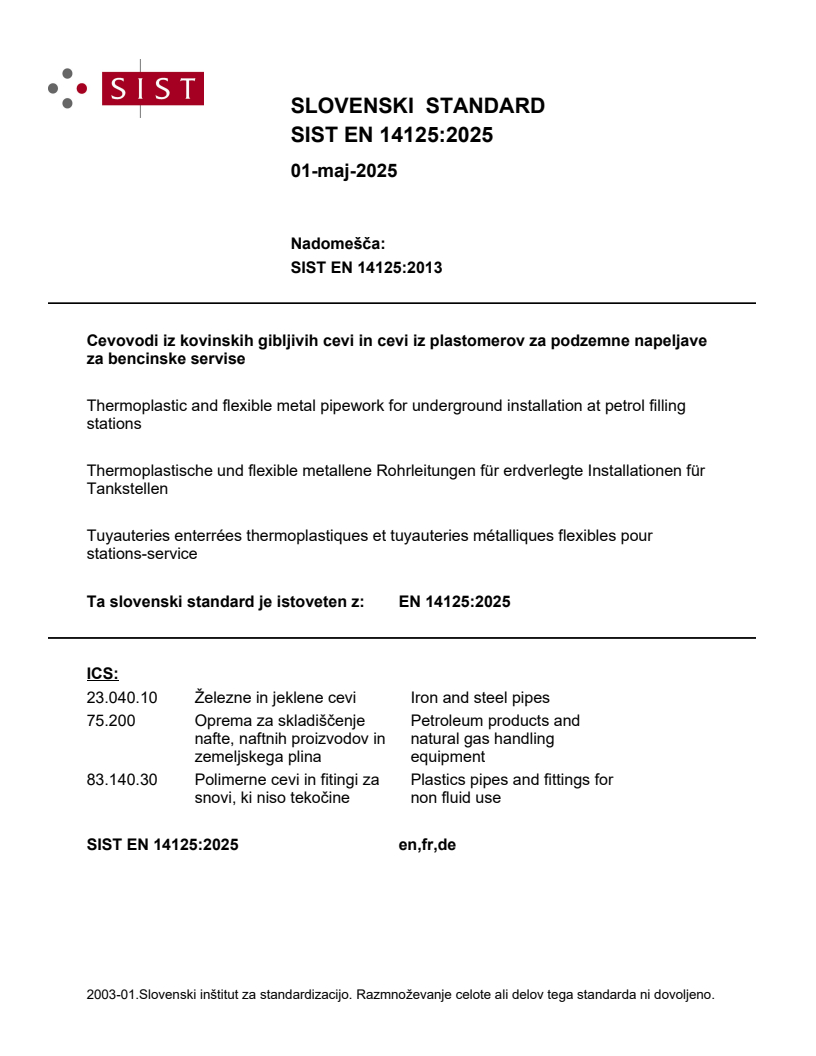
SLOVENSKI STANDARD
01-maj-2025
Nadomešča:
SIST EN 14125:2013
Cevovodi iz kovinskih gibljivih cevi in cevi iz plastomerov za podzemne napeljave
za bencinske servise
Thermoplastic and flexible metal pipework for underground installation at petrol filling
stations
Thermoplastische und flexible metallene Rohrleitungen für erdverlegte Installationen für
Tankstellen
Tuyauteries enterrées thermoplastiques et tuyauteries métalliques flexibles pour
stations-service
Ta slovenski standard je istoveten z: EN 14125:2025
ICS:
23.040.10 Železne in jeklene cevi Iron and steel pipes
75.200 Oprema za skladiščenje Petroleum products and
nafte, naftnih proizvodov in natural gas handling
zemeljskega plina equipment
83.140.30 Polimerne cevi in fitingi za Plastics pipes and fittings for
snovi, ki niso tekočine non fluid use
2003-01.Slovenski inštitut za standardizacijo. Razmnoževanje celote ali delov tega standarda ni dovoljeno.
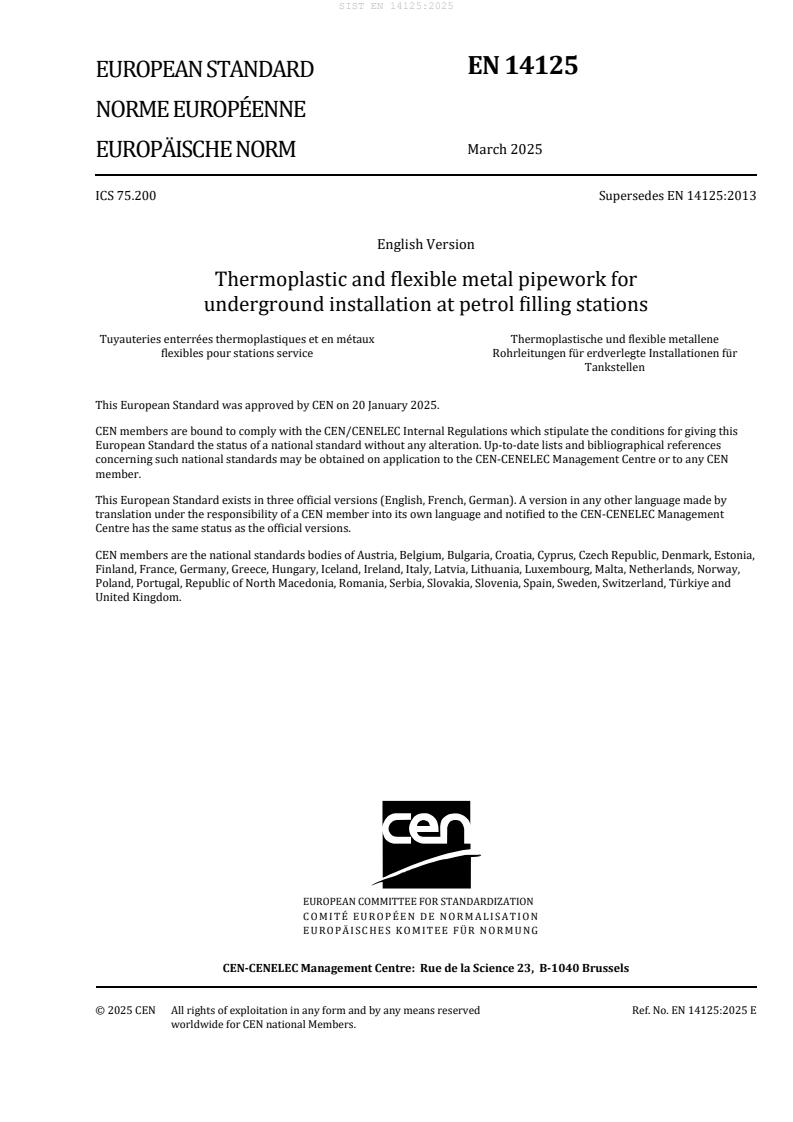
EN 14125
EUROPEAN STANDARD
NORME EUROPÉENNE
March 2025
EUROPÄISCHE NORM
ICS 75.200 Supersedes EN 14125:2013
English Version
Thermoplastic and flexible metal pipework for
underground installation at petrol filling stations
Tuyauteries enterrées thermoplastiques et en métaux Thermoplastische und flexible metallene
flexibles pour stations service Rohrleitungen für erdverlegte Installationen für
Tankstellen
This European Standard was approved by CEN on 20 January 2025.
CEN members are bound to comply with the CEN/CENELEC Internal Regulations which stipulate the conditions for giving this
European Standard the status of a national standard without any alteration. Up-to-date lists and bibliographical references
concerning such national standards may be obtained on application to the CEN-CENELEC Management Centre or to any CEN
member.
This European Standard exists in three official versions (English, French, German). A version in any other language made by
translation under the responsibility of a CEN member into its own language and notified to the CEN-CENELEC Management
Centre has the same status as the official versions.
CEN members are the national standards bodies of Austria, Belgium, Bulgaria, Croatia, Cyprus, Czech Republic, Denmark, Estonia,
Finland, France, Germany, Greece, Hungary, Iceland, Ireland, Italy, Latvia, Lithuania, Luxembourg, Malta, Netherlands, Norway,
Poland, Portugal, Republic of North Macedonia, Romania, Serbia, Slovakia, Slovenia, Spain, Sweden, Switzerland, Türkiye and
United Kingdom.
EUROPEAN COMMITTEE FOR STANDARDIZATION
COMITÉ EUROPÉEN DE NORMALISATION
EUROPÄISCHES KOMITEE FÜR NORMUNG
CEN-CENELEC Management Centre: Rue de la Science 23, B-1040 Brussels
© 2025 CEN All rights of exploitation in any form and by any means reserved Ref. No. EN 14125:2025 E
worldwide for CEN national Members.
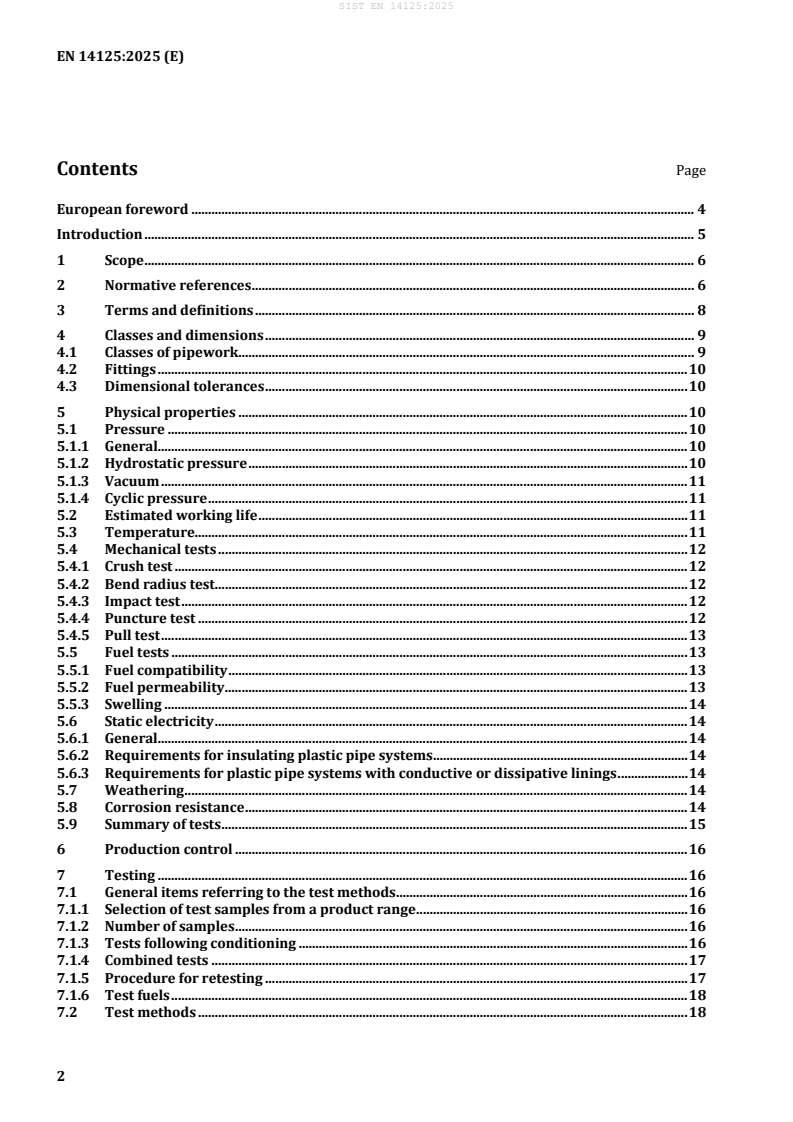
Contents Page
European foreword . 4
Introduction . 5
1 Scope . 6
2 Normative references . 6
3 Terms and definitions . 8
4 Classes and dimensions . 9
4.1 Classes of pipework. 9
4.2 Fittings . 10
4.3 Dimensional tolerances . 10
5 Physical properties . 10
5.1 Pressure . 10
5.1.1 General. 10
5.1.2 Hydrostatic pressure . 10
5.1.3 Vacuum . 11
5.1.4 Cyclic pressure . 11
5.2 Estimated working life . 11
5.3 Temperature. 11
5.4 Mechanical tests . 12
5.4.1 Crush test . 12
5.4.2 Bend radius test . 12
5.4.3 Impact test . 12
5.4.4 Puncture test . 12
5.4.5 Pull test . 13
5.5 Fuel tests . 13
5.5.1 Fuel compatibility . 13
5.5.2 Fuel permeability . 13
5.5.3 Swelling . 14
5.6 Static electricity . 14
5.6.1 General. 14
5.6.2 Requirements for insulating plastic pipe systems . 14
5.6.3 Requirements for plastic pipe systems with conductive or dissipative linings . 14
5.7 Weathering . 14
5.8 Corrosion resistance . 14
5.9 Summary of tests . 15
6 Production control . 16
7 Testing . 16
7.1 General items referring to the test methods . 16
7.1.1 Selection of test samples from a product range . 16
7.1.2 Number of samples . 16
7.1.3 Tests following conditioning . 16
7.1.4 Combined tests . 17
7.1.5 Procedure for retesting . 17
7.1.6 Test fuels . 18
7.2 Test methods . 18
7.2.1 Hydrostatic pressure . 18
7.2.2 Vacuum test . 19
7.2.3 Cyclic pressure test . 19
7.2.4 Crush test . 20
7.2.5 Bend radius test . 20
7.2.6 Impact test . 21
7.2.7 Puncture resistance . 21
7.2.8 Fuel compatibility test . 21
7.2.9 Fuel permeability test . 22
7.2.10 Longitudinal swelling . 23
7.2.11 Pull-out test . 23
7.2.12 Fitting pull-out test . 24
8 Markings on pipe and fittings . 24
9 Manuals . 26
9.1 Product manual . 26
9.2 Installation manuals . 26
10 Records . 26
Annex A (informative) A-deviations . 27
Annex B (informative) Static electricity . 29
Annex C (informative) Environmental aspects . 33
Bibliography . 36
European foreword
This document (EN 14125:2025) has been prepared by Technical Committee CEN/TC 393 “Equipment
for storage tanks and for service stations”, the secretariat of which is held by DIN.
This European Standard shall be given the status of a national standard, either by publication of an
identical text or by endorsement, at the latest by September 2025, and conflicting national standards shall
be withdrawn at the latest by September 2025.
Attention is drawn to the possibility that some of the elements of this document may be the subject of
patent rights. CEN shall not be held responsible for identifying any or all such patent rights.
This document will supersede EN 14125:2013.
— new test fuels added;
— Annex C for environmental aspects added.
Any feedback and questions on this document should be directed to the users’ national standards body.
A complete listing of these bodies can be found on the CEN website.
According to the CEN-CENELEC Internal Regulations, the national standards organisations of the
following countries are bound to implement this European Standard: Austria, Belgium, Bulgaria, Croatia,
Cyprus, Czech Republic, Denmark, Estonia, Finland, France, Germany, Greece, Hungary, Iceland, Ireland,
Italy, Latvia, Lithuania, Luxembourg, Malta, Netherlands, Norway, Poland, Portugal, Republic of North
Macedonia, Romania, Serbia, Slovakia, Slovenia, Spain, Sweden, Switzerland, Türkiye and the United
Kingdom.
Introduction
The purpose of this document is to ensure the suitability of underground pipework for conveying liquid
fuels and their vapours at petrol filling stations.
Pipework should have a designated means of fitting specified by the manufacturer or supplier.
For the topic of environmental aspects see Annex C.
In this document the unit bar is used, due to its universal use in the gas industry. It should, however, be
noted that bar is not an SI unit, and that the corresponding SI unit for pressure is Pa
5 5 2
(1 bar = 10 Pa = 10 N/m ).
1 Scope
This document specifies requirements for underground pipework systems used to transfer liquid fuels
and their vapours at petrol filling stations. Minimum performance requirements covering fitness for
purpose, safety and environmental protection are given.
This document is applicable to pipework made from thermoplastics, which can include some degree of
reinforcement, and to flexible metal pipework. It does not apply to fibre reinforced thermosets,
commonly referred to as glass fibre reinforced plastic (GRP), nor to rigid metals.
This document is applicable to:
— delivery pipes from tanks to dispensers, including positive pressure, vacuum suction and siphon
modes;
— fill pipes from road tankers to tanks;
— vapour recovery and vent pipework;
— pipework for secondary containment;
— fittings.
It does not apply to pipework for use with liquefied petroleum gas.
2 Normative references
The following documents are referred to in the text in such a way that some or all of their content
constitutes requirements of this document. For dated references, only the edition cited applies. For
undated references, the latest edition of the referenced document (including any amendments) applies.
EN 1555-1, Plastics piping systems for the supply of gaseous fuels — Polyethylene (PE) — Part 1: General
EN 1555-2, Plastics piping systems for the supply of gaseous fuels — Polyethylene (PE) — Part 2: Pipes
EN 1555-3, Plastics piping systems for the supply of gaseous fuels — Polyethylene (PE) — Part 3: Fittings
EN 1555-4, Plastics piping systems for the supply of gaseous fuels — Polyethylene (PE) — Part 4: Valves
EN 1555-5, Plastics piping systems for the supply of gaseous fuels — Polyethylene (PE) — Part 5: Fitness for
purpose of the system
EN 12201-1, Plastics piping systems for water supply, and for drainage and sewerage under pressure —
Polyethylene (PE) — Part 1: General
EN 12201-2, Plastics piping systems for water supply, and for drainage and sewerage under pressure —
Polyethylene (PE) — Part 2: Pipes
EN 12201-3, Plastics piping systems for water supply, and for drainage and sewerage under pressure —
Polyethylene (PE) — Part 3: Fittings
EN 12201-4, Plastics piping systems for water supply, and for drainage and sewerage under pressure —
Polyethylene (PE) — Part 4: Valves
EN 12201-5, Plastics piping systems for water supply, and for drainage and sewerage under pressure -
Polyethylene (PE) —Part 5: Fitness for purpose of the system
EN 13160-1, Leak detection systems — Part 1: General Principles
EN 13160-2, Leak detection systems — Part 2: Requirements and test/assessment methods for pressure and
vacuum systems
EN 13160-7, Leak detection systems — Part 7: Requirements and test/assessment methods for interstitial
spaces, leak detection linings and leak detection jackets
EN 14214, Liquid petroleum products — Fatty acid methyl esters (FAME) for use in diesel engines and
heating applications - Requirements and test methods
EN 15376, Automotive fuels — Ethanol as a blending component for petrol — Requirements and test
methods
EN 15940, Automotive fuels — Paraffinic diesel fuel from synthesis or hydrotreatment - Requirements and
test methods
EN 28510-1, Adhesives — Peel test for a flexible-bonded-to-rigid test specimen assembly — Part 1: 90º peel
EN ISO 1167-1, Thermoplastics pipes, fittings and assemblies for the conveyance of fluids — Determination
of the resistance to internal pressure — Part 1: General method (ISO 1167-1)
EN ISO 1167-2, Thermoplastics pipes, fittings and assemblies for the conveyance of fluids — Determination
of the resistance to internal pressure — Part 2: Preparation of pipe test pieces (ISO 1167-2)
EN ISO 1167-3, Thermoplastics pipes, fittings and assemblies for the conveyance of fluids — Determination
of the resistance to internal pressure — Part 3: Preparation of components (ISO 1167-3)
EN ISO 1167-4, Thermoplastics pipes, fittings and assemblies for the conveyance of fluids — Determination
of the resistance to internal pressure — Part 4: Preparation of assemblies (ISO 1167-4)
EN ISO 4892-2:2013, Plastics — Methods of exposure to laboratory light sources — Part 2: Xenon-arc
lamps (ISO 4892-2:2013)
EN ISO 8510-2, Adhesives — Peel test for a flexible-bonded-to-rigid test specimen assembly — Part 2:
180 degree peel (ISO 8510-2)
EN ISO 11306, Corrosion of metals and alloys — Guidelines for exposing and evaluating metals and alloys
in surface sea water (ISO 11306)
EN ISO 11339, Adhesives — T-peel test for flexible-to-flexible bonded assemblies (ISO 11339)
EN ISO 13056, Plastics piping systems — Pressure systems for hot and cold water — Test method for
leaktightness under vacuum (ISO 13056)
EN ISO 16871, Plastics piping and ducting systems — Plastics pipes and fittings — Method for exposure to
direct (natural) weathering (ISO 16871)
EN ISO 19892, Plastics piping systems — Thermoplastics pipes and fittings for hot and cold water — Test
method for the resistance of joints to pressure cycling (ISO 19892)
EN ISO 80079-36, Explosive atmospheres — Part 36: Non-electrical equipment for explosive
atmospheres — Basic method and requirements (ISO 80079-36)
ISO 11922-1, Thermoplastics pipes for the conveyance of fluids — Dimensions and tolerances — Part 1:
Metric series
3 Terms and definitions
For the purposes of this document, the following terms and definitions apply.
ISO and IEC maintain terminology databases for use in standardization at the following addresses:
— ISO Online browsing platform: available at https://www.iso.org/obp/
— IEC Electropedia: available at https://www.electropedia.org/
3.1
pipework system
pipes and fittings used to convey or retain liquid fuels and their vapours
3.2
fittings
in-line connector, elbow, reducer, tee or cap, or flange or other component supplied to connect one pipe
to another or pipework to equipment
3.3
flexible pipe
pipe that can be bent by hand to any radius above a set minimum without any change in performance
3.4
primary delivery pipework
pipework designed to convey liquid fuels by positive pressure or vacuum suction
3.5
permeation rate
rate of mass loss from a test fuel per unit pipe surface typically expressed in grams /(square meter ⨯ day)
−2 −1
also written as g⋅m ⋅d
3.6
fill pipework
pipework designed to convey liquid fuels from a delivery tanker to an underground storage tank by
gravity discharge
3.7
multilayer pipe
pipe where more than one identified layer is present
3.8
vent pipework
pipework designed to convey vapour from a storage tank to the atmosphere
3.9
vapour recovery pipework
pipework designed to convey vapour (or condensate) to or from a storage tank
3.10
liquid fuel
commercially available petrol and diesel fuel comprising biofuels and biofuels blends
3.11
leakage containment
system which is designed to prevent leakage from a primary system entering the environment and which
enables the detection of leakage
3.12
secondary containment
system which is designed to achieve leakage containment
3.13
design pressure
P
d
maximum effective pressure of the fluid in the piping system, expressed in bar, which is allowed in
continuous use
4 Classes and dimensions
4.1 Classes of pipework
Pipes for underground fuel distribution shall conform to one of the following two classes:
— Class 1 — Double wall pipework capable of containing and facilitating the detection of leakage from
a primary delivery pipe.
— Class 2 — Single wall pipework.
The primary pipe of Class 1, and pipes of Class 2, shall conform to one of Types A or B. The secondary
pipe of Class 1 shall conform to one of Types C1 or C2.
a) Type A. Plastic systems.
Pipes shall be principally made of thermoplastic polymers, with some metal or fibre reinforcement
optional.
b) Type B. Flexible metal systems.
Pipes shall comprise a fluid tight primary pipe made of a metal.
c) Type C. Secondary containment.
1) Type CS. System with continuous 360° separation between the primary containment and
secondary containment.
i. Type CS1: A pipe system designed to contain any leakage from the primary pipe. The system
is at atmospheric pressure.
ii. Type CS2: A pipe system designed to contain any leakage from the primary pipe. The system
is designed to conform to the performance criteria of Class I leak detection systems in
accordance with EN 13160-1, EN 13160-2 and EN 13160-7.
2) Type CP: System without continuous 360° separation between the primary containment and
secondary containment.
i. Type CP1: A pipe system designed to contain leakage from the primary pipe. The system is at
atmospheric pressure.
ii. Type CP2: A pipe system designed to contain leakage from the primary pipe. The system is
designed to conform to the performance criteria of Class I leak detection systems in
accordance with EN 13160-1, EN 13160-2 and EN 13160-7.
4.2 Fittings
All pipework shall include fittings to provide leak-tight attachment to other systems, terminations,
branches and changes of direction.
4.3 Dimensional tolerances
The external diameter and wall thickness shall be stated by the manufacturer. For plastic pipework the
tolerance on the external diameter shall be in accordance with ISO 11922-1, Grade B, and the out-of-
roundness shall be in accordance with ISO 11922-1, Grade N.
5 Physical properties
5.1 Pressure
5.1.1 General
Operating and test pressures shall be in accordance with Table 1 according to the application.
All pressures in Table 1 are gauge pressures.
Table 1 — Operating and test pressures for pipework
Operating Test Lower test Higher test
pressure vacuum pressure pressure
Application
bar bar bar bar
Primary delivery pipework: positive
+3,5 — +5,0 ± 0,1
pressure
Primary delivery pipework: vacuum
−0,6 −0,9 ± 0,05 +5,0 ± 0,1
+30,0 ± 1,0
suction including siphons
Vents and vapour recovery pipework 1,0 −0,9 ± 0,05 +5,0 ± 0,1
Fill pipework 1,0 — +5,0 ± 0,1
Secondary containment Type CP1
+0,5 — +1,0 ± 0,02 +5,0 ± 0,1
and CS1
Secondary containment Type CP2
−0,5 to +4,5 −0,6 ± 0,05 +5,0 ± 0,1 +10 ± 0,2
and CS2
5.1.2 Hydrostatic pressure
This requirement applies to all pipes and fittings.
When tested in accordance with 7.2.1.1, all pipes and fittings, sampled in accordance with 7.1.2 and
connected together as one or more assemblies, shall:
— withstand the lower test pressure in Table 1 for no less than 5 min with no signs of leakage.
When tested in accordance with 7.2.1.2, all pipes and fittings, sampled in accordance with 7.1.2 and
connected together as one or more assemblies, shall:
— withstand the lower test pressure in Table 1 for no less than 5 min with no signs of leakage;
— withstand the higher test pressure in Table 1 for no less than 1 min with no signs of leakage.
5.1.3 Vacuum
This requirement applies to all pipes and fittings intended for vacuum suction, including siphons, vent
and vapour recovery and secondary containment, Type CP2 and CS2.
When tested in accordance with 7.2.2, all pipes and fittings, sampled in accordance with 7.1.2, shall:
— withstand the vacuum specified in Table 1 for no less than 30 min. The loss of vacuum shall not exceed
0,05 bar and there shall be no signs of collapse.
5.1.4 Cyclic pressure
This requirement applies to pipes and fittings for all applications except secondary containment.
When tested in accordance with 7.2.3, a sample of pipes and fittings selected in accordance with 7.1.1 and
7.1.2 shall withstand the test conditions without leakage.
5.2 Estimated working life
Design plans shall be available for all pipework which demonstrate that the pipework is designed to have
an estimated working life of at least 30 years.
NOTE The pressure design of polymeric pipes where only one layer contributes to the pressure rating of the
pipe will be designed through a regression curve generated in accordance with EN ISO 9080. In the case of a
polymeric multilayer pipe construction, where more than one layers contribute to the pressure rating of the pipe,
the stress base design can be measured (procedure II) or calculated (procedure I) as defined in ISO 17456.
When tested in accordance with EN ISO 1167-1 through EN ISO 1167-4, pipes, fittings and assemblies
shall not leak under the following test conditions:
a) a 1 h hydrostatic pressure test, at (20 ± 2) °C, at 1,5 times the design pressure P , or at 9 bar for
d
primary pipe and 3 bar for secondary containment Type CP2 and CS2 piping, whichever is the
greater;
b) a 1 000 h hydrostatic pressure test, at (80 ± 2) °C, at 0,8 times the design pressure P , or at 5 bar for
d
primary piping and 2,6 bar for secondary containment Type CP2 and CS2 piping, whichever is the
greater.
5.3 Temperature
There shall be two temperature classes:
— Temperature Class T1: Underground pipework shall be fully operational between −40 °C and +50 °C.
— Temperature Class T2: Underground pipework shall be fully operational between −20 °C and +50 °C,
but suitable for transport and storage at −40 °C and +50 °C.
Pipework that passes the tests in 7.2.1.1, 7.2.5.3, 7.2.6 and 7.2.7.3 at the appropriate temperature shall
be deemed to conform this requirement.
5.4 Mechanical tests
5.4.1 Crush test
This requirement applies to all pipes and fittings.
When tested in accordance with 7.2.4, a sample of pipes and fittings selected in accordance with 7.1.1 and
7.1.2 shall:
— recover to not less than 90 % of their original diameter within 5 min of the load being removed;
— show no visible sign of leakage or cracking;
— when tested in accordance with 7.1.3 show no signs of leakage and, where vacuum testing is
specified, show no signs of collapse.
5.4.2 Bend radius test
This requirement applies to all pipes and in-line connectors.
When tested in accordance with 7.2.5, a sample of pipes and straight connectors selected in accordance
with 7.1.1 and 7.1.2 shall:
— show no visible sign of leakage or cracking;
— when tested in accordance with 7.1.3 show no signs of leakage and, where vacuum testing is
specified, show no signs of collapse.
The sample of pipes chosen in accordance with 7.1.1 shall include that pipe diameter for which the
d
bending strain is greatest. The bending strain is equal to , where d is the outer diameter of the pipe
2R
and R the bending radius specified by the manufacturer.
5.4.3 Impact test
This requirement applies to all pipes and fittings.
When tested in accordance with 7.2.6, a sample of pipes and fittings selected in accordance with 7.1.1 and
7.1.2 shall:
— show no visible sign of leakage or cracking; in Type B pipes there shall be no through-thickness
damage to any protective coating;
— when tested in accordance with 7.1.3 show no signs of leakage and, where vacuum testing is
specified, show no signs of collapse.
5.4.4 Puncture test
This requirement applies to all pipes.
When tested in accordance with 7.2.7, a sample of pipes selected in accordance with 7.1.1 and 7.1.2 shall:
— show no visible sign of leakage or cracking;
— when tested in accordance with 7.1.3 show no signs of leakage and, where vacuum testing is
specified, show no signs of collapse.
5.4.5 Pull test
This requirement applies to all pipes and straight connectors intended for positive pressure and vacuum
suction applications.
When tested in accordance with 7.2.11, a sample of pipes and straight connectors selected in accordance
with 7.1.1 and 7.1.2 and connected to pipes to form assemblies, shall:
— show no visible sign of slippage;
— when tested in accordance with 7.1.3 show no signs of leakage and, where vacuum testing is
specified, show no signs of collapse.
The samples of pipes and fittings chosen in accordance with 7.1.1 shall include those with the lowest
diameter and those with the lowest diameter > 63 mm.
5.5 Fuel tests
5.5.1 Fuel compatibility
This requirement applies to all pipes and fittings.
When tested in accordance with 7.2.8, a sample of pipes and fittings selected in accordance with 7.1.1 and
7.1.2 shall:
— show no signs of damage or swelling, for example of seals, which could impair correct functioning
of the pipework;
— when tested in accordance with 7.1.3 show no signs of leakage and, where vacuum testing is
specified, show no signs of collapse;
— pipes with a multi-layer construction where the layers are all flexible, shall be subjected to peel
test in accordance with 7.2.8.2.1;
— pipes with a multi-layer construction where the layers are flexible-rigid shall be subjected to peel
test in accordance with 7.2.8.2.2;
— in each case the mean peel strength shall be a minimum of 15 N/cm and the ratio of the mean peel
strength to the unexposed samples shall be not less than 0,8.
5.5.2 Fuel permeability
This requirement applies to all pipes of Types A, CP1, CS1, CP2, CS2. Permeability classes are defined in
accordance with the maximum level of permeability as stated in Table 2. See Annex A for national
deviations.
Table 2 — Maximum fuel permeability of underground pipes
Maximum fuel
Fuel permeability
permeability
Application
−2 −1 −2 −1
g⋅m ⋅d g⋅m ⋅d
Primary delivery pipework: positive pressure
0,2
0 —
and vacuum suction including siphons
Vents and vapour recovery pipework — 2,0
Fill pipework — 2,0
Secondary containment — 24,0
When tested in accordance with 7.2.9 a sample of pipes selected in accordance with 7.1.1 and 7.1.2 shall
conform to the values given in Table 2 for Test Fuel 1, Test Fuel 2, Test Fuel 3 and Test Fuel 4 (according
to 7.1.6), in accordance with the application or permeability class. The sample of pipes chosen in
accordance with 7.1.1 shall include the pipes with the lowest diameter having the same design.
5.5.3 Swelling
For pipes intended for positive pressure and vacuum suction delivery, the swelling when tested in
accordance with 7.2.10 using Test Fuel 2 shall not exceed 0,2 %.
5.6 Static electricity
5.6.1 General
Ignition hazards by static electricity caused by fuel pipe systems shall be avoided. In 5.6.2 to 5.6.3
corresponding requirements for the various pipe types are stated.
Classification of pipes:
The following boundary limits are used for classifying the resistance of piping according to ISO 8031, into
the categories given as follows:
3 −1
Conductive: resistance per unit length < 10 Ω m
3 −1 6 −1
Dissipative: 10 Ω m ≤ resistance per unit length ≤ 10 Ω m
6 −1
Insulating: resistance per unit length > 10 Ω m
The resistance per unit length shall include the effect of one coupling connection.
More information about electrostatic hazards can be found in Annex B and EN ISO 80079-36.
5.6.2 Requirements for insulating plastic pipe systems
To avoid pin holing insulating plastic pipe should have an electrical breakthrough strength across the
pipe exceeding 100 kV, measured in accordance with EN 60243-2. A polyethylene layer of at least 4 mm
in thickness usually exceeds this breakthrough strength.
5.6.3 Requirements for plastic pipe systems with conductive or dissipative linings
The conductive liners or conductive layers shall encircle the whole pipe profile and shall be securely
electrostatically connected with each other and electrostatically grounded.
5.7 Weathering
Three assemblies consisting of two sections of pipe each having a minimum length of 375 mm and joined
by a straight connector shall be preconditioned in accordance to a cumulative solar radiation
−2
of ≥ 3,5 GJ⋅m using natural weathering in accordance with EN ISO 16871 or artificial weathering by
using method A, cycle 1 of Table 3 of EN ISO 4892-2:2013. After exposure the assembly shall show no
visible signs of cracking when tested in accordance with 7.2.6. If black PE material is used to manufacture
pipe and fittings according to EN 1555-1 through EN 1555-5 and EN 12201-1 through EN 12201-5, this
requirement shall be considered as fulfilled.
5.8 Corrosion resistance
All metallic parts that are designed to be directly buried in the ground shall be tested in accordance with
EN ISO 11306 by exposure to water and surface sea water to establish the effectiveness of corrosion
resistance for an expected life period of 30 years. In addition, an assessment shall be made to ensure that
adequate external corrosion resistance exists in respect to damage caused by stray electrical currents for
the same period of time. The coating of the pipework shall be tested for integrity and holidays with
−1
5 kV mm thickness of the coating, but with not more than 20 kV.
NOTE For cathodic protection, see EN 13636.
5.9 Summary of tests
Testing of requirements 5.1 to 5.7 shall be carried out in accordance with Table 3 according to the type.
Table 3 — Tests survey
Type CP1 Type CS2
Test Clause Applies to Type A Type B
and CS1 and CP2
Estimated working
5.2 pipes and fittings yes yes yes yes
life
Hydrostatic pipes and fittings to
7.2.1.1 yes yes yes yes
pressure at 50 °C pressures in Table 1
Hydrostatic pipes and fittings to
7.2.1.2 yes yes yes yes
pressure at 23 °C pressures in Table 1
Hydrostatic burst secondary containment yes yes
7.2.1.3 no no
pressure CP1 and CP2 (CP1 only) (CP2 only)
pipes and fittings for
Vacuum 7.2.2 vacuum suction yes yes no yes
applications
Static electricity 5.6 pipes and fittings yes yes yes yes
pipes and straight
Weathering 5.7 yes yes yes yes
connectors
Corrosion all metallic parts designed
5.8 yes yes yes yes
resistance to be directly buried
pipes and fittings for
Cyclic pressure 7.2.3 positive pressure yes yes no no
applications
Crush 7.2.4 pipes and fittings yes yes yes yes
pipes and straight
Bend radius 7.2.5 yes yes yes yes
connectors
Impact 7.2.6 pipes and fittings yes yes yes yes
Puncture 7.2.7 pipes only yes yes yes yes
Fuel compatibility 7.2.8 pipes and fittings yes yes yes yes
Fuel permeability 7.2.9
pipes only yes no yes yes
Swelling 7.2.10
pipes and straight
connectors for positive
Pull-out 7.2.11 yes yes no no
pressure and vacuum
suction
secondary containment yes yes
Fitting pull out test 7.2.12 no no
CP1 and CP2 (CP1 only) (CP2 only)
6 Production control
A factory production control scheme shall be established and documented in a manual prior to a new
product type being placed on the market. Subsequently, any fundamental changes in raw materials and
additives, manufacturing procedures or the control scheme that affects the properties or use of a product
shall be recorded in the manual.
The manual shall include the factory production control procedures relevant to the declared properties,
as confirmed by the initial type tests.
The factory production control procedures shall consist of a system for the permanent internal control of
the production of the products to ensure that such products subsequently placed on the market conform
to this document and that the measured values conform to the declared values.
The manufacturer shall specify a batch or lot number which shall be marked on the product.
7 Testing
7.1 General items referring to the test methods
7.1.1 Selection of test samples from a product range
Hydrostatic testing to 7.2.1 and, for vacuum suction applications, vacuum testing to 7.2.2, shall be applied
to all sizes and types of pipe and fitting.
Where a product with a range of sizes consisting of identical materials and similar design is under test,
construct a programme for the remaining tests in which each test is applied to a minimum of two sizes of
pipe and fitting.
7.1.2 Number of samples
Three samples shall be used for each test. Unless otherwise specified the samples shall be assemblies
consisting of lengths of pipe, one of which shall have a minimum free length of 375 mm or three times the
external diameter, whichever is the greater, together with examples of the fittings as appropriate. Fit
fittings in accordance with the manufacturer’s instructions.
7.1.3 Tests following conditioning
The requirement for hydrostatic pressure testing (5,0 bar or 1,5 bar) and vacuum testing (−0,9 bar) after
conditioning tests according to7.2.4 to 7.2.11 depends on the application, as detailed in Table 4. Where
such testing is required, fit the samples with an end seal at one end and with a pressure fitting at the
other. These fittings can be fitted before or after the conditioning test.
After the conditioning test proceed as follows.
If vacuum testing is required, condition the samples in at a temperature of (23 ± 2) °C for not less than
16 h. Then apply to each sample an internal pressure of (−0,9 ± 0,05) bar [(0,1 ± 0,05) bar absolute].
Isolate the sample from the vacuum pump and maintain for 5 min at a temperature of (23 ± 2) °C. During
this period there shall be no loss of vacuum. Inspect the exterior and, after disassembly, the interior of
the sample for signs of leakage or collapse.
If hydrostatic pressure testing is required, fill the samples with water and keep them in an environment
maintained at a constant temperature of (23 ± 2) °C for a minimum of 1 h. Apply an internal pressure as
defined in Table 4 at the same temperature. Inspect the samples for leaks.
Table 4 — Test pressure after conditioning
a a
Test pressure Test vacuum Test duration
Application
bar bar min
Primary delivery pipework:
(5,0 ± 0,1) — 5
positive pressure
Primary delivery pipework:
(5,0 ± 0,1) (−0,9 ± 0,05) 5
vacuum suction including siphons
Vent and vapour recovery pipework (5,0 ± 0,1) (−0,9 ± 0,05) 5
Fill pipework (5,0 ± 0,1) — 5
Secondary containment Type CP1 and CS1 (1,5 ± 0,03) — 5
Secondary containment Type CP2 and CS2 (5,0 ± 0,1) — 5
a
All pressures are gauge pressures.
7.1.4 Combined tests
For the sake of efficiency conditioning tests may be combined. For example, the samples may be subjected
to the crush, impact and puncture tests in accordance with 7.2.4, 7.2.6 and 7.2.7 respectively before being
tested in accordance with 7.1.3. However, if they then fail the test in accordance with 7.1.3 they shall be
deemed to have failed all three conditioning tests, unless they can be shown to have passed one or another
of the tests separately.
7.1.5 Procedure for retesting
Where one or more failures are noted, the retest protocol in Table 5 shall be adopted.
Table 5 — Retest protocol
Number of failures Action
0 Product passes the test
Retest with 3 new samples
If any one of the new samples fails, the product fails the test
2 or 3 Product fails the test
7.1.6 Test fuels
The test fuels % by volume shall be:
Test Fuel 1: 41,5 % toluene
41,5 % iso-octane
15 % methanol
2,0 % iso-butyl alcohol
Test Fuel 2: 41,5 % toluene
41,5 % iso-octane
17 % methyl tertiary butyl ether (MTBE)
Test Fuel 3: 7,5 % toluene
7,5 % iso-octane
85 % ethanol (in accordance with EN 15376)
Test Fuel 4: bio-diesel B-100 (in accordance with EN 14214 or EN 15940)
7.2 Test methods
7.2.1 Hydrostatic pressure
7.2.1.1 50 °C test
This test is applicable to all pipes and fittings (connected together as one or more assemblies). At least
one section of pipe of each diameter shall have a free length of 375 mm.
Fill each assembly with water and place it in a water environment held at a constant temperature of
(50,0 ± 2,0) °C for a minimum of 1 h.
Increase the internal pressure at a steady rate to the lower test pressure specified in Table 1 for the
application con
...