

EN 17169:2020
(Main)Tattooing - Safe and hygienic practice
- Abstract
This document specifies hygiene requirements before and during tattooing and for aftercare. It gives guidelines for tattooists and their routine interactions with clients and public authorities. It gives guidelines for the correct procedures to be used to ensure optimum protection of the client, the tattooist and others in the tattoo work area.
- Status
- Published
- Publication Date
- 14-Jan-2020
- Withdrawal Date
- 30-Jul-2020
- Technical Committee
- CEN/TC 435 - Project Committee - Tattooing services
- Drafting Committee
- CEN/TC 435 - Project Committee - Tattooing services
- Current Stage
- 9093 - Decision to confirm - Review Enquiry
- Start Date
- 03-Sep-2025
- Completion Date
- 07-Oct-2026



Overview
EN 17169:2020 - "Tattooing - Safe and hygienic practice" is a European Standard published by CEN that defines hygiene and safety requirements for tattoo services. The standard covers hygiene measures before, during and after tattooing, guidance for tattooists’ interactions with clients and authorities, and procedures to protect clients, practitioners and others in the tattoo work area. EN 17169 is intended to reduce infection risk and promote consistent, safe tattoo practice across tattoo studios, conventions and temporary events.
Key Topics and Requirements
EN 17169 organizes practical technical requirements and recommendations into clear sections. Major topics include:
- Responsibilities of business owners/operators: training, first-aid, needle-stick injury protocols and vaccination guidance.
- Facilities and premises: layout and hygiene requirements for studios and temporary tattooing areas (conventions).
- Waste management: risk assessment, disposal processes and safe sharps handling.
- Cleaning, disinfection and sterilization: environmental cleaning, treatment of reusable equipment, single‑use device management and sterilization process controls (including requirements for steam sterilizers and validated procedures).
- Tattooing process controls: client interaction and suitability assessment, consent, aftercare instructions, skin preparation, rinsing procedures and general tattoo technique safeguards.
- Infection prevention measures: hand hygiene (Annex H), personal protective equipment (PPE) including glove standards, and procedures for body fluid exposure (Annex B).
- Supporting material: training framework on infection prevention (Annex A), consent and client information templates (Annex F), aftercare guidance (Annex G) and packing/sterilization processes (Annexes D–E).
Applications and Who Uses It
EN 17169 is for anyone involved in tattoo services who needs to apply robust hygiene and safety practices:
- Tattooists and studio owners implementing daily hygiene, sterilization and client-care processes.
- Health and safety officers, trainers and certifying bodies using the training framework and competence criteria.
- Public health authorities and regulators requiring consistent standards for premises inspections and licensing.
- Event organizers and convention managers to ensure temporary tattooing complies with hygiene and waste-management requirements.
Keywords: EN 17169, tattoo hygiene, tattoo safety, infection prevention, sterilization, tattoo aftercare, PPE, hand hygiene, sharps disposal.
Related Standards
EN 17169 references and aligns with several normative standards, including:
- EN 374 / EN 455 (protective gloves)
- EN 1500 (hygienic handrub)
- EN 13060 (small steam sterilizers)
- EN ISO 11607-1, EN ISO 17665-1 (sterilization and packaging)
- EN ISO 23907-1 (sharps containers)
Use EN 17169 as the practical, hygiene-focused baseline for safe tattooing and integrate applicable national regulations where required.
Relations
- Effective Date
- 28-Jan-2026
- Effective Date
- 28-Jan-2026
- Effective Date
- 28-Jan-2026
- Effective Date
- 28-Jan-2026
- Effective Date
- 28-Jan-2026
- Effective Date
- 28-Jan-2026
- Effective Date
- 28-Jan-2026
- Effective Date
- 28-Jan-2026
- Effective Date
- 28-Jan-2026
- Effective Date
- 28-Jan-2026
- Effective Date
- 28-Jan-2026
- Effective Date
- 28-Jan-2026
- Effective Date
- 28-Jan-2026
- Effective Date
- 28-Jan-2026
Get Certified
Connect with accredited certification bodies for this standard

Great Wall Tianjin Quality Assurance Center
Established 1993, first batch to receive national accreditation with IAF recognition.
Hong Kong Quality Assurance Agency (HKQAA)
Hong Kong's leading certification body.

Innovative Quality Certifications Pvt. Ltd. (IQCPL)
Known for integrity, providing ethical & impartial Assessment & Certification. CMMI Institute Partner.
Sponsored listings
Frequently Asked Questions
EN 17169:2020 is a standard published by the European Committee for Standardization (CEN). Its full title is "Tattooing - Safe and hygienic practice". This standard covers: This document specifies hygiene requirements before and during tattooing and for aftercare. It gives guidelines for tattooists and their routine interactions with clients and public authorities. It gives guidelines for the correct procedures to be used to ensure optimum protection of the client, the tattooist and others in the tattoo work area.
This document specifies hygiene requirements before and during tattooing and for aftercare. It gives guidelines for tattooists and their routine interactions with clients and public authorities. It gives guidelines for the correct procedures to be used to ensure optimum protection of the client, the tattooist and others in the tattoo work area.
EN 17169:2020 is classified under the following ICS (International Classification for Standards) categories: 03.080.30 - Services for consumers. The ICS classification helps identify the subject area and facilitates finding related standards.
EN 17169:2020 has the following relationships with other standards: It is inter standard links to EN 1500:2013, EN ISO 374-1:2016, EN ISO 11607-1:2020, EN 455-1:2020+A2:2024, EN 16523-1:2015+A1:2018, EN ISO 374-4:2019, EN ISO 374-2:2019, EN ISO 17665:2024, EN 455-5:2025, EN 455-2:2024, EN 13060:2025, EN 455-4:2009, EN 455-3:2023, EN ISO 23907-1:2019. Understanding these relationships helps ensure you are using the most current and applicable version of the standard.
EN 17169:2020 is available in PDF format for immediate download after purchase. The document can be added to your cart and obtained through the secure checkout process. Digital delivery ensures instant access to the complete standard document.
Standards Content (Sample)
SLOVENSKI STANDARD
01-marec-2020
Tetoviranje - Zahteve za varno in higiensko prakso
Tattooing - Safe and hygienic practice
Tätowierdienstleistungen - Sichere Praxis und Hygieneanforderungen
Services de tatouage - Pratiques sûres et exigences d'hygiène
Ta slovenski standard je istoveten z: EN 17169:2020
ICS:
03.080.30 Storitve za potrošnike Services for consumers
2003-01.Slovenski inštitut za standardizacijo. Razmnoževanje celote ali delov tega standarda ni dovoljeno.
EN 17169
EUROPEAN STANDARD
NORME EUROPÉENNE
March 2019
EUROPÄISCHE NORM
ICS 03.080.30
English Version
Tattooing - Safe and hygienic practice
Tatouage - Bonnes pratiques d'hygiène et de salubrité Tätowieren - Sichere und hygienische Praxis
This European Standard was approved by CEN on 6 January 2019.
CEN members are bound to comply with the CEN/CENELEC Internal Regulations which stipulate the conditions for giving this
European Standard the status of a national standard without any alteration. Up-to-date lists and bibliographical references
concerning such national standards may be obtained on application to the CEN-CENELEC Management Centre or to any CEN
member.
This European Standard exists in three official versions (English, French, German). A version in any other language made by
translation under the responsibility of a CEN member into its own language and notified to the CEN-CENELEC Management
Centre has the same status as the official versions.
CEN members are the national standards bodies of Austria, Belgium, Bulgaria, Croatia, Cyprus, Czech Republic, Denmark, Estonia,
Finland, Former Yugoslav Republic of Macedonia, France, Germany, Greece, Hungary, Iceland, Ireland, Italy, Latvia, Lithuania,
Luxembourg, Malta, Netherlands, Norway, Poland, Portugal, Romania, Serbia, Slovakia, Slovenia, Spain, Sweden, Switzerland,
Turkey and United Kingdom.
EUROPEAN COMMITTEE FOR STANDARDIZATION
COMITÉ EUROPÉEN DE NORMALISATION
EUROPÄISCHES KOMITEE FÜR NORMUNG
CEN-CENELEC Management Centre: Rue de la Science 23, B-1040 Brussels
© 2019 CEN All rights of exploitation in any form and by any means reserved Ref. No. EN 17169:2019 E
worldwide for CEN national Members.
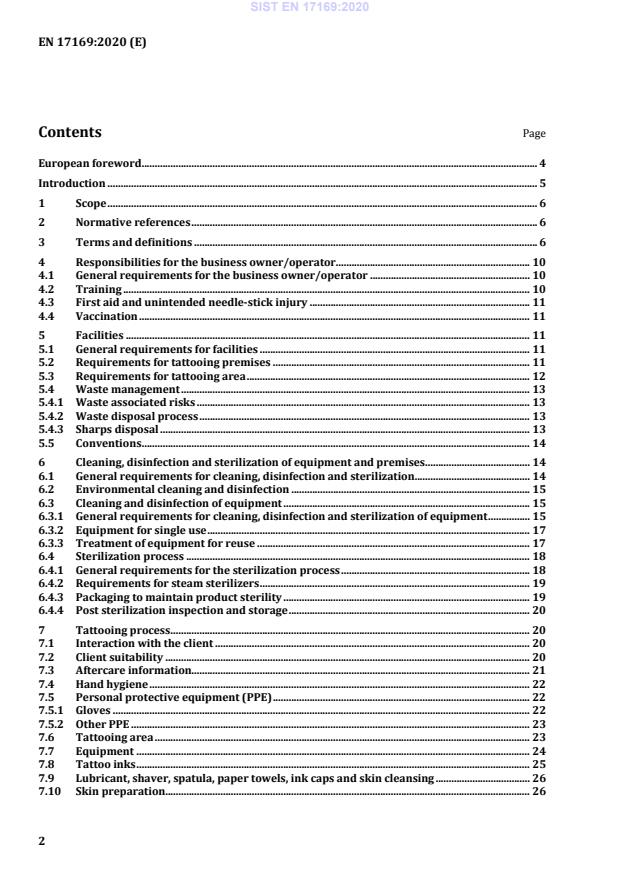
Contents Page
European foreword . 4
Introduction . 5
1 Scope . 6
2 Normative references . 6
3 Terms and definitions . 6
4 Responsibilities for the business owner/operator. 10
4.1 General requirements for the business owner/operator . 10
4.2 Training . 10
4.3 First aid and unintended needle-stick injury . 11
4.4 Vaccination . 11
5 Facilities . 11
5.1 General requirements for facilities . 11
5.2 Requirements for tattooing premises . 11
5.3 Requirements for tattooing area . 12
5.4 Waste management . 13
5.4.1 Waste associated risks . 13
5.4.2 Waste disposal process . 13
5.4.3 Sharps disposal . 13
5.5 Conventions . 14
6 Cleaning, disinfection and sterilization of equipment and premises. 14
6.1 General requirements for cleaning, disinfection and sterilization. 14
6.2 Environmental cleaning and disinfection . 15
6.3 Cleaning and disinfection of equipment . 15
6.3.1 General requirements for cleaning, disinfection and sterilization of equipment . 15
6.3.2 Equipment for single use . 17
6.3.3 Treatment of equipment for reuse . 17
6.4 Sterilization process . 18
6.4.1 General requirements for the sterilization process . 18
6.4.2 Requirements for steam sterilizers . 19
6.4.3 Packaging to maintain product sterility . 19
6.4.4 Post sterilization inspection and storage . 20
7 Tattooing process . 20
7.1 Interaction with the client . 20
7.2 Client suitability . 20
7.3 Aftercare information. 21
7.4 Hand hygiene . 22
7.5 Personal protective equipment (PPE) . 22
7.5.1 Gloves . 22
7.5.2 Other PPE . 23
7.6 Tattooing area . 23
7.7 Equipment . 24
7.8 Tattoo inks . 25
7.9 Lubricant, shaver, spatula, paper towels, ink caps and skin cleansing . 26
7.10 Skin preparation. 26
7.11 Rinsing the needle while tattooing . 27
7.12 Procedure . 27
Annex A (informative) Basic framework for training and qualification on infection
prevention and control . 29
A.1 General . 29
A.2 Structure of the skin . 29
A.3 Microbiology and the skin . 30
A.4 Transmission of infection . 30
A.5 Clinical presentation of skin conditions . 30
A.6 Inks . 30
A.7 Occupational safety . 31
A.8 Client information / selection / exclusion . 31
A.9 Legal aspects . 31
A.10 Work premises . 32
A.11 Waste management. 32
A.12 Cleaning, disinfection and sterilization . 32
A.13 Safe practice for tattooing . 32
Annex B (informative) Body fluid exposure. 33
Annex C (informative) Ultrasonic cleaning . 34
Annex D (normative) Processes for subcontracted sterilization . 36
Annex E (normative) Method for packing and sterilizing instruments . 37
Annex F (informative) Consent Form . 38
F.1 Example of a consent form . 38
F.2 Client information to accompany the consent form . 41
Annex G (informative) Aftercare . 43
G.1 General . 43
G.2 Aftercare treatment . 43
G.2.1 Aftercare by the tattooist immediately after the procedure . 43
G.2.2 Aftercare at home . 44
G.3 Activities to avoid during the healing period . 45
G.4 Descriptions of signs of normal healing and signs of infection and allergy . 45
G.4.1 General . 45
G.4.2 Normal signs . 45
G.4.3 Abnormal signs . 46
Annex H (normative) Hand hygiene . 47
Bibliography . 49
European foreword
This document (EN 17169:2020) has been prepared by Technical Committee CEN/TC 435 “Tattooing
services”, the secretariat of which is held by DIN.
This European Standard shall be given the status of a national standard, either by publication of an
identical text or by endorsement, at the latest by July 2020, and conflicting national standards shall be
withdrawn at the latest by July 2020.
Attention is drawn to the possibility that some of the elements of this document may be the subject of
patent rights. CEN shall not be held responsible for identifying any or all such patent rights.
According to the CEN-CENELEC Internal Regulations, the national standards organisations of the
following countries are bound to implement this European Standard: Austria, Belgium, Bulgaria,
Croatia, Cyprus, Czech Republic, Denmark, Estonia, Finland, France, Germany, Greece, Hungary, Iceland,
Ireland, Italy, Latvia, Lithuania, Luxembourg, Malta, Netherlands, Norway, Poland, Portugal, Republic of
North Macedonia, Romania, Serbia, Slovakia, Slovenia, Spain, Sweden, Switzerland, Turkey and the
United Kingdom.
Introduction
This document provides requirements and recommendations on hygienic and safe tattoo practice to
protect both the client and the tattooist against infection. It is essential to minimize infection risks
caused by tattooing to clients, tattooists and others working in tattoo premises by use of appropriate
hygiene procedures. Anyone carrying out tattooing is bound to be responsible for their own, their
clients’ and others’ safety in respect of the tattooing process.
It is essential to also apply relevant European and national regulations, where they exist.
The verbal forms “shall” and “shall not” are used to express requirements.
The verbal forms “should” and “should not” are used to express recommendations.
The verbal forms “may” and “need not” are used to express permission.
The verbal forms “can” and “cannot” are used to express possibility and capability.
1 Scope
This document specifies hygiene requirements before and during tattooing and for aftercare. It gives
guidelines for tattooists and their routine interactions with clients and public authorities. It gives
guidelines for the correct procedures to be used to ensure optimum protection of the client, the
tattooist and others in the tattoo work area.
2 Normative references
The following documents are referred to in the text in such a way that some or all of their content
constitutes requirements of this document. For dated references, only the edition cited applies. For
undated references, the latest edition of the referenced document (including any amendments) applies.
EN 374 (all parts), Protective gloves against chemicals and micro-organisms
EN 455 (all parts), Medical gloves for single use
EN 1500, Chemical disinfectants and antiseptics - Hygienic handrub - Test method and requirements
(phase 2/step 2)
EN 13060, Small steam sterilizers
EN ISO 11607-1, Packaging for terminally sterilized medical devices - Part 1: Requirements for materials,
sterile barrier systems and packaging systems (ISO 11607-1)
EN ISO 17665-1, Sterilization of health care products - Moist heat - Part 1: Requirements for the
development, validation and routine control of a sterilization process for medical devices (ISO 17665-1)
EN ISO 23907-1, Sharps injury protection - Requirements and test methods - Part 1: Single-use sharps
containers (ISO 23907-1)
3 Terms and definitions
For the purposes of this document, the following terms and definitions apply.
ISO and IEC maintain terminological databases for use in standardization at the following addresses:
— IEC Electropedia: available at http://www.electropedia.org/
— ISO Online browsing platform: available at http://www.iso.org/obp
3.1
aftercare
care process following tattooing to promote optimal healing
3.2
body fluids
fluids such as blood, serum and other fluids that may be contaminated with these substances that
present a risk of infection transmission in the context of tattooing
Note 1 to entry: Bodily fluids such as tears, sweat or vomit do not present a specific tattooing hazard.
3.3
cleaning
removal of foreign materials from a surface
3.4
connector cable
clip cord
electrical cable connecting power supply and drive unit for tattooing
3.5
convention
any premises or place used on a temporary basis for an event such as an exhibition, fair, festival or
similar type of arrangement where tattooing is intended to be provided to the public with or without
payment
3.6
disinfectant
chemical that is able to produce a defined reduction of specific microorganisms under defined
conditions
Note 1 to entry: The Biocidal Products Regulation, as per 1 September 2013 (BPR, Regulation (EU) 528/2012),
with a transitional period for certain provisions, will apply to relevant disinfectants.
3.7
disinfection
act of disinfecting, using controlled techniques, that reduces the number of microorganisms to a level
safe for that particular application
3.8
drive unit
motor used to power tattoo apparatus
3.9
grip
textured surface cylinder which connects tube and tip intended to provide a secure grasp for the
tattooist during the process of tattooing
3.10
hand hygiene
process used to inactivate or remove transmittable microorganisms on hands regardless of the resident
skin flora
3.11
high risk equipment
equipment that penetrates the skin, comes into contact with broken skin and/or body fluids or may
contaminate items that do so (e.g. needle holder, tube, grip, tip)
3.12
hygienic hand rub
product (liquid, gel or foam) applied to hands and rubbed to dryness intended to inactivate
transmittable microorganisms regardless of the resident skin flora
3.13
ink cap
cap that contains tattoo ink
3.14
ink cap tray
tray with recesses to hold a number of ink caps
3.15
needle bar
rod connecting tattoo machine and needle
3.16
needle cartridge
single use item containing needle and housing
3.17
personal protective equipment
special device or appliance designed to be worn or held by an individual for protection against one or
more health and safety hazards
[SOURCE: IEC 82079-1:2012, 3.27]
3.18
pre-treatment
treatment of equipment to aid subsequent effective cleaning, disinfection and/or sterilization
3.19
sharps disposal container
container designed for the safe containment and disposal of sharps such as tattoo needles
3.20
single use
product intended to be used once and then discarded
[SOURCE: EN ISO 11810:2015, 3.18]
3.21
skin preparation
procedure for cleaning, disinfecting and, where necessary, shaving the skin prior to tattooing
3.22
steam sterilizer
autoclave
device using super-atmospheric steam at over 100 °C in a validated process to render processed items
sterile
3.23
stencil
device allowing the transfer of a drawing onto the skin
3.24
sterile
free from viable microorganisms
[SOURCE: EN ISO 11139:2018, 3.271]
3.25
sterilization
validated process used to render product free from viable microorganisms
[SOURCE: EN ISO 11139:2018, 3.277 – modified: Note 1 omitted]
3.26
sterilization container
container that allows sterilization of the contents and protects that sterility afterwards whilst it
remains unopened for a defined time period
Note 1 to entry: The time period should be specified by the manufacturer of the container or, in the absence of
such instruction for use, should be a period of no longer than six months.
EXAMPLE Pouches and boxes.
3.27
tattooing
procedure that penetrates the skin or mucous membrane for the purpose of insertion of tattoo ink to
create a permanent or long-lasting design
3.28
tattoo machine
fully assembled device that produces reciprocal movement of a tattooing needle
EXAMPLE Coil machine, rotary machine, permanent make-up pen, manual operated device, handle.
3.29
tip
tapered hollow cylinder that holds and guides a tattooing needle during the tattooing process
3.30
tube
hollow cylinder through which the needle bar passes
3.31
ultrasonic cleaner
device that cleans by immersion aided by ultrasonic energy
3.32
validation
confirmation, through the provision of objective evidence, that the requirements for a specific intended
use or application have been fulfilled
[SOURCE: EN ISO 17664:2017, 3.20]
4 Responsibilities for the business owner/operator
4.1 General requirements for the business owner/operator
Business owners/operators shall be responsible for ensuring that the necessary registrations and
licences required for the business are in place and copies of all relevant documents are available for
inspection.
The owners/operators of a tattooing business shall document, maintain and update a procedures
manual to ensure that good practice is used in the premises.
The content of the manual should include, but is not limited to:
— hand hygiene;
— the use of personal protective equipment;
— the management of exposure to body fluids;
— the cleaning and disinfection of tattoo premises (including all equipment and surfaces);
— waste management;
— aftercare procedures.
Where the business carries out sterilization, documented procedures shall be available for:
— the validation of the sterilization process;
— the method of inspection of packing and seals, copies of sterilizer maintenance details and
verification records;
— the storage facilities and practices for sterile packs.
4.2 Training
Business owners/operators providing tattooing services shall ensure that all staff are trained
commensurate with their activities. Training may be provided by the authorized operators according to
national regulations, where they exist, using documented procedures that address the activities of the
business.
All persons undertaking tattooing shall have received training in the following areas:
1) the basics of hygiene including hygiene for personal and client safety as well as environmental
hygiene such as cleaning and disinfection;
2) sterilization procedures, if the tattooist carries out sterilization of equipment;
3) the basics of microbiology and relevant infection prevention;
4) the anatomy of the skin and basics of wound care, and contraindications;
5) the principles of occupational health and safety;
6) first aid, including potential infection due to unintended needle-stick injuries;
7) an understanding of legal and other relevant requirements applicable to the business activities.
Information regarding the content of the basic framework for training is given in Annex A.
The curriculum shall be delivered in a manner to achieve the learning objectives as outlined below.
The objective of the training is to provide comprehensive knowledge of the content of this document
such that it can be put effectively into practice.
The training shall include:
— the curriculum as specified in this document;
— at least one day of practical training; and
— an assessment by a competent person in an appropriate environment.
A refresher course to maintain competence and update previous training shall be undertaken at least
every five years. A record of training received by all persons undertaking tattooing shall be retained and
updated as required in 1) to 7). This record shall be available for inspection.
To ensure that training is uniform and of equivalent quality, training courses should reference the
European Qualification Framework (EQF).
4.3 First aid and unintended needle-stick injury
All persons undertaking tattooing shall have received training in first aid measures relevant to the
context of tattooing.
The tattooist shall provide documented evidence of being trained in such first aid. First aid training
should be performed according to national regulations, where they exist.
First aid equipment shall be available and adequately stocked.
If the client has had an unintended needle stick injury (i.e. percutaneous exposure to a sharp
contaminated with somone else's body fluid), they shall be advised and assisted to seek immediate
medical advice.
Where the tattooist has a needle-stick injury, immediate action shall be taken because of the risk of
infection with blood borne viruses (HIV, Hepatitis B and C).
The tattooist should comply with the instructions in Annex B following a needle-stick injury.
4.4 Vaccination
All tattooists should be vaccinated against Hepatitis B and records of all such vaccinations should be
retained.
5 Facilities
5.1 General requirements for facilities
The facilities to be provided by the business owners/operators are detailed below including those to be
provided at conventions and other non-permanent and temporary operations.
5.2 Requirements for tattooing premises
All areas shall be kept clean and uncluttered at all times.
The following shall apply to the premises:
— a documented cleaning programme in place for all areas and records maintained;
— all hard surfaces shall be in good repair and easily cleanable;
— all areas shall be clean and free from extraneous items;
— sterile products shall be stored appropriately.
5.3 Requirements for tattooing area
Tattooing shall be carried out in a specific area of the premises separated from the other areas and
clearly identified.
— The walls and floors shall be smooth, impervious, and easy to clean and disinfect.
— The construction, equipment and furnishings shall be suitable to ensure hygienic tattooing.
— The tattooing area shall be well ventilated and adequately lit.
— Work surfaces in the tattooing area shall be smooth, impervious and easy to clean and disinfect.
— A single use impervious barrier film/paper should be placed on the chair/couch/arm rest.
— The floor in the tattooing area shall not be carpeted.
The following waste containers shall be provided and clearly identified to facilitate separation of
domestic and contaminated waste:
— a waste bin with hands-free opening for contaminated waste, where it is a national regulation
requirement;
— an open waste bin lined with a clean plastic bag for general waste;
— a sharps container (see 5.4.3).
The work area shall be cleaned and disinfected prior to setting up for each client.
The following equipment shall be provided for hand hygiene:
— running water of drinking quality supplied from a tap with hands-free operation;
— liquid soap dispenser, preferably with hands-free operation;
— hygienic hand rub dispenser, preferably with hands-free operation;
— paper towel dispenser;
— bin for the disposal of paper towels.
Separate facilities shall be provided for:
— hand washing in the tattooing area;
— hand washing in the toilet facilities;
— dish washing, where necessary;
— cleaning of equipment and for the disposal of water used to clean reusable equipment. These shall
not be the same facilities as used for hand washing.
The furniture provided shall be able to adequately support the client during the procedure. The client
shall be physically supported whilst the procedure is carried out.
The following shall not be permitted in the tattooing area:
— eating and drinking;
NOTE Except when necessary for the client's well-being.
— smoking, e-cigarettes and other electronic nicotine delivery systems;
— consumption of non-prescribed and illegal drugs or alcohol;
— animals, except guide dogs and companion dogs for special needs, (see national regulations).
5.4 Waste management
5.4.1 Waste associated risks
Tattooing generates biohazardous waste, which shall be segregated according to risk and disposal
categories in accordance with national requirements.
The tattooist shall note the waste separation categories in Table 1.
Table 1 — Waste separation
Contaminated waste Non-contaminated waste
Waste container Sharps container Plastic waste bag in bin Waste bin
Waste type Sharps Non-sharp waste with body Non-contaminated waste
fluid (including blood)
contamination
Examples Razors, blades, Gloves, ink caps, single use Packaging, hand towels
needles tubes, compresses
5.4.2 Waste disposal process
Waste bags, fit for purpose, shall be used for waste disposal.
Contaminated waste from the work area shall be securely stored and disposed of in accordance with
national requirements.
Stored contaminated waste shall not be accessible to unauthorized people and animals.
Waste generated during a tattooing session shall be disposed of as soon as possible into the appropriate
waste bins, which shall be emptied at least daily. Waste bins shall not be allowed to overflow. It is
important, not to touch the waste bin during a tattooing session due to the potential of cross-
contamination.
The business owner/operator is responsible for monitoring the performance of staff and the waste
disposal.
5.4.3 Sharps disposal
Sharps (e.g. needles) disposal containers compliant with EN ISO 23907-1 shall be used. The container
shall close securely and should be disposed of according to national regulations.
5.5 Conventions
All requirements in this document shall also apply to tattooing carried out at conventions.
The organizer of the convention shall ensure that every tattooist, including any tattooist visiting from
other countries, is made fully aware of all relevant regulations and guidelines applicable in the country
hosting the convention.
Each tattooist participating in a convention should ensure compliance with the national regulations of
the host country regarding the safety of clients and employees.
The organizer shall be responsible for the provision of a safe tattooing environment to be used by the
tattooist and communicate to visiting tattooists the facilities that will be provided at the convention.
Where, for practical reasons, the requirements of the hand-washing facilities for tattooists cannot be
provided at a convention, the following variations may be used:
— At each tattooist's stand a hygienic hand rub shall be available.
— Easily accessible hand washing facilities shall be located separately from the toilets.
— The walking distance from any work area to the hand washing facilities shall be no further than
25 m and an accessible pathway shall be maintained.
— The water used shall be drinking water quality. The use of tanks for short-term storage of water is
acceptable, i.e. not more than one day's supply.
Waste water shall not be disposed of in a hand-washing facility.
Sterilization shall not be undertaken on the convention site. Therefore reuseable sterile equipment shall
be used once only.
Where carpet is already present at a convention, it shall be protected with an impervious covering.
The organizer shall retain details of the tattooists offering tattooing services at the convention and this
should include: the tattooist's name, business name, business address and the registration and/or
licence and training certificates of practising tattooist at the convention.
6 Cleaning, disinfection and sterilization of equipment and premises
6.1 General requirements for cleaning, disinfection and sterilization
There shall be a documented, regular cleaning and disinfection programme in operation.
All products selected for cleaning and disinfection shall be suitable for the purpose (including
recommended compliance with any national regulations) and used in accordance with the
manufacturer's instructions.
The instructions relating to dilution and contact time for all chemicals and disinfectants shall be
adhered to by the business owner/operator and only the quantities required for immediate use should
be prepared.
Chemical disinfection should only be used for the environment and non-invasive items. Chemical
disinfectants are usually inactivated by organic matter and should only be used after cleaning has
removed the majority of organic matter.
6.2 Environmental cleaning and disinfection
The tattooing area shall be kept clean and tidy and procedures shall be in place for routine cleaning.
Tattoo couches shall be cleaned and disinfected after each client.
Working surfaces shall be cleaned and disinfected after each client.
Floors, working surfaces, chairs and washing facilities shall be cleaned thoroughly at the end of each
day.
Surfaces which may have been in direct or indirect contact with a client's body fluids shall be cleaned
and disinfected immediately with an appropriate disinfectant.
6.3 Cleaning and disinfection of equipment
6.3.1 General requirements for cleaning, disinfection and sterilization of equipment
Cleaning of equipment shall be carried out as soon as possible after each client.
All items of equipment including cable, drive unit and wash bottle, which are to be reused and cannot be
sterilized shall be protected from contamination, e.g. by using single use plastic sleeves and films.
Persons in contact with contaminated items shall wear gloves and should also wear an apron and eye
protection, when dealing with contaminated equipment or material e.g. cleaning, tattooing, etc.
Figure 1 provides a flow diagram for disposal, cleaning, disinfecting and sterilizing.
In some countries additional disinfection steps may be required.
NOTE It is essential to use Figure 1 together with the text of Clause 6.
Key
a Disinfection and sterilization involve all preceding processes.
Figure 1 — Flow diagram for cleaning, disinfecting and sterilizing
6.3.2 Equipment for single use
Single use sterile needles or single use sterile needle cartridges shall be used.
Single use sterile needle holders (tube, grip and tip) or needle cartridge holders (grip, or grip and tube)
with sterile needle cartridges shall be obtained from a suitable supplier who can demonstrate that the
production process for the sterile equipment has been validated.
Single use equipment shall not be used if the packaging or equipment is damaged or past its use-by
date.
6.3.3 Treatment of equipment for reuse
6.3.3.1 General
The cleaning and disinfection and, where used, sterilization facility shall be specifically identified within
tattooing premises either as a separate room or a dedicated part of the treatment room.
When carried out in a dedicated part of the tattooing area it may be done without the presence of
clients.
Items to be prepared for reuse shall flow along a defined routine procedure from dirty (i.e. used and
contaminated), through cleaning (which should have both a manual and an ultrasonic stage, see
Annex C), through sterilization and into a phase of clean storage prior to return to use.
6.3.3.2 Pre-treatment
Contamination becomes more difficult to remove if it is allowed to dry. If equipment cannot be cleaned
immediately after use, it shall be kept moist until cleaning, e.g. immersed in a pre-treatment bath or
otherwise.
6.3.3.3 Cleaning
Equipment shall be disassembled before cleaning. Cleaning shall be carried out in a wash facility
dedicated to equipment cleaning and not one shared with other functions (handwashing, eating utensil
washing etc.). Water below 40 °C shall be used, as water at a higher temperature can coagulate proteins
onto the equipment making it difficult to remove.
Needle holders and needle cartridge holders which are not single use items shall be taken apart prior to
cleaning and shall be placed in a bath containing a cleaning agent. The cleaning agent shall be used in
accordance with the manufacturer’s instructions and disposed of at the end of each working day. The
bath with equipment and cleaning agent should be placed in a safe, accessible space that will provide
protection from falling over or spillage. Before any further processing, the pre-treated needle holder
shall be rinsed with water of drinking water quality.
Utensils used for equipment cleaning shall be used only for that purpose and shall be fit for purpose
(e.g. bristles on brushes in good order). The person responsible for cleaning shall ensure that cleaning
takes place under the surface of the cleaning solution to minimize the potential of splashing.
The cleaning shall be followed by rinsing to remove any residue of cleaning agent.
Cleaning of difficult to reach surfaces should be carried out with additional utensils (e.g. brush).
A visual inspection using adequate lighting shall be carried out to ensure that all equipment is clean
with particular attention to hollow spaces, edges and corners to ensure that all contaminations have
been removed.
Where on inspection the equipment is not clean, the cleaning and inspection process shall be repeated
until the equipment is clean.
If inspection shows any equipment having signs of wear e.g. rust or surface deterioration, it shall be
discarded.
Where a needle cartridge is sealed to effectively prevent liquid transfer into the needle cartridge holder,
such that there is no ingress of body fluids, the needle cartridge holder is not regarded as high-risk
equipment. The needle cartridge holder shall be made safe for reuse by treatment with a suitable
chemical disinfectant in accordance with the manufacturer's instructions. It shall be the responsibility
of the tattooist to obtain and retain documented proof from the supplier that the needle cartridge in use
is effectively sealed.
Where a cartridge without a physical barrier is used, a sterilizable or single use cartridge holder shall be
used.
To ensure that a safely sealed product is used, the following shall be carried out:
— the supplier shall be asked for cartridges with a physical barrier;
— the labelling shall be checked to confirm that a physical barrier is provided;
— each cartridge type shall be tested by filling one cartridge sample with fluid (e.g. tattoo ink) and
operating the back-end plunger while the tip is in upright position for at least 50 times to look for
signs of leakage through the plunger.
6.3.3.4 Disinfection
Equipment that does not require sterilization shall be cleaned and disinfected.
Equipment to be disinfected by immersion shall be disinfected using a suitable disinfectant in
accordance with the manufacturer’s instructions.
Equipment to be disinfected (e.g. cable, driver unit, wash bottle) shall be protected with a single use
cover, if possible and the cover shall be removed after the tattooing process. After unwrapping the
equipment shall be cleaned (wiped) and disinfected.
Fixed wrapped equipment, such as the drive unit, cables and power supply, shall be unwrapped and
wiped clean and disinfected immediately following use.
6.3.3.5 Sterilization
High-risk equipment according to Figure 1 shall be sterilized.
The needle shall be sterile before starting the tattooing process. Needle holders with a lumen shall be
sterile if the sterile needle passes through (e.g. tip, tube).
In addition to the single use sterile needle, all parts of the tattooing machine, which may have contact
with the sterile needle during assembly of the machine, shall be sterile.
Where high risk equipment is to be reused and is sent offsite for disinfection and sterilization, the
reusable needle holders and/or needle cartridge holders shall be conveyed in a transport box which is
robust and leak resistant, and the contents kept moist to prevent the equipment drying out in transit.
6.4 Sterilization process
6.4.1 General requirements for the sterilization process
Sterilizers shall only be used by those trained in their correct operation. Sterilizers shall be operated
according to the sterilizer manufacturer’s instructions.
A validated sterilization process shall be used which shall at least include sterilization and packaging for
maintenance of sterility during transportation and storage which is compatible with the instruments to
be sterilized.
Steam sterilization is currently considered to be the most suitable method for the sterilization of tattoo
equipment.
The method described in Annex E, should be used for packing and sterilizing instruments.
Where sterilization is carried out away from the tattooist's premises or by a third party, the
requirements for performing the sterilization shall be applied, both on the part of the sterilization
device manufacturer and the manufacturer of the products to be sterilized.
NOTE Information on the management of subcontracted sterilization is given in Annex D.
6.4.2 Requirements for steam sterilizers
A steam sterilizer shall be used for all sterilization as this type of equipment will monitor each
...