Packaging for terminally sterilized medical devices - Part 1: Requirements for materials, sterile barrier systems and packaging systems (ISO 11607-1:2019)

This document specifies requirements and test methods for materials, preformed sterile barrier systems, sterile barrier systems and packaging systems that are intended to maintain sterility of terminally sterilized medical devices until the point of use.
It is applicable to industry, to health care facilities, and to wherever medical devices are placed in sterile barrier systems and sterilized.
It does not cover all requirements for sterile barrier systems and packaging systems for medical devices that are manufactured aseptically. Additional requirements can be necessary for drug/device combinations.
It does not describe a quality assurance system for control of all stages of manufacture.
It does not apply to packaging materials and/or systems used to contain a contaminated medical device during transportation of the item to the site of reprocessing or disposal.

Verpackungen für in der Endverpackung zu sterilisierende Medizinprodukte - Teil 1: Anforderungen an Materialien, Sterilbarrieresysteme und Verpackungssysteme (ISO 11607-1:2019)

Dieses Dokument legt Anforderungen an und Prüfverfahren für Materialien, vorgefertigte Sterilbarrieresysteme, Sterilbarrieresysteme und Verpackungssysteme fest, die dazu vorgesehen sind, die Sterilität von in der Endverpackung sterilisierten Medizinprodukten bis zum Anwendungszeitpunkt zu erhalten.
Es gilt für die Industrie, für Einrichtungen des Gesundheitswesens und für alle anderen Einrichtungen, in denen Medizinprodukte in Sterilbarrieresysteme verpackt und sterilisiert werden.
Es erfasst nicht alle Anforderungen an Sterilbarrieresysteme und Verpackungssysteme für aseptisch hergestellte Medizinprodukte. Für Kombinationen von Medikamenten und Medizinprodukten können zusätzliche Anforderungen erforderlich sein.
Es beschreibt kein Qualitätssicherungssystem zur Lenkung aller Herstellungsschritte.
Es gilt nicht für Verpackungsmaterialien und/oder  systeme, die dazu verwendet werden, ein verunreinigtes Medizinprodukt während des Transports zur Wiederaufbereitung oder Entsorgung aufzunehmen.

Emballages des dispositifs médicaux stérilisés au stade terminal - Partie 1: Exigences relatives aux matériaux, aux systèmes de barrière stérile et aux systèmes d'emballage (ISO 11607-1:2019)

Le présent document spécifie les exigences et les méthodes d'essai pour les matériaux, les systèmes de barrière stérile préformés, les systèmes de barrière stérile et les systèmes d'emballage destinés à maintenir l'état de stérilité des dispositifs médicaux stérilisés de façon terminale jusqu'au point d'utilisation.
Il s'applique à l'industrie, aux établissements de santé et à tout lieu où des dispositifs médicaux sont insérés dans des systèmes de barrière stérile et stérilisés.
Il ne couvre pas toutes les exigences relatives aux systèmes de barrière stérile et systèmes d'emballage pour les dispositifs médicaux fabriqués de manière aseptique. Dans ce cas, des exigences supplémentaires peuvent être nécessaires pour garantir les combinaisons médicaments/dispositifs.
Il ne décrit pas de système d'assurance qualité pour le contrôle de toutes les étapes de fabrication.
Il ne s'applique pas aux matériaux d'emballage et/ou systèmes utilisés pour contenir un dispositif médical contaminé pendant le transport du dispositif vers le site de retraitement ou d'élimination.

Embalaža za končno sterilizirane medicinske pripomočke - 1. del: Zahteve za materiale, sterilne pregradne sisteme in sisteme embalaže (ISO 11607-1:2019)

Ta dokument določa zahteve in preskusne metode za materiale, izvedene sterilne pregradne sisteme, sterilne pregradne sisteme in sisteme embalaže, ki so namenjeni za vzdrževanje sterilnosti končno steriliziranih medicinskih pripomočkov do njihove uporabe. Uporablja se za industrijo, zdravstvene ustanove in vse medicinske pripomočke, ki so sterilizirani v sterilnih pregradnih sistemih. Ne zajema vseh zahtev za sterilne pregradne sisteme in sisteme embalaže medicinskih pripomočkov, ki so izdelani aseptično. Za kombinacije zdravil/pripomočkov so morda potrebne dodatne zahteve. Ne opisuje sistema zagotavljanja kakovosti za nadzor vseh faz proizvodnje. Ne uporablja se za embalažo in/ali sisteme, ki se uporabljajo za hrambo kontaminiranega medicinskega pripomočka med prevozom elementa na mesto predelave ali odstranjevanja.

General Information

Status
Published
Publication Date
14-Jan-2020
Withdrawal Date
30-Jul-2020
Current Stage
6060 - Definitive text made available (DAV) - Publishing
Start Date
15-Jan-2020
Completion Date
15-Jan-2020

Relations

Effective Date
21-Jan-2020
Effective Date
04-May-2022
Effective Date
10-Jun-2020

Overview

EN ISO 11607-1:2020 (identical to ISO 11607-1:2019) is the international/CEN standard for packaging for terminally sterilized medical devices. It specifies requirements and test methods for materials, preformed sterile barrier systems, sterile barrier systems and packaging systems intended to maintain sterility of terminally sterilized medical devices until the point of use. The standard is applicable to industry, health care facilities and other organizations that place medical devices into sterile barrier systems and sterilize them. It is not intended for aseptically manufactured devices, does not cover every quality assurance element of manufacture, and excludes packaging used solely for transporting contaminated items for reprocessing or disposal.

Key Topics and Requirements

EN ISO 11607-1:2020 covers the full range of packaging attributes needed for terminal sterilization, including:

  • General requirements - quality system expectations, risk management, sampling, test methods and documentation.
  • Materials and sterile barrier systems - basic attributes for materials and preformed sterile barrier components.
  • Microbial barrier properties - demonstrating maintenance of sterility until point-of-use.
  • Compatibility with sterilization processes - ensuring materials and seals tolerate intended sterilization methods.
  • Labelling, storage and transport - marking, expiry considerations and handling of materials and sterile barrier systems.
  • Design and development of complete packaging systems - design inputs and outputs, and usability for aseptic presentation.
  • Performance, stability and validation - testing protocols, stability (shelf-life) assessment and requirements for validation and revalidation (linked to ISO 11607-2).
  • Inspection prior to aseptic presentation and information to be provided with sterile packs.

The standard also contains informative and normative annexes (guidance on medical packaging, standardized test methods, environmental aspects and differentiation of sterile barrier vs protective packaging).

Practical Applications and Who Uses It

EN ISO 11607-1 is used by:

  • Medical device manufacturers designing terminally sterilized products and packaging systems.
  • Suppliers of packaging materials and preformed sterile barrier systems (pouches, reels, etc.).
  • Sterilization service providers and hospital sterilization departments validating in-house packaging processes.
  • Regulatory and quality teams for product submissions and demonstrating compliance with device packaging requirements.

Practical uses include selecting compliant materials, defining packaging design inputs, performing microbial barrier and compatibility testing, establishing shelf-life/stability protocols, and preparing documentation for regulatory conformity.

Related Standards

  • ISO 11607-2 - process development, forming, sealing and assembly validation for packaging systems.
  • EN 868 series - European standards for specific materials and preformed sterile barrier systems (can demonstrate conformity).
  • ISO/TS 16775 - guidance for the ISO 11607 series.
  • ISO 11139 - related definitions for sterilization terminology.

Keywords: EN ISO 11607-1:2020, packaging for terminally sterilized medical devices, sterile barrier systems, packaging systems, ISO 11607-1:2019, materials, microbial barrier, sterilization compatibility.

Standard

EN ISO 11607-1:2020

English language
52 pages
Preview
Preview
e-Library read for
1 day
Standard

EN ISO 11607-1:2020

English language
52 pages
Preview
Preview
e-Library read for
1 day

Frequently Asked Questions

EN ISO 11607-1:2020 is a standard published by the European Committee for Standardization (CEN). Its full title is "Packaging for terminally sterilized medical devices - Part 1: Requirements for materials, sterile barrier systems and packaging systems (ISO 11607-1:2019)". This standard covers: This document specifies requirements and test methods for materials, preformed sterile barrier systems, sterile barrier systems and packaging systems that are intended to maintain sterility of terminally sterilized medical devices until the point of use. It is applicable to industry, to health care facilities, and to wherever medical devices are placed in sterile barrier systems and sterilized. It does not cover all requirements for sterile barrier systems and packaging systems for medical devices that are manufactured aseptically. Additional requirements can be necessary for drug/device combinations. It does not describe a quality assurance system for control of all stages of manufacture. It does not apply to packaging materials and/or systems used to contain a contaminated medical device during transportation of the item to the site of reprocessing or disposal.

This document specifies requirements and test methods for materials, preformed sterile barrier systems, sterile barrier systems and packaging systems that are intended to maintain sterility of terminally sterilized medical devices until the point of use. It is applicable to industry, to health care facilities, and to wherever medical devices are placed in sterile barrier systems and sterilized. It does not cover all requirements for sterile barrier systems and packaging systems for medical devices that are manufactured aseptically. Additional requirements can be necessary for drug/device combinations. It does not describe a quality assurance system for control of all stages of manufacture. It does not apply to packaging materials and/or systems used to contain a contaminated medical device during transportation of the item to the site of reprocessing or disposal.

EN ISO 11607-1:2020 is classified under the following ICS (International Classification for Standards) categories: 11.080.30 - Sterilized packaging. The ICS classification helps identify the subject area and facilitates finding related standards.

EN ISO 11607-1:2020 has the following relationships with other standards: It is inter standard links to EN ISO 11607-1:2017, EN ISO 11607-1:2020/A11:2022, EN ISO 11607-1:2020/A1:2023. Understanding these relationships helps ensure you are using the most current and applicable version of the standard.

EN ISO 11607-1:2020 is associated with the following European legislation: EU Directives/Regulations: 2007/47/EC, 2017/745, 2017/746, 90/385/EEC, 93/42/EEC, 98/79/EC; Standardization Mandates: M/023, M/575, M/575 AMD 1, M/575 AMD 2. When a standard is cited in the Official Journal of the European Union, products manufactured in conformity with it benefit from a presumption of conformity with the essential requirements of the corresponding EU directive or regulation.

You can purchase EN ISO 11607-1:2020 directly from iTeh Standards. The document is available in PDF format and is delivered instantly after payment. Add the standard to your cart and complete the secure checkout process. iTeh Standards is an authorized distributor of CEN standards.

Standards Content (Sample)


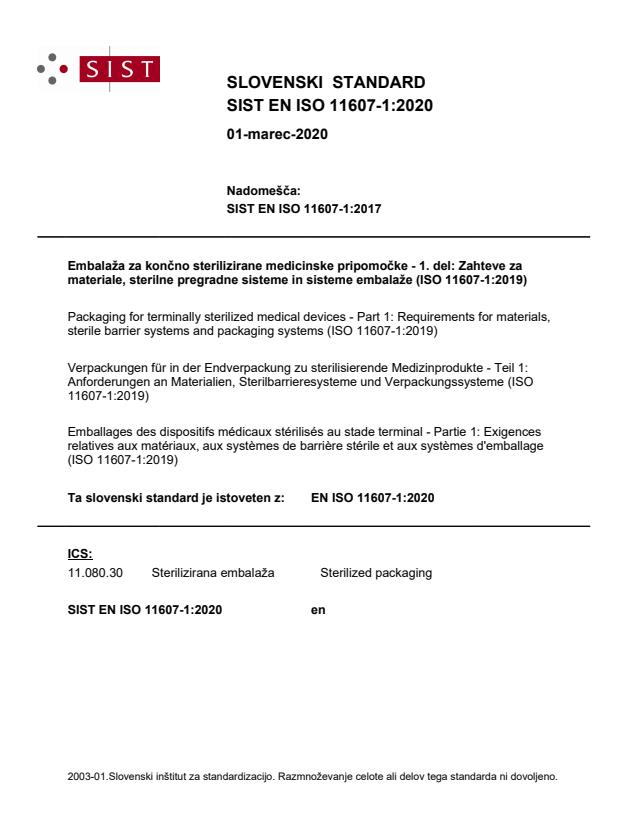
SLOVENSKI STANDARD
01-marec-2020
Nadomešča:
SIST EN ISO 11607-1:2017
Embalaža za končno sterilizirane medicinske pripomočke - 1. del: Zahteve za
materiale, sterilne pregradne sisteme in sisteme embalaže (ISO 11607-1:2019)
Packaging for terminally sterilized medical devices - Part 1: Requirements for materials,
sterile barrier systems and packaging systems (ISO 11607-1:2019)
Verpackungen für in der Endverpackung zu sterilisierende Medizinprodukte - Teil 1:
Anforderungen an Materialien, Sterilbarrieresysteme und Verpackungssysteme (ISO
11607-1:2019)
Emballages des dispositifs médicaux stérilisés au stade terminal - Partie 1: Exigences
relatives aux matériaux, aux systèmes de barrière stérile et aux systèmes d'emballage
(ISO 11607-1:2019)
Ta slovenski standard je istoveten z: EN ISO 11607-1:2020
ICS:
11.080.30 Sterilizirana embalaža Sterilized packaging
2003-01.Slovenski inštitut za standardizacijo. Razmnoževanje celote ali delov tega standarda ni dovoljeno.

EN ISO 11607-1
EUROPEAN STANDARD
NORME EUROPÉENNE
January 2020
EUROPÄISCHE NORM
ICS 11.080.30 Supersedes EN ISO 11607-1:2009
English Version
Packaging for terminally sterilized medical devices - Part
1: Requirements for materials, sterile barrier systems and
packaging systems (ISO 11607-1:2019)
Emballages des dispositifs médicaux stérilisés au stade Verpackungen für in der Endverpackung zu
terminal - Partie 1: Exigences relatives aux matériaux, sterilisierende Medizinprodukte - Teil 1:
aux systèmes de barrière stérile et aux systèmes Anforderungen an Materialien, Sterilbarrieresysteme
d'emballage (ISO 11607-1:2019) und Verpackungssysteme (ISO 11607-1:2019)
This European Standard was approved by CEN on 3 November 2018.

CEN members are bound to comply with the CEN/CENELEC Internal Regulations which stipulate the conditions for giving this
European Standard the status of a national standard without any alteration. Up-to-date lists and bibliographical references
concerning such national standards may be obtained on application to the CEN-CENELEC Management Centre or to any CEN
member.
This European Standard exists in three official versions (English, French, German). A version in any other language made by
translation under the responsibility of a CEN member into its own language and notified to the CEN-CENELEC Management
Centre has the same status as the official versions.

CEN members are the national standards bodies of Austria, Belgium, Bulgaria, Croatia, Cyprus, Czech Republic, Denmark, Estonia,
Finland, France, Germany, Greece, Hungary, Iceland, Ireland, Italy, Latvia, Lithuania, Luxembourg, Malta, Netherlands, Norway,
Poland, Portugal, Republic of North Macedonia, Romania, Serbia, Slovakia, Slovenia, Spain, Sweden, Switzerland, Turkey and
United Kingdom.
EUROPEAN COMMITTEE FOR STANDARDIZATION
COMITÉ EUROPÉEN DE NORMALISATION

EUROPÄISCHES KOMITEE FÜR NORMUNG

CEN-CENELEC Management Centre: Rue de la Science 23, B-1040 Brussels
© 2020 CEN All rights of exploitation in any form and by any means reserved Ref. No. EN ISO 11607-1:2020 E
worldwide for CEN national Members.

Contents Page
European foreword . 3

European foreword
This document (EN ISO 11607-1:2020) has been prepared by Technical Committee ISO/TC 198
"Sterilization of health care products" in collaboration with Technical Committee CEN/TC 102
“Sterilizers and associated equipment for processing of medical devices” the secretariat of which is held
by DIN.
This European Standard shall be given the status of a national standard, either by publication of an
identical text or by endorsement, at the latest by July 2020, and conflicting national standards shall be
withdrawn at the latest by July 2020.
Attention is drawn to the possibility that some of the elements of this document may be the subject of
patent rights. CEN shall not be held responsible for identifying any or all such patent rights.
This document supersedes EN ISO 11607-1:2009.
This document has been prepared under a mandate given to CEN by the European Commission and the
European Free Trade Association.
According to the CEN-CENELEC Internal Regulations, the national standards organizations of the
following countries are bound to implement this European Standard: Austria, Belgium, Bulgaria,
Croatia, Cyprus, Czech Republic, Denmark, Estonia, Finland, France, Germany, Greece, Hungary, Iceland,
Ireland, Italy, Latvia, Lithuania, Luxembourg, Malta, Netherlands, Norway, Poland, Portugal, Republic of
North Macedonia, Romania, Serbia, Slovakia, Slovenia, Spain, Sweden, Switzerland, Turkey and the
United Kingdom.
Endorsement notice
The text of ISO 11607-1:2019 has been approved by CEN as EN ISO 11607-1:2020 without any
modification.
INTERNATIONAL ISO
STANDARD 11607-1
Second edition
2019-02
Packaging for terminally sterilized
medical devices —
Part 1:
Requirements for materials, sterile
barrier systems and packaging systems
Emballages des dispositifs médicaux stérilisés au stade terminal —
Partie 1: Exigences relatives aux matériaux, aux systèmes de barrière
stérile et aux systèmes d'emballage
Reference number
ISO 11607-1:2019(E)
©
ISO 2019
ISO 11607-1:2019(E)
© ISO 2019
All rights reserved. Unless otherwise specified, or required in the context of its implementation, no part of this publication may
be reproduced or utilized otherwise in any form or by any means, electronic or mechanical, including photocopying, or posting
on the internet or an intranet, without prior written permission. Permission can be requested from either ISO at the address
below or ISO’s member body in the country of the requester.
ISO copyright office
CP 401 • Ch. de Blandonnet 8
CH-1214 Vernier, Geneva
Phone: +41 22 749 01 11
Fax: +41 22 749 09 47
Email: copyright@iso.org
Website: www.iso.org
Published in Switzerland
ii © ISO 2019 – All rights reserved

ISO 11607-1:2019(E)
Contents Page
Foreword .iv
Introduction .v
1 Scope . 1
2 Normative references . 1
3 Terms and definitions . 1
4 General requirements . 6
4.1 Quality systems . 6
4.2 Risk management . 6
4.3 Sampling . 6
4.4 Test methods . 6
4.5 Documentation . 7
5 Materials, preformed sterile barrier systems and sterile barrier systems .7
5.1 General requirements . 7
5.2 Microbial barrier properties .10
5.3 Compatibility with the sterilization process .11
5.4 Labelling system .11
5.5 Storage and transport of materials and preformed sterile barrier systems .11
6 Design and development for packaging systems .12
6.1 General .12
6.2 Design .12
7 Usability evaluation for aseptic presentation .13
8 Packaging system performance and stability .14
8.1 General .14
8.2 Packaging system performance testing .14
8.3 Stability testing .15
9 Packaging system validation and changes .15
10 Inspection immediately prior to aseptic presentation .16
11 Information to be provided .16
Annex A (informative) Guidance on medical packaging .17
Annex B (informative) Standardized test methods, guides and procedures that can be used
to demonstrate conformity with the requirements of this document .20
Annex C (normative) Test method for resistance of impermeable materials to the passage of air .31
Annex D (informative) Environmental aspects .32
Annex E (informative) Draft guidance on ways to differentiate a sterile barrier system from
protective packaging .33
Bibliography .38
ISO 11607-1:2019(E)
Foreword
ISO (the International Organization for Standardization) is a worldwide federation of national standards
bodies (ISO member bodies). The work of preparing International Standards is normally carried out
through ISO technical committees. Each member body interested in a subject for which a technical
committee has been established has the right to be represented on that committee. International
organizations, governmental and non-governmental, in liaison with ISO, also take part in the work.
ISO collaborates closely with the International Electrotechnical Commission (IEC) on all matters of
electrotechnical standardization.
The procedures used to develop this document and those intended for its further maintenance are
described in the ISO/IEC Directives, Part 1. In particular, the different approval criteria needed for the
different types of ISO documents should be noted. This document was drafted in accordance with the
editorial rules of the ISO/IEC Directives, Part 2 (see www .iso .org/directives).
Attention is drawn to the possibility that some of the elements of this document may be the subject of
patent rights. ISO shall not be held responsible for identifying any or all such patent rights. Details of
any patent rights identified during the development of the document will be in the Introduction and/or
on the ISO list of patent declarations received (see www .iso .org/patents).
Any trade name used in this document is information given for the convenience of users and does not
constitute an endorsement.
For an explanation of the voluntary nature of standards, the meaning of ISO specific terms and
expressions related to conformity assessment, as well as information about ISO's adherence to the
World Trade Organization (WTO) principles in the Technical Barriers to Trade (TBT) see www .iso
.org/iso/foreword .html.
This document was prepared by Technical Committee ISO/TC 198, Sterilization of health care products.
This second edition cancels and replaces the first edition (ISO 11607-1:2006), which has been technically
revised. It also incorporates the amendment ISO 11607-1:2006/Amd.1:2014.
The main changes compared to the previous edition are as follows:
— the definitions have been aligned with the latest version of ISO 11139;
— new requirements for the evaluation of usability for aseptic presentation have been added;
— new requirements for the inspection of sterile barrier system integrity prior to use have been added;
— a new subclause with requirements for revalidation in accordance with ISO 11607-2 has been added;
— Annex B has been updated and various national, international and European test methods have
been added or deleted;
— a new Annex D has been added with environmental considerations;
— a new Annex E has been added with draft guidance on ways to differentiate a sterile barrier system
from protective packaging.
A list of all parts in the ISO 11607 series can be found on the ISO website.
Any feedback or questions on this document should be directed to the user’s national standards body. A
complete listing of these bodies can be found at www .iso .org/members .html.
iv © ISO 2019 – All rights reserved

ISO 11607-1:2019(E)
Introduction
The process of designing and developing a packaging system for terminally sterilized medical devices
is a complicated and critical endeavour. The device components and the packaging system should be
combined to create a sterile medical device that performs efficiently, safely and effectively in the hands
of the user.
This document specifies requirements for the design of sterile barrier systems and packaging systems
for terminally sterilized medical devices, the basic attributes required of materials and preformed
sterile barrier systems, and design validation requirements. This document is written as a general
(horizontal) standard considering a wide range of potential materials, medical devices, packaging
system designs and sterilization methods. It can be applied by suppliers of materials or of preformed
sterile barrier systems, by medical device manufacturers or health care facilities. ISO 11607-2 describes
the process development and validation requirements for forming, sealing and assembly processes and
addresses controls during normal operations.
Guidance for ISO 11607 series can be found in ISO/TS 16775.
European standards that provide requirements for particular materials and preformed sterile barrier
systems are available and known as the EN 868 series. Conformity with the EN 868 series can be used
to demonstrate conformity with one or more of the requirements of this document.
The goal of a terminally sterilized medical device packaging system is to allow sterilization, provide
physical protection, maintain sterility up to the point of use and allow aseptic presentation. The
specific nature of the medical device, the intended sterilization methods(s), the intended use, expiry
date, transport and storage all influence the packaging system design and choice of materials.
The term “sterile barrier system” was introduced in ISO 11607-1:2006 to describe the minimum
packaging required to perform the unique functions required of medical packaging: to allow sterilization,
to provide an acceptable microbial barrier, and to allow for aseptic presentation. “Protective packaging”
protects the sterile barrier system, and together they form the packaging system. “Preformed sterile
barrier systems” would include any partially assembled sterile barrier systems such as pouches, header
bags or hospital packaging reels. An overview of sterile barrier systems is given in Annex A.
The sterile barrier system is essential to ensure the safety of terminally sterilized medical devices.
Regulatory authorities recognize the critical nature of sterile barrier systems by considering them as
an accessory or a component of a medical device. Preformed sterile barrier systems sold to health care
facilities for use in internal sterilization are considered medical devices in many parts of the world.
INTERNATIONAL STANDARD ISO 11607-1:2019(E)
Packaging for terminally sterilized medical devices —
Part 1:
Requirements for materials, sterile barrier systems and
packaging systems
1 Scope
This document specifies requirements and test methods for materials, preformed sterile barrier
systems, sterile barrier systems and packaging systems that are intended to maintain sterility of
terminally sterilized medical devices until the point of use.
It is applicable to industry, to health care facilities, and to wherever medical devices are placed in sterile
barrier systems and sterilized.
It does not cover all requirements for sterile barrier systems and packaging systems for medical
devices that are manufactured aseptically. Additional requirements can be necessary for drug/device
combinations.
It does not describe a quality assurance system for control of all stages of manufacture.
It does not apply to packaging materials and/or systems used to contain a contaminated medical device
during transportation of the item to the site of reprocessing or disposal.
2 Normative references
The following documents are referred to in the text in such a way that some or all of their content
constitutes requirements of this document. For dated references, only the edition cited applies. For
undated references, the latest edition of the referenced document (including any amendments) applies.
ISO 5636-5, Paper and board — Determination of air permeance (medium range) — Part 5: Gurley method
ISO 11607-2, Packaging for terminally sterilized medical devices — Part 2: Validation requirements for
forming, sealing and assembly processes
3 Terms and definitions
For the purposes of this document, the following terms and definitions apply.
ISO and IEC maintain terminological databases for use in standardization at the following addresses:
— ISO Online browsing platform: available at https: //www .iso .org/obp
— IEC Electropedia: available at http: //www .electropedia .org/
3.1
aseptic presentation
transfer of sterile contents from its sterile barrier system using conditions and procedures that
minimize the risk of microbial contamination
[SOURCE: ISO 11139:2018, 3.13]
ISO 11607-1:2019(E)
3.2
bioburden
population of viable microorganisms on or in product and/or sterile barrier system
[SOURCE: ISO 11139:2018, 3.23]
3.3
closure
means used to complete a sterile barrier system where no seal is formed
EXAMPLE By a reusable container gasket or sequential folding to construct a tortuous path.
[SOURCE: ISO 11139:2018, 3.51, modified — The example has been added.]
3.4
closure integrity
characteristics of a closure to minimize the risk of ingress of microorganisms
[SOURCE: ISO 11139:2018, 3.52]
3.5
control
regulation of variables within specified limits
[SOURCE: ISO 11139:2018, 3.63]
3.6
expiry date
date by which product should be used
Note 1 to entry: For the purpose of this document and ISO 11607-2, expiry date refers to the medical device in a
sterile barrier system. The term “use by date” (3.29) is used to describe the shelf life of packaging materials and
preformed sterile barrier systems prior to assembly into a sterile barrier system.
[SOURCE: ISO 11139:2018, 3.110, modified — Note 1 to entry has been added.]
3.7
labelling
label, instructions for use and any other information that is related to identification, technical
description, intended purpose and proper use of the health care product, but excluding shipping
documents
[SOURCE: ISO 13485:2016, 3.8, modified — The term “medical device” has been replaced by “health
care product”.]
3.8
medical device
instrument, apparatus, implement, machine, appliance, implant, reagent for in vitro use, software,
material or other similar or related article, intended by the manufacturer to be used, alone or in
combination, for human beings, for one or more of the specific medical purpose(s) of:
— diagnosis, prevention, monitoring, treatment or alleviation of disease;
— diagnosis, monitoring, treatment, alleviation of or compensation for an injury;
— investigation, replacement, modification, or support of the anatomy or of a physiological process;
— supporting or sustaining life;
— control of conception;
— disinfection of medical devices;
2 © ISO 2019 – All rights reserved

ISO 11607-1:2019(E)
— providing information by means of in vitro examination of specimens derived from the human body;
and does not achieve its primary intended action by pharmacological, immunological or metabolic
means, in or on the human body, but which may be assisted in its intended function by such means
Note 1 to entry: Products which may be considered to be medical devices in some jurisdictions but not in others
include:
— items specifically intended for cleaning or sterilization of medical devices;
— pouches, reel goods, sterilization wrap and reusable containers for packaging of medical devices for
sterilization;
— disinfection substances;
— aids for persons with disabilities;
— devices incorporating animal and/or human tissues;
— devices for in vitro fertilization or assisted reproduction technologies.
[SOURCE: ISO 13485:2016, 3.11, modified — The first two list items in Note 1 to entry have been added.]
3.9
microbial barrier
property of a sterile barrier system to minimize the risk of ingress of microorganisms
[SOURCE: ISO 11139:2018, 3.169]
3.10
monitoring
continual checking, supervising, critically observing, or determining the status, in order to identify
change from the performance level required or expected
[SOURCE: ISO Guide 73:2009, 3.8.2.1, modified — The note has been deleted.]
3.11
packaging system
combination of a sterile barrier system and protective packaging
[SOURCE: ISO 11139:2018, 3.192]
3.12
preformed sterile barrier system
sterile barrier system (3.23) that is supplied partially assembled for filling and final closure or sealing
EXAMPLE Pouches, bags and open reusable containers (3.17).
[SOURCE: ISO 11139:2018, 3.201, modified — The example has been added.]
3.13
product
tangible result of a process
EXAMPLE Raw material(s), intermediate(s), sub-assembly(ies), health care product(s).
Note 1 to entry: For the purpose of this document and ISO 11607-2, products include preformed sterile barrier
systems, sterile barrier systems, and contents within them.
[SOURCE: ISO 11139:2018, 3.217, modified — Note 1 to entry has been added.]
ISO 11607-1:2019(E)
3.14
protective packaging
configuration of materials designed to prevent damage to the sterile barrier system and its contents
from the time of their assembly until the point of use
[SOURCE: ISO 11139:2018, 3.219]
3.15
repeatability
condition of measurement, out of a set of conditions that includes the same measurement procedure,
same operators, same measuring system, same operating conditions and same location, and replicate
measurements on the same or similar objects over a short period of time
[SOURCE: ISO/IEC Guide 99:2007, 2.20, modified — The term name has been simplified and the notes
omitted.]
3.16
reproducibility
condition of measurement, out of a set of conditions that includes different locations, processors,
measuring systems, and replicate measurements on the same or similar objects
Note 1 to entry: The different measuring systems may use different measurement procedures.
Note 2 to entry: A specification should give the conditions changed and unchanged to the extent practical.
[SOURCE: ISO/IEC Guide 99:2007, 2.24, modified — The term name has been simplified.]
3.17
reusable container
rigid sterile barrier system (3.23) designed to be used repeatedly
[SOURCE: ISO 11139:2018, 3.235]
3.18
seal
result of joining surfaces together by fusion to form a microbial barrier
Note 1 to entry: Surfaces can be joined together by, for example, adhesives or thermal fusion.
[SOURCE: ISO 11139:2018, 3.244, modified — Note 1 to entry has been added.]
3.19
seal integrity
characteristics of a seal to minimize the ingress of microorganisms
[SOURCE: ISO 11139:2018, 3.245]
3.20
seal strength
mechanical capacity of the seal to withstand force
[SOURCE: ISO 11139:2018, 3.246]
3.21
service life
number of processing cycles and/or lifetime up to which a product is claimed to remain suitable and
safe for its intended use when used according to the labelling
[SOURCE: ISO 11139:2018, 3.251]
4 © ISO 2019 – All rights reserved

ISO 11607-1:2019(E)
3.22
sterile
free from viable microorganisms
[SOURCE: ISO 11139:2018, 3.271]
3.23
sterile barrier system
SBS
minimum package that minimizes the risk of ingress of microorganisms and allows aseptic presentation
of the sterile contents at the point of use
[SOURCE: ISO 11139:2018, 3.272]
3.24
sterile fluid-path packaging
system of protective port covers and/or packaging designed to ensure sterility of the portion of the
medical device intended for contact with fluids
EXAMPLE The interior of the tubing for administration of an intravenous fluid.
[SOURCE: ISO 11139:2018, 3.273]
3.25
sterilization compatibility
attributes of the packaging material and/or system that allow it both to withstand the
sterilization process and attain the required conditions for sterilization within the packaging system
[SOURCE: ISO 11139:2018, 3.278]
3.26
sterilizing agent
physical or chemical entity, or combination of entities, having sufficient microbiocidal activity to
achieve sterility under specified conditions
[SOURCE: ISO 11139:2018, 3.288]
3.27
terminal sterilization
process whereby a product is sterilized within its sterile barrier system
[SOURCE: ISO 11139:2018, 3.295]
3.28
terminally sterilized
condition of a product that has been exposed to a sterilization process in its sterile barrier system
[SOURCE: ISO 11139:2018, 3.296]
3.29
use by date
upper limit of the time interval during which the performance characteristics of a material and/or
preformed sterile barrier system, stored under the specified conditions, have been demonstrated
3.30
validation
confirmation process, through the provision of objective evidence, that the requirements for a specific
intended use or application have been fulfilled
Note 1 to entry: The objective evidence needed for a validation is the result of a test or other form of determination
such as performing alternative calculations or reviewing documents.
Note 2 to entry: The word “validated” is used to designate the corresponding status.
ISO 11607-1:2019(E)
Note 3 to entry: The use conditions for validation can be real or simulated.
[SOURCE: ISO 9000:2015, 3.8.13, modified — “process” has been added to the definition.]
3.31
verification
confirmation, through the provision of objective evidence, that specified requirements have been
fulfilled
Note 1 to entry: The objective evidence needed for a verification can be the result of an inspection or of other
forms of determination such as performing alternative calculations or reviewing documents.
Note 2 to entry: The word “verified” is used to designate the corresponding status.
[SOURCE: ISO 9000:2015, 3.8.12, modified — The original Note 2 to entry has been deleted and Note 3
has been renumbered as Note 2 accordingly.]
4 General requirements
4.1 Quality systems
The activities described within this document shall be carried out within a formal quality system.
NOTE ISO 9001, ISO 13485, and ANSI/AAMI ST90 contain requirements for suitable quality systems.
Additional requirements can be specified by a country or region.
4.2 Risk management
The activities described within this document shall consider risk management to medical devices.
NOTE ISO 14971 contains requirements for risk management to medical devices. Additional requirements
can be specified by a country or region.
4.3 Sampling
The sampling plans used for testing of materials, sterile barrier systems or packaging systems shall be
applicable to materials, sterile barrier systems or packaging systems being evaluated. Sampling plans
shall be based upon statistically valid rationale.
NOTE Common statistically based sampling plans as given, for example, in ISO 2859-1 or ISO 186 (with
appropriate modifications if necessary) can be applied to materials, sterile barrier systems or packaging systems.
Additional sampling plans can be specified by countries or regions. For further guidance, see ISO/TS 16775.
4.4 Test methods
4.4.1 A rationale for the selection of appropriate tests for the packaging system shall be established
and recorded.
4.4.2 A rationale for acceptance criteria shall be established and recorded.
NOTE Pass/fail is a type of acceptance criterion.
4.4.3 All test methods used to show conformity to this document shall be validated and documented
by the laboratory performing the test.
NOTE Annex B contains a list of test methods. Publication of a method by a standards body does not make it
validated in any laboratory.
6 © ISO 2019 – All rights reserved

ISO 11607-1:2019(E)
4.4.4 The test method validation shall demonstrate the suitability of the method as used. The following
elements shall be included:
— determination of test method repeatability;
— determination of test method reproducibility;
— establishment of test method sensitivity for integrity tests.
4.5 Documentation
4.5.1 Demonstration of conformity with the requirements of this document shall be recorded.
4.5.2 All records shall be retained for a specified period of time. The retention period shall consider
factors such as applicable requirements, expiry date and traceability of the medical device or sterile
barrier system.
4.5.3 Records of conformity with the requirements shall include, but is not limited to, performance
data, specifications and test results from validated test methods as well as validation protocols,
conclusions and any necessary actions.
4.5.4 Electronic records, electronic signatures and handwritten signatures executed to electronic
records that contribute to validation, process control or other quality decision-making processes shall
remain legible, readily identifiable and retrievable.
5 Materials, preformed sterile barrier systems and sterile barrier systems
5.1 General requirements
5.1.1 Materials and/or preformed sterile barrier systems shall be selected to fulfil the goals of a
terminally sterilized medical device packaging system.
NOTE 1 Conformity with one or more requirements of this document can be demonstrated by using one or
more parts of the EN 868 series.
NOTE 2 A confirmation of conformity to a part of the EN 868 series is not sufficient to be in full conformity
with this document.
NOTE 3 Guidance on sustainability aspects is given in Annex D.
The requirements on materials shall apply to those used in preformed sterile barrier systems, as well
as sterile barrier systems.
5.1.2 The requirements listed in 5.1 are not intended to be all-inclusive. Characteristics not listed in
this subclause may be evaluated using the usability and performance criteria given in Clauses 7 and 8.
5.1.3 The conditions under which the material and/or preformed sterile barrier system are produced
and handled shall be established, controlled and recorded, if applicable, in order to ensure the following:
a) the conditions are compatible with the use for which the material and/or sterile barrier system is
designed;
b) the performance characteristics of the material and/or sterile barrier system are maintained;
c) the material and/or sterile barrier meets the specification.
ISO 11607-1:2019(E)
5.1.4 As applicable, the influences of the following shall be evaluated and recorded:
a) temperature range;
b) pressure range;
c) humidity range;
d) maximum rate of change of the above, where necessary;
e) exposure to sunlight or UV light;
f) cleanliness;
g) bioburden;
h) electrostatic properties.
5.1.5 The source, history and traceability of all materials, especially recycled materials, shall be known
and controlled to ensure that the preformed sterile barrier system and/or sterile barrier system will
consistently meet the requirements of this document.
NOTE With current commercial technologies, it is unlikely that anything other than virgin manufacturing
waste will be used in recycled materials, due to insufficient controls to allow the safe use of other recycled
material in sterile barrier systems.
5.1.6 The following properties shall be evaluated:
a) microbial barrier (see 5.2);
b) biocompatibility and toxicological attributes;
NOTE This is usually restricted to material in contact with the device. Guidance on biocompatibility is
given in ISO 10993-1. For further guidance, see ISO/TS 16775.
c) physical and chemical properties;
d) compatibility with respect to forming, sealing and assembly processes;
e) compatibility with respect to the intended sterilization process(es) (see 5.3);
f) any use by date limitations for pre-sterilization storage and shelf-life limitations for post-
sterilization storage.
5.1.7 Materials, e.g. wrapping materials, paper, plastic film, nonwovens or reusable fabrics, shall meet
the following general performance requirements.
a) Materials shall be non-leaching and odourless under specified conditions of use, to such an extent
that neither performance nor safety is impaired and the medical devices with which they are in
contact are not adversely affected.
NOTE Odour determination does not require a standardized test method, since odours are readily
evident.
b) Materials shall be free of holes, cracks, tears, creases or localized thickening and/or thinning
sufficient to impair functioning.
c) Materials shall have a basis weight (mass per unit area) which is consistent with the specified value.
d) Materials shall exhibit acceptable levels of cleanliness, particulate matter and linting.
e) Materials shall conform to established specific or minimum physical properties, such as tensile
strength, thickness variation, tear resistance, air permeance and burst strength.
8 © ISO 2019 – All rights reserved

ISO 11607-1:2019(E)
f) Materials shall conform to established specific chemical characteristics (e.g. pH value, chloride, and
sulfate content) to meet the requirements of the medical device, packaging system or sterilization
process.
g) Materials shall not contain or release substances known to be toxic in sufficient quantity to cause a
health hazard either before, during or after sterilization under the conditions of use.
h) Materials shall have microbial barrier properties which are consistent with the specified acceptance
criteria unless they meet the criterion of impermeability when evaluated as per Annex C.
5.1.8 In addition to the requirements given in 5.1.1 through 5.1.7, adhesive-coated materials shall meet
the requirements listed below.
a) Coating patterns shall be continuous without skips or breaks in the pattern sufficient to cause a
discontinuity in the seal.
b) Coating mass shall be consistent with the stated value.
c) Materials shall demonstrate minimum specified seal strength when a seal is formed with another
specified material under specified conditions.
5.1.9 In addition to the requirements given in 5.1.1 through 5.1.7 and, if appropriate, 5.1.8, sterile
barrier systems and preformed sterile barrier systems shall meet the requirements listed below.
a) Sterile barrier systems and preformed sterile barrier systems shall meet the requirements of
ISO 11607-2.
b) Materials and components, e.g. coatings, ink or chemical indicators, shall not adversely affect the
medical device by reaction, contamination and/or transfer before, during or after the defined
sterilization process.
c) If formed by sealing, the specified requirements for seal width and seal strength shall be met.
d) Peel-open characteristics shall be continuous and homogeneous, without delamination or tearing
of the material that can affect aseptic opening and presentation.
NOTE If seals are not intended to be opened for aseptic presentation, a maximum seal strength limit is
usually not necessary.
e) Once formed, the sterile barrier system shall provide seal integrity and/or closure integrity until it
is opened at the point of use.
f) Opening a seal or a closure should be irreversible or destructive. If the open seal or closure is
reversible, it shall be clearly evident that the seal or closure has been opened.
5.1.10 For reusable sterile barrier systems, e.g. containers and woven textile wraps, it shall be
determined if processing in accordance with the provided instruction leads to a degradation that will
limit the service life.
a) If degradation is anticipated, the labelling shall state the number of reprocessing cycles that can
be tolerated, unless the end of the service life is detectable. This can be done in the form of stating
how many times the sterile barrier system can be reused based on testing, or in the form of stating
a performance test method prior to use, or in the form of stating a recommended visual inspection
along with acceptance or failure criteria (e.g. unacceptable deterioration such as corrosion,
discoloration, pitting, cracked seals).
b) It shall be determined that the minimum performance characteristics are maintained throughout
the stated service life of the reusable sterile barrier system when following the recommended
processing and sterilization instructions.
ISO 11607-1:2019(E)
5.1.11 In addition to the requirements given in 5.1.1 through 5.1.7 and 5.1.10, reusable containers shall
meet the requirements given below.
a) The container shall be fitted with a tamper-evident system to provide a clear indication when the
closure integrity has been compromised.
b) The sterilizing agent port shall provide a barrier to microorganisms during removal from the
sterilizer, transport and storage (see 5.2).
c) After forming the sterile barrier system, the closure shall provide a barrier to microorganisms
until it is opened at the point of use.
d) The container shall be constructed to facilitate inspection of all essential parts.
e) Acceptance criteria shall be established for inspection prior to each reuse.
NOTE 1 Visual inspection is the most common procedure.
f) Individual components of the same container models shall be either completely interchangeable or
designed such that the components cannot be interchanged.
NOTE 2 Suitable coding and/or labelling can address this design requirement.
g) Service, cleaning procedures and the manner of inspection, maintenance and replacement of
components shall be specified.
NOTE 3 For additional guidance on reusable containers, see EN 868-8, ANSI/AAMI ST77 and ISO/
TS 16775.
5.1.12 In addition to the requirements given in 5.1.1 through 5.1.7 and, if appropriate, 5.1.8, reusable
woven textile wraps shall meet the requirements given below.
a) Performance requirements shall be met after any repairs to the material including qualifying the
compatibility of the repair to the recommended processing and sterilization instructions.
b) Processing procedures for laundering and refurbishing shall be established and documented and
ensure that performance requirements shall continue to be met.
NOTE Visual inspection is the most common procedure.
c) Processing procedures shall conform to the product labelling.
5.2 Microbial barrier properties
5.2.1 If not a declared porous material, the impermeability shall be determined in accordance with
Annex C.
NOTE The microbial barrier properties of materials used in the construction of sterile barrier systems
are critical for ensuring integrity and product safety. The methods used for evaluation of the microbial barrier
properties are divided into two categories: those that are appropriate for impermeable materials, and those that
are appropriate for porous materials.
5.2.2 A demonstration that the material is impermeable shall satisfy the microbial barrier requirement.
5.2.3 Porous materials shall provide an adequate microbial barrier to microorganisms.
10 © ISO 2019 – All rights reserved

ISO 11607-1:2019(E)
NOTE Evaluation of the microb
...


SLOVENSKI STANDARD
01-marec-2020
Nadomešča:
SIST EN ISO 11607-1:2017
Embalaža za končno sterilizirane medicinske pripomočke - 1. del: Zahteve za
materiale, sterilne pregradne sisteme in sisteme embalaže (ISO 11607-1:2019)
Packaging for terminally sterilized medical devices - Part 1: Requirements for materials,
sterile barrier systems and packaging systems (ISO 11607-1:2019)
Verpackungen für in der Endverpackung zu sterilisierende Medizinprodukte - Teil 1:
Anforderungen an Materialien, Sterilbarrieresysteme und Verpackungssysteme (ISO
11607-1:2019)
Emballages des dispositifs médicaux stérilisés au stade terminal - Partie 1: Exigences
relatives aux matériaux, aux systèmes de barrière stérile et aux systèmes d'emballage
(ISO 11607-1:2019)
Ta slovenski standard je istoveten z: EN ISO 11607-1:2020
ICS:
11.080.30 Sterilizirana embalaža Sterilized packaging
2003-01.Slovenski inštitut za standardizacijo. Razmnoževanje celote ali delov tega standarda ni dovoljeno.

EN ISO 11607-1
EUROPEAN STANDARD
NORME EUROPÉENNE
January 2020
EUROPÄISCHE NORM
ICS 11.080.30 Supersedes EN ISO 11607-1:2017
English Version
Packaging for terminally sterilized medical devices - Part
1: Requirements for materials, sterile barrier systems and
packaging systems (ISO 11607-1:2019)
Emballages des dispositifs médicaux stérilisés au stade Verpackungen für in der Endverpackung zu
terminal - Partie 1: Exigences relatives aux matériaux, sterilisierende Medizinprodukte - Teil 1:
aux systèmes de barrière stérile et aux systèmes Anforderungen an Materialien, Sterilbarrieresysteme
d'emballage (ISO 11607-1:2019) und Verpackungssysteme (ISO 11607-1:2019)
This European Standard was approved by CEN on 3 November 2018.

This European Standard was corrected and reissued by the CEN-CENELEC Management Centre on 12 February 2020.

CEN members are bound to comply with the CEN/CENELEC Internal Regulations which stipulate the conditions for giving this
European Standard the status of a national standard without any alteration. Up-to-date lists and bibliographical references
concerning such national standards may be obtained on application to the CEN-CENELEC Management Centre or to any CEN
member.
This European Standard exists in three official versions (English, French, German). A version in any other language made by
translation under the responsibility of a CEN member into its own language and notified to the CEN-CENELEC Management
Centre has the same status as the official versions.

CEN members are the national standards bodies of Austria, Belgium, Bulgaria, Croatia, Cyprus, Czech Republic, Denmark, Estonia,
Finland, France, Germany, Greece, Hungary, Iceland, Ireland, Italy, Latvia, Lithuania, Luxembourg, Malta, Netherlands, Norway,
Poland, Portugal, Republic of North Macedonia, Romania, Serbia, Slovakia, Slovenia, Spain, Sweden, Switzerland, Turkey and
United Kingdom.
EUROPEAN COMMITTEE FOR STANDARDIZATION
COMITÉ EUROPÉEN DE NORMALISATIO N

EUROPÄISCHES KOMITEE FÜR NORMUN G

CEN-CENELEC Management Centre: Rue de la Science 23, B-1040 Brussels
© 2020 CEN All rights of exploitation in any form and by any means reserved Ref. No. EN ISO 11607-1:2020 E
worldwide for CEN national Members.

Contents Page
European foreword . 3

European foreword
This document (EN ISO 11607-1:2020) has been prepared by Technical Committee ISO/TC 198
"Sterilization of health care products" in collaboration with Technical Committee CEN/TC 102
“Sterilizers and associated equipment for processing of medical devices” the secretariat of which is held
by DIN.
This European Standard shall be given the status of a national standard, either by publication of an
identical text or by endorsement, at the latest by July 2020, and conflicting national standards shall be
withdrawn at the latest by July 2020.
Attention is drawn to the possibility that some of the elements of this document may be the subject of
patent rights. CEN shall not be held responsible for identifying any or all such patent rights.
This document supersedes EN ISO 11607-1:2017.
This document has been prepared under a mandate given to CEN by the European Commission and the
European Free Trade Association.
According to the CEN-CENELEC Internal Regulations, the national standards organizations of the
following countries are bound to implement this European Standard: Austria, Belgium, Bulgaria,
Croatia, Cyprus, Czech Republic, Denmark, Estonia, Finland, France, Germany, Greece, Hungary, Iceland,
Ireland, Italy, Latvia, Lithuania, Luxembourg, Malta, Netherlands, Norway, Poland, Portugal, Republic of
North Macedonia, Romania, Serbia, Slovakia, Slovenia, Spain, Sweden, Switzerland, Turkey and the
United Kingdom.
Endorsement notice
The text of ISO 11607-1:2019 has been approved by CEN as EN ISO 11607-1:2020 without any
modification.
INTERNATIONAL ISO
STANDARD 11607-1
Second edition
2019-02
Packaging for terminally sterilized
medical devices —
Part 1:
Requirements for materials, sterile
barrier systems and packaging systems
Emballages des dispositifs médicaux stérilisés au stade terminal —
Partie 1: Exigences relatives aux matériaux, aux systèmes de barrière
stérile et aux systèmes d'emballage
Reference number
ISO 11607-1:2019(E)
©
ISO 2019
ISO 11607-1:2019(E)
© ISO 2019
All rights reserved. Unless otherwise specified, or required in the context of its implementation, no part of this publication may
be reproduced or utilized otherwise in any form or by any means, electronic or mechanical, including photocopying, or posting
on the internet or an intranet, without prior written permission. Permission can be requested from either ISO at the address
below or ISO’s member body in the country of the requester.
ISO copyright office
CP 401 • Ch. de Blandonnet 8
CH-1214 Vernier, Geneva
Phone: +41 22 749 01 11
Fax: +41 22 749 09 47
Email: copyright@iso.org
Website: www.iso.org
Published in Switzerland
ii © ISO 2019 – All rights reserved

ISO 11607-1:2019(E)
Contents Page
Foreword .iv
Introduction .v
1 Scope . 1
2 Normative references . 1
3 Terms and definitions . 1
4 General requirements . 6
4.1 Quality systems . 6
4.2 Risk management . 6
4.3 Sampling . 6
4.4 Test methods . 6
4.5 Documentation . 7
5 Materials, preformed sterile barrier systems and sterile barrier systems .7
5.1 General requirements . 7
5.2 Microbial barrier properties .10
5.3 Compatibility with the sterilization process .11
5.4 Labelling system .11
5.5 Storage and transport of materials and preformed sterile barrier systems .11
6 Design and development for packaging systems .12
6.1 General .12
6.2 Design .12
7 Usability evaluation for aseptic presentation .13
8 Packaging system performance and stability .14
8.1 General .14
8.2 Packaging system performance testing .14
8.3 Stability testing .15
9 Packaging system validation and changes .15
10 Inspection immediately prior to aseptic presentation .16
11 Information to be provided .16
Annex A (informative) Guidance on medical packaging .17
Annex B (informative) Standardized test methods, guides and procedures that can be used
to demonstrate conformity with the requirements of this document .20
Annex C (normative) Test method for resistance of impermeable materials to the passage of air .31
Annex D (informative) Environmental aspects .32
Annex E (informative) Draft guidance on ways to differentiate a sterile barrier system from
protective packaging .33
Bibliography .38
ISO 11607-1:2019(E)
Foreword
ISO (the International Organization for Standardization) is a worldwide federation of national standards
bodies (ISO member bodies). The work of preparing International Standards is normally carried out
through ISO technical committees. Each member body interested in a subject for which a technical
committee has been established has the right to be represented on that committee. International
organizations, governmental and non-governmental, in liaison with ISO, also take part in the work.
ISO collaborates closely with the International Electrotechnical Commission (IEC) on all matters of
electrotechnical standardization.
The procedures used to develop this document and those intended for its further maintenance are
described in the ISO/IEC Directives, Part 1. In particular, the different approval criteria needed for the
different types of ISO documents should be noted. This document was drafted in accordance with the
editorial rules of the ISO/IEC Directives, Part 2 (see www .iso .org/directives).
Attention is drawn to the possibility that some of the elements of this document may be the subject of
patent rights. ISO shall not be held responsible for identifying any or all such patent rights. Details of
any patent rights identified during the development of the document will be in the Introduction and/or
on the ISO list of patent declarations received (see www .iso .org/patents).
Any trade name used in this document is information given for the convenience of users and does not
constitute an endorsement.
For an explanation of the voluntary nature of standards, the meaning of ISO specific terms and
expressions related to conformity assessment, as well as information about ISO's adherence to the
World Trade Organization (WTO) principles in the Technical Barriers to Trade (TBT) see www .iso
.org/iso/foreword .html.
This document was prepared by Technical Committee ISO/TC 198, Sterilization of health care products.
This second edition cancels and replaces the first edition (ISO 11607-1:2006), which has been technically
revised. It also incorporates the amendment ISO 11607-1:2006/Amd.1:2014.
The main changes compared to the previous edition are as follows:
— the definitions have been aligned with the latest version of ISO 11139;
— new requirements for the evaluation of usability for aseptic presentation have been added;
— new requirements for the inspection of sterile barrier system integrity prior to use have been added;
— a new subclause with requirements for revalidation in accordance with ISO 11607-2 has been added;
— Annex B has been updated and various national, international and European test methods have
been added or deleted;
— a new Annex D has been added with environmental considerations;
— a new Annex E has been added with draft guidance on ways to differentiate a sterile barrier system
from protective packaging.
A list of all parts in the ISO 11607 series can be found on the ISO website.
Any feedback or questions on this document should be directed to the user’s national standards body. A
complete listing of these bodies can be found at www .iso .org/members .html.
iv © ISO 2019 – All rights reserved

ISO 11607-1:2019(E)
Introduction
The process of designing and developing a packaging system for terminally sterilized medical devices
is a complicated and critical endeavour. The device components and the packaging system should be
combined to create a sterile medical device that performs efficiently, safely and effectively in the hands
of the user.
This document specifies requirements for the design of sterile barrier systems and packaging systems
for terminally sterilized medical devices, the basic attributes required of materials and preformed
sterile barrier systems, and design validation requirements. This document is written as a general
(horizontal) standard considering a wide range of potential materials, medical devices, packaging
system designs and sterilization methods. It can be applied by suppliers of materials or of preformed
sterile barrier systems, by medical device manufacturers or health care facilities. ISO 11607-2 describes
the process development and validation requirements for forming, sealing and assembly processes and
addresses controls during normal operations.
Guidance for ISO 11607 series can be found in ISO/TS 16775.
European standards that provide requirements for particular materials and preformed sterile barrier
systems are available and known as the EN 868 series. Conformity with the EN 868 series can be used
to demonstrate conformity with one or more of the requirements of this document.
The goal of a terminally sterilized medical device packaging system is to allow sterilization, provide
physical protection, maintain sterility up to the point of use and allow aseptic presentation. The
specific nature of the medical device, the intended sterilization methods(s), the intended use, expiry
date, transport and storage all influence the packaging system design and choice of materials.
The term “sterile barrier system” was introduced in ISO 11607-1:2006 to describe the minimum
packaging required to perform the unique functions required of medical packaging: to allow sterilization,
to provide an acceptable microbial barrier, and to allow for aseptic presentation. “Protective packaging”
protects the sterile barrier system, and together they form the packaging system. “Preformed sterile
barrier systems” would include any partially assembled sterile barrier systems such as pouches, header
bags or hospital packaging reels. An overview of sterile barrier systems is given in Annex A.
The sterile barrier system is essential to ensure the safety of terminally sterilized medical devices.
Regulatory authorities recognize the critical nature of sterile barrier systems by considering them as
an accessory or a component of a medical device. Preformed sterile barrier systems sold to health care
facilities for use in internal sterilization are considered medical devices in many parts of the world.
INTERNATIONAL STANDARD ISO 11607-1:2019(E)
Packaging for terminally sterilized medical devices —
Part 1:
Requirements for materials, sterile barrier systems and
packaging systems
1 Scope
This document specifies requirements and test methods for materials, preformed sterile barrier
systems, sterile barrier systems and packaging systems that are intended to maintain sterility of
terminally sterilized medical devices until the point of use.
It is applicable to industry, to health care facilities, and to wherever medical devices are placed in sterile
barrier systems and sterilized.
It does not cover all requirements for sterile barrier systems and packaging systems for medical
devices that are manufactured aseptically. Additional requirements can be necessary for drug/device
combinations.
It does not describe a quality assurance system for control of all stages of manufacture.
It does not apply to packaging materials and/or systems used to contain a contaminated medical device
during transportation of the item to the site of reprocessing or disposal.
2 Normative references
The following documents are referred to in the text in such a way that some or all of their content
constitutes requirements of this document. For dated references, only the edition cited applies. For
undated references, the latest edition of the referenced document (including any amendments) applies.
ISO 5636-5, Paper and board — Determination of air permeance (medium range) — Part 5: Gurley method
ISO 11607-2, Packaging for terminally sterilized medical devices — Part 2: Validation requirements for
forming, sealing and assembly processes
3 Terms and definitions
For the purposes of this document, the following terms and definitions apply.
ISO and IEC maintain terminological databases for use in standardization at the following addresses:
— ISO Online browsing platform: available at https: //www .iso .org/obp
— IEC Electropedia: available at http: //www .electropedia .org/
3.1
aseptic presentation
transfer of sterile contents from its sterile barrier system using conditions and procedures that
minimize the risk of microbial contamination
[SOURCE: ISO 11139:2018, 3.13]
ISO 11607-1:2019(E)
3.2
bioburden
population of viable microorganisms on or in product and/or sterile barrier system
[SOURCE: ISO 11139:2018, 3.23]
3.3
closure
means used to complete a sterile barrier system where no seal is formed
EXAMPLE By a reusable container gasket or sequential folding to construct a tortuous path.
[SOURCE: ISO 11139:2018, 3.51, modified — The example has been added.]
3.4
closure integrity
characteristics of a closure to minimize the risk of ingress of microorganisms
[SOURCE: ISO 11139:2018, 3.52]
3.5
control
regulation of variables within specified limits
[SOURCE: ISO 11139:2018, 3.63]
3.6
expiry date
date by which product should be used
Note 1 to entry: For the purpose of this document and ISO 11607-2, expiry date refers to the medical device in a
sterile barrier system. The term “use by date” (3.29) is used to describe the shelf life of packaging materials and
preformed sterile barrier systems prior to assembly into a sterile barrier system.
[SOURCE: ISO 11139:2018, 3.110, modified — Note 1 to entry has been added.]
3.7
labelling
label, instructions for use and any other information that is related to identification, technical
description, intended purpose and proper use of the health care product, but excluding shipping
documents
[SOURCE: ISO 13485:2016, 3.8, modified — The term “medical device” has been replaced by “health
care product”.]
3.8
medical device
instrument, apparatus, implement, machine, appliance, implant, reagent for in vitro use, software,
material or other similar or related article, intended by the manufacturer to be used, alone or in
combination, for human beings, for one or more of the specific medical purpose(s) of:
— diagnosis, prevention, monitoring, treatment or alleviation of disease;
— diagnosis, monitoring, treatment, alleviation of or compensation for an injury;
— investigation, replacement, modification, or support of the anatomy or of a physiological process;
— supporting or sustaining life;
— control of conception;
— disinfection of medical devices;
2 © ISO 2019 – All rights reserved

ISO 11607-1:2019(E)
— providing information by means of in vitro examination of specimens derived from the human body;
and does not achieve its primary intended action by pharmacological, immunological or metabolic
means, in or on the human body, but which may be assisted in its intended function by such means
Note 1 to entry: Products which may be considered to be medical devices in some jurisdictions but not in others
include:
— items specifically intended for cleaning or sterilization of medical devices;
— pouches, reel goods, sterilization wrap and reusable containers for packaging of medical devices for
sterilization;
— disinfection substances;
— aids for persons with disabilities;
— devices incorporating animal and/or human tissues;
— devices for in vitro fertilization or assisted reproduction technologies.
[SOURCE: ISO 13485:2016, 3.11, modified — The first two list items in Note 1 to entry have been added.]
3.9
microbial barrier
property of a sterile barrier system to minimize the risk of ingress of microorganisms
[SOURCE: ISO 11139:2018, 3.169]
3.10
monitoring
continual checking, supervising, critically observing, or determining the status, in order to identify
change from the performance level required or expected
[SOURCE: ISO Guide 73:2009, 3.8.2.1, modified — The note has been deleted.]
3.11
packaging system
combination of a sterile barrier system and protective packaging
[SOURCE: ISO 11139:2018, 3.192]
3.12
preformed sterile barrier system
sterile barrier system (3.23) that is supplied partially assembled for filling and final closure or sealing
EXAMPLE Pouches, bags and open reusable containers (3.17).
[SOURCE: ISO 11139:2018, 3.201, modified — The example has been added.]
3.13
product
tangible result of a process
EXAMPLE Raw material(s), intermediate(s), sub-assembly(ies), health care product(s).
Note 1 to entry: For the purpose of this document and ISO 11607-2, products include preformed sterile barrier
systems, sterile barrier systems, and contents within them.
[SOURCE: ISO 11139:2018, 3.217, modified — Note 1 to entry has been added.]
ISO 11607-1:2019(E)
3.14
protective packaging
configuration of materials designed to prevent damage to the sterile barrier system and its contents
from the time of their assembly until the point of use
[SOURCE: ISO 11139:2018, 3.219]
3.15
repeatability
condition of measurement, out of a set of conditions that includes the same measurement procedure,
same operators, same measuring system, same operating conditions and same location, and replicate
measurements on the same or similar objects over a short period of time
[SOURCE: ISO/IEC Guide 99:2007, 2.20, modified — The term name has been simplified and the notes
omitted.]
3.16
reproducibility
condition of measurement, out of a set of conditions that includes different locations, processors,
measuring systems, and replicate measurements on the same or similar objects
Note 1 to entry: The different measuring systems may use different measurement procedures.
Note 2 to entry: A specification should give the conditions changed and unchanged to the extent practical.
[SOURCE: ISO/IEC Guide 99:2007, 2.24, modified — The term name has been simplified.]
3.17
reusable container
rigid sterile barrier system (3.23) designed to be used repeatedly
[SOURCE: ISO 11139:2018, 3.235]
3.18
seal
result of joining surfaces together by fusion to form a microbial barrier
Note 1 to entry: Surfaces can be joined together by, for example, adhesives or thermal fusion.
[SOURCE: ISO 11139:2018, 3.244, modified — Note 1 to entry has been added.]
3.19
seal integrity
characteristics of a seal to minimize the ingress of microorganisms
[SOURCE: ISO 11139:2018, 3.245]
3.20
seal strength
mechanical capacity of the seal to withstand force
[SOURCE: ISO 11139:2018, 3.246]
3.21
service life
number of processing cycles and/or lifetime up to which a product is claimed to remain suitable and
safe for its intended use when used according to the labelling
[SOURCE: ISO 11139:2018, 3.251]
4 © ISO 2019 – All rights reserved

ISO 11607-1:2019(E)
3.22
sterile
free from viable microorganisms
[SOURCE: ISO 11139:2018, 3.271]
3.23
sterile barrier system
SBS
minimum package that minimizes the risk of ingress of microorganisms and allows aseptic presentation
of the sterile contents at the point of use
[SOURCE: ISO 11139:2018, 3.272]
3.24
sterile fluid-path packaging
system of protective port covers and/or packaging designed to ensure sterility of the portion of the
medical device intended for contact with fluids
EXAMPLE The interior of the tubing for administration of an intravenous fluid.
[SOURCE: ISO 11139:2018, 3.273]
3.25
sterilization compatibility
attributes of the packaging material and/or system that allow it both to withstand the
sterilization process and attain the required conditions for sterilization within the packaging system
[SOURCE: ISO 11139:2018, 3.278]
3.26
sterilizing agent
physical or chemical entity, or combination of entities, having sufficient microbiocidal activity to
achieve sterility under specified conditions
[SOURCE: ISO 11139:2018, 3.288]
3.27
terminal sterilization
process whereby a product is sterilized within its sterile barrier system
[SOURCE: ISO 11139:2018, 3.295]
3.28
terminally sterilized
condition of a product that has been exposed to a sterilization process in its sterile barrier system
[SOURCE: ISO 11139:2018, 3.296]
3.29
use by date
upper limit of the time interval during which the performance characteristics of a material and/or
preformed sterile barrier system, stored under the specified conditions, have been demonstrated
3.30
validation
confirmation process, through the provision of objective evidence, that the requirements for a specific
intended use or application have been fulfilled
Note 1 to entry: The objective evidence needed for a validation is the result of a test or other form of determination
such as performing alternative calculations or reviewing documents.
Note 2 to entry: The word “validated” is used to designate the corresponding status.
ISO 11607-1:2019(E)
Note 3 to entry: The use conditions for validation can be real or simulated.
[SOURCE: ISO 9000:2015, 3.8.13, modified — “process” has been added to the definition.]
3.31
verification
confirmation, through the provision of objective evidence, that specified requirements have been
fulfilled
Note 1 to entry: The objective evidence needed for a verification can be the result of an inspection or of other
forms of determination such as performing alternative calculations or reviewing documents.
Note 2 to entry: The word “verified” is used to designate the corresponding status.
[SOURCE: ISO 9000:2015, 3.8.12, modified — The original Note 2 to entry has been deleted and Note 3
has been renumbered as Note 2 accordingly.]
4 General requirements
4.1 Quality systems
The activities described within this document shall be carried out within a formal quality system.
NOTE ISO 9001, ISO 13485, and ANSI/AAMI ST90 contain requirements for suitable quality systems.
Additional requirements can be specified by a country or region.
4.2 Risk management
The activities described within this document shall consider risk management to medical devices.
NOTE ISO 14971 contains requirements for risk management to medical devices. Additional requirements
can be specified by a country or region.
4.3 Sampling
The sampling plans used for testing of materials, sterile barrier systems or packaging systems shall be
applicable to materials, sterile barrier systems or packaging systems being evaluated. Sampling plans
shall be based upon statistically valid rationale.
NOTE Common statistically based sampling plans as given, for example, in ISO 2859-1 or ISO 186 (with
appropriate modifications if necessary) can be applied to materials, sterile barrier systems or packaging systems.
Additional sampling plans can be specified by countries or regions. For further guidance, see ISO/TS 16775.
4.4 Test methods
4.4.1 A rationale for the selection of appropriate tests for the packaging system shall be established
and recorded.
4.4.2 A rationale for acceptance criteria shall be established and recorded.
NOTE Pass/fail is a type of acceptance criterion.
4.4.3 All test methods used to show conformity to this document shall be validated and documented
by the laboratory performing the test.
NOTE Annex B contains a list of test methods. Publication of a method by a standards body does not make it
validated in any laboratory.
6 © ISO 2019 – All rights reserved

ISO 11607-1:2019(E)
4.4.4 The test method validation shall demonstrate the suitability of the method as used. The following
elements shall be included:
— determination of test method repeatability;
— determination of test method reproducibility;
— establishment of test method sensitivity for integrity tests.
4.5 Documentation
4.5.1 Demonstration of conformity with the requirements of this document shall be recorded.
4.5.2 All records shall be retained for a specified period of time. The retention period shall consider
factors such as applicable requirements, expiry date and traceability of the medical device or sterile
barrier system.
4.5.3 Records of conformity with the requirements shall include, but is not limited to, performance
data, specifications and test results from validated test methods as well as validation protocols,
conclusions and any necessary actions.
4.5.4 Electronic records, electronic signatures and handwritten signatures executed to electronic
records that contribute to validation, process control or other quality decision-making processes shall
remain legible, readily identifiable and retrievable.
5 Materials, preformed sterile barrier systems and sterile barrier systems
5.1 General requirements
5.1.1 Materials and/or preformed sterile barrier systems shall be selected to fulfil the goals of a
terminally sterilized medical device packaging system.
NOTE 1 Conformity with one or more requirements of this document can be demonstrated by using one or
more parts of the EN 868 series.
NOTE 2 A confirmation of conformity to a part of the EN 868 series is not sufficient to be in full conformity
with this document.
NOTE 3 Guidance on sustainability aspects is given in Annex D.
The requirements on materials shall apply to those used in preformed sterile barrier systems, as well
as sterile barrier systems.
5.1.2 The requirements listed in 5.1 are not intended to be all-inclusive. Characteristics not listed in
this subclause may be evaluated using the usability and performance criteria given in Clauses 7 and 8.
5.1.3 The conditions under which the material and/or preformed sterile barrier system are produced
and handled shall be established, controlled and recorded, if applicable, in order to ensure the following:
a) the conditions are compatible with the use for which the material and/or sterile barrier system is
designed;
b) the performance characteristics of the material and/or sterile barrier system are maintained;
c) the material and/or sterile barrier meets the specification.
ISO 11607-1:2019(E)
5.1.4 As applicable, the influences of the following shall be evaluated and recorded:
a) temperature range;
b) pressure range;
c) humidity range;
d) maximum rate of change of the above, where necessary;
e) exposure to sunlight or UV light;
f) cleanliness;
g) bioburden;
h) electrostatic properties.
5.1.5 The source, history and traceability of all materials, especially recycled materials, shall be known
and controlled to ensure that the preformed sterile barrier system and/or sterile barrier system will
consistently meet the requirements of this document.
NOTE With current commercial technologies, it is unlikely that anything other than virgin manufacturing
waste will be used in recycled materials, due to insufficient controls to allow the safe use of other recycled
material in sterile barrier systems.
5.1.6 The following properties shall be evaluated:
a) microbial barrier (see 5.2);
b) biocompatibility and toxicological attributes;
NOTE This is usually restricted to material in contact with the device. Guidance on biocompatibility is
given in ISO 10993-1. For further guidance, see ISO/TS 16775.
c) physical and chemical properties;
d) compatibility with respect to forming, sealing and assembly processes;
e) compatibility with respect to the intended sterilization process(es) (see 5.3);
f) any use by date limitations for pre-sterilization storage and shelf-life limitations for post-
sterilization storage.
5.1.7 Materials, e.g. wrapping materials, paper, plastic film, nonwovens or reusable fabrics, shall meet
the following general performance requirements.
a) Materials shall be non-leaching and odourless under specified conditions of use, to such an extent
that neither performance nor safety is impaired and the medical devices with which they are in
contact are not adversely affected.
NOTE Odour determination does not require a standardized test method, since odours are readily
evident.
b) Materials shall be free of holes, cracks, tears, creases or localized thickening and/or thinning
sufficient to impair functioning.
c) Materials shall have a basis weight (mass per unit area) which is consistent with the specified value.
d) Materials shall exhibit acceptable levels of cleanliness, particulate matter and linting.
e) Materials shall conform to established specific or minimum physical properties, such as tensile
strength, thickness variation, tear resistance, air permeance and burst strength.
8 © ISO 2019 – All rights reserved

ISO 11607-1:2019(E)
f) Materials shall conform to established specific chemical characteristics (e.g. pH value, chloride, and
sulfate content) to meet the requirements of the medical device, packaging system or sterilization
process.
g) Materials shall not contain or release substances known to be toxic in sufficient quantity to cause a
health hazard either before, during or after sterilization under the conditions of use.
h) Materials shall have microbial barrier properties which are consistent with the specified acceptance
criteria unless they meet the criterion of impermeability when evaluated as per Annex C.
5.1.8 In addition to the requirements given in 5.1.1 through 5.1.7, adhesive-coated materials shall meet
the requirements listed below.
a) Coating patterns shall be continuous without skips or breaks in the pattern sufficient to cause a
discontinuity in the seal.
b) Coating mass shall be consistent with the stated value.
c) Materials shall demonstrate minimum specified seal strength when a seal is formed with another
specified material under specified conditions.
5.1.9 In addition to the requirements given in 5.1.1 through 5.1.7 and, if appropriate, 5.1.8, sterile
barrier systems and preformed sterile barrier systems shall meet the requirements listed below.
a) Sterile barrier systems and preformed sterile barrier systems shall meet the requirements of
ISO 11607-2.
b) Materials and components, e.g. coatings, ink or chemical indicators, shall not adversely affect the
medical device by reaction, contamination and/or transfer before, during or after the defined
sterilization process.
c) If formed by sealing, the specified requirements for seal width and seal strength shall be met.
d) Peel-open characteristics shall be continuous and homogeneous, without delamination or tearing
of the material that can affect aseptic opening and presentation.
NOTE If seals are not intended to be opened for aseptic presentation, a maximum seal strength limit is
usually not necessary.
e) Once formed, the sterile barrier system shall provide seal integrity and/or closure integrity until it
is opened at the point of use.
f) Opening a seal or a closure should be irreversible or destructive. If the open seal or closure is
reversible, it shall be clearly evident that the seal or closure has been opened.
5.1.10 For reusable sterile barrier systems, e.g. containers and woven textile wraps, it shall be
determined if processing in accordance with the provided instruction leads to a degradation that will
limit the service life.
a) If degradation is anticipated, the labelling shall state the number of reprocessing cycles that can
be tolerated, unless the end of the service life is detectable. This can be done in the form of stating
how many times the sterile barrier system can be reused based on testing, or in the form of stating
a performance test method prior to use, or in the form of stating a recommended visual inspection
along with acceptance or failure criteria (e.g. unacceptable deterioration such as corrosion,
discoloration, pitting, cracked seals).
b) It shall be determined that the minimum performance characteristics are maintained throughout
the stated service life of the reusable sterile barrier system when following the recommended
processing and sterilization instructions.
ISO 11607-1:2019(E)
5.1.11 In addition to the requirements given in 5.1.1 through 5.1.7 and 5.1.10, reusable containers shall
meet the requirements given below.
a) The container shall be fitted with a tamper-evident system to provide a clear indication when the
closure integrity has been compromised.
b) The sterilizing agent port shall provide a barrier to microorganisms during removal from the
sterilizer, transport and storage (see 5.2).
c) After forming the sterile barrier system, the closure shall provide a barrier to microorganisms
until it is opened at the point of use.
d) The container shall be constructed to facilitate inspection of all essential parts.
e) Acceptance criteria shall be established for inspection prior to each reuse.
NOTE 1 Visual inspection is the most common procedure.
f) Individual components of the same container models shall be either completely interchangeable or
designed such that the components cannot be interchanged.
NOTE 2 Suitable coding and/or labelling can address this design requirement.
g) Service, cleaning procedures and the manner of inspection, maintenance and replacement of
components shall be specified.
NOTE 3 For additional guidance on reusable containers, see EN 868-8, ANSI/AAMI ST77 and ISO/
TS 16775.
5.1.12 In addition to the requirements given in 5.1.1 through 5.1.7 and, if appropriate, 5.1.8, reusable
woven textile wraps shall meet the requirements given below.
a) Performance requirements shall be met after any repairs to the material including qualifying the
compatibility of the repair to the recommended processing and sterilization instructions.
b) Processing procedures for laundering and refurbishing shall be established and documented and
ensure that performance requirements shall continue to be met.
NOTE Visual inspection is the most common procedure.
c) Processing procedures shall conform to the product labelling.
5.2 Microbial barrier properties
5.2.1 If not a declared porous material, the impermeability shall be determined in accordance with
Annex C.
NOTE The microbial barrier properties of materials used in the construction of sterile barrier systems
are critical for ensuring integrity and product safety. The methods used for evaluation of the microbial barrier
properties are divided into two categories: those that are appropriate for impermeable materials, and those that
are appropriate for porous materials.
5.2.2 A demonstration that the material is impermeable shall satisfy the microbial barrier requirement.
5.2.3 Porous materials shall provide an adequate microbial barrier to microorganisms.
10 © ISO 2019 – All rights reserved

------
...

Questions, Comments and Discussion

Ask us and Technical Secretary will try to provide an answer. You can facilitate discussion about the standard in here.

Loading comments...

SIST EN ISO 11607-1:2020 표준은 최종적으로 멸균된 의료기기의 포장에 관한 요구 사항, 멸균 장벽 시스템 및 포장 시스템에 대한 특정 요구 사항을 강조합니다. 이 표준의 범위는 멸균된 의료기기가 사용될 지점까지 멸균 상태를 유지하도록 설계된 소재와 시스템에 대한 요구 사항 및 시험 방법을 명확히 규정하고 있습니다. 가장 큰 강점 중 하나는 이 표준이 의료기기 산업 및 의료 시설에서 광범위하게 적용될 수 있다는 점입니다. 이는 멸균 장벽 시스템의 중요성을 강조하며, 의료기기의 안전성과 효율적인 사용을 보장하는 데 필수적입니다. 또한, 표준의 명확한 요구 사항과 시험 방법은 사용자와 제조업체 간의 신뢰를 구축하는 데 기여합니다. 그러나, 이 표준은 무균 제조를 위한 모든 요구 사항을 충족하지는 않습니다. 특히, 약물-장치 조합에 필요한 추가 요구 사항이나 모든 제조 단계에 대한 품질 보증 시스템에 대한 설명이 포함되어 있지 않다는 점은 주의해야 합니다. 또한, 오염된 의료기기의 포장 시스템은 이 문서의 범위에서 제외된다는 점도 고려해야 합니다. 이러한 요소들은 개발자와 사용자가 표준을 적용하는 데 있어서 유의해야 할 사항입니다. 결론적으로, EN ISO 11607-1:2020은 의료기기의 멸균성을 유지하기 위한 포장 및 시스템에 대한 명확한 지침과 요구 사항을 제공하여 의료기기 분야에서의 안전성과 표준화를 지원합니다.

The EN ISO 11607-1:2020 standard outlines essential requirements for packaging intended for terminally sterilized medical devices. The scope of this standard is pivotal as it addresses the materials, preformed sterile barrier systems, and packaging systems designed to maintain the sterility of medical devices until they are ready for use. This ensures that healthcare facilities and industry players can rely on effective packaging to protect critical medical devices from contamination. One of the principal strengths of this standard is its comprehensive focus on the integrity of sterile barrier systems. By specifying test methods and requirements, it establishes a clear framework for evaluating the performance of packaging solutions in real-world applications. This significantly enhances the safety portfolio of medical devices, reducing the risks associated with sterile barrier failures. Moreover, the standard’s relevance is highlighted by its applicability across various sectors, including healthcare facilities and industries involved in medical device manufacturing and packaging. This broad applicability underscores its importance in ensuring compliance with best practices in sterilization and packaging for medical devices globally. However, it is crucial to note that the EN ISO 11607-1:2020 does not encompass all requirements for sterile barrier systems or packaging systems for aseptically manufactured medical devices. Additionally, it is not intended to serve as a quality assurance system for controlling all manufacturing stages, nor does it cater to packaging when it comes to contaminated medical devices during transportation. These clarifications are essential for users to understand potential limitations when implementing the standard. Overall, the EN ISO 11607-1:2020 standard is a vital document that underpins the safety and effectiveness of terminally sterilized medical device packaging, providing a reliable foundation for industry best practices and regulatory compliance.

La norme EN ISO 11607-1:2020 est un document essentiel pour l'industrie des dispositifs médicaux, spécifiant les exigences relatives aux matériaux, aux systèmes de barrière stériles prédéformés et aux systèmes d'emballage destinés à maintenir la stérilité des dispositifs médicaux stérilisés à la fin du processus jusqu'à leur utilisation. Son champ d'application est crucial, s'adressant non seulement à l'industrie mais également aux établissements de santé et à tout environnement où les dispositifs médicaux sont soumis à des systèmes de barrière stériles et à des processus de stérilisation. Parmi les points forts de cette norme, on trouve la clarté des exigences et des méthodes d'essai qu'elle propose. Ces spécifications garantissent que les dispositifs médicaux restent stériles, minimisant ainsi le risque d'infection chez les patients. De plus, la norme aborde des aspects essentiels tels que les systèmes d'emballage, soulignant l'importance de la sécurité et de l'intégrité des produits médicaux lors de leur transport et stockage. Il est pertinent de noter que cette norme ne couvre pas toutes les exigences pour les systèmes de barrière stériles et les systèmes d'emballage des dispositifs médicaux fabriqués de manière aseptique, ce qui peut nécessiter des exigences supplémentaires pour les combinaisons médicament/dispositif. De même, la norme ne fournit pas de système d'assurance qualité pour le contrôle de toutes les étapes de fabrication, ce qui est un aspect à prendre en compte pour les fabricants. Enfin, elle ne s'applique pas aux matériaux d'emballage ou aux systèmes utilisés pour contenir un dispositif médical contaminé durant son transport vers le site de reprocessing ou de mise au rebut. En résumé, la norme EN ISO 11607-1:2020 est un document fondamental qui assure la sécurité et l’efficacité des systèmes de barrière stériles et des systèmes d'emballage pour les dispositifs médicaux, renforçant ainsi la confiance envers les produits utilisés dans le domaine de la santé.

The EN ISO 11607-1:2020 standard provides critical requirements and test methods for materials used in preformed sterile barrier systems, as well as for sterile barrier systems and packaging systems designed to maintain the sterility of terminally sterilized medical devices until they reach the point of use. Its relevance is directly aligned with the industry's need for effective packaging solutions that ensure the safety and reliability of medical devices. One of the significant strengths of this standard is its comprehensive approach to the specification of packaging materials that adequately protect medical devices against contamination. By defining clear and stringent requirements, it helps manufacturers, health care facilities, and stakeholders ensure that their packaging solutions meet the high safety standards necessary for medical applications. This is particularly important in environments where the integrity of sterile barrier systems can have life-or-death implications. The scope of EN ISO 11607-1:2020 is broad, applying not just to manufacturing but also to health care facilities where medical devices are utilized. This makes the standard highly applicable across various sectors in the medical field, facilitating consistency and reliability in sterilization practices. However, it is important to note that the standard does recognize limitations; it does not cover the requirements for sterile barrier systems or packaging systems intended for aseptically manufactured medical devices, nor does it address quality assurance systems throughout all manufacturing stages. Another strength of the standard is its focus on the physical and performance characteristics required of the packaging systems and sterile barrier materials. By delineating test methods, it enables manufacturers to validate that their products will maintain sterility and secure medical devices effectively throughout the intended shelf life and transportation. In summary, EN ISO 11607-1:2020 serves as a pivotal guideline for ensuring that packaging for terminally sterilized medical devices not only meets safety and efficacy standards but also adapts to the unique challenges presented throughout the medical field. Its relevance is underscored by the ongoing developments in medical device technology and the growing emphasis on sterile processing in health care settings.

SIST EN ISO 11607-1:2020 표준은 최종적으로 멸균된 의료 기기의 포장에 대한 요구 사항을 다루고 있으며, 특히 멸균 상태를 유지해야 하는 의료 기기의 포장 시스템과 관련된 중요한 기준을 제공합니다. 이 문서는 멸균 장치가 사용 되기까지의 모든 과정에서 멸균 상태를 유지하기 위한 재료, 사전 형성된 멸균 장벽 시스템, 멸균 장벽 시스템 및 포장 시스템의 요구 사항 및 시험 방법을 명시하고 있습니다. 이 표준의 주요 강점 중 하나는 다양한 산업 및 의료 시설에 적용 가능하다는 점입니다. 의료 기기가 멸균 장벽 시스템 내에서 안전하게 보관될 수 있도록 보장하는 기능은 의료 기기의 안전성과 신뢰성을 높이는 데 기여합니다. 또한, 의료 기기와 관련된 다양한 포장 및 멸균 방법에 대해 명확한 기준을 제공하며, 이는 업계 전반에 걸쳐 일관성을 유지하는 데 중요한 역할을 합니다. 또한, SIST EN ISO 11607-1:2020은 멸균 시스템에 대한 요구 조건을 체계적으로 정리하여 제조 과정의 모든 단계에서 품질 보증 시스템이 필요하다는 점을 강조합니다. 다만, 이 표준은 무균 제조된 의료 기기에 대한 모든 요구 사항을 다루지는 않으며, 약물-장치 조합에 대한 추가 요구 사항이 필요할 수 있습니다. 또한, 재처리 또는 폐기 사이트로의 운송 중 오염된 의료 기기를 담기 위한 포장 재료 및 시스템에 대해서는 적용되지 않습니다. 결론적으로, SIST EN ISO 11607-1:2020 표준은 의료 기기의 안전한 포장 및 멸균 상태 유지를 위한 필수 요구 조건을 제시하며, 의료 산업에서 특히 중요한 기준으로 자리 잡고 있습니다. 이 문서의 적용 범위와 요구 사항은 의료 기사의 품질 및 안전성을 보장하는 데 매우 중요한 역할을 합니다.

SIST EN ISO 11607-1:2020は、最終的に滅菌された医療機器のための包装に関する重要な標準文書であり、その範囲と要求事項は医療業界において極めて重要です。この標準は、医療機器の滅菌を維持するための材料、事前形成された滅菌バリアシステム、滅菌バリアシステム、および包装システムに関する要件と試験方法を具体的に定めています。 この文書は、業界、医療施設、そして滅菌された医療機器が滅菌バリアシステムに配置されるすべての場所に適用されます。これは、医療機器が使用される際に、滅菌状態を維持するための強力な基盤を提供し、それによって患者の安全性を高める役割を果たします。 特筆すべきは、SIST EN ISO 11607-1:2020が、滅菌バリアシステムや包装システムに対する要求事項の明確化だけでなく、適切な試験方法の提供によって、業界全体での標準化を促進している点です。また、これは、医療機器が無菌であることを確実に保つためのガイドラインとして機能します。 ただし、この標準は無菌製造された医療機器に対するすべての要件を網羅しているわけではなく、薬剤と医療機器の組み合わせには追加の要件が必要となる場合があります。また、製造のすべての段階を制御するための品質保証システムに関する記述は含まれていません。さらに、汚染された医療機器を再処理または廃棄するための輸送中に使用される包装材料やシステムには適用されません。 このように、SIST EN ISO 11607-1:2020は、滅菌された医療機器の包装に関する要求事項を明確にし、業界の標準化を推進することで、患者の安全を保障するための重要な役割を果たしています。

SIST EN ISO 11607-1:2020は、終末的に滅菌された医療機器のパッケージングに関する標準であり、その材料、無菌バリアシステム、およびパッケージングシステムに関する要件を定めています。この標準は、医療機器の無菌性を、使用時点まで維持するための重要な要件と試験方法を提供しており、業界及び医療施設において幅広く適用されています。 特に、この標準は無菌バリアシステムとパッケージングシステムの設計と機能に関する基本的な要件を網羅しており、適切な材料選定から、耐久性、そして収納および輸送中の安全性に至るまで、包括的な指針を提供します。このため、ユーザーは無菌状態を確保し、医療機器の使用に際して信頼性を持つことができます。 さらに、EN ISO 11607-1:2020は、無菌医療機器の安全性と効果を保障するための基準を厳格に定義することで、業界のベストプラクティスを促進しています。ただし、無菌で製造される医療機器の場合の全要件についてはカバーしていないため、薬剤・機器の組み合わせには別途要件が必要となる点も注意が必要です。このように、標準は業界内での整合性を保つための重要な役割を果たし、その有用性は非常に高いと言えます。

Die Norm EN ISO 11607-1:2020 definiert wichtige Anforderungen und Prüfmethoden für Materialien sowie vorgeformte sterile Barrièresysteme und Verpackungssysteme, die darauf abzielen, die Sterilität von terminal sterilisierten Medizinprodukten bis zum Einsatzpunkt aufrechtzuerhalten. Der Anwendungsbereich dieser Norm ist sowohl für die Industrie als auch für Gesundheitseinrichtungen von großer Bedeutung, da sie sicherstellt, dass medizinische Geräte in geeigneten sterilen Barrièresystemen verpackt sind. Ein wesentlicher Vorteil der Norm EN ISO 11607-1:2020 liegt in der klaren Festlegung der Anforderungen an die verwendeten Materialien. Diese Anforderungen gewährleisten, dass die Verpackungssysteme nicht nur die Sterilität der Produkte schützen, sondern auch die Integrität und Sicherheit während der Lagerung und Handhabung gewährleisten. Durch die standardisierten Prüfmethoden wird zusätzlich sichergestellt, dass jedes verpackte Produkt den festgelegten Kriterien entspricht, was die Qualität und Zuverlässigkeit von sterilen medizinischen Geräten erhöht. Die Relevanz der Norm wird insbesondere in ihrer Anwendung nachvollziehbar, da sie auf eine Vielzahl von Bereichen innerhalb des Gesundheitswesens anwendbar ist und somit eine breite Akzeptanz und Einhaltung fördert. Obwohl die Norm nicht alle Anforderungen für aseptisch hergestellte Medizinprodukte abdeckt, liefert sie einen soliden Rahmen für die Verpackung terminal sterilisierter Produkte, was für die Sicherheit und Qualität in der Patientenversorgung entscheidend ist. Zusammenfassend stellt die EN ISO 11607-1:2020 einen bedeutenden Standard dar, der die Anforderungen an sterile Verpackungssysteme präzise definiert und damit zur Verbesserung der Sicherheit von medizinischen Geräten im Gesundheitswesen beiträgt.

La norme EN ISO 11607-1:2020 est un document fondamental qui établit les exigences et les méthodes d'essai pour les matériaux, les systèmes de barrières stériles préformés et les systèmes d'emballage destinés à maintenir la stérilité des dispositifs médicaux stérilisés terminalement jusqu'au moment de leur utilisation. Son champ d'application englobe non seulement l'industrie, mais également les établissements de santé, assurant ainsi une large pertinence pour tous les lieux où les dispositifs médicaux doivent être placés dans des systèmes de barrières stériles et stérilisés. Les points forts de cette norme incluent sa capacité à spécifier de manière claire les exigences nécessaires pour garantir la sécurité et la stérilité des dispositifs médicaux. Cela contribue à réduire les risques d'infections nosocomiales, crucial dans le contexte actuel de soins de santé. De plus, la norme fournit des directives précises sur les méthodes d'essai, renforçant ainsi la fiabilité et la conformité des systèmes de barrières stériles et des matériaux d'emballage. Il est également important de noter que la norme ne couvre pas toutes les exigences relatives aux systèmes de barrières stériles et aux systèmes d'emballage pour les dispositifs médicaux fabriqués de manière aseptique, ce qui peut nécessiter des exigences supplémentaires dans le cas des combinaisons médicament/dispositif. De plus, elle ne décrit pas un système d'assurance qualité pour le contrôle de toutes les étapes de fabrication, ce qui souligne la nécessité d'un cadre complémentaire pour assurer la qualité des processus de production. Bien qu'elle ne s'applique pas aux matériaux et/ou systèmes d'emballage utilisés pour contenir un dispositif médical contaminé durant son transport vers le site de reprocessing ou de mise au rebut, la norme EN ISO 11607-1:2020 demeure essentielle dans le cadre des préoccupations de stérilité et de sécurité sanitaire. La pertinence de cette norme dans le secteur des dispositifs médicaux est indéniable, fournissant une base solide pour les pratiques d'emballage et de stérilisation.

Die EN ISO 11607-1:2020 ist ein wesentlicher Standard, der Anforderungen und Prüfmöglichkeiten für Materialien, vorgeformte sterile Barrieresysteme sowie sterile Barrieresysteme und Verpackungssysteme festlegt, die darauf abzielen, die Sterilität von terminal sterilisierten Medizinprodukten bis zum Punkt der Anwendung aufrechtzuerhalten. Dieser Standard ist von großer Bedeutung für die Industrie und Gesundheitseinrichtungen und gewährleistet, dass medizinische Geräte, die in sterile Barrieresysteme eingeführt und sterilisiert werden, die erforderliche Sterilität beibehalten. Ein herausragendes Merkmal der EN ISO 11607-1:2020 ist ihr klar definierter Anwendungsbereich, der sowohl Hersteller als auch Einrichtungen des Gesundheitswesens anspricht. Dies verbessert die Sicherheit und Effektivität in der Handhabung von Medizinprodukten erheblich. Darüber hinaus bietet der Standard spezifische Anforderungen und testmethodische Ansätze, die sicherstellen, dass die verwendeten Materialien und Systeme zuverlässig sind und die Sterilitätsbarriere aufrechterhalten. Stärken dieser Norm sind die umfassende Berücksichtigung der verschiedenen Aspekte von Sterilität und Verpackungssystemen, was eine präzise Anwendung in der Praxis ermöglicht. Sie unterstützt außerdem die Entwicklung qualitativ hochwertiger Produkte, indem sie eine klare Grundlage für die Materialauswahl und -prüfung bietet. Gleichzeitig ist die Relevanz der EN ISO 11607-1:2020 unbestritten, da sie nicht nur dazu beiträgt, die Sicherheitsstandards für Medizinprodukte zu erhöhen, sondern auch die Compliance mit regulatorischen Anforderungen zu unterstützen. Es wird jedoch darauf hingewiesen, dass der Standard nicht alle Anforderungen für sterile Barrieresysteme und Verpackungssysteme abdeckt, die für aseptisch hergestellte Medizinprodukte erforderlich sind. Auch das Qualitätsmanagement für alle Herstellungsphasen wird nicht behandelt, was in einigen Fällen zu zusätzlichen Anforderungen führen kann, insbesondere bei Kombinationen von Arzneimitteln und Medizingeräten. Insgesamt ist die EN ISO 11607-1:2020 ein unverzichtbares Dokument für die Gewährleistung der Sterilität von terminal sterilisierten Medizinprodukten und bietet eine professionelle Grundlage für den Verpackungs- und Sterilisierungsprozess in der Medizinbranche.