

EN 267:2009+A1:2011
(Main + Amendment)Automatic forced draught burners for liquid fuels
General Information
- Abstract
This European Standard specifies the terminology, the general requirements for the construction and operation of automatic forced draught oil burners and also the provision of control and safety devices, and the test procedure for these burners.
This European Standard applies to automatic forced draught oil burners supplied with:
- a fuel having a viscosity at the burner inlet of 1,6 mm²/s (cSt) up to 6 mm²/s (cSt) at 20 °C; and
- higher boiling petroleum based first raffinates (viscosity greater than 6 mm2/s), that require preheating for proper atomisation.
This European Standard is applicable to:
- single burners fitted to a single combustion chamber;
- single burners fitted to an appliance with additional requirements, then the relevant standard of this appliance shall be taken into account;
- single-fuel and dual-fuel burners when operating on oil only;
- the oil function of dual-fuel burners designed to operate simultaneously on gaseous and liquid fuels, in which case the requirements of EN 676 will also apply in respect of the gaseous fuel function.
This European Standard deals with all significant machine hazards, hazardous situations and events relevant to burners, when they are used as intended and under conditions of misuse which are reasonably foreseeable by the manufacturer, see Annex J.
This European Standard also deals with the additional requirements for the burners in the scope with pressurised parts and/or firing pressurised bodies, see Annex K.
This European Standard specifies the requirements to be met by the manufacturer to ensure the safety during commissioning, start-up, operation, shut-down and maintenance.
This European Standard does not deal with hazards due to specific applications.
This European Standard is not applicable to automatic forced draught oil burners which are manufactured before the date of its publication as European Standard.
- Status
- Withdrawn
- Publication Date
- 23-Aug-2011
- Withdrawal Date
- 29-Sep-2026
- Current Stage
- 9960 - Withdrawal effective - Withdrawal
- Start Date
- 22-Jan-2020
- Completion Date
- 30-Sep-2026
- Directive
- 2006/42/EC - Directive 2006/42/EC of the European Parliament and of the Council of 17 May 2006 on machinery, and amending Directive 95/16/EC (recast)OJ Ref: C, C 338 OJ Date: 18-Nov-2011
2014/68/EU - Directive 2014/68/EU of the European Parliament and of the Council of 15 May 2014 on the harmonisation of the laws of the Member States relating to the making available on the market of pressure equipmentOJ Ref: C 293/01 OJ Date: 12-Aug-2016
97/23/EC - Pressure equipmentOJ Ref: C, C 104 OJ Date: 11-Apr-2012

Relations
- Effective Date
- 18-Jan-2023
- Effective Date
- 02-Jul-2011
- Effective Date
- 11-Mar-2015
- Effective Date
- 25-Aug-2026
- Effective Date
- 25-Aug-2026
- Effective Date
- 25-Aug-2026
- Effective Date
- 25-Aug-2026
- Effective Date
- 25-Aug-2026
- Effective Date
- 25-Aug-2026
- Effective Date
- 25-Aug-2026
- Effective Date
- 25-Aug-2026
- Effective Date
- 25-Aug-2026
- Effective Date
- 25-Aug-2026
- Effective Date
- 09-Feb-2026
- Effective Date
- 09-Feb-2026
Get Certified
Connect with accredited certification bodies for this standard

DNV
DNV is an independent assurance and risk management provider.

Lloyd's Register
Lloyd's Register is a global professional services organisation specialising in engineering and technology.
DNV Energy Systems
Energy and renewable energy certification.
Sponsored listings
Frequently Asked Questions
EN 267:2009+A1:2011 is a standard published by the European Committee for Standardization (CEN). Its full title is "Automatic forced draught burners for liquid fuels". This standard covers: This European Standard specifies the terminology, the general requirements for the construction and operation of automatic forced draught oil burners and also the provision of control and safety devices, and the test procedure for these burners. This European Standard applies to automatic forced draught oil burners supplied with: - a fuel having a viscosity at the burner inlet of 1,6 mm²/s (cSt) up to 6 mm²/s (cSt) at 20 °C; and - higher boiling petroleum based first raffinates (viscosity greater than 6 mm2/s), that require preheating for proper atomisation. This European Standard is applicable to: - single burners fitted to a single combustion chamber; - single burners fitted to an appliance with additional requirements, then the relevant standard of this appliance shall be taken into account; - single-fuel and dual-fuel burners when operating on oil only; - the oil function of dual-fuel burners designed to operate simultaneously on gaseous and liquid fuels, in which case the requirements of EN 676 will also apply in respect of the gaseous fuel function. This European Standard deals with all significant machine hazards, hazardous situations and events relevant to burners, when they are used as intended and under conditions of misuse which are reasonably foreseeable by the manufacturer, see Annex J. This European Standard also deals with the additional requirements for the burners in the scope with pressurised parts and/or firing pressurised bodies, see Annex K. This European Standard specifies the requirements to be met by the manufacturer to ensure the safety during commissioning, start-up, operation, shut-down and maintenance. This European Standard does not deal with hazards due to specific applications. This European Standard is not applicable to automatic forced draught oil burners which are manufactured before the date of its publication as European Standard.
This European Standard specifies the terminology, the general requirements for the construction and operation of automatic forced draught oil burners and also the provision of control and safety devices, and the test procedure for these burners. This European Standard applies to automatic forced draught oil burners supplied with: - a fuel having a viscosity at the burner inlet of 1,6 mm²/s (cSt) up to 6 mm²/s (cSt) at 20 °C; and - higher boiling petroleum based first raffinates (viscosity greater than 6 mm2/s), that require preheating for proper atomisation. This European Standard is applicable to: - single burners fitted to a single combustion chamber; - single burners fitted to an appliance with additional requirements, then the relevant standard of this appliance shall be taken into account; - single-fuel and dual-fuel burners when operating on oil only; - the oil function of dual-fuel burners designed to operate simultaneously on gaseous and liquid fuels, in which case the requirements of EN 676 will also apply in respect of the gaseous fuel function. This European Standard deals with all significant machine hazards, hazardous situations and events relevant to burners, when they are used as intended and under conditions of misuse which are reasonably foreseeable by the manufacturer, see Annex J. This European Standard also deals with the additional requirements for the burners in the scope with pressurised parts and/or firing pressurised bodies, see Annex K. This European Standard specifies the requirements to be met by the manufacturer to ensure the safety during commissioning, start-up, operation, shut-down and maintenance. This European Standard does not deal with hazards due to specific applications. This European Standard is not applicable to automatic forced draught oil burners which are manufactured before the date of its publication as European Standard.
EN 267:2009+A1:2011 is classified under the following ICS (International Classification for Standards) categories: 27.060.10 - Liquid and solid fuel burners. The ICS classification helps identify the subject area and facilitates finding related standards.
EN 267:2009+A1:2011 has the following relationships with other standards: It is inter standard links to EN 267:2009, EN 267:2009/FprA1, EN 267:2020, ISO 9330-1:1990, ISO 7-1:1994, ISO 9330-5:2000, ISO 9330-2:1997, ISO 3183:2007, ISO 9330-6:1997, ISO 23552-1:2007, ISO 9330-3:1997, ISO 9330-4:2000, ISO 1129:1980, EN 50156-1:2004, EN 61310-1:2008. Understanding these relationships helps ensure you are using the most current and applicable version of the standard.
EN 267:2009+A1:2011 is associated with the following European legislation: EU Directives/Regulations: 2006/42/EC, 2014/68/EU, 97/23/EC; Standardization Mandates: M/071, M/079. When a standard is cited in the Official Journal of the European Union, products manufactured in conformity with it benefit from a presumption of conformity with the essential requirements of the corresponding EU directive or regulation.
EN 267:2009+A1:2011 is available in PDF format for immediate download after purchase. The document can be added to your cart and obtained through the secure checkout process. Digital delivery ensures instant access to the complete standard document.
Standards Content (Sample)
2003-01.Slovenski inštitut za standardizacijo. Razmnoževanje celote ali delov tega standarda ni dovoljeno.Automatische Brenner mit Gebläse für flüssige BrennstoffeBrûleurs automatiques à air soufflé pour combustibles liquidesAutomatic forced draught burners for liquid fuels27.060.10JRULYRLiquid and solid fuel burnersICS:Ta slovenski standard je istoveten z:EN 267:2009+A1:2011SIST EN 267:2010+A1:2012en,fr,de01-januar-2012SIST EN 267:2010+A1:2012SLOVENSKI
STANDARD
EUROPEAN STANDARD NORME EUROPÉENNE EUROPÄISCHE NORM
EN 267:2009+A1
August 2011 ICS 27.060.10 Supersedes EN 267:2009English Version
Automatic forced draught burners for liquid fuels
Brûleurs automatiques à air soufflé pour combustibles liquides
Automatische Brenner mit Gebläse für flüssige BrennstoffeThis European Standard was approved by CEN on 5 October 2009 and includes Amendment 1 approved by CEN on 21 July 2011.
CEN members are bound to comply with the CEN/CENELEC Internal Regulations which stipulate the conditions for giving this European Standard the status of a national standard without any alteration. Up-to-date lists and bibliographical references concerning such national standards may be obtained on application to the CEN-CENELEC Management Centre or to any CEN member.
This European Standard exists in three official versions (English, French, German). A version in any other language made by translation under the responsibility of a CEN member into its own language and notified to the CEN-CENELEC Management Centre has the same status as the official versions.
CEN members are the national standards bodies of Austria, Belgium, Bulgaria, Croatia, Cyprus, Czech Republic, Denmark, Estonia, Finland, France, Germany, Greece, Hungary, Iceland, Ireland, Italy, Latvia, Lithuania, Luxembourg, Malta, Netherlands, Norway, Poland, Portugal, Romania, Slovakia, Slovenia, Spain, Sweden, Switzerland and United Kingdom.
EUROPEAN COMMITTEE FOR STANDARDIZATION
COMITÉ EUROPÉEN DE NORMALISATION EUROPÄISCHES KOMITEE FÜR NORMUNG
Management Centre:
Avenue Marnix 17,
B-1000 Brussels © 2011 CEN All rights of exploitation in any form and by any means reserved worldwide for CEN national Members. Ref. No. EN 267:2009+A1:2011: ESIST EN 267:2010+A1:2012
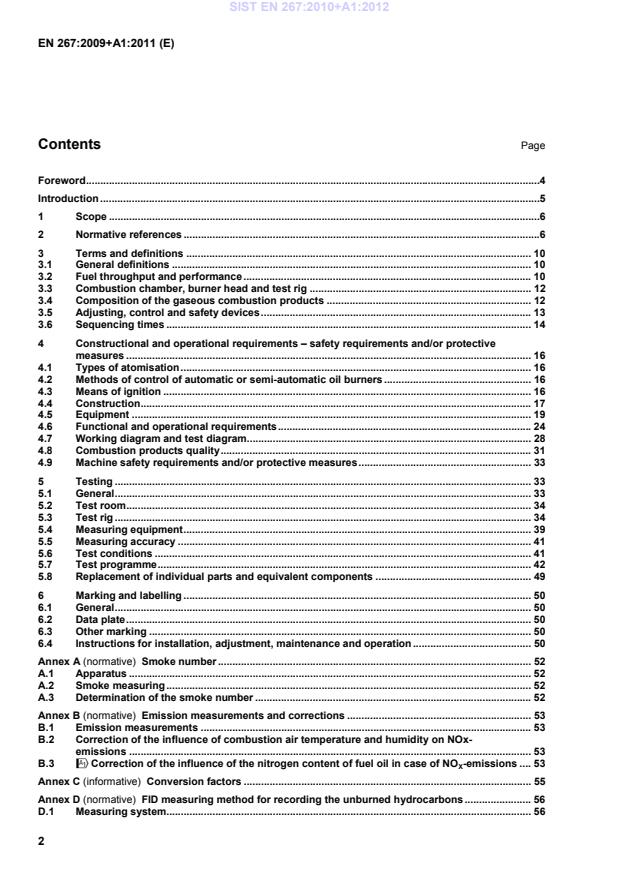
Smoke number . 52A.1Apparatus . 52A.2Smoke measuring . 52A.3Determination of the smoke number . 52Annex B (normative)
Emission measurements and corrections . 53B.1Emission measurements . 53B.2Correction of the influence of combustion air temperature and humidity on NOx-emissions . 53B.3!Correction of the influence of the nitrogen content of fuel oil in case of NOX-emissions . 53Annex C (informative)
Conversion factors . 55Annex D (normative)
FID measuring method for recording the unburned hydrocarbons . 56D.1Measuring system. 56SIST EN 267:2010+A1:2012
Conformity evaluation . 57E.1Test laboratories and test samples, procedure . 57E.2Types of test and test documents for oil burners . 57Annex F (informative)
Examples for equipping of burners . 60F.1Burners ≤≤≤≤ 100 kg/h . 60F.2Burners > 100 kg/h . 62Annex G (informative)
Other fuels . 64Annex H (informative)
Specific additional requirements and limitations for use of EN 267 burners for industrial applications . 65H.1Pre-heating of the combustion air . 65H.2Continuous working of the forced draught fan . 65H.3Variable excess of combustion air . 65H.4Burner with spark ignition . 65H.5Air filtering . 65H.6Electrical equipment and EMC-compatibility . 65Annex I (informative)
Check of the air proving device . 66Annex J (normative)
Machine related hazards - additional safety requirements and/or protective measures . 67J.1General . 67J.2List of significant hazards . 67J.3Safety requirements and /or protective measures . 67J.4Verification of machine safety requirements and/or protective measures . 70J.5Information for use . 70Annex K (normative)
Additional requirements for burners with pressurised parts and burners firing pressurised bodies as defined in the Pressure Equipment Directive (PED) 97/23/EC . 71K.1General . 71K.2Design . 71K.3Materials . 71K.4Pressurised parts . 72K.5Fuel line components. 72K.6Air proving device . 73K.7Automatic burner control unit . 73K.8General functions requirements . 73K.9Protection of the oil and air supply . 73K.10External safety limiter . 73K.11Design according to EN 50156-1 . 74K.12Consideration: Safety life cycle . 75K.13Tests of pressurised parts . 76K.14Marking . 77K.15Instructions for installation, adjustment, maintenance and operation . 77Annex ZA (informative)
Relationship between this European Standard and the Essential Requirements of EU Directive 98/37/EC Machinery Directive . 79Annex ZB (informative)
Relationship between this European Standard and the Essential Requirements of EU Directive 2006/42/EC Machinery Directive . 80Annex ZC (informative)
Relationship between this European Standard and the Essential Requirements of EU Directive 97/23/EC Pressure Equipment Directive (PED) . 81Bibliography . 89 SIST EN 267:2010+A1:2012
When provisions of this type C standard are different from those which are stated in type A or B standards, the provisions of this type C standard take precedence over the provisions of the other standard, for machines that have been designed and built according to the provisions of this type C standard.
higher boiling petroleum based first raffinates (viscosity greater than 6 mm2/s), that require preheating for proper atomisation. This European Standard is applicable to: single burners fitted to a single combustion chamber; single burners fitted to an appliance with additional requirements, then the relevant standard of this appliance shall be taken into account; single-fuel and dual-fuel burners when operating on oil only; the oil function of dual-fuel burners designed to operate simultaneously on gaseous and liquid fuels, in which case the requirements of EN 676 will also apply in respect of the gaseous fuel function. This European Standard deals with all significant machine hazards, hazardous situations and events relevant to burners, when they are used as intended and under conditions of misuse which are reasonably foreseeable by the manufacturer, see Annex J. This European Standard also deals with the additional requirements for the burners in the scope with pressurised parts and/or firing pressurised bodies, see Annex K. This European Standard specifies the requirements to be met by the manufacturer to ensure the safety during commissioning, start-up, operation, shut-down and maintenance. This European Standard does not deal with hazards due to specific applications. This European Standard is not applicable to automatic forced draught oil burners which are manufactured before the date of its publication as European Standard. 2 Normative references The following referenced documents are indispensable for the application of this document. For dated references only the edition cited applies. For undated references the latest edition of the referenced document (including any amendments) applies. EN 230, Automatic burner control systems for oil burners EN 287-1, Qualification test of welders — Fusion welding — Part 1: Steels EN 676:2003+A2:2008, Automatic forced draught burners for gaseous fuels EN 953, Safety of machinery — Guards — General requirements for the design and construction of fixed and movable guards EN 1044, Brazing — Filler metals SIST EN 267:2010+A1:2012
(IEC 60335-2-102:2004, modified) SIST EN 267:2010+A1:2012
(IEC 60730-1:1999, modified) EN 61310-1, Safety of machinery — Indication, marking and actuation — Part 1: Requirements for visual, auditory and tactile signals (IEC 61310-1:2007) EN ISO 228-1, Pipe threads where pressure-tight joints are not made on the threads — Part 1: Dimensions, tolerances and designation (ISO 228-1:2000) EN ISO 1127, Stainless steel tubes — Dimensions, tolerances and conventional masses per unit length (ISO 1127:1992) EN ISO 4871, Acoustics — Declaration and verification of noise emission values of machinery and equipment (ISO 4871:1996) EN ISO 6806, Plastics hoses and hose assemblies for suction and low-pressure discharge of petroleum liquids — Specification (ISO 6806:1992) EN ISO 9606-2, Qualification test of welders — Fusion welding — Part 2: Aluminium and aluminium alloys (ISO 9606- 2:2004) EN ISO 9606-3, Approval testing of welders — Fusion welding — Part 3: Copper and copper alloys (ISO 9606-3:1999) EN ISO 9606-4, Approval testing of welders — Fusion welding — Part 4: Nickel and nickel alloys (ISO 9606-4:1999) EN ISO 9606-5, Approval testing of welders — Fusion welding — Part 5: Titanium and titanium alloys, zirconium and zirconium alloys (ISO 9606-5:2000) EN ISO 11688-1:1998, Acoustics — Recommended practice for the design of low-noise machinery and equipment — Part 1: Planning (ISO/TR 11688-1:1995) EN ISO 12100-1:2003, Safety of machinery — Basic concepts, general principles for design — Part 1: Basic terminology, methodology (ISO 12100-1:2003) EN ISO 12100-2:2003, Safety of machinery — Basic concepts, general principles for design — Part 2: Technical principles (ISO 12100-2:2003) EN ISO 13849-1, Safety of machinery — Safety-related parts of control systems — Part 1: General principles for design (ISO 13849-1:2006) EN ISO 13857, Safety of machinery — Safety distances to prevent hazard zones being reached by upper and lower limbs (ISO 13857:2008) EN ISO 15609-1, Specification and qualification of welding procedures for metallic materials — Welding procedure specification — Part 1: Arc welding (ISO 15609-1:2004) EN ISO 15609-2, Specification and qualification of welding procedures for metallic materials — Welding procedure specification — Part 2: Gas welding (ISO 15609-2:2001) EN ISO 15609-3, Specification and qualification of welding procedures for metallic materials — Welding procedure specification — Part 3: Electron beam welding (ISO 15609-3:2004) EN ISO 15609-4, Specification and qualification of welding procedures for metallic materials — Welding procedure specification — Part 4: Laser beam welding (ISO 15609-4:2009) SIST EN 267:2010+A1:2012
resistance and induction welded unalloyed and alloyed steel tubes with specified elevated temperature properties ISO 9330-3, Welded steel tubes for pressure purposes — Technical delivery conditions — Part 3: Electric resistance and induction welded unalloyed and alloyed steel tubes with specified low temperature properties ISO 9330-4, Welded steel tubes for pressure purposes § Technical delivery conditions — Part 4: Submerged arc-welded unalloyed and alloyed steel tubes with specified elevated temperature properties ISO 9330-5, Welded steel tubes for pressure purposes — Technical delivery conditions — Part 5: Submerged arc-welded unalloyed and alloyed steel tubes with specified low temperature properties ISO 9330-6, Welded steel tubes for pressure purposes — Technical delivery conditions — Part 6: Longitudinally welded austenitic stainless steel tubes ISO 23552-1, Safety and control devices for gas and/or oil burners and gas and/or oil appliances — Particular requirements — Part 1: Fuel/air ratio controls, electronic type SIST EN 267:2010+A1:2012
growth,
refining,
processing,
production,
manufacture or
preparation
of materials, plants, livestock, animal products, food or artefacts 3.2 Fuel throughput and performance 3.2.1
throughput constant mass of fuel consumed during one hour NOTE Throughput is expressed in kilograms per hour (kg/h). SIST EN 267:2010+A1:2012
maximum throughput mass of fuel consumed during one hour at the highest throughput stated by the manufacturer NOTE Maximum throughput is expressed in kilograms per hour (kg/h). 3.2.1.2
minimum throughput mass of fuel consumed during one hour at the lowest throughput indicated by the manufacturer NOTE Minimum throughput is expressed in kilograms per hour (kg/h). 3.2.2
heat input
QF
quantity of energy used in unit time corresponding to the volumetric or mass flow rates, the calorific value used being either the net or gross calorific value NOTE 1 Burners with fixed heat input or single stage burners have a single heat input. NOTE 2 Range-rated burners have a maximum heat input and a minimum heat input declared by the manufacturer. NOTE 3 Heat input is expressed in kilowatts (kW) or in kilograms/hour (kg/h) multiplied with the net calorific value (e.g. 11,86 kW h/kg). 3.2.2.1 maximum heat input QFmax highest value of the heat input declared by the manufacturer NOTE Maximum heat input is expressed in kilowatts (kW). 3.2.2.2 minimum heat input QFmin lowest value of the heat input declared by the manufacturer NOTE Minimum heat input is expressed in kilowatts (kW). 3.2.2.3 start heat input Qs
input of the burner during start-up position as a function of the maximum heat input NOTE Start heat input is expressed in percent (%). 3.2.2.4 nominal heat input QFN
value of the heat input declared by the manufacturer NOTE 1 Fixed heat input or range-rated burners have a single nominal heat input. NOTE 2 Range-rated burners can be adjusted between the maximum nominal heat input and the minimum nominal heat input stated by the manufacturer. NOTE 3 Nominal heat input is expressed in kilowatts (kW). SIST EN 267:2010+A1:2012
pF pressure or depression, relative to atmospheric pressure, prevailing in the combustion chamber NOTE Pressure in the combustion chamber is expressed in kilopascals (kPa). 3.3.2 length of the combustion chamber l distance between the face of the nozzle or the fuel outlet and the rear wall of the test flame tube or combustion chamber NOTE Length of the combustion chamber is expressed in millimetres (mm). 3.3.3 combustion chamber part of the appliance in which the combustion takes place 3.3.4 burner head mixing device consisting of an atomizing system (s) and other components for the mixing of air and fuel, e.g. stabilizing disc, blast tube 3.3.5 test rig combustion chamber defined by the manufacturer NOTE In the case where the manufacturer has not defined a combustion chamber, the test is carried out on test rigs with the test flame tubes according to 5.3. 3.4 Composition of the gaseous combustion products 3.4.1 CO2 content quantity of carbon dioxide (CO2) in the dry gaseous products expressed as a proportion of the total volume NOTE CO2 content is expressed in percent (%). 3.4.2 O2 content quantity of oxygen (O2) contained in the dry gaseous products, expressed as a proportion of the total volume NOTE O2 content is expressed in percent (%). 3.4.3 CO content quantity of carbon monoxide (CO) in the dry gaseous combustion products, measured as volumetric ml/m³ NOTE CO content is expressed in milligrams per kilowatt hour (mg/kWh). 3.4.4 content of nitrogen oxide quantity of nitrogen oxide (NO and NO2) in the dry gaseous combustion products, measured as volumetric ml/m³, calculated as NO2 NOTE Content of nitrogen oxide is expressed in milligrams per kilowatt hour (mg/kWh). SIST EN 267:2010+A1:2012
ratio between the effectively introduced quantity of air and the theoretically required quantity of air 3.5 Adjusting, control and safety devices 3.5.1 flame detector device device by which the presence of a flame is detected and signalled NOTE It can consist of a flame sensor, an amplifier and an element for signal transmission. These parts, with the possible exception of the actual flame sensor, may be assembled in a single housing for use in conjunction with a programming unit. 3.5.2 automatic burner control system system which comprises at least a programming unit and all the elements of a flame detector device
NOTE The various functions of an automatic burner control system can be in one or more housings. 3.5.3 programming unit programming unit reacts to signals from control and safety devices, gives control commands, controls the start-up sequence, supervises the burner operation and causes controlled shut-down, and if necessary safety shut-down and non-volatile lock-out NOTE The programming unit follows a predetermined sequence of actions and always operates in conjunction with a flame detector device. 3.5.4 safe start check procedure employing a protection circuit or circuits, to establish whether or not a fault in a safety system or a flame simulating condition exists prior to start-up 3.5.5
controlled shut-down process by which the power to the fuel shut-off valve(s) is immediately removed before any other action takes place, e.g. as a result of the action of a controlling function 3.5.6
non-volatile lock-out safety shut-down condition of the system, such that a recycling can only be accomplished by a manual reset of the system and by no other means SIST EN 267:2010+A1:2012
first safety time tsmax time starting from the signal for release of the fuel and terminating at the moment at which the signal for interrupting the fuel supply is given NOTE Ignition safety time is expressed in seconds (s). 3.6.4 safety time during operation time starting at the moment the sensed flame is extinguished and ending at the moment the signal for interrupting the fuel supply is given NOTE Safety time during operation is expressed in seconds (s). SIST EN 267:2010+A1:2012
NOTE It is the end of the starting process. 3.6.11 intermittent operation state of operation the duration of which does not exceed 24 h 3.6.12 continuous operation state of operation the duration of which exceeds 24 h 3.7 working diagram admissible range of application of the burner (pressure in the combustion chamber as a function of fuel flow) 3.8
test diagram
test range of the burner during the tests (pressure in the combustion chamber as a function of fuel flow) 3.9
maximum oil pressure
pressure which is generated by the oil pump SIST EN 267:2010+A1:2012
Construction 4.4.1 Design 4.4.1.1 Design related to combustion The design and construction of the burner shall for its intended application be such that with the intended input or input range and within the prescribed range of pressure, the liquid fuel that is to be used is burned completely and safely. The length of the burner head can be varied as long as the performance of the burner is not affected in an unsafe manner. 4.4.1.2 Mechanical safety, stabi
...