

prEN 14434
(Main)Writing boards for educational institutions - Ergonomic, technical and safety requirements and their test methods
- Abstract
This document specifies ergonomic, technical and safety requirements for wall-mounted and free-standing writing boards, white projecting boards, interactive systems and interactive screens for use in rooms for educational and training purposes, e.g. classrooms, lecture theatres for schools, universities, etc.
This document applies is applicable to units after installation. Safety depending on the structure of the building is not included, e.g. the strength of wall-mounted boards includes only the board and its parts. The wall and the wall attachment are not included.
This document does not apply to technical aspects of connected hardware, such as computers, speakers, video cameras.
Requirements concerning electrical safety are not included.
Annex A (normative) Assessment scale for the ability to write – Five levels chalk scale
Annex B (normative) Test methods and requirements for white projecting boards
Annex C (informative) Additional test methods and requirements for white projecting boards
Annex D (normative) Test methods and requirements for interactive systems
Annex E (informative) Additional test methods and requirements for interactive systems
Annex F (normative) Test methods and requirements for interactive screens
Annex G (informative) Additional test methods and requirements for interactive screens
Annex H (normative) Surface flatness test
Annex I (informative) Vibration test
- Status
- Not Published
- Publication Date
- 23-May-2027
- Technical Committee
- CEN/TC 207 - Furniture
- Drafting Committee
- CEN/TC 207/WG 6 - Test methods for fire behaviour
- Current Stage
- 4020 - Submission to enquiry - Enquiry
- Start Date
- 30-Jul-2026
- Due Date
- 07-Feb-2026
- Completion Date
- 30-Jul-2026

prEN 14434 is a CEN draft European Standard for writing boards for educational institutions. It specifies ergonomic, technical and safety requirements, together with test methods, for wall-mounted and free-standing writing boards, white projecting boards, interactive systems and interactive screens used in classrooms, lecture theatres and similar rooms for education and training. The document applies to units after installation and focuses on the board itself, not on the building structure or connected hardware.
What does prEN 14434 specify?
prEN 14434 sets the requirements for the product, its test methods, and the information that has to be supplied with it. It covers the board types, surface performance, structural safety, ergonomics, installation instructions and product information.
The scope is limited to the board and its own parts after installation. The wall, wall attachment, building structure, electrical safety and technical aspects of connected hardware such as computers, speakers and video cameras are outside the scope.
The document is organized into general test conditions and equipment, safety requirements, surface tests, structural tests, ergonomic requirements, and documentation clauses.
| Annex | What it covers |
|---|---|
| Annex A | Assessment scale for the ability to write on chalkboards |
| Annex B | Test methods and requirements for white projecting boards |
| Annex C | Additional test methods and requirements for white projecting boards |
| Annex D | Test methods and requirements for interactive systems |
| Annex E | Additional test methods and requirements for interactive systems |
| Annex F | Test methods and requirements for interactive screens |
| Annex G | Additional test methods and requirements for interactive screens |
| Annex H | Surface flatness test |
| Annex I | Vibration test |
What are the key requirements of prEN 14434?
prEN 14434 combines general safety rules, surface performance tests, mechanical strength tests and ergonomic limits. The practical result is that a board has to be safe to use, stable in service, and able to keep working after repeated movement and cleaning.
Safety and stability
Clause 6 requires accessible edges and corners to be rounded or chamfered, with no burrs, and hollow ends to be closed. It also sets limits for gaps between moving parts to reduce shear and squeeze risks. In practice, this means the user should not be exposed to pinch points, loose end caps, or accidental operation of controls.
Clause 6.2 requires free-standing boards to pass the overturning test of EN 1023-3. Clause 6.3 requires mobile boards to pass the dynamic stability test of EN 16122. Clause 6.4 adds a static stability test for mobile or free-standing winged boards and pivoting boards with vertical pivots, using a 750 N load. This matters because these products can tip when wings are open or when loads are applied off-centre.
Surface performance
Clauses 7 and 8 split the surface requirements into two groups: writing boards other than chalkboards, and chalkboards. For both groups, the writing surface has performance levels 1 to 3, with Level 1 as the minimum requirement.
For writing boards other than chalkboards, the document uses abrasion, scratch, staining and light-fastness tests from EN 438-2. For chalkboards, the document uses a chalk-specific assessment scale in Annex A, plus its own abrasion-based writing test. In practice, this checks whether the surface still writes clearly after wear and cleaning.
Clause 7.6 and Annex H require surface flatness for white projecting boards and interactive systems. That matters because uneven surfaces can affect writing quality and projected images.
Structural durability
Clause 9 covers vertical loads, movement endurance, rigidity, stops, surface deflection, vibration and castors. Rail-based systems and horizontally sliding boards are loaded vertically downward with 750 N at specific positions; prominent parts such as trays and hooks are tested with 250 N; rail-based systems are also tested with a 200 N upward load. This shows whether parts loosen, deform or detach in use.
Moving elements are cycled repeatedly: 15 000 cycles for rail-based systems and boards with rotating or pivoting/swivelling parts, and 25 000 cycles for sliding boards with transmission elements and power operated sliding boards. Clause 9 also limits surface deflection to 5 mm under a 50 N load, and castors are tested for 2 000 cycles. These checks are meant to show whether the board still moves, locks and supports its parts after long use.
Ergonomics, reporting and user information
Clause 10 sets the position of controls and handles, as well as maximum operating and moving forces. Controls must be reachable within defined height ranges, and operating forces are limited for finger, hand, foot and knob operation. This helps ensure that the board can be used without excessive effort.
Clauses 11 to 13 require a test report, installation instructions and product information. The report has to identify the board, the test results and any deviations; the instructions have to warn about incorrect installation and wall suitability; and the product information has to identify the manufacturer, board type and maintenance information, with surface-property information for most board types.
What terms does prEN 14434 define?
- board attachment - the element that connects the board to the rail.
- fixing element - the joint that mounts the rail to the wall.
- rail-based board or system - a board that hangs and/or slides on horizontally wall-mounted rails.
- pivoting board - a two-sided board that pivots on a horizontal or vertical axis and stands on braced feet.
- white projecting board - a special whiteboard that can show a projected image and also be written on with a dry marker pen.
- interactive system - a writing board linked to a computer or beamer that can be written on with a dry marker pen, a finger or a specialised pen.
- interactive screen - a display with an integrated computer or computer link that can be written on with a finger or a specialised pen.
Who uses prEN 14434?
prEN 14434 is used by manufacturers of classroom and training-room boards, test laboratories, and specifiers or buyers who need to compare products for educational use. It is also relevant to quality managers who check durability, stability and surface performance, and to installers who need the assembly and installation instructions in Clause 12.
The standard is aimed at products used in educational and training rooms such as schools and universities. That makes it useful for procurement and acceptance checks in the education furniture and presentation equipment market.
What changed in prEN 14434 from the previous edition?
prEN 14434 will supersede EN 14434:2023. The foreword lists these significant technical changes:
- insertion of a test method for the static stability of mobile or free-standing winged boards and pivoting boards in Clause 6.4
- exclusion of small boards from the vertical upwards static load test for rail-based systems in Clause 9.1.4
- clarification of the test method for durability of transmission elements of vertically sliding boards in Clause 9.2.3
- clarification of the rigidity test for mobile boards in Clause 9.3
- additional installation and product information requirements for white projecting boards in Annex B
- additional installation and product information requirements for interactive systems in Annex D
- additional installation and product information requirements for interactive screens in Annex F
Which standards are used with prEN 14434?
| Reference | What it contributes |
|---|---|
| EN 438-2:2016+A1:2018 | Core test methods for abrasion, scratch, staining and light fastness on writing surfaces |
| EN 1023-3:2000 | Overturning stability test for free-standing boards |
| EN 16122:2012 | Dynamic stability, rigidity, stop testing and castor testing for movable furniture |
| EN ISO 2813:2014 | Gloss measurement used in the additional test methods for white projecting boards in Annex C |
Annexes B, D and F provide the product-specific test matrices for white projecting boards, interactive systems and interactive screens, while Annexes C, E and G add optional or additional checks for some of those products.
What does the prEN 14434 document contain?
prEN 14434 contains general test conditions, test equipment requirements, safety rules, surface tests, structural tests and ergonomic limits. It also contains the reporting, installation and product-information clauses that support procurement, testing and product acceptance.
The annexes add the detailed tools for implementation: the chalkboard assessment scale in Annex A, product-specific test schedules in Annexes B, D and F, extra tests in Annexes C, E and G, and detailed setups for surface flatness and vibration in Annexes H and I.
The document uses tables and figures to define where loads are applied, how surfaces are marked, how flatness is measured, and how vibration is set up. In practice, these figures and tables give laboratories and manufacturers the exact test arrangement they need for design verification and compliance testing.
Relations
- Effective Date
- 26-Mar-2025
Get Certified
Connect with accredited certification bodies for this standard

CIS Institut d.o.o.
Personal Protective Equipment (PPE) certification body. Notified Body NB-2890 for EU Regulation 2016/425 PPE.
Great Wall Tianjin Quality Assurance Center
Established 1993, first batch to receive national accreditation with IAF recognition.
Hong Kong Quality Assurance Agency (HKQAA)
Hong Kong's leading certification body.
Sponsored listings
Frequently Asked Questions
prEN 14434 is a draft published by the European Committee for Standardization (CEN). Its full title is "Writing boards for educational institutions - Ergonomic, technical and safety requirements and their test methods". This standard covers: This document specifies ergonomic, technical and safety requirements for wall-mounted and free-standing writing boards, white projecting boards, interactive systems and interactive screens for use in rooms for educational and training purposes, e.g. classrooms, lecture theatres for schools, universities, etc. This document applies is applicable to units after installation. Safety depending on the structure of the building is not included, e.g. the strength of wall-mounted boards includes only the board and its parts. The wall and the wall attachment are not included. This document does not apply to technical aspects of connected hardware, such as computers, speakers, video cameras. Requirements concerning electrical safety are not included. Annex A (normative) Assessment scale for the ability to write – Five levels chalk scale Annex B (normative) Test methods and requirements for white projecting boards Annex C (informative) Additional test methods and requirements for white projecting boards Annex D (normative) Test methods and requirements for interactive systems Annex E (informative) Additional test methods and requirements for interactive systems Annex F (normative) Test methods and requirements for interactive screens Annex G (informative) Additional test methods and requirements for interactive screens Annex H (normative) Surface flatness test Annex I (informative) Vibration test
This document specifies ergonomic, technical and safety requirements for wall-mounted and free-standing writing boards, white projecting boards, interactive systems and interactive screens for use in rooms for educational and training purposes, e.g. classrooms, lecture theatres for schools, universities, etc. This document applies is applicable to units after installation. Safety depending on the structure of the building is not included, e.g. the strength of wall-mounted boards includes only the board and its parts. The wall and the wall attachment are not included. This document does not apply to technical aspects of connected hardware, such as computers, speakers, video cameras. Requirements concerning electrical safety are not included. Annex A (normative) Assessment scale for the ability to write – Five levels chalk scale Annex B (normative) Test methods and requirements for white projecting boards Annex C (informative) Additional test methods and requirements for white projecting boards Annex D (normative) Test methods and requirements for interactive systems Annex E (informative) Additional test methods and requirements for interactive systems Annex F (normative) Test methods and requirements for interactive screens Annex G (informative) Additional test methods and requirements for interactive screens Annex H (normative) Surface flatness test Annex I (informative) Vibration test
prEN 14434 is classified under the following ICS (International Classification for Standards) categories: 03.180 - Education; 13.180 - Ergonomics; 97.140 - Furniture. The ICS classification helps identify the subject area and facilitates finding related standards.
prEN 14434 has the following relationships with other standards: It is inter standard links to EN 14434:2023. Understanding these relationships helps ensure you are using the most current and applicable version of the standard.
prEN 14434 is available in PDF format for immediate download after purchase. The document can be added to your cart and obtained through the secure checkout process. Digital delivery ensures instant access to the complete standard document.
Standards Content (Sample)
SLOVENSKI STANDARD
01-julij-2026
Table za pisanje za vzgojno-izobraževalne ustanove - Ergonomske, tehnične in
varnostne zahteve ter preskusne metode
Writing boards for educational institutions - Ergonomic, technical and safety
requirements and their test methods
Wandtafeln für Bildungseinrichtungen - Ergonomische, technische und
sicherheitstechnische Anforderungen und Prüfverfahren
Tableaux pour établissements d'enseignement - Exigences ergonomiques, techniques et
de sécurité et méthodes d'essai correspondantes
Ta slovenski standard je istoveten z: prEN 14434
ICS:
03.180 Vzgoja in izobraževanje Education
13.180 Ergonomija Ergonomics
97.140 Pohištvo Furniture
2003-01.Slovenski inštitut za standardizacijo. Razmnoževanje celote ali delov tega standarda ni dovoljeno.
DRAFT
EUROPEAN STANDARD
NORME EUROPÉENNE
EUROPÄISCHE NORM
July 2026
ICS 03.180; 13.180; 97.140 Will supersede EN 14434:2023
English Version
Writing boards for educational institutions - Ergonomic,
technical and safety requirements and their test methods
Tableaux pour établissements d'enseignement - Wandtafeln für Bildungseinrichtungen - Ergonomische,
Exigences ergonomiques, techniques et de sécurité et technische und sicherheitstechnische Anforderungen
méthodes d'essai correspondantes und Prüfverfahren
This draft European Standard is submitted to CEN members for enquiry. It has been drawn up by the Technical Committee
CEN/TC 207.
If this draft becomes a European Standard, CEN members are bound to comply with the CEN/CENELEC Internal Regulations
which stipulate the conditions for giving this European Standard the status of a national standard without any alteration.
This draft European Standard was established by CEN in three official versions (English, French, German). A version in any other
language made by translation under the responsibility of a CEN member into its own language and notified to the CEN-CENELEC
Management Centre has the same status as the official versions.
CEN members are the national standards bodies of Austria, Belgium, Bulgaria, Croatia, Cyprus, Czech Republic, Denmark, Estonia,
Finland, France, Germany, Greece, Hungary, Iceland, Ireland, Italy, Latvia, Lithuania, Luxembourg, Malta, Netherlands, Norway,
Poland, Portugal, Republic of North Macedonia, Romania, Serbia, Slovakia, Slovenia, Spain, Sweden, Switzerland, Türkiye and
United Kingdom.
Recipients of this draft are invited to submit, with their comments, notification of any relevant patent rights of which they are
aware and to provide supporting documentation.
Warning : This document is not a European Standard. It is distributed for review and comments. It is subject to change without
notice and shall not be referred to as a European Standard.
EUROPEAN COMMITTEE FOR STANDARDIZATION
COMITÉ EUROPÉEN DE NORMALISATION
EUROPÄISCHES KOMITEE FÜR NORMUNG
CEN-CENELEC Management Centre: Rue de la Science 23, B-1040 Brussels
© 2026 CEN All rights of exploitation in any form and by any means reserved Ref. No. prEN 14434:2026 E
worldwide for CEN national Members.
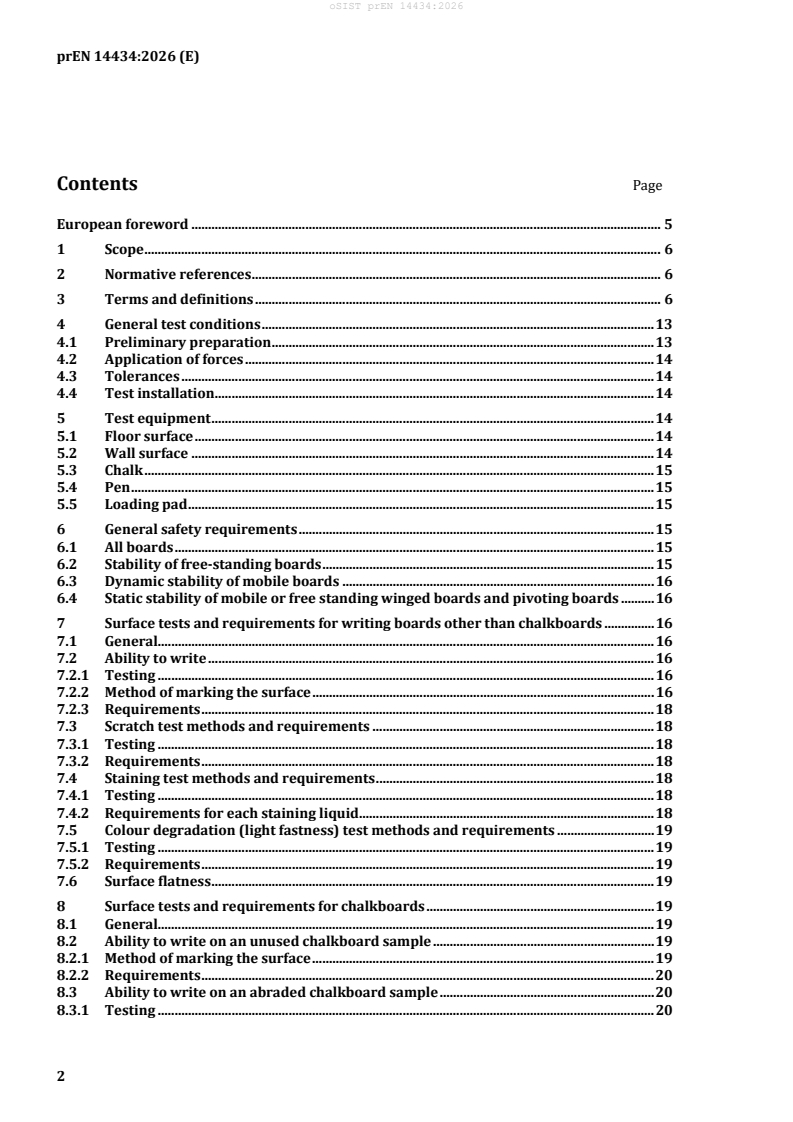
Contents Page
European foreword . 5
1 Scope . 6
2 Normative references . 6
3 Terms and definitions . 6
4 General test conditions . 13
4.1 Preliminary preparation . 13
4.2 Application of forces . 14
4.3 Tolerances . 14
4.4 Test installation . 14
5 Test equipment . 14
5.1 Floor surface . 14
5.2 Wall surface . 14
5.3 Chalk . 15
5.4 Pen . 15
5.5 Loading pad . 15
6 General safety requirements . 15
6.1 All boards . 15
6.2 Stability of free-standing boards . 15
6.3 Dynamic stability of mobile boards . 16
6.4 Static stability of mobile or free standing winged boards and pivoting boards . 16
7 Surface tests and requirements for writing boards other than chalkboards . 16
7.1 General. 16
7.2 Ability to write . 16
7.2.1 Testing . 16
7.2.2 Method of marking the surface . 16
7.2.3 Requirements . 18
7.3 Scratch test methods and requirements . 18
7.3.1 Testing . 18
7.3.2 Requirements . 18
7.4 Staining test methods and requirements . 18
7.4.1 Testing . 18
7.4.2 Requirements for each staining liquid . 18
7.5 Colour degradation (light fastness) test methods and requirements . 19
7.5.1 Testing . 19
7.5.2 Requirements . 19
7.6 Surface flatness . 19
8 Surface tests and requirements for chalkboards . 19
8.1 General. 19
8.2 Ability to write on an unused chalkboard sample . 19
8.2.1 Method of marking the surface . 19
8.2.2 Requirements . 20
8.3 Ability to write on an abraded chalkboard sample . 20
8.3.1 Testing . 20
8.3.2 Method of marking the surface . 20
8.3.3 Requirements . 21
8.4 Scratch test methods and requirements . 21
8.4.1 Testing . 21
8.4.2 Requirements . 21
8.5 Staining test methods and requirements . 22
8.5.1 Testing . 22
8.5.2 Requirements for each staining liquid . 22
8.6 Colour degradation test methods and requirements . 22
8.6.1 Testing . 22
8.6.2 Requirements . 22
9 Structural tests and requirements . 22
9.1 Vertical static load tests and requirements . 22
9.1.1 Vertical downwards static load for rail-based systems and horizontally sliding boards
................................................................................................................................................................... 22
9.1.2 Vertical downwards static load for winged boards and pivoting boards . 23
9.1.3 Vertical downwards static load for all prominent parts . 23
9.1.4 Vertical upwards static load for rail-based systems . 24
9.2 Durability of moving elements . 24
9.2.1 Rail-based systems . 24
9.2.2 Boards with rotating or pivoting/swivelling parts . 24
9.2.3 Sliding boards with transmission elements . 24
9.2.4 Power operated sliding boards . 25
9.3 Test of rigidity . 25
9.4 Test of stops . 26
9.5 Surface deflection . 27
9.6 Vibration . 27
9.7 Castors for mobile boards . 27
9.7.1 Test method . 27
9.7.2 Requirements . 27
10 Ergonomic requirements . 27
10.1 Position of controls and handles . 27
10.2 Operating forces . 27
10.3 Requirements for moving forces. 27
11 Test report . 28
12 Installation instructions . 28
13 Product information . 29
Annex A (normative) Assessment scale for the ability to write on chalkboards . 30
Annex B (normative) Test methods and requirements for white projecting boards . 31
Annex C (informative) Additional test methods and requirements for white projecting
boards . 32
Annex D (normative) Test methods and requirements for interactive systems . 33
Annex E (informative) Additional test methods and requirements for interactive systems
................................................................................................................................................................... 34
Annex F (normative) Test methods and requirements for interactive screens. 35
Annex G (informative) Additional test methods and requirements for interactive screens 36
Annex H (normative) Surface flatness test . 37
H.1 Test method . 37
H.2 Requirement . 37
Annex I (informative) Vibration test . 38
I.1 Test method . 38
I.2 Requirements . 41
Bibliography . 42
European foreword
This document (prEN 14434:2026) has been prepared by Technical Committee CEN/TC 207 “Furniture”,
the secretariat of which is held by UNI.
This document is currently submitted to the CEN Enquiry.
This document will supersede EN 14434:2023.
a) insertion of test method for the static stability of mobile or free standing winged boards pivoting
boards (Clause 6.4);
b) exclusion of small boards from vertical upwards static load test for rail based systems (Clause 9.1.4);
c) clarification in test method for durability of transition elements of vertically sliding boards
(Clause 9.2.3);
d) clarification in the test of rigidity for mobile boards (Clause 9.3);
e) additional requirements for the provision of installation and product information for white
projecting boards (Annex B);
f) additional requirements for the provision of installation and product information for interactive
systems (Annex D);
g) additional requirements for the provision of Installation and product information for interactive
screens (Annex F).
1 Scope
This document specifies ergonomic, technical and safety requirements for wall-mounted and free-
standing writing boards, white projecting boards, interactive systems and interactive screens for use in
rooms for educational and training purposes, e.g. classrooms, lecture theatres for schools, universities,
etc.
This document applies is applicable to units after installation. Safety depending on the structure of the
building is not included, e.g. the strength of wall-mounted boards includes only the board and its parts.
The wall and the wall attachment are not included.
This document does not apply to technical aspects of connected hardware, such as computers, speakers,
video cameras.
Requirements concerning electrical safety are not included.
Annex A (normative) Assessment scale for the ability to write – Five levels chalk scale
Annex B (normative) Test methods and requirements for white projecting boards
Annex C (informative) Additional test methods and requirements for white projecting boards
Annex D (normative) Test methods and requirements for interactive systems
Annex E (informative) Additional test methods and requirements for interactive systems
Annex F (normative) Test methods and requirements for interactive screens
Annex G (informative) Additional test methods and requirements for interactive screens
Annex H (normative) Surface flatness test
Annex I (informative) Vibration test
2 Normative references
The following documents are referred to in the text in such a way that some or all of their content
constitutes requirements of this document. For dated references, only the edition cited applies. For
undated references, the latest edition of the referenced document (including any amendments) applies.
EN 438-2:2016+A1:2018, High-pressure decorative laminates (HPL) — Sheets based on thermosetting
resins (usually called laminates) — Part 2: Determination of properties
EN 1023-3:2000, Office furniture — Screens — Part 3: Test methods
EN 16122:2012, Domestic and non-domestic storage furniture — Test methods for the determination of
strength, durability and stability
3 Terms and definitions
For the purposes of this document, the following terms and definitions apply.
ISO and IEC maintain terminology databases for use in standardization at the following addresses:
— ISO Online browsing platform: available at https://www.iso.org/obp/
— IEC Electropedia: available at https://www.electropedia.org/
3.1
board attachment
element by which the board is attached to the rail
Note 1 to entry: See Figure 1.
Figure 1 — Board attachment
3.2
chalkboard
writing board with a writing surface to be used for chalk
3.3
fixing element
joint by which the rail is mounted to the wall
3.4
flipchart
one-sided board placed or fixed on an easel or a rail with the facility to attach a paper pad
Note 1 to entry: See Figure 2.
Figure 2 — Flipcharts
3.5
horizontally sliding board
board with or without wing with only horizontal board movements in the same plane, manually or power
operated
3.6
mobile board
board or assembly of boards incorporating wheels or castors, which may be moved on the floor from one
place to another
Note 1 to entry: See Figure 3.
Figure 3 — Mobile board
3.7
pivoting board
two-sided board articulated on its horizontal or vertical axis and standing on braced feet, with or without
castors
Note 1 to entry: See Figure 4.
Figure 4 — Pivoting boards
3.8
rail-based board or system
board hanging and/or sliding on horizontally wall-mounted rails
Note 1 to entry: See Figure 5.
Figure 5 — Rail-based board/system
3.9
roller or revolving surface board
assembly with top and bottom horizontal rollers allowing a continuous loop of flexible writing surface to
be revolved between rollers
Note 1 to entry: See Figure 6.
Figure 6 — Roller/revolving surface board
3.10
sash board
assembly of one- or two-sided boards sliding vertically, independent of each other and individually
counter balanced
Note 1 to entry: See Figure 7.
Figure 7 — Sash board
3.11
sliding board
board with horizontal and/or vertical movements in the same plane, manually or power operated
Note 1 to entry: See Figure 8.
Figure 8 — Various types of sliding board
3.12
tilting board
manually or power operated inclinable one-sided board articulated on its lower horizontal edge, e.g.
screen for overhead projector
Note 1 to entry: See Figure 9.
Figure 9 — Tilting board
3.13
to and fro board
assembly of one- or two-sided boards sliding vertically, counter-balancing each other in all positions
Note 1 to entry: See Figure 10.
Figure 10 — To and fro board
3.14
transmission element
any means to transmit a movement such as to and fro, or sash
3.15
tray
ledge placed at the lower part of the board upon which writing implements may be placed
Note 1 to entry: See Figure 11.
Key
1 Tray
Figure 11 — Tray
3.16
vertically and horizontally sliding board
board with or without wing with vertical and horizontal movements in the same plane, manually or
power operated
3.17
vertically sliding board
board with or without wing with only vertical movements in the same plane, manually or power operated
Note 1 to entry: See Figure 12.
Figure 12 — Various types of vertically sliding boards
3.18
whiteboard
writing board with a writing surface of a light colour to be used with a dry marker pen
3.19
wall-mounted board
one-sided board fixed to the wall
3.20
wing
two-sided board mounted on a vertically hinged system
3.21
winged board
assembly comprising a one-sided board and with one or more wings
Note 1 to entry: See Figure 13.
Figure 13 — Various types of winged board
3.22
writing board
board with one or more writing surfaces for the display of information
3.23
writing surface
surface for the display of information by means of writing and/or by other methods
Note 1 to entry: The surface is erasable and re-usable.
3.24
white projecting board
special whiteboard onto which an image from a beamer can be projected and which can be written on by
a dry marker pen
3.25
interactive system
writing board with a link to a computer or a beamer and which can be written on by a dry marker pen or
a finger or a specialised pen, e.g. smart board
3.26
interactive screen
type of display with an integrated computer or a link to a computer, on which it is possible to write with
a finger or a specialised pen
4 General test conditions
4.1 Preliminary preparation
Before any of the tests are commenced, the item shall be old enough to ensure that it has developed its
full strength.
The unit(s)/component(s) shall be tested as delivered. The unit(s)/component(s) shall be assembled
and/or configured according to the instructions supplied. Unless otherwise stated, the most adverse
configuration shall be used for each test. If mounting or assembly instructions are not supplied, the
mounting or assembly method shall be recorded in the test report. Fittings shall be tightened before
testing and shall not be retightened unless specifically required in the manufacturer’s instructions. If the
configuration needs to be changed in order to produce the worst-case conditions, this shall be recorded
in the test report.
The tests shall be carried out in indoor conditions, but if during a test the temperature is outside the range
of 15° C to 27° C, the maximum and/or minimum temperature shall be recorded in the test report.
4.2 Application of forces
The test forces in the static load tests shall be applied sufficiently slowly to ensure that negligible dynamic
force is applied. Unless otherwise specified, each specified force shall be maintained for not less than 10 s
and not more than 15 s.
The test forces in durability tests shall be applied at a rate to ensure that excessive heating does not occur.
Unless otherwise specified, each test force shall be maintained for (2 ± 1) s.
The forces may be replaced by masses. The relationship 10 N = 1 kg shall be used.
4.3 Tolerances
Unless otherwise stated the following tolerances apply:
— Masses: ±1 % of the nominal mass;
— Dimensions: ±1,0 mm of the nominal dimension;
— Angles: ±2° of the nominal angle;
— Forces: ±5 % of the nominal force.
The accuracy for the positioning of loading pads shall be 5 mm.
NOTE For the purposes of uncertainty measurement, test results are not considered to be adversely affected
when the above tolerances are met.
4.4 Test installation
For the structural tests in Clause 9, the board shall be installed according to the manufacturer's
instructions. Where the manner of mounting is ambiguously specified, the manner of mounting shall be
recorded in the test report.
Wall-mounted boards shall be mounted to a structure sufficiently strong and stiff to eliminate the
possibility of it affecting the results of the tests. The mounting of the structure shall be representative of
the service installation.
5 Test equipment
5.1 Floor surface
The floor surface shall be rigid, horizontal and flat.
5.2 Wall surface
The wall surface shall be rigid, vertical and flat.
5.3 Chalk
Both types of chalk listed below shall be used in Clause 8.2.1:
a) white chalk made from calcium carbonate;
b) white chalk made from calcium sulphate.
5.4 Pen
An acrylic-tipped dry marker pen with alcohol-based red colour shall be used in Clause 7.2.2.
5.5 Loading pad
A rigid disc 50 mm in diameter, with a flat face and a 12 mm front edge blend radius, shall be used in
Clause 9.5.
6 General safety requirements
6.1 All boards
All accessible edges and corners shall be rounded or chamfered and shall have no burrs. When accessible
to the user under normal use, hollow ends shall be capped or otherwise closed.
In order to avoid shearing and squeeze, the distance between parts moving relative to each other shall
have safety distances, which shall always be less than 8 mm or more than 25 mm in any position during
movement.
a) Shear and squeeze points, which are held apart by buffers are exempt from this requirement
provided that the gap produced by the buffer is at least 25 mm.
b) For winged boards, the gap between two parts of the board is exempt from this requirement.
c) For vertically sliding boards (sash boards, to and fro boards), where there is a risk of entrapment,
the requirement is applicable except between the boards. The gap between the boards shall be at
least 25 mm. Gaps of 50 mm or more are recommended.
For vertically sliding boards (sash boards, to and fro boards), there shall be at least 120 mm from the
floor to the board if no protection at the front is provided.
It shall not be possible to remove detachable parts, including end caps, without the use of a tool.
It shall not be possible to detach unintentionally any part attached to the rail system.
Counterweight mechanisms shall not be accessible during normal use.
It shall not be possible to operate controls inadvertently or accidentally.
If castors are provided as a means of mobility, at least half of them shall be lockable.
NOTE Requirements for shear and compression points created under the influence of electrical motors are
specified in FprEN 17684:2026.
6.2 Stability of free-standing boards
The board shall not overturn when tested according to Clause 6.1 of EN 1023-3:2000.
6.3 Dynamic stability of mobile boards
The board shall not overturn when tested according to Clause 11.6 of EN 16122:2012 in the direction/s
most likely to tip over.
All other components shall be unloaded
Unless otherwise specified in the instructions manual, the board shall be tested at its highest position,
6.4 Static stability of mobile or free standing winged boards and pivoting boards
This test is only applicable to winged boards and pivoting boards which are fitted with vertical pivots.
Pivoting boards shall be fixed to prevent rotation of the board.
Wings shall be opened 90° to the main board.
Apply a load of 750 N for 30 s at a point 50 mm from the outer edge of the wing or of the pivoting board.
After testing, the board shall not tip over.
7 Surface tests and requirements for writing boards other than chalkboards
7.1 General
There are three performance levels specified in this clause, Level 1, 2 and 3.
The minimum requirement for the writing surface is Level 1 (see also Clause 13).
For whiteboards, the tests shall be carried out as specified in 7.2 to 7.5.
For white projecting boards, the applicable surface tests and requirements are specified in Table B.1 in
Annex B, and additional tests are given in Table C.1 in Annex C.
F
...