

EN 14802:2005
(Main)Plastics piping systems - Thermoplastics shafts or risers for inspection chambers and manholes - Determination of resistance against surface and traffic loading
- Abstract
This European Standard specifies a method of testing the resistance of the upper assembly of inspection chambers and manhole components against surface and traffic loading.
It does not include requirements for testing the cover and frame. These requirements are specified in EN 124 or other standards depending on the material.
NOTE Upper assembly components would normally include riser shafts, tapers, reducing slabs and telescopic joints.
- Status
- Withdrawn
- Publication Date
- 06-Dec-2005
- Withdrawal Date
- 06-Oct-2026
- Technical Committee
- CEN/TC 155 - Plastics piping systems and ducting systems
- Current Stage
- 9960 - Withdrawal effective - Withdrawal
- Start Date
- 11-Jan-2023
- Completion Date
- 07-Oct-2026

Relations
- Effective Date
- 16-Jan-2023
- Effective Date
- 28-Jan-2026
- Effective Date
- 28-Jan-2026
- Effective Date
- 28-Jan-2026
- Effective Date
- 28-Jan-2026
- Effective Date
- 28-Jan-2026
- Effective Date
- 28-Jan-2026
- Effective Date
- 28-Jan-2026
- Effective Date
- 28-Jan-2026
- Effective Date
- 28-Jan-2026
Get Certified
Connect with accredited certification bodies for this standard

Zavod za gradbeništvo Slovenije (ZAG) - Inšpekcija
ZAG inspection body for construction products, structures, and materials.
Sponsored listings
Frequently Asked Questions
EN 14802:2005 is a standard published by the European Committee for Standardization (CEN). Its full title is "Plastics piping systems - Thermoplastics shafts or risers for inspection chambers and manholes - Determination of resistance against surface and traffic loading". This standard covers: This European Standard specifies a method of testing the resistance of the upper assembly of inspection chambers and manhole components against surface and traffic loading. It does not include requirements for testing the cover and frame. These requirements are specified in EN 124 or other standards depending on the material. NOTE Upper assembly components would normally include riser shafts, tapers, reducing slabs and telescopic joints.
This European Standard specifies a method of testing the resistance of the upper assembly of inspection chambers and manhole components against surface and traffic loading. It does not include requirements for testing the cover and frame. These requirements are specified in EN 124 or other standards depending on the material. NOTE Upper assembly components would normally include riser shafts, tapers, reducing slabs and telescopic joints.
EN 14802:2005 is classified under the following ICS (International Classification for Standards) categories: 93.025 - External water conveyance systems; 93.030 - External sewage systems. The ICS classification helps identify the subject area and facilitates finding related standards.
EN 14802:2005 has the following relationships with other standards: It is inter standard links to EN ISO 13266:2023, CEN/TS 1046:2021, EN 124-1:2015, EN 124-6:2015, EN 124-3:2015, EN 124-2:2015, EN ISO 13260:2011, EN 124-4:2015, EN 124-5:2015, EN 13598-2:2009. Understanding these relationships helps ensure you are using the most current and applicable version of the standard.
EN 14802:2005 is associated with the following European legislation: EU Directives/Regulations: 305/2011, 89/106/EEC; Standardization Mandates: M/118. When a standard is cited in the Official Journal of the European Union, products manufactured in conformity with it benefit from a presumption of conformity with the essential requirements of the corresponding EU directive or regulation.
EN 14802:2005 is available in PDF format for immediate download after purchase. The document can be added to your cart and obtained through the secure checkout process. Digital delivery ensures instant access to the complete standard document.
Standards Content (Sample)
SLOVENSKI STANDARD
01-april-2006
Plastics piping systems - Thermoplastics shafts or risers for inspection chambers
and manholes - Determination of resistance against surface and traffic loading
Plastics piping systems - Thermoplastics shafts or risers for inspection chambers and
manholes - Determination of resistance against surface and traffic loading
Kunststoff-Rohrleitungssysteme - Kontrollschächte (Inspektionsöffnungen) und
Einsteigschächte aus Thermoplasten - Bestimmung der Widerstandsfähigkeit gegen
Belastungen der Oberfläche und Verkehrslasten
Systemes de canalisations en plastique - Eléments de rehausse en thermoplastiques
pour boîtes d'inspection et de branchement ou regards - Détermination de la résistance
aux charges de remblai et de circulation
Ta slovenski standard je istoveten z: EN 14802:2005
ICS:
23.040.20 Cevi iz polimernih materialov Plastics pipes
93.025 Zunanji sistemi za prevajanje External water conveyance
vode systems
93.030 Zunanji sistemi za odpadno External sewage systems
vodo
2003-01.Slovenski inštitut za standardizacijo. Razmnoževanje celote ali delov tega standarda ni dovoljeno.
EUROPEAN STANDARD
EN 14802
NORME EUROPÉENNE
EUROPÄISCHE NORM
December 2005
ICS 93.025; 93.030
English Version
Plastics piping systems - Thermoplastics shafts or risers for
inspection chambers and manholes - Determination of
resistance against surface and traffic loading
Systèmes de canalisations en plastique - Eléments de Kunststoff-Rohrleitungssysteme - Kontrollschächte
rehausse en thermoplastiques pour boîtes d'inspection et (Inspektionsöffnungen) und Einsteigschächte aus
de branchement ou regards - Détermination de la Thermoplasten - Bestimmung der Widerstandsfähigkeit
résistance aux charges de remblai et de circulation gegen Belastungen der Oberfläche und Verkehrslasten
This European Standard was approved by CEN on 4 November 2005.
CEN members are bound to comply with the CEN/CENELEC Internal Regulations which stipulate the conditions for giving this European
Standard the status of a national standard without any alteration. Up-to-date lists and bibliographical references concerning such national
standards may be obtained on application to the Central Secretariat or to any CEN member.
This European Standard exists in three official versions (English, French, German). A version in any other language made by translation
under the responsibility of a CEN member into its own language and notified to the Central Secretariat has the same status as the official
versions.
CEN members are the national standards bodies of Austria, Belgium, Cyprus, Czech Republic, Denmark, Estonia, Finland, France,
Germany, Greece, Hungary, Iceland, Ireland, Italy, Latvia, Lithuania, Luxembourg, Malta, Netherlands, Norway, Poland, Portugal, Slovakia,
Slovenia, Spain, Sweden, Switzerland and United Kingdom.
EUROPEAN COMMITTEE FOR STANDARDIZATION
COMITÉ EUROPÉEN DE NORMALISATION
EUROPÄISCHES KOMITEE FÜR NORMUNG
Management Centre: rue de Stassart, 36 B-1050 Brussels
© 2005 CEN All rights of exploitation in any form and by any means reserved Ref. No. EN 14802:2005: E
worldwide for CEN national Members.
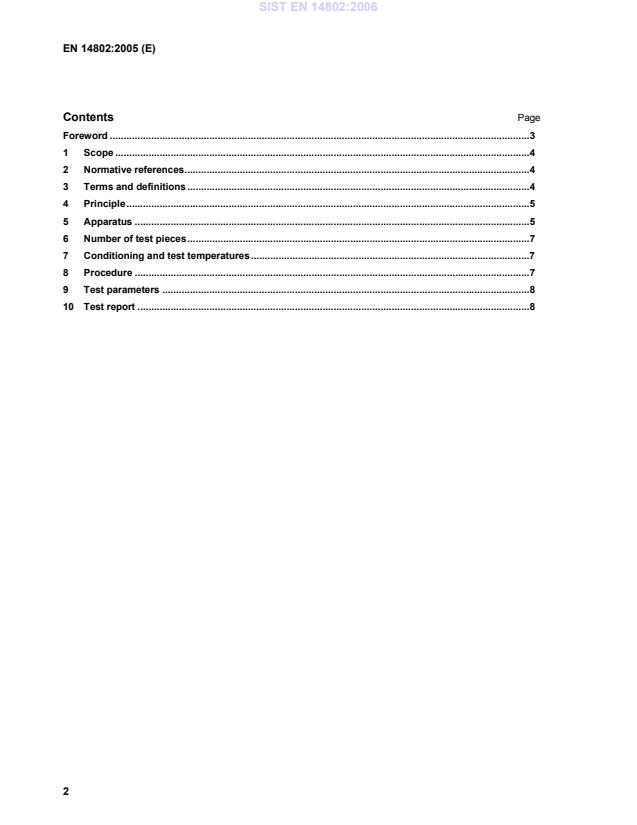
Contents Page
Foreword .3
1 Scope .4
2 Normative references.4
3 Terms and definitions .4
4 Principle.5
5 Apparatus .5
6 Number of test pieces.7
7 Conditioning and test temperatures.7
8 Procedure .7
9 Test parameters .8
10 Test report .8
Foreword
This European Standard (EN 14802:2005) has been prepared by Technical Committee CEN/TC 155 “Plastics
piping systems and ducting systems”, the secretariat of which is held by NEN.
This European Standard shall be given the status of a national standard, either by publication of an identical
text or by endorsement, at the latest by June 2006, and conflicting national standards shall be withdrawn at
the latest by June 2006.
The relevant performance requirements are contained within the referring standard(s) concerned.
This European Standard is one of a series of standards on test methods that support system standards for
plastics piping systems and ducting systems.
According to the CEN/CENELEC Internal Regulations, the national standards organizations of the following
countries are bound to implement this European Standard: Austria, Belgium, Cyprus, Czech Republic,
Denmark, Estonia, Finland, France, Germany, Greece, Hungary, Iceland, Ireland, Italy, Latvia, Lithuania,
Luxembourg, Malta, Netherlands, Norway, Poland, Portugal, Slovakia, Slovenia, Spain, Sweden, Switzerland
and United Kingdom.
1 Scope
This European Standard specifies a method of testing the resistance of the upper assembly of inspection
chambers and manhole components against surface and traffic loading.
It does not include requirements for testing the cover and frame. These requirements are specified in EN 124
or other standards depending on the material.
NOTE 1 Upper assembly components would normally include riser shafts, tapers, reducing slabs and telescopic joints.
NOTE 2 This test method is intended to support prEN 13598-2 and prEN 15229 (see bibliography)
2 Normative references
The following referenced documents are indispensable for the application of this European Standard. For
dated references, only the edition cited applies. For undated references, the latest edition of the referenced
document (including any amendments) applies.
EN 124, Gully tops and manhole tops for vehicular and pedestrian areas — Design requirements, type testing,
marking, quality control
ENV 1046, Plastics piping and ducting systems — Systems outside building structures for the conveyance of
water or sewage — Practices for installation above and below ground
EN 1437, Plastics piping systems — Piping systems for underground drainage and sewerage — Test method
for resistance to combined temperature cycling and external loading
3 Terms and definitions
For the purposes of this European Standard, the following terms and definitions apply.
3.1
inspection chamber
drainage or sewerage fitting used to connect drainage or sewerage installations and/or to c
...