

EN 16905-1:2023
(Main)Gas-fired endothermic engine driven heat pumps - Part 1: Terms and definitions
General Information
- Abstract
1.1 Scope of the EN 16905 series
This part of EN 16905 specifies the terms and definitions for the rating and performance calculation of gas-fired endothermic engine driven heat pumps for heating and/or cooling mode including the engine heat recovery, to be used outdoor.
This European Standard specifies the terms and definitions.
This European Standard is to be used in conjunction with the following standards:
a) FprEN 16905-2:2022 on safety;
b) EN 16905-3:2017 on test conditions;
c) prEN 16905-4:2022 on the requirements, test conditions and test methods;
d) FprEN 16905‐5:2022 on the calculation of seasonal performances in heating and cooling mode;
e) the heat pump standards, EN 14511‐2, EN 14511-3 and EN 14825.
This European Standard only applies to appliances with a maximum heat input (based on net calorific value) not exceeding 70 kW at standard rating conditions.
This European Standard only applies to appliances under categories I2H, I2E, I2Er, I2R, I2E(S)B, I2L, I2LL, I2ELL, I2E(R)B, I2ESi, I2E(R), I3P, I3B, I3B/P, II2H3+, II2Er3+, II2H3B/P, II2L3B/P, II2E3B/P, II2ELL3B/P, II2L3P, II2H3P, II2E3P and II2Er3P according to EN 437.
This European Standard only applies to appliances having:
f) gas fired endothermic engines under the control of fully automatic control systems;
g) closed system refrigerant circuits in which the refrigerant does not come into direct contact with the fluid to be cooled or heated;
h) where the temperature of the heat transfer fluid of the heating system (heating water circuit) does not exceed 105 °C during normal operation;
i) where the maximum operating pressure in the:
1) heating water circuit (if installed) does not exceed 6 bar
2) domestic hot water circuit (if installed) does not exceed 10 bar.
This European Standard applies to GEHP appliances only when used for space heating or space cooling or for refrigeration, with or without heat recovery.
This European Standard is applicable to GEHP appliances that are intended to be type tested. Requirements for GEHP appliances that are not type tested would need to be subject to further consideration.
- Status
- Published
- Publication Date
- 24-Oct-2023
- Technical Committee
- CEN/TC 299 - Gas-fired sorption appliances and domestic gas-fired washing and drying appliances
- Drafting Committee
- CEN/TC 299/WG 3 - Gas-fired endothermic engine heat pumps
- Current Stage
- 6060 - Definitive text made available (DAV) - Publishing
- Start Date
- 25-Oct-2023
- Due Date
- 10-May-2024
- Completion Date
- 25-Oct-2023

Overview
EN 16905-1:2023 is the CEN European standard that defines the terms and definitions for gas-fired endothermic engine driven heat pumps (GEHP). Part 1 of the EN 16905 series establishes a common vocabulary used for rating and performance calculation of outdoor GEHP appliances used for space heating, space cooling and refrigeration, including provisions for engine heat recovery. This edition (approved September 2023) supersedes EN 16905-1:2017 and is intended to support consistent testing, safety and seasonal performance assessment across Europe.
Key topics and requirements
- Scope limits: applies to GEHP appliances with maximum heat input ≤ 70 kW (net calorific value) at standard rating conditions and only to appliances intended to be type tested.
- Applicability constraints: only covers GEHPs with
- gas-fired endothermic engines under fully automatic control systems,
- closed refrigerant circuits (refrigerant not in direct contact with heated/cooled fluid),
- heating fluid temperatures ≤ 105 °C,
- maximum operating pressures: heating water circuit ≤ 6 bar, domestic hot water ≤ 10 bar.
- Gas categories: applies to appliances in the specific gas categories referenced in EN 437 (categories such as I2H, I2E, I3P, II2E3P, etc. as listed in the standard).
- Terminology coverage: comprehensive definitions across sections including appliance constituents, combustion products circuit, control and safety devices, operation modes, gases, and conditions of operation, measurement and calculations. Examples: “engine heat recovery”, “indoor/outdoor heat exchanger”, “range‑rating device”, and “simultaneously heating and cooling mode multi-split system”.
Practical applications and users
- Manufacturers: for consistent product specification, technical documentation and conformity assessment of GEHPs.
- Test laboratories and certification bodies: to ensure uniform interpretation of test conditions, measurements and rating terminology.
- Designers and specifiers: to reference standardized definitions when integrating GEHPs into HVAC systems, including heat recovery and multi‑split installations.
- Regulators and compliance officers: when applying energy-related product directives and national implementations linked to Mandate M/535.
- Installers and maintenance teams: to understand defined terms related to controls, safety devices and operating limits.
Related standards
- EN 16905 series: Part 2 (safety), Part 3 (test conditions), Part 4 (test methods), Part 5 (seasonal performance calculation).
- Heat pump standards: EN 14511‑2, EN 14511‑3, EN 14825.
Keywords: EN 16905-1:2023, GEHP, gas-fired endothermic engine driven heat pumps, terms and definitions, engine heat recovery, performance calculation, CEN standard.
Relations
- Replaces
EN 16905-1:2017 - Gas-fired endothermic engine driven heat pumps - Part 1: Terms and definitions - Effective Date
- 23-May-2018
- Effective Date
- 28-Jan-2026
- Referred By
EN 16905-3:2024 - Gas-fired endothermic engine-driven heat pumps - Part 3: Test conditions - Effective Date
- 28-Jan-2026
- Effective Date
- 28-Jan-2026
- Referred By
EN 16905-3:2017 - Gas-fired endothermic engine driven heat pumps - Part 3: Test conditions - Effective Date
- 28-Jan-2026
- Effective Date
- 28-Jan-2026
Get Certified
Connect with accredited certification bodies for this standard

DNV
DNV is an independent assurance and risk management provider.

Lloyd's Register
Lloyd's Register is a global professional services organisation specialising in engineering and technology.
DNV Energy Systems
Energy and renewable energy certification.
Sponsored listings
Frequently Asked Questions
EN 16905-1:2023 is a standard published by the European Committee for Standardization (CEN). Its full title is "Gas-fired endothermic engine driven heat pumps - Part 1: Terms and definitions". This standard covers: 1.1 Scope of the EN 16905 series This part of EN 16905 specifies the terms and definitions for the rating and performance calculation of gas-fired endothermic engine driven heat pumps for heating and/or cooling mode including the engine heat recovery, to be used outdoor. This European Standard specifies the terms and definitions. This European Standard is to be used in conjunction with the following standards: a) FprEN 16905-2:2022 on safety; b) EN 16905-3:2017 on test conditions; c) prEN 16905-4:2022 on the requirements, test conditions and test methods; d) FprEN 16905‐5:2022 on the calculation of seasonal performances in heating and cooling mode; e) the heat pump standards, EN 14511‐2, EN 14511-3 and EN 14825. This European Standard only applies to appliances with a maximum heat input (based on net calorific value) not exceeding 70 kW at standard rating conditions. This European Standard only applies to appliances under categories I2H, I2E, I2Er, I2R, I2E(S)B, I2L, I2LL, I2ELL, I2E(R)B, I2ESi, I2E(R), I3P, I3B, I3B/P, II2H3+, II2Er3+, II2H3B/P, II2L3B/P, II2E3B/P, II2ELL3B/P, II2L3P, II2H3P, II2E3P and II2Er3P according to EN 437. This European Standard only applies to appliances having: f) gas fired endothermic engines under the control of fully automatic control systems; g) closed system refrigerant circuits in which the refrigerant does not come into direct contact with the fluid to be cooled or heated; h) where the temperature of the heat transfer fluid of the heating system (heating water circuit) does not exceed 105 °C during normal operation; i) where the maximum operating pressure in the: 1) heating water circuit (if installed) does not exceed 6 bar 2) domestic hot water circuit (if installed) does not exceed 10 bar. This European Standard applies to GEHP appliances only when used for space heating or space cooling or for refrigeration, with or without heat recovery. This European Standard is applicable to GEHP appliances that are intended to be type tested. Requirements for GEHP appliances that are not type tested would need to be subject to further consideration.
1.1 Scope of the EN 16905 series This part of EN 16905 specifies the terms and definitions for the rating and performance calculation of gas-fired endothermic engine driven heat pumps for heating and/or cooling mode including the engine heat recovery, to be used outdoor. This European Standard specifies the terms and definitions. This European Standard is to be used in conjunction with the following standards: a) FprEN 16905-2:2022 on safety; b) EN 16905-3:2017 on test conditions; c) prEN 16905-4:2022 on the requirements, test conditions and test methods; d) FprEN 16905‐5:2022 on the calculation of seasonal performances in heating and cooling mode; e) the heat pump standards, EN 14511‐2, EN 14511-3 and EN 14825. This European Standard only applies to appliances with a maximum heat input (based on net calorific value) not exceeding 70 kW at standard rating conditions. This European Standard only applies to appliances under categories I2H, I2E, I2Er, I2R, I2E(S)B, I2L, I2LL, I2ELL, I2E(R)B, I2ESi, I2E(R), I3P, I3B, I3B/P, II2H3+, II2Er3+, II2H3B/P, II2L3B/P, II2E3B/P, II2ELL3B/P, II2L3P, II2H3P, II2E3P and II2Er3P according to EN 437. This European Standard only applies to appliances having: f) gas fired endothermic engines under the control of fully automatic control systems; g) closed system refrigerant circuits in which the refrigerant does not come into direct contact with the fluid to be cooled or heated; h) where the temperature of the heat transfer fluid of the heating system (heating water circuit) does not exceed 105 °C during normal operation; i) where the maximum operating pressure in the: 1) heating water circuit (if installed) does not exceed 6 bar 2) domestic hot water circuit (if installed) does not exceed 10 bar. This European Standard applies to GEHP appliances only when used for space heating or space cooling or for refrigeration, with or without heat recovery. This European Standard is applicable to GEHP appliances that are intended to be type tested. Requirements for GEHP appliances that are not type tested would need to be subject to further consideration.
EN 16905-1:2023 is classified under the following ICS (International Classification for Standards) categories: 01.040.27 - Energy and heat transfer engineering (Vocabularies); 27.080 - Heat pumps. The ICS classification helps identify the subject area and facilitates finding related standards.
EN 16905-1:2023 has the following relationships with other standards: It is inter standard links to EN 16905-1:2017, EN 16905-2:2020, EN 16905-3:2024, EN 16905-5:2017, EN 16905-3:2017, EN 16905-4:2017. Understanding these relationships helps ensure you are using the most current and applicable version of the standard.
EN 16905-1:2023 is associated with the following European legislation: EU Directives/Regulations: 2009/125/EC. When a standard is cited in the Official Journal of the European Union, products manufactured in conformity with it benefit from a presumption of conformity with the essential requirements of the corresponding EU directive or regulation.
EN 16905-1:2023 is available in PDF format for immediate download after purchase. The document can be added to your cart and obtained through the secure checkout process. Digital delivery ensures instant access to the complete standard document.
Standards Content (Sample)
SLOVENSKI STANDARD
01-januar-2024
Nadomešča:
SIST EN 16905-1:2018
Toplotna črpalka s plinsko gnanim motorjem z notranjim zgorevanjem - 1. del:
Izrazi in definicije
Gas-fired endothermic engine driven heat pumps - Part 1: Terms and definitions
Gasbefeuerte endothermische Motor-Wärmepumpen - Teil 1: Begriffe
Pompes à chaleur à moteur endothermique alimenté en gaz - Partie 1 : Termes et
définitions
Ta slovenski standard je istoveten z: EN 16905-1:2023
ICS:
01.040.27 Prenos energije in toplote Energy and heat transfer
(Slovarji) engineering (Vocabularies)
27.080 Toplotne črpalke Heat pumps
2003-01.Slovenski inštitut za standardizacijo. Razmnoževanje celote ali delov tega standarda ni dovoljeno.
EN 16905-1
EUROPEAN STANDARD
NORME EUROPÉENNE
October 2023
EUROPÄISCHE NORM
ICS 01.040.27; 27.080 Supersedes EN 16905-1:2017
English Version
Gas-fired endothermic engine driven heat pumps - Part 1:
Terms and definitions
Pompes à chaleur à moteur endothermique alimenté Gasbefeuerte endothermische Motor-Wärmepumpen -
au gaz - Partie 1 : Termes et définitions Teil 1: Begriffe
This European Standard was approved by CEN on 11 September 2023.
CEN members are bound to comply with the CEN/CENELEC Internal Regulations which stipulate the conditions for giving this
European Standard the status of a national standard without any alteration. Up-to-date lists and bibliographical references
concerning such national standards may be obtained on application to the CEN-CENELEC Management Centre or to any CEN
member.
This European Standard exists in three official versions (English, French, German). A version in any other language made by
translation under the responsibility of a CEN member into its own language and notified to the CEN-CENELEC Management
Centre has the same status as the official versions.
CEN members are the national standards bodies of Austria, Belgium, Bulgaria, Croatia, Cyprus, Czech Republic, Denmark, Estonia,
Finland, France, Germany, Greece, Hungary, Iceland, Ireland, Italy, Latvia, Lithuania, Luxembourg, Malta, Netherlands, Norway,
Poland, Portugal, Republic of North Macedonia, Romania, Serbia, Slovakia, Slovenia, Spain, Sweden, Switzerland, Türkiye and
United Kingdom.
EUROPEAN COMMITTEE FOR STANDARDIZATION
COMITÉ EUROPÉEN DE NORMALISATION
EUROPÄISCHES KOMITEE FÜR NORMUNG
CEN-CENELEC Management Centre: Rue de la Science 23, B-1040 Brussels
© 2023 CEN All rights of exploitation in any form and by any means reserved Ref. No. EN 16905-1:2023 E
worldwide for CEN national Members.
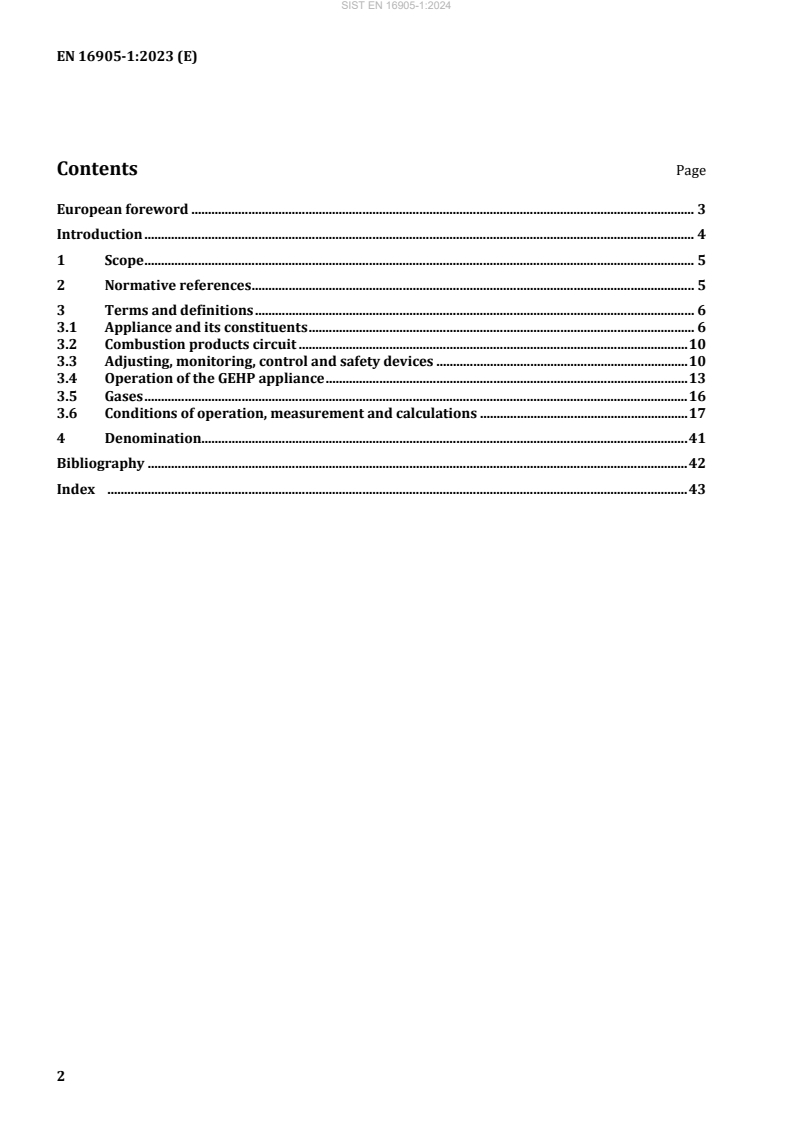
Contents Page
European foreword . 3
Introduction . 4
1 Scope . 5
2 Normative references . 5
3 Terms and definitions . 6
3.1 Appliance and its constituents . 6
3.2 Combustion products circuit . 10
3.3 Adjusting, monitoring, control and safety devices . 10
3.4 Operation of the GEHP appliance . 13
3.5 Gases . 16
3.6 Conditions of operation, measurement and calculations . 17
4 Denomination. 41
Bibliography . 42
Index . 43
European foreword
This document (EN 16905-1:2023) has been prepared by Technical Committee CEN/TC 299 “Gas-fired
sorption appliances, indirect fired sorption appliances, gas-fired endothermic engine heat pumps and
domestic gas-fired washing and drying appliances”, the secretariat of which is held by UNI.
This European Standard shall be given the status of a national standard, either by publication of an
identical text or by endorsement, at the latest by April 2024 and conflicting national standards shall be
withdrawn at the latest by April 2024.
Attention is drawn to the possibility that some of the elements of this document may be the subject of
patent rights. CEN shall not be held responsible for identifying any or all such patent rights.
This document supersedes EN 16905-1:2017.
The main changes compared to the previous edition are listed below:
— new definitions added in 3.1, 3.4, 3.5 and 3.6;
— modifications of existing definitions in 3.6.
The EN 16905 series comprises the following parts under the general title Gas-fired endothermic engine
driven heat pumps:
— Part 1: Terms and definitions;
— Part 2: Safety;
— Part 3: Test conditions;
— Part 4: Test methods;
— Part 5: Calculation of seasonal performances in heating and cooling mode.
Any feedback and questions on this document should be directed to the users’ national standards body.
A complete listing of these bodies can be found on the CEN website.
According to the CEN-CENELEC Internal Regulations, the national standards organizations of the
following countries are bound to implement this European Standard: Austria, Belgium, Bulgaria,
Croatia, Cyprus, Czech Republic, Denmark, Estonia, Finland, France, Germany, Greece, Hungary, Iceland,
Ireland, Italy, Latvia, Lithuania, Luxembourg, Malta, Netherlands, Norway, Poland, Portugal, Republic of
North Macedonia, Romania, Serbia, Slovakia, Slovenia, Spain, Sweden, Switzerland, Türkiye and the
United Kingdom.
Introduction
The GEHP appliances having their condenser cooled by air and by the evaporation of external additional
water are not covered by this document.
Single split and multisplit systems are covered by this document.
The GEHP appliances can have one or more primary or secondary functions.
This document specifies the requirements, test methods and test conditions concerning, in particular,
the construction, safety, fitness for purpose, and rational use of energy, for the rating and performance
calculation of air conditioners and heat pumps using either air, water or brine as heat transfer media,
with gas-fired endothermic engine driven compressors when used for space heating, cooling and
refrigeration, hereafter referred to as “GEHP appliance”.
This document has been prepared to address the definitions used in all parts of the EN 16905 series.
1 2 3
to the Energy Related Products Directive (2009/125/EC) in terms of tests conditions, tests methods
and seasonal performances calculation methods under Mandate M/535; (see EN 16905-2:— ,
2 3
Annexes ZB and ZC, EN 16905-3:— , Annex ZA, EN 16905-4:— , Annex ZA and EN 16905-5:2022,
Annex ZA).
These documents will be reviewed whenever new mandates could apply.
Under preparation. Current stage at the time of publication: FprEN 16905-2:2022.
Under preparation. Current stage at the time of publication: prEN 16905-3:2023.
Under preparation. Current stage at the time of publication: FprEN 16905-4:2023.
1 Scope
This part of the EN 16905 series specifies the terms and definitions for the rating and performance
calculation of gas-fired endothermic engine driven heat pumps for heating and/or cooling mode
including the engine heat recovery, to be used outdoors.
This document specifies the terms and definitions.
This document is intended to be used in conjunction with the following standards:
— EN 16905-2:— on safety;
— EN 16905-3:— on test conditions;
— EN 16905-4:— on the requirements, test conditions and test methods;
— EN 16905-5:2022 on the calculation of seasonal performances in heating and cooling mode;
— the heat pump standards, EN 14511-2, EN 14511-3 and EN 14825.
This document only applies to appliances with a maximum heat input (based on net calorific value) not
exceeding 70 kW at standard rating conditions.
This document only applies to appliances under categories I , I , I , I , I , I , I , I ,
2H 2E 2Er 2R 2E(S)B 2L 2LL 2ELL
I , I , I , I , I , I , II , II , II , II , II , II , II , II ,
2E(R)B 2ESi 2E(R) 3P 3B 3B/P 2H3+ 2Er3+ 2H3B/P 2L3B/P 2E3B/P 2ELL3B/P 2L3P 2H3P
II and II according to EN 437.
2E3P 2Er3P
This document only applies to appliances:
a) having gas fired endothermic engines under the control of fully automatic control systems;
b) having closed system refrigerant circuits in which the refrigerant does not come into direct contact
with the fluid to be cooled or heated;
c) where the temperature of the heat transfer fluid of the heating system (heating water circuit) does
not exceed 105 °C during normal operation;
d) where the maximum operating pressure in the:
1) heating water circuit (if installed) does not exceed 6 bar,
2) domestic hot water circuit (if installed) does not exceed 10 bar.
This document applies to GEHP appliances only when used for space heating or space cooling or for
refrigeration, with or without heat recovery.
This document is applicable to GEHP appliances that are intended to be type tested. Requirements for
GEHP appliances that are not type tested would need to be subject to further consideration.
2 Normative references
There are no normative references in this document.
3 Terms and definitions
For the purposes of this document, the following terms and definitions apply.
ISO and IEC maintain terminology databases for use in standardization at the following addresses:
— ISO Online browsing platform: available at https://www.iso.org/obp/
— IEC Electropedia: available at https://www.electropedia.org/
3.1 Appliance and its constituents
3.1.1
air conditioner
encased assembly or assemblies designed as a unit to provide delivery of conditioned air to an enclosed
space (room for instance) or zone
Note 1 to entry: It includes a refrigeration system for cooling and possibly dehumidifying the air.
Note 2 to entry: It can have means for heating, circulating, cleaning and humidifying the air. If the unit provides
heating by reversing the refrigerating cycle, then it is a heat pump.
3.1.2
close control air conditioner
air conditioner to satisfy the requirements of the process carried out in the air conditioned room
3.1.3
control cabinet air conditioner
air conditioner to satisfy the requirements of the control cabinet
3.1.4
double-duct air conditioner
air conditioner in which, during cooling or heating, the condenser (or evaporator) intake air is
introduced from the outdoor environment to the unit by a duct and rejected to the outdoor
environment by a second duct, and which is placed wholly inside the place to be conditioned, near a
wall
3.1.5
engine heat recovery
recovery of residual heat energy from the engine by means of a heat exchanger
3.1.6
engine heat recovery heat exchanger
heat exchanger assembly which is designed to transfer the residual heat energy to the engine heat
recovery medium
3.1.7
exhaust air
air from the air conditioned space entering the outdoor heat exchanger
3.1.8
brine
heat transfer medium that has a freezing point lower than the freezing point of water
3.1.9
gas carrying circuit
assembly of parts of the GEHP appliance that carry or contain supplied gas or process gas
Note 1 to entry: This circuit includes the gas circuit.
3.1.10
gas circuit
assembly of parts of the GEHP appliance that carry or contain the supplied gas between the gas inlet
connection and the outlet of the safety shut-off valves
3.1.11
gas inlet connection
part of the GEHP appliance intended to be connected to the gas supply
3.1.12
gas rate adjuster
component allowing the gas rate of a gas mixture equipment to be brought to a predetermined value
according to the supply conditions
Note 1 to entry: The action of operating this device is called “adjustment of the gas rate”.
Note 2 to entry: E.g. gas mixer.
3.1.13
GEHP appliance
gas-fired endothermic engine driven heat pump
3.1.14
heat pump
encased assembly or assemblies designed as a unit to provide delivery of heat
Note 1 to entry: It includes a refrigeration system for heating.
Note 2 to entry: It can have means for cooling, circulating, cleaning and dehumidifying the air. The cooling is by
means of reversing the refrigerating cycle.
3.1.15
heat recovery
recovery of heat rejected by the unit whose primary control is in the cooling mode by means of either
an additional heat exchanger (e.g. a liquid chiller with an additional condenser) or by transferring the
heat through the refrigerating system for use by units whose primary control remains in heating mode
(e.g. variable refrigerant flow with simultaneous cooling and heating operation)
3.1.16
heat recovery heat exchanger
heat exchanger assembly which is designed to transfer heat to the heat recovery medium
3.1.17
heat transfer medium
medium (water, air …) used for the transfer of the heat without changing the state
3.1.18
ignition device
means (e.g. electrical, etc.) used to ignite the gas admitted to the internal combustion engine
3.1.19
indoor heat exchanger
heat exchanger which is designed to transfer heat between the refrigerant and the indoor heat transfer
medium
Note 1 to entry: In the case of an air conditioner operating in the cooling mode, this is the evaporator. In the case
of an air conditioner operating in heating mode, this is the condenser.
Note 2 to entry: In case the indoor heat transfer is water or brine, the indoor heat exchanger is also placeable at
outdoor.
3.1.20
injector
component that admits gas into an internal combustion engine
3.1.21
internal combustion engine
mechanism delivering shaft power by the combustion of fuel in one or more cylinders in which working
pistons reciprocate
3.1.22
multi-split system
split system incorporating more than one indoor units, one or more refrigerant circuits, one or more
compressors, and one or more outdoor units
Note 1 to entry: The indoor units can be individually controlled or not.
3.1.23
outdoor heat exchanger
heat exchanger which is designed to transfer heat between any available heat source and the
refrigerant
Note 1 to entry: In the case of an air conditioner operating in the cooling mode, this is the condenser. In the case
of an air conditioner operating in heating mode, this is the evaporator.
3.1.24
primary function
main purpose for which the GEHP appliance is designed
Note 1 to entry: Both the heating and cooling functions of the GEHP appliance are classed as primary functions if
they satisfy the rational use of energy requirements for those functions.
3.1.25
range-rating device
component on the GEHP appliance intended to be used by the installer to adjust the nominal heat input
(value of the heat input at standard rating condition) of the GEHP appliance within the range of
maximum and minimum heat inputs stated in the technical specifications/instructions, to suit the actual
heat requirements of the installation
3.1.26
recycled air
air from the air-conditioned space entering the indoor heat exchanger
3.1.27
sealing an adjuster or control device
arrangements made to make evident any attempt to change the set adjustment (e.g. breakage of the
device or the sealing material)
Note 1 to entry: A sealed adjuster or control device is considered to be non-existent.
3.1.28
secondary function
optional function of the GEHP appliance, such as heating or cooling, which is not expected to satisfy the
rational use of energy requirements of a primary function
3.1.29
single-duct air conditioner
air conditioner in which, during cooling or heating, the condenser (or evaporator) intake air is
introduced from the space containing the unit and discharged outside this space
3.1.30
single split unit
factory assembly of components of refrigeration system fixed on two mountings to form a discrete
matched functional unit
3.1.31
simultaneously heating and cooling mode multi-split system
split system air conditioner or heat pump incorporating a single refrigerant circuit, at least one variable
speed compressor or an alternate compressor combination for varying the capacity of the system by
three or more steps, multiple indoor units, each capable of being individually controlled and one or
more outdoor units
Note 1 to entry: This system is capable of operating as a heat pump where recovered heat from the indoor units
operating in the cooling mode can be transferred to one or more units operating in the heating mode.
Note 2 to entry: This may be achieved by a gas/liquid separator or a third line in the refrigeration circuit.
3.1.32
water loop
closed circuit of water maintained with a temperature range on which the units in cooling mode reject
heat and the units in heating mode take heat
3.2 Combustion products circuit
3.2.1
air supply and combustion products evacuation ducts
means for transporting combustion air to the internal combustion engine and the combustion products
to the terminal or fitting piece
Note 1 to entry: It is necessary to distinguish between:
— completely surrounded ducts: the combustion products evacuation duct is surrounded by combustion air
throughout its length,
— separate ducts: the combustion products evacuation duct and the combustion air supply duct are neither
concentric nor completely surrounded ducts.
3.2.2
backflow valve
valve to prevent flue gas backflow
3.2.3
combustion chamber
enclosure inside which combustion of the air-gas mixture takes place
3.2.4
combustion circuit
circuit including the air supply duct and the combustion products circuit
3.2.5
combustion products circuit
circuit including the combustion chamber, the heat exchanger, the combustion products evacuation
duct and either the fitting piece or the connection to the terminal, if any
3.2.6
terminal
part of the combustion circuit fitted external to the building which has the function of the air supply
inlet and/or combustion products outlet of the appliance
3.2.7
terminal guard
device that protects the terminal from physical damage from outside influences
3.3 Adjusting, monitoring, control and safety devices
3.3.1
adjustable pressure regulator
pressure regulator fitted with a means of adjusting the downstream pressure
Note 1 to entry: This means is considered as an “adjusting device”.
3.3.2
adjustable control thermostat
control thermostat that permits the user to obtain setting temperatures between a minimum and a
maximum value
3.3.3
air proving device
device intended to cause safety shutdown in the event of abnormal conditions of air admission or of
combustion products evacuation
3.3.4
automatic engine control system
system that comprises a programming unit and the combustion detection function
Note 1 to entry: All the functions of an automatic control system are assembled in one or more housings.
3.3.5
automatic shut-off valve
device that automatically opens, closes or varies a rate on a signal from the engine control system
Note 1 to entry: Automatic valves are classified in accordance with EN 161 into classes A, B, C, D and J.
3.3.6
breather hole
orifice that allows atmospheric pressure to be maintained in a compartment of variable volume
3.3.7
closure member
movable part of the valve or the thermoelectric device that opens, varies or shuts off the gas path
3.3.8
control knob
component intended to be moved by hand in order to act on an appliance control (e.g. tap, thermostat,
etc.)
3.3.9
control thermostat
device enabling the water temperature to be kept automatically within a given range at a
predetermined value
3.3.10
diaphragm
flexible component that operates a valve by means of a force resulting from a pressure difference
3.3.11
external soundness
soundness, with respect to the atmosphere, of an enclosure containing gas
3.3.12
fault tolerating time
time between the occurrence of a fault and the shut-down of the internal combustion engine which is
tolerated by the application without creating a hazardous situation
3.3.13
gas/air ratio control
device that automatically adapts the combustion air rate to the gas rate or vice versa
3.3.14
frost protection system
system that actively protects the water in the GEHP appliance against freezing
Note 1 to entry: An anti-freeze solution is not considered as an active frost protective system.
3.3.15
ignition safety time
TSA
time elapsing between the start and the stop of the gas supply to internal combustion engine in the
event of ignition not taking place
3.3.16
internal soundness
soundness of a closure member in the closed position and isolating an enclosure containing gas from
another enclosure or from the outlet of the valve
3.3.17
limit thermostat
device that causes a shut off of the gas supply when a limit value of the temperature is reached, and
automatically enables a new start-up sequence when the temperature returns below the fixed limit
3.3.18
maximum allowable working temperature
temperature that the material can withstand over a long period of time under working condition
3.3.19
multifunctional control
device which has two or more controls and/or control function(s) whereby the functional parts cannot
operate if separated
3.3.20
overheat cut-off device
device that causes safety shutdown and non-volatile lockout before the GEHP appliance is damaged
and/or before safety is put in question
3.3.21
pressure regulator
device which maintains the downstream pressure constant to within fixed limits independent of
variations within a given range of the upstream pressure and the gas rate
3.3.22
programme
sequence of control operations determined by the programming unit, involving switching on,
supervising and switching off the internal combustion engine
3.3.23
programming unit
device that reacts to impulses from control and safety systems, gives control commands, controls the
start-up programme, supervises the internal combustion engine operation and causes controlled
shutdown, safety shutdown or lockout, if necessary and follows a predetermined sequence of actions
operating in conjunction with a combustion detection device
3.3.24
remote control
device that performs the remote control function by wires or wireless connection, with or without line
of sight of the GEHP appliance
3.3.25
remote control function
function that provides automatic and normal operation by means of a control intended to be actuated
with or without line of sight of the GEHP appliance, e.g. through:
a) communication lines/protocols,
b) additional hardware and/or software,
c) ultra-sonic,
d) infrared (IR)/radio frequency (RF) transmission,
e) all kind of combinations of a) to c) via the internet, e.g. modems, portable telephones
3.3.26
remote reset
device that performs a specific remote-control function, being reset from lock-out to allow a restart
attempt
3.3.27
safety temperature limiter
device that causes safety shutdown and non-volatile lockout so as to prevent a gas or a water
temperature exceeding a preset limit
3.4 Operation of the GEHP appliance
3.4.1
backfire
mistimed explosion in the cylinder or exhaust of an engine
3.4.2
complete combustion
combustion with no more than traces of combustible constituents (hydrogen, hydrocarbons, carbon
monoxide, carbon etc.) in the combustion products
3.4.3
condensing operation mode of the flue system
operation mode where, under normal operation conditions, condensate is produced in the combustion
products
3.4.4
controlled shutdown
process by which a control device (on the GEHP appliance or external to it) causes the gas supply to the
internal combustion engine to be stopped immediately, the GEHP appliance returning to its start
position
3.4.5
domestic hot water
DHW
water delivered by the GEHP appliance, raised to a certain temperature in order to use it for domestic
needs, e.g. kitchen, bathroom, etc
3.4.6
engine rpm equivalent
E
rpmequivalent
revolution per minute at standard rating conditions of the internal combustion engine calculated on the
basis of an engine rpm at 70 %, 60 %, 40 % and 20 % part load ratios for heating (or cooling if no
heating function is offered) and weighing factors of 0,15, 0,25, 0,30 and 0,30 respectively
3.4.7
extinction safety time
T
Se
time that elapses between extinction of the supervised flame and the order to shut off the gas supply to
internal combustion engine
3.4.8
heat input
Q
g
quantity of energy used in unit time corresponding to the volumetric or mass flow rates, the calorific
value used being either the net or gross calorific value
Note 1 to entry: The heat input is expressed in kilowatt (kW).
3.4.9
incomplete combustion
combustion at which at least one combustible constituent is present in significant proportions in the
combustion products
3.4.10
internal cooling circuit
loop in which a fluid circulates intended to maintain the various elements of the GEHP appliance at their
operating temperature
3.4.11
locking out
complete interruption of the gas supply with lockout
3.4.12
maximum water operating pressure
PMS
maximum water operating pressure at which the GEHP appliance can be used, in bars given by the
symbol PMS, followed by the equals sign, the numerical value and the unit bar
3.4.13
maximum water service pressure
maximum pressure permitted in the domestic water circuit of combinations GEHP appliance, as stated
in the appliance instructions
3.4.14
nominal electrical frequency
frequency stated in the technical specifications/instructions at which the GEHP appliance can operate
normally
3.4.15
nominal voltage
voltage or range of voltages stated in the technical specifications/instructions at which the GEHP
appliance can operate normally
3.4.16
non-volatile lockout
shutdown condition such that a restart can only be accomplished by a manual reset
3.4.17
pre-purge time
period during which pre-purge takes place
3.4.18
purge
mechanical introduction of air into the combustion circuit in order to displace any gas/air mixture,
which could remain there
Note 1 to entry: A distinction is made between:
— pre-purge: the purge that takes place between the start command and the ignition device being energized,
— post-purge: the purge that is carried out after burner shutdown.
3.4.19
recycling
automatic process by which, after loss of combustion during operation, the gas supply is interrupted
and the full start procedure is re-initiated automatically
3.4.20
safety shutdown
process which is effected immediately following the response of a protection device or the detection of
a fault and puts the internal combustion engine out of operation such as to maintain a safe condition
and avoid damage to the GEHP appliance, and through which the resulting state of the system is defined
by deactivated terminals for the shut-off valves and the ignition device
3.4.21
start
action which causes the GEHP appliance to leave its prestart operation allowing the predetermined
programme to commence
3.5 Gases
3.5.1
calorific value
quantity of heat produced by the complete combustion, at a constant pressure equal to '101, 325 kPa, of
a unit volume or mass of gas, the constituents of the combustible mixture being taken at reference
conditions and the products of combustion being brought back to the same conditions
Note 1 to entry: A distinction is made between:
— the gross calorific value Hs: the water produced by combustion is assumed to be condensed,
— the net calorific value Hi: the water produced by combustion is assumed to be in the vapour state.
Note 2 to entry: The calorific value is expressed:
— either in megajoules per cubic metre (MJ/m ) of dry gas under the reference conditions,
— in megajoules per kilogram (MJ/kg) of dry gas.
3.5.2
flame lift limit gas
special test gas composition as defined in EN 437 for each gas family and group
3.5.3
gas pressure
static pressure of the moving gas, relative to the atmospheric pressure, measured at right angles to the
direction of the flow of the gas
Note 1 to entry: Symbol: p. The gas pressures used are expressed in millibars (mbar); 1 mbar = 10 Pa.
3.5.4
incomplete combustion limit gas
special test gas composition as defined in EN 437 for each gas family and group
3.5.5
limit gases
test gases representative of the extreme variations in the characteristics of the gases for which
appliances have been designed
3.5.6
limit pressures
pressures representative of the extreme variations in the appliance supply conditions
Note 1 to entry: Maximum pressure: pmax; minimum pressure: pmin.
3.5.7
normal pressure
p
n
pressure under which the appliances operate in nominal conditions (condition used to obtain the values
of the rating plate) when they are supplied with the corresponding reference gas
3.5.8
pressure couple
combination of two distinct gas distribution pressures applied by reason of the significant difference
existing between the Wobbe indices within a single gas family or group in which:
— the higher pressure corresponds only to gases of low Wobbe index,
— the lower pressure corresponds to gases of high Wobbe index
3.5.9
reference gases
test gases with which appliances operate under nominal conditions (condition used to obtain the values
of the rating plate) when they are supplied at the corresponding normal pressure
3.5.10
relative density
d
ratio of the masses of equal volumes of dry gas and dry air under the same conditions of temperature
and pressure: 15 °C or 0 °C and 1 013,25 mbar
3.5.11
test gases
gases which are intended for the verification of the operational characteristics of gas appliances and
which consist of reference gases and limit gases
3.5.12
test pressure
gas pressures used to verify the operational characteristics of gas appliances, consisting of normal and
limit pressures
3.5.13
Wobbe index
ratio of the calorific value of a gas per unit volume to the square root of its relative density under the
same reference conditions
Note 1 to entry: Gross Wobbe index: Ws; net Wobbe index: Wi.
Note 2 to entry: It is said to be gross or net according to whether the calorific value used is the gross or net
calorific value.
Note 3 to entry: The Wobbe index is expressed:
— either in megajoules per cubic metre (MJ/m ) of dry gas under reference conditions, or
— in megajoules per kilogram (MJ/kg) of dry gas.
3.6 Conditions of operation, measurement and calculations
3.6.1
active mode
mode corresponding to the hours with a cooling or heating load of the building and whereby the cooling
or heating function is switched on
3.6.2
active mode seasonal auxiliary energy factor in cooling mode
SAEF
cON
average seasonal auxiliary energy factor of the unit in cooling mode and active mode for the designated
cooling season, determined from the part load, and bin-specific auxiliary energy factor in cooling mode
(AEF (Tj)) and weighted by the bin hours where the bin condition occurs
cPL
3.6.3
active mode seasonal auxiliary energy factor in heating mode
SAEF
hON
average seasonal auxiliary energy factor of the unit in heating mode and active mode for the designated
heating season, determined from the part load, and bin-specific auxiliary energy factor in heating mode
(AEF (Tj)) and weighted by the bin hours where the bin condition occurs
hPL
3.6.4
annual primary energy consumption cooling
Q
CP
reference annual cooling demand divided by the seasonal primary energy ratio cooling
3.6.5
annual primary energy consumption heating
Q
HP
reference annual heating demand divided by the seasonal primary energy ratio heating
3.6.6
application rating condition
rating condition which provides additional information on the performance of the appliance within its
operation range when applicable
3.6.7
auxiliary energy factor in cooling mode
AEFc
cooling capacity to effective electrical power input ratio
Note 1 to entry: The auxiliary energy factor in cooling mode is expressed in kilowatt/kilowatt (kW/kW).
3.6.8
auxiliary energy factor in heating mode
AEFh
heating capacity to effective electrical power input ratio
Note 1 to entry: The auxiliary energy factor in heating mode is expressed in kilowatt/kilowatt (kW/kW).
3.6.9
auxiliary energy factor in simultaneous heating and cooling mode
AEF
shc
simultaneous heating and cooling capacity to effective electrical power input ratio
Note 1 to entry: The auxiliary energy factor in simultaneous heating and cooling mode is expressed in
kilowatt/kilowatt (kW/kW).
3.6.10
auxiliary energy factor ratio in cooling mode at declared capacity
AEF
cDC
auxiliary energy factor specific in cooling mode at specific temperature conditions, A, B, C, D
Note 1 to entry: The auxiliary energy factor in cooling mode at declared capacity is expressed in in
kilowatt/kilowatt (kW/kW).
Note 2 to entry: AEF in point A, B, C and D are referred to as AEF A, AEF B, AEF C and AEF D
cDC cDC cDC cDC cDC
respectively in process cooling.
3.6.11
auxiliary energy factor ratio in heating mode at declared capacity
AEF
hDC
auxiliary energy factor specific in heating mode at specific temperature conditions, A, B, C, D, E, F and G,
where applicable
Note 1 to entry: The auxiliary energy factor in heating mode at declared capacity is expressed in
kilowatt/kilowatt (kW/kW).
3.6.12
auxiliary engine heat recovery energy factor ratio in cooling mode at declared capacity
AEHRF
cDC
auxiliary engine heat recovery factor specific in cooling mode at specific temperature conditions, A, B, C,
D
Note 1 to entry: The auxiliary engine heat recovery energy factor in cooling mode at declared capacity is
expressed in kilowatt/kilowatt (kW/kW).
Note 2 to entry: AEHRF in point A, B, C and D are referred to as AEHRF A, AEHRF B, AEHRF C and
cDC cDC cDC cDC
AEHRF D respectively in process cooling.
cDC
3.6.13
auxiliary engine heat recovery energy factor ratio in heating mode at declared capacity
AEHRF
hDC
auxiliary engine heat recovery factor specific in heating mode at specific temperature conditions, A, B, C,
D, E, F and G, where applicable
Note 1 to entry: The auxiliary engine heat recovery energy factor in heating mode at declared capacity is
expressed in kilowatt/kilowatt (kW/kW).
3.6.14
gas utilization efficiency ratio in cooling mode at declared capacity
GUE
c DC
declared cooling capacity of the unit to measured heat input ratio at specific temperature conditions, A,
B, C, D
Note 1 to entry: The gas utilization efficiency ratio in cooling mode at declared capacity is expressed in
kilowatt/kilowatt (kW/kW).
Note 2 to entry: GUE in point A, B, C and D are referred to as GUE A, GUE B, GUE C and GUE D
c DC c DC c DC c DC c DC
respectively in process cooling.
3.6.15
gas utilization efficiency ratio in heating mode at declared capacity
GUE
h DC
declared heating capacity of the unit to measured heat input ratio at specific temperature conditions, A,
B, C, D, E, F and G, where applicable
Note 1 to entry: The gas utilization efficiency ratio in heating mode at declared capacity is expressed in
kilowatt/kilowatt (kW/kW).
3.6.16
engine heat recovery efficiency ratio in cooling mode at declared capacity
EHRE
cDC
declared engine heat recovery of the unit to measured heat input ratio at specific temperature
conditions, A, B, C, D
Note 1 to entry: The heat recovery efficiency ratio in cooling mode is expressed in kilowatt/kilowatt (kW/kW).
Note 2 to entry: EHRE in point A, B, C and D are referred to as EHRE A, EHRE B, EHRE C and EHRE
cDC cDC cDC cDC cDC
D respectively in process cooling.
3.6.17
engine heat recovery efficiency ratio in heating mode at declared capacity
EHRE
hCD
declared engine heat recovery of the unit to measured heat input ratio at specific temperature
conditions, A, B, C, D, E, F and G, where applicable
Note 1 to entry: The heat recovery efficiency ratio in heating mode is expressed in kilowatt/kilowatt (kW/kW).
3.6.18
total auxiliary energy factor ratio in cooling mode at declared capacity
AEF
Tc DC
sum of declared auxiliary energy factor specific in cooling mode (AEF ) and declared auxiliary engine
cDC
heat recovery factor specific in cooling (AEHRF ) at specific temperature conditions, A, B, C, D
cDC
Note 1 to entry: The total auxiliary energy factor in cooling mode at declared capacity is expressed in
kilowatt/kilowatt (kW/kW).
Note 2 to entry: AEF in point A, B, C and D are referred to as AEF A, AEF B, AEF C and AEF D
TcDC TcDC TcDC TcDC TcDC
respectively in process cooling.
3.6.19
total auxiliary energy factor ratio in heating mode at declared capacity
AEF
ThDC
sum of declared auxiliary energy factor specific in heating mode (AEF ) and declared auxiliary engine
c DC
heat recovery factor specific in heating (AEHRF ) at specific temperature conditions, A, B, C, D, E, F
hDC
and G, where applicable
Note 1 to entry: The total auxiliary energy factor in heating mode at declared capacity is expressed in
kilowatt/kilowatt (kW/kW).
3.6.20
total gas utilization efficiency ratio in cooling mode at declared capacity
GUE
Tc DC
sum of declared cooling capacity of the unit (GUE ) and declared engine heat recovery of the unit in
c DC
cooling (EHRE ) at specific temperature conditions, A, B, C, D
cDC
Note 1 to entry: Total gas utilization efficiency ratio in cooling mode at declared capacity is expressed in
kilowatt/kilowatt (kW/kW).
in point A, B, C and D are referred to as GUE A, GUE B, GUE C and GUE
Note 2 to entry: GUE
TC DC TC DC TC DC TC DC TC
D respectively in process cooling.
DC
3.6.21
total gas utilization efficiency ratio in heating mode at declared capacity
GUE
Th DC
sum of declared heating capacity of the unit (GUE ) and declared engine heat recovery of the unit in
h DC
heating (EHRE ) at specific temperature conditions, A, B, C, D, E, F and G, where applicable
hDC
Note 1 to entry: The total gas utilization efficiency ratio in heating mode at declared capacity is expressed in
kilowatt/kilowatt (kW/kW).
3.6.22
auxiliary energy factor ratio in cooling mode at part load
AEF
cPL
auxiliary energy factor specific in cooling mode at the declared capacity, corrected with the degradation
coefficient, where applicable
Note 1 to entry: The AEF includes degradation losses when the declared capacity of the unit is higher than the
cPL
cooling load.
Note 2 to entry: The auxiliary heat recovery energy factor in cooling mode is expressed in kilowatt/kilowatt
(kW/kW).
3.6.23
auxiliary energy factor ratio in heating mode at part load
AEF
hPL
auxiliary energy factor in heating mode at the declared capacity, corrected with the degradation
coefficient, where applicable
Note 1 to entry: The AEF includes degradation losses when the declared capacity of the unit is higher than the
hPL
heating load.
Note 2 to entry: The auxiliary heat recovery energy factor in heating mode is expressed in kilowatt/kilowatt
(kW/kW).
3.6.24
auxiliary engine heat recovery energy factor ratio in cooling mode at part load
AEHRF
cPL
auxiliary engine heat recovery energy specific in cooling mode at the declared capacity, corrected with
the degradation coefficient, where applicable
Note 1 to entry: The AEHRF includes degradation losses when the declared capacity of the unit is higher than
cPL
the cooling load.
Note 2 to entry: The auxiliary engine heat recovery energy factor in cooling mode is expressed in
kilowatt/kilowatt (kW/kW).
3.6.25
auxiliary engine heat recovery energy factor ratio in heating mode at part load
AEHRF
hPL
auxiliary engine heat recovery energy factor in heating mode at the declared capacity, corrected with
the degradation coefficient, where applicable
Note 1 to entry: The AEHRF includes degradation losses when the declared capacity of the unit is higher than
hPL
the heating load.
3.6.26
gas utilization efficiency ratio in cooling mode at part load
GUEc
PL
gas utilization efficiency ratio in cooling mode at the declared capacity, corrected with the degradation
coefficient, where applicable
Note 1 to entry: The GUEc includes degradation losses when the declared capacity of the unit is higher than the
PL
cooling load.
Note 2 to entry: The gas utilization efficiency in cooling mode at partial load is expressed in kilowatt/kilowatt
(kW/kW).
3.6.27
gas utilization efficiency ratio in heating mode at part load
GUE
hPL
gas utilization efficiency ratio in heating mode at the declared capacity, corrected with the degradation
coefficient, where applicable
Note 1 to entry: The GUE includes degradation losses when the declared capacity of the unit is higher than the
hPL
heating load.
Note 2 to entry: The gas utilization efficiency in heating mode at partial load is expressed in kilowatt/kilowatt
(kW/kW).
3.6.28
engine heat recovery efficiency ratio in cooling mode at part load
EHRE
cPL
engine heat recovery efficiency in cooling mode at the declared capacity, corrected with the degradation
coefficient, wher
...