

EN 378-1:2016+A1:2020
(Main + Amendment)Refrigerating systems and heat pumps - Safety and environmental requirements - Part 1: Basic requirements, definitions, classification and selection criteria
- Abstract
This European Standard specifies the requirements for the safety of persons and property, provides guidance for the protection of the environment and establishes procedures for the operation, maintenance and repair of refrigerating systems and the recovery of refrigerants.
The term “refrigerating system” used in this European Standard includes heat pumps.
This part of EN 378 specifies the classification and selection criteria applicable to refrigerating systems. These classification and selection criteria are used in parts 2, 3 and 4.
This standard applies:
a) to refrigerating systems, stationary or mobile, of all sizes except to vehicle air conditioning systems covered by a specific product standard e.g. ISO 13043;
b) to secondary cooling or heating systems;
c) to the location of the refrigerating systems;
d) to replaced parts and added components after adoption of this standard if they are not identical in function and in the capacity;
Systems using refrigerants other than those listed in Annex E of this European Standard are not covered by this standard.
Annex C specifies how to determine the amount of refrigerant permitted in a given space, which when exceeded, requires additional protective measures to reduce the risk.
Annex E specifies criteria for safety and environmental considerations of different refrigerants used in refrigeration and air conditioning.
This standard is not applicable to refrigerating systems and heat pumps which were manufactured before the date of its publication as a European Standard except for extensions and modifications to the system which were implemented after publication.
This standard is applicable to new refrigerating systems, extensions or modifications of already existing systems, and for existing stationary systems, being transferred to and operated on another site.
This standard also applies in the case of the conversion of a system to another refrigerant type, in which case conformity to the relevant clauses of parts 1 to 4 of the standard shall be assessed.
Product family standards dealing with the safety of refrigerating systems takes precedence over horizontal and generic standards covering the same subject.
- Status
- Published
- Publication Date
- 27-Oct-2020
- Withdrawal Date
- 29-Apr-2021
- Technical Committee
- CEN/TC 182 - Refrigerating systems, safety and environmental requirements
- Drafting Committee
- CEN/TC 182/WG 6 - Revision of EN 378
- Current Stage
- 6060 - Definitive text made available (DAV) - Publishing
- Start Date
- 28-Oct-2020
- Due Date
- 18-Oct-2021
- Completion Date
- 28-Oct-2020



Overview - EN 378-1:2016+A1:2020
EN 378-1:2016+A1:2020 (EN 378-1) sets out the basic safety and environmental requirements, definitions, classification and selection criteria for refrigerating systems and heat pumps. It establishes the framework used by EN 378 parts 2–4 and applies to new systems, system extensions or modifications, relocations and conversions to other refrigerants. The standard addresses stationary and mobile systems (except vehicle air‑conditioning covered by product standards) and excludes systems using refrigerants not listed in Annex E.
Key topics and technical requirements
- Definitions and scope: clear terms for refrigerating systems, components, locations, pressures and access categories to support consistent application across parts 2–4.
- Classification and selection criteria: system and location classification, access categories and designation of refrigerants (aligned with ISO 817) to determine applicable protective measures.
- Refrigerant charge limits (Annex C): methods to calculate permitted refrigerant mass per space with limits driven by toxicity and flammability; includes an alternative risk‑management approach (C.3).
- Space volume and charge calculations: procedures to calculate room volumes and to determine when additional protective measures are required.
- Refrigerant safety & environmental data (Annex E): safety classes, flammability/toxicity information and GWP values (supporting F‑gas considerations) to aid refrigerant selection.
- Environmental assessment tools: guidance on Total Equivalent Warming Impact (TEWI, Annex B) and lifecycle considerations for refrigerant and system choices.
- Special topics: protection for cold rooms (Annex D), ice rink requirements (Annex F), and a catalogue of potential hazards (Annex G).
- Application limits: not applicable to systems manufactured before publication unless modified after publication; product family standards override EN 378 where they cover the same subject.
Practical applications
- Design and selection of refrigerating systems and heat pumps with compliant safety and environmental measures.
- Determining refrigerant type and maximum allowed charge for installations in occupied and unoccupied spaces.
- Preparing installation, operation, maintenance and refrigerant‑recovery procedures consistent with EN 378 series.
- Risk assessments for conversions, relocations or system extensions where refrigerant properties or charge change.
Who should use this standard
- HVAC / refrigeration designers and engineers
- System manufacturers and OEMs
- Installation and service technicians
- Safety and compliance officers, facility managers
- Regulators and consultants performing risk assessments or environmental impact evaluations
Related standards and references
- EN 378 parts 2–4 (design/construction, installation, operation/maintenance)
- ISO 817 (refrigerant designation and safety classification)
- ISO 5149 (harmonization aspects)
- EN ISO 14040 series (life‑cycle assessment)
- EU F‑gas Regulation (Regulation (EU) No 517/2014) - referenced for GWP considerations
Keywords: EN 378-1:2016+A1:2020, EN 378-1, refrigerating systems, heat pumps, safety and environmental requirements, refrigerant charge limits, classification, TEWI, GWP, refrigerant selection.
Relations
- Effective Date
- 19-Jan-2023
- Effective Date
- 18-Jan-2023
- Effective Date
- 09-Feb-2026
- Effective Date
- 28-Jan-2026
- Effective Date
- 28-Jan-2026
- Effective Date
- 28-Jan-2026
- Effective Date
- 28-Jan-2026
- Effective Date
- 16-Sep-2026
- Effective Date
- 28-Jan-2026
- Effective Date
- 28-Jan-2026
- Effective Date
- 28-Jan-2026
- Effective Date
- 28-Jan-2026
- Effective Date
- 28-Jan-2026
- Referred By
EN 12284:2003 - Refrigerating systems and heat pumps - Valves - Requirements, testing and marking - Effective Date
- 28-Jan-2026
- Referred By
EN ISO 22712:2023 - Refrigerating systems and heat pumps - Competence of personnel (ISO 22712:2023) - Effective Date
- 28-Jan-2026
Get Certified
Connect with accredited certification bodies for this standard

DNV
DNV is an independent assurance and risk management provider.

Lloyd's Register
Lloyd's Register is a global professional services organisation specialising in engineering and technology.
DNV Energy Systems
Energy and renewable energy certification.
Sponsored listings
Frequently Asked Questions
EN 378-1:2016+A1:2020 is a standard published by the European Committee for Standardization (CEN). Its full title is "Refrigerating systems and heat pumps - Safety and environmental requirements - Part 1: Basic requirements, definitions, classification and selection criteria". This standard covers: This European Standard specifies the requirements for the safety of persons and property, provides guidance for the protection of the environment and establishes procedures for the operation, maintenance and repair of refrigerating systems and the recovery of refrigerants. The term “refrigerating system” used in this European Standard includes heat pumps. This part of EN 378 specifies the classification and selection criteria applicable to refrigerating systems. These classification and selection criteria are used in parts 2, 3 and 4. This standard applies: a) to refrigerating systems, stationary or mobile, of all sizes except to vehicle air conditioning systems covered by a specific product standard e.g. ISO 13043; b) to secondary cooling or heating systems; c) to the location of the refrigerating systems; d) to replaced parts and added components after adoption of this standard if they are not identical in function and in the capacity; Systems using refrigerants other than those listed in Annex E of this European Standard are not covered by this standard. Annex C specifies how to determine the amount of refrigerant permitted in a given space, which when exceeded, requires additional protective measures to reduce the risk. Annex E specifies criteria for safety and environmental considerations of different refrigerants used in refrigeration and air conditioning. This standard is not applicable to refrigerating systems and heat pumps which were manufactured before the date of its publication as a European Standard except for extensions and modifications to the system which were implemented after publication. This standard is applicable to new refrigerating systems, extensions or modifications of already existing systems, and for existing stationary systems, being transferred to and operated on another site. This standard also applies in the case of the conversion of a system to another refrigerant type, in which case conformity to the relevant clauses of parts 1 to 4 of the standard shall be assessed. Product family standards dealing with the safety of refrigerating systems takes precedence over horizontal and generic standards covering the same subject.
This European Standard specifies the requirements for the safety of persons and property, provides guidance for the protection of the environment and establishes procedures for the operation, maintenance and repair of refrigerating systems and the recovery of refrigerants. The term “refrigerating system” used in this European Standard includes heat pumps. This part of EN 378 specifies the classification and selection criteria applicable to refrigerating systems. These classification and selection criteria are used in parts 2, 3 and 4. This standard applies: a) to refrigerating systems, stationary or mobile, of all sizes except to vehicle air conditioning systems covered by a specific product standard e.g. ISO 13043; b) to secondary cooling or heating systems; c) to the location of the refrigerating systems; d) to replaced parts and added components after adoption of this standard if they are not identical in function and in the capacity; Systems using refrigerants other than those listed in Annex E of this European Standard are not covered by this standard. Annex C specifies how to determine the amount of refrigerant permitted in a given space, which when exceeded, requires additional protective measures to reduce the risk. Annex E specifies criteria for safety and environmental considerations of different refrigerants used in refrigeration and air conditioning. This standard is not applicable to refrigerating systems and heat pumps which were manufactured before the date of its publication as a European Standard except for extensions and modifications to the system which were implemented after publication. This standard is applicable to new refrigerating systems, extensions or modifications of already existing systems, and for existing stationary systems, being transferred to and operated on another site. This standard also applies in the case of the conversion of a system to another refrigerant type, in which case conformity to the relevant clauses of parts 1 to 4 of the standard shall be assessed. Product family standards dealing with the safety of refrigerating systems takes precedence over horizontal and generic standards covering the same subject.
EN 378-1:2016+A1:2020 is classified under the following ICS (International Classification for Standards) categories: 01.040.27 - Energy and heat transfer engineering (Vocabularies); 27.080 - Heat pumps; 27.200 - Refrigerating technology. The ICS classification helps identify the subject area and facilitates finding related standards.
EN 378-1:2016+A1:2020 has the following relationships with other standards: It is inter standard links to EN 378-1:2016/FprA1, EN 378-1:2016, ISO 817:2014, EN 378-3:2016+A1:2020, EN 12263:1998, EN 14276-2:2020, EN 378-2:2016, EN 12693:2026, EN 13732:2022, EN 12178:2016, EN 17893:2024, CEN/TS 17607:2021, EN 15502-2-3:2023, EN 12284:2003, EN ISO 22712:2023. Understanding these relationships helps ensure you are using the most current and applicable version of the standard.
EN 378-1:2016+A1:2020 is available in PDF format for immediate download after purchase. The document can be added to your cart and obtained through the secure checkout process. Digital delivery ensures instant access to the complete standard document.
Standards Content (Sample)
SLOVENSKI STANDARD
01-januar-2021
Hladilni sistemi in toplotne črpalke - Varnostnotehnične in okoljevarstvene
zahteve - 1. del: Osnovne zahteve, definicije, razvrstitev in kriteriji za izbiro
Refrigerating systems and heat pumps - Safety and environmental requirements - Part 1:
Basic requirements, definitions, classification and selection criteria
Kälteanlagen und Wärmepumpen - Sicherheitstechnische und umweltrelevante
Anforderungen - Teil 1: Grundlegende Anforderungen, Begriffe, Klassifikationen und
Auswahlkriterien
Systèmes frigorifiques et pompes à chaleur - Exigences de sécurité et d'environnement -
Partie 1 : Exigences de base, définitions, classification et critères de choix
Ta slovenski standard je istoveten z: EN 378-1:2016+A1:2020
ICS:
01.040.27 Prenos energije in toplote Energy and heat transfer
(Slovarji) engineering (Vocabularies)
27.080 Toplotne črpalke Heat pumps
27.200 Hladilna tehnologija Refrigerating technology
2003-01.Slovenski inštitut za standardizacijo. Razmnoževanje celote ali delov tega standarda ni dovoljeno.
EN 378-1:2016+A1
EUROPEAN STANDARD
NORME EUROPÉENNE
October 2020
EUROPÄISCHE NORM
ICS 01.040.27; 27.080; 27.200 Supersedes EN 378-1:2016
English Version
Refrigerating systems and heat pumps - Safety and
environmental requirements - Part 1: Basic requirements,
definitions, classification and selection criteria
Systèmes frigorifiques et pompes à chaleur - Exigences Kälteanlagen und Wärmepumpen -
de sécurité et d'environnement - Partie 1 : Exigences Sicherheitstechnische und umweltrelevante
de base, définitions, classification et critères de choix Anforderungen - Teil 1: Grundlegende Anforderungen,
Begriffe, Klassifikationen und Auswahlkriterien
This European Standard was approved by CEN on 3 September 2016 and includes Amendment 1 approved by CEN on 17 August
2020.
CEN members are bound to comply with the CEN/CENELEC Internal Regulations which stipulate the conditions for giving this
European Standard the status of a national standard without any alteration. Up-to-date lists and bibliographical references
concerning such national standards may be obtained on application to the CEN-CENELEC Management Centre or to any CEN
member.
This European Standard exists in three official versions (English, French, German). A version in any other language made by
translation under the responsibility of a CEN member into its own language and notified to the CEN-CENELEC Management
Centre has the same status as the official versions.
CEN members are the national standards bodies of Austria, Belgium, Bulgaria, Croatia, Cyprus, Czech Republic, Denmark, Estonia,
Finland, France, Germany, Greece, Hungary, Iceland, Ireland, Italy, Latvia, Lithuania, Luxembourg, Malta, Netherlands, Norway,
Poland, Portugal, Republic of North Macedonia, Romania, Serbia, Slovakia, Slovenia, Spain, Sweden, Switzerland, Turkey and
United Kingdom.
EUROPEAN COMMITTEE FOR STANDARDIZATION
COMITÉ EUROPÉEN DE NORMALISATION
EUROPÄISCHES KOMITEE FÜR NORMUNG
CEN-CENELEC Management Centre: Rue de la Science 23, B-1040 Brussels
© 2020 CEN All rights of exploitation in any form and by any means reserved Ref. No. EN 378-1:2016+A1:2020 E
worldwide for CEN national Members.
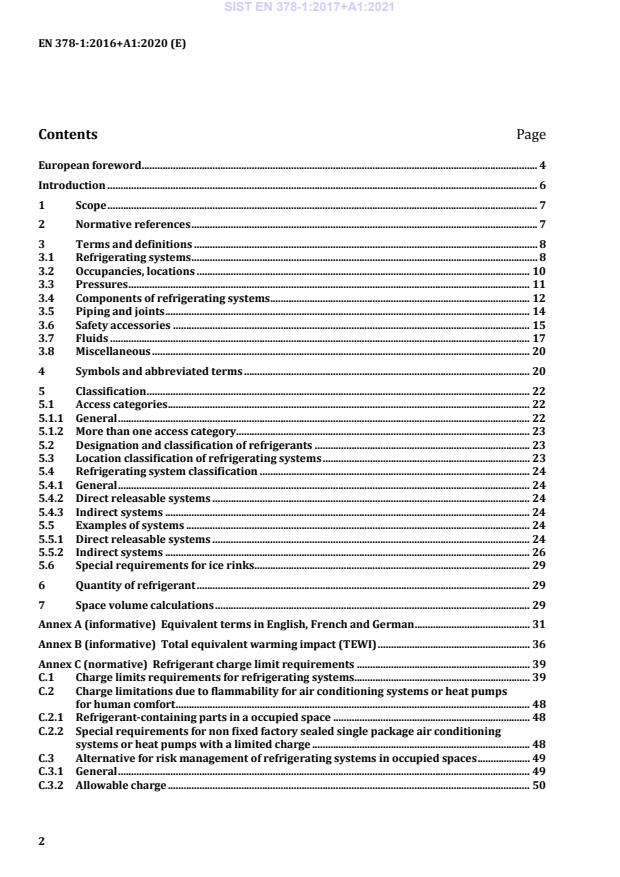
Contents Page
European foreword . 4
Introduction . 6
1 Scope . 7
2 Normative references . 7
3 Terms and definitions . 8
3.1 Refrigerating systems . 8
3.2 Occupancies, locations . 10
3.3 Pressures . 11
3.4 Components of refrigerating systems . 12
3.5 Piping and joints . 14
3.6 Safety accessories . 15
3.7 Fluids . 17
3.8 Miscellaneous . 20
4 Symbols and abbreviated terms . 20
5 Classification . 22
5.1 Access categories . 22
5.1.1 General . 22
5.1.2 More than one access category. 23
5.2 Designation and classification of refrigerants . 23
5.3 Location classification of refrigerating systems . 23
5.4 Refrigerating system classification . 24
5.4.1 General . 24
5.4.2 Direct releasable systems . 24
5.4.3 Indirect systems . 24
5.5 Examples of systems . 24
5.5.1 Direct releasable systems . 24
5.5.2 Indirect systems . 26
5.6 Special requirements for ice rinks . 29
6 Quantity of refrigerant . 29
7 Space volume calculations . 29
Annex A (informative) Equivalent terms in English, French and German . 31
Annex B (informative) Total equivalent warming impact (TEWI) . 36
Annex C (normative) Refrigerant charge limit requirements . 39
C.1 Charge limits requirements for refrigerating systems. 39
C.2 Charge limitations due to flammability for air conditioning systems or heat pumps
for human comfort . 48
C.2.1 Refrigerant-containing parts in a occupied space . 48
C.2.2 Special requirements for non fixed factory sealed single package air conditioning
systems or heat pumps with a limited charge . 48
C.3 Alternative for risk management of refrigerating systems in occupied spaces . 49
C.3.1 General . 49
C.3.2 Allowable charge . 50
Annex D (informative) Protection for people who are inside cold rooms . 53
D.1 General . 53
D.2 Operation of doors and emergency exit doors . 53
D.3 Emergency switch or signal . 53
D.4 Cold rooms with a controlled atmosphere . 54
Annex E (normative) Safety classification and information about refrigerants . 55
Annex F (normative) Special requirements for ice rinks . 71
F.1 Indoor ice rinks . 71
F.2 Outdoor ice rinks and installations for similar sporting activities . 71
Annex G (informative) Potential hazards for refrigerating systems. 72
Annex H (informative) Calculation examples related to C.2 and C.3. 74
H.1 Example 1 for C.2.1 . 74
H.2 Example 2 for C.2.1 . 74
H.3 Example 3 for C.3 . 74
H.4 Example 4 for C.3 . 74
Bibliography . 76
European foreword
This document (EN 378-1:2016+A1:2020) has been prepared by Technical Committee CEN/TC 182
“Refrigerating systems, safety and environmental requirements”, the secretariat of which is held by DIN.
This European Standard shall be given the status of a national standard, either by publication of an
identical text or by endorsement, at the latest by April 2021, and conflicting national standards shall be
withdrawn at the latest by April 2021.
Attention is drawn to the possibility that some of the elements of this document may be the subject of
patent rights. CEN shall not be held responsible for identifying any or all such patent rights.
This document includes Amendment 1 approved by CEN on 17 August 2020.
This document supersedes !EN 378-1:2016".
The start and finish of text introduced or altered by amendment is indicated in the text by tags !".
EN 378 consists of the following parts under the general title “Refrigerating systems and heat pumps —
Safety and environmental requirements”:
— Part 1: Basic requirements, definitions, classification and selection criteria;
— Part 2: Design, construction, testing, marking and documentation;
— Part 3: Installation site and personal protection;
— Part 4: Operation, maintenance, repair and recovery.
The main changes in part 1 with respect to the previous edition are listed below:
— harmonization as far as possible with ISO 5149:2014 and ISO 817:2014;
— adapt definitions for the purpose of harmonizing EN 378-2:2016 with PED.
Following detailed changes are worth noting:
— modification of the term “special machinery room” to “separate refrigeration machinery room” and
adapt the definition in view of combustion equipment;
— modifications/inclusion of definitions for “part of the refrigerating system” (3.1.8), “pressure
equipment” (3.1.20) and “pressure vessels” (3.4.8) in view of PED;
— movement of the location classification from Annex C to 5.3;
— rewording of the system examples in 5.3 to make the relation clear with location classification;
— replacement of Annex F (safety group) classifications by 5.2;
— modification of the approach to determine the refrigerant charge of a refrigeration system. The
charge limit requirement is decided based on the most stringent refrigerant charge that results
from the calculation based on toxicity and the calculation based on flammability. To this purpose,
the tables in Annex C are modified. Table C.1 contains requirements based on toxicity classes,
Table C.2 contains requirements based on flammability classes;
— addition of the refrigerant classes as determined in ISO 817 to toxicity classes A, B and flammability
classes 1, 2L, 2, 3;
— modification of the charge limits for refrigerants of flammability class 3, for location classification
III;
— addition of C.3, alternative risk management;
— addition of refrigerants in Annex E that have been approved for publication in ASHRAE 34 in
January 2015 (not those approved for public review in January 2015);
— inclusion in Annex E of GWP values for refrigerants in view of REGULATION (EU) No 517/2014 (F-
gas).
According to the CEN-CENELEC Internal Regulations, the national standards organisations of the
following countries are bound to implement this European Standard: Austria, Belgium, Bulgaria,
Croatia, Cyprus, Czech Republic, Denmark, Estonia, Finland, France, Germany, Greece, Hungary, Iceland,
Ireland, Italy, Latvia, Lithuania, Luxembourg, Malta, Netherlands, Norway, Poland, Portugal, Republic of
North Macedonia, Romania, Serbia, Slovakia, Slovenia, Spain, Sweden, Switzerland, Turkey and the
United Kingdom.
Introduction
This European Standard relates to safety and environmental requirements in the design, manufacture,
construction, installation, operation, maintenance, repair and disposal of refrigerating systems and
appliances regarding local and global environments. It does not related to the final destruction of the
refrigerants.
It is intended to minimize possible hazards to persons, property and the environment from
refrigerating systems and refrigerants. These hazards are associated with the physical and chemical
characteristics of refrigerants and the pressures and temperatures occurring in refrigeration cycles.
Attention is drawn to hazards such as excessive temperature at compressor discharge, liquid slugging,
erroneous operation and reduction in mechanical strength caused by corrosion, erosion, thermal stress,
liquid hammer or vibration. Corrosion deserves special consideration as conditions peculiar to
refrigerating systems arise due to alternate frosting and defrosting or the covering of equipment by
insulation.
The extent to which hazards are covered is indicated in Annex G. In addition, machinery should comply
as appropriate with EN ISO 12100 for hazards which are not covered by this European Standard.
Commonly used refrigerants except R-717 are heavier than air. Care should be taken to avoid stagnant
pockets of heavy refrigerant vapours by proper location of ventilation inlet and exhaust openings.
Refrigerants and their combinations with oils, water or other substances, can affect the system
chemically and physically. They can, if they have detrimental properties, endanger persons, property
and the environment when escaping from the refrigerating system. Refrigerants shall be selected with
due regard to their potential influence on the global environment (ODP, GWP) as well as their possible
effects on the local environment. Evaluation of the environmental performance requires a life cycle
approach. With regard to global climate change the Total Equivalent Warming Impact approach is
generally used as the basis (see Annex B). Reference should be made to the EN ISO 14040- series to
address other environmental aspects. Many factors influence environmental impacts such as:
— location of the system;
— energy efficiency of the system;
— type of refrigerant;
— service frequency;
— refrigerant leaks;
— sensitivity of charge on efficiency;
— minimization of heat load;
— control methods.
Additional investments may be directed towards reducing leaks, increasing energy efficiency or
modifying the design in order to use a different refrigerant. A life cycle approach is necessary to identify
where additional investments will have the most beneficial effects.
1 Scope
This European Standard specifies the requirements for the safety of persons and property, provides
guidance for the protection of the environment and establishes procedures for the operation,
maintenance and repair of refrigerating systems and the recovery of refrigerants.
The term “refrigerating system” used in this European Standard includes heat pumps.
This part of EN 378 specifies the classification and selection criteria applicable to refrigerating systems.
These classification and selection criteria are used in parts 2, 3 and 4.
This standard applies:
a) to refrigerating systems, stationary or mobile, of all sizes except to vehicle air conditioning systems
covered by a specific product standard e.g. ISO 13043;
b) to secondary cooling or heating systems;
c) to the location of the refrigerating systems;
d) to replaced parts and added components after adoption of this standard if they are not identical in
function and in the capacity;
Systems using refrigerants other than those listed in Annex E of this European Standard are not covered
by this standard.
Annex C specifies how to determine the amount of refrigerant permitted in a given space, which when
exceeded, requires additional protective measures to reduce the risk.
Annex E specifies criteria for safety and environmental considerations of different refrigerants used in
refrigeration and air conditioning.
This standard is not applicable to refrigerating systems and heat pumps which were manufactured
before the date of its publication as a European Standard except for extensions and modifications to the
system which were implemented after publication.
This standard is applicable to new refrigerating systems, extensions or modifications of already existing
systems, and for existing stationary systems, being transferred to and operated on another site.
This standard also applies in the case of the conversion of a system to another refrigerant type, in which
case conformity to the relevant clauses of parts 1 to 4 of the standard shall be assessed.
Product family standards dealing with the safety of refrigerating systems takes precedence over
horizontal and generic standards covering the same subject.
2 Normative references
The following documents, in whole or in part, are normatively referenced in this document and are
indispensable for its application. For dated references, only the edition cited applies. For undated
references, the latest edition of the referenced document (including any amendments) applies.
EN 378-2:2016, Refrigerating systems and heat pumps — Safety and environmental requirements —
Part 2: Design, construction, testing, marking and documentation
!EN 378-3:2016+A1:2020, Refrigerating systems and heat pumps - Safety and environmental
requirements - Part 3: Installation site and personal protection "
EN 12263, Refrigerating systems and heat pumps — Safety switching devices for limiting the pressure —
Requirements and tests
EN 14276-2, Pressure equipment for refrigerating systems and heat pumps — Part 2: Piping — General
requirements
ISO 817:2014, Refrigerants — Designation and safety classification
3 Terms and definitions
For the purposes of this document, the following terms and definitions apply.
NOTE See informative Annex A for equivalent terms in English, French and German.
3.1 Refrigerating systems
3.1.1
refrigerating system
heat pump
combination of interconnected refrigerant-containing parts constituting one closed circuit in which the
refrigerant is circulated for the purpose of extracting and delivering heat (i.e. cooling and heating)
3.1.2
self-contained system
complete factory-made refrigerating system in a suitable frame and/or enclosure, that is fabricated and
transported complete, or in two or more sections and in which no refrigerant-containing parts are
connected on site other than by isolation valves, such as companion valves
3.1.3
unit system
self-contained system that has been assembled, filled ready for use and tested prior to its installation
and is installed without the need for connecting any refrigerant-containing parts
Note 1 to entry: A unit system can include factory assembled companion valves.
3.1.4
limit charged system
refrigerating system in which the internal volume and total refrigerant charge are such that, with the
system idle, the allowable pressure will not be exceeded when complete evaporation of the refrigerant
occurs
3.1.5
sorption system
refrigerating system in which refrigeration is effected by evaporation of a refrigerant, the vapour then
being absorbed or adsorbed by an absorbent or adsorbent medium respectively, from which it is
subsequently expelled at a higher partial vapour pressure by heating and then liquefied by cooling
3.1.6
secondary cooling or heating system
system employing a fluid which transfers heat from the product or spaces to be cooled or heated or
from another cooling or heating system to the refrigerating system without compression and expansion
of the fluid
3.1.7
sealed system
refrigerating system in which all refrigerant containing parts are made tight by welding, brazing or a
similar permanent connection which may include capped valves and capped service ports that allow
proper repair or disposal and which have a tested leakage rate of less than 3 grams per year under a
pressure of at least a quarter of the maximum allowable pressure
Note 1 to entry: Joints based on mechanical forces which are prevented from improper use by the need of a
special tool (e.g. by glue) are considered as a similar permanent connection.
Note 2 to entry: Hermetically sealed systems in EN 16084 are equivalent to sealed systems in EN 378–2.
3.1.8
part of the refrigerating system
several components assembled together and exposed to the same pressure in operation or pressure
source, respectively, as determined by the manufacturer
Note 1 to entry: The definitions 3.1.9 and 3.1.10 describe the most common situation.
3.1.9
high pressure side
part of a refrigerating system operating at approximately the condenser or gas cooler pressure
3.1.10
low pressure side
part of a refrigerating system operating at approximately the evaporator pressure
3.1.11
mobile system
refrigerating system which is usually in transit during operation
Note 1 to entry: Mobile systems includes refrigerated cargo systems in ships, refrigerating systems in fishing
boats, air conditioning on board, and transport of refrigerated cargo by road, train and containers.
3.1.12
cascade system
two or more independent refrigeration circuits where the condenser of one circuit rejects heat directly
to the evaporator of another
3.1.13
transcritical system
refrigerating system where the compressor discharges refrigerant at a pressure above the critical point
3.1.14
assembly
several components assembled to constitute an integrated and functional whole
Note 1 to entry: Assemblies are often connected together on-site to make a complete refrigerating system.
3.1.15
component
individual functional item of a refrigerating system
3.1.16
split system
!refrigerating system, comprising one or more factory-made indoor units in a space and one or more
factory made units which are located outside the space and which are connected on site by refrigerant
piping in accordance with the instructions of the manufacturers of the factory-made units
Note 1 to entry: Refrigerating systems include air conditioners and heat pumps."
3.1.17
multisplit system
split system with more than one indoor unit
3.1.18
indoor unit
part of the split system that controls the temperature of the air inside the building or substances located
in the building
3.1.19
fixed appliance
appliance that is intended to be used while fastened to a support or while secured in a specific location
3.1.20
pressure equipment
components of the refrigerating system, classified as pressure vessels according to definition 3.4.8,
piping including its accessories (e.g. valves) according to definition 3.5, and safety accessories according
to definition 3.6
3.2 Occupancies, locations
3.2.1
machinery room
enclosed room or space, with mechanical ventilation, sealed from public areas and not accessible to the
public, which is intended to contain components of the refrigerating system
Note 1 to entry: A machinery room can contain other equipment provided design and its installation
requirements are compatible with the requirements for the safety of the refrigerating system.
3.2.2
separate refrigeration machinery room
machinery room intended to contain only components of the refrigerating system, accessible only to
competent personnel for the purposes of inspection, maintenance and repair
Note 1 to entry: Where the standard refers to the term machinery room, separate refrigeration machinery
rooms are included.
3.2.3
occupied space
space in a building which is bounded by walls, floors and ceilings and which is occupied by persons for a
significant period
Note 1 to entry: Where the spaces around the apparent occupied space are, by construction or design, not air
tight with respect to the occupied space, these may be considered as part of the occupied space. above; e.g. false
ceilings voids, crawl ways, ducts, movable partitions and doors with transfer grilles or undercut doors.
3.2.4
hallway
corridor for the passage of people
3.2.5
exit
opening in the outer wall, with or without a door or gate
3.2.6
exit passageway
passageway immediately in the vicinity of the exit through which people leave the building
3.2.7
cold room
room maintained by a refrigerating system at a temperature lower than ambient temperature
3.2.8
open air
any unenclosed space, possibly but not necessarily roofed
3.2.9
crawl space
space that is in general accessed for maintenance only and where it is not possible to walk or access by
walking
Note 1 to entry: Usually, the height of crawl spaces is less than 1 m.
3.2.10
ventilated enclosure
enclosure containing the refrigerating system that does not enable air to flow from the enclosure to the
surrounding space and has a ventilation system that produces airflow from the enclosures to the open
air through a ventilation duct
3.3 Pressures
3.3.1
maximum allowable pressure
PS
maximum pressure for which the system or component is designed for, as specified by the
manufacturer
Note 1 to entry: PS is the limit which should not be exceeded whether the system is working or not.
Note 2 to entry: The Pressure Equipment Directive 2014/68/EU designates the maximum allowable pressure
as the symbol “PS”.
3.4 Components of refrigerating systems
3.4.1
refrigerating installation
assembly of components of a refrigerating system and all the apparatus necessary for its operation
3.4.2
refrigerating equipment
components forming a part of the refrigerating system, e.g. compressor, condenser, generator, absorber,
adsorber, receiver, evaporator, surge drum
3.4.3
compressor
device for mechanically increasing the pressure of a refrigerant vapour
3.4.4
motor-compressor
fixed combination of electrical motor and compressor in one unit
3.4.4.1
hermetic motor-compressor
combination of a compressor and electrical motor, both of which are enclosed in the same housing, with
no external shaft or shaft seals
3.4.4.2
semi-hermetic (accessible hermetic) motor-compressor
combination consisting of a compressor and electrical motor, both of which are enclosed in the same
housing, having removable covers for access, but having no external shaft or shaft seals
3.4.5
open compressor
compressor having a drive shaft penetrating the refrigerant-tight housing
3.4.6
positive displacement compressor
compressor in which compression is obtained by changing the internal volume of the compression
chamber
3.4.7
non-positive displacement compressor
compressor in which compression is obtained without changing the internal volume of the compression
chamber
3.4.8
pressure vessel
any refrigerant-containing component of a refrigerating system other than:
— coils (including their headers) consisting of pipes with air as secondary fluid;
— piping and its valves, joints and fittings;
— control devices;
— pressure switches, gauges, liquid indicators;
— safety valves, fusible plugs, bursting discs;
— equipment comprising casings or machinery where the dimensioning, choice of material and
manufacturing rules are based primarily on requirements for sufficient strength, rigidity and
stability to meet the static and dynamic operational effects or other operational characteristics and
for which pressure is not a significant design factor. Such equipment may include: pumps and
compressors
Note 1 to entry: The semi-hermetic and open type compressors used in refrigerating systems may be subject to
the exclusion article 1.2.j of the Directive 2014/68/EU by referring to the working party group guidelines WPG
1/11, 1/12 and 2/34. The compressor manufacturer needs to decide on the basis of a case by case assessment, if
the exclusion article 1.2.j of the Directive 2014/68/EU is applicable.
Note 2 to entry: This definition is aligned to directive 2014/68 EU.
3.4.9
condenser
heat exchanger in which refrigerant vapour is liquefied by removal of heat
3.4.10
gas cooler
heat exchanger in a transcritical system in which supercritical refrigerant is cooled by removal of heat
3.4.11
receiver
vessel permanently connected to a system by inlet and outlet pipes for accumulation of liquid
refrigerant
3.4.12
accumulator
vessel capable of holding liquid refrigerant and permanently connected between the exit of the
evaporator and suction of the compressor
3.4.13
evaporator
heat exchanger in which liquid refrigerant is vaporised by absorbing heat from the substance to be
cooled
3.4.14
coil or grid
component of the refrigerating system constructed from pipes or tubes suitably connected and serving
as a heat exchanger (e.g. evaporator or condenser)
3.4.15
compressor unit
combination of one or more compressors and associated components
3.4.16
condensing unit
combination of one or more compressors, condensers, receivers (when required) and the associated
components
3.4.17
surge drum
vessel containing refrigerant at low pressure and temperature and connected by liquid feed and vapour
return pipes to one or more evaporators
3.4.18
internal net volume
volume calculated from the internal dimensions of a vessel, and excluding the volume of the permanent
internal parts
3.4.19
type approved component
component for which examination is performed on one or more samples of this component in
accordance with a recognized standard for type approval
3.5 Piping and joints
3.5.1
piping
all piping covered in the scope of EN 14276-2 such as pipes or tubes (including hoses, bellows, fittings,
or flexible pipes) for interconnecting the various components of a refrigerating system
3.5.2
joint
connection made between two parts
3.5.3
welded joint
joint obtained by the joining of metal parts in the plastic or molten state
3.5.4
brazed joint
joint obtained by the joining of metal parts with alloys which melt at temperatures higher than 450 °C
but less than the melting temperatures of the joined parts
3.5.5
flanged joint
joint made by bolting together a pair of flanged ends
3.5.6
flared joint
metal-to-metal compression joint in which a conical spread is made on the end of the tube
3.5.7
compression joint
joints which achieve tightness by deforming a compressing ring
3.5.8
taper pipe thread joint
pipe joint with tapered threads that achieves tightness with filling material or deformation of thread
mount
3.5.9
header
pipe or tube component of a refrigerating system to which several other pipes or tubes are connected
3.5.10
shut-off device
device to shut off the flow of the fluid, e.g. refrigerant, brine
3.5.11
companion valves
pairs of mating stop valves, isolating sections of systems and arranged so that these sections may be
joined before opening these valves or separated after closing them
3.5.12
isolating valves
valves which prevent flow in either direction when closed
3.5.13
locked valve
valve sealed or in other ways constrained, so that it can only be operated by a competent person
3.5.14
nominal size
DN
numerical designation of size which is common to all components in a piping system other than
components indicated by outside diameters or by thread size
Note 1 to entry: It is a convenient round number for reference purposes and is only loosely related to
manufacturing dimensions. The nominal size is designated by DN followed by a number.
3.6 Safety accessories
3.6.1
pressure relief device
pressure relief valve or bursting disc device designed to relieve excessive pressure automatically
3.6.2
pressure relief valve
pressure actuated valve held shut by a spring or other means and designed to relieve excessive
pressure automatically by starting to open at a set pressure and re-closing after the pressure has fallen
below the set pressure
3.6.3
bursting disc
disc or foil which bursts at a predetermined differential pressure
3.6.4
fusible plug
device containing a material which melts at a predetermined temperature and thereby relieves the fluid
3.6.5
temperature limiting device
temperature actuated device that is designed to prevent the generation of excessive temperatures
3.6.6
safety switching device for limiting the pressure
pressure actuated device that is designed to stop the operation of the pressure generator
3.6.6.1
pressure limiter
safety switching device for limiting the pressure which automatically resets
Note 1 to entry: A pressure limiter is designated PSH for high pressure protection and PSL for low pressure
protection.
3.6.6.2
type approved pressure limiter
safety switching device for limiting the pressure that is type approved according to EN 12263 with
automatically reset
Note 1 to entry: A type approved pressure limiter is designated PSH for high pressure protection and PSL for low
pressure protection.
3.6.6.3
type approved pressure cut out
safety switching device for limiting the pressure that is type approved according to EN 12263 which is
reset manually without the aid of a tool
Note 1 to entry: A type approved pressure cut out is designated PZH for high pressure protection and PZL for
low pressure protection.
3.6.6.4
type approved safety pressure cut out
safety switching device for limiting the pressure that is type approved according to EN 12263 which is
reset manually only with the aid of a tool
Note 1 to entry: A type approved safety pressure cut out is designated PZH for high pressure protection and PZL
for low pressure protection.
3.6.7
changeover valve
valve serving two safety devices and so arranged that only one can be made inoperative at any one time
3.6.8
overflow valve
pressure relief valve discharging to a part of the refrigerating system with lower pressure
3.6.9
surge protection device
device which shuts down the compressor after a few surge pulses (e.g. by measuring pressure
differences across the compressor or current input to the drive motor)
3.6.10
liquid level cut out
switching device for limiting the liquid level
3.6.11
self closing valve
valve that closes automatically e.g. by weight or spring force
3.7 Fluids
3.7.1
refrigerant
fluid used for heat transfer in a refrigerating system, which absorbs heat at a low temperature and a low
pressure of the fluid and rejects heat at a higher temperature and a higher pressure usually involving
changes of the state of the fluid
3.7.2
refrigerant type
specific nomenclature designation of a chemical compound or blend of compounds used as a refrigerant
3.7.3
heat-transfer fluid
fluid for the transmission of heat usually without any change in its phase (e.g. brine, water, air) or with
evaporating and condensing at approximately the same pressure
Note 1 to entry: When fluids listed in Annex E are used they need to comply with all requirements of
refrigerants even if they are used as a heat transfer fluid.
3.7.4
toxicity
ability of a fluid to be harmful, or lethal, or to impair a person’s ability to escape due to acute or chronic
exposure by contact, inhalation or ingestion
Note 1 to entry: Temporary discomfort that does not impair health is not considered to be harmful.
3.7.5
acute-toxicity exposure limit
ATEL
maximum recommended refrigerant concentration determined in accordance with this European
Standard and intended to reduce the risks of acute toxicity hazards to humans in the event of a
refrigerant release
3.7.6
oxygen deprivation limit
ODL
concentration of a refrigerant or other gas that results in insufficient oxygen for normal breathing
3.7.7
flammability
ability of a refrigerant or heat-transfer fluid to propagate a flame from an ignition source
3.7.8
lower flammability limit
LFL
minimum concentration of refrigerant that is capable of propagating a flame within a homogeneous
mixture of refrigerant and air
3.7.9
practical limit
concentration used for simplified calculation to determine the maximum acceptable amount of
refrigerant in an occupied space
Note 1 to entry: RCL is determined by toxicity and flammability tests, but practical limit is derived from RCL or
historically established charge limit.
3.7.10
refrigerant concentration limit
RCL
maximum refrigerant concentration, in air, in accordance with and specified in C.3 of this European
Standard and established to reduce the risks of acute toxicity, asphyxiation, and flammability hazards
Note 1 to entry: It is used to determine the maximum charge size for that refrigerant in a specific application.
3.7.11
quantity limit with additional ventilation
QLAV
charge density of refrigerant that when exceeded creates an instantaneous dangerous situation, if the
total charge leaked within the occupied space
Note 1 to entry: See C.3 for the use of Quantity Limit with Additional Ventilation (QLAV) to manage risk for
systems in occupied spaces where the level of ventilation is sufficient to disperse the leaked refrigerant within 15
min.
3.7.12
quantity limit with minimum ventilation
QLMV
charge density of refrigerant that would result in a concentration equal to the RCL in a room of non-air
tight construction with a moderately severe refrigerant leak
Note 1 to entry: See C.3 for the use of Quantity Limit with Minimum Ventilation (QLMV) to manage risk for
systems in occupied spaces not below ground level where the level of ventilation is not sufficient to disperse the
leaked refrigerant within 15 min. The calculation is based on an opening of 0,003 2 m and a leak rate of 2,78 g/s.
3.7.13
outside air
air from outside the building
3.7.14
halocarbon and hydrocarbon
either:
— CFC: fully-halogenated halocarbon containing only chlorine, fluorine and carbon;
— HCFC: halocarbon containing hydrogen, chlorine, fluorine and carbon;
— HFC: halocarbon containing only hydrogen, fluorine and carbon;
— PFC: fully fluorinated halocarbon containing only fluorine and carbon;
— HC: hydrocarbon containing only hydrogen and carbon
3.7.15
recover
removing refrigerant in any condition from a system and storing it in an external container
3.7.16
recycle
reducing contaminants in used refrigerants by separating oil, removing non-condensables and using
devices such as filters, driers or filter-driers to reduce moisture, acidity and particulate matter
Note 1 to entry: The aim of recycling is to reuse the recovered refrigerant.
3.7.17
reclaim
processing used refrigerants to new product specifications
Note 1 to entry: Chemical analysis of the refrigerant determines that appropriate specifications are met. The
identification of contaminants and required chemical analysis both are specified in national and international
standards for new product specifications.
3.7.18
disposal
to dispose or to convey a product usually for scrapping or destruction
3.7.19
bubble point
liquid saturation temperature of a refrigerant at a specified pressure at whi
...