


EN 1974:1998+A1:2009
(Main)Food processing machinery - Slicing machines - Safety and hygiene requirements
General Information
- Abstract
1.1 This European Standard specifies the safety and hygiene requirements for the design and manufacture of slicing machines which are fitted with power driven circular cutting blade of more than 150 mm in diameter, with a reciprocating feed carriage and are transportable. These types of slicing machines are intended to be used in shops, restaurants, supermarkets, canteens etc.
Industrial slicers are excluded. They are normally used in meat and sausage processing plants; they are not intended to be transportable and are permanently placed in position.
It covers all significant hazards at such machines, as identified by risk assessment (see EN 1050), which are listed in 4 of this Standard.
It applies when such machines are operated under the intended use as defined in 3.12 of EN 292-1:1991 and stated in the instruction handbook (see 7.2), included cleaning, dismantling of removable parts and changing the blade.
NOTE If the machine is not used under the above conditions, the manufacturer should, when informed of such a situation, check by a new risk analysis that the preventative measures remain valid.
Noise and vibration are not considered to be significant hazards for these machines.
1.2 This Standard covers the following types of slicing machines:
- Horizontal feed slicers (manual - see figure 1 - or automatic - see figure 13 - );
- Gravity feed slicers (manual - see figure 2 - or automatic).
Slicing machines consist of a base, a blade, a blade cover, a blade guard, a blade sharpener, a gauge plate (a guard plate for automatic slicers), a product holder, a reciprocating carriage, a product pusher and electrical control components.
Slicing machines can be equipped with:
- Clamping device,
- Stacker,
- Discharge conveyor.
This Standard applies to machines which are manufactured after the date of issue of this Standard.
- Status
- Withdrawn
- Publication Date
- 18-Aug-2009
- Withdrawal Date
- 16-Sep-2026
- Technical Committee
- CEN/TC 153 - Food processing machinery - Safety and hygiene specifications
- Drafting Committee
- CEN/TC 153/WG 3 - Slicers
- Current Stage
- 9960 - Withdrawal effective - Withdrawal
- Start Date
- 25-Nov-2020
- Completion Date
- 17-Sep-2026
- Directive
- Harmonized Standard2006/42/EC - Directive 2006/42/EC of the European Parliament and of the Council of 17 May 2006 on machinery, and amending Directive 95/16/EC (recast)OJ Ref: C, C 309 OJ Date: 18-Dec-2009
Not Harmonized98/37/EC - Machinery

Relations
- Merged From
EN 1974:1998 - Food processing machinery - Slicing machines - Safety and hygiene requirements - Effective Date
- 19-Jan-2023
- Replaced By
EN 1974:2020 - Food processing machinery - Slicing machines - Safety and hygiene requirements - Effective Date
- 02-Dec-2020
- Effective Date
- 25-Aug-2026
- Effective Date
- 25-Aug-2026
- Effective Date
- 09-Feb-2026
- Effective Date
- 28-Jan-2026
- Effective Date
- 28-Jan-2026
- Effective Date
- 28-Jan-2026
- Effective Date
- 28-Jan-2026
- Effective Date
- 28-Jan-2026
- Effective Date
- 28-Jan-2026
- Effective Date
- 28-Jan-2026
- Effective Date
- 28-Jan-2026
- Effective Date
- 28-Jan-2026
- Effective Date
- 28-Jan-2026
Get Certified
Connect with accredited certification bodies for this standard

BSI Group
BSI (British Standards Institution) is the business standards company that helps organizations make excellence a habit.

Bureau Veritas
Bureau Veritas is a world leader in laboratory testing, inspection and certification services.

DNV
DNV is an independent assurance and risk management provider.
Sponsored listings
Frequently Asked Questions
EN 1974:1998+A1:2009 is a standard published by the European Committee for Standardization (CEN). Its full title is "Food processing machinery - Slicing machines - Safety and hygiene requirements". This standard covers: 1.1 This European Standard specifies the safety and hygiene requirements for the design and manufacture of slicing machines which are fitted with power driven circular cutting blade of more than 150 mm in diameter, with a reciprocating feed carriage and are transportable. These types of slicing machines are intended to be used in shops, restaurants, supermarkets, canteens etc. Industrial slicers are excluded. They are normally used in meat and sausage processing plants; they are not intended to be transportable and are permanently placed in position. It covers all significant hazards at such machines, as identified by risk assessment (see EN 1050), which are listed in 4 of this Standard. It applies when such machines are operated under the intended use as defined in 3.12 of EN 292-1:1991 and stated in the instruction handbook (see 7.2), included cleaning, dismantling of removable parts and changing the blade. NOTE If the machine is not used under the above conditions, the manufacturer should, when informed of such a situation, check by a new risk analysis that the preventative measures remain valid. Noise and vibration are not considered to be significant hazards for these machines. 1.2 This Standard covers the following types of slicing machines: - Horizontal feed slicers (manual - see figure 1 - or automatic - see figure 13 - ); - Gravity feed slicers (manual - see figure 2 - or automatic). Slicing machines consist of a base, a blade, a blade cover, a blade guard, a blade sharpener, a gauge plate (a guard plate for automatic slicers), a product holder, a reciprocating carriage, a product pusher and electrical control components. Slicing machines can be equipped with: - Clamping device, - Stacker, - Discharge conveyor. This Standard applies to machines which are manufactured after the date of issue of this Standard.
1.1 This European Standard specifies the safety and hygiene requirements for the design and manufacture of slicing machines which are fitted with power driven circular cutting blade of more than 150 mm in diameter, with a reciprocating feed carriage and are transportable. These types of slicing machines are intended to be used in shops, restaurants, supermarkets, canteens etc. Industrial slicers are excluded. They are normally used in meat and sausage processing plants; they are not intended to be transportable and are permanently placed in position. It covers all significant hazards at such machines, as identified by risk assessment (see EN 1050), which are listed in 4 of this Standard. It applies when such machines are operated under the intended use as defined in 3.12 of EN 292-1:1991 and stated in the instruction handbook (see 7.2), included cleaning, dismantling of removable parts and changing the blade. NOTE If the machine is not used under the above conditions, the manufacturer should, when informed of such a situation, check by a new risk analysis that the preventative measures remain valid. Noise and vibration are not considered to be significant hazards for these machines. 1.2 This Standard covers the following types of slicing machines: - Horizontal feed slicers (manual - see figure 1 - or automatic - see figure 13 - ); - Gravity feed slicers (manual - see figure 2 - or automatic). Slicing machines consist of a base, a blade, a blade cover, a blade guard, a blade sharpener, a gauge plate (a guard plate for automatic slicers), a product holder, a reciprocating carriage, a product pusher and electrical control components. Slicing machines can be equipped with: - Clamping device, - Stacker, - Discharge conveyor. This Standard applies to machines which are manufactured after the date of issue of this Standard.
EN 1974:1998+A1:2009 is classified under the following ICS (International Classification for Standards) categories: 67.260 - Plants and equipment for the food industry. The ICS classification helps identify the subject area and facilitates finding related standards.
EN 1974:1998+A1:2009 has the following relationships with other standards: It is inter standard links to EN 1974:1998, EN 1974:2020, ISO 468:1982, ISO 8598:1996, EN 60529:1991, EN 1088:1995, EN ISO 12100-2:2003, EN 614-1:2006, EN ISO 13849-1:2008, EN 2286:1989, EN ISO 12100-1:2003, EN 294:1992, EN 349:1993, EN 1672-2:2005, EN 663:1994. Understanding these relationships helps ensure you are using the most current and applicable version of the standard.
EN 1974:1998+A1:2009 is associated with the following European legislation: EU Directives/Regulations: 2006/42/EC, 98/37/EC; Standardization Mandates: M/079, M/396. When a standard is cited in the Official Journal of the European Union, products manufactured in conformity with it benefit from a presumption of conformity with the essential requirements of the corresponding EU directive or regulation.
EN 1974:1998+A1:2009 is available in PDF format for immediate download after purchase. The document can be added to your cart and obtained through the secure checkout process. Digital delivery ensures instant access to the complete standard document.
Standards Content (Sample)
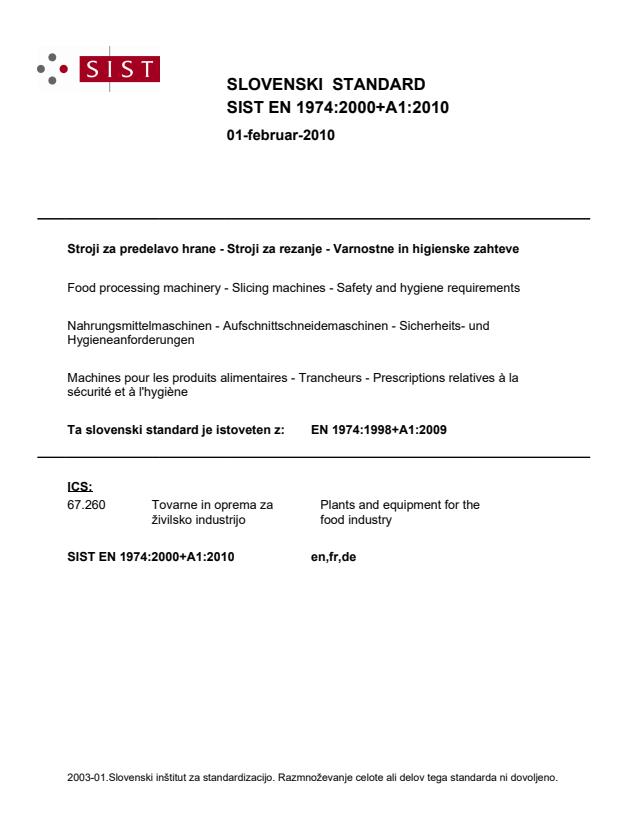
2003-01.Slovenski inštitut za standardizacijo. Razmnoževanje celote ali delov tega standarda ni dovoljeno.Stroji za predelavo hrane - Stroji za rezanje - Varnostne in higienske zahteveNahrungsmittelmaschinen - Aufschnittschneidemaschinen - Sicherheits- und HygieneanforderungenMachines pour les produits alimentaires - Trancheurs - Prescriptions relatives à la sécurité et à l'hygièneFood processing machinery - Slicing machines - Safety and hygiene requirements67.260Tovarne in oprema za živilsko industrijoPlants and equipment for the food industryICS:Ta slovenski standard je istoveten z:EN 1974:1998+A1:2009SIST EN 1974:2000+A1:2010en,fr,de01-februar-2010SIST EN 1974:2000+A1:2010SLOVENSKI
STANDARD
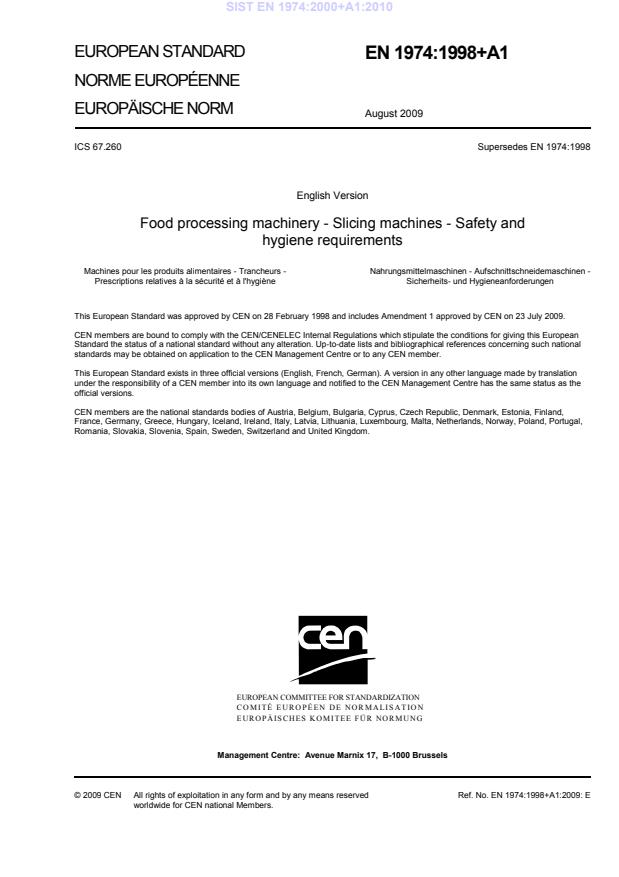
EUROPEAN STANDARD NORME EUROPÉENNE EUROPÄISCHE NORM
EN 1974:1998+A1
August 2009 ICS 67.260 Supersedes EN 1974:1998English Version
Food processing machinery - Slicing machines - Safety and hygiene requirements
Machines pour les produits alimentaires - Trancheurs - Prescriptions relatives à la sécurité et à l'hygiène
Nahrungsmittelmaschinen - Aufschnittschneidemaschinen -Sicherheits- und Hygieneanforderungen This European Standard was approved by CEN on 28 February 1998 and includes Amendment 1 approved by CEN on 23 July 2009.
CEN members are bound to comply with the CEN/CENELEC Internal Regulations which stipulate the conditions for giving this European Standard the status of a national standard without any alteration. Up-to-date lists and bibliographical references concerning such national standards may be obtained on application to the CEN Management Centre or to any CEN member.
This European Standard exists in three official versions (English, French, German). A version in any other language made by translation under the responsibility of a CEN member into its own language and notified to the CEN Management Centre has the same status as the official versions.
CEN members are the national standards bodies of Austria, Belgium, Bulgaria, Cyprus, Czech Republic, Denmark, Estonia, Finland, France, Germany, Greece, Hungary, Iceland, Ireland, Italy, Latvia, Lithuania, Luxembourg, Malta, Netherlands, Norway, Poland, Portugal, Romania, Slovakia, Slovenia, Spain, Sweden, Switzerland and United Kingdom.
EUROPEAN COMMITTEE FOR STANDARDIZATION
COMITÉ EUROPÉEN DE NORMALISATION EUROPÄISCHES KOMITEE FÜR NORMUNG
Management Centre:
Avenue Marnix 17,
B-1000 Brussels © 2009 CEN All rights of exploitation in any form and by any means reserved worldwide for CEN national Members. Ref. No. EN 1974:1998+A1:2009: ESIST EN 1974:2000+A1:2010
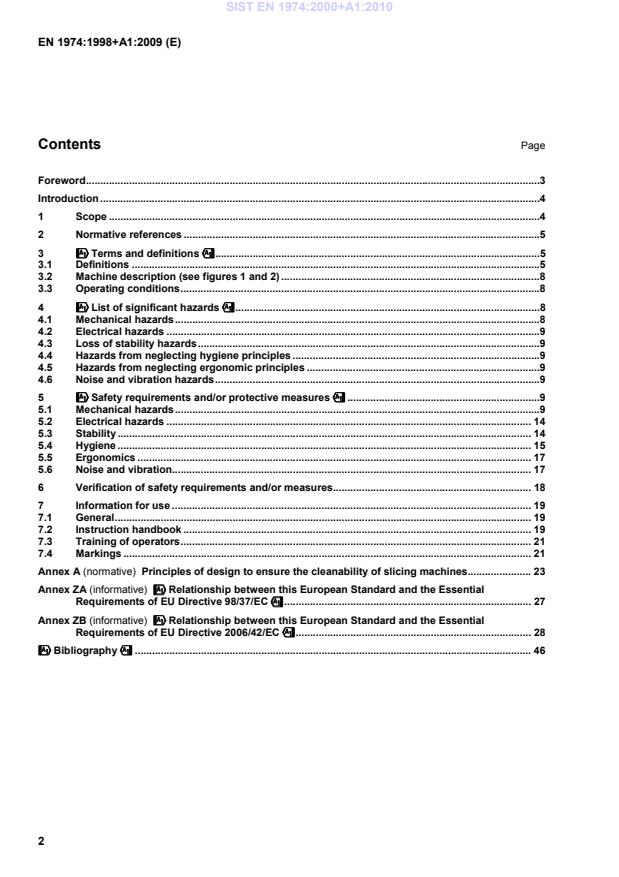
Principles of design to ensure the cleanability of slicing machines. 23Annex ZA (informative)
!!!!Relationship between this European Standard and the Essential
Requirements of EU Directive 98/37/EC"""" . 27Annex ZB (informative)
!!!!Relationship between this European Standard and the Essential
Requirements of EU Directive 2006/42/EC"""" . 28!!!!Bibliography"""" . 46 SIST EN 1974:2000+A1:2010
...