

CEN/TR 17828:2022
(Main)Road infrastructure - Automated vehicle interactions - Reference Framework Release 1
- Abstract
This document provides the current road equipment suppliers’ visions and their associated short term and medium-term priority deployment scenarios. Potential functional/operational standardization issues enabling a safe interaction of road equipment/infrastructure with automated vehicles in a consistent and interoperable way are identified. This is paving the way for a deeper analysis of standardization actions which are necessary for the deployment of priority short-time applications and use cases.
This deeper analysis will be done at the level of each priority application/use case by identifying existing standards to be used, standards gaps/overlaps and new standards to be developed to support this deployment.
The release 1 is focusing on short-term (2022 to 2027) and medium-term deployment. Further releases will update this initial vision according to short term deployment reality.
The objectives of this document are to:
- Support the TC 226 and its WG12 work through the development of a common vision of the roles and responsibilities of a modern, smart road infrastructure in the context of the automated vehicle deployment from SAE level 1 to SAE level 5. The roles and responsibilities of the road infrastructure are related to its level of intelligence provided by functions and data being managed at its level.
- Promote the road equipment suppliers and partners visions associated to their short-term and medium- term priorities to European SDOs and European Union with the goal of having available relevant, consistent standards sets enabling the identified priority deployment scenarios.
NOTE Road equipment/infrastructure includes the physical reality as its digital representation (digital twin). Both need to present a real time consistency.
- Status
- Published
- Publication Date
- 21-Jun-2022
- Technical Committee
- CEN/TC 226 - Road equipment
- Drafting Committee
- CEN/TC 226/WG 12 - Road interaction - ADAS / Autonomous vehicles
- Current Stage
- 6060 - Definitive text made available (DAV) - Publishing
- Start Date
- 22-Jun-2022
- Due Date
- 20-Aug-2021
- Completion Date
- 22-Jun-2022



Overview
CEN/TR 17828:2022 - Road infrastructure: Automated vehicle interactions (Reference Framework Release 1) defines a common vision and pre‑standardization roadmap for how modern, smart road infrastructure should interact with automated vehicles. Focused on short‑term (2022–2027) and medium‑term deployments, this CEN technical report captures road equipment suppliers’ priorities, identifies potential standardization issues, and paves the way for deeper analysis of standards needed to enable safe, consistent and interoperable interactions between infrastructure and vehicles (SAE levels 1–5). The document explicitly treats the physical road environment and its digital twin as needing real‑time consistency.
Key topics
- Roles & responsibilities of road infrastructure versus vehicle systems, tied to the infrastructure’s level of intelligence and data management.
- Operational Design Domain (ODD) considerations for infrastructure‑assisted automation.
- Functional distribution and interaction modes: cooperative, model‑based, fusion and autonomous safety interactions between roadside equipment and vehicle ADAS.
- Functional safety & redundancy principles to ensure fault‑tolerant interactions.
- System requirements for interoperability, performance, scalability and security of ITS elements.
- Deployment scenarios & prioritization: short‑ and medium‑term use cases (e.g., digital mapping, dynamic navigation, corridor management, parking/valet, VRU support, platooning, intersection assistance, tolling).
- Digital twin requirements - ensuring real‑time alignment between physical infrastructure and its digital representation.
- Standardization pathway: identification of existing standards to reuse, gaps/overlaps, and needs for new standards per prioritized applications.
Applications
CEN/TR 17828 is practical for planning and deploying infrastructure that cooperates with automated vehicles. Typical applications include:
- Accurate digital mapping and dynamic navigation support for automated driving.
- Contextual corridor management and dedicated lanes for mixed traffic.
- Roadside support for vulnerable road user (VRU) safety and platoon management.
- Automated parking, tolling approaches and intersection crossing assistance.
- Integration of C‑ITS elements into public warning systems and energy distribution for automated fleets.
Who should use this standard
- Road equipment and ITS suppliers
- Road authorities, infrastructure managers and local governments
- Vehicle manufacturers and ADAS/automated driving system integrators
- Standards developers (CEN TC226 / WG12), policymakers and regulators
- Researchers and urban mobility planners
Related standards & next steps
Release 1 is a reference framework guiding WG12’s next pre‑standardization studies. It maps priority use cases to existing standards and flags gaps for new standard development. For adoption guidance or feedback, consult your national standards body or CEN/TC 226.
Get Certified
Connect with accredited certification bodies for this standard

BSI Group
BSI (British Standards Institution) is the business standards company that helps organizations make excellence a habit.

TÜV Rheinland
TÜV Rheinland is a leading international provider of technical services.

TÜV SÜD
TÜV SÜD is a trusted partner of choice for safety, security and sustainability solutions.
Sponsored listings
Frequently Asked Questions
CEN/TR 17828:2022 is a technical report published by the European Committee for Standardization (CEN). Its full title is "Road infrastructure - Automated vehicle interactions - Reference Framework Release 1". This standard covers: This document provides the current road equipment suppliers’ visions and their associated short term and medium-term priority deployment scenarios. Potential functional/operational standardization issues enabling a safe interaction of road equipment/infrastructure with automated vehicles in a consistent and interoperable way are identified. This is paving the way for a deeper analysis of standardization actions which are necessary for the deployment of priority short-time applications and use cases. This deeper analysis will be done at the level of each priority application/use case by identifying existing standards to be used, standards gaps/overlaps and new standards to be developed to support this deployment. The release 1 is focusing on short-term (2022 to 2027) and medium-term deployment. Further releases will update this initial vision according to short term deployment reality. The objectives of this document are to: - Support the TC 226 and its WG12 work through the development of a common vision of the roles and responsibilities of a modern, smart road infrastructure in the context of the automated vehicle deployment from SAE level 1 to SAE level 5. The roles and responsibilities of the road infrastructure are related to its level of intelligence provided by functions and data being managed at its level. - Promote the road equipment suppliers and partners visions associated to their short-term and medium- term priorities to European SDOs and European Union with the goal of having available relevant, consistent standards sets enabling the identified priority deployment scenarios. NOTE Road equipment/infrastructure includes the physical reality as its digital representation (digital twin). Both need to present a real time consistency.
This document provides the current road equipment suppliers’ visions and their associated short term and medium-term priority deployment scenarios. Potential functional/operational standardization issues enabling a safe interaction of road equipment/infrastructure with automated vehicles in a consistent and interoperable way are identified. This is paving the way for a deeper analysis of standardization actions which are necessary for the deployment of priority short-time applications and use cases. This deeper analysis will be done at the level of each priority application/use case by identifying existing standards to be used, standards gaps/overlaps and new standards to be developed to support this deployment. The release 1 is focusing on short-term (2022 to 2027) and medium-term deployment. Further releases will update this initial vision according to short term deployment reality. The objectives of this document are to: - Support the TC 226 and its WG12 work through the development of a common vision of the roles and responsibilities of a modern, smart road infrastructure in the context of the automated vehicle deployment from SAE level 1 to SAE level 5. The roles and responsibilities of the road infrastructure are related to its level of intelligence provided by functions and data being managed at its level. - Promote the road equipment suppliers and partners visions associated to their short-term and medium- term priorities to European SDOs and European Union with the goal of having available relevant, consistent standards sets enabling the identified priority deployment scenarios. NOTE Road equipment/infrastructure includes the physical reality as its digital representation (digital twin). Both need to present a real time consistency.
CEN/TR 17828:2022 is classified under the following ICS (International Classification for Standards) categories: 35.240.60 - IT applications in transport; 43.020 - Road vehicles in general; 93.080.99 - Other standards related to road engineering. The ICS classification helps identify the subject area and facilitates finding related standards.
CEN/TR 17828:2022 is available in PDF format for immediate download after purchase. The document can be added to your cart and obtained through the secure checkout process. Digital delivery ensures instant access to the complete standard document.
Standards Content (Sample)
SLOVENSKI STANDARD
01-september-2022
Cestna infrastruktura - Avtomatizirane interakcije vozil - Referenčni okvir, različica
Road infrastructure - Automated vehicle interactions - Reference Framework Release 1
Straßeninfrastruktur - Bezugsrahmen für die Interaktion automatisierter Fahrzeuge
Interactions Infrastructure routière - Véhicule automatisé : Cadre de référence Version 1
Ta slovenski standard je istoveten z: CEN/TR 17828:2022
ICS:
35.240.60 Uporabniške rešitve IT v IT applications in transport
prometu
43.020 Cestna vozila na splošno Road vehicles in general
93.080.99 Drugi standardi v zvezi s Other standards related to
cestnim inženiringom road engineering
2003-01.Slovenski inštitut za standardizacijo. Razmnoževanje celote ali delov tega standarda ni dovoljeno.
CEN/TR 17828
TECHNICAL REPORT
RAPPORT TECHNIQUE
June 2022
TECHNISCHER BERICHT
ICS 35.240.60; 43.020; 93.080.99
English Version
Road infrastructure - Automated vehicle interactions -
Reference Framework Release 1
Interactions Infrastructures routières - Véhicules Straßeninfrastruktur - Bezugsrahmen für die
automatisés - Cadre de référence Interaktion automatisierter Fahrzeuge
This Technical Report was approved by CEN on 6 June 2022. It has been drawn up by the Technical Committee CEN/TC 226.
CEN members are the national standards bodies of Austria, Belgium, Bulgaria, Croatia, Cyprus, Czech Republic, Denmark, Estonia,
Finland, France, Germany, Greece, Hungary, Iceland, Ireland, Italy, Latvia, Lithuania, Luxembourg, Malta, Netherlands, Norway,
Poland, Portugal, Republic of North Macedonia, Romania, Serbia, Slovakia, Slovenia, Spain, Sweden, Switzerland, Turkey and
United Kingdom.
EUROPEAN COMMITTEE FOR STANDARDIZATION
COMITÉ EUROPÉEN DE NORMALISATION
EUROPÄISCHES KOMITEE FÜR NORMUNG
CEN-CENELEC Management Centre: Rue de la Science 23, B-1040 Brussels
© 2022 CEN All rights of exploitation in any form and by any means reserved Ref. No. CEN/TR 17828:2022 E
worldwide for CEN national Members.
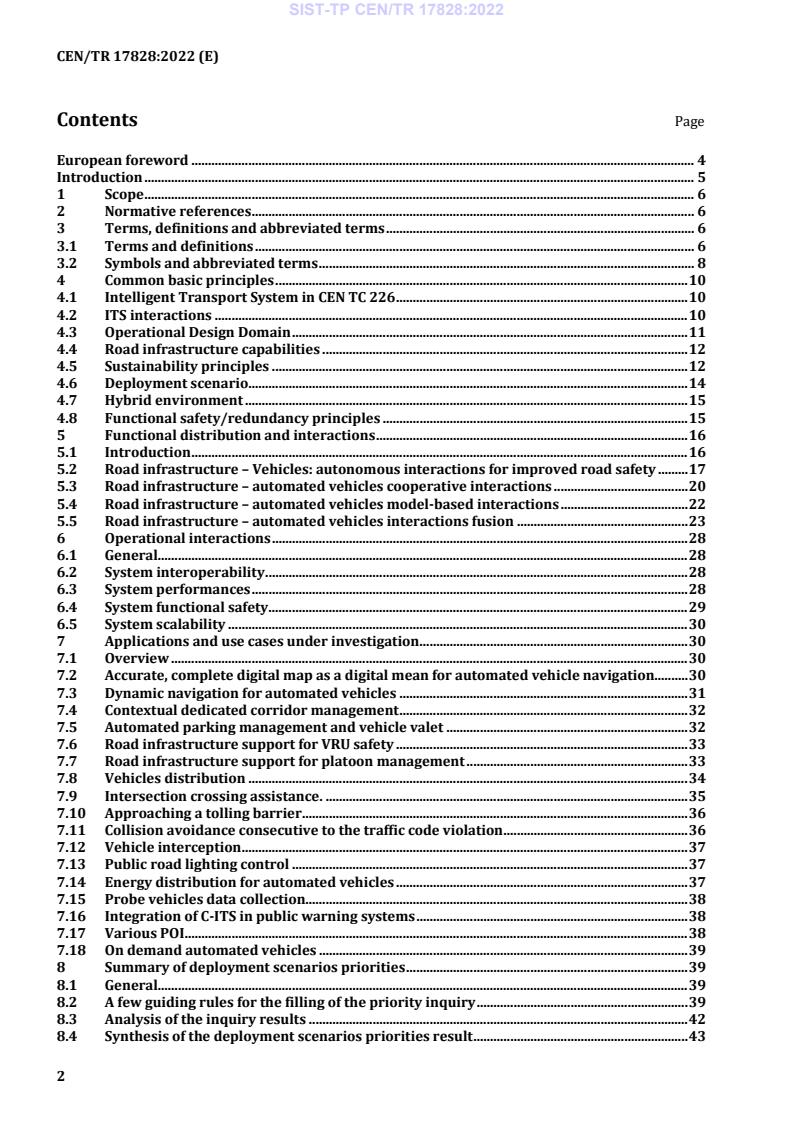
Contents Page
European foreword . 4
Introduction . 5
1 Scope . 6
2 Normative references . 6
3 Terms, definitions and abbreviated terms . 6
3.1 Terms and definitions . 6
3.2 Symbols and abbreviated terms . 8
4 Common basic principles . 10
4.1 Intelligent Transport System in CEN TC 226 . 10
4.2 ITS interactions . 10
4.3 Operational Design Domain . 11
4.4 Road infrastructure capabilities . 12
4.5 Sustainability principles . 12
4.6 Deployment scenario . 14
4.7 Hybrid environment . 15
4.8 Functional safety/redundancy principles . 15
5 Functional distribution and interactions . 16
5.1 Introduction . 16
5.2 Road infrastructure – Vehicles: autonomous interactions for improved road safety . 17
5.3 Road infrastructure – automated vehicles cooperative interactions . 20
5.4 Road infrastructure – automated vehicles model-based interactions . 22
5.5 Road infrastructure – automated vehicles interactions fusion . 23
6 Operational interactions . 28
6.1 General. 28
6.2 System interoperability . 28
6.3 System performances . 28
6.4 System functional safety . 29
6.5 System scalability . 30
7 Applications and use cases under investigation. . 30
7.1 Overview . 30
7.2 Accurate, complete digital map as a digital mean for automated vehicle navigation. 30
7.3 Dynamic navigation for automated vehicles . 31
7.4 Contextual dedicated corridor management . 32
7.5 Automated parking management and vehicle valet . 32
7.6 Road infrastructure support for VRU safety . 33
7.7 Road infrastructure support for platoon management . 33
7.8 Vehicles distribution . 34
7.9 Intersection crossing assistance. . 35
7.10 Approaching a tolling barrier . 36
7.11 Collision avoidance consecutive to the traffic code violation . 36
7.12 Vehicle interception . 37
7.13 Public road lighting control . 37
7.14 Energy distribution for automated vehicles . 37
7.15 Probe vehicles data collection. 38
7.16 Integration of C-ITS in public warning systems . 38
7.17 Various POI. 38
7.18 On demand automated vehicles . 39
8 Summary of deployment scenarios priorities . 39
8.1 General. 39
8.2 A few guiding rules for the filling of the priority inquiry . 39
8.3 Analysis of the inquiry results . 42
8.4 Synthesis of the deployment scenarios priorities result . 43
9 Long-term evolution . 45
10 Economic & organizational potential impacts . 46
10.1 General . 46
10.2 Roles and responsibilities . 46
10.3 Organizational impacts . 46
10.4 Economic impacts . 49
11 Projected standardization approaches for identified priority applications. 50
11.1 General . 50
11.2 Contextual, dedicated corridor management . 50
11.3 Road infrastructure support for VRUs safety . 50
11.4 Parking management . 51
11.5 Vehicles’ distribution . 51
11.6 Approaching a tolling barrier . 51
11.7 Accurate digital map . 52
11.8 Dynamic navigation . 52
11.9 Intersection crossing assist. 52
11.10 Platooning . 53
Bibliography . 54
European foreword
This document (CEN/TR 17828:2022) has been prepared by Technical Committee CEN/TC 226 “Road
equipment”, the secretariat of which is held by AFNOR.
This document provides a pre-standardization study for the road infrastructure – automated vehicle
interactions which will be used by WG12 as a reference framework for the development of other pre-
standardization studies.
Attention is drawn to the possibility that some of the elements of this document may be the subject of
patent rights. CEN shall not be held responsible for identifying any or all such patent rights.
Any feedback and questions on this document should be directed to the users’ national standards body.
A complete listing of these bodies can be found on the CEN website.
Introduction
A shared general vision between the main stakeholders which are involved in the development and
deployment of automated vehicles is that their complexity requires a constant effort to converge toward
safe, interoperable solutions.
This complexity is related to the considered mobility environment, in terms of road topography, traffic
and weather conditions, human behaviour, vehicle diversity, etc.
This led these main stakeholders to think that it is necessary, in a certain number of situations, to provide
some forms of cooperation between the roadside infrastructure (road equipment) and automated
vehicles.
Such necessity is reinforced through the fact that the deployment of automated vehicles will be
progressive, leading to a heterogeneous mix of different levels of automated vehicles from not automated
in-service vehicles (SAE level 0) to fully automated vehicles (SAE levels 4 &5).
This cooperation will require different forms of interactions between the road equipment and the
embedded ADAS of automated vehicles. These interactions should be reliable and secure in such a way to
be fault tolerant during the fulfilment of the main functions of the automated vehicle. This latest
constraint means that system redundancy will be a key element ensuring the required functional safety
of the system.
1 Scope
This document provides the current road equipment suppliers’ visions and their associated short term
and medium-term priority deployment scenarios. Potential functional/operational standardization
issues enabling a safe interaction of road equipment/infrastructure with automated vehicles in a
consistent and interoperable way are identified. This is paving the way for a deeper analysis of
standardization actions which are necessary for the deployment of priority short-time applications and
use cases.
This deeper analysis will be done at the level of each priority application/use case by identifying existing
standards to be used, standards gaps/overlaps and new standards to be developed to support this
deployment.
The release 1 is focusing on short-term (2022 to 2027) and medium-term deployment. Further releases
will update this initial vision according to short term deployment reality.
The objectives of this document are to:
— Support the TC 226 and its WG12 work through the development of a common vision of the roles and
responsibilities of a modern, smart road infrastructure in the context of the automated vehicle
deployment from SAE level 1 to SAE level 5. The roles and responsibilities of the road infrastructure
are related to its level of intelligence provided by functions and data being managed at its level.
— Promote the road equipment suppliers’ and partners’ visions associated to their short-term and
medium- term priorities to European SDOs and the European Union with the goal of having available
relevant, consistent standards sets enabling the identified priority deployment scenarios.
NOTE Road equipment/infrastructure includes the physical reality as its digital representation (digital twin).
Both need to present a real time consistency.
2 Normative references
There are no normative references in this document.
3 Terms, definitions and abbreviated terms
For the purposes of this document, the following terms, definitions and abbreviated terms apply.
3.1 Terms and definitions
3.1.1
use case
specific situation describing stakeholders’ interactions which illustrate the execution of one or several
customers’ service(s) via support applications
Note 1 to entry: The stakeholders’ interactions are represented via standardized exchanges between elements
constituting the Intelligent Transport System (ITS).
3.1.2
user
equipped or un-equipped road user such as drivers, vulnerable road users and suppliers which are
themselves accessing services provided by a private or public organization
3.1.3
personal ITS-S
ITS-S in a nomadic ITS sub-system in the context of a portable device
3.1.4
traffic scenario
possible behavioural of a use case situation in the form of a sequence of events that affect the mobility
and safety with respect to the initial situation
Note 1 to entry: Scenario is defined in terms of the positioning of a User and other road users, environmental
situations, the system equipment, and any obstacles and environmental conditions hampering the detectability of
the User, the behavioural relations and communication performance of the ITS system. Therefore, the sequence of
events includes road user activities, movement of obstacles, and changes in the conditions that affect the VRU safety
with respect to the initial situation.
3.1.5
deployment scenarios
main steps to be followed to deploy and manage a functionally and operationally specified system during
its whole life cycle, starting with the system installation and commissioning and finishing with its
recycling
Note 1 to entry: If the system is a new one, its compatibility with existing legacy systems needs to be considered.
3.1.6
manoeuvres
specific and recognized movements bringing an actor, e.g. vulnerable road user, vehicle or any other form
of transport, from one position to another with a given velocity (dynamic)
3.1.7
traffic conflict
situation involving two or more moving users or vehicles approaching each other in such a way that a
traffic collision would ensue unless at least one of the users or vehicles performs an emergency
manoeuvre
Note 1 to entry: Traffic conflicts are defined by the following parameters:
— traffic conflict point (time and space) where the trajectories intersect,
— time-to-collision, distance-to-collision, post-encroachment time, and angle of conflict.
3.1.8
road
way allowing the passage of vehicles, people and/or animals that is made of none, one or a combination
of the following lanes: driving lane, bicycle lane and sidewalk
3.1.9
vehicle
road vehicle designed to legally carry people or cargo on public roads and highways such as busses, cars,
trucks, vans, motor homes, and motorcycles
Note 1 to entry: This does not include motor driven vehicles not approved for use of the road, such as forklifts or
marine vehicles.
3.1.10
vru
non-motorized road users as well as L class of vehicles
Note 1 to entry: L class of vehicles are defined in Annex I of EU Regulation 168/2013.
3.1.11
vru-s
ensemble of ITS stations interacting with each other to support VRU user cases, e.g. personal ITS-S, vehicle
ITS-S, roadside ITS-S or Central ITS-S
3.2 Symbols and abbreviated terms
ACC Adaptive Cruise Control
ADAS Advanced Driving Assistance System
AEBS Advanced Emergency Braking System
CACC Cooperative Adaptive Cruise Control
CAM Cooperative Awareness Message
CCAM Cooperative, Connected Automated Mobility
CDA Cooperative Driving Automation
CEDR Conférence Européenne des Directeurs de Routes
CPM Collaborative Perception Message
CPS Collaborative Perception Service
C-ITS Cooperative ITS
CMC Connected Motorcycle Consortium
C2C-CC Car to Car Communication Consortium
DENM Decentralized Environmental Notification Message
DDT Dynamic Driving Task
FMECA Failure Mode Effects and Criticality Analysis
GLOSA Green Light Optimal Speed Advisory
GNSS Global Navigation Satellite System
ISAD Infrastructure Support levels for Automated Driving
ITS Intelligent Transport System
ITS-S ITS Station
IVI In Vehicle Information
IVIM Infrastructure to Vehicle Information Message
LDM Local Dynamic Map
LTCA Long Term Certificate Administration
MANTRA Making full use of Automation for National Road Transport Authorities
MAP Map
MCO: Multi Channel Operation
MCM Manoeuvre Coordination Message
MCS Manoeuvre Coordination Service
ODD Operational Design Domain
PAC V2X Perception Augmented by Cooperation V2X
PCA Pseudonyms Certificates Administration
POI Point Of Interest
POTI Position and Time management
ROI Return On Investment
RSU Roadside Unit
RTCM Radio Technical Commission for Maritime services
RTCMEM RTCM Extended Message
RTK Real Time Kinematic
SAE Society of Automotive Engineers
SDO Standards Development Organization
SPaT Signal Phase and Timing
STF: Specialist Task Force
TCU Telematic Control Unit
TTC Time-To-Collision
TVRA Threat Vulnerability Risk Analysis
V2I Vehicle to Infrastructure
V2V Vehicle to Vehicle
V2X Vehicle to X
VAM VRU Awareness Message
VBS VRU Awareness Basic Service
VITS-S Vehicle ITS Station
VRU Vulnerable Road Users
VRU-S Vulnerable Road User System
4 Common basic principles
4.1 Intelligent Transport System in CEN TC 226
According to the European Commission ITS Directive (2010/40/EU), Intelligent Transport Systems (ITS)
are advanced applications which without embodying intelligence as such aim to provide innovative
services relating to different modes of transport and traffic management and enable various users to be
better informed and make safer, more coordinated and "smarter" use of transport networks.
ITS integrate telecommunications, electronics and information technologies with transport engineering
in order to plan, operate, maintain and manage transport systems.
The TC 226 WG12 is focusing on the road interaction- ADAS / Automated vehicles, meaning that the
considered ITS is composed of at least two elements: The road infrastructure and the automated vehicle
(including its ADAS) which are interacting together.
The inclusion of automated vehicle in ITS leads automatically to the design and development of innovative
services as such system elements are not yet deployed. The automated vehicle standardization is already
considered in CEN TC 278, ETSI TC ITS and ISO TC 204 which are all focusing on ITS.
It is then the object of this WG12 to work on the identification of these innovative services, their selection
and the associated standardization needs in strong liaisons with the on-going ITS standardization work.
4.2 ITS interactions
An ITS may exhibit several types of interactions which are relevant to all TC 226 WGs. These types of
interactions are relative of the functional distribution of the information technologies, data and
communication means:
The road may be passive, not embodying some information technology. Examples are the horizontal
marking or the vertical signs. However, even such a passive road is designed with a lot of human
intelligence. In this case, the interactions with automated vehicles' embedded ADAS are mainly achieved
by the vehicle itself using some relevant sensors (ADAS: for example, cameras, radars, lidars). In this case,
advanced applications will analyse the collected perception data of the vehicle for automatically, safely
guiding it.
Mobile objects (e.g. vehicles, Vulnerable Road Users (VRUs), obstacles, etc.) can also be passively
perceived by vehicle sensors and then processed by advanced applications for collision avoidance
purposes.
The road infrastructure and mobile objects may be equipped with electronic devices, information
processing and telecommunication technologies enabling them to interact and cooperate via standard
communication protocols and information exchanges (standard message sets).
Several interaction capabilities are existing at the level of automated vehicles (see Figure 1). These
capabilities are constituting a de-facto redundancy system which can be used to detect an ITS failure or a
cyberattack and then automatically reconfigure the system to maintain its operationality. However, this
advantage requires constantly verifying the consistency of existing interactions results which are
providing several sources of information (e.g. the consistency between the horizontal marking / vertical
signing and the digital twin, or the consistency between the vehicle autonomous perception and received
remote perception via C-ITS).
Direct interactions between the road infrastructure and the automated vehicles are made using actuators
and sensors which need to respect minimum quality requirements according to the vehicles ADASs which
are using the collected data. These autonomous interactions can be disturbed consecutively to their
quality degradation, visibility problems (obstacles or bad weather conditions) or absence.
Cooperative ITS (C-ITS) and more generally vehicles’ connectivity is achieved via radio
telecommunication (local ad-hoc networks (short range) or global networks (long range)) which of
course may be not always available.
A local dynamic map should be accurate enough and complete, reflecting the horizontal marking and
vertical signing. The vehicles’ map matching is also requiring an accurate vehicle positioning system
which is not yet available. A positioning system or the associated digital map should be fault tolerant,
resilient in case of temporary perception problems.
Figure 1 — Three categories of interactions between the automated vehicles and its
environment
The consistency of the WG12 approach shall be maintained between Task Groups (TGs) cooperation:
— TG1 needs to consider the perception data fusion between locally collected perception data, remote
perception data received from the ITS connectivity and digital data provided by the embedded vehicle
Local Dynamic Map (LDM).
— TG4 also needs to maintain the consistency between the Local Digital Map data and the perception
data received from local vehicle’s sensors.
4.3 Operational Design Domain
Operational Design Domain (ODD) is a description of the specific operating conditions in which the
automated driving system is designed to properly operate, including but not limited to roadway types,
speed range, environmental conditions (weather, daytime / night-time, etc.), prevailing traffic law and
regulations, and other domain constraints [41]. An ODD can be very limited: for instance, a single fixed
route on low-speed public streets or private grounds (such as business parks) in temperate weather
conditions during daylight hours (Waymo 2017).
The ODD is relevant to all level of automation except for 0 (not applicable) and 5 (unlimited). Any
automation use case of level 1 to 4 is usable only in its specific ODD.
4.4 Road infrastructure capabilities
The deployment of automated vehicles needs some evolution of the road infrastructure capabilities, as
currently, in-service road infrastructure and equipment are designed only for human driven vehicles.
However, such evolution must respect the long-term cohabitation of automated vehicles with human
driven vehicles (hybrid environment being discussed here below).
An automated vehicle needs to know if the road infrastructure offers the expected capabilities to stay in
automated mode. If it is not the case, SAE level 1 to 3 vehicles may transfer their driving control to the
human driver who is still available in the vehicle. However, this transfer decision needs to respect some
transition rules ensuring that the driver is ready to take back control of the vehicle. Driving mode transfer
is then requiring an anticipation (prediction) of the loss of the road infrastructure capability to support
automated vehicles motions.
SAE level 4 and 5 vehicles may not have a human driver inside, however, in such cases they need to be
remotely supervised with the objective to be remotely controlled (at least partly) if the road
infrastructure no longer offers the expected capabilities.
The Inframix European project proposed an infrastructure categorization model, represented in Figure 2
(ISAD: Infrastructure Support levels for Automated Driving) [33].
Figure 2 — ISAD levels
4.5 Sustainability principles
The life cycles of vehicles and road infrastructures are covering different long periods of time from their
engineering phase to their recycling phase (see Figure 3). These periods of time may be different for the
two main system elements (road infrastructure and vehicles).
Interactions between the road infrastructure and the automated vehicles need standard exchange
protocols which are not independent of technologies being used. Moreover, preventive, corrective and
evolutive maintenance operations need to manage them consistently.
One important operational requirement is the interoperability between interacting road infrastructure
elements and automated vehicles elements. This interoperability needs to be maintained during the life
cycle of both the road infrastructure and automated vehicles.
This interoperability necessity imposes a specific change management process enabling the secured
cohabitation, during determined periods of time, of several versions of standard information exchange
protocols without cross disturbances of operational ITS. Different versions need to cohabit together
without operational problems.
Such specific change management processes need to be applied in strong concertation between the
vehicles’ manufacturers and the road operators/managers who have the responsibility to develop
together some migration plan including a common and consistent selection of changes to be considered
as well as its deployment operation.
Figure 3 — ITS life cycle
The interoperability requirement needs a continuous cooperation between the main stakeholders of the
ITS. This is true at:
— The engineering level for the system and system elements specification. When standards are
required, the standards need to be developed/selected in such a way as to enable a full
interoperability of the constituted system. Generally, the required standards are regrouped into
“profiles” (e.g. “communication profiles”, “security profiles”, “applications profiles” are constituting
what can be called “exchange profiles”).
— The engineering level for the system validation including system elements testing, system integration
and system validation in diverse environments. Then resulting products can be delivered on the
market after a certification/compliance assessment validating their functionality, interoperability
and safe operation in targeted environments.
— During the system operation when new versions of the system need to be delivered. In such cases, a
change management process is enabling the ITS stakeholders to agree on interoperable evolutions
constituting the new version. Some migration plans have then to be proposed to avoid maintaining
too many different versions simultaneously.
— The hardware component recycling needs to be considered during their engineering phase.
4.6 Deployment scenario
A deployment scenario is a set of activities (steps of the scenario) which lead to the market delivery of
new customer services supported by applications and targeting identified use cases (situations of usage).
The following activities can be considered as being the main ones belonging to the identified deployment
scenarios involving automated vehicles and a supporting smart road infrastructure:
— Development / stabilization of a relevant set of standards per identified deployment scenario. These
standards are judged necessary for the interoperability of automated vehicles and the road
infrastructure during their identified interactions whatever the type of interactions.
— Development and stabilization of the test standards which are judged necessary for the standards
compliance assessment of developed products which are proposed to be delivered on the market.
— Achievement of the validation/certification procedures which are made mandatory to achieve the
compliance assessment and the quality verification of proposed products and subsystems.
— Possibly some pre-deployment projects completing the validation/certification process with the
objective to verify the good operation of a set of certified products constituting an ITS.
For short-term deployment scenarios, it is considered that this set of activities can be achieved by the
vehicles and the road equipment industries within a 5-year period (2 years for the development of
standards (basic and tests) and 3 years for the pre-deployment projects).
For medium-term deployment scenarios, it is considered that also 5 years are necessary, but starting at
the start of the short-term deployment, that is to say within 10 years.
NOTE A deployment scenario can be resulting from research or Proof of Concept (POC) project(s) which might
be proposing new standards or evolutions of existing standards.
Consequently, a deployment scenario can be applied to a new identified customer service which is
supported by a given application used in well identified situations (use cases). Such approach is
illustrated in Figure 4.
Figure 4 — Illustration of relationships existing between a new customer service and its
deployment.
Customer service definition -> supporting application-> main use cases -> deployment scenario including
a standardization activity.
4.7 Hybrid environment
The deployment of the automated vehicles from SAE level 1 to 5 will take a long time (at least 20 to 30
years). Consequently, the road infrastructure will have to interact with a diversity of vehicles from non-
connected/cooperative in-service vehicles to fully connected/cooperative vehicles of several deployed
versions. The first version of cooperative vehicles, which deployment is starting is called release 1, but
other releases are under specification and validation (release 1.5, release 2 in ETSI and CEN / ISO focusing
more on automated vehicles).
For a long time, connected/cooperating vehicles will only be partly automated (level 1 to 3) with some of
them (e.g. shuttles, taxis) running in protected environments (level 4). This is leading to the cohabitation
on the same road infrastructure of human driven vehicles and automated vehicles which may have to
transit to a human driving mode if the road infrastructure doesn’t have the capability to support them.
Such a hybrid environment is creating problems to the automated vehicle as human driven vehicles
behaviours are not predictable as often, they don’t respect the traffic code, while automated vehicles must
respect it.
One interesting characteristic of automated vehicles is this respect of the traffic code as this may have a
quick impact on all vehicles which can be de facto constrained to act similarly when following automated
vehicles.
Automated vehicles are cooperating (V2V) and are cooperating with the road infrastructure (V2I) so
acting to increase road safety and traffic efficiency. Consequently, if more cooperative vehicles are present
in traffic, it is possible to better control the traffic in terms of safety and efficiency.
4.8 Functional safety/redundancy principles
Automated vehicles are robots which are executing program instructions respecting the road traffic code
and other rules which must avoid severe accidents causing human fatalities or injuries. For this purpose,
automated vehicles need to constantly have a complete perception of their environment via the identified
interactions previously mentioned in 4.2. Then, the whole operational ITS needs to remain functional,
satisfying its minimum performances requirement. This is called functional safety and includes the
management of the following situations:
Failure of hardware/software components at the ITS level (not only in the automated vehicle itself but
also in other elements of the system including the road infrastructure in case of cooperation). In the
vehicle industry, the FMECA (Failure Mode Effect and Criticality Analysis) methodology is used to analyse
the functional safety risks and their likelihood with the objective to mitigate them (fault tolerance) in such
a way to avoid severe accidents. It has to be noted that the software is occupying more and more place
and that new release mixed with the complexity of situations can generate more and more bugs, so more
risk of failure.
Cyberattacks which may also cause some dysfunctions at the ITS level. Cyberattacks may exploit open
interfaces such as telecommunication functions. ETSI TC ITS WG5 has been conducting a TVRA (Threat
Vulnerability Risk Analysis) focusing on ITS G5 technology for proposing a standard security profile
mitigating the risks of cyberattacks. But the automated vehicle was not at that time in the scope of the
study.
Many reports are existing about functional safety and in particular with regard to cybersecurity. The three
following reports are good references:
— Safer Roads with Automated Vehicles [35],
— Good practices for security in Smart cars [36],
— Cybersecurity Challenges in Uptake of Artificial Intelligence in Autonomous Driving [37].
Moreover, two important ISO standards are covering this aspect of functional safety:
ISO 26262 [43] and particularly its Part 3 HARA deals with different aspects of the functional safety in
Automotive. It is designed to eliminate any unacceptable risk to the human life. The purpose of HARA is
to identify the malfunctions that could possibly lead to E/E system hazard and assess the risk associated
to them.
SOTIF (ISO/PAS 21448 [44]) provides guidance on design, verification, and validation measures. Applying
these measures helps you achieve safety in situations without failure.
Examples that ISO 21448 provides:
— Design measure example: requirement for sensor performance,
— Verification measure example: Test cases with high coverage of scenarios,
— Validation measure example: Simulations.
One solution which can be used to overcome some failures / fault is the creation of redundancies at the
level of the ITS. This could be achieved by exploiting the various capabilities of the ITS elements including
the road infrastructure.
As it is shown at the level of ITS interactions, the automated vehicles may have redundant functions which
can at least temporarily overcome the failure of one of them. For example:
A failure of the autonomous perception of the vehicle can be overcome by the local dynamic map or the
remote perception provided by other ITS-S via the C-ITS network.
A failure of C-ITS can be overcome by the local perception of the vehicle.
C-ITS based on local ad-hoc area networks is also offering redundant communication capabilities (several
available channels, see several ad-hoc network technologies (ITS G5, C-V2X). However, standard channels
management should be provided to maintain the ITS-S interoperability. In ETSI, the STF 585 supported
by the European Commission has this objective to develop MCO (Multi-Channel Operation) standards
considering the two available ad-hoc network technologies and their usage for the support of available
services. Moreover, the progressive development of the 5G is also adding a new telecommunication
redundancy. But as 5G is only an access network, generally, it will be necessary to consider the whole
global network (e.g. Internet or local area fibre network) to be used for assessing their performances.
Another solution is the monitoring of the automated vehicles behaviour and performances with the
objective to detect some deviations compared to reference models. This could lead to preventive
maintenance. Such approach is mandatory for automated vehicles level 4 and 5 which need to be
supervised.
5 Functional distribution and interactions
5.1 Introduction
An Intelligent Transport System (ITS) can be composed of several elements which are interacting
together to achieve several objectives. Each system element comprises a set of functions and data which
contribute to the common goals. These functions and data can be distributed (see an example of
distribution in Figure 5) according to different technical, economic, and organizational criteria related to
the respective visions of the main involved stakeholders. A selected functional / data distribution leads
to system elements interactions which need to be identified and specified.
Figure 5 — Example of ITS functional / data distribution
In 5.2, three categories of interactions have been identified which can be existing between the main
elements of an intelligent transport system. These interactions are more detailed in Clause 6:
— 6.2 focuses on direct interactions between the road infrastructure and automated vehicles via their
respective sensors and actioners.
— 6.3 considers cooperative interactions between the road infrastructure and automated vehicles.
— 6.4 considers model-based interactions between a digital representation of the road infrastructure
and ITS evolving dynamic objects and automated vehicles.
The functional / data distribution schema which is retained is immediately impacting the roles and
responsibilities of involved stakeholders.
As identified in 5.2, these three categories of interactions are de-facto constituting a redundant system
which can be used to increase the functional safety of the ITS via the detection of inconsistencies and
automatic reconfiguration.
Interactions between ITS elements which integrate redundant functions enable the fusion of resulting
data. This fusion may then augment the obtained result (e.g. an augmented perception) or may enable the
detection of inconsistency (e.g. the detection a failure or of a cyberattack).
5.2 Road infrastructure – Vehicles: autonomous interactions for improved road safety
rd
The EU 3 Mobility Package (2018) pursues a drastic reduction in accidents, road fatalities and injuries,
by combining the General Safety Regulation (GSR) with the Road Infrastructure Management Directive
(RISM).
CEN/TR 17828:2
...