

EN 13892-6:2002
(Main)Methods of test for screed materials - Part 6: Determination of surface hardness
- Abstract
This European standard specifies a method for determining the surface hardness of moulded mortar specimens made from magnesite screed material or from cementitious screed-, calcium sulfate screed-, and synthetic resin screed material with fine aggregates (
- Status
- Published
- Publication Date
- 19-Nov-2002
- Withdrawal Date
- 30-May-2003
- Technical Committee
- CEN/TC 303 - Floor screeds and in-situ floorings in buildings
- Drafting Committee
- CEN/TC 303/WG 2 - Test methods
- Current Stage
- 9060 - Closure of 2 Year Review Enquiry - Review Enquiry
- Start Date
- 03-Jun-2024
- Completion Date
- 03-Jun-2024

Overview
EN 13892-6:2002 is a CEN test method for determining the surface hardness of screed materials. It specifies how to measure the permanent indentation produced by a steel ball on moulded mortar specimens made from magnesite, cementitious, calcium sulfate or synthetic resin screed materials with fine aggregates (≤ 4 mm). The method also applies to specimens cut from in-situ floor screeds and is intended to support quality control and product assessment for screed materials.
Key Topics
- Scope and applicability
- Applies to screed materials with aggregates smaller than 4 mm.
- Specimens must be prepared and cured according to EN 13892-1.
- Test principle
- Surface hardness is determined from the permanent depth of indentation produced by a polished steel ball under a defined load, and expressed as a hardness value in N/mm².
- Apparatus and measurement
- Steel ball: 10 mm diameter (10 ± 0.01 mm).
- Loads: initial preload (FV) of (10 ± 0.1) N and main load (F) of (500 ± 5) N.
- Dial gauge: precise vertical movement measurement (resolution 0.001 mm), indentation read to 0.01 mm.
- Procedure
- Apply preload, zero or record initial gauge reading, apply main load for 1 minute, unload to preload and measure indentation depth.
- Surface hardness calculated from test parameters; measurements taken on three specimens with arithmetic means reported.
- Reporting
- Test report must include specimen identification, density, preparation/curing details (EN 13892-1), individual hardness values (nearest 0.05 N/mm²) and mean values (nearest 0.1 N/mm²), equipment details and calibration, plus standard reference.
Applications
- Quality control and acceptance testing for manufacturers of screed materials (magnesite, cementitious, calcium sulfate, synthetic resin).
- Product development and comparative performance testing in R&D labs.
- Construction and flooring contractors for verifying cured floor screed surface hardness on-site or from retained specimens.
- Independent testing laboratories performing conformity assessment or compliance checks against product standards such as EN 13813.
Who uses this standard
- Materials and floor screed manufacturers
- Construction quality assurance teams and site inspectors
- Third‑party testing laboratories and certification bodies
- Specifiers and consultants in flooring design and building performance
Related standards
- EN 13892-1 - Sampling, making and curing specimens for test (referenced for specimen preparation)
- EN 13813 - Screed material and floor screeds – Properties and requirements
- EN 13318 - Screed materials and floor screeds – Definitions
Keywords: EN 13892-6, surface hardness, screed materials, test method, steel ball indentation, floor screed testing, magnesite, cementitious screeds, calcium sulfate, synthetic resin screed, EN 13892-1.
Relations
- Refers
EN 13813:2002 - Screed material and floor screeds - Screed material - Properties and requirements - Effective Date
- 28-Jan-2026
- Effective Date
- 28-Jan-2026
Get Certified
Connect with accredited certification bodies for this standard

DIBt (Deutsches Institut für Bautechnik)
German Institute for Building Technology.
DIN CERTCO
DIN Group product certification.

Aboma Certification B.V.
Specialized in construction, metal, and transport sectors.
Sponsored listings
Frequently Asked Questions
EN 13892-6:2002 is a standard published by the European Committee for Standardization (CEN). Its full title is "Methods of test for screed materials - Part 6: Determination of surface hardness". This standard covers: This European standard specifies a method for determining the surface hardness of moulded mortar specimens made from magnesite screed material or from cementitious screed-, calcium sulfate screed-, and synthetic resin screed material with fine aggregates (</- 4mm). The method is also suitable for specimens cut from floor screed.
This European standard specifies a method for determining the surface hardness of moulded mortar specimens made from magnesite screed material or from cementitious screed-, calcium sulfate screed-, and synthetic resin screed material with fine aggregates (</- 4mm). The method is also suitable for specimens cut from floor screed.
EN 13892-6:2002 is classified under the following ICS (International Classification for Standards) categories: 91.100.10 - Cement. Gypsum. Lime. Mortar. The ICS classification helps identify the subject area and facilitates finding related standards.
EN 13892-6:2002 has the following relationships with other standards: It is inter standard links to EN 13813:2002, EN 13892-1:2002. Understanding these relationships helps ensure you are using the most current and applicable version of the standard.
EN 13892-6:2002 is associated with the following European legislation: EU Directives/Regulations: 305/2011, 89/106/EEC; Standardization Mandates: M/132. When a standard is cited in the Official Journal of the European Union, products manufactured in conformity with it benefit from a presumption of conformity with the essential requirements of the corresponding EU directive or regulation.
EN 13892-6:2002 is available in PDF format for immediate download after purchase. The document can be added to your cart and obtained through the secure checkout process. Digital delivery ensures instant access to the complete standard document.
Standards Content (Sample)
2003-01.Slovenski inštitut za standardizacijo. Razmnoževanje celote ali delov tega standarda ni dovoljeno.Prüfverfahren für Estrichmörtel und Estrichmassen - Teil 6: Bestimmung der OberflächenhärteMéthodes d'essai des matériaux pour chapes - Partie 6: Détermination de la dureté superficielleMethods of test for screed materials - Part 6: Determination of surface hardness91.100.10Cement. Mavec. Apno. MaltaCement. Gypsum. Lime. MortarICS:Ta slovenski standard je istoveten z:EN 13892-6:2002SIST EN 13892-6:2003en01-september-2003SIST EN 13892-6:2003SLOVENSKI
STANDARD
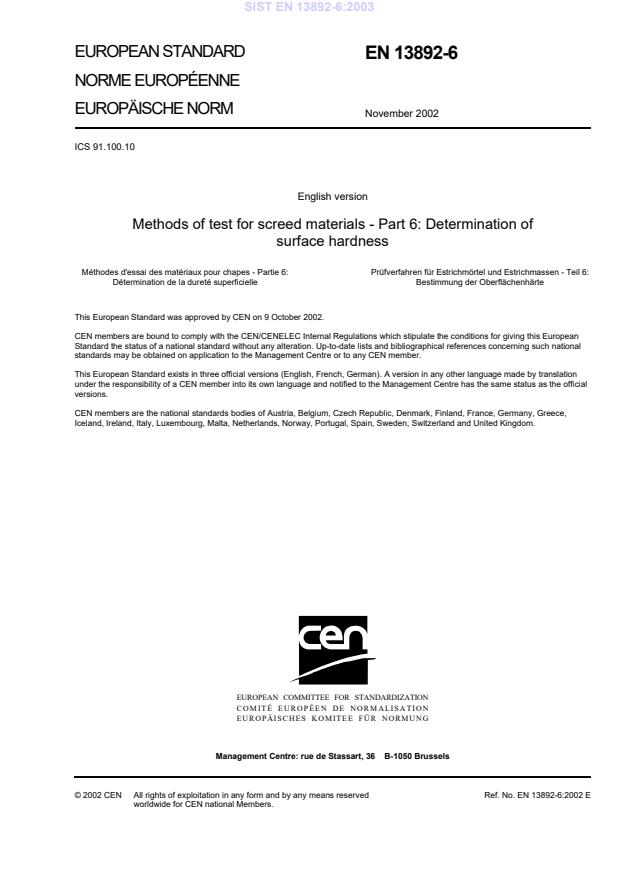
EUROPEAN STANDARDNORME EUROPÉENNEEUROPÄISCHE NORMEN 13892-6November 2002ICS 91.100.10English versionMethods of test for screed materials - Part 6: Determination ofsurface hardnessMéthodes d'essai des matériaux pour chapes - Partie 6:Détermination de la dureté superficiellePrüfverfahren für Estrichmörtel und Estrichmassen - Teil 6:Bestimmung der OberflächenhärteThis European Standard was approved by CEN on 9 October 2002.CEN members are bound to comply with the CEN/CENELEC Internal Regulations which stipulate the conditions for giving this EuropeanStandard the status of a national standard without any alteration. Up-to-date lists and bibliographical references concerning such nationalstandards may be obtained on application to the Management Centre or to any CEN member.This European Standard exists in three official versions (English, French, German). A version in any other language made by translationunder the responsibility of a CEN member into its own language and notified to the Management Centre has the same status as the officialversions.CEN members are the national standards bodies of Austria, Belgium, Czech Republic, Denmark, Finland, France, Germany, Greece,Iceland, Ireland, Italy, Luxembourg, Malta, Netherlands, Norway, Portugal, Spain, Sweden, Switzerland and United Kingdom.EUROPEAN COMMITTEE FOR STANDARDIZATIONCOMITÉ EUROPÉEN DE NORMALISATIONEUROPÄISCHES KOMITEE FÜR NORMUNGManagement Centre: rue de Stassart, 36
B-1050 Brussels© 2002 CENAll rights of exploitation in any form and by any means reservedworldwide for CEN national Members.Ref. No. EN 13892-6:2002 ESIST EN 13892-6:2003
...