

EN 13892-8:2002
(Main)Methods of test for screed materials - Part 8: Determination of bond strength
- Abstract
This European Standard specifies a method for determining the bond strength between a screed and a standard substrate and specifies a method for determining the tensile strength at the surface of specimens made from cementitious screed-, calcium sulfate, screed-, magnesia screed- and synthetic resin screed material. The method is also suitable for floor screeds for determining the tensile strength at the surface of the floor screed or for determining the bond strength between a bonded floor screed and a base.
- Status
- Published
- Publication Date
- 19-Nov-2002
- Withdrawal Date
- 30-May-2003
- Technical Committee
- CEN/TC 303 - Floor screeds and in-situ floorings in buildings
- Drafting Committee
- CEN/TC 303/WG 2 - Test methods
- Current Stage
- 9060 - Closure of 2 Year Review Enquiry - Review Enquiry
- Start Date
- 03-Jun-2024
- Completion Date
- 03-Jun-2024

Overview
EN 13892-8:2002 is a European Standard issued by CEN that outlines a standardized method for determining the bond strength between screed materials and a defined substrate. It applies to various screed types, including cementitious screeds, calcium sulfate screeds, magnesia screeds, and synthetic resin screeds. The standard is crucial for assessing the tensile strength at the surface of screed specimens and the bond strength in bonded floor screeds, ensuring reliable evaluation of flooring system performance.
This standard ensures consistent testing protocols across Europe, enhancing quality assurance in the construction and flooring industries. It supports manufacturers, laboratories, and construction professionals in verifying screed adhesion and surface strength according to unified procedures.
Key Topics
Scope and Applicable Materials
Applies to cement-based, calcium sulfate, magnesia, and synthetic resin screed materials for bond strength and surface tensile strength testing.Test Principle
Bond strength is determined by applying a perpendicular tensile load to the bond area until failure occurs. The tensile strength is calculated as the ratio of failure load to test area (N/mm²).Apparatus and Test Setup
- Standardized test specimens made from concrete substrate (minimum 300 x 300 x 50 mm)
- Steel pull-head plates (circular or square, 50 mm diameter/side)
- Resin-based adhesive to bond pull-head plates onto screed surface
- Core drilling or diamond sawing equipment for precise test sample preparation
- Pull-off test equipment with at least 10 kN capacity and ±2% accuracy
Procedure
- Specimens are prepared and cured following EN 13892-1.
- Pull-head plates are adhered centrally on cored or cut test areas (~50 mm cross-section).
- Tensile load is applied uniformly at a controlled rate until failure.
- The failure mode is recorded, distinguishing between adhesive and cohesive failures.
Result Expression
- Bond strength values are obtained from at least five test areas.
- Results include mean bond strength and failure type classification: cohesive failure in substrate, failure at interface, or cohesive failure in screed.
Test Report Content
Comprehensive reporting ensures traceability and clarity, including details such as sample identification, preparation, testing apparatus, results, and visual failure analysis.
Applications
Flooring Quality Control
This standard supports quality assurance in flooring installation by verifying secure adhesion between screeds and substrates, preventing delamination or bonding failures.Material Development and Certification
Manufacturers use EN 13892-8 to test new screed formulations, ensuring compliance with performance criteria before market release.Structural Assessment and Repair
Engineers and contractors apply bond strength measurements when assessing floor screed integrity in renovation or repair works.Research and Laboratory Testing
Provides a reliable and replicable testing methodology for academic and industrial research focusing on screed materials’ mechanical performance.
Related Standards
- EN 13892-1: Sampling, making, and curing specimens for screed material testing
- EN 13813: Screed material properties and requirements
- EN 1766: Reference concretes for testing
- EN 24624: Pull-off test methods for paints and varnishes, referenced for test equipment requirements
By adhering to EN 13892-8:2002, professionals involved in screed production, installation, and testing can ensure consistent, reliable evaluation of bond integrity, contributing to durable flooring solutions and building safety.
Relations
- Effective Date
- 28-Jan-2026
- Effective Date
- 28-Jan-2026
- Refers
EN 13813:2002 - Screed material and floor screeds - Screed material - Properties and requirements - Effective Date
- 28-Jan-2026
- Effective Date
- 28-Jan-2026
- Effective Date
- 28-Jan-2026
- Effective Date
- 28-Jan-2026
- Effective Date
- 28-Jan-2026
- Effective Date
- 28-Jan-2026
- Effective Date
- 28-Jan-2026
- Effective Date
- 28-Jan-2026
- Effective Date
- 28-Jan-2026
- Effective Date
- 28-Jan-2026
Get Certified
Connect with accredited certification bodies for this standard

DIBt (Deutsches Institut für Bautechnik)
German Institute for Building Technology.
DIN CERTCO
DIN Group product certification.

Aboma Certification B.V.
Specialized in construction, metal, and transport sectors.
Sponsored listings
Frequently Asked Questions
EN 13892-8:2002 is a standard published by the European Committee for Standardization (CEN). Its full title is "Methods of test for screed materials - Part 8: Determination of bond strength". This standard covers: This European Standard specifies a method for determining the bond strength between a screed and a standard substrate and specifies a method for determining the tensile strength at the surface of specimens made from cementitious screed-, calcium sulfate, screed-, magnesia screed- and synthetic resin screed material. The method is also suitable for floor screeds for determining the tensile strength at the surface of the floor screed or for determining the bond strength between a bonded floor screed and a base.
This European Standard specifies a method for determining the bond strength between a screed and a standard substrate and specifies a method for determining the tensile strength at the surface of specimens made from cementitious screed-, calcium sulfate, screed-, magnesia screed- and synthetic resin screed material. The method is also suitable for floor screeds for determining the tensile strength at the surface of the floor screed or for determining the bond strength between a bonded floor screed and a base.
EN 13892-8:2002 is classified under the following ICS (International Classification for Standards) categories: 91.100.10 - Cement. Gypsum. Lime. Mortar. The ICS classification helps identify the subject area and facilitates finding related standards.
EN 13892-8:2002 has the following relationships with other standards: It is inter standard links to EN 1766:2000, EN 24624:1992, EN 13813:2002, EN ISO 24232:2025, EN ISO 15027-2:2012, EN ISO 20471:2013, EN 13892-1:2002, EN ISO 12402-7:2020, EN ISO 15027-1:2012, EN 1150:1999, EN ISO 12402-7:2006, EN 1073-1:1998. Understanding these relationships helps ensure you are using the most current and applicable version of the standard.
EN 13892-8:2002 is associated with the following European legislation: EU Directives/Regulations: 305/2011, 89/106/EEC; Standardization Mandates: M/132. When a standard is cited in the Official Journal of the European Union, products manufactured in conformity with it benefit from a presumption of conformity with the essential requirements of the corresponding EU directive or regulation.
EN 13892-8:2002 is available in PDF format for immediate download after purchase. The document can be added to your cart and obtained through the secure checkout process. Digital delivery ensures instant access to the complete standard document.
Standards Content (Sample)
2003-01.Slovenski inštitut za standardizacijo. Razmnoževanje celote ali delov tega standarda ni dovoljeno.Methods of test for screed materials - Part 8: Determination of bond strengthMéthodes d'essai des matériaux pour chapes - Partie 8: Détermination de la force d'adhérencePrüfverfahren für Estrichmörtel und Estrichmassen - Teil 8: Bestimmung der Haftzugfestigkeit91.100.10Cement. Mavec. Apno. MaltaCement. Gypsum. Lime. MortarICS:SIST EN 13892-8:2003enTa slovenski standard je istoveten z:EN 13892-8:200201-september-2003SIST EN 13892-8:2003SLOVENSKI
STANDARD
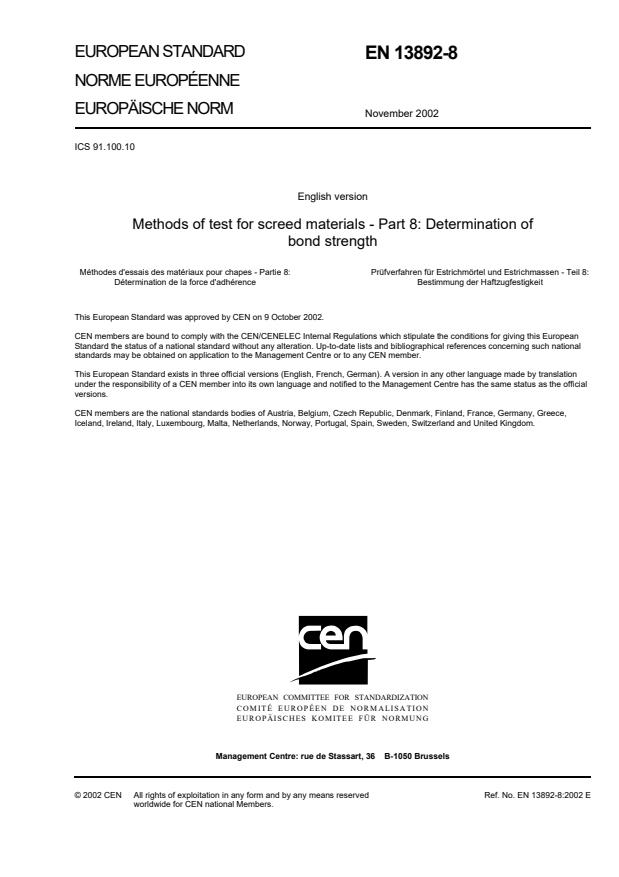
EUROPEAN STANDARDNORME EUROPÉENNEEUROPÄISCHE NORMEN 13892-8November 2002ICS 91.100.10English versionMethods of test for screed materials - Part 8: Determination ofbond strengthMéthodes d'essais des matériaux pour chapes - Partie 8:Détermination de la force d'adhérencePrüfverfahren für Estrichmörtel und Estrichmassen - Teil 8:Bestimmung der HaftzugfestigkeitThis European Standard was approved by CEN on 9 October 2002.CEN members are bound to comply with the CEN/CENELEC Internal Regulations which stipulate the conditions for giving this EuropeanStandard the status of a national standard without any alteration. Up-to-date lists and bibliographical references concerning such nationalstandards may be obtained on application to the Management Centre or to any CEN member.This European Standard exists in three official versions (English, French, German). A version in any other language made by translationunder the responsibility of a CEN member into its own language and notified to the Management Centre has the same status as the officialversions.CEN members are the national standards bodies of Austria, Belgium, Czech Republic, Denmark, Finland, France, Germany, Greece,Iceland, Ireland, Italy, Luxembourg, Malta, Netherlands, Norway, Portugal, Spain, Sweden, Switzerland and United Kingdom.EUROPEAN COMMITTEE FOR STANDARDIZATIONCOMITÉ EUROPÉEN DE NORMALISATIONEUROPÄISCHES KOMITEE FÜR NORMUNGManagement Centre: rue de Stassart, 36
B-1050 Brussels© 2002 CENAll rights of exploitation in any form and by any means reservedworldwide for CEN national Members.Ref. No. EN 13892-8:2002 E
...