

EN 13892-3:2014
(Main)Methods of test for screed materials - Part 3: Determination of wear resistance - Böhme
- Abstract
This European Standard specifies a method for determining the wear resistance of moulded specimens made from cementitious screed material, primarily for hard aggregate wearing screed materials or optionally for other screed materials. The method is also suitable for specimens cut from floor screed. This method is unsuitable for synthetic resin screed materials.
- Status
- Published
- Publication Date
- 16-Dec-2014
- Withdrawal Date
- 29-Jun-2015
- Technical Committee
- CEN/TC 303 - Floor screeds and in-situ floorings in buildings
- Drafting Committee
- CEN/TC 303/WG 2 - Test methods
- Current Stage
- 9020 - Submission to 2 Year Review Enquiry - Review Enquiry
- Start Date
- 15-Jul-2026
- Completion Date
- 15-Jul-2026

Overview
EN 13892-3:2014 is a European Standard established by CEN that specifies the method for determining the wear resistance of screed materials using the Böhme test. This standard focuses on cementitious screed materials, particularly those with hard aggregate wearing screeds, but also applies to specimens cut from floor screed. It excludes synthetic resin screed materials. The standard outlines a precise testing procedure involving a Böhme abrader device, designed to measure the volume loss under controlled abrasive loading, thereby providing reliable and reproducible wear resistance data.
Key Topics
Scope and Applicability
The standard applies exclusively to cementitious screed materials, primarily hard aggregate types. The method is unsuitable for synthetic resin screeds, ensuring proper selection according to material type.Testing Principle
The Böhme method uses a rotating test track where molded screed specimens are exposed to abrasive material under a load of 294 N. The specimen's volume or thickness loss after standardized cycles indicates wear resistance.Specimen Preparation
Specimens should be molded cubes or blocks (approximately 71 mm edge length) prepared under conditions defined in EN 13892-1. They must be dried to a constant mass at 110 ± 5 °C prior to testing.Apparatus Description
The Böhme abrader includes a rotating cast iron disk with a test track that holds abrasive material. The device applies a vertical load to the specimen while rotating the abrasive track at 30 rpm. The apparatus ensures accurate measurement of wear under consistent conditions.Abrasive Material
Artificial corundum abrasive with strict chemical composition and particle size controls must be used to ensure test consistency. Particle size distribution and bulk density are standardized based on ISO sieve tests.Measurement and Calculation
Wear resistance is expressed as the volume loss of the specimen per 50 cm² area, derived from mass loss and density measurements or thickness reductions for multi-layer specimens.Reporting Requirements
A comprehensive test report must include sample identification, preparation details, testing equipment information, individual and mean test results, and any relevant remarks, ensuring traceability and reproducibility.
Applications
Quality Control in Construction
Enables manufacturers and contractors to assess the durability of screed materials used in flooring systems, particularly in environments subject to abrasive wear such as industrial floors, warehouses, and commercial buildings.Material Selection and Specification
Architects and engineers use this standard to specify screed materials with requisite wear resistance properties for specific applications, promoting longevity and maintenance cost reduction.Research and Development
Laboratories and material scientists apply EN 13892-3:2014 to develop new screed formulations and compare the performance of varying compositions under standardized wear conditions.Compliance and Certification
Provides a recognized benchmark for compliance with product standards like EN 13813, supporting product certification and market acceptance across European markets.
Related Standards
EN 13892-1: Sampling, making, and curing specimens for tests related to screed materials - foundational for specimen preparation in wear resistance testing.
EN 13813: Defines properties and requirements for screed materials and floor screeds including performance criteria complementary to wear resistance.
EN 13892-2: Methods for determining mechanical strength (flexural and compressive) of screed materials.
EN 13454-2: Test methods for binders used in floor screeds, relevant for constituent material characterization.
Keywords
EN 13892-3, wear resistance testing, Böhme method, cementitious screed materials, screed test standards, abrasion resistance, floor screeds durability, screed specimen preparation, Böhme abrader, standard abrasive material, construction material testing, European screed standards, CEN standards for screeds.
Relations
- Effective Date
- 25-Dec-2013
- Effective Date
- 18-Mar-2026
- Effective Date
- 28-Jan-2026
- Effective Date
- 28-Jan-2026
- Effective Date
- 28-Jan-2026
- Effective Date
- 28-Jan-2026
- Effective Date
- 28-Jan-2026
- Effective Date
- 28-Jan-2026
- Effective Date
- 28-Jan-2026
- Effective Date
- 28-Jan-2026
- Effective Date
- 28-Jan-2026
- Effective Date
- 28-Jan-2026
- Effective Date
- 28-Jan-2026
- Effective Date
- 28-Jan-2026
- Effective Date
- 28-Jan-2026
Get Certified
Connect with accredited certification bodies for this standard

DIBt (Deutsches Institut für Bautechnik)
German Institute for Building Technology.
DIN CERTCO
DIN Group product certification.

Aboma Certification B.V.
Specialized in construction, metal, and transport sectors.
Sponsored listings
Frequently Asked Questions
EN 13892-3:2014 is a standard published by the European Committee for Standardization (CEN). Its full title is "Methods of test for screed materials - Part 3: Determination of wear resistance - Böhme". This standard covers: This European Standard specifies a method for determining the wear resistance of moulded specimens made from cementitious screed material, primarily for hard aggregate wearing screed materials or optionally for other screed materials. The method is also suitable for specimens cut from floor screed. This method is unsuitable for synthetic resin screed materials.
This European Standard specifies a method for determining the wear resistance of moulded specimens made from cementitious screed material, primarily for hard aggregate wearing screed materials or optionally for other screed materials. The method is also suitable for specimens cut from floor screed. This method is unsuitable for synthetic resin screed materials.
EN 13892-3:2014 is classified under the following ICS (International Classification for Standards) categories: 91.100.10 - Cement. Gypsum. Lime. Mortar. The ICS classification helps identify the subject area and facilitates finding related standards.
EN 13892-3:2014 has the following relationships with other standards: It is inter standard links to EN 13892-3:2004, ISO 565:1990, EN 459-2:2021, EN 12503-2:2001, EN ISO 1452-3:2010, EN ISO 1452-2:2009, EN ISO 15877-2:2009, EN ISO 15874-2:2013, EN ISO 15876-3:2017, EN ISO 15875-2:2025, EN ISO 21003-3:2008, EN ISO 21003-2:2008, EN ISO 15876-2:2017, EN ISO 15875-3:2025, EN 13892-1:2002. Understanding these relationships helps ensure you are using the most current and applicable version of the standard.
EN 13892-3:2014 is available in PDF format for immediate download after purchase. The document can be added to your cart and obtained through the secure checkout process. Digital delivery ensures instant access to the complete standard document.
Standards Content (Sample)
2003-01.Slovenski inštitut za standardizacijo. Razmnoževanje celote ali delov tega standarda ni dovoljeno.Metode preskušanja mešanice za estrih - 3. del: Ugotavljanje odpornosti proti obrabi po BöhmejuPrüfverfahren für Estrichmörtel und Estrichmassen - Teil 3: Bestimmung des Verschleißwiderstandes nach BöhmeMéthodes d'essai des matériaux pour chapes - Partie 3: Détermination de la résistance à l'usure BöhmeMethods of test for screed materials - Part 3: Determination of wear resistance - Böhme91.100.10Cement. Mavec. Apno. MaltaCement. Gypsum. Lime. MortarICS:Ta slovenski standard je istoveten z:EN 13892-3:2014SIST EN 13892-3:2015en,fr,de01-april-2015SIST EN 13892-3:2015SLOVENSKI
STANDARDSIST EN 13892-3:20041DGRPHãþD
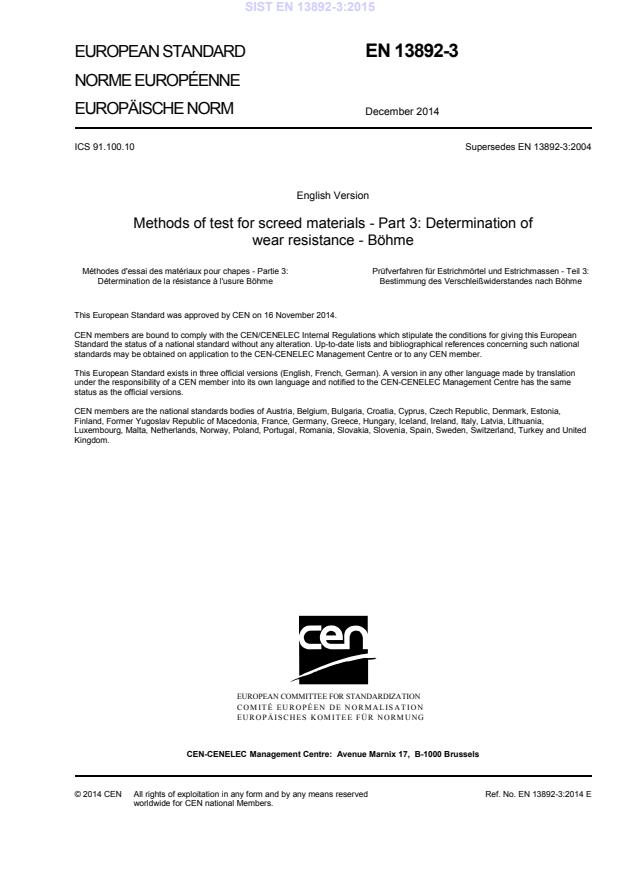
EUROPEAN STANDARD NORME EUROPÉENNE EUROPÄISCHE NORM
EN 13892-3
December 2014 ICS 91.100.10 Supersedes EN 13892-3:2004English Version
Methods of test for screed materials - Part 3: Determination of wear resistance - Böhme
Méthodes d'essai des matériaux pour chapes - Partie 3: Détermination de la résistance à l'usure Böhme
Prüfverfahren für Estrichmörtel und Estrichmassen - Teil 3: Bestimmung des Verschleißwiderstandes nach Böhme This European Standard was approved by CEN on 16 November 2014.
CEN members are bound to comply with the CEN/CENELEC Internal Regulations which stipulate the conditions for giving this European Standard the status of a national standard without any alteration. Up-to-date lists and bibliographical references concerning such national standards may be obtained on application to the CEN-CENELEC Management Centre or to any CEN member.
This European Standard exists in three official versions (English, French, German). A version in any other language made by translation under the responsibility of a CEN member into its own language and notified to the CEN-CENELEC Management Centre has the same status as the official versions.
CEN members are the national standards bodies of Austria, Belgium, Bulgaria, Croatia, Cyprus, Czech Republic, Denmark, Estonia, Finland, Former Yugoslav Republic of Macedonia, France, Germany, Greece, Hungary, Iceland, Ireland, Italy, Latvia, Lithuania, Luxembourg, Malta, Netherlands, Norway, Poland, Portugal, Romania, Slovakia, Slovenia, Spain, Sweden, Switzerland, Turkey and United Kingdom.
EUROPEAN COMMITTEE FOR STANDARDIZATION
COMITÉ EUROPÉEN DE NORMALISATION EUROPÄISCHES KOMITEE FÜR NORMUNG
CEN-CENELEC Management Centre:
Avenue Marnix 17,
B-1000 Brussels © 2014 CEN All rights of exploitation in any form and by any means reserved worldwide for CEN national Members. Ref. No. EN 13892-3:2014 ESIST EN 13892-3:2015
— Clause 7, 2nd paragraph. EN 13892, Methods of test for screed materials, is divided in the following parts: —
Part 1: Sampling, making and curing specimens for test; —
Part 2: Determination of flexural and compressive strength; —
Part 3: Determination of wear resistance – Böhme [the present document]; —
Part 4: Determination of wear resistance-BCA; —
Part 5: Determination of wear resistance to rolling wheel of screed material for wearing layer; —
Part 6: Determination of surface hardness; —
Part 7: Determination of wear resistance to rolling wheel of screed material with floor coverings; — Part 8: Determination of bond strength. According to the CEN-CENELEC Internal Regulations, the national standards organizations of the following countries are bound to implement this European Standard: Austria, Belgium, Bulgaria, Croatia, Cyprus, Czech Republic, Denmark, Estonia, Finland, Former Yugoslav Republic of Macedonia, France, Germany, Greece, Hungary, Iceland, Ireland, Italy, Latvia, Lithuania, Luxembourg, Malta, Netherlands, Norway, Poland, Portugal, Romania, Slovakia, Slovenia, Spain, Sweden, Switzerland, Turkey and the United Kingdom.
= ûV is the wear resistance-Böhme in cm3 per 50 cm2 and the loss in volume after 16 cycles ûl = l0 – l16m is the mean reduction in mm after 16 cycles l0 is the mean thickness of the specimen in mm from the measurements made at all nine measuring points prior to testing l16m is the mean thickness of the specimen in mm from the measurements made at all nine measuring points after completion of the test ûm is the reduction in mass in g after 16 cycles R is the density of the specimen in g/cm3 or, in the case of multi-layer specimens, the density of the wearing layer 5 Apparatus The Böhme abrader as shown in Figure 1 consists of a rotating table with a defined test track to receive the abrasive, a specimen holder and a loading device. The rotating table shall have a diameter of approximately 750 mm and be flat and positioned horizontally. When loaded, its speed shall be (30 ± 1) r/min. SIST EN 13892-3:2015
...