

EN 17666:2022
(Main)Maintenance - Maintenance engineering - Requirements
- Abstract
This document specifies the maintenance engineering discipline throughout the entire life cycle.
This document gives guidance on how maintenance engineering can contribute to the assurance of required dependability to achieve a sustainable balance between performance, risk and costs.
This document refers to standards that further describe detailed methods and techniques.
This document does not give guidance on how to set up systems and infrastructure for maintenance engineering nor does it include guidance on software maintenance.
NOTE 1 For software components of an item, the maintenance activities are covered in ISO/IEC/IEEE 14764 [54].
NOTE 2 The overall maintenance process is covered by EN 17007 [10].
- Status
- Published
- Publication Date
- 22-Nov-2022
- Technical Committee
- CEN/TC 319 - Maintenance
- Drafting Committee
- CEN/TC 319/WG 14 - Maintenance engineering
- Current Stage
- 6060 - Definitive text made available (DAV) - Publishing
- Start Date
- 23-Nov-2022
- Due Date
- 18-Jul-2022
- Completion Date
- 23-Nov-2022

Overview
EN 17666:2022 - Maintenance engineering - Requirements (CEN) defines the maintenance engineering discipline across the entire life cycle of physical assets. It provides generic, non-prescriptive guidance on how maintenance engineering contributes to assuring required dependability, balancing performance, risk and costs, and applying sustainability principles. The standard applies to maintenance engineering activities from concept through disposal/transition and references more detailed methods in related standards.
Key topics and requirements
- Life‑cycle focus: Maintenance engineering activities are described for these stages - concept, development (preliminary and detailed design), realization (build, implementation/commissioning), utilization (operation and maintenance) and disposal/transition (reuse, recycling, disposal).
- Dependability and risk: Guidance on influencing design and performing risk analysis to achieve required reliability, availability, maintainability and safety objectives.
- Maintainability and design influence: Emphasis on design-for-maintainability practices and analyses (see informative Annex C) to reduce life‑cycle costs and environmental footprint.
- Techniques and analyses: Informative guidance on applicable techniques, analyses and practices (Annex B) to support maintenance engineering work.
- Integrated logistic support (ILS): Relationship between maintenance engineering and ILS is described in Annex A to align supportability and logistic planning.
- Digitalization: Clause 7 addresses digitalization requirements and how digital tools and data support maintenance engineering across the life cycle.
- Scope limits: EN 17666 does not prescribe infrastructure or organizational systems setup for maintenance engineering and it excludes software maintenance (software components are covered by ISO/IEC/IEEE 14764). The overall maintenance process is addressed by EN 17007.
Practical applications and who uses it
EN 17666 is intended for personnel involved in:
- Asset owners and operators aiming to define maintenance requirements and optimize life‑cycle performance
- Design and engineering teams integrating maintainability and supportability requirements early in product/system design
- Maintenance planners and reliability engineers assessing risk, maintainability and life‑extension decisions
- Procurement and contract managers specifying maintenance-related deliverables and warranties
- Maintenance service providers aligning technical support with dependability objectives
Practical uses include shaping maintenance requirements during concept and design, guiding maintainability assessments, informing logistic support analyses, and defining digital data needs for condition‑based maintenance.
Related standards
- EN 17007 - Overall maintenance process
- EN 13306 - Maintenance terminology
- ISO/IEC/IEEE 14764 - Software maintenance (for software components)
- ISO 55000 series and IEC 60300 series - Asset management and dependability context
Keywords: EN 17666:2022, maintenance engineering, dependability, life cycle, maintainability, asset management, maintenance standards, CEN.
Relations
- Effective Date
- 28-Jan-2026
Get Certified
Connect with accredited certification bodies for this standard

Great Wall Tianjin Quality Assurance Center
Established 1993, first batch to receive national accreditation with IAF recognition.
Hong Kong Quality Assurance Agency (HKQAA)
Hong Kong's leading certification body.

Innovative Quality Certifications Pvt. Ltd. (IQCPL)
Known for integrity, providing ethical & impartial Assessment & Certification. CMMI Institute Partner.
Sponsored listings
Frequently Asked Questions
EN 17666:2022 is a standard published by the European Committee for Standardization (CEN). Its full title is "Maintenance - Maintenance engineering - Requirements". This standard covers: This document specifies the maintenance engineering discipline throughout the entire life cycle. This document gives guidance on how maintenance engineering can contribute to the assurance of required dependability to achieve a sustainable balance between performance, risk and costs. This document refers to standards that further describe detailed methods and techniques. This document does not give guidance on how to set up systems and infrastructure for maintenance engineering nor does it include guidance on software maintenance. NOTE 1 For software components of an item, the maintenance activities are covered in ISO/IEC/IEEE 14764 [54]. NOTE 2 The overall maintenance process is covered by EN 17007 [10].
This document specifies the maintenance engineering discipline throughout the entire life cycle. This document gives guidance on how maintenance engineering can contribute to the assurance of required dependability to achieve a sustainable balance between performance, risk and costs. This document refers to standards that further describe detailed methods and techniques. This document does not give guidance on how to set up systems and infrastructure for maintenance engineering nor does it include guidance on software maintenance. NOTE 1 For software components of an item, the maintenance activities are covered in ISO/IEC/IEEE 14764 [54]. NOTE 2 The overall maintenance process is covered by EN 17007 [10].
EN 17666:2022 is classified under the following ICS (International Classification for Standards) categories: 03.080.10 - Maintenance services. Facilities management. The ICS classification helps identify the subject area and facilitates finding related standards.
EN 17666:2022 has the following relationships with other standards: It is inter standard links to EN 13306:2017. Understanding these relationships helps ensure you are using the most current and applicable version of the standard.
EN 17666:2022 is available in PDF format for immediate download after purchase. The document can be added to your cart and obtained through the secure checkout process. Digital delivery ensures instant access to the complete standard document.
Standards Content (Sample)
SLOVENSKI STANDARD
01-februar-2023
Vzdrževanje - Vzdrževalni inženiring - Zahteve
Maintenance - Maintenance engineering - Requirements
Instandhaltung - Instandhaltungsengineering - Anforderungen
Maintenance - Ingénierie de maintenance - Exigences
Ta slovenski standard je istoveten z: EN 17666:2022
ICS:
03.080.10 Vzdrževalne storitve. Maintenance services.
Upravljanje objektov Facilities management
2003-01.Slovenski inštitut za standardizacijo. Razmnoževanje celote ali delov tega standarda ni dovoljeno.
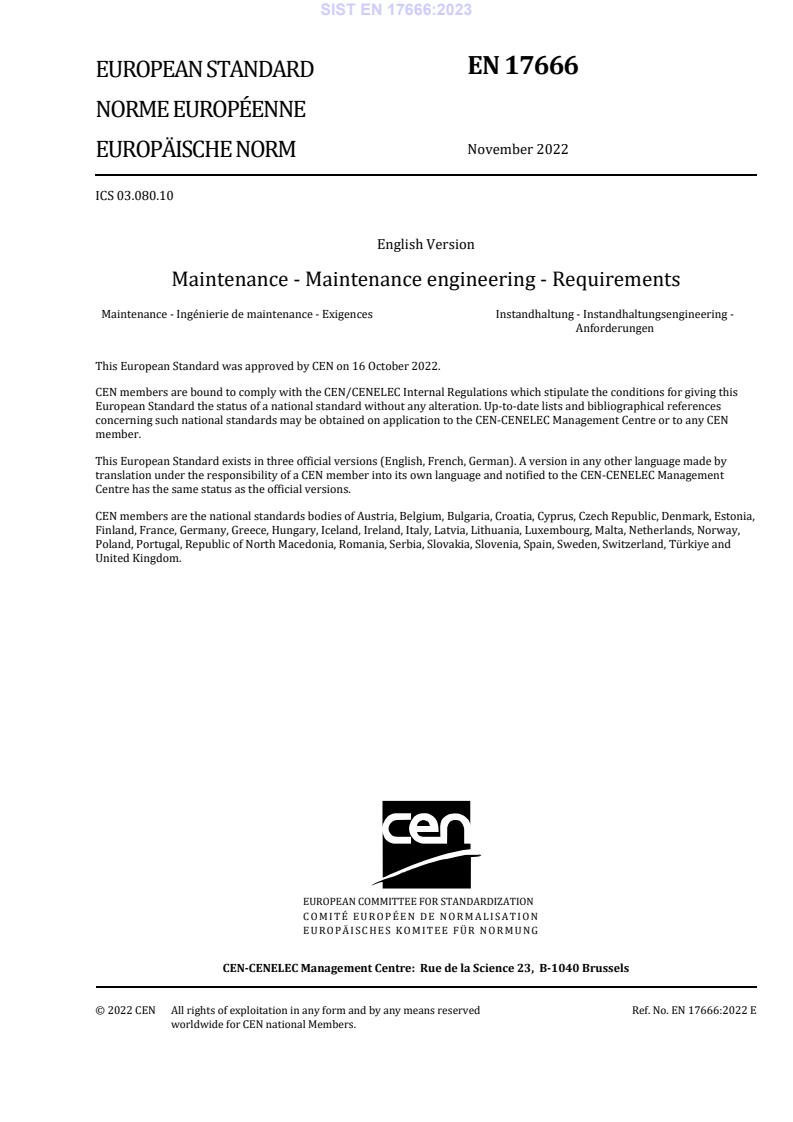
EN 17666
EUROPEAN STANDARD
NORME EUROPÉENNE
November 2022
EUROPÄISCHE NORM
ICS 03.080.10
English Version
Maintenance - Maintenance engineering - Requirements
Maintenance - Ingénierie de maintenance - Exigences Instandhaltung - Instandhaltungsengineering -
Anforderungen
This European Standard was approved by CEN on 16 October 2022.
CEN members are bound to comply with the CEN/CENELEC Internal Regulations which stipulate the conditions for giving this
European Standard the status of a national standard without any alteration. Up-to-date lists and bibliographical references
concerning such national standards may be obtained on application to the CEN-CENELEC Management Centre or to any CEN
member.
This European Standard exists in three official versions (English, French, German). A version in any other language made by
translation under the responsibility of a CEN member into its own language and notified to the CEN-CENELEC Management
Centre has the same status as the official versions.
CEN members are the national standards bodies of Austria, Belgium, Bulgaria, Croatia, Cyprus, Czech Republic, Denmark, Estonia,
Finland, France, Germany, Greece, Hungary, Iceland, Ireland, Italy, Latvia, Lithuania, Luxembourg, Malta, Netherlands, Norway,
Poland, Portugal, Republic of North Macedonia, Romania, Serbia, Slovakia, Slovenia, Spain, Sweden, Switzerland, Türkiye and
United Kingdom.
EUROPEAN COMMITTEE FOR STANDARDIZATION
COMITÉ EUROPÉEN DE NORMALISATION
EUROPÄISCHES KOMITEE FÜR NORMUNG
CEN-CENELEC Management Centre: Rue de la Science 23, B-1040 Brussels
© 2022 CEN All rights of exploitation in any form and by any means reserved Ref. No. EN 17666:2022 E
worldwide for CEN national Members.
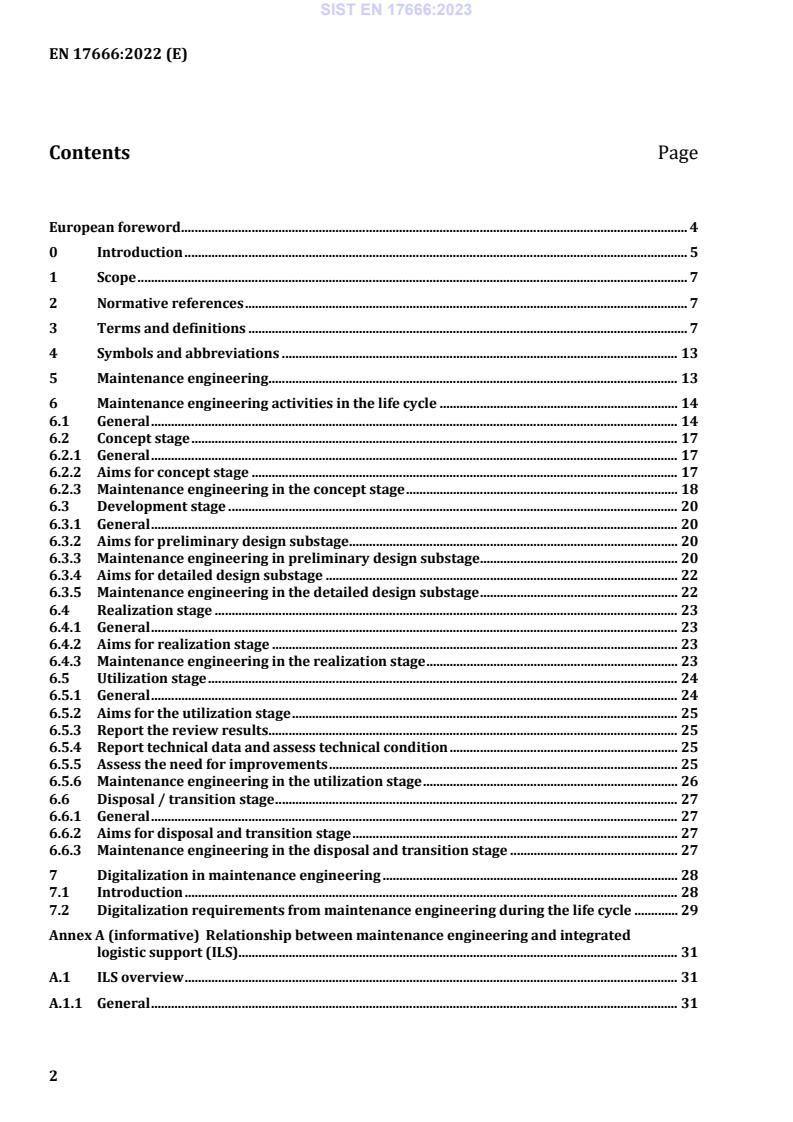
Contents Page
European foreword . 4
0 Introduction . 5
1 Scope . 7
2 Normative references . 7
3 Terms and definitions . 7
4 Symbols and abbreviations . 13
5 Maintenance engineering . 13
6 Maintenance engineering activities in the life cycle . 14
6.1 General . 14
6.2 Concept stage . 17
6.2.1 General . 17
6.2.2 Aims for concept stage . 17
6.2.3 Maintenance engineering in the concept stage . 18
6.3 Development stage . 20
6.3.1 General . 20
6.3.2 Aims for preliminary design substage . 20
6.3.3 Maintenance engineering in preliminary design substage . 20
6.3.4 Aims for detailed design substage . 22
6.3.5 Maintenance engineering in the detailed design substage . 22
6.4 Realization stage . 23
6.4.1 General . 23
6.4.2 Aims for realization stage . 23
6.4.3 Maintenance engineering in the realization stage . 23
6.5 Utilization stage . 24
6.5.1 General . 24
6.5.2 Aims for the utilization stage . 25
6.5.3 Report the review results . 25
6.5.4 Report technical data and assess technical condition . 25
6.5.5 Assess the need for improvements . 25
6.5.6 Maintenance engineering in the utilization stage . 26
6.6 Disposal / transition stage . 27
6.6.1 General . 27
6.6.2 Aims for disposal and transition stage . 27
6.6.3 Maintenance engineering in the disposal and transition stage . 27
7 Digitalization in maintenance engineering . 28
7.1 Introduction . 28
7.2 Digitalization requirements from maintenance engineering during the life cycle . 29
Annex A (informative) Relationship between maintenance engineering and integrated
logistic support (ILS) . 31
A.1 ILS overview . 31
A.1.1 General . 31
A.1.2 ILS objectives . 31
A.1.3 Elements of ILS. 31
A.1.4 Logistic support analysis (LSA) . 32
A.2 Relationship between maintenance engineering and ILS. 32
Annex B (informative) Techniques, analyses and practices applicable to maintenance
engineering . 33
B.1 General . 33
B.2 Techniques, analyses and practices applicable to maintenance engineering . 33
Annex C (informative) Maintainability design within maintenance engineering . 39
C.1 General . 39
C.2 Design for maintainability. 39
Annex D (informative) Life cycle stages . 42
Bibliography . 43
European foreword
This document (EN 17666:2022) has been prepared by Technical Committee CEN/TC 319
“Maintenance”, the secretariat of which is held by UNI.
This European Standard shall be given the status of a national standard, either by publication of an
identical text or by endorsement, at the latest by May 2022, and conflicting national standards shall be
withdrawn at the latest by May 2022.
Attention is drawn to the possibility that some of the elements of this document may be the subject of
patent rights. CEN shall not be held responsible for identifying any or all such patent rights.
Any feedback and questions on this document should be directed to the users’ national standards body.
A complete listing of these bodies can be found on the CEN website.
According to the CEN-CENELEC Internal Regulations, the national standards organisations of the
following countries are bound to implement this European Standard: Austria, Belgium, Bulgaria, Croatia,
Cyprus, Czech Republic, Denmark, Estonia, Finland, France, Germany, Greece, Hungary, Iceland, Ireland,
Italy, Latvia, Lithuania, Luxembourg, Malta, Netherlands, Norway, Poland, Portugal, Republic of North
Macedonia, Romania, Serbia, Slovakia, Slovenia, Spain, Sweden, Switzerland, Türkiye and the United
Kingdom.
0 Introduction
0.1 Scope and benefits of maintenance engineering
Maintenance engineering is a discipline applying competencies, methods, techniques and tools to develop
and support maintenance in order to ensure that an item is able to perform its required functions in a
safe, sustainable and cost-effective manner throughout the life cycle.
The prime aim of maintenance engineering is to contribute to the achievement of overall stakeholder
requirements through optimized and cost-effective maintenance as part of physical asset management.
The benefits of the contributions from maintenance engineering include, but are not limited to:
— achievement of dependability goals by influencing design;
— risk analysis related to maintenance;
— application of sustainability principles;
— achieved required integrity and safety level;
— achieved required performance and technical condition;
— improved life extension decisions;
— improved maintenance support performance;
— reduced environmental footprint by saving energy and raw materials consumption;
— improved competitiveness and output value.
0.2 Use of this document
This document is generic and provides guidance on the methodology to achieve maintenance engineering
aims.
The intended users of this document are personnel involved in design, procurement, construction,
commissioning, operation, improvement, maintenance and disposal/transition or decommissioning of
physical assets. No specific structure or size of organization is assumed so that maintenance engineering
effort should be tailored to suit specific applications and organisational requirements.
This document is based on the maintenance terminology as defined in EN 13306 Maintenance —
Maintenance terminology. Adjustments and additional terminology used, are found in Clause 3.
Clause 5 of this document describes maintenance engineering discipline and its objectives.
Clause 6 of this document describes maintenance engineering activities during the life cycle stages.
Activities are used to express the application of knowledge, skills and tools in maintenance engineering.
The following life cycle stages and substages are used, see 6.1:
1) concept stage with the following substages: feasibility and concept baseline;
2) development stage with the following substages: preliminary design and detailed design;
3) realization stage with the following substages: build and implementation / commissioning;
4) utilization stage with the following substage: operation and maintenance;
5) disposal/transition stage with the following substage: reuse, recycling or disposal.
NOTE These life cycle stages are harmonized as far as possible and based on what are used in EN 16646 [7]
and IEC 60300 series [see Bibliography]. Disposal and transition are used instead of retirement used in IEC 60300
series. See an overview in Annex D.
While maintenance engineering has the most impact when applied during the concept stage and design
of a physical item, this document is applicable to maintenance engineering in all life cycle stages, and for
different scenarios, for example:
— manufacturer producing one equipment and then maintaining it;
— transfer of property at commissioning to a buyer who will be in charge of maintenance;
— transfer of property at commissioning followed by a warranty period. The seller is responsible during
the warranty and the buyer thereafter;
— maintenance service (sub) contract by the seller to the buyer or to a third party.
Clause 7 of this document describes maintenance engineering and digitalization.
The document also includes informative Annexes A to D with additional guidance.
Processes are defined as set of interrelated or interacting activities that use inputs to deliver an intended
result (3.24). In the context of this document, the term “maintenance engineering activities” is used to
express the application of knowledge, skills and tools to support the processes given in EN 17007 [10].
While EN 17007 describes the processes, this document FprEN 17666 follows the life cycle stages.
0.3 Related standards
This document is part of a group of European maintenance standards published by CEN/TC 319
Maintenance giving requirements and guidance on maintenance, see the committee site on
https://standards.cencenelec.eu/dyn/www/f?p=CEN:105::RESET and Bibliography [2] to [7] and [9] to
[12].
In addition, there are a number of standards published in CEN, ISO and IEC which address maintenance
as part of asset management and dependability view.
The asset management standards in the ISO 55000 series [59 to 61] address the overall requirements for
assets, decision criteria, strategic asset management plan (SAMP) and asset management plan. EN 17485
[12] and EN 16646 [7] create a bridge between these ISO standards and the EN maintenance standards
which determine the requirements for maintenance engineering.
The IEC dependability standards (principally the IEC 60300 series) address the management and
technical activities to produce and / or sustain a dependable item, which is one where there is justified
confidence that it will operate as desired and satisfy agreed stakeholder needs and expectations.
1 Scope
This document specifies the maintenance engineering discipline throughout the entire life cycle.
This document gives guidance on how maintenance engineering can contribute to the assurance of
required dependability to achieve a sustainable balance between performance, risk and costs.
This document refers to standards that further describe detailed methods and techniques.
This document does not give guidance on how to set up systems and infrastructure for maintenance
engineering nor does it include guidance on software maintenance.
NOTE 1 For software components of an item, the maintenance activities are covered in ISO/IEC/IEEE 14764
[54].
NOTE 2 The overall maintenance process is covered by EN 17007 [10].
2 Normative references
The following documents are referred to in the text in such a way that some or all of their content
constitutes requirements of this document. For dated references, only the edition cited applies. For
undated references, the latest edition of the referenced document (including any amendments) applies.
EN 13306, Maintenance — Maintenance terminology
3 Terms and definitions
For the purposes of this document the terms and definitions given in EN 13306 and the following apply.
ISO and IEC maintain terminological databases for use in standardization at the following addresses:
— IEC Electropedia: available at https://www.electropedia.org/
— ISO Online browsing platform: available at https://www.iso.org/obp/
3.1
maintenance
combination of all technical, administrative and managerial actions during the life cycle (3.10) of an item
(3.13) intended to retain it in, or restore it to, a state in which it can perform the required function (3.8)
Note 1 to entry: Technical maintenance actions include observation and analyses of the item state (e.g.
inspection, monitoring, testing, diagnosis, prognosis, etc.) and active maintenance actions (e.g. repair,
refurbishment).
Note 2 to entry: See also the definitions of improvement and modification in EN 13306.
[SOURCE: EN 13306:2017, 2.1]
3.2
maintenance engineering
engineering discipline applying competencies (3.14), methods, techniques and tools to develop and
support maintenance (3.1) in order to assure that an item (3.13) is able to perform its required functions
(3.8) in a safe, sustainable and cost-effective (3.9) manner throughout the life cycle (3.10)
3.3
maintenance management
all activities of the management that determine the maintenance (3.1) requirements, objectives,
strategies and responsibilities, and implementation of them by such means as maintenance planning,
maintenance control, and the improvement of maintenance activities and economics
[SOURCE: EN 13306:2017, 2.2]
3.4
maintenance plan
structured and documented set of tasks that include the activities, procedures, resources and the time
scale required to carry out maintenance (3.1)
[SOURCE: EN 13306:2017, 2.5]
3.5
maintenance strategy
management method used in order to achieve the maintenance objectives
EXAMPLE Outsourcing of maintenance, allocation of resources, etc.
[SOURCE: EN 13306:2017, 2.4]
3.6
failure management policy
maintenance activities, operational changes, design modifications or other actions in order to mitigate
the consequences of failure
[SOURCE: EN 60300-3-11:2009, 3.1.6]
3.7
operation
combination of all technical, administrative and managerial actions, other than maintenance actions, that
results in the item being in use
Note 1 to entry: Maintenance actions carried out by operators are not included in operation.
Note 2 to entry: In this document, operational and operations are used as synonyms.
[SOURCE: EN 13306:2017, 2.9, modified – Note 2 to entry have been added.]
3.8
required function
function, combination of functions, or a total combination of functions of an item which are considered
necessary to fulfil a given requirement
Note 1 to entry: “Necessary to fulfil a given requirement” may also include asset value preservation.
Note 2 to entry: The given requirement may be expressed or implied and may in some cases be below the original
design specifications.
Note 3 to entry: The required function, by implication, also covers what the item shall not do.
[SOURCE: EN 13306:2017, 2.6]
3.9
cost-effective
balance of cost, risk (3.26), opportunity and performance taking into account stakeholder objectives
Note 1 to entry: Performance covers quality, short and long term.
3.10
life cycle
series of stages through which an item goes, from its conception to disposal
Note 1 to entry: The stages identified will vary with the application. Reuse and recycle follows disposal.
[SOURCE: EN 13306:2017, 4.18, modified — List of examples of life cycle stages is omitted because
EN 17666 defines the stages given in Clause 6.]
3.11
life cycle cost
sum of the costs generated during the life cycle (3.10) of the item (3.13)
[SOURCE: EN 13306:2017, 11.1, modified — Note 1 to entry is omitted because EN 17666 defines the
stages given in Clause 6.]
3.12
physical asset
item (3.13) that has potential or actual value to an organization
Note 1 to entry: Examples of physical assets are components, machines, plants, buildings, infrastructures, etc.
[SOURCE: EN 13306:2017, 3.2]
3.13
item
part, component, device, subsystem, functional unit, equipment or system that can be individually
described and considered
[SOURCE: EN 13306:2017, modified — Notes 1, 2 and 3 to entry are omitted]
3.14
competence
proven ability to use knowledge, skills (3.15), and personal, social and/or methodological abilities, in
work or study situations and in professional and personal development
Note 1 to entry: Competence is described in the terms of responsibility and autonomy.
[SOURCE: EN 15628:2014, 3.1]
3.15
skills
ability to apply knowledge and use know-how to complete tasks and resolve problems
Note 1 to entry: Skills are described as cognitive (involving the use of logical, intuitive and creative thinking) or
practical (involving manual dexterity and the use of methods, tools and instruments).
[SOURCE: EN 15628:2014, 3.6]
3.16
dependability
ability to perform as and when required
Note 1 to entry: Dependability includes availability (3.20), safety, security, durability, economics and their
influencing factors (reliability, maintainability (3.19), supportability (3.17), conditions of use and operators
influence).
Note 2 to entry: Dependability is used as a collective term for the time-related quality characteristics of an item.
[SOURCE: EN 13306:2017, 2.7, modified — In Note 1 to entry “maintenance support performance” is
replaced by “supportability”]
3.17
supportability
ability to be supported to sustain the required availability with a defined operational profile and given
logistic and maintenance resources
Note 1 to entry: Supportability of an item results from the inherent maintainability, combined with factors
external to the item that affect the relative ease of providing the required maintenance and logistic support.
[SOURCE: IEC 60050-192:2015, 192-01-31]
3.18
integrated logistic support
ILS
management process to determine and coordinate the provision of all materials and resources required
to meet the needs for operation and maintenance
Note 1 to entry: ILS is a process to determine the optimal maintenance support. ILS integrates logistic support
analysis and the development of resources, see Annex A.
[SOURCE: IEC 60050-192:2015, 192-01-30, modified — Note 1 to entry added]
3.19
maintainability
ability of an item under given conditions of use, to be retained in, or restored to, a state in which it can
perform a required function (3.8), when maintenance (3.1) is performed under given conditions and using
stated procedures and resources
Note 1 to entry: Maintainability may be quantified using appropriate measures or indicators and is then referred
to as maintainability performance.
[SOURCE: EN 13306:2017, 4.5]
3.20
availability
ability of an item to be in a state to perform as and when required, under given conditions, assuming that
the necessary external resources are provided
Note 1 to entry: Required external resources, other than maintenance resources, do not affect the availability of
the item although the item may not be available from the user’s viewpoint.
Note 2 to entry: This ability depends on the combined aspects of the reliability, maintainability of the item, the
maintenance supportability and the maintenance actions carried out on the item.
Note 3 to entry: Availability may be quantified using appropriate measures or indicators and is then referred to
as availability performance (see EN 13306:2017, 4.9).
Note 4 to entry: There are several types of availability, for example: achieved availability (3.21), operational
availability (3.22) and inherent availability (3.23).
[SOURCE: EN 13306:2017, 4.7, modified — Note 4 to entry added]
3.21
achieved availability
probability than an item when used under stated conditions in an ideal support environment will operate
satisfactorily at any point in time
3.22
operational availability
availability (3.20) experienced under actual conditions of operation and maintenance
Note 1 to entry: Operational availability is determined considering down time due to failures and associated
delays, but excluding external causes.
[SOURCE: IEC 60050-192:2015, 192-08-03]
3.23
inherent availability
availability (3.20) provided by the design under ideal conditions of operation and maintenance
Note 1 to entry: Delays associated with maintenance, such as logistic and administrative delays, are excluded.
[SOURCE: IEC 60050-192:2015, 192-08-02]
3.24
process
set of interrelated or interacting activities that use inputs to deliver an intended result
Note 1 to entry: Whether the “intended result” of a process is called output, product or service depends on the
context of the reference.
Note 2 to entry: Inputs to a process are generally the outputs of other processes and outputs of a process are
generally the inputs to other processes.
Note 3 to entry: Two or more interrelated and interacting processes in series can also be referred to as a process.
Note 4 to entry: Processes in an organization are generally planned and carried out under controlled conditions to
add value.
Note 5 to entry: A process where the conformity of the resulting output cannot be readily or economically validated
is frequently referred to as a “special process”.
[SOURCE: EN ISO 9000:2015, 3.4.1 and EN 17007:2017, 3.12, modified — Note 6 to entry in the original
definition from EN ISO 9000:2015 has been deleted.]
3.25
stakeholder
person or organization that can affect, be affected by, or perceive themselves to be affected by a decision
or activity
[SOURCE: ISO 55000:2014, 3.1.22, modified — Note 1 to entry deleted.]
3.26
risk
effect of uncertainty on objectives
Note 1 to entry: An effect is a deviation from the expected. It can be positive, negative or both, and can address,
create or result in opportunities and threats.
Note 2 to entry: Objectives can have different aspects and categories and can be applied at different levels.
Note 3 to entry: Risk is usually expressed in terms of risk sources, potential events, their consequences and their
likelihood.
[SOURCE: ISO 31073:2022, 3.1.1]
3.27
sustainability
state of the global system, including environmental, social and economic aspects, in which the needs of
the present are met without compromising the ability of future generations to meet their own needs
Note 1 to entry: The environmental, social and economic aspects interact, are interdependent and are often referred
to as the three dimensions of sustainability.
Note 2 to entry: Sustainability is the goal of sustainable development.
Note 3 to entry: Sustainability aspects of maintenance covers but are not limited to unnecessary maintenance, rest
useful lifetime, maintenance efficiency, (re)use of materials.
[SOURCE: ISO Guide 82:2019, 3.1, modified — Note 3 to entry has been added.]
4 Symbols and abbreviations
For the purposes of this document, the following symbols and abbreviations apply.
CBM Condition based maintenance
FMEA Failure modes and effects analysis
FME(C)A Failure modes, effects (and criticality) analysis
HAZOP Hazards and operability analysis
HSE Health, safety, and environment
ILS Integrated logistic support
IEC International Electrotechnical Commission (https://www.iec.ch/)
KPI Key performance indicator
LCA Life cycle assessment
LCC Life cycle cost
LCP Life cycle profit
OH&S Occupational health and safety
RAM Reliability, availability and maintainability
RAMS Reliability, availability, maintainability and safety
RBD Reliability block diagram
RBI Risk based inspection
RCA Root cause analysis
RCM Reliability centred maintenance
5 Maintenance engineering
Maintenance engineering is an engineering discipline applying competencies, methods, techniques and
tools to develop and support maintenance in order to ensure that an item is able to perform its required
functions in a safe, sustainable and cost-effective manner throughout the life cycle.
The maintenance engineering competencies shall be maintained through continuing professional
development.
Maintenance engineering makes use of basic knowledge and sciences (mathematics, physics, chemistry
and biology), as well as of other areas of engineering knowledge (Civil, Mechanics, Materials,
Mechatronics, Electrotechnics, Informatics, Data Analysis etc.) together with their methods and
supporting tools. Examples of relevant techniques, analyses and practices that may be used in
maintenance engineering are given in Annex B.
Maintenance engineering embodies the competences to enable the creation, development and
application of technology and procedures for maintenance of equipment throughout its entire life cycle.
This is achieved through a structured approach of identifying opportunities, developing and analysing
solutions, making trade-offs and considering risks using clearly defined steps; these include but are not
limited to:
a) analysis of needs, objectives and timescale;
b) identification of constraints and stakeholder requirements such as: safety, sustainability, statutory
requirements, ethical and socio-economic impacts;
c) evaluation of risk;
d) development of actions, procedures and proposals including modelling with an appropriate level of
detail. Iterations of the preceding steps may be necessary, to achieve objectives;
e) finalization of actions, procedures and proposals, considering identified restrictions and implement
the decisions agreed upon.
The relationship between the maintenance engineering competences and maintenance engineering
activities is described in Clause 6.
6 Maintenance engineering activities in the life cycle
6.1 General
Maintenance engineering activities are focused on assuring that an item fulfils its required functions in a
safe, sustainable and cost-effective manner. The type of activity required changes through the lifespan of
an item: initially directed at developing and documenting maintenance requirements, changing into
delivering and optimizing item maintenance. Throughout the life cycle, maintenance engineering activity
inputs to design and results shall be traceable and auditable, see more guidance on information, data
management and documentation in ISO 55002 [61] and EN 13460 [3]. The results from maintenance
activities should follow a defined asset hierarchy approved by the relevant stakeholders.
NOTE 1 See examples of asset hierarchy in EN 17485 [12] and EN ISO 14224 [36].
This document uses the following life cycle stages:
1. concept;
2. development;
3. realization;
4. utilization;
5. disposal/transition.
NOTE 2 The life cycle stages are a harmonization of those in other existing maintenance related standards (see
Annex D). Individual organizations might use different terminology.
Individual stages rarely, if ever, have precise boundaries as activities from one stage tend to gradually
diminish as the following stage commences.
The contribution of maintenance engineering to item design and utilization depends on the detail of the
proposal, level within the asset hierarchy and the life cycle stage. Maintenance engineering should
interact with all relevant disciplines in order to fulfil the stakeholder objectives. The extent of activities
will also depend upon the benefit which can be derived and the degree of control the organization can
exert.
Design and maintenance engineering inputs are influenced by internal and external factors to an
organization such as: legislation, socio-economic conditions, technologies, technical condition of
interrelated physical assets, logistics, competencies and the characteristics of the organization. The need
to balance these factors in order to satisfy stakeholders may result in suboptimal maintainability and
supportability.
Table 1 gives an overview of the maintenance engineering aims, inputs and activities during the life cycle
which realize asset value for the stakeholders through dependability. The following 6.2 to 6.6 address the
range of activities which could be undertaken during the life cycle of an item; those planning and
undertaking the work shall identify the most cost-effective approaches to achieve the desired outcomes.
Tables 2 to 7 provide a more detailed view of the primary activities in each life cycle stage, their inputs,
results and interactions. “Input” in Table 2 to 7 refers to typical inputs for maintenance engineering.
Generally, the results (“output”) from one stage are part of the input to the next stage. Stakeholders in
maintenance engineering output are listed as well as principal constraints. These tables present the most
common aspects of maintenance engineering and thus should not be regarded as exhaustive: the need
for additional or fewer activities or interactions should be evaluated as part of the implementation.
During the different stages and substages communication between the project owners, the operational
organization and the engineering organization is essential for establishment of requirements to meet
stakeholder needs. The maintenance policy is the basis for maintenance engineering in the life cycle and
shall be consistent with the overall organization policy and objectives.
Annex B lists examples of relevant techniques and tools for maintenance engineering in the life cycle
stages.
Table 1 — Maintenance engineering aims, inputs and activities during the life cycle
Life cycle Life cycle substage Aims of maintenance Maintenance engineering
stage engineering activities activities and inputs to the
different life cycle stages
Concept Feasibility Provide early technical input Assist in definition of design
to the feasibility study solutions by providing
concerning maintenance assessment of maintenance
requirements resulting from consequences associated with
proposed solutions them and their impact on
stakeholder requirements.
Concept baseline Contribute to the definition Deliver assessment of
of baseline design though maintenance requirements
assessment of maintenance and maintainability of
alternative options. Contribute
requirements
to achievement of stakeholder
requirements such as
assessment of the
dependability, sustainability
and safety of alternative
options.
Ensure options comply with
all applicable statutory and
organisational requirements.
Life cycle Life cycle substage Aims of maintenance Maintenance engineering
stage engineering activities activities and inputs to the
different life cycle stages
Development Preliminary design Influence design to achieve Contribute to the
required dependability dependability assessment of
performance. the selected whole asset
solution design options
through assessment of
maintenance and
maintainability.
Detailed design Develop maintenance tasks Support design activities to
and assist in design efforts to achieve reliability,
achieve required maintainability and
maintainability levels and supportability goals. Develop
provide assurance of preliminary maintenance
operational availability. processes, instructions and
identify maintenance related
technological opportunities.
Define maintenance plans,
develop task descriptions.
Realization Build Implement the maintenance Advise on and participate in
decisions from the concept inspection, testing and
and development stages conformity assessment during
the build process. Update
maintenance plans as required
in response to as-built
systems.
Implementation and Implement the maintenance Identify resource and
decisions from the concept, competence requirements for
commissioning
development stages and maintenance and implement
during the commissioning, accordingly.
preparing handover
Implement maintenance plans
including inspection plans,
operator maintenance (where
applicable) and condition
monitoring plans.
Validate maintenance
procedures as required.
Contribute to e.g. start-up, test
run and performance
acceptance test.
Life cycle Life cycle substage Aims of maintenance Maintenance engineering
stage engineering activities activities and inputs to the
different life cycle stages
Utilization Operation and Execute maintenance tasks Undertake task analysis,
maintenance and update plans in order to specify schedules and plans,
achieve the dependability repair plans and condition
objectives based maintenance
development plans.
Update maintenance plans and
other selected failure
management policies through
technical assessment of
maintenance outcomes and in
response to changing
operating conditions.
Participate in revision of
maintenance schedules and
planning of relevant activities
to improve operations. Assist
in developing operating
practices and operator skills
(where appropriate).
Participate in analyses of
support requirements.
Disposal/ Reuse, recycling or Facilitate reuse, recycling or Estimate end of useful life of
items or assets. Assist in
transition disposal disposal of an item or asset
identification of items for
reuse, recycling, re-
manufacturing, obsolescence
or disposal.
6.2 Concept stage
6.2.1 General
The concept stage includes feasibility studies and concept baseline development.
The requirements for assets to be acquired are defined on the basis of the critical success factors (see
EN 17485 [12] and EN 16646 [7]) which are identified within the feasibility stage. If required, feasibility
studies are performed to assess the practicality of a proposed project or item.
The main activity in the concept baseline development is the determination of the physical asset solution
and maintenance requirements of the whole project or item based on feasibility studies (if required) and
critical success factors. This may require assessment of alternative asset solutions from the dependability
point of view in order to identify the preferred solution. Maintenance engineering input in this stage
provides more detailed assessment of inputs made during the feasibility substage.
6.2.2 Aims for concept stage
As part of the development and evaluation of design solutions leading to a concept baseline design the
aim is to provide early technical assessment and input regarding the maintainability and maintenance
impact of proposed solutions and how these relate to stakeholder requirements.
Technical assessment of selected or alternative asset design solutions include, but are not limited to:
— the relevance and effect of maintenance and maintainability;
— the maintenance needs;
— maintenance load (such as competences and resources);
— opportunities to extend operational life;
— the ability to meet specified requirements, including safety and security;
— Integrated logistic support (ILS) requirements where relevant (see Annex A).
The early stages of design development provide the most cost-effective opportunities to influence
reliability, availability, maintainability and safety (RAMS) as once a design is fixed, any changes to
improve these attributes will be significantly more expensive and time-consuming to achieve. Increased
reliability and maintainability may increase investment costs but reduce the costs of ownership.
Maintenance engineering activities should therefore determine maintenance value and costs involved in
order to support trade-off analysis where required.
6.2.3 Maintenance engineering in the concept stage
Table 2 describes maintenance engineering primary activities and their input, output, stakeholders,
interfaces and constraints for the concept stage.
Table 2 — Maintenance engineering in the concept stage
Primary activities
1. contribute to achievement of stakeholder requirements such as assessment of the dependability,
sustainability and safety of alternative options;
2. contribute to the definition of design solutions by providing assessment of maintenance
consequences associated with them and their impact on stakeholder requirements;
3. deliver assessment of maintenance requirements and maintainability of alternative options;
4. deliver information for analysis with generic reliability and maintainability data that show the
effects of the proposed solutions related to specific topics such as HSE, maintenance needs,
availability, personnel, energy consumption, life cycle cost, etc.;
5. deliver documentation of assumptions used in analyses for use in next stage of project, including
implicit constraints, uncertainties and expectations.
Input Output
— maintenance policy (fundamentals, company — maintainability results;
principles);
— maintainability requirements;
— design capacity;
— evaluation of maintenance concepts options
— dependability requirements; for struc
...