

ASTM D7171-20
(Test Method)Standard Test Method for Hydrogen Content of Middle Distillate Petroleum Products by Low-Resolution Pulsed Nuclear Magnetic Resonance Spectroscopy
General Information
- Abstract
SIGNIFICANCE AND USE
5.1 Hydrogen content represents a fundamental quality of a petroleum distillate that has been correlated with many of the performance characteristics of that product. Combustion properties of gas turbine fuels are related primarily to hydrogen content. As hydrogen content of these fuels decreases, soot deposits, exhaust smoke, and thermal radiation increase. Soot deposits and thermal radiation can increase to the point that combustor liner burnout will occur. Hydrogen content is a procurement requirement of the following military fuels: JP-5 specified in MIL-DTL-5624, JP-8 specified in MIL-DTL-83133, and Naval Distillate Fuel specified in MIL-DTL-16884.
5.2 This test method provides a simple and precise alternative to existing test methods (D3701, D4808, and D5291) for determining the hydrogen content of petroleum distillate products.
SCOPE
1.1 This test method covers the determination of the hydrogen content of middle distillate petroleum products using a low-resolution pulsed nuclear magnetic resonance (NMR) spectrometer. The boiling range of distillates covered by the test method is 150 °C to 390 °C. While this test method may be applicable to middle distillates outside this boiling range, in such cases the precision statements may not apply. The test method is generally based on Test Methods D3701 and D4808, with a major difference being the use of a pulsed NMR spectrometer instead of a continuous wave NMR spectrometer.
1.2 The values stated in SI units are to be regarded as standard. No other units of measurement are included in this standard.
1.2.1 The preferred units are mass %.
1.3 This standard does not purport to address all of the safety concerns, if any, associated with its use. It is the responsibility of the user of this standard to establish appropriate safety, health, and environmental practices and determine the applicability of regulatory limitations prior to use.
1.4 This international standard was developed in accordance with internationally recognized principles on standardization established in the Decision on Principles for the Development of International Standards, Guides and Recommendations issued by the World Trade Organization Technical Barriers to Trade (TBT) Committee.
- Status
- Published
- Publication Date
- 30-Apr-2020
- Technical Committee
- D02 - Petroleum Products, Liquid Fuels, and Lubricants
- Drafting Committee
- D02.03 - Elemental Analysis
Buy Documents
ASTM D7171-20 - Standard Test Method for Hydrogen Content of Middle Distillate Petroleum Products by Low-Resolution Pulsed Nuclear Magnetic Resonance Spectroscopy
REDLINE ASTM D7171-20 - Standard Test Method for Hydrogen Content of Middle Distillate Petroleum Products by Low-Resolution Pulsed Nuclear Magnetic Resonance Spectroscopy
Overview
ASTM D7171-20: Standard Test Method for Hydrogen Content of Middle Distillate Petroleum Products by Low-Resolution Pulsed Nuclear Magnetic Resonance (NMR) Spectroscopy is an internationally recognized standard developed by ASTM International. This test method details the precise determination of hydrogen content in middle distillate petroleum products using a low-resolution pulsed NMR spectrometer.
Hydrogen content is a critical quality attribute of petroleum distillates and strongly influences various performance characteristics, such as combustion behavior in gas turbine fuels. The standard provides a robust, non-destructive, and efficient alternative to other hydrogen quantification techniques, supporting the requirements for fuels like JP-5, JP-8, and Naval Distillate Fuel.
Key Topics
- Hydrogen Content Measurement: The core focus of ASTM D7171-20 is accurately measuring the hydrogen content in middle distillates (boiling range 150 °C to 390 °C) expressed as mass percent.
- Low-Resolution Pulsed NMR Spectroscopy: Utilizes a low-field, pulsed NMR spectrometer to measure total hydrogen atoms in a sample compared to calibration standards, providing precise, repeatable results.
- Calibration Protocols: The method emphasizes calibration using a set of reference standards with known hydrogen content, ensuring reliability and comparability of results.
- Quality Control (QC): Incorporates ongoing analysis of check standards and QC samples to confirm instrument accuracy, supporting consistent analytical performance.
- Precision: The repeatability and reproducibility of results are verified through interlaboratory studies, ensuring the reliability of the testing process across different environments.
- Safety Practices: Highlights the need for appropriate safety, health, and environmental practices during the handling and analysis of petroleum products.
Applications
ASTM D7171-20 is widely applied in laboratory settings for the following purposes:
- Fuel Procurement: Serves as an essential quality control tool for military and naval procurement where hydrogen content (such as JP-5, JP-8, and Naval Distillate Fuel) is a specified requirement.
- Performance Assessment: Enables correlation between hydrogen content and combustion properties, aiding in minimizing issues such as soot formation, exhaust smoke, and thermal radiation during fuel combustion.
- Research & Development: Facilitates R&D in petroleum refining and additive development, where the hydrogen content of distillate fractions must be closely monitored.
- Regulatory Compliance: Supports compliance with industry, military, and international specifications by ensuring traceable and standardized hydrogen content measurement.
- Statistical Quality Assurance: Laboratories can use this method in conjunction with statistical process control to maintain measurement consistency and data integrity across batches.
Related Standards
Several standards and specifications are referenced within ASTM D7171-20, facilitating comprehensive quality assessment and laboratory best practices:
- ASTM D3701: Hydrogen Content of Aviation Turbine Fuels by Low Resolution NMR Spectrometry
- ASTM D4808: Hydrogen Content Determination in Light to Middle Distillates, Gas Oils, and Residua by Low-Resolution NMR
- ASTM D4057: Practice for Manual Sampling of Petroleum and Petroleum Products
- ASTM D5291: Instrumental Determination of Carbon, Hydrogen, and Nitrogen in Petroleum Products and Lubricants
- ASTM D6299 and D6708: Statistical Quality Assurance and Data Agreement Assessment
- MIL-DTL-5624, MIL-DTL-83133, MIL-DTL-16884: Military specifications for JP-5, JP-8, and Naval Distillate Fuel
Conclusion
ASTM D7171-20 offers a standardized, efficient, and highly reliable method for determining hydrogen content in middle distillate petroleum products. Its application ensures compliance with quality standards, supports fuel performance optimization, and enhances laboratory data consistency through robust calibration and quality control practices. As a key reference in the petroleum industry, it is instrumental for laboratories seeking accurate hydrogen content determination using advanced NMR spectroscopy.
Relations
- Effective Date
- 01-May-2020
- Effective Date
- 01-Mar-2024
- Effective Date
- 01-Dec-2023
- Effective Date
- 01-Nov-2023
- Effective Date
- 01-Nov-2023
- Effective Date
- 01-May-2019
- Effective Date
- 01-Apr-2018
- Effective Date
- 15-Dec-2017
- Effective Date
- 15-Nov-2017
- Effective Date
- 01-Jan-2017
- Effective Date
- 01-Apr-2016
- Effective Date
- 01-Jan-2016
- Effective Date
- 01-Jul-2015
- Effective Date
- 01-Apr-2015
- Effective Date
- 01-Oct-2013
Buy Documents
ASTM D7171-20 - Standard Test Method for Hydrogen Content of Middle Distillate Petroleum Products by Low-Resolution Pulsed Nuclear Magnetic Resonance Spectroscopy
REDLINE ASTM D7171-20 - Standard Test Method for Hydrogen Content of Middle Distillate Petroleum Products by Low-Resolution Pulsed Nuclear Magnetic Resonance Spectroscopy
Get Certified
Connect with accredited certification bodies for this standard

Element Materials Technology
Materials testing and product certification.

ABS Group Brazil
ABS Group certification services in Brazil.

ABS Quality Evaluations Inc.
American Bureau of Shipping quality certification.
Sponsored listings
Frequently Asked Questions
ASTM D7171-20 is a standard published by ASTM International. Its full title is "Standard Test Method for Hydrogen Content of Middle Distillate Petroleum Products by Low-Resolution Pulsed Nuclear Magnetic Resonance Spectroscopy". This standard covers: SIGNIFICANCE AND USE 5.1 Hydrogen content represents a fundamental quality of a petroleum distillate that has been correlated with many of the performance characteristics of that product. Combustion properties of gas turbine fuels are related primarily to hydrogen content. As hydrogen content of these fuels decreases, soot deposits, exhaust smoke, and thermal radiation increase. Soot deposits and thermal radiation can increase to the point that combustor liner burnout will occur. Hydrogen content is a procurement requirement of the following military fuels: JP-5 specified in MIL-DTL-5624, JP-8 specified in MIL-DTL-83133, and Naval Distillate Fuel specified in MIL-DTL-16884. 5.2 This test method provides a simple and precise alternative to existing test methods (D3701, D4808, and D5291) for determining the hydrogen content of petroleum distillate products. SCOPE 1.1 This test method covers the determination of the hydrogen content of middle distillate petroleum products using a low-resolution pulsed nuclear magnetic resonance (NMR) spectrometer. The boiling range of distillates covered by the test method is 150 °C to 390 °C. While this test method may be applicable to middle distillates outside this boiling range, in such cases the precision statements may not apply. The test method is generally based on Test Methods D3701 and D4808, with a major difference being the use of a pulsed NMR spectrometer instead of a continuous wave NMR spectrometer. 1.2 The values stated in SI units are to be regarded as standard. No other units of measurement are included in this standard. 1.2.1 The preferred units are mass %. 1.3 This standard does not purport to address all of the safety concerns, if any, associated with its use. It is the responsibility of the user of this standard to establish appropriate safety, health, and environmental practices and determine the applicability of regulatory limitations prior to use. 1.4 This international standard was developed in accordance with internationally recognized principles on standardization established in the Decision on Principles for the Development of International Standards, Guides and Recommendations issued by the World Trade Organization Technical Barriers to Trade (TBT) Committee.
SIGNIFICANCE AND USE 5.1 Hydrogen content represents a fundamental quality of a petroleum distillate that has been correlated with many of the performance characteristics of that product. Combustion properties of gas turbine fuels are related primarily to hydrogen content. As hydrogen content of these fuels decreases, soot deposits, exhaust smoke, and thermal radiation increase. Soot deposits and thermal radiation can increase to the point that combustor liner burnout will occur. Hydrogen content is a procurement requirement of the following military fuels: JP-5 specified in MIL-DTL-5624, JP-8 specified in MIL-DTL-83133, and Naval Distillate Fuel specified in MIL-DTL-16884. 5.2 This test method provides a simple and precise alternative to existing test methods (D3701, D4808, and D5291) for determining the hydrogen content of petroleum distillate products. SCOPE 1.1 This test method covers the determination of the hydrogen content of middle distillate petroleum products using a low-resolution pulsed nuclear magnetic resonance (NMR) spectrometer. The boiling range of distillates covered by the test method is 150 °C to 390 °C. While this test method may be applicable to middle distillates outside this boiling range, in such cases the precision statements may not apply. The test method is generally based on Test Methods D3701 and D4808, with a major difference being the use of a pulsed NMR spectrometer instead of a continuous wave NMR spectrometer. 1.2 The values stated in SI units are to be regarded as standard. No other units of measurement are included in this standard. 1.2.1 The preferred units are mass %. 1.3 This standard does not purport to address all of the safety concerns, if any, associated with its use. It is the responsibility of the user of this standard to establish appropriate safety, health, and environmental practices and determine the applicability of regulatory limitations prior to use. 1.4 This international standard was developed in accordance with internationally recognized principles on standardization established in the Decision on Principles for the Development of International Standards, Guides and Recommendations issued by the World Trade Organization Technical Barriers to Trade (TBT) Committee.
ASTM D7171-20 is classified under the following ICS (International Classification for Standards) categories: 75.080 - Petroleum products in general. The ICS classification helps identify the subject area and facilitates finding related standards.
ASTM D7171-20 has the following relationships with other standards: It is inter standard links to ASTM D7171-16, ASTM D6708-24, ASTM D6299-23a, ASTM D3701-23, ASTM D4808-23, ASTM D6708-19, ASTM D6708-18, ASTM D6299-17b, ASTM D6299-17a, ASTM D6299-17, ASTM D6708-16a, ASTM D6708-16, ASTM D6708-15, ASTM D5291-10(2015), ASTM D6299-13e1. Understanding these relationships helps ensure you are using the most current and applicable version of the standard.
ASTM D7171-20 is available in PDF format for immediate download after purchase. The document can be added to your cart and obtained through the secure checkout process. Digital delivery ensures instant access to the complete standard document.
Standards Content (Sample)
This international standard was developed in accordance with internationally recognized principles on standardization established in the Decision on Principles for the
Development of International Standards, Guides and Recommendations issued by the World Trade Organization Technical Barriers to Trade (TBT) Committee.
Designation: D7171 − 20
Standard Test Method for
Hydrogen Content of Middle Distillate Petroleum Products
by Low-Resolution Pulsed Nuclear Magnetic Resonance
Spectroscopy
This standard is issued under the fixed designation D7171; the number immediately following the designation indicates the year of
original adoption or, in the case of revision, the year of last revision.Anumber in parentheses indicates the year of last reapproval.A
superscript epsilon (´) indicates an editorial change since the last revision or reapproval.
1. Scope* Resonance Spectrometry
D4057Practice for Manual Sampling of Petroleum and
1.1 This test method covers the determination of the hydro-
Petroleum Products
gen content of middle distillate petroleum products using a
D4808 Test Methods for Hydrogen Content of Light
low-resolution pulsed nuclear magnetic resonance (NMR)
Distillates, Middle Distillates, Gas Oils, and Residua by
spectrometer. The boiling range of distillates covered by the
Low-Resolution Nuclear Magnetic Resonance Spectros-
testmethodis150°Cto390°C.Whilethistestmethodmaybe
copy
applicable to middle distillates outside this boiling range, in
D5291Test Methods for Instrumental Determination of
such cases the precision statements may not apply. The test
Carbon, Hydrogen, and Nitrogen in Petroleum Products
methodisgenerallybasedonTestMethodsD3701andD4808,
and Lubricants
with a major difference being the use of a pulsed NMR
D6299Practice for Applying Statistical Quality Assurance
spectrometerinsteadofacontinuouswaveNMRspectrometer.
and Control Charting Techniques to Evaluate Analytical
1.2 The values stated in SI units are to be regarded as
Measurement System Performance
standard. No other units of measurement are included in this
D6708Practice for StatisticalAssessment and Improvement
standard.
of Expected Agreement Between Two Test Methods that
1.2.1 The preferred units are mass%.
Purport to Measure the Same Property of a Material
1.3 This standard does not purport to address all of the
2.2 Other Documents:
safety concerns, if any, associated with its use. It is the MIL-DTL-5624Turbine Fuel, Aviation, Grades JP-4 and
responsibility of the user of this standard to establish appro-
JP-5
priate safety, health, and environmental practices and deter-
MIL-DTL-83133Turbine Fuel, Aviation, Kerosene Type,
mine the applicability of regulatory limitations prior to use. JP-8 (NATO F-34), NATO F-35, and JP-8+100 (NATO
1.4 This international standard was developed in accor-
F-37)
dance with internationally recognized principles on standard- MIL-DTL-16884Fuel, Naval Distillate
ization established in the Decision on Principles for the
3. Terminology
Development of International Standards, Guides and Recom-
mendations issued by the World Trade Organization Technical
3.1 Definitions:
Barriers to Trade (TBT) Committee. 3.1.1 calibration, n—the determination of the values of the
significant parameters by comparison with values indicated by
2. Referenced Documents
a set of calibration standards.
2.1 ASTM Standards:
3.1.2 calibration curve (or calibration line), n—the graphi-
D3701Test Method for Hydrogen Content of Aviation
cal or mathematical representation of a relationship between
Turbine Fuels by Low Resolution Nuclear Magnetic
the assigned (known) values of calibration standards and the
measured responses from the measurement system.
This test method is under the jurisdiction of ASTM Committee D02 on
3.1.3 calibration standard, n—a standard having an as-
Petroleum Products, Liquid Fuels, and Lubricants and is the direct responsibility of
signed (known) value (reference value) for use in calibrating a
Subcommittee D02.03 on Elemental Analysis.
measurementinstrumentorsystem.Thisstandardisnotusedto
Current edition approved May 1, 2020. Published June 2020. Originally
determine the accuracy of the measurement instrument or
approved in 2005. Last previous edition approved in 2016 as D7171 – 16. DOI:
10.1520/D7171-20.
system (see check standard).
For referenced ASTM standards, visit the ASTM website, www.astm.org, or
contact ASTM Customer Service at service@astm.org. For Annual Book of ASTM
Standards volume information, refer to the standard’s Document Summary page on Available online at the ASSIST Quick Search website http://
the ASTM website. quicksearch.dla.mil.
*A Summary of Changes section appears at the end of this standard
Copyright © ASTM International, 100 Barr Harbor Drive, PO Box C700, West Conshohocken, PA 19428-2959. United States
D7171 − 20
3.1.4 check standard, n—in QC testing, material having an combustor liner burnout will occur. Hydrogen content is a
accepted reference value used to determine the accuracy of a procurement requirement of the following military fuels: JP-5
measurement system. specified in MIL-DTL-5624, JP-8 specified in MIL-DTL-
3.1.4.1 Discussion—This standard is not used to calibrate 83133,andNavalDistillateFuelspecifiedinMIL-DTL-16884.
the measurement instrument or system (see calibration stan-
5.2 This test method provides a simple and precise alterna-
dard).
tive to existing test methods (D3701, D4808, and D5291) for
3.1.5 low resolution nuclear magnetic resonance (NMR)
determining the hydrogen content of petroleum distillate prod-
spectroscopy, n—a form of NMR spectroscopy using a simple
ucts.
NMR analyzer that employs a low magnetic field and conse-
quentially low NMR frequency. An example is proton NMR
6. Apparatus
below 60 MHz. Resolution is expressed as time at half height
6.1 Nuclear Magnetic Resonance Spectrometer:
of signal and is typically 1 millisecond (ms) or less.
6.1.1 This test method requires a low-resolution pulsed
3.1.6 nuclear magnetic resonance (NMR) spectroscopy,
instrumentcapableofmeasuringanuclearmagneticresonance
n—that form of spectroscopy concerned with radio-frequency-
signal due to hydrogen atoms in the sample in a linear fashion
induced transitions between magnetic energy levels of atomic
over the filling volume of interest.The instrument includes the
nuclei.
following:
3.1.7 radio frequency, n—the range of frequencies of elec-
6.1.1.1 Permanent magnet to provide the necessary static
tromagnetic radiation between 3 kHz and 300 GHz.
magnetic field for the NMR test,
6.1.1.2 Sample compartment containing a radio frequency
3.1.8 recycle delay, n—NMR spectrometer parameter set-
(RF) coil for excitation and detection, and
ting for the time delay that allows magnetization recovery.
6.1.1.3 Electronic unit to control and monitor the resonance
3.1.9 relaxation time constant (T ), n—a numerical value
conditioninvolvingmagnettemperaturecontrolandfieldoffset
which is a measure of magnetization relaxation time following
coils.
an excitation pulse of an NMR spectrometer.
6.1.2 The test method also requires that the instrument have
4. Summary of Test Method
theabilitytoequilibratesampleswithintheprobeataconstant
temperature (that is, 35°C or 40°C).
4.1 AtestspecimenisanalyzedinapulsedNMRspectrom-
eter calibrated with reference standard materials. The analyzer
6.2 Conditioning Block—Block of aluminum alloy drilled
records in a nondestructive fashion the total NMR signal,
with holes of sufficient size to accommodate the nominal
which arises from the absolute amount of hydrogen atoms in
18mmdiametertestcellstoadepthofatleast42mmandwith
thereferencestandardsandtestsample.Theabsolutehydrogen
a centrally positioned well to house a temperature-sensing
signalintensityreportedbythepulsedNMRinstrumentforthe
device, such as a thermometer or thermocouple.
standard and test specimens is normalized by the correspond-
6.3 Conditioning Apparatus—Bath or other temperature
ing sample mass.The resulting signal-per-gram ratios are used
control device (into which the conditioning block is inserted)
as a means of comparing theoretical hydrogen contents of the
for controlling block temperature to 35°C 6 0.2°C or 40°C
standardswiththatofthesample.Theresultisexpressedasthe
6 0.2°C.
hydrogen content (on a mass% basis) of the sample.
6.4 Test Cell—Glass tube (with a flat or round bottom) with
4.2 Toensureanaccuratemeasureoftheabsolutehydrogen
an outside diameter of 17.6mm to 18.1mm and an inside
contentofthereferencestandardsandsample,itisnecessaryto
diameterof15.2mmto16.4mm.Anytubelengththatpermits
ensure that the measured hydrogen signal intensity is always
easy insertion into and removal from the NMR sample cham-
directly proportional to the absolute hydrogen content of the
ber may be used.
standards and sample.
6.5 Polytetrafluorethylene (PTFE) Plug—Device made of
4.3 Undercounting of the reference standard with respect to
PTFE used to tightly fit and close the test cells.An example of
the sample is avoided by a number of strategies, including
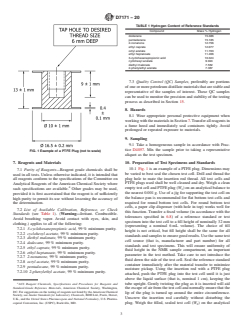
one type of PTFE plug design is shown in Fig. 1.
accurate filling into the linear response region of the sample
compartment so that the mass recorded for the sample repre-
6.6 Insertion Rod—Straight, rigid rod with a threaded end
sents the true amount measured by NMR, and use of a recycle
(to screw into the PTFE plug) for inserting and removing the
delay considerably greater than the longest relaxation time
PTFE plugs from the test cells. Any diameter and length rod
constant (T ) for the sample.
that facilitates easy plug insertion and removal may be used.
6.7 Analytical Balance—Top loading pan-type balance, ca-
5. Significance and Use
pable of weighing the test cells in an upright position to an
5.1 Hydrogen content represents a fundamental quality of a
accuracy of 0.001g or better.
petroleum distillate that has been correlated with many of the
performance characteristics of that product. Combustion prop- 6.8 Volume Transferring Device—Capableofaccuratelyand
erties of gas turbine fuels are related primarily to hydrogen repeatedly delivering a fixed volume of material within 61%
content. As hydrogen content of these fuels decreases, soot or better, for use in preparing test specimens and standards for
deposits, exhaust smoke, and thermal radiation increase. Soot analysis. A 10mL capacity serological pipet with 0.1mL
deposits and thermal radiation can increase to the point that marked subdivisions has been found suitable to use.
D7171 − 20
TABLE 1 Hydrogen Content of Reference Standards
Compound Mass % Hydrogen
dodecane 15.386
pentadecane 15.185
2-nonanone 12.756
ethyl caprate 12.077
octyl acetate 11.703
ethyl heptanoate 11.466
3-cyclohexanepropionic acid 10.324
cyclohexyl acetate 9.924
diethyl malonate 7.552
2-phenylethyl acetate 7.367
7.3 Quality Control (QC) Samples, preferably are portions
ofoneormorepetroleumdistillatematerialsthatarestableand
representative of the samples of interest. These QC samples
canbeusedtomonitortheprecisionandstabilityofthetesting
process as described in Section 15.
8. Hazards
8.1 Wear appropriate personal protective equipment when
workingwiththematerialsinSection7.Transferallreagentsin
a fume hood and immediately seal containers tightly. Avoid
prolonged or repeated exposure to materials.
9. Sampling
9.1 Take a homogeneous sample in accordance with Prac-
tice D4057. Mix the sample prior to taking a representative
FIG. 1 Example of a PTFE Plug (not to scale)
aliquot as the test specimen.
10. Preparation of Test Specimens and Standards
7. Reagents and Materials
10.1 Fig. 1 is an example of a PTFE plug. Dimensions may
7.1 Purity of Reagents—Reagent grade chemicals shall be
be varied to best seal the chosen test cell. Drill and thread the
used in all tests. Unless otherwise indicated, it is intended that
plug hole to mate the insertion rod thread. All test cells and
all reagents conform to the specifications of the Committee on
PTFE plugs used shall be well cleaned and dry. Weigh a clean
Analytical Reagents of theAmerican Chemical Society where
emptytestcellandPTFEplug(W )onananalyticalbalanceto
such specifications are available. Other grades may be used,
the nearest 0.001g. Use of a jig for supporting the test cell on
provided it is first ascertained that the reagent is of sufficiently
the balance pan is recommended for flat bottom test cells and
high purity to permit its use without lessening the accuracy of
required for round bottom test cells. For round bottom test
the determination.
cells, a paper clip dispenser (with hole in top) works well for
7.2 List of Available Calibration, Reference, or Check
this function. Transfer a fixed volume (in accordance with the
Standards (see Table 1). (Warning—Irritant. Combustible.
tolerances specified in 6.8) of a reference standard or test
Avoid breathing vapor. Avoid contact with eyes, skin, and
specimen into the test cell to a fill height of nominally 32mm
clothing.) applies to all of the following:
(representing a nominal 6mL volume). The choice of fill
7.2.1 3-cyclohexanepropionic acid, 99% minimum purity.
height is not critical, but fill height shall be the same for all
7.2.2 cyclohexyl acetate, 99% minimum purity.
standardsandsamplestoensuregoodresults.Usethesametest
7.2.3 diethyl malonate, 99% minimum purity.
cell source (that is, manufacturer and part number) for all
7.2.4 dodecane, 99% minimum purity.
standards and test specimens. This will ensure uniformity of
...
This document is not an ASTM standard and is intended only to provide the user of an ASTM standard an indication of what changes have been made to the previous version. Because
it may not be technically possible to adequately depict all changes accurately, ASTM recommends that users consult prior editions as appropriate. In all cases only the current version
of the standard as published by ASTM is to be considered the official document.
Designation: D7171 − 16 D7171 − 20
Standard Test Method for
Hydrogen Content of Middle Distillate Petroleum Products
by Low-Resolution Pulsed Nuclear Magnetic Resonance
Spectroscopy
This standard is issued under the fixed designation D7171; the number immediately following the designation indicates the year of
original adoption or, in the case of revision, the year of last revision. A number in parentheses indicates the year of last reapproval. A
superscript epsilon (´) indicates an editorial change since the last revision or reapproval.
1. Scope*
1.1 This test method covers the determination of the hydrogen content of middle distillate petroleum products using a
low-resolution pulsed nuclear magnetic resonance (NMR) spectrometer. The boiling range of distillates covered by the test method
is 150 °C to 390 °C. While this test method may be applicable to middle distillates outside this boiling range, in such cases the
precision statements may not apply. The test method is generally based on Test Methods D3701 and D4808, with a major difference
being the use of a pulsed NMR spectrometer instead of a continuous wave NMR spectrometer.
1.2 The values stated in SI units are to be regarded as standard. No other units of measurement are included in this standard.
1.2.1 The preferred units are mass %.
1.3 This standard does not purport to address all of the safety concerns, if any, associated with its use. It is the responsibility
of the user of this standard to establish appropriate safety safety, health, and healthenvironmental practices and determine the
applicability of regulatory limitations prior to use.
1.4 This international standard was developed in accordance with internationally recognized principles on standardization
established in the Decision on Principles for the Development of International Standards, Guides and Recommendations issued
by the World Trade Organization Technical Barriers to Trade (TBT) Committee.
2. Referenced Documents
2.1 ASTM Standards:
D3701 Test Method for Hydrogen Content of Aviation Turbine Fuels by Low Resolution Nuclear Magnetic Resonance
Spectrometry
D4057 Practice for Manual Sampling of Petroleum and Petroleum Products
D4808 Test Methods for Hydrogen Content of Light Distillates, Middle Distillates, Gas Oils, and Residua by Low-Resolution
Nuclear Magnetic Resonance Spectroscopy
D5291 Test Methods for Instrumental Determination of Carbon, Hydrogen, and Nitrogen in Petroleum Products and Lubricants
D6299 Practice for Applying Statistical Quality Assurance and Control Charting Techniques to Evaluate Analytical Measure-
ment System Performance
D6708 Practice for Statistical Assessment and Improvement of Expected Agreement Between Two Test Methods that Purport
to Measure the Same Property of a Material
2.2 Other Documents:
MIL-DTL-5624 Turbine Fuel, Aviation, Grades JP-4 and JP-5
MIL-DTL-83133 Turbine Fuel, Aviation, Kerosene Type, JP-8 (NATO F-34), NATO F-35, and JP-8+100 (NATO F-37)
MIL-DTL-16884 Fuel, Naval Distillate
3. Terminology
3.1 Definitions:
This test method is under the jurisdiction of ASTM Committee D02 on Petroleum Products, Liquid Fuels, and Lubricants and is the direct responsibility of Subcommittee
D02.03 on Elemental Analysis.
Current edition approved Oct. 1, 2016May 1, 2020. Published October 2016June 2020. Originally approved in 2005. Last previous edition approved in 2016 as D7171
– 05 (2016). 16. DOI: 10.1520/D7171-16.10.1520/D7171-20.
For referenced ASTM standards, visit the ASTM website, www.astm.org, or contact ASTM Customer Service at service@astm.org. For Annual Book of ASTM Standards
volume information, refer to the standard’s Document Summary page on the ASTM website.
Available online at the ASSIST Quick Search website http://quicksearch.dla.mil.
*A Summary of Changes section appears at the end of this standard
Copyright © ASTM International, 100 Barr Harbor Drive, PO Box C700, West Conshohocken, PA 19428-2959. United States
D7171 − 20
3.1.1 calibration, n—the determination of the values of the significant parameters by comparison with values indicated by a set
of calibration standards.
3.1.2 calibration curve (or calibration line), n—the graphical or mathematical representation of a relationship between the
assigned (known) values of calibration standards and the measured responses from the measurement system.
3.1.3 calibration standard, n—a standard having an assigned (known) value (reference value) for use in calibrating a
measurement instrument or system. This standard is not used to determine the accuracy of the measurement instrument or system
(see check standard).
3.1.4 check standard, n—a in QC testing, material having an assigned (known) value (reference value) accepted reference value
used to determine the accuracy of thea measurement instrument or system. This standard is not used to calibrate the measurement
instrument or system (see system.calibration standard).
3.1.4.1 Discussion—
This standard is not used to calibrate the measurement instrument or system (see calibration standard).
3.1.5 low resolution nuclear magnetic resonance (NMR) spectroscopy, n—a form of NMR spectroscopy using a simple NMR
analyzer that employs a low magnetic field and consequentially low NMR frequency. An example is proton NMR below 60 MHz.
Resolution is expressed as time at half height of signal and is typically 1 millisecond (ms) or less.
3.1.6 nuclear magnetic resonance (NMR) spectroscopy, n—that form of spectroscopy concerned with radio-frequency-induced
transitions between magnetic energy levels of atomic nuclei.
3.1.7 radio frequency, n—the range of frequencies of electromagnetic radiation between 3 kHz and 300 GHz.
3.1.8 recycle delay, n—NMR spectrometer parameter setting for the time delay that allows magnetization recovery.
3.1.9 relaxation time constant (T ), n—a numerical value which is a measure of magnetization relaxation time following an
excitation pulse of an NMR spectrometer.
4. Summary of Test Method
4.1 A test specimen is analyzed in a pulsed NMR spectrometer calibrated with reference standard materials. The analyzer
records in a nondestructive fashion the total NMR signal, which arises from the absolute amount of hydrogen atoms in the
reference standards and test sample. The absolute hydrogen signal intensity reported by the pulsed NMR instrument for the
standard and test specimens is normalized by the corresponding sample mass. The resulting signal-per-gram ratios are used as a
means of comparing theoretical hydrogen contents of the standards with that of the sample. The result is expressed as the hydrogen
content (on a mass % basis) of the sample.
4.2 To ensure an accurate measure of the absolute hydrogen content of the reference standards and sample, it is necessary to
ensure that the measured hydrogen signal intensity is always directly proportional to the absolute hydrogen content of the standards
and sample.
4.3 Undercounting of the reference standard with respect to the sample is avoided by a number of strategies, including accurate
filling into the linear response region of the sample compartment so that the mass recorded for the sample represents the true
amount measured by NMR, and use of a recycle delay considerably greater than the longest relaxation time constant (T ) for the
sample.
5. Significance and Use
5.1 Hydrogen content represents a fundamental quality of a petroleum distillate that has been correlated with many of the
performance characteristics of that product. Combustion properties of gas turbine fuels are related primarily to hydrogen content.
As hydrogen content of these fuels decreases, soot deposits, exhaust smoke, and thermal radiation increase. Soot deposits and
thermal radiation can increase to the point that combustor liner burnout will occur. Hydrogen content is a procurement requirement
of the following military fuels: JP-5 specified in MIL-DTL-5624, JP-8 specified in MIL-DTL-83133, and Naval Distillate Fuel
specified in MIL-DTL-16884.
5.2 This test method provides a simple and precise alternative to existing test methods (D3701, D4808, and D5291) for
determining the hydrogen content of petroleum distillate products.
6. Apparatus
6.1 Nuclear Magnetic Resonance Spectrometer:
6.1.1 This test method requires a low-resolution pulsed instrument capable of measuring a nuclear magnetic resonance signal
due to hydrogen atoms in the sample in a linear fashion over the filling volume of interest. The instrument includes the following:
6.1.1.1 Permanent magnet to provide the necessary static magnetic field for the NMR test,
6.1.1.2 Sample compartment containing a radio frequency (RF) coil for excitation and detection, and
D7171 − 20
FIG. 1 Example of a PTFE Plug (not to scale)
6.1.1.3 Electronic unit to control and monitor the resonance condition involving magnet temperature control and field offset
coils.
6.1.2 The test method also requires that the instrument have the ability to equilibrate samples within the probe at a constant
temperature (that is, 35 °C or 40 °C).
6.2 Conditioning Block—Block of aluminum alloy drilled with holes of sufficient size to accommodate the nominal 18 mm
diameter test cells to a depth of at least 42 mm and with a centrally positioned well to house a temperature-sensing device, such
as a thermometer or thermocouple.
6.3 Conditioning Apparatus—Bath or other temperature control device (into which the conditioning block is inserted) for
controlling block temperature to 35 °C 6 0.2 °C or 40 °C 6 0.2 °C.
6.4 Test Cell—Glass tube (with a flat or round bottom) with an outside diameter of 17.6 mm to 18.1 mm and an inside diameter
of 15.2 mm to 16.4 mm. Any tube length that permits easy insertion into and removal from the NMR sample chamber may be used.
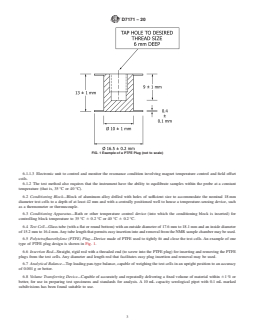
6.5 Polytetrafluorethylene (PTFE) Plug—Device made of PTFE used to tightly fit and close the test cells. An example of one
type of PTFE plug design is shown in Fig. 1.
6.6 Insertion Rod—Straight, rigid rod with a threaded end (to screw into the PTFE plug) for inserting and removing the PTFE
plugs from the test cells. Any diameter and length rod that facilitates easy plug insertion and removal may be used.
6.7 Analytical Balance—Top loading pan-type balance, capable of weighing the test cells in an upright position to an accuracy
of 0.001 g or better.
6.8 Volume Transferring Device—Capable of accurately and repeatedly delivering a fixed volume of material within 61 % or
better, for use in preparing test specimens and standards for analysis. A 10 mL capacity serological pipet with 0.1 mL marked
subdivisions has been found suitable to use.
D7171 − 20
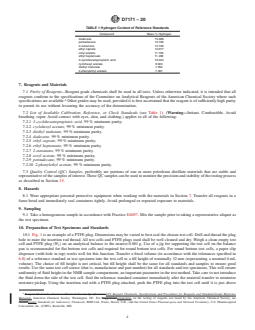
TABLE 1 Hydrogen Content of Reference Standards
Compound Mass % Hydrogen
dodecane 15.386
pentadecane 15.185
2-nonanone 12.756
ethyl caprate 12.077
octyl acetate 11.703
ethyl heptanoate 11.466
3-cyclohexanepropionic acid 10.324
cyclohexyl acetate 9.924
diethyl malonate 7.552
2-phenylethyl acetate 7.367
7. Reagents and Materials
7.1 Purity of Reagents—Reagent grade chemicals shall be used in all tests. Unless otherwise indicated, it is intended that all
reagents conform to the specifications of the Committee on Analytical Reagents of the American Chemical Society where such
specifications are available. Other grades may be used, provided it is first ascertained that the reagent is of sufficiently high purity
to permit its use without lessening the accuracy of the determination.
7.2 List of Available Calibration, Reference, or Check Standards (see Table 1). (Warning—Irritant. Combustible. Avoid
breathing vapor. Avoid contact with eyes, skin, and clothing.) applies to all of the following:
7.2.1 3-cyclohexanepropionic acid, 99 % minimum purity.
7.2.2 cyclohexyl acetate, 99 % minimum purity.
7.2.3 diethyl malonate, 99 % minimum purity.
7.2.4 dodecane, 99 % minimum purity.
7.2.5 ethyl caprate, 99 % minimum purity.
7.2.6 ethyl heptanoate, 99 % minimum purity.
7.2.7 2-nonanone, 99 % minimum purity.
7.2.8 octyl acetate, 99 % minimum purity.
7.2.9 pentadecane, 99 % minimum purity.
7.2.10 2-phenylethyl acetate, 99 % minimum purity.
7.3 Quality Control (QC) Samples, preferably are portions of one or more petroleum distillate materials that are stable and
representative of the samples of interest. These QC samples can be used to monitor the precision and stability of the testing process
as described in Section 15.
8. Hazards
8.1 Wear appropriate personal protective equipment when working with the materials in Section 7. Transfer all reagents in a
fume hood and immediately seal containers tightly. Avoid prolonged or repeated exposure to materials.
9. Sampling
9.1 Take a homogeneous sample in accordance with Practice D4057. Mix the sample prior to taking a representative aliquot as
the test specimen.
10. Preparation of Test Specimens and Standards
10.1 Fig. 1 is an example of a PTFE plug. Dimensions may be varied to best seal the chosen test cell. Drill and thread the plug
hole to mate the insertion rod thread. All test cells and PTFE plugs used shall be well cleaned and dry. Weigh a clean empty test
cell and PTFE plug (W ) on an analytical balance to the nearest 0.001 g. Use of a jig for supporting the test cell on the balance
pan is recommended for flat bottom test cells and required for round bottom test cells. For round bottom test cells, a paper clip
dispenser (with hole in top) works well for this function. Transfer a fixed volume (in accordance with the tolerances specified in
6.8) of a reference standard or tes
...