

ASTM D4808-23
(Test Method)Standard Test Methods for Hydrogen Content of Light Distillates, Middle Distillates, Gas Oils, and Residua by Low-Resolution Nuclear Magnetic Resonance Spectroscopy
General Information
- Abstract
SIGNIFICANCE AND USE
5.1 The hydrogen content represents a fundamental quality of a petroleum product that has been correlated with many of the performance characteristics of that product.
5.2 This test method provides a simple and more precise alternative to existing test methods, specifically combustion techniques (Test Methods D5291) for determining the hydrogen content on a range of petroleum products.
SCOPE
1.1 These test methods cover the determination of the hydrogen content of petroleum products ranging from atmospheric distillates to vacuum residua using a continuous wave, low-resolution nuclear magnetic resonance spectrometer. (Test Method D3701 is the preferred method for determining the hydrogen content of aviation turbine fuels using nuclear magnetic resonance spectroscopy.)
1.2 Three test methods are included here that account for the special characteristics of different petroleum products and apply to the following distillation ranges:
Test Method
Petroleum Products
Boiling Range, °C (°F)
(approximate)
A
Light Distillates
15–260 (60–500)
B
Middle Distillates
200–370 (400–700)
Gas Oils
370–510 (700–950)
C
Residua
510+ (950+ )
1.3 The values stated in SI units are to be regarded as standard. No other units of measurement are included in this standard. The preferred units are mass %.
1.4 This standard does not purport to address all of the safety concerns, if any, associated with its use. It is the responsibility of the user of this standard to establish appropriate safety, health, and environmental practices and determine the applicability of regulatory limitations prior to use. For specific warning statements, see Sections 7.2 and 7.4.
1.5 This international standard was developed in accordance with internationally recognized principles on standardization established in the Decision on Principles for the Development of International Standards, Guides and Recommendations issued by the World Trade Organization Technical Barriers to Trade (TBT) Committee.
- Status
- Published
- Publication Date
- 31-Oct-2023
- Technical Committee
- D02 - Petroleum Products, Liquid Fuels, and Lubricants
- Drafting Committee
- D02.03 - Elemental Analysis
Buy Documents
ASTM D4808-23 - Standard Test Methods for Hydrogen Content of Light Distillates, Middle Distillates, Gas Oils, and Residua by Low-Resolution Nuclear Magnetic Resonance Spectroscopy
REDLINE ASTM D4808-23 - Standard Test Methods for Hydrogen Content of Light Distillates, Middle Distillates, Gas Oils, and Residua by Low-Resolution Nuclear Magnetic Resonance Spectroscopy
Overview
ASTM D4808-23 sets out standardized test methods for determining the hydrogen content in a broad range of petroleum products-including light distillates, middle distillates, gas oils, and residua. Using continuous wave, low-resolution nuclear magnetic resonance (NMR) spectroscopy, these methods provide a precise and efficient alternative to traditional combustion techniques for hydrogen analysis.
Hydrogen content is a critical quality parameter for petroleum products, closely linked to many key performance attributes such as energy content, combustion behavior, and emission characteristics. ASTM D4808-23 is recognized internationally and developed in line with globally accepted standardization principles.
Key Topics
- Hydrogen Content Determination: The core focus is measuring the absolute hydrogen atom concentration in petroleum products using NMR spectroscopy, reported as mass percent (%).
- Test Methods for Different Product Ranges:
- Test Method A: For light distillates (boiling range 15–260°C).
- Test Method B: For middle distillates and gas oils (boiling range 200–510°C).
- Test Method C: For residua (boiling range 510°C and above).
- Precision and Repeatability: The standard describes the precision and reproducibility of results, reflecting the reliability of NMR analysis compared to combustion techniques.
- Sample Preparation and Safety: Detailed procedures for sample homogenization, dilution, and handling are outlined, along with reminders for adhering to safety, health, and environmental regulations.
Applications
- Quality Assurance in Refining: Refineries use ASTM D4808-23 to control and optimize hydrogen content in various streams, impacting final fuel quality and process efficiency.
- Product Specification Compliance: Verification of hydrogen levels supports compliance with regulatory and industry specifications for fuels and feedstocks.
- Performance Evaluation: Hydrogen content data informs predictions about combustion behavior, energy yield, and the environmental performance of petroleum products.
- Research and Development: Laboratories and R&D teams utilize these NMR-based methods for developing new fuel formulations and for comparative analysis with traditional methods, such as combustion analysis (ASTM D5291).
- Environmental Impact Assessment: Accurate hydrogen determination assists in estimating the potential emissions profile of fuels, supporting sustainability initiatives.
Related Standards
- ASTM D3701: Preferred NMR method for hydrogen content in aviation turbine fuels.
- ASTM D5291: Combustion techniques for instrumental measurement of hydrogen, carbon, and nitrogen in petroleum products.
- ASTM D4057 & D4177: Guidelines for manual and automatic sampling of petroleum and petroleum products.
- ASTM D4175: Standard terminology relating to petroleum products, liquid fuels, and lubricants.
Practical Value
Adopting ASTM D4808-23 offers several practical benefits:
- Improved Accuracy: Low-resolution NMR provides high precision in hydrogen quantification across various petroleum product types.
- Efficiency: The nondestructive nature of NMR analysis allows for faster results and reduced sample preparation time compared to combustion methods.
- Versatility: Applicable to a range of distillation fractions, from light distillates to heavy residua, enhancing laboratory productivity and supporting comprehensive quality monitoring.
- Regulatory Confidence: As a globally recognized standard, ASTM D4808-23 ensures acceptance of analytical results in both domestic and international quality or compliance contexts.
By implementing these test methods, organizations in the petroleum industry gain reliable tools for product quality assessment, process optimization, and regulatory compliance, all while ensuring safer and more efficient hydrogen content measurement.
Relations
- Effective Date
- 01-Nov-2023
- Refers
ASTM D4175-23a - Standard Terminology Relating to Petroleum Products, Liquid Fuels, and Lubricants - Effective Date
- 15-Dec-2023
- Effective Date
- 01-Nov-2023
- Refers
ASTM D4175-23e1 - Standard Terminology Relating to Petroleum Products, Liquid Fuels, and Lubricants - Effective Date
- 01-Jul-2023
- Effective Date
- 01-Jun-2017
- Effective Date
- 01-Nov-2023
- Effective Date
- 01-Nov-2023
Buy Documents
ASTM D4808-23 - Standard Test Methods for Hydrogen Content of Light Distillates, Middle Distillates, Gas Oils, and Residua by Low-Resolution Nuclear Magnetic Resonance Spectroscopy
REDLINE ASTM D4808-23 - Standard Test Methods for Hydrogen Content of Light Distillates, Middle Distillates, Gas Oils, and Residua by Low-Resolution Nuclear Magnetic Resonance Spectroscopy
Get Certified
Connect with accredited certification bodies for this standard

Element Materials Technology
Materials testing and product certification.

ABS Group Brazil
ABS Group certification services in Brazil.

ABS Quality Evaluations Inc.
American Bureau of Shipping quality certification.
Sponsored listings
Frequently Asked Questions
ASTM D4808-23 is a standard published by ASTM International. Its full title is "Standard Test Methods for Hydrogen Content of Light Distillates, Middle Distillates, Gas Oils, and Residua by Low-Resolution Nuclear Magnetic Resonance Spectroscopy". This standard covers: SIGNIFICANCE AND USE 5.1 The hydrogen content represents a fundamental quality of a petroleum product that has been correlated with many of the performance characteristics of that product. 5.2 This test method provides a simple and more precise alternative to existing test methods, specifically combustion techniques (Test Methods D5291) for determining the hydrogen content on a range of petroleum products. SCOPE 1.1 These test methods cover the determination of the hydrogen content of petroleum products ranging from atmospheric distillates to vacuum residua using a continuous wave, low-resolution nuclear magnetic resonance spectrometer. (Test Method D3701 is the preferred method for determining the hydrogen content of aviation turbine fuels using nuclear magnetic resonance spectroscopy.) 1.2 Three test methods are included here that account for the special characteristics of different petroleum products and apply to the following distillation ranges: Test Method Petroleum Products Boiling Range, °C (°F) (approximate) A Light Distillates 15–260 (60–500) B Middle Distillates 200–370 (400–700) Gas Oils 370–510 (700–950) C Residua 510+ (950+ ) 1.3 The values stated in SI units are to be regarded as standard. No other units of measurement are included in this standard. The preferred units are mass %. 1.4 This standard does not purport to address all of the safety concerns, if any, associated with its use. It is the responsibility of the user of this standard to establish appropriate safety, health, and environmental practices and determine the applicability of regulatory limitations prior to use. For specific warning statements, see Sections 7.2 and 7.4. 1.5 This international standard was developed in accordance with internationally recognized principles on standardization established in the Decision on Principles for the Development of International Standards, Guides and Recommendations issued by the World Trade Organization Technical Barriers to Trade (TBT) Committee.
SIGNIFICANCE AND USE 5.1 The hydrogen content represents a fundamental quality of a petroleum product that has been correlated with many of the performance characteristics of that product. 5.2 This test method provides a simple and more precise alternative to existing test methods, specifically combustion techniques (Test Methods D5291) for determining the hydrogen content on a range of petroleum products. SCOPE 1.1 These test methods cover the determination of the hydrogen content of petroleum products ranging from atmospheric distillates to vacuum residua using a continuous wave, low-resolution nuclear magnetic resonance spectrometer. (Test Method D3701 is the preferred method for determining the hydrogen content of aviation turbine fuels using nuclear magnetic resonance spectroscopy.) 1.2 Three test methods are included here that account for the special characteristics of different petroleum products and apply to the following distillation ranges: Test Method Petroleum Products Boiling Range, °C (°F) (approximate) A Light Distillates 15–260 (60–500) B Middle Distillates 200–370 (400–700) Gas Oils 370–510 (700–950) C Residua 510+ (950+ ) 1.3 The values stated in SI units are to be regarded as standard. No other units of measurement are included in this standard. The preferred units are mass %. 1.4 This standard does not purport to address all of the safety concerns, if any, associated with its use. It is the responsibility of the user of this standard to establish appropriate safety, health, and environmental practices and determine the applicability of regulatory limitations prior to use. For specific warning statements, see Sections 7.2 and 7.4. 1.5 This international standard was developed in accordance with internationally recognized principles on standardization established in the Decision on Principles for the Development of International Standards, Guides and Recommendations issued by the World Trade Organization Technical Barriers to Trade (TBT) Committee.
ASTM D4808-23 is classified under the following ICS (International Classification for Standards) categories: 75.160.20 - Liquid fuels. The ICS classification helps identify the subject area and facilitates finding related standards.
ASTM D4808-23 has the following relationships with other standards: It is inter standard links to ASTM D4808-17, ASTM D4175-23a, ASTM D3701-23, ASTM D4175-23e1, ASTM D3701-17, ASTM D7455-19, ASTM D7171-20. Understanding these relationships helps ensure you are using the most current and applicable version of the standard.
ASTM D4808-23 is available in PDF format for immediate download after purchase. The document can be added to your cart and obtained through the secure checkout process. Digital delivery ensures instant access to the complete standard document.
Standards Content (Sample)
This international standard was developed in accordance with internationally recognized principles on standardization established in the Decision on Principles for the
Development of International Standards, Guides and Recommendations issued by the World Trade Organization Technical Barriers to Trade (TBT) Committee.
Designation: D4808 − 23
Standard Test Methods for
Hydrogen Content of Light Distillates, Middle Distillates,
Gas Oils, and Residua by Low-Resolution Nuclear Magnetic
Resonance Spectroscopy
This standard is issued under the fixed designation D4808; the number immediately following the designation indicates the year of
original adoption or, in the case of revision, the year of last revision. A number in parentheses indicates the year of last reapproval. A
superscript epsilon (´) indicates an editorial change since the last revision or reapproval.
This standard has been approved for use by agencies of the U.S. Department of Defense.
1. Scope* 2. Referenced Documents
2.1 ASTM Standards:
1.1 These test methods cover the determination of the
D3701 Test Method for Hydrogen Content of Aviation
hydrogen content of petroleum products ranging from atmo-
Turbine Fuels by Low Resolution Nuclear Magnetic
spheric distillates to vacuum residua using a continuous wave,
Resonance Spectrometry
low-resolution nuclear magnetic resonance spectrometer. (Test
D4057 Practice for Manual Sampling of Petroleum and
Method D3701 is the preferred method for determining the
Petroleum Products
hydrogen content of aviation turbine fuels using nuclear
D4175 Terminology Relating to Petroleum Products, Liquid
magnetic resonance spectroscopy.)
Fuels, and Lubricants
1.2 Three test methods are included here that account for the
D4177 Practice for Automatic Sampling of Petroleum and
special characteristics of different petroleum products and
Petroleum Products
apply to the following distillation ranges:
D5291 Test Methods for Instrumental Determination of
Test Method Petroleum Products Boiling Range, °C (°F)
Carbon, Hydrogen, and Nitrogen in Petroleum Products
(approximate)
and Lubricants
A Light Distillates 15–260 (60–500)
B Middle Distillates 200–370 (400–700)
3. Terminology
Gas Oils 370–510 (700–950)
C Residua 510+ (950+ )
3.1 Definitions:
1.3 The values stated in SI units are to be regarded as
3.1.1 For definitions of terms used in this test method, refer
standard. No other units of measurement are included in this
to Terminology D4175.
standard. The preferred units are mass %.
4. Summary of Test Methods
1.4 This standard does not purport to address all of the
4.1 A test specimen is compared in a continuous wave,
safety concerns, if any, associated with its use. It is the
responsibility of the user of this standard to establish appro- low-resolution nuclear magnetic resonance (NMR) spectrom-
eter with a reference standard sample. The spectrometer
priate safety, health, and environmental practices and deter-
mine the applicability of regulatory limitations prior to use. records in a nondestructive fashion the absolute concentration
of hydrogen atoms in the reference standard and test sample.
For specific warning statements, see Sections 7.2 and 7.4.
The absolute hydrogen concentrations reported by the integra-
1.5 This international standard was developed in accor-
tor on the NMR instrument for the standard and test specimens
dance with internationally recognized principles on standard-
are used as a means of comparing the theoretical hydrogen
ization established in the Decision on Principles for the
content of the standard with that of the sample, the result being
Development of International Standards, Guides and Recom-
expressed as the hydrogen content (on a mass % basis) of the
mendations issued by the World Trade Organization Technical
sample.
Barriers to Trade (TBT) Committee.
4.2 To ensure an accurate measure of the absolute hydrogen
content of the reference standard and sample, it is necessary to
These test methods are under the jurisdiction of ASTM Committee D02 on
Petroleum Products, Liquid Fuels, and Lubricants and are the direct responsibility
of Subcommittee D02.03 on Elemental Analysis. For referenced ASTM standards, visit the ASTM website, www.astm.org, or
Current edition approved Nov. 1, 2023. Published November 2023. Originally contact ASTM Customer Service at service@astm.org. For Annual Book of ASTM
approved in 1988. Last previous edition approved in 2017 as D4808 – 17. DOI: Standards volume information, refer to the standard’s Document Summary page on
10.1520/D4808-23. the ASTM website.
*A Summary of Changes section appears at the end of this standard
Copyright © ASTM International, 100 Barr Harbor Drive, PO Box C700, West Conshohocken, PA 19428-2959. United States
D4808 − 23
ensure that the measured hydrogen integrator counts are always
directly proportional to the absolute hydrogen content of the
standard and sample.
4.3 Undercounting of the reference standard with respect to
the sample is avoided in Test Methods B and C by dilution of
the standard with a relaxation reagent solution. Undercounting
of highly viscous or solid test samples is avoided by dissolving
the sample in a non-hydrogen containing solvent, which
ensures that all of the weighed sample is in a fluid and
homogeneous solution at the time of measurement. An elevated
sample temperature at the time of measurement also ensures a
homogeneous liquid-phase sample.
5. Significance and Use
5.1 The hydrogen content represents a fundamental quality
of a petroleum product that has been correlated with many of
the performance characteristics of that product.
5.2 This test method provides a simple and more precise
alternative to existing test methods, specifically combustion
techniques (Test Methods D5291) for determining the hydro-
gen content on a range of petroleum products.
6. Apparatus
NOTE 1—This test method has been written around the Newport
Analyzer Mark IIIF or its replacement version, the Newport 4000 (Oxford
Analytical Instruments, Ltd., Oxford, England), and the details of the test
method are to be read in conjunction with the manufacturer’s handbook.
These instruments have demonstrated statistically indistinguishable per-
formance in these standard test methods and in Test Method D3701. Any
similar instrument is acceptable, provided that the new instrument is
adequately correlated and proved to be statistically similar. As of the
mid-1990s, however, the Newport 4000 instrument is no longer being
FIG. 1 Conditioning Block and Insertion Rod
manufactured by the vendor. No newer models are currently being
manufactured as replacements for the Newport 4000 instrument.
the test cells used for the sample and reference material should
6.1 Nuclear Magnetic Resonance Spectrometer:
not be greater than 60.5 mm.
6.1.1 A low-resolution, continuous wave instrument capable
of measuring a nuclear magnetic resonance signal due to
NOTE 2—To avoid potential difficulties with tightness when the test cell
hydrogen atoms in the sample and includes an excitation and
is introduced into the magnet coil, users are cautioned to avoid test cells
detection coil of suitable dimensions to contain the test cell; an that have nominal external diameters that are greater than 34.2 mm.
electronic unit, to control and monitor the magnet and coil, and
6.4 Polytetrafluoroethylene (PTFE) Plugs, for closing the
containing: circuits, to control and adjust the radio-frequency
test cells and made from pure PTFE.
level and audio-frequency gain; and integrating counter, with
6.5 Insertion Rod—A metal rod with a threaded end used for
variable time period in seconds.
inserting and removing the PTFE plugs from the test cells (see
6.1.2 Test Methods B and C also require that the instrument
Fig. 1).
has the ability to equilibrate samples within the probe at an
6.6 Analytical Balance—A top pan-type balance, capable of
elevated temperature (50 °C).
weighing the test cells in an upright position to an accuracy of
6.2 Conditioning Block—A block of aluminum alloy drilled
at least 0.001 g.
with holes of sufficient size to accommodate the test cells with
6.7 Beakers, 150 mL and 50 mL with pour spouts.
the mean height of the sample being at least 20 mm below the
top of the conditioning block, capable of holding the sample at
6.8 Glass Stirring Rod, approximately 250 mm length.
the given test temperature (see Fig. 1).
7. Reagents and Materials
6.3 Test Cells—Nessler-type tubes of approximately
100 mL capacity with a nominal external diameter of 34 mm 7.1 Purity of Reagents—Reagent grade chemicals shall be
and a nominal internal diameter of 31 mm marked at a distance used in all tests. Unless otherwise indicated, it is intended that
of 51 mm above the bottom of the tube by a ring around the all reagents shall conform to the specifications of the Commit-
circumference. The variation between the internal diameters of tee on Analytical Reagents of the American Chemical Society,
D4808 − 23
where such specifications are available. Other grades may be 9.1.5 Place the test cell in the sample conditioning block to
used, provided it is first ascertained that the reagent is of equilibrate.
sufficiently high purity to permit its use without lessening the 9.1.6 Use procedures 9.1.1 through 9.1.5 to prepare both the
accuracy of the determination. reference and sample test cells.
7.2 Reference Standard—n-Dodecane. (Warning— 9.2 Test Method B—Middle Distillates, Gas Oils
Flammable.) 9.2.1 Reference Standard Preparation:
9.2.1.1 Take a clean and dry test cell with PTFE plug and a
7.3 Relaxation Reagent Solution, prepared from ferric
150 mL beaker with glass rod. Weigh the test cell with plug and
acetylacetonate (Fe(C H O ) − MW = 353.16, reagent
5 7 2 3
beaker with glass rod to the nearest 0.001 g and record as tare
grade)—Prepare a fresh 0.02 M Fe(C H O ) solution by
5 7 2 3
masses.
dissolving 1.77 g of Fe(C H O ) in 250 mL TCE. If any of
5 7 2 3
9.2.1.2 Add 20 g of the reference standard, n-dodecane, to
the Fe(C H O ) remains undissolved, filter the solution, and
5 7 2
the beaker. Record this mass to the nearest 0.001 g as S .
M
use the filtrate in subsequent steps.
9.2.1.3 To the beaker add 8.6 g TCE and 4.7 g of relaxation
7.4 Tetrachloroethylene (TCE). (Warning—Cancer-suspect
reagent solution, as described in 7.3, consisting of TCE and
agent.)
Fe(C H O ) (40 % dilution of reference standard with 1 mg
5 7 2 3
relaxation reagent/mL). Mix thoroughly using the glass stirring
8. Sampling
rod.
8.1 Take a homogeneous sample in accordance with Prac-
NOTE 4—Burets can also be used to aid the addition of TCE and
tice D4057 or D4177. Mix the sample prior to taking a
relaxation reagent solutions.
representative aliquot as the test specimen. Middle distillates,
9.2.1.4 Transfer this solution from the beaker to the test cell,
gas oils, and residue can require heating to facilitate mixing to
using the glass rod to prevent splashing the liquid above the
obtain a homogeneous test specimen, as described in 9.2.2.2
line inscribed on the test cell. Fill the test cell to the prescribed
and 9.3.2.
level, just below this mark.
9.2.1.5 Continue as in 9.1.2 and 9.1.3.
9. Preparation of Test Specimen and Standard
9.2.1.6 Weigh the test cell containing the reference solution
9.1 Test Method A—Light Distillates
and plug. Record the mass of the reference solution to the
9.1.1 Take a clean and dry test cell and PTFE plug, and
nearest 0.001 g as M .
weigh them together to the nearest 0.001 g and record the
9.2.1.7 Weigh the beaker and glass rod containing the
weight. Add 30 mL 6 1 mL of the reference standard or test
unused solution, and record the mass of the remaining solution
specimen to the tube, taking extreme care to prevent splashing
to the nearest 0.001 g as M .
the liquid above the line inscribed on the tube. Use a pipet for
9.2.1.8 Place the test cell containing reference solution into
this operation.
the conditioning block to equilibrate.
9.1.2 Using the insertion rod, push the PTFE plug into the
9.2.2 Test Specimen Preparation:
tube until it is about 3 cm above the liquid surface, being
9.2.2.1 Take a clean and dry test cell with PTFE plug and a
careful to keep the tube upright. A gentle twisting or rocking of
150 mL beaker with glass stirring rod. Weigh the test cell with
the plug as it is inserted usually aids the escape of air from the
plug and the beaker with glass rod to the nearest mg, and
test cell and ensures that the lip of the PTFE plug is turned up
record as tare masses.
around the entire circumference. Take care to ensure that this is
9.2.2.2 Add 20 g of the test specimen to the beaker. Record
so, since a plug that is not properly inserted allows
...
This document is not an ASTM standard and is intended only to provide the user of an ASTM standard an indication of what changes have been made to the previous version. Because
it may not be technically possible to adequately depict all changes accurately, ASTM recommends that users consult prior editions as appropriate. In all cases only the current version
of the standard as published by ASTM is to be considered the official document.
Designation: D4808 − 17 D4808 − 23
Standard Test Methods for
Hydrogen Content of Light Distillates, Middle Distillates,
Gas Oils, and Residua by Low-Resolution Nuclear Magnetic
Resonance Spectroscopy
This standard is issued under the fixed designation D4808; the number immediately following the designation indicates the year of
original adoption or, in the case of revision, the year of last revision. A number in parentheses indicates the year of last reapproval. A
superscript epsilon (´) indicates an editorial change since the last revision or reapproval.
This standard has been approved for use by agencies of the U.S. Department of Defense.
1. Scope*
1.1 These test methods cover the determination of the hydrogen content of petroleum products ranging from atmospheric
distillates to vacuum residua using a continuous wave, low-resolution nuclear magnetic resonance spectrometer. (Test Method
D3701 is the preferred method for determining the hydrogen content of aviation turbine fuels using nuclear magnetic resonance
spectroscopy.)
1.2 Three test methods are included here that account for the special characteristics of different petroleum products and apply to
the following distillation ranges:
Test Method Petroleum Products Boiling Range, °C (°F)
(approximate)
A Light Distillates 15–260 (60–500)
B Middle Distillates 200–370 (400–700)
Gas Oils 370–510 (700–950)
C Residua 510+ (950+ )
1.3 The values stated in SI units are to be regarded as standard. No other units of measurement are included in this standard. The
preferred units are mass %.
1.4 This standard does not purport to address all of the safety concerns, if any, associated with its use. It is the responsibility
of the user of this standard to establish appropriate safety and healthsafety, health, and environmental practices and determine
the applicability of regulatory limitations prior to use. For specific warning statements, see Sections 6.27.2 and 6.47.4.
1.5 This international standard was developed in accordance with internationally recognized principles on standardization
established in the Decision on Principles for the Development of International Standards, Guides and Recommendations issued
by the World Trade Organization Technical Barriers to Trade (TBT) Committee.
2. Referenced Documents
2.1 ASTM Standards:
These test methods are under the jurisdiction of ASTM Committee D02 on Petroleum Products, Liquid Fuels, and Lubricants and are the direct responsibility of
Subcommittee D02.03 on Elemental Analysis.
Current edition approved June 1, 2017Nov. 1, 2023. Published June 2017November 2023. Originally approved in 1988. Last previous edition approved in 20122017 as
D4808 – 01 (2012).D4808 – 17. DOI: 10.1520/D4808-17.10.1520/D4808-23.
For referenced ASTM standards, visit the ASTM website, www.astm.org, or contact ASTM Customer Service at service@astm.org. For Annual Book of ASTM Standards
volume information, refer to the standard’s Document Summary page on the ASTM website.
*A Summary of Changes section appears at the end of this standard
Copyright © ASTM International, 100 Barr Harbor Drive, PO Box C700, West Conshohocken, PA 19428-2959. United States
D4808 − 23
D3701 Test Method for Hydrogen Content of Aviation Turbine Fuels by Low Resolution Nuclear Magnetic Resonance
Spectrometry
D4057 Practice for Manual Sampling of Petroleum and Petroleum Products
D4175 Terminology Relating to Petroleum Products, Liquid Fuels, and Lubricants
D4177 Practice for Automatic Sampling of Petroleum and Petroleum Products
D5291 Test Methods for Instrumental Determination of Carbon, Hydrogen, and Nitrogen in Petroleum Products and Lubricants
3. Terminology
3.1 Definitions:
3.1.1 For definitions of terms used in this test method, refer to Terminology D4175.
4. Summary of Test Methods
4.1 A test specimen is compared in a continuous wave, low-resolution nuclear magnetic resonance (NMR) spectrometer with a
reference standard sample. The spectrometer records in a nondestructive fashion the absolute concentration of hydrogen atoms in
the reference standard and test sample. The absolute hydrogen concentrations reported by the integrator on the NMR instrument
for the standard and test specimens are used as a means of comparing the theoretical hydrogen content of the standard with that
of the sample, the result being expressed as the hydrogen content (on a mass % basis) of the sample.
4.2 To ensure an accurate measure of the absolute hydrogen content of the reference standard and sample, it is necessary to ensure
that the measured hydrogen integrator counts are always directly proportional to the absolute hydrogen content of the standard and
sample.
4.3 Undercounting of the reference standard with respect to the sample is avoided in Test Methods B and C by dilution of the
standard with a relaxation reagent solution. Undercounting of highly viscous or solid test samples is avoided by dissolving the
sample in a non-hydrogen containing solvent, which ensures that all of the weighed sample is in a fluid and homogeneous solution
at the time of measurement. An elevated sample temperature at the time of measurement also ensures a homogeneous liquid-phase
sample.
5. Significance and Use
5.1 The hydrogen content represents a fundamental quality of a petroleum product that has been correlated with many of the
performance characteristics of that product.
5.2 This test method provides a simple and more precise alternative to existing test methods, specifically combustion techniques
(Test Methods D5291) for determining the hydrogen content on a range of petroleum products.
6. Apparatus
NOTE 1—This test method has been written around the Newport Analyzer Mark IIIF or its replacement version, the Newport 4000 (Oxford Analytical
Instruments, Ltd., Oxford, England), and the details of the test method are to be read in conjunction with the manufacturer’s handbook. These instruments
have demonstrated statistically indistinguishable performance in these standard test methods and in Test Method D3701. Any similar instrument is
acceptable, provided that the new instrument is adequately correlated and proved to be statistically similar. As of the mid-1990s, however, the Newport
4000 instrument is no longer being manufactured by the vendor. No newer models are currently being manufactured as replacements for the Newport
4000 instrument.
6.1 Nuclear Magnetic Resonance Spectrometer:
6.1.1 A low-resolution, continuous wave instrument capable of measuring a nuclear magnetic resonance signal due to hydrogen
atoms in the sample and includes an excitation and detection coil of suitable dimensions to contain the test cell; an electronic unit,
to control and monitor the magnet and coil, and containing: circuits, to control and adjust the radio-frequency level and
audio-frequency gain; and integrating counter, with variable time period in seconds.
6.1.2 Test Methods B and C also require that the instrument has the ability to equilibrate samples within the probe at an elevated
temperature (50 °C).
D4808 − 23
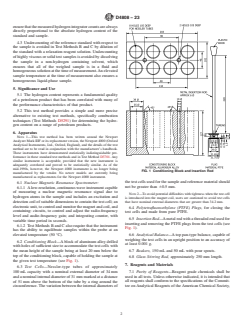
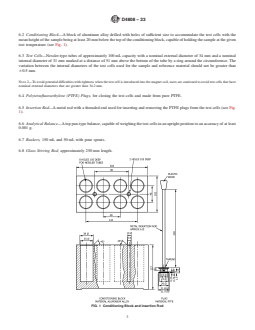
6.2 Conditioning Block—A block of aluminum alloy drilled with holes of sufficient size to accommodate the test cells with the
mean height of the sample being at least 20 mm below the top of the conditioning block, capable of holding the sample at the given
test temperature (see Fig. 1).
6.3 Test Cells—Nessler-type tubes of approximately 100 mL capacity with a nominal external diameter of 34 mm and a nominal
internal diameter of 31 mm marked at a distance of 51 mm above the bottom of the tube by a ring around the circumference. The
variation between the internal diameters of the test cells used for the sample and reference material should not be greater than
60.5 mm.
NOTE 2—To avoid potential difficulties with tightness when the test cell is introduced into the magnet coil, users are cautioned to avoid test cells that have
nominal external diameters that are greater than 34.2 mm.
6.4 Polytetrafluoroethylene (PTFE) Plugs, for closing the test cells and made from pure PTFE.
6.5 Insertion Rod—A metal rod with a threaded end used for inserting and removing the PTFE plugs from the test cells (see Fig.
1).
6.6 Analytical Balance—A top pan-type balance, capable of weighing the test cells in an upright position to an accuracy of at least
0.001 g.
6.7 Beakers, 150 mL and 50 mL with pour spouts.
6.8 Glass Stirring Rod, approximately 250 mm length.
FIG. 1 Conditioning Block and Insertion Rod
D4808 − 23
7. Reagents and Materials
7.1 Purity of Reagents—Reagent grade chemicals shall be used in all tests. Unless otherwise indicated, it is intended that all
reagents shall conform to the specifications of the Committee on Analytical Reagents of the American Chemical Society, where
such specifications are available. Other grades may be used, provided it is first ascertained that the reagent is of sufficiently high
purity to permit its use without lessening the accuracy of the determination.
7.2 Reference Standard—n-Dodecane. (Warning—Flammable.)
7.3 Relaxation Reagent Solution, prepared from ferric acetylacetonate (Fe(C H O ) − MW = 353.16, reagent grade)—Prepare
5 7 2 3
a fresh 0.02 M Fe(C H O ) solution by dissolving 1.77 g of Fe(C H O ) in 250 mL TCE. If any of the Fe(C H O ) remains
5 7 2 3 5 7 2 3 5 7 2
undissolved, filter the solution, and use the filtrate in subsequent steps.
7.4 Tetrachloroethylene (TCE). (Warning—Cancer-suspect agent.)
8. Sampling
8.1 Take a homogeneous sample in accordance with Practice D4057 or D4177. Mix the sample prior to taking a representative
aliquot as the test specimen. Middle distillates, gas oils, and residue can require heating to facilitate mixing to obtain a
homogeneous test specimen, as described in 8.2.2.29.2.2.2 and 8.3.29.3.2.
9. Preparation of Test Specimen and Standard
9.1 Test Method A—Light Distillates
9.1.1 Take a clean and dry test cell and PTFE plug, and weigh them together to the nearest 0.001 g and record the weight. Add
30 mL 6 1 mL of the reference standard or test specimen to the tube, taking extreme care to prevent splashing the liquid above
the line inscribed on the tube. Use a pipet for this operation.
9.1.2 Using the insertion rod, push the PTFE plug into the tube until it is about 3 cm above the liquid surface, being careful to
keep the tube upright. A gentle twisting or rocking of the plug as it is inserted usually aids the escape of air from the test cell and
ensures that the lip of the PTFE plug is turned up around the entire circumference. Take care to ensure that this is so, since a plug
that is not properly inserted allows sample evaporation and gives rise to erroneous results.
NOTE 3—If difficulties are encountered in the insertion of the PTFE plug, this operation is facilitated by inserting a length of thin (less than 0.2 mm
diameter) and clean copper wire down the inside surface of the test cell until it is approximately 4 cm from the graduation mark, and then pushing the
PTFE plug down past the wire which is then removed.
9.1.3 Unscrew the insertion rod carefully and remove without disturbing the plug and without contacting the liquid with the under
surface of the plug.
9.1.4 Weigh the test cell containing the test specimen or standard and plug. Record this mass as M or M , respectively, to the
S R
nearest 0.001 g.
9.1.5 Place the test cell in the sample conditioning block to equilibrate.
9.1.6 Use procedures 8.1.19.1.1 through 8.1.59.1.5 to prepare both the reference and sample test cells.
9.2 Test Method B—Middle Distillates, Gas Oils
9.2.1 Reference Standard Preparation:
Reagent Chemicals, American Chemical Society Specifications,ACS Reagent Chemicals, Specifications and Procedures for Reagents and Standard-Grade Reference
Materials, American Chemical Society, Washington, DC. For suggestions on the testing of reagents not listed by the American Chemical Society, see Analar Standards for
Laboratory Chemicals, BDH Ltd., Poole, Dorset, U.K., and the United States Pharmacopeia and National Formulary, U.S. Pharmacopeial Convention, Inc. (USPC),
Rockville, MD.
D4808 − 23
9.2.1.1 Take a clean and dry test cell with PTFE plug and a 150 mL beaker with glass rod. Weigh the test cell with plug and beaker
with glass rod to the nearest 0.001 g and record as tare masses.
9.2.1.2 Add 20 g of the reference standard, n-dodecane, to the beaker. Record this mass to the nearest 0.001 g as S .
M
9.2.1.3 To the beaker add 8.6 g TCE and 4.7 g of relaxation rea
...