

ASTM D8161-17(2022)
(Test Method)Standard Test Method for Impact Resistance of Thermoplastic Pavement Marking Materials over a Highway Substrate by Means of a Striker Impacted by a Falling Weight
General Information
- Abstract
SIGNIFICANCE AND USE
5.1 The significance of this test is to determine the thermoplastic pavement marking material’s resistance to impact over a simulated pavement substrate, under laboratory conditions, and is expressed as pass/fail or numerically. The test result can be used as a quality test or to differentiate marking materials.
5.2 Anyone attempting to perform this test should initially review Test Methods D5420 and D2794, specifically the equipment setup.
5.3 Sample preparation and equipment set-up should be followed precisely to minimize variability in the test result.
SCOPE
1.1 This test method covers the sample preparation over a road-type substrate and test methodology of thermoplastic pavement marking materials similar to the “Gardner Impact” method as listed in Test Method D5420.
1.2 The values stated in inch-pound units are to be regarded as standard. The values given in parentheses are mathematical conversions to SI units that are provided for information only and are not considered standard.
1.3 This standard does not purport to address all of the safety concerns, if any, associated with its use. It is the responsibility of the user of this standard to establish appropriate safety, health, and environmental practices and determine the applicability of regulatory limitations prior to use.
1.4 This international standard was developed in accordance with internationally recognized principles on standardization established in the Decision on Principles for the Development of International Standards, Guides and Recommendations issued by the World Trade Organization Technical Barriers to Trade (TBT) Committee.
- Status
- Published
- Publication Date
- 30-Nov-2022
- Technical Committee
- D01 - Paint and Related Coatings, Materials, and Applications
- Drafting Committee
- D01.44 - Traffic Coatings
Overview
ASTM D8161-17(2022) – Standard Test Method for Impact Resistance of Thermoplastic Pavement Marking Materials over a Highway Substrate by Means of a Striker Impacted by a Falling Weight provides a detailed protocol for assessing the impact resistance of thermoplastic pavement marking materials when applied to highway substrates. Developed by ASTM International, this standard is used to determine how well thermoplastic road markings withstand sudden impacts, simulating stresses encountered during real-world service conditions. The test results support quality control, product differentiation, and performance verification for pavement marking products.
Key Topics
Impact Resistance Testing: The standard specifies a test method involving a striker impacted by a falling weight, commonly referred to as a “Gardner Impact” test. This approach evaluates the ability of thermoplastic pavement markings to resist cracking, chipping, delamination, or other forms of failure under impact.
Sample Preparation: Strict guidelines for preparing samples on standard road-type substrates help ensure consistent and reliable results. This includes melting and applying the thermoplastic marking, as well as conditioning both substrate and marking at controlled temperature and humidity.
Apparatus Setup: The falling weight impact tester is configured according to referenced standards (ASTM D5420 and D2794). It is essential that equipment setup and calibration are followed closely to minimize test variability.
Test Procedures: Two main testing procedures are outlined:
- Pass/Fail Testing: Dropping the weight from a consistent height to assess material failure.
- Failure Height Impact: Gradually increasing the drop height to determine the exact point of material failure.
Result Interpretation: Failures are identified by visible cracks, delamination, or agreed-upon criteria, supporting both qualitative (pass/fail) and quantitative assessments (impact energy values).
Safety Considerations: The standard emphasizes proper safety measures, including wearing protective eyewear and ensuring stable apparatus placement, due to the risk of flying debris during impact testing.
Applications
This ASTM standard is highly relevant for:
Quality Assurance for Road Marking Materials: Manufacturers, contractors, and regulatory authorities can use this test to verify that thermoplastic pavement markings meet required durability and performance criteria.
Product Development and Benchmarking: The standardized impact resistance test enables objective comparison between different thermoplastic formulations, supporting innovation and continuous improvement.
Specification Compliance: Project managers and procurement specialists may specify compliance with ASTM D8161 to ensure long-lasting pavement markings that will withstand the rigors of traffic and environmental stresses.
Forensic and Failure Analysis: When pavement markings underperform or fail, this test provides a reliable method for diagnosing impact-related weaknesses and identifying root causes.
Related Standards
ASTM D8161 references and aligns with several other ASTM test methods and practices, including:
- ASTM D5420 – Test Method for Impact Resistance of Flat, Rigid Plastic Specimens
- ASTM D2794 – Test Method for Resistance of Organic Coatings to the Effects of Rapid Deformation (Impact)
- ASTM D4796 – Test Method for Bond Strength of Thermoplastic Pavement Marking Materials
- ASTM D7307 – Practice for Sampling of Thermoplastic Pavement Marking Materials
- ASTM D7308 – Practice for Sample Preparation of Thermoplastic Pavement Marking Materials
- ASTM E284 – Terminology of Appearance
Adherence to these standards enhances testing precision and ensures that thermoplastic pavement marking products deliver reliable and safe performance in real-world road environments.
Keywords: ASTM D8161, impact resistance test, thermoplastic pavement marking, road marking durability, highway substrate, Gardner Impact, quality assurance, performance testing, impact failure, delamination, crack resistance.
Relations
- Effective Date
- 01-Feb-2024
- Effective Date
- 15-Jan-2024
- Effective Date
- 01-Nov-2023
- Effective Date
- 01-Jan-2020
- Effective Date
- 01-Aug-2019
- Effective Date
- 15-Apr-2019
- Effective Date
- 01-Feb-2019
- Effective Date
- 01-Dec-2018
- Effective Date
- 01-Nov-2018
- Effective Date
- 15-Aug-2017
- Effective Date
- 01-May-2014
- Effective Date
- 01-Nov-2013
- Effective Date
- 01-Jun-2013
- Effective Date
- 01-May-2013
- Effective Date
- 01-May-2013
Get Certified
Connect with accredited certification bodies for this standard

Zavod za gradbeništvo Slovenije (ZAG) - Inšpekcija
ZAG inspection body for construction products, structures, and materials.
Sponsored listings
Frequently Asked Questions
ASTM D8161-17(2022) is a standard published by ASTM International. Its full title is "Standard Test Method for Impact Resistance of Thermoplastic Pavement Marking Materials over a Highway Substrate by Means of a Striker Impacted by a Falling Weight". This standard covers: SIGNIFICANCE AND USE 5.1 The significance of this test is to determine the thermoplastic pavement marking material’s resistance to impact over a simulated pavement substrate, under laboratory conditions, and is expressed as pass/fail or numerically. The test result can be used as a quality test or to differentiate marking materials. 5.2 Anyone attempting to perform this test should initially review Test Methods D5420 and D2794, specifically the equipment setup. 5.3 Sample preparation and equipment set-up should be followed precisely to minimize variability in the test result. SCOPE 1.1 This test method covers the sample preparation over a road-type substrate and test methodology of thermoplastic pavement marking materials similar to the “Gardner Impact” method as listed in Test Method D5420. 1.2 The values stated in inch-pound units are to be regarded as standard. The values given in parentheses are mathematical conversions to SI units that are provided for information only and are not considered standard. 1.3 This standard does not purport to address all of the safety concerns, if any, associated with its use. It is the responsibility of the user of this standard to establish appropriate safety, health, and environmental practices and determine the applicability of regulatory limitations prior to use. 1.4 This international standard was developed in accordance with internationally recognized principles on standardization established in the Decision on Principles for the Development of International Standards, Guides and Recommendations issued by the World Trade Organization Technical Barriers to Trade (TBT) Committee.
SIGNIFICANCE AND USE 5.1 The significance of this test is to determine the thermoplastic pavement marking material’s resistance to impact over a simulated pavement substrate, under laboratory conditions, and is expressed as pass/fail or numerically. The test result can be used as a quality test or to differentiate marking materials. 5.2 Anyone attempting to perform this test should initially review Test Methods D5420 and D2794, specifically the equipment setup. 5.3 Sample preparation and equipment set-up should be followed precisely to minimize variability in the test result. SCOPE 1.1 This test method covers the sample preparation over a road-type substrate and test methodology of thermoplastic pavement marking materials similar to the “Gardner Impact” method as listed in Test Method D5420. 1.2 The values stated in inch-pound units are to be regarded as standard. The values given in parentheses are mathematical conversions to SI units that are provided for information only and are not considered standard. 1.3 This standard does not purport to address all of the safety concerns, if any, associated with its use. It is the responsibility of the user of this standard to establish appropriate safety, health, and environmental practices and determine the applicability of regulatory limitations prior to use. 1.4 This international standard was developed in accordance with internationally recognized principles on standardization established in the Decision on Principles for the Development of International Standards, Guides and Recommendations issued by the World Trade Organization Technical Barriers to Trade (TBT) Committee.
ASTM D8161-17(2022) is classified under the following ICS (International Classification for Standards) categories: 93.080.20 - Road construction materials. The ICS classification helps identify the subject area and facilitates finding related standards.
ASTM D8161-17(2022) has the following relationships with other standards: It is inter standard links to ASTM D883-24, ASTM D2794-93(2024), ASTM D883-23, ASTM D883-20, ASTM D883-19c, ASTM D883-19a, ASTM D883-19, ASTM D883-18a, ASTM D883-18, ASTM D883-17, ASTM E177-14, ASTM E284-13b, ASTM E284-13a, ASTM E177-13, ASTM E691-13. Understanding these relationships helps ensure you are using the most current and applicable version of the standard.
ASTM D8161-17(2022) is available in PDF format for immediate download after purchase. The document can be added to your cart and obtained through the secure checkout process. Digital delivery ensures instant access to the complete standard document.
Standards Content (Sample)
This international standard was developed in accordance with internationally recognized principles on standardization established in the Decision on Principles for the
Development of International Standards, Guides and Recommendations issued by the World Trade Organization Technical Barriers to Trade (TBT) Committee.
Designation: D8161 − 17 (Reapproved 2022)
Standard Test Method for
Impact Resistance of Thermoplastic Pavement Marking
Materials over a Highway Substrate by Means of a Striker
Impacted by a Falling Weight
This standard is issued under the fixed designation D8161; the number immediately following the designation indicates the year of
original adoption or, in the case of revision, the year of last revision. A number in parentheses indicates the year of last reapproval. A
superscript epsilon (´) indicates an editorial change since the last revision or reapproval.
1. Scope D5628 Test Method for Impact Resistance of Flat, Rigid
Plastic Specimens by Means of a Falling Dart (Tup or
1.1 This test method covers the sample preparation over a
Falling Mass)
road-type substrate and test methodology of thermoplastic
D7307 Practice for Sampling of Thermoplastic Pavement
pavement marking materials similar to the “Gardner Impact”
Marking Materials
method as listed in Test Method D5420.
D7308 Practice for Sample Preparation of Thermoplastic
1.2 The values stated in inch-pound units are to be regarded
Pavement Marking Materials
as standard. The values given in parentheses are mathematical
E177 Practice for Use of the Terms Precision and Bias in
conversions to SI units that are provided for information only
ASTM Test Methods
and are not considered standard.
E284 Terminology of Appearance
1.3 This standard does not purport to address all of the
E691 Practice for Conducting an Interlaboratory Study to
safety concerns, if any, associated with its use. It is the Determine the Precision of a Test Method
responsibility of the user of this standard to establish appro-
priate safety, health, and environmental practices and deter-
3. Terminology
mine the applicability of regulatory limitations prior to use.
3.1 Definitions:
1.4 This international standard was developed in accor-
3.1.1 The terms and definitions in Terminology D883 and
dance with internationally recognized principles on standard-
E284 apply to this method.
ization established in the Decision on Principles for the
3.2 Definitions of Terms Specific to This Standard:
Development of International Standards, Guides and Recom-
mendations issued by the World Trade Organization Technical
3.2.1 failure(oftestspecimen),n—thepresenceofanycrack
Barriers to Trade (TBT) Committee. or split created by the impact of the falling weight that can be
seen by the naked eye under normal laboratory lighting
2. Referenced Documents
conditions.
2.1 ASTM Standards:
3.2.2 Falling Weight (Gardner) Impact Tester, n—impact
D883 Terminology Relating to Plastics
tester designed as described in Test Method D5420.
D2794 Test Method for Resistance of Organic Coatings to
3.2.3 thermoplastic pavement marking, n—a highly filled
the Effects of Rapid Deformation (Impact)
100 % total solids highway marking system that when heated
D4796 Test Method for Bond Strength of Thermoplastic
toamoltenstatecanbeextrudedorsprayedontoaroadsurface
Pavement Marking Materials
and when cooled forms a solid durable delineator or marking.
D5420 Test Method for Impact Resistance of Flat, Rigid
Plastic Specimen by Means of a Striker Impacted by a
4. Summary of Test Method
Falling Weight (Gardner Impact)
4.1 In this test method, a weight falls through a guide tube
and impacts a striker resting on top of a supported specimen.
This test method is under the jurisdiction of ASTM Committee D01 on Paint
This test method is similar to Test Methods D5420 and D2794
and Related Coatings, Materials, andApplications and is the direct responsibility of
Subcommittee D01.44 on Traffic Coatings.
except the impact occurs on thermoplastic pavement marking
Current edition approved Dec. 1, 2022. Published December 2022. Originally
material applied over a solid road-type substrate with minimal
approved in 2017. Last previous edition approved in 2017 as D8161-17. DOI:
deformation.
10.1520/D8161-17R22.
For referenced ASTM standards, visit the ASTM website, www.astm.org, or
4.2 The test result is typically pass/fail, however maximum
contact ASTM Customer Service at service@astm.org. For Annual Book of ASTM
impacttocausematerialfailurecanbedeterminedasshownby
Standards volume information, refer to the standard’s Document Summary page on
the ASTM website. cracking, chipping, delaminating, etc.
Copyright © ASTM International, 100 Barr Harbor Drive, PO Box C700, West Conshohocken, PA 19428-2959. United States
D8161 − 17 (2022)
5. Significance and Use
5.1 The significance of this test is to determine the thermo-
plastic pavement marking material’s resistance to impact over
a simulated pavement substrate, under laboratory conditions,
and is expressed as pass/fail or numerically. The test result can
be used as a quality test or to differentiate marking materials.
5.2 Anyone attempting to perform this test should initially
review Test Methods D5420 and D2794, specifically the
equipment setup.
5.3 Sample preparation and equipment set-up should be
followed precisely to minimize variability in the test result.
6. Interferences
6.1 Falling-weight-impact test results are dependent on the
geometry of the falling weight, striker, and the support. Thus,
use impact tests only to obtain relative rankings of materials.
Impact values cannot be considered absolute unless the geom-
etryofthetestequipmentandspecimenconformtotheend-use
requirement. Data obtained with different geometries, cannot,
in general, be compared directly with each other
6.2 Since this method is based on the impact of a material
on a non-deformable substrate, the failure mode can come in
many different forms. This method may not cover the type of
deformation seen on some type of products. In this instance, a
determination of whether an impact causes a passing or a
FIG. 1 Impact Tester
failing deformation will then need to be determined by the
buyer and the seller.
6.3 Impact properties of thermoplastic pavement marking
materials can be very sensitive to temperature. This test can be
carried out at any reasonable temperature and humidity, thus
representing actual-use environments. However, this test
method as written is intended primarily for rating materials
under specific impact conditions and at 75 °F 6 2 °F (24 °C 6
1 °C).
6.4 It is possible that the apparatus used in this test method
will not have sufficient energy available to cause failure of
some specimens under the conditions of this procedure.
7. Apparatus
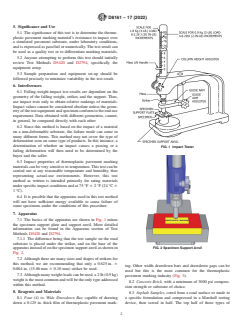
7.1 The basics of the apparatus are shown in Fig. 1 minus
the specimen support plate and support anvil. More detailed
information can be found in the Apparatus section of Test
Methods D5420 and D2794.
7.1.1 The difference being that the test sample on the road
substrate is placed under the striker, and on the base of the
apparatus instead of on the specimen support anvil as shown in FIG. 2 Specimen Support Anvil
Fig. 2.
7.2 Although there are many sizes and shapes of strikers for
this method, we are recommending that only a 0.625 in. 6
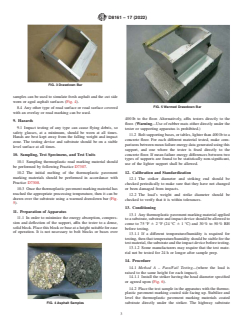
ing. Other width drawdown bars and drawdown gaps can be
0.004 in. (15.86 mm 6 0.10 mm) striker be used.
used but this is the most common for the thermoplastic
7.3 Although many weight loads can be used,a2lb (0.9 kg)
pavement marking industry (Fig. 3).
weightisthemostcommonandwillbetheonlytypeaddressed
8.2 Concrete Brick, with a minimum of 3000 psi compres-
within this method.
sion strength or substrate of choice.
8. Reagents and Materials
8.3 Asphalt Samples, cored from a road surface or made to
8.1 Four (4) in. Wide Drawdown Bar, capable of drawing a specific formulation and compressed in a Marshall testing
down a 0.125 in. thick film of thermoplastic pavement mark- device, then sawed in half. The top half of these types of
D8161 − 17 (2022)
FIG. 3 Drawdown Bar
samples can be used to simulate fresh asphalt and the cut side
worn or aged asphalt surfaces (Fig. 4).
FIG. 5 Warmed Drawdown Bar
8.4 Any other type of road surface or road surface covered
with an overlay or road marking can be used.
400 lb to the floor. Alternatively, affix testers directly to the
9. Hazards
floor. (Warning—Use of rubber mats either directly under the
9.1 Impact testing of any type can cause flying debris, so
tester or supporting apparatus is prohibite
...