

ASTM D913-20
(Practice)Standard Practice for Evaluating Degree of Pavement Marking Line Wear
General Information
- Abstract
SIGNIFICANCE AND USE
4.1 This practice is designed to evaluate the resistance to wear of a pavement marking. It should be noted that a high degree of wear resistance of pavement marking applied to a bare pavement surface may not guarantee similar results when the same pavement marking is applied over old markings.
SCOPE
1.1 This practice covers the evaluation of degree of resistance to wear that may occur with pavement markings in road tests (see Practice D713) or in actual service, using photographic standards for comparative evaluation.
1.2 This standard does not purport to address all of the safety concerns, if any, associated with its use. It is the responsibility of the user of this standard to establish appropriate safety, health, and environmental practices and determine the applicability of regulatory limitations prior to use.
1.3 This international standard was developed in accordance with internationally recognized principles on standardization established in the Decision on Principles for the Development of International Standards, Guides and Recommendations issued by the World Trade Organization Technical Barriers to Trade (TBT) Committee.
- Status
- Published
- Publication Date
- 31-May-2020
- Technical Committee
- D01 - Paint and Related Coatings, Materials, and Applications
- Drafting Committee
- D01.44 - Traffic Coatings




Overview
ASTM D913-20, titled Standard Practice for Evaluating Degree of Pavement Marking Line Wear, is an established ASTM standard focused on assessing the durability and wear resistance of pavement marking lines. This practice is essential for transportation authorities, civil engineers, and road maintenance professionals interested in ensuring long-lasting and visible traffic markings on roadways. The evaluation is typically performed by comparing in-service or test marking lines with photographic standards that visually represent different degrees of wear.
Pavement markings play a crucial role in road safety and traffic guidance. The ongoing evaluation of their condition using a standardized practice ensures that road markings remain effective and meet necessary safety standards.
Key Topics
- Wear Resistance: The main focus is the degree to which pavement markings resist detachment and erosion when exposed to traffic and environmental factors.
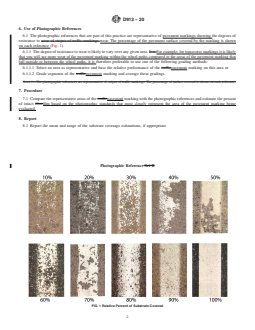
- Photographic Comparison: The standard employs photographic reference images as benchmarks to estimate the percent of intact marking film covering the substrate.
- Applicability: The procedure is suitable for both laboratory road tests and real-world service conditions.
- Substrate Awareness: It accounts for variations in performance when markings are applied to different substrates, such as bare pavement or existing markings.
- Procedural Flexibility: Evaluators may select a representative area or average results from multiple segments for a comprehensive assessment.
Applications
The standardized evaluation of pavement marking wear has practical value in:
- Roadway Maintenance Planning: Determining when pavement markings require renewal or replacement improves resource allocation and budgeting.
- Performance Testing of Marking Materials: Comparing the wear performance of different traffic marking paints, thermoplastics, or tapes to select the most durable options for specific road conditions.
- Quality Control: Contractors and agencies can ensure compliance with regulatory and safety standards for road markings through regular wear assessment.
- Research and Development: Assists manufacturers and laboratories in developing new or improved marking materials by providing a consistent evaluation method.
- Regulatory Compliance: Supports conformance with national and international transportation safety requirements by offering a traceable, repeatable evaluation procedure.
Related Standards
The following standards and resources are closely associated with ASTM D913-20:
- ASTM D713 - Practice for Conducting Road Service Tests on Fluid Traffic Marking Materials: Outlines methods for conducting road performance tests relevant to D913 assessments.
- ASTM Adjuncts - Photographic Reference Prints: Official glossy prints used as comparison benchmarks in the evaluation process.
Other related keywords and standards include durability, pavement markings, resistance to wear, traffic markings, and traffic paint. Adhering to ASTM D913-20 ensures consistent, objective assessment and helps maintain the effectiveness and safety of road marking systems worldwide.
Relations
- Effective Date
- 15-Dec-2012
- Effective Date
- 01-Dec-2010
- Effective Date
- 01-Aug-2004
- Effective Date
- 10-Oct-1998
Get Certified
Connect with accredited certification bodies for this standard

Zavod za gradbeništvo Slovenije (ZAG) - Inšpekcija
ZAG inspection body for construction products, structures, and materials.
Sponsored listings
Frequently Asked Questions
ASTM D913-20 is a standard published by ASTM International. Its full title is "Standard Practice for Evaluating Degree of Pavement Marking Line Wear". This standard covers: SIGNIFICANCE AND USE 4.1 This practice is designed to evaluate the resistance to wear of a pavement marking. It should be noted that a high degree of wear resistance of pavement marking applied to a bare pavement surface may not guarantee similar results when the same pavement marking is applied over old markings. SCOPE 1.1 This practice covers the evaluation of degree of resistance to wear that may occur with pavement markings in road tests (see Practice D713) or in actual service, using photographic standards for comparative evaluation. 1.2 This standard does not purport to address all of the safety concerns, if any, associated with its use. It is the responsibility of the user of this standard to establish appropriate safety, health, and environmental practices and determine the applicability of regulatory limitations prior to use. 1.3 This international standard was developed in accordance with internationally recognized principles on standardization established in the Decision on Principles for the Development of International Standards, Guides and Recommendations issued by the World Trade Organization Technical Barriers to Trade (TBT) Committee.
SIGNIFICANCE AND USE 4.1 This practice is designed to evaluate the resistance to wear of a pavement marking. It should be noted that a high degree of wear resistance of pavement marking applied to a bare pavement surface may not guarantee similar results when the same pavement marking is applied over old markings. SCOPE 1.1 This practice covers the evaluation of degree of resistance to wear that may occur with pavement markings in road tests (see Practice D713) or in actual service, using photographic standards for comparative evaluation. 1.2 This standard does not purport to address all of the safety concerns, if any, associated with its use. It is the responsibility of the user of this standard to establish appropriate safety, health, and environmental practices and determine the applicability of regulatory limitations prior to use. 1.3 This international standard was developed in accordance with internationally recognized principles on standardization established in the Decision on Principles for the Development of International Standards, Guides and Recommendations issued by the World Trade Organization Technical Barriers to Trade (TBT) Committee.
ASTM D913-20 is classified under the following ICS (International Classification for Standards) categories: 87.040 - Paints and varnishes; 93.080.20 - Road construction materials. The ICS classification helps identify the subject area and facilitates finding related standards.
ASTM D913-20 has the following relationships with other standards: It is inter standard links to ASTM D713-12, ASTM D713-90(2010), ASTM D713-90(2004), ASTM D713-90(1998). Understanding these relationships helps ensure you are using the most current and applicable version of the standard.
ASTM D913-20 is available in PDF format for immediate download after purchase. The document can be added to your cart and obtained through the secure checkout process. Digital delivery ensures instant access to the complete standard document.
Standards Content (Sample)
This international standard was developed in accordance with internationally recognized principles on standardization established in the Decision on Principles for the
Development of International Standards, Guides and Recommendations issued by the World Trade Organization Technical Barriers to Trade (TBT) Committee.
Designation: D913 − 20
Standard Practice for
Evaluating Degree of Pavement Marking Line Wear
This standard is issued under the fixed designation D913; the number immediately following the designation indicates the year of
original adoption or, in the case of revision, the year of last revision. A number in parentheses indicates the year of last reapproval. A
superscript epsilon (´) indicates an editorial change since the last revision or reapproval.
1. Scope 4. Significance and Use
1.1 This practice covers the evaluation of degree of resis- 4.1 This practice is designed to evaluate the resistance to
tance to wear that may occur with pavement markings in road wear of a pavement marking. It should be noted that a high
tests (see Practice D713) or in actual service, using photo- degree of wear resistance of pavement marking applied to a
graphic standards for comparative evaluation. bare pavement surface may not guarantee similar results when
the same pavement marking is applied over old markings.
1.2 This standard does not purport to address all of the
safety concerns, if any, associated with its use. It is the
5. Type of Failure
responsibility of the user of this standard to establish appro-
5.1 The failure as described in Section 3 does not presume
priate safety, health, and environmental practices and deter-
any specific mechanism, and all areas where the substrate is
mine the applicability of regulatory limitations prior to use.
visible shall be considered a failure.
1.3 This international standard was developed in accor-
dance with internationally recognized principles on standard-
6. Use of Photographic References
ization established in the Decision on Principles for the
Development of International Standards, Guides and Recom- 6.1 The photographic references that are part of this practice
mendations issued by the World Trade Organization Technical are representative of pavement markings showing the degrees
Barriers to Trade (TBT) Committee. of resistance to wear. The percentage of the pavement surface
covered by the marking is shown on each reference (Fig. 1).
2. Referenced Documents
6.1.1 The degree of resistance to wear is likely to vary over
2.1 ASTM Standards:
any given area. For example; for transverse markings it is
D713 Practice for Conducting Road Service Tests on Fluid likely that you will see more wear of the pavement marking
Traffic Marking Materials within the wheel paths compared to the areas of the pavement
marking that fall outside or between the wheel paths, it is
3. Terminology
therefore preferable to use one of the following grading
3.1 Definitions of Terms Specific to This Standard:
methods:
3.1.1 failure, described by these photographic references, 6.1.1.1 Select an area as representative and base the relative
n—that condition manifested in pavement markings by actual
performance of the pavement marking on this area or
detachment of sections of the film from its substrate or erosi
...
This document is not an ASTM standard and is intended only to provide the user of an ASTM standard an indication of what changes have been made to the previous version. Because
it may not be technically possible to adequately depict all changes accurately, ASTM recommends that users consult prior editions as appropriate. In all cases only the current version
of the standard as published by ASTM is to be considered the official document.
Designation: D913 − 15 D913 − 20
Standard Practice for
Evaluating Degree of TrafficPavement Marking Line Wear
This standard is issued under the fixed designation D913; the number immediately following the designation indicates the year of
original adoption or, in the case of revision, the year of last revision. A number in parentheses indicates the year of last reapproval. A
superscript epsilon (´) indicates an editorial change since the last revision or reapproval.
1. Scope
1.1 This practice covers the evaluation of degree of resistance to wear that may occur with trafficpavement markings in road
tests (see Practice D713) or in actual service, using photographic standards for comparative evaluation.
1.2 This standard does not purport to address all of the safety problems,concerns, if any, associated with its use. It is the
responsibility of the user of this standard to establish appropriate safety safety, health, and healthenvironmental practices and
determine the applicability of regulatory limitations prior to use.
1.3 This international standard was developed in accordance with internationally recognized principles on standardization
established in the Decision on Principles for the Development of International Standards, Guides and Recommendations issued
by the World Trade Organization Technical Barriers to Trade (TBT) Committee.
2. Referenced Documents
2.1 ASTM Standards:
D713 Practice for Conducting Road Service Tests on Fluid Traffic Marking Materials
2.2 ASTM Adjuncts:
Glossy Prints of Photographic Reference
3. Terminology
3.1 Definitions of Terms Specific to This Standard:
3.1.1 failure, described by these photographic references, n—that condition manifested in trafficpavement markings by actual
detachment of sections of the film from its substrate or erosion of sections of the marking down to the substrate.
3.1.1.1 Discussion—
The degree of resistance to failure is judged by the amountarea of substrate that is covered.covered by the pavement marking.
3.1.2 substrate, n—the roadway surface or previously applied traffic marking over which the trafficpavement marking being
tested was applied.
4. Significance and Use
4.1 This practice is designed to evaluate the resistance to wear of a trafficpavement marking. It mustshould be rememberednoted
that a high degree of performance wear resistance of trafficpavement marking applied to a bare roadpavement surface may not
guarantee similar results when the same trafficpavement marking is applied over old markings.
5. Type of Failure
5.1 The failure as described in Section 3 does not presume any specific mechanism, and all areas where the substrate is visible
shall be considered a failure.
This practice is under the jurisdiction of ASTM Committee D01 on Paint and Related Coatings, Materials, and Applications and is the direct responsibility of
Subcommittee D01.44 on Traffic Coatings.
Current edition approved Dec. 1, 2015June 1, 2020. Published December 2015July 2020. Originally approved in 1947. Last previous edition approved in 20102015 as
D913 – 10.D913 – 15. DOI: 10.1520/D0913-15.10.1520/D0913-20.
For referenced ASTM standards, visit the ASTM website, www.astm.org, or contact ASTM Customer Service at service@astm.org. For Annual Book of ASTM St
...