

ASTM D7681-11(2021)
(Test Method)Standard Test Method for Measuring Gradation of Glass Spheres Using a Flowing Stream Digital Image Analyzer
General Information
- Abstract
SIGNIFICANCE AND USE
5.1 The gradation (size distribution) of glass beads has a significant influence on the retroreflective efficiency of a pavement marking system.
5.2 This test method is for the characterization of the gradation (size distribution) of glass beads for the purpose of compliance testing against standard specification for glass beads in pavement marking applications.
5.3 While there are potential industrial applications for this test method beyond the measurement of gradation (size distribution) of glass beads for pavement markings, those are beyond the scope of this standard.
SCOPE
1.1 This test method covers the determination of the gradation (size distribution) of glass spheres used in pavement marking systems using a Flowing Stream Digital Analyzer. Typical gradations for pavement marking systems are defined in ranges from Type 0 through 5 in AASHTO M247-08.
1.2 This test method provides for the presentation of the size data in a variety of formats to the requirements of the agency pavement marking material specification. For most specifications the standard format is to present the size data as “Percent Retained” or “Percent Passing” relative to a series of standard US sieve sizes.
1.3 The values stated in SI units are to be regarded as standard. No other units of measurement are included in this standard.
1.4 This standard does not purport to address all of the safety concerns, if any, associated with its use. It is the responsibility of the user of this standard to establish appropriate safety, health, and environmental practices and determine the applicability of regulatory limitations prior to use.
1.5 This international standard was developed in accordance with internationally recognized principles on standardization established in the Decision on Principles for the Development of International Standards, Guides and Recommendations issued by the World Trade Organization Technical Barriers to Trade (TBT) Committee.
- Status
- Published
- Publication Date
- 31-Oct-2021
- Technical Committee
- D01 - Paint and Related Coatings, Materials, and Applications
- Drafting Committee
- D01.44 - Traffic Coatings
Overview
ASTM D7681-11(2021) - Standard Test Method for Measuring Gradation of Glass Spheres Using a Flowing Stream Digital Image Analyzer is a standard developed by ASTM International. This test method outlines procedures for accurately determining the gradation (size distribution) of glass beads used in pavement marking systems. By utilizing a Flowing Stream Digital Image Analyzer, the standard provides agencies, manufacturers, and laboratories with a reliable approach to measure and report the size distribution of glass spheres, which is crucial for roadway visibility and compliance with regulatory specifications.
Key Topics
Purpose and Scope:
- The standard specifies the process for determining the gradation (size distribution) of glass spheres intended for use in pavement marking systems.
- Focuses on glass beads used for retroreflective roadway markings, as gradation directly affects their performance and efficiency.
- Applies SI units exclusively, with no alternative measurement systems included.
Test Methodology:
- Glass bead samples are analyzed using a computer-controlled particle size analyzer equipped with high-resolution digital imaging and image processing software.
- Measurements are typically reported as “Percent Retained” or “Percent Passing” across a sequence of standard US sieve sizes.
- Sample sizes and handling procedures are specified to ensure representative and accurate analysis.
Data Presentation:
- The results are formatted in accordance with pavement marking material specifications, supporting compliance verification.
- Output can be tailored as per agency requirements, providing flexibility in data usage and reporting.
Precision and Repeatability:
- The method includes assessment of repeatability and reproducibility, ensuring test results are reliable for both intra-laboratory and inter-laboratory comparisons.
Safety and Compliance:
- Users are responsible for establishing proper safety, health, and environmental practices in accordance with local and national regulations.
Applications
Pavement Marking System Quality Assurance:
- Ensures that glass beads used in traffic markings meet specified gradation criteria.
- Directly impacts the retroreflective efficiency of road markings, enhancing night-time visibility and road safety.
Regulatory Compliance:
- Supports compliance testing for agencies and manufacturers against standard specifications for glass beads in pavement markings (e.g., AASHTO M247-08).
Material Specification and Acceptance:
- Useful for material specification, purchase acceptance, and ongoing quality control in road construction and maintenance projects.
Laboratory Testing and Certification:
- Employed by independent laboratories and quality assurance teams to provide accurate, repeatable gradation measurements.
Related Standards
- ASTM B215: Practices for Sampling Metal Powders
- ASTM E177: Practice for Use of the Terms Precision and Bias in ASTM Test Methods
- ASTM E691: Practice for Conducting an Interlaboratory Study to Determine the Precision of a Test Method
- AASHTO M247-08: Standard Specification for Glass Beads Used in Traffic Markings
Keywords: ASTM D7681, glass spheres gradation, digital image analyzer, glass bead size distribution, pavement marking retroreflectivity, road marking materials testing, compliance testing, traffic marking glass beads, particle size analysis, US sieve sizes, laboratory quality control.
Relations
- Effective Date
- 01-May-2014
- Effective Date
- 01-May-2013
- Effective Date
- 01-May-2013
- Effective Date
- 01-Nov-2011
- Effective Date
- 01-Dec-2010
- Effective Date
- 01-Oct-2010
- Effective Date
- 01-Nov-2008
- Effective Date
- 01-Oct-2008
- Effective Date
- 01-Oct-2008
- Refers
ASTM E177-06b - Standard Practice for Use of the Terms Precision and Bias in ASTM Test Methods - Effective Date
- 15-Nov-2006
- Refers
ASTM E177-06a - Standard Practice for Use of the Terms Precision and Bias in ASTM Test Methods - Effective Date
- 01-Nov-2006
- Effective Date
- 01-Nov-2005
- Effective Date
- 01-Nov-2004
- Effective Date
- 01-Nov-2004
- Refers
ASTM E177-04e1 - Standard Practice for Use of the Terms Precision and Bias in ASTM Test Methods - Effective Date
- 01-Nov-2004
Get Certified
Connect with accredited certification bodies for this standard

Zavod za gradbeništvo Slovenije (ZAG) - Inšpekcija
ZAG inspection body for construction products, structures, and materials.
Sponsored listings
Frequently Asked Questions
ASTM D7681-11(2021) is a standard published by ASTM International. Its full title is "Standard Test Method for Measuring Gradation of Glass Spheres Using a Flowing Stream Digital Image Analyzer". This standard covers: SIGNIFICANCE AND USE 5.1 The gradation (size distribution) of glass beads has a significant influence on the retroreflective efficiency of a pavement marking system. 5.2 This test method is for the characterization of the gradation (size distribution) of glass beads for the purpose of compliance testing against standard specification for glass beads in pavement marking applications. 5.3 While there are potential industrial applications for this test method beyond the measurement of gradation (size distribution) of glass beads for pavement markings, those are beyond the scope of this standard. SCOPE 1.1 This test method covers the determination of the gradation (size distribution) of glass spheres used in pavement marking systems using a Flowing Stream Digital Analyzer. Typical gradations for pavement marking systems are defined in ranges from Type 0 through 5 in AASHTO M247-08. 1.2 This test method provides for the presentation of the size data in a variety of formats to the requirements of the agency pavement marking material specification. For most specifications the standard format is to present the size data as “Percent Retained” or “Percent Passing” relative to a series of standard US sieve sizes. 1.3 The values stated in SI units are to be regarded as standard. No other units of measurement are included in this standard. 1.4 This standard does not purport to address all of the safety concerns, if any, associated with its use. It is the responsibility of the user of this standard to establish appropriate safety, health, and environmental practices and determine the applicability of regulatory limitations prior to use. 1.5 This international standard was developed in accordance with internationally recognized principles on standardization established in the Decision on Principles for the Development of International Standards, Guides and Recommendations issued by the World Trade Organization Technical Barriers to Trade (TBT) Committee.
SIGNIFICANCE AND USE 5.1 The gradation (size distribution) of glass beads has a significant influence on the retroreflective efficiency of a pavement marking system. 5.2 This test method is for the characterization of the gradation (size distribution) of glass beads for the purpose of compliance testing against standard specification for glass beads in pavement marking applications. 5.3 While there are potential industrial applications for this test method beyond the measurement of gradation (size distribution) of glass beads for pavement markings, those are beyond the scope of this standard. SCOPE 1.1 This test method covers the determination of the gradation (size distribution) of glass spheres used in pavement marking systems using a Flowing Stream Digital Analyzer. Typical gradations for pavement marking systems are defined in ranges from Type 0 through 5 in AASHTO M247-08. 1.2 This test method provides for the presentation of the size data in a variety of formats to the requirements of the agency pavement marking material specification. For most specifications the standard format is to present the size data as “Percent Retained” or “Percent Passing” relative to a series of standard US sieve sizes. 1.3 The values stated in SI units are to be regarded as standard. No other units of measurement are included in this standard. 1.4 This standard does not purport to address all of the safety concerns, if any, associated with its use. It is the responsibility of the user of this standard to establish appropriate safety, health, and environmental practices and determine the applicability of regulatory limitations prior to use. 1.5 This international standard was developed in accordance with internationally recognized principles on standardization established in the Decision on Principles for the Development of International Standards, Guides and Recommendations issued by the World Trade Organization Technical Barriers to Trade (TBT) Committee.
ASTM D7681-11(2021) is classified under the following ICS (International Classification for Standards) categories: 93.080.20 - Road construction materials. The ICS classification helps identify the subject area and facilitates finding related standards.
ASTM D7681-11(2021) has the following relationships with other standards: It is inter standard links to ASTM E177-14, ASTM E691-13, ASTM E177-13, ASTM E691-11, ASTM B215-10, ASTM E177-10, ASTM B215-08, ASTM E177-08, ASTM E691-08, ASTM E177-06b, ASTM E177-06a, ASTM E691-05, ASTM E177-06, ASTM E177-04, ASTM E177-04e1. Understanding these relationships helps ensure you are using the most current and applicable version of the standard.
ASTM D7681-11(2021) is available in PDF format for immediate download after purchase. The document can be added to your cart and obtained through the secure checkout process. Digital delivery ensures instant access to the complete standard document.
Standards Content (Sample)
This international standard was developed in accordance with internationally recognized principles on standardization established in the Decision on Principles for the
Development of International Standards, Guides and Recommendations issued by the World Trade Organization Technical Barriers to Trade (TBT) Committee.
Designation: D7681 − 11 (Reapproved 2021)
Standard Test Method for
Measuring Gradation of Glass Spheres Using a Flowing
Stream Digital Image Analyzer
This standard is issued under the fixed designation D7681; the number immediately following the designation indicates the year of
original adoption or, in the case of revision, the year of last revision. A number in parentheses indicates the year of last reapproval. A
superscript epsilon (´) indicates an editorial change since the last revision or reapproval.
1. Scope E691 Practice for Conducting an Interlaboratory Study to
Determine the Precision of a Test Method
1.1 This test method covers the determination of the grada-
2.2 AASHTO Standards:
tion (size distribution) of glass spheres used in pavement
AASHTO M247-08 Standard Glass Beads Used in Traffic
marking systems using a Flowing Stream Digital Analyzer.
Markings
Typical gradations for pavement marking systems are defined
in ranges from Type 0 through 5 in AASHTO M247-08.
3. Terminology
1.2 Thistestmethodprovidesforthepresentationofthesize
3.1 Definitions:
data in a variety of formats to the requirements of the agency
3.1.1 flowing stream digital image analyzer, n—a computer
pavement marking material specification. For most specifica-
controlled particle size analyzer employing a high resolution
tions the standard format is to present the size data as “Percent
digital imaging device and computer image processing soft-
Retained” or “Percent Passing” relative to a series of standard
ware to do photo optical single particle counting and particle
US sieve sizes.
size analysis.
1.3 The values stated in SI units are to be regarded as
3.1.2 gradation of glass beads, n—the measurement of the
standard. No other units of measurement are included in this
size(diameter)ofglassbeadsandtheirsubsequentpresentation
standard.
in ranges between ASTM standard sieve sizes and/or micron
1.4 This standard does not purport to address all of the
designation starting with the largest to the smallest; the ranges
safety concerns, if any, associated with its use. It is the are listed as “percent passing” and “percent retained.”
responsibility of the user of this standard to establish appro-
4. Summary of Test Method
priate safety, health, and environmental practices and deter-
mine the applicability of regulatory limitations prior to use.
4.1 The glass particles are run through a flowing stream
1.5 This international standard was developed in accor-
digital image analyzer, a measuring system for determining the
dance with internationally recognized principles on standard-
gradation (size distribution) of dry, free flowing and harmless
ization established in the Decision on Principles for the
bulk products. The total recommended measuring range is
Development of International Standards, Guides and Recom-
between 100 µm and 2.36 mm. The operating test method uses
mendations issued by the World Trade Organization Technical
photo optical single particle counting technology for the image
Barriers to Trade (TBT) Committee.
processing. The measurement time depends on the quantity of
material to be measured, the width of the metering feeder and
2. Referenced Documents
the mean grain size. The quantity of material to be measured
2.1 ASTM Standards:
depends on the grain size and the width of the metering feeder.
B215 Practices for Sampling Metal Powders Typical measuring times are approximately 2 to 10 min.
E177 Practice for Use of the Terms Precision and Bias in
5. Significance and Use
ASTM Test Methods
5.1 The gradation (size distribution) of glass beads has a
significant influence on the retroreflective efficiency of a
This test method is under the jurisdiction of ASTM Committee D01 on Paint
pavement marking system.
and Related Coatings, Materials, andApplications and is the direct responsibility of
Subcommittee D01.44 on Traffic Coatings.
5.2 This test method is for the characterization of the
Current edition approved Nov. 1, 2021. Published November 2021. Originally
ɛ1
gradation (size distribution) of glass beads for the purpose of
approved in 2011. Last previous edition approved in 2016 as D7681 – 11 (2016) .
DOI: 10.1520/D7681-11R21.
For referenced ASTM standards, visit the ASTM website, www.astm.org, or
contact ASTM Customer Service at service@astm.org. For Annual Book of ASTM Available from American Association of State Highway and Transportation
Standards volume information, refer to the standard’s Document Summary page on Officials (AASHTO), 444 N. Capitol St., NW, Suite 249, Washington, DC 20001,
the ASTM website. http://www.transportation.org.
Copyright © ASTM International, 100 Barr Harbor Drive, PO Box C700, West Conshohocken, PA 19428-2959. United States
D7681 − 11 (2021)
compliance testing against standard specification for glass 10. Calibration and Standardization
beads in pavement marking applications.
10.1 The particle analyzer, in most cases, will be calibrated
5.3 While there are potential industrial applications for this by the manufacturer prior to shipping. Re-calibration might
test method beyond the measurement of gradation (size distri- become necessary occasionally, for example, after the trans-
bution) of glass beads for pavement markings, those are portation of the instrument or if required by quality manage-
beyond the scope of this standard. mentregulations.Inthiscase,followthecalibrationprocedures
as outlined in the manufacturer’s instruction manual.
6. Apparatus
11. Conditioning
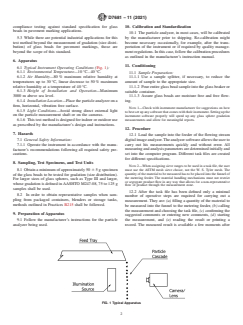
6.1 Typical Instrument Operating Conditions (Fig. 1):
6.1.1 Environmental Temperature—10 °C.40 °C.
11.1 Sample Preparation:
6.1.2 Air Humidity—80 % maximum relative humidity at
11.1.1 Use a sample splitter, if necessary, to reduce the
temperatures up to 30 °C, linear decrease to 50 % maximum
amount of sample to the appropriate size.
relative humidity at a temperature of 40 °C.
11.1.2 Pour entire glass bead sample into the glass beaker or
6.1.3 Height of Installation and Operation—Maximum suitable container.
3000 m above sea level.
11.1.3 Assure glass beads are moisture free and free flow-
6.1.4 Installation Location—Place the particle analyzer on a ing.
firm, horizontal, vibration free surface.
NOTE 1—Check with instrument manufacturer for suggestions on how
6.1.5 Light Conditions—Avoid strong direct external light
tobestsetupanysoftwarethatcomeswiththeirinstrument.Settingupthe
on the particle measurement shaft or on the cameras.
instrument software properly will speed up any glass sphere gradation
measurements and allow for meaningful reports.
6.1.6 This test method is designed for indoor or outdoor use
as prescribed by the manufacturer’s design and instructions.
12. Procedure
7. Hazards
12.1 Load the sample into the feeder of the flowing stream
digitalimageanalyzer.Theanalyzersoftwareallowstheuserto
7.1 General Safety Information:
7.1.1 Operate the instrument in accordance with the manu- carry out his measurements quickly and without error. All
measuring and analysis parameters are determined initially and
facturer’s recommendations following all required safety pre-
cautions. set into the computer program. Different task files are created
for different specifications.
8. Sampling, Test Specimens, and Test Units
NOTE 2—When assigning sieve ranges to be used in a task file, the user
8.1 Obtain a minimum of approximately 50 6 5 g specimen must use the ASTM mesh sieve choice, not the W. S. Tyler mesh. The
quantity of the material to be measured has to be placed into the funnel of
of the glass beads to be tested for gradation (size distribution).
the metering feeder. The material handling mechanisms must not restrict
For larger sizes of glass spheres, such as Type III and larger,
or segregate product flow in any way that allows for a non-representative
whose gradation is defined inAASHTO M247-08, 75 to 125 g
flow of product through the measurement zone.
samples shall be used.
12.2 After the task file has been defined only a minimal
8.2 In order to obtain representative samples when sam-
number of operative steps are required for carrying out a
pling from packaged containers, blenders or storage tanks,
measurement. They are: (a) filling a quantity of the material to
methods outlined in Practices B215 shall be followed.
be measured into the funnel to the metering feeder, (b) calling
the measurement and choosing the task file, (c) confirming the
9. Preparation of Apparatus
suggested comments or entering new comments, (d) starting
9.1 Follow the manufacturer’s instructions for the particle the measurement, and (e) reading the result or printing a
analyzer being used. record. The measured result is available a few moments after
FIG. 1 Typical Apparatus
D7681 − 11 (2021)
the measurement is completed and can be displayed in many results for the same material, obtained by the same operator
forms, and be printed and saved with the help of the PC. using the same equipment on the same day in the same
laboratory.
13. Report
14.1.2.1 Repeatability limits are listed in Tables 1-12.
...