

ASTM D4796-17(2022)
(Test Method)Standard Test Method for Bond Strength of Thermoplastic Pavement Marking Materials
General Information
- Abstract
SIGNIFICANCE AND USE
5.1 The function of this test method is to provide numerical instrumental results indicating the cohesive and/or adhesive bond strength of thermoplastic pavement marking to a specified cement brick substrate.
5.2 The use of this test method allows the user and manufacturer to control the quality of the product and make inferences about the performance of the thermoplastic pavement marking product. Results from these tests also provide information helpful in researching and developing thermoplastic pavement marking materials.
5.3 The method has been revised to be more consistent to methodology in other ASTM bond methods for coatings in Test Methods D4541, D5179, and D7234.
5.4 Strict adherence to the procedures outlined is necessary for precision of the test method. Under no conditions should the bond strength be accepted unless there is conformance to the method.
SCOPE
1.1 This test method provides an instrumental means for the determination of thermoplastic pavement marking material bond strengths using cement bricks and loading fixtures.
1.2 The values stated in inch-pound units are to be regarded as standard. The values given in parentheses are mathematical conversions to SI units that are provided for information only and are not considered standard.
1.3 This standard does not purport to address all of the safety concerns, if any, associated with its use. It is the responsibility of the user of this standard to establish appropriate safety, health, and environmental practices and determine the applicability of regulatory limitations prior to use.
1.4 This international standard was developed in accordance with internationally recognized principles on standardization established in the Decision on Principles for the Development of International Standards, Guides and Recommendations issued by the World Trade Organization Technical Barriers to Trade (TBT) Committee.
- Status
- Published
- Publication Date
- 30-Nov-2022
- Technical Committee
- D01 - Paint and Related Coatings, Materials, and Applications
- Drafting Committee
- D01.44 - Traffic Coatings
Overview
ASTM D4796-17(2022) is the internationally recognized standard test method for measuring the bond strength of thermoplastic pavement marking materials to cement brick substrates. Developed by ASTM International, this standard outlines a reproducible and precise protocol for determining both cohesive and adhesive bond strengths, which are essential for evaluating the adhesive performance and quality of pavement markings used in road and traffic safety applications. The method serves as a critical tool for manufacturers, quality control specialists, and researchers, enabling them to monitor product consistency, support R&D, and ensure compliance with industry performance criteria.
Key Topics
- Bond Strength Measurement: The standard specifies an instrumental process using cement bricks and specialized loading fixtures to evaluate the adhesion and cohesion properties of thermoplastic pavement marking materials.
- Quality Control and Assurance: By adhering to this test method, manufacturers can systematically verify product performance, while users can assess whether products meet the necessary requirements for road marking durability.
- Consistency with Other ASTM Methods: The procedures in ASTM D4796-17(2022) align with methodologies outlined in other ASTM standards for coatings, ensuring harmonized testing and reporting practices across related materials.
- Test Precision and Repeatability: The protocol details how to ensure accuracy and repeatability in test results, including guidelines for sample preparation, test execution, and interpretation of separation types.
- Safety and Compliance: The standard emphasizes the importance of safety, health, and environmental practices during testing, and highlights the need to consider regulatory limitations and local requirements.
Applications
- Road and Highway Marking Evaluation: This test method is widely applied in assessing thermoplastic materials used for lane lines, crosswalks, and other pavement markings subject to demanding traffic conditions.
- Product Development: Researchers and developers leverage the method to innovate and optimize new thermoplastic pavement marking formulations, ensuring strong bonding to cement substrates for improved longevity.
- Manufacturing Quality Assurance: Routine use of ASTM D4796-17(2022) helps manufacturers maintain consistent production standards, ensuring that products delivered to the market meet or exceed required bond strength values.
- Comparative Performance Testing: When testing multiple thermoplastic pavement marking products, this standard provides a reliable basis for comparing adhesion performance, guiding decision-making in product selection and specification.
- Regulatory and Contractual Compliance: Public agencies, contractors, and specifying engineers use the results from this standard to verify that installed pavement markings comply with performance-based procurement and safety standards.
Related Standards
- ASTM D4541: Standard Test Method for Pull-Off Strength of Coatings Using Portable Adhesion Testers
- ASTM D5179: Test Method for Measuring Adhesion of Organic Coatings in the Laboratory by Direct Tensile Method
- ASTM D7234: Test Method for Pull-Off Adhesion Strength of Coatings on Concrete Using Portable Pull-Off Adhesion Testers
- ASTM D7307: Practice for Sampling of Thermoplastic Pavement Marking Materials
- ASTM D7308: Practice for Sample Preparation of Thermoplastic Pavement Marking Materials
By integrating ASTM D4796-17(2022) into quality control and product development processes, stakeholders across the pavement marking industry ensure the reliability, durability, and safety of road markings, enhancing traffic guidance and long-term infrastructure performance. For detailed implementation, laboratories and manufacturers should consult the full ASTM standard and adhere to the outlined procedures to achieve the highest levels of test precision and material performance verification.
Relations
- Effective Date
- 01-Jan-2024
- Effective Date
- 15-Dec-2023
- Effective Date
- 01-Jul-2016
- Effective Date
- 01-Dec-2014
- Effective Date
- 01-May-2014
- Effective Date
- 01-May-2013
- Effective Date
- 01-May-2013
- Effective Date
- 15-Dec-2012
- Effective Date
- 01-Aug-2012
- Effective Date
- 01-Jul-2012
- Effective Date
- 01-Jun-2012
- Effective Date
- 01-Nov-2011
- Effective Date
- 01-Oct-2011
- Effective Date
- 01-Jun-2011
- Effective Date
- 01-Apr-2011
Get Certified
Connect with accredited certification bodies for this standard

Zavod za gradbeništvo Slovenije (ZAG) - Inšpekcija
ZAG inspection body for construction products, structures, and materials.
Sponsored listings
Frequently Asked Questions
ASTM D4796-17(2022) is a standard published by ASTM International. Its full title is "Standard Test Method for Bond Strength of Thermoplastic Pavement Marking Materials". This standard covers: SIGNIFICANCE AND USE 5.1 The function of this test method is to provide numerical instrumental results indicating the cohesive and/or adhesive bond strength of thermoplastic pavement marking to a specified cement brick substrate. 5.2 The use of this test method allows the user and manufacturer to control the quality of the product and make inferences about the performance of the thermoplastic pavement marking product. Results from these tests also provide information helpful in researching and developing thermoplastic pavement marking materials. 5.3 The method has been revised to be more consistent to methodology in other ASTM bond methods for coatings in Test Methods D4541, D5179, and D7234. 5.4 Strict adherence to the procedures outlined is necessary for precision of the test method. Under no conditions should the bond strength be accepted unless there is conformance to the method. SCOPE 1.1 This test method provides an instrumental means for the determination of thermoplastic pavement marking material bond strengths using cement bricks and loading fixtures. 1.2 The values stated in inch-pound units are to be regarded as standard. The values given in parentheses are mathematical conversions to SI units that are provided for information only and are not considered standard. 1.3 This standard does not purport to address all of the safety concerns, if any, associated with its use. It is the responsibility of the user of this standard to establish appropriate safety, health, and environmental practices and determine the applicability of regulatory limitations prior to use. 1.4 This international standard was developed in accordance with internationally recognized principles on standardization established in the Decision on Principles for the Development of International Standards, Guides and Recommendations issued by the World Trade Organization Technical Barriers to Trade (TBT) Committee.
SIGNIFICANCE AND USE 5.1 The function of this test method is to provide numerical instrumental results indicating the cohesive and/or adhesive bond strength of thermoplastic pavement marking to a specified cement brick substrate. 5.2 The use of this test method allows the user and manufacturer to control the quality of the product and make inferences about the performance of the thermoplastic pavement marking product. Results from these tests also provide information helpful in researching and developing thermoplastic pavement marking materials. 5.3 The method has been revised to be more consistent to methodology in other ASTM bond methods for coatings in Test Methods D4541, D5179, and D7234. 5.4 Strict adherence to the procedures outlined is necessary for precision of the test method. Under no conditions should the bond strength be accepted unless there is conformance to the method. SCOPE 1.1 This test method provides an instrumental means for the determination of thermoplastic pavement marking material bond strengths using cement bricks and loading fixtures. 1.2 The values stated in inch-pound units are to be regarded as standard. The values given in parentheses are mathematical conversions to SI units that are provided for information only and are not considered standard. 1.3 This standard does not purport to address all of the safety concerns, if any, associated with its use. It is the responsibility of the user of this standard to establish appropriate safety, health, and environmental practices and determine the applicability of regulatory limitations prior to use. 1.4 This international standard was developed in accordance with internationally recognized principles on standardization established in the Decision on Principles for the Development of International Standards, Guides and Recommendations issued by the World Trade Organization Technical Barriers to Trade (TBT) Committee.
ASTM D4796-17(2022) is classified under the following ICS (International Classification for Standards) categories: 93.080.20 - Road construction materials. The ICS classification helps identify the subject area and facilitates finding related standards.
ASTM D4796-17(2022) has the following relationships with other standards: It is inter standard links to ASTM D16-24, ASTM C109/C109M-23, ASTM D16-16, ASTM D16-14, ASTM E177-14, ASTM E691-13, ASTM E177-13, ASTM C109/C109M-12, ASTM D16-12, ASTM D7234-12, ASTM D7308-07(2012), ASTM E691-11, ASTM C109/C109M-11a, ASTM D16-11a, ASTM C109/C109M-11. Understanding these relationships helps ensure you are using the most current and applicable version of the standard.
ASTM D4796-17(2022) is available in PDF format for immediate download after purchase. The document can be added to your cart and obtained through the secure checkout process. Digital delivery ensures instant access to the complete standard document.
Standards Content (Sample)
This international standard was developed in accordance with internationally recognized principles on standardization established in the Decision on Principles for the
Development of International Standards, Guides and Recommendations issued by the World Trade Organization Technical Barriers to Trade (TBT) Committee.
Designation: D4796 − 17 (Reapproved 2022)
Standard Test Method for
Bond Strength of Thermoplastic Pavement Marking
Materials
This standard is issued under the fixed designation D4796; the number immediately following the designation indicates the year of
original adoption or, in the case of revision, the year of last revision. A number in parentheses indicates the year of last reapproval. A
superscript epsilon (´) indicates an editorial change since the last revision or reapproval.
1. Scope ings on Concrete Using Portable Pull-Off Adhesion Tes-
ters
1.1 This test method provides an instrumental means for the
D7307 Practice for Sampling of Thermoplastic Pavement
determination of thermoplastic pavement marking material
Marking Materials
bond strengths using cement bricks and loading fixtures.
D7308 Practice for Sample Preparation of Thermoplastic
1.2 The values stated in inch-pound units are to be regarded
Pavement Marking Materials
as standard. The values given in parentheses are mathematical
E177 Practice for Use of the Terms Precision and Bias in
conversions to SI units that are provided for information only
ASTM Test Methods
and are not considered standard.
E691 Practice for Conducting an Interlaboratory Study to
1.3 This standard does not purport to address all of the Determine the Precision of a Test Method
safety concerns, if any, associated with its use. It is the
3. Terminology
responsibility of the user of this standard to establish appro-
priate safety, health, and environmental practices and deter- 3.1 The terms and definitions in Terminology D16 apply to
this method.
mine the applicability of regulatory limitations prior to use.
1.4 This international standard was developed in accor-
3.2 Definitions of Terms Specific to This Standard:
dance with internationally recognized principles on standard-
3.2.1 cement brick, n—a type of brick (a solid masonry unit,
ization established in the Decision on Principles for the
rectangular in shape) made from a mixture of cement and sand,
Development of International Standards, Guides and Recom-
molded under pressure and cured under steam at 200 °F
mendations issued by the World Trade Organization Technical
(93 °C); used as backing brick and where there is no danger of
Barriers to Trade (TBT) Committee.
attack from acid or alkaline conditions. These bricks are not
colorized and have a compressive strength of 3000 psi to
2. Referenced Documents
5000 psi.
2.1 ASTM Standards:
3.2.2 loadingfixture,n—(alsoreferredtoasdollies,studs,or
C109/C109M Test Method for Compressive Strength of
jigs) metal fixture round and flat on one end for bonding to test
Hydraulic Cement Mortars (Using 2-in. or [50 mm] Cube
sample and shaped on the other end for attaching to tensile
Specimens)
testing device. Measurements are listed in inches. (Fig. 1).
D16 TerminologyforPaint,RelatedCoatings,Materials,and
3.2.3 thermoplastic, n—pavement marking (same as 3.2.4).
Applications
3.2.4 thermoplastic pavement marking, n—a highly filled
D4541 Test Method for Pull-Off Strength of Coatings Using
100 % total solids highway marking system that when heated
Portable Adhesion Testers
toamoltenstatecanbeextrudedorsprayedontoaroadsurface
D5179 Test Method for Measuring Adhesion of Organic
and when cooled forms a solid durable delineator or road
Coatings in the Laboratory by Direct Tensile Method
marking thermoplastic usually melted to 425 °F (218 °C).
D7234 Test Method for Pull-OffAdhesion Strength of Coat-
4. Summary of Test Method
This test method is under the jurisdiction of ASTM Committee D01 on Paint
4.1 The thermoplastic specimen is prepared for this test by
and Related Coatings, Materials, andApplications and is the direct responsibility of
first melting a sample to its application temperature under
Subcommittee D01.44 on Traffic Coatings.
continuous agitation. The specimen is then applied to the
Current edition approved Dec. 1, 2022. Published December 2022. Originally
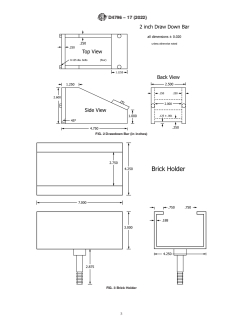
specified cement brick using a hot drawdown bar (Fig. 2),
approved in 1988. Last previous edition approved in 2017 as D4796 – 17. DOI:
10.1520/D4796-17R22.
heated to 220 °F 6 5 °F (104 °C 6 2 °C), at 125 mils
For referenced ASTM standards, visit the ASTM website, www.astm.org, or
(3.175 mm) thickness. While the thermoplastic is still soft,
contact ASTM Customer Service at service@astm.org. For Annual Book of ASTM
three cuts are made with a 1.6 in. (40.6 mm) diameter die (Fig.
Standards volume information, refer to the standard’s Document Summary page on
the ASTM website. 4), heated to 220 °F 6 5 °F (104 °C 6 2 °C), in order to
Copyright © ASTM International, 100 Barr Harbor Drive, PO Box C700, West Conshohocken, PA 19428-2959. United States
D4796 − 17 (2022)
6. Types of Separation in Bond Strength Tests
6.1 Thermoplastic to Loading Fixture Separation—This
type of separation occurs when:
(a) an insufficient coverage of the thermoplastic to the
fixture at time of placement,
(b) material or jig temperature is too low.
These type of separations are acceptable when the the results
exceed the specified bond strength.
6.2 Thermoplastic to Thermoplastic Separation—This type
of separation is caused by internal cohesive failure of the
thermoplastic. This separation is acceptable when it exceeds
the specified bond strength.
6.3 Thermoplastic to Cement Brick Separation—This type
of separation is caused by the failure of the bond between the
thermoplastic specimen and the cement brick. This separation
is acceptable when it exceeds the specified bond strength.
6.4 Cement Brick to Cement Brick—This type of separation
is caused by the internal cohesive failure of the brick. This is
due, in most cases, to a bond between the thermoplastic and
cement brick that exceeds the cohesive strength of the cement
brick. This separation is not acceptable when the bond strength
values are lower than specified.
7. Apparatus
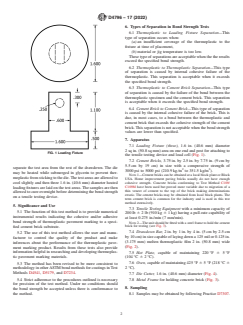
7.1 Loading Fixture (three), 1.6 in. (40.6 mm) diameter
2 sq in. (50.8 sq mm) area on one end and post for attaching to
FIG. 1 Loading Fixture
the tensile testing device and load cell (Fig. 1).
7.2 Cement Bricks, 3.75 in. by 2.5 in. by 7.75 in. (9 cm by
5.5 cm by 19 cm) in size with a compressive strength of
separate the test area from the rest of the drawdown. The die
2 2
3000 psi to 5000 psi (210.9 kg⁄m to 351.5 kg/m ).
may be heated while submerged in glycerin to prevent ther-
NOTE 1—Cement bricks can be obtained at a local block plant or Block
moplastic from sticking to the die.The test areas are allowed to
USA. Home improvement paving bricks usually do not have enough
cool slightly and then three 1.6 in. (40.6 mm) diameter heated
cohesive strength. Concrete bricks conforming to Test Method C109/
C109M have been used but proved more variable due to migration of a
loading fixtures are laid on the test areas. The samples are then
thin veneer of cement to the top of the brick making determinations
allowed to cure overnight before determining the bond strength
erratic. The cement bricks may be obtained from local block plants. The
on a tensile testing device.
term cement brick is common for the industry and is used in this test
method extensively.
5. Significance and Use
7.3 Tensile Testing Equipment with a minimum capacity of
5.1 The function of this test method is to provide numerical
200 lb 6 2 lb (910 kg 6 1 kg) having a pull-rate capability of
instrumental results indicating the cohesive and/or adhesive
at least 0.275 in./min (7 mm/min).
bond strength of thermoplastic pavement marking to a speci-
NOTE 2—The unit should be fitted with a steel frame to hold the cement
fied cement brick substrate. brick for testing (see Fig. 3).
7.4 Drawdown Bar, 2 in. by 1 in. by 4 in. (5 cm by 2.5 cm
5.2 The use of this test method allows the user and manu-
by 10 cm) in size capable of laying down a 125 mil or 0.125 in.
facturer to control the quality of the product and make
(3.175 mm) molten thermoplastic film 2 in. (50.8 mm) wide
inferences about the performance of the thermoplastic pave-
(Fig. 2).
ment marking product. Results from these tests also provide
information helpful in researching and developing thermoplas- 7.5 Hot Plate, capable of maintaining 220 °F 6 5°F
tic pavement marking materials.
(104 °C 6 2 °C).
5.3 The method has been revised to be more consistent to 7.6 Oven, capable of maintaining 425 °F 6 5 °F (218 °C 6
methodologyinotherASTMbondmethodsforcoatingsinTest 2 °C).
Methods D4541, D5179, and D7234.
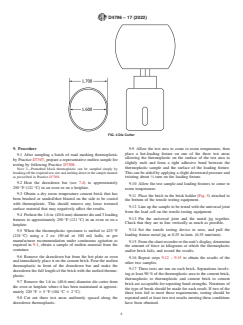
7.7 Die Cutter, 1.6 in. (40.6 mm) diameter (Fig. 4).
5.4 Strict adherence to the procedures outlined is necessary
7.8 Metal Frame for holding concrete brick (Fig. 3).
for precision of the test method. Under no conditions should
8. Sampling
the bond strength be accepted unless there is conformance to
the method. 8.1 Samples may be obtained by following Practice D7307.
D4796 − 17
...