

ASTM D8162-20a
(Test Method)Standard Test Method for Determination of the Apparent Viscosity of Thermoplastic Pavement Marking Materials using a Rotational Viscometer with Temperature Control Heating Unit
General Information
- Abstract
SIGNIFICANCE AND USE
5.1 This test method is used to measure the apparent viscosity of thermoplastic pavement marking at elevated temperatures. Elevated temperature viscosities of thermoplastic pavement marking may be related to the properties of coatings, adhesives, and composite thermoplastics. This method is helpful in determining the flow properties which can be used in determining processability when applied to the road surface.
5.2 Thermoplastic pavement markings may be applied to the road surface in several different ways. Typical methods of application are screed extrude, ribbon extrude, thin film spray, and standard spray. Proper application depends on the viscosity of the thermoplastic material at application temperatures for the method being used. Thin-line applied thermoplastic pavement marking, for example, requires a relatively lower viscosity. Screed extrude applied thermoplastic requires a higher viscosity.
5.3 Materials of the type described in this procedure may be non-Newtonian, and as such, the apparent viscosity will be a function of shear rate under the conditions of test. Although the viscometer described in this test method operates under conditions of relatively low shear rate, differences in shear effect can exist depending upon the spindle and rotational speed conditions selected for the test program. Comparisons between non-Newtonian viscosity values should be made only for measurements made with similar viscometers under conditions of equivalent shear. For this method, “torpedo” spindles are recommended. Spindles considered torpedo spindles are ~1-in. long and come in many diameters with a 45° conical bottom. A diameter that is half the diameter of the thimbles used is recommended. If large glass beads are used in the pavement marking formulation, a smaller diameter spindle may be needed so the beads do not cause an impedance of the spindle due to a jamming between the inside wall of the thimble and the spindle.
SCOPE
1.1 This test method covers the sample preparation and testing procedure needed to determine the apparent viscosity of a thermoplastic pavement marking formulation at elevated temperatures to the specimen.
1.2 The values stated in SI units are to be regarded as standard. The values given in parentheses after SI units are customary units and are provided as a courtesy to the user.
1.3 This standard does not purport to address all of the safety concerns, if any, associated with its use. It is the responsibility of the user of this standard to establish appropriate safety, health, and environmental practices and determine the applicability of regulatory limitations prior to use.
1.4 This international standard was developed in accordance with internationally recognized principles on standardization established in the Decision on Principles for the Development of International Standards, Guides and Recommendations issued by the World Trade Organization Technical Barriers to Trade (TBT) Committee.
- Status
- Published
- Publication Date
- 31-Aug-2020
- Technical Committee
- D01 - Paint and Related Coatings, Materials, and Applications
- Drafting Committee
- D01.44 - Traffic Coatings
Buy Documents
ASTM D8162-20a - Standard Test Method for Determination of the Apparent Viscosity of Thermoplastic Pavement Marking Materials using a Rotational Viscometer with Temperature Control Heating Unit
REDLINE ASTM D8162-20a - Standard Test Method for Determination of the Apparent Viscosity of Thermoplastic Pavement Marking Materials using a Rotational Viscometer with Temperature Control Heating Unit
Overview
ASTM D8162-20a is the Standard Test Method for Determination of the Apparent Viscosity of Thermoplastic Pavement Marking Materials using a Rotational Viscometer with Temperature Control Heating Unit. Developed by ASTM International, this method establishes procedures for assessing the apparent viscosity of thermoplastic pavement markings at elevated temperatures. The measurement of viscosity is integral to determining the processability and application quality of these materials on roadways, providing critical data for manufacturers, applicators, and quality control professionals in the pavement marking industry.
Key Topics
- Apparent Viscosity Measurement: Focuses on testing thermoplastic pavement marking materials to evaluate resistance to flow at elevated temperatures, which closely simulates real-life application conditions.
- Temperature Control: Uses a rotational viscometer equipped with a temperature control heating unit, ensuring specimens are evaluated under precisely regulated thermal environments to ensure accuracy and repeatability.
- Application Relevance: Viscosity values help determine the best practices for different pavement marking techniques such as screed extrude, ribbon extrude, thin film spray, and standard spray.
- Non-Newtonian Behavior: Addresses that many thermoplastic materials exhibit non-Newtonian viscosity, meaning viscosity values can change with different shear rates and instrumentation conditions.
- Standardized Equipment and Procedure: Details recommended viscometer spindle shapes (“torpedo” spindles), sample preparation guidelines, and safe laboratory practices to achieve consistent and reliable results.
Applications
ASTM D8162-20a is widely used by:
- Pavement Marking Manufacturers: To verify and control the viscosity of thermoplastic materials during development and production, ensuring materials meet required flow characteristics and application properties.
- Quality Control Laboratories: For batch testing and certification, aiding in compliance with regulatory and project specifications.
- Application Contractors: To adjust application parameters and select the appropriate method based on viscosity measurements, resulting in proper material laydown and effective roadway marking performance.
- Research and Development: Supporting the testing of new formulations or additives by offering a standardized approach to viscosity assessment.
- Regulatory and Procurement Agencies: For acceptance testing, material certification, and specification compliance in resurfacing or new road construction projects.
Related Standards
Several ASTM standards are referenced or related to ASTM D8162-20a, providing a comprehensive framework for thermoplastic pavement marking evaluation:
- ASTM D883: Terminology Relating to Plastics
- ASTM D7307: Practice for Sampling of Thermoplastic Traffic Marking Materials
- ASTM D7308: Practice for Sample Preparation of Thermoplastic Pavement Marking Materials
- ASTM E177: Practice for Use of the Terms Precision and Bias in ASTM Test Methods
- ASTM E284: Terminology of Appearance
- ASTM E691: Practice for Conducting an Interlaboratory Study to Determine the Precision of a Test Method
- ASTM E2975: Test Method for Calibration or Calibration Verification of Concentric Cylinder Rotational Viscometers
Practical Value
Using ASTM D8162-20a promotes quality control, optimizes material processability, and enhances application performance of thermoplastic pavement marking materials. Its standardized test procedure helps ensure that road markings are applied with consistency, durability, and visibility, thereby improving road safety and maximizing material performance under real-world conditions.
Keywords: thermoplastic pavement marking, apparent viscosity, rotational viscometer, temperature control, ASTM D8162-20a, quality control, pavement marking application, non-Newtonian viscosity, sample preparation, standard test method.
Relations
- Effective Date
- 01-Feb-2024
- Effective Date
- 01-Nov-2023
- Effective Date
- 01-Jan-2020
- Effective Date
- 01-Aug-2019
- Effective Date
- 15-Apr-2019
- Effective Date
- 01-Feb-2019
- Effective Date
- 01-Dec-2018
- Effective Date
- 01-Nov-2018
- Effective Date
- 15-Aug-2017
- Effective Date
- 01-Dec-2016
- Refers
ASTM E2975-15 - Standard Test Method for Calibration of Concentric Cylinder Rotational Viscometers - Effective Date
- 01-Sep-2015
- Refers
ASTM E2975-14 - Standard Test Method for Calibration of Concentric Cylinder Rotational Viscometers - Effective Date
- 01-Aug-2014
- Effective Date
- 01-May-2014
- Effective Date
- 01-Nov-2013
- Effective Date
- 01-Jun-2013
Buy Documents
ASTM D8162-20a - Standard Test Method for Determination of the Apparent Viscosity of Thermoplastic Pavement Marking Materials using a Rotational Viscometer with Temperature Control Heating Unit
REDLINE ASTM D8162-20a - Standard Test Method for Determination of the Apparent Viscosity of Thermoplastic Pavement Marking Materials using a Rotational Viscometer with Temperature Control Heating Unit
Get Certified
Connect with accredited certification bodies for this standard

Zavod za gradbeništvo Slovenije (ZAG) - Inšpekcija
ZAG inspection body for construction products, structures, and materials.
Sponsored listings
Frequently Asked Questions
ASTM D8162-20a is a standard published by ASTM International. Its full title is "Standard Test Method for Determination of the Apparent Viscosity of Thermoplastic Pavement Marking Materials using a Rotational Viscometer with Temperature Control Heating Unit". This standard covers: SIGNIFICANCE AND USE 5.1 This test method is used to measure the apparent viscosity of thermoplastic pavement marking at elevated temperatures. Elevated temperature viscosities of thermoplastic pavement marking may be related to the properties of coatings, adhesives, and composite thermoplastics. This method is helpful in determining the flow properties which can be used in determining processability when applied to the road surface. 5.2 Thermoplastic pavement markings may be applied to the road surface in several different ways. Typical methods of application are screed extrude, ribbon extrude, thin film spray, and standard spray. Proper application depends on the viscosity of the thermoplastic material at application temperatures for the method being used. Thin-line applied thermoplastic pavement marking, for example, requires a relatively lower viscosity. Screed extrude applied thermoplastic requires a higher viscosity. 5.3 Materials of the type described in this procedure may be non-Newtonian, and as such, the apparent viscosity will be a function of shear rate under the conditions of test. Although the viscometer described in this test method operates under conditions of relatively low shear rate, differences in shear effect can exist depending upon the spindle and rotational speed conditions selected for the test program. Comparisons between non-Newtonian viscosity values should be made only for measurements made with similar viscometers under conditions of equivalent shear. For this method, “torpedo” spindles are recommended. Spindles considered torpedo spindles are ~1-in. long and come in many diameters with a 45° conical bottom. A diameter that is half the diameter of the thimbles used is recommended. If large glass beads are used in the pavement marking formulation, a smaller diameter spindle may be needed so the beads do not cause an impedance of the spindle due to a jamming between the inside wall of the thimble and the spindle. SCOPE 1.1 This test method covers the sample preparation and testing procedure needed to determine the apparent viscosity of a thermoplastic pavement marking formulation at elevated temperatures to the specimen. 1.2 The values stated in SI units are to be regarded as standard. The values given in parentheses after SI units are customary units and are provided as a courtesy to the user. 1.3 This standard does not purport to address all of the safety concerns, if any, associated with its use. It is the responsibility of the user of this standard to establish appropriate safety, health, and environmental practices and determine the applicability of regulatory limitations prior to use. 1.4 This international standard was developed in accordance with internationally recognized principles on standardization established in the Decision on Principles for the Development of International Standards, Guides and Recommendations issued by the World Trade Organization Technical Barriers to Trade (TBT) Committee.
SIGNIFICANCE AND USE 5.1 This test method is used to measure the apparent viscosity of thermoplastic pavement marking at elevated temperatures. Elevated temperature viscosities of thermoplastic pavement marking may be related to the properties of coatings, adhesives, and composite thermoplastics. This method is helpful in determining the flow properties which can be used in determining processability when applied to the road surface. 5.2 Thermoplastic pavement markings may be applied to the road surface in several different ways. Typical methods of application are screed extrude, ribbon extrude, thin film spray, and standard spray. Proper application depends on the viscosity of the thermoplastic material at application temperatures for the method being used. Thin-line applied thermoplastic pavement marking, for example, requires a relatively lower viscosity. Screed extrude applied thermoplastic requires a higher viscosity. 5.3 Materials of the type described in this procedure may be non-Newtonian, and as such, the apparent viscosity will be a function of shear rate under the conditions of test. Although the viscometer described in this test method operates under conditions of relatively low shear rate, differences in shear effect can exist depending upon the spindle and rotational speed conditions selected for the test program. Comparisons between non-Newtonian viscosity values should be made only for measurements made with similar viscometers under conditions of equivalent shear. For this method, “torpedo” spindles are recommended. Spindles considered torpedo spindles are ~1-in. long and come in many diameters with a 45° conical bottom. A diameter that is half the diameter of the thimbles used is recommended. If large glass beads are used in the pavement marking formulation, a smaller diameter spindle may be needed so the beads do not cause an impedance of the spindle due to a jamming between the inside wall of the thimble and the spindle. SCOPE 1.1 This test method covers the sample preparation and testing procedure needed to determine the apparent viscosity of a thermoplastic pavement marking formulation at elevated temperatures to the specimen. 1.2 The values stated in SI units are to be regarded as standard. The values given in parentheses after SI units are customary units and are provided as a courtesy to the user. 1.3 This standard does not purport to address all of the safety concerns, if any, associated with its use. It is the responsibility of the user of this standard to establish appropriate safety, health, and environmental practices and determine the applicability of regulatory limitations prior to use. 1.4 This international standard was developed in accordance with internationally recognized principles on standardization established in the Decision on Principles for the Development of International Standards, Guides and Recommendations issued by the World Trade Organization Technical Barriers to Trade (TBT) Committee.
ASTM D8162-20a is classified under the following ICS (International Classification for Standards) categories: 93.080.20 - Road construction materials. The ICS classification helps identify the subject area and facilitates finding related standards.
ASTM D8162-20a has the following relationships with other standards: It is inter standard links to ASTM D883-24, ASTM D883-23, ASTM D883-20, ASTM D883-19c, ASTM D883-19a, ASTM D883-19, ASTM D883-18a, ASTM D883-18, ASTM D883-17, ASTM E2975-16, ASTM E2975-15, ASTM E2975-14, ASTM E177-14, ASTM E284-13b, ASTM E284-13a. Understanding these relationships helps ensure you are using the most current and applicable version of the standard.
ASTM D8162-20a is available in PDF format for immediate download after purchase. The document can be added to your cart and obtained through the secure checkout process. Digital delivery ensures instant access to the complete standard document.
Standards Content (Sample)
This international standard was developed in accordance with internationally recognized principles on standardization established in the Decision on Principles for the
Development of International Standards, Guides and Recommendations issued by the World Trade Organization Technical Barriers to Trade (TBT) Committee.
Designation: D8162 − 20a
Standard Test Method for
Determination of the Apparent Viscosity of Thermoplastic
Pavement Marking Materials using a Rotational Viscometer
with Temperature Control Heating Unit
This standard is issued under the fixed designation D8162; the number immediately following the designation indicates the year of
original adoption or, in the case of revision, the year of last revision. A number in parentheses indicates the year of last reapproval. A
superscript epsilon (´) indicates an editorial change since the last revision or reapproval.
1. Scope E691 Practice for Conducting an Interlaboratory Study to
Determine the Precision of a Test Method
1.1 This test method covers the sample preparation and
E2975 Test Method for Calibration or Calibration Verifica-
testing procedure needed to determine the apparent viscosity of
tion of Concentric Cylinder Rotational Viscometers
a thermoplastic pavement marking formulation at elevated
temperatures to the specimen.
3. Terminology
1.2 The values stated in SI units are to be regarded as
3.1 The terms and definitions in Terminology D883 and
standard. The values given in parentheses after SI units are
Terminology E284 apply to this test method.
customary units and are provided as a courtesy to the user.
3.2 Definitions of Terms Specific to This Standard:
1.3 This standard does not purport to address all of the
safety concerns, if any, associated with its use. It is the 3.2.1 apparent viscosity, n—the viscosity determined by this
responsibility of the user of this standard to establish appro- test method can be expressed in millipascal seconds,
priate safety, health, and environmental practices and deter- Centipoise, and Poise. Common viscosity units of Poise (P) are
mine the applicability of regulatory limitations prior to use. related to the SI units by the equivalency 1 cP = 1 mPa·s.
1.4 This international standard was developed in accor-
3.2.1.1 Discussion—An apparent viscosity value may vary
dance with internationally recognized principles on standard-
with the spindle and rotational speed elected for measuring
ization established in the Decision on Principles for the
non-Newtonian materials.
Development of International Standards, Guides and Recom-
3.2.2 thermoplastic pavement marking (material), n—a
mendations issued by the World Trade Organization Technical
highly filled 100 % total solids highway marking system that
Barriers to Trade (TBT) Committee.
when heated to a molten state can be extruded or sprayed onto
a road surface. Retroreflective optics are applied (dropped on)
2. Referenced Documents
to the surface of the molten marking immediately after
2.1 ASTM Standards:
application to provide, when cooled, a solid durable delineator
D883 Terminology Relating to Plastics
or thermoplastic pavement marking usually melted to ~218°C
D7307 PracticeforSamplingofThermoplasticTrafficMark-
(425°F)
ing Materials
3.2.3 viscosity, n—the ratio of shear stress to shear rate.
D7308 Practice for Sample Preparation of Thermoplastic
3.2.3.1 Discussion—The viscosity of a liquid is a measure
Pavement Marking Materials
of the resistance to flow of the liquid. The SI unit of dynamic
E177 Practice for Use of the Terms Precision and Bias in
viscosity is the pascal second. For a Newtonian liquid, the
ASTM Test Methods
viscosity is constant at all shear rates. For a non-Newtonian
E284 Terminology of Appearance
liquid, viscosity will vary depending on shear rate.
4. Summary of Test Method
This test method is under the jurisdiction of ASTM Committee D01 on Paint
and Related Coatings, Materials, andApplications and is the direct responsibility of
4.1 This viscosity method is used to determine the apparent
Subcommittee D01.44 on Traffic Coatings.
viscosity of thermoplastic pavement marking products at
Current edition approved Sept. 1, 2020. Published September 2020. Originally
elevated temperatures. Apparent viscosity is determined under
approved in 2020. Last previous edition approved in 2020 as D8162 – 20. DOI:
10.1520/D8162-20A.
temperature equilibrium conditions using a rotating spindle
For referenced ASTM standards, visit the ASTM website, www.astm.org, or
type viscometer. The torque on a spindle rotating in a
contact ASTM Customer Service at service@astm.org. For Annual Book of ASTM
temperature-controlled sample holder containing a small
Standards volume information, refer to the standard’s Document Summary page on
the ASTM website. amount of sample is used to measure the relative resistance to
Copyright © ASTM International, 100 Barr Harbor Drive, PO Box C700, West Conshohocken, PA 19428-2959. United States
D8162 − 20a
rotation. A factor is applied to the torque reading to yield the 7. Apparatus
viscosity in mPa·s (cP or Poise).
7.1 Viscometer, Rotational—The essential instrumental re-
quired providing the minimum rotational viscometer analytical
5. Significance and Use
capabilities include:
7.1.1 A drive motor, to apply a unidirectional torque to the
5.1 This test method is used to measure the apparent
specimen constant to 61%;
viscosity of thermoplastic pavement marking at elevated tem-
7.1.2 Aforce sensor to measure the torque developed by the
peratures. Elevated temperature viscosities of thermoplastic
specimen readable to within 61%;
pavement marking may be related to the properties of coatings,
7.1.3 A coupling shaft or other means to transmit the
adhesives, and composite thermoplastics. This method is help-
rotational force from the motor;
ful in determining the flow properties which can be used in
7.1.4 A spindle, rotational element, geometry or tool to fix
determining processability when applied to the road surface.
the specimen between the drive shaft and a stationary position.
5.2 Thermoplastic pavement markings may be applied to
The spindle has a torpedo shape as in Fig. 1. Note: For this
the road surface in several different ways. Typical methods of
testing we are recommending a nominal length (L) of 33.0 mm
application are screed extrude, ribbon extrude, thin film spray,
and a diameter (D) of 11.8 mm. Different sizes can be chosen
andstandardspray.Properapplicationdependsontheviscosity to be run with agreement between the buyer and seller of the
of the thermoplastic material at application temperatures for product.Wheremorethanonespindleisavailablefortherange
selected, choose a spindle that produces results nearest the
the method being used. Thin-line applied thermoplastic pave-
midpoint of the measurable viscosity (or torque or rotational
ment marking, for example, requires a relatively lower viscos-
speed) range;
ity. Screed extrude applied thermoplastic requires a higher
7.1.5 A specimen container (thimbles), matched to the
viscosity.
-1
spindle and heating chamber to provide, a shear rate of 0.34s
5.3 Materials of the type described in this procedure may be
times the rotational speed in r/min, with a total capacity of
non-Newtonian, and as such, the apparent viscosity will be a
25 ml, to contain the test specimen and spindle during the
function of shear rate under the conditions of test.Although the
testing. Can be stainless steel or disposable aluminum. Note:A
viscometer described in this test method operates under con-
thimble sample holder/rack should come with the viscometer
ditions of relatively low shear rate, differences in shear effect
which helps indicate fill height;
can exist depending upon the spindle and rotational speed
7.1.6 Data analysis capability to provide viscosity, stress,
conditions selected for the test program. Comparisons between
shear rate, or other useful parameters derived from measured
non-Newtonian viscosity values should be made only for
signals (of torque and rotational speed).
measurements made with similar viscometers under conditions
7.1.7 Auxiliary instrumentation considered necessary or
of equivalent shear. For this method, “torpedo” spindles are
useful in conducting this method includes:
recommended. Spindles considered torpedo spindles are ~1-in.
7.1.7.1 A level to indicate the vertical plumb of the drive
long and come in many diameters with a 45° conical bottom.A
motor, shaft, and spindle.
diameter that is half the diameter of the thimbles used is
7.1.7.2 A stand, to support, level, and adjust the height of
recommended. If large glass beads are used in the pavement
the drive motor, shaft, and rotational elem
...
This document is not an ASTM standard and is intended only to provide the user of an ASTM standard an indication of what changes have been made to the previous version. Because
it may not be technically possible to adequately depict all changes accurately, ASTM recommends that users consult prior editions as appropriate. In all cases only the current version
of the standard as published by ASTM is to be considered the official document.
Designation: D8162 − 20 D8162 − 20a
Standard Test Method for
Determination of the Apparent Viscosity of Thermoplastic
Pavement Marking Materials using a Rotational Viscometer
with Temperature Control Heating Unit
This standard is issued under the fixed designation D8162; the number immediately following the designation indicates the year of
original adoption or, in the case of revision, the year of last revision. A number in parentheses indicates the year of last reapproval. A
superscript epsilon (´) indicates an editorial change since the last revision or reapproval.
1. Scope
1.1 This test method covers the sample preparation and testing procedure needed to determine the apparent viscosity of a
thermoplastic pavement marking formulation at elevated temperatures to the specimen.
1.2 The values stated in SI units are to be regarded as standard. The values given in parentheses after SI units are customary units
and are provided as a courtesy to the user.
1.3 This standard does not purport to address all of the safety concerns, if any, associated with its use. It is the responsibility
of the user of this standard to establish appropriate safety, health, and environmental practices and determine the applicability of
regulatory limitations prior to use.
1.4 This international standard was developed in accordance with internationally recognized principles on standardization
established in the Decision on Principles for the Development of International Standards, Guides and Recommendations issued
by the World Trade Organization Technical Barriers to Trade (TBT) Committee.
2. Referenced Documents
2.1 ASTM Standards:
D883 Terminology Relating to Plastics
D7307 Practice for Sampling of Thermoplastic Traffic Marking Materials
D7308 Practice for Sample Preparation of Thermoplastic Pavement Marking Materials
E177 Practice for Use of the Terms Precision and Bias in ASTM Test Methods
E284 Terminology of Appearance
E691 Practice for Conducting an Interlaboratory Study to Determine the Precision of a Test Method
E2975 Test Method for Calibration or Calibration Verification of Concentric Cylinder Rotational Viscometers
3. Terminology
3.1 The terms and definitions in Terminology D883 and Terminology E284 apply to this test method.
3.2 Definitions of Terms Specific to This Standard:
This test method is under the jurisdiction of ASTM Committee D01 on Paint and Related Coatings, Materials, and Applications and is the direct responsibility of
Subcommittee D01.44 on Traffic Coatings.
Current edition approved June 1, 2020Sept. 1, 2020. Published September 2020. Originally approved in 2020. Last previous edition approved in 2020 as D8162 – 20. DOI:
10.1520/D8162-20.10.1520/D8162-20A.
For referenced ASTM standards, visit the ASTM website, www.astm.org, or contact ASTM Customer Service at service@astm.org. For Annual Book of ASTM Standards
volume information, refer to the standard’s Document Summary page on the ASTM website.
Copyright © ASTM International, 100 Barr Harbor Drive, PO Box C700, West Conshohocken, PA 19428-2959. United States
D8162 − 20a
3.2.1 apparent viscosity, n—the viscosity determined by this test method can be expressed in millipascal seconds, Centipoise, and
Poise. Common viscosity units of Poise (P) are related to the SI units by the equivalency 1 cP = 1 mPa·s.
3.2.1.1 Discussion—
An apparent viscosity value may vary with the spindle and rotational speed elected for measuring non-Newtonian materials.
3.2.2 thermoplastic pavement marking (material), n—a highly filled 100 % total solids highway marking system that when heated
to a molten state can be extruded or sprayed onto a road surface. Retroreflective optics are applied (dropped on) to the surface of
the molten marking immediately after application to provide, when cooled, a solid durable delineator or thermoplastic pavement
marking usually melted to ~218°C (425°F)
3.2.3 viscosity, n—the ratio of shear stress to shear rate.
3.2.3.1 Discussion—
The viscosity of a liquid is a measure of the resistance to flow of the liquid. The SI unit of dynamic viscosity is the pascal second.
For a Newtonian liquid, the viscosity is constant at all shear rates. For a non-Newtonian liquid, viscosity will vary depending on
shear rate.
4. Summary of Test Method
4.1 This viscosity method is used to determine the apparent viscosity of thermoplastic pavement marking products at elevated
temperatures. Apparent viscosity is determined under temperature equilibrium conditions using a rotating spindle type viscometer.
The torque on a spindle rotating in a temperature-controlled sample holder containing a small amount of sample is used to measure
the relative resistance to rotation. A factor is applied to the torque reading to yield the viscosity in mPa·s (cP or Poise).
5. Significance and Use
5.1 This test method is used to measure the apparent viscosity of thermoplastic pavement marking at elevated temperatures.
Elevated temperature viscosities of thermoplastic pavement marking may be related to the properties of coatings, adhesives, and
composite thermoplastics. This method is helpful in determining the flow properties which can be used in determining
processability when applied to the road surface.
5.2 Thermoplastic pavement markings may be applied to the road surface in several different ways. Typical methods of application
are screed extrude, ribbon extrude, thin film spray, and standard spray. Proper application depends on the viscosity of the
thermoplastic material at application temperatures for the method being used. Thin-line applied thermoplastic pavement marking,
for example, requires a relatively lower viscosity. Screed extrude applied thermoplastic requires a higher viscosity.
5.3 Materials of the type described in this procedure may be non-Newtonian, and as such, the apparent viscosity will be a function
of shear rate under the conditions of test. Although the viscometer described in this test method operates under conditions of
relatively low shear rate, differences in shear effect can exist depending upon the spindle and rotational speed conditions selected
for the test program. Comparisons between non-Newtonian viscosity values should be made only for measurements made with
similar viscometers under conditions of equivalent shear. For this method, “torpedo” spindles are recommended. Spindles
considered torpedo spindles are ~1-in. long and come in many diameters with a 45° conical bottom. A diameter that is half the
diameter of the thimbles used is recommended. If large glass beads are used in the pavement marking formulation, a smaller
diameter spindle may be needed so the beads do not cause an impedance of the spindle due to a jamming between the inside wall
of the thimble and the spindle.
6. Interferences
6.1 Thermoplastic pavement marking products can change in viscosity over extended periods of heat history; therefore, it is
recommended that these type viscosities be performed on product samples which have the same heat history in order to lower
deviation of comparative results.
6.2 Thermoplastic pavement marking products contain glass beads which can settle quickly if the formulation is not stirred
constantly. Because of that fact, some formulations may have too low of viscosity to stay homogeneous at the commonly used
processing temperature 218°C (425°F) for any length of time for the test sample’s temperature and viscosity to be stable. Therefore,
a pre-set time-period may be necessary after the sample is placed in the thimble and heater at which to record the viscosity.
D8162 − 20a
7. Apparatus
7.1 Viscometer, Rotational—The essential instrumental required providing the minimum rotational viscometer analytical
capabilities include:
7.1.1 A drive motor, to apply a unidirectional torque to the specimen constant to 61 %;
7.1.2 A force sensor to measure the torque developed by the specimen readable to within 61 %;
7.1.3 A coupling shaft or other means to transmit the rotational force from the motor;
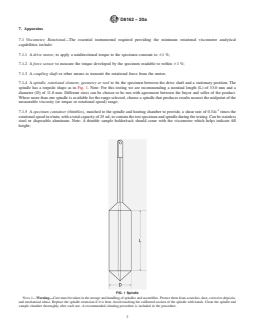
7.1.4 A spindle, rotational element, geometry or tool to fix the specimen between the drive shaft and a stationary position. The
spindle has a torpedo shape as in Fig. 1. Note: For this testing we are recommending a nominal length (L) of 33.0 mm and a
diameter (D) of 11.8 mm. Different sizes can be chosen to be run with agreement between the buyer and seller of the product.
Where more than one spindle is available for the range selected, choose a spindle that produc
...