

ASTM D7971-20
(Guide)Standard Guide for Measuring Roundness of Glass Spheres Using a Flowing Stream Digital Image Analyzer
General Information
- Abstract
SIGNIFICANCE AND USE
4.1 The roundness of glass beads has a significant influence on the retroreflective efficiency of a pavement marking system.
4.2 The guide is for the characterization of the roundness of glass beads for the purpose of compliance testing against standard specification for glass beads in pavement marking applications.
4.3 While there are potential industrial applications for this guide beyond the measurement of roundness of glass beads for pavement markings, those are beyond the scope of this standard.
SCOPE
1.1 This guide covers the determination of the roundness of glass spheres used in pavement marking systems using a flowing stream digital analyzer. Typical gradations for pavement marking systems are defined in ranges from Type 0 through 5 in AASHTO M247.
1.2 This guide provides for the presentation of roundness data in a variety of formats to the requirement of the agency pavement marking material specification. For most specifications the standard format is to present the roundness data as Percent True Spheres relative to a series of standard ASTM sieve sizes.
1.3 The values stated in SI units are to be regarded as standard. No other units of measurement are included in this standard.
1.4 This standard does not purport to address all of the safety concerns, if any, associated with its use. It is the responsibility of the user of this standard to establish appropriate safety, health, and environmental practices and determine the applicability of regulatory limitations prior to use.
1.5 This international standard was developed in accordance with internationally recognized principles on standardization established in the Decision on Principles for the Development of International Standards, Guides and Recommendations issued by the World Trade Organization Technical Barriers to Trade (TBT) Committee.
- Status
- Published
- Publication Date
- 31-May-2020
- Technical Committee
- D01 - Paint and Related Coatings, Materials, and Applications
- Drafting Committee
- D01.44 - Traffic Coatings
Buy Documents

ASTM D7971-20 - Standard Guide for Measuring Roundness of Glass Spheres Using a Flowing Stream Digital Image Analyzer
REDLINE ASTM D7971-20 - Standard Guide for Measuring Roundness of Glass Spheres Using a Flowing Stream Digital Image Analyzer
Overview
ASTM D7971-20 provides guidance for measuring the roundness of glass spheres using a flowing stream digital image analyzer. This standard is essential for ensuring the consistent quality and performance of glass beads used in pavement marking systems. The roundness of glass beads directly impacts the retroreflective efficiency of road markings, making standardized measurement crucial for compliance with specifications and optimal roadway visibility.
This guide is particularly relevant for testing compliance against requirements found in documents such as AASHTO M247, which defines gradation ranges for glass beads used in traffic markings.
Key Topics
- Measurement Methodology: The standard details the use of a flowing stream digital image analyzer-a system that employs high-resolution imaging and computer processing to assess particle shape and size characteristics.
- Roundness Evaluation: Roundness is defined as the percentage of true spheres in a sample. Two key methods used are:
- Aspect Ratio: The ratio of object dimensions (width to length), ideal when particles predominantly resemble spheres.
- Sphericity: Calculated from the projected particle image, using the relation between area and perimeter in accordance with ISO 9276-6.
- Presentation of Results: Results are reported primarily as "Percent True Spheres" classified by ASTM sieve sizes to align with procurement agency specifications.
- Sample Preparation and Testing Protocol: The standard sets requirements for sample size (based on glass bead type), moisture-free condition, and the need to follow precise operational steps for accurate results.
Applications
The primary application of ASTM D7971-20 is in the quality control and compliance testing of glass beads for road and pavement marking materials. Specifically:
- Traffic Safety: Round glass beads are critical in pavement markings for their retroreflective properties, improving nighttime and wet-weather visibility for drivers.
- Quality Assurance in Manufacturing: Glass bead producers use this guide to verify that their products meet roundness specifications prior to certification and distribution.
- Specification Compliance: Procurement agencies and independent laboratories incorporate this standard in routine testing to ensure that supplied glass beads fit the performance requirements outlined in documents like AASHTO M247.
While ASTM D7971-20 is primarily focused on the road marking sector, its methodology for roundness measurement may find broader use in industries needing reliable particle shape analysis, such as in other reflective or abrasive media-though these uses are outside the official scope.
Related Standards
ASTM D7971-20 references and aligns with several key standards to support consistent measurement practices:
- AASHTO M247: Specifies the types and gradations of glass beads for use in traffic markings.
- ASTM B215: Provides practices for sampling methods, ensuring representative samples for metal powders, which are adaptable for glass bead media.
- ISO 9276-6: Details approaches for descriptive and quantitative representation of particle shape and morphology.
- ISO 13322-1: Focuses on static image analysis methods for particle size analysis, ensuring image-based techniques are robust and comparable.
Adhering to ASTM D7971-20 helps manufacturers, specifiers, and testers uphold high standards in pavement marking materials, ensuring safer roads through reliable, high-performance reflective products.
Relations
- Effective Date
- 01-Dec-2010
- Effective Date
- 01-Nov-2008
- Effective Date
- 01-Oct-2004
- Effective Date
- 01-Jan-1996
Buy Documents
ASTM D7971-20 - Standard Guide for Measuring Roundness of Glass Spheres Using a Flowing Stream Digital Image Analyzer
REDLINE ASTM D7971-20 - Standard Guide for Measuring Roundness of Glass Spheres Using a Flowing Stream Digital Image Analyzer
Get Certified
Connect with accredited certification bodies for this standard

Zavod za gradbeništvo Slovenije (ZAG) - Inšpekcija
ZAG inspection body for construction products, structures, and materials.
Sponsored listings
Frequently Asked Questions
ASTM D7971-20 is a guide published by ASTM International. Its full title is "Standard Guide for Measuring Roundness of Glass Spheres Using a Flowing Stream Digital Image Analyzer". This standard covers: SIGNIFICANCE AND USE 4.1 The roundness of glass beads has a significant influence on the retroreflective efficiency of a pavement marking system. 4.2 The guide is for the characterization of the roundness of glass beads for the purpose of compliance testing against standard specification for glass beads in pavement marking applications. 4.3 While there are potential industrial applications for this guide beyond the measurement of roundness of glass beads for pavement markings, those are beyond the scope of this standard. SCOPE 1.1 This guide covers the determination of the roundness of glass spheres used in pavement marking systems using a flowing stream digital analyzer. Typical gradations for pavement marking systems are defined in ranges from Type 0 through 5 in AASHTO M247. 1.2 This guide provides for the presentation of roundness data in a variety of formats to the requirement of the agency pavement marking material specification. For most specifications the standard format is to present the roundness data as Percent True Spheres relative to a series of standard ASTM sieve sizes. 1.3 The values stated in SI units are to be regarded as standard. No other units of measurement are included in this standard. 1.4 This standard does not purport to address all of the safety concerns, if any, associated with its use. It is the responsibility of the user of this standard to establish appropriate safety, health, and environmental practices and determine the applicability of regulatory limitations prior to use. 1.5 This international standard was developed in accordance with internationally recognized principles on standardization established in the Decision on Principles for the Development of International Standards, Guides and Recommendations issued by the World Trade Organization Technical Barriers to Trade (TBT) Committee.
SIGNIFICANCE AND USE 4.1 The roundness of glass beads has a significant influence on the retroreflective efficiency of a pavement marking system. 4.2 The guide is for the characterization of the roundness of glass beads for the purpose of compliance testing against standard specification for glass beads in pavement marking applications. 4.3 While there are potential industrial applications for this guide beyond the measurement of roundness of glass beads for pavement markings, those are beyond the scope of this standard. SCOPE 1.1 This guide covers the determination of the roundness of glass spheres used in pavement marking systems using a flowing stream digital analyzer. Typical gradations for pavement marking systems are defined in ranges from Type 0 through 5 in AASHTO M247. 1.2 This guide provides for the presentation of roundness data in a variety of formats to the requirement of the agency pavement marking material specification. For most specifications the standard format is to present the roundness data as Percent True Spheres relative to a series of standard ASTM sieve sizes. 1.3 The values stated in SI units are to be regarded as standard. No other units of measurement are included in this standard. 1.4 This standard does not purport to address all of the safety concerns, if any, associated with its use. It is the responsibility of the user of this standard to establish appropriate safety, health, and environmental practices and determine the applicability of regulatory limitations prior to use. 1.5 This international standard was developed in accordance with internationally recognized principles on standardization established in the Decision on Principles for the Development of International Standards, Guides and Recommendations issued by the World Trade Organization Technical Barriers to Trade (TBT) Committee.
ASTM D7971-20 is classified under the following ICS (International Classification for Standards) categories: 93.080.20 - Road construction materials. The ICS classification helps identify the subject area and facilitates finding related standards.
ASTM D7971-20 has the following relationships with other standards: It is inter standard links to ASTM B215-10, ASTM B215-08, ASTM B215-04, ASTM B215-96. Understanding these relationships helps ensure you are using the most current and applicable version of the standard.
ASTM D7971-20 is available in PDF format for immediate download after purchase. The document can be added to your cart and obtained through the secure checkout process. Digital delivery ensures instant access to the complete standard document.
Standards Content (Sample)
This international standard was developed in accordance with internationally recognized principles on standardization established in the Decision on Principles for the
Development of International Standards, Guides and Recommendations issued by the World Trade Organization Technical Barriers to Trade (TBT) Committee.
Designation: D7971 − 20
Standard Guide for
Measuring Roundness of Glass Spheres Using a Flowing
Stream Digital Image Analyzer
This standard is issued under the fixed designation D7971; the number immediately following the designation indicates the year of
original adoption or, in the case of revision, the year of last revision. A number in parentheses indicates the year of last reapproval. A
superscript epsilon (´) indicates an editorial change since the last revision or reapproval.
1. Scope 2.2 AASHTO Standard:
AASHTO M247 Standard Glass Beads Used in Traffic
1.1 This guide covers the determination of the roundness of
Markings
glass spheres used in pavement marking systems using a
2.3 ISO Standards:
flowing stream digital analyzer. Typical gradations for pave-
ISO 9276–6 Representation of results of particle size analy-
ment marking systems are defined in ranges from Type 0
sis — Part 6: Descriptive and quantitative representation
through 5 in AASHTO M247.
of particle shape and morphology
1.2 This guide provides for the presentation of roundness
ISO 13322–1 Particle size analysis — Image analysis meth-
data in a variety of formats to the requirement of the agency
ods — Part 1: Static image analysis methods
pavement marking material specification. For most specifica-
3. Terminology
tions the standard format is to present the roundness data as
Percent True Spheres relative to a series of standard ASTM
3.1 Flowing Stream Digital Analyzer:
sieve sizes.
3.1.1 A computer controlled particle analyzer employing a
high resolution digital imaging device and computer image
1.3 The values stated in SI units are to be regarded as
processingsoftwaretodophotoopticalsingleparticlecounting
standard. No other units of measurement are included in this
and particle size analysis.
standard.
3.2 Roundness of Glass Beads:
1.4 This standard does not purport to address all of the
3.2.1 Roundness, in the context of this guide, refers to the
safety concerns, if any, associated with its use. It is the
percentage of true spheres in a sample as a ratio of the total
responsibility of the user of this standard to establish appro-
number of particles measured.
priate safety, health, and environmental practices and deter-
3.2.2 Methods:
mine the applicability of regulatory limitations prior to use.
3.2.2.1 These are specific observations and calculations of
1.5 This international standard was developed in accor-
the streaming particles that combine to form a protocol for
dance with internationally recognized principles on standard-
measuring the percentage of true spheres within the sample.
ization established in the Decision on Principles for the
3.3 Aspect Ratio:
Development of International Standards, Guides and Recom-
3.3.1 Aspect ratio, often referred to as b/l or w/l, is one of
mendations issued by the World Trade Organization Technical
the several methods of determining roundness and is illustrated
Barriers to Trade (TBT) Committee.
in Fig. 1.
3.3.2 Aspect ratio will be the recommended method for the
2. Referenced Documents
majority of roundness measurements, especially when there
2.1 ASTM Standards:
exists a reasonable expectation that all of the particles being
B215 Practices for Sampling Metal Powders
measured have rounded surfaces and mostly resemble the
shape of a sphere.
3.4 Sphericity (also referred to as circularity):
This guide is under the jurisdiction of ASTM Committee D01 on Paint and
3.4.1 Sphericity is one of a number of methods of determin-
Related Coatings, Materials, and Applications and is the direct responsibility of
ing roundness and is illustrated in Fig. 2.
Subcommittee D01.44 on Traffic Coatings.
CurrenteditionapprovedJune1,2020.PublishedJuly2020.Originallyapproved
in 2015. Last previous edition approved in 2015 as D7971 – 15. DOI: 10.1520/
D7971-20. Available from American Association of State Highway and Transportation
For referenced ASTM standards, visit the ASTM website, www.astm.org, or Officials (AASHTO), 444 N. Capitol St., NW, Suite 249, Washington, DC 20001,
contact ASTM Customer Service at service@astm.org. For Annual Book of ASTM http://www.transportation.org.
Standards volume information, refer to the standard’s Document Summary page on Available fromAmerican National Standards Institute (ANSI), 25 W. 43rd St.,
the ASTM website. 4th Floor, New York, NY 10036, http://www.ansi.org.
Copyright © ASTM International, 100 Barr Harbor Drive, PO Box C700, West Conshohocken, PA 19428-2959. United States
D7971 − 20
3.5.2 Nominal covered area (set value of obscuration) is
calculated using the obscured area by particles divided by the
total measurement area.
3.5.3 The higher the nominal covered area, the more coin-
cidental particles that are captured. With more coincidental
particles measured, the more non-round particles detected.
3.5.4 The task file setting for nominal covered area should
not exceed a certain percentage. Values of nominal covered
area (fld = field density) of 0.8 % for smaller grades (20 to 100
FIG. 1 Aspect Ratio
mesh,Type 0 andType 1 outlined inAASHTO M247) and 1 %
for larger grades (10 to 25 mesh, Type 2, Type 3, Type 4 and
Type 5) should not be exceeded. Lower values are possible.
Values of 0.3 % to 0.5 % will lead to more accurate results. For
example, a measurement with 0.7 % nominal covered area
leads to 18 % non-round particles, a measurement with 0.3 %
nominal covered area would show 17 % non-round particles.
4. Significance and Use
4.1 The roundness of glass beads has a significant influence
on the retroreflective efficiency of a pavement marking system.
FIG. 2 Sphericity
4.2 The guide is for the characterization of the roundness of
glass beads for the purpose of compliance testing against
standard specification for glass beads in pavement marking
3.4.2 SPHT-value or sphericity is calculated from the mea-
applications.
surements of
4.3 While there are potential industrial applications for this
1. the area* A* of the particle projection (particle image),
guide beyond the measurement of roundness of glass beads for
2. multiplied by four · Pi (4π) and
pavement markings, those are beyond the scope of this
3. divided by the perimeter P of the particle projection
standard.
squared (P ).
3.4.3 SPHT result values are between 0 and 1 (including 1)
5. Summary of Guide
and following ISO 9276–6.
5.1 The glass particles are run through a flowing stream
NOTE 1—Ahigh percentage of the volume of glass beads are produced
digital image analyzer, a measuring system for determining the
from crushed and sized recycled glass. The most common method of
production involves passing the particles in a reverse free fall through a
roundness of dry, free flowing and harmless bulk products.The
gas-rich, highly luminous, natural gas flame wherein they reach their
total recommended measuring range of sizes is be-
melting point. Due to nature’s insistence that all liquids exhibit tension at
tween 110 µm and 2.36 mm. The method uses photo optical
their surface, the particles are then forced to reconfigure into a shape
single particle counting technology for the image processing.
wh
...
This document is not an ASTM standard and is intended only to provide the user of an ASTM standard an indication of what changes have been made to the previous version. Because
it may not be technically possible to adequately depict all changes accurately, ASTM recommends that users consult prior editions as appropriate. In all cases only the current version
of the standard as published by ASTM is to be considered the official document.
Designation: D7971 − 15 D7971 − 20
Standard Guide for
Measuring Roundness of Glass Spheres Using a Flowing
Stream Digital Image Analyzer
This standard is issued under the fixed designation D7971; the number immediately following the designation indicates the year of
original adoption or, in the case of revision, the year of last revision. A number in parentheses indicates the year of last reapproval. A
superscript epsilon (´) indicates an editorial change since the last revision or reapproval.
1. Scope
1.1 This guide covers the determination of the roundness of glass spheres used in pavement marking systems using a flowing
stream digital analyzer. Typical gradations for pavement marking systems are defined in ranges from Type 0 through 5 in AASHTO
M247.
1.2 This guide provides for the presentation of roundness data in a variety of formats to the requirement of the agency pavement
marking material specification. For most specifications the standard format is to present the roundness data as Percent True Spheres
relative to a series of standard ASTM sieve sizes.
1.3 The values stated in SI units are to be regarded as standard. No other units of measurement are included in this standard.
1.4 This standard does not purport to address all of the safety concerns, if any, associated with its use. It is the responsibility
of the user of this standard to establish appropriate safety safety, health, and healthenvironmental practices and determine the
applicability of regulatory limitations prior to use.
1.5 This international standard was developed in accordance with internationally recognized principles on standardization
established in the Decision on Principles for the Development of International Standards, Guides and Recommendations issued
by the World Trade Organization Technical Barriers to Trade (TBT) Committee.
2. Referenced Documents
2.1 ASTM Standards:
B215 Practices for Sampling Metal Powders
2.2 AASHTO Standard:
AASHTO M247 Standard Glass Beads Used in Traffic Markings
2.3 ISO Standards:
ISO 9276–6 Representation of results of particle size analysis — Part 6: Descriptive and quantitative representation of particle
shape and morphology
ISO 13322–1 Particle size analysis — Image analysis methods — Part 1: Static image analysis methods
3. Terminology
3.1 Flowing Stream Digital Analyzer:
3.1.1 A computer controlled particle analyzer employing a high resolution digital imaging device and computer image
processing software to do photo optical single particle counting and particle size analysis.
3.2 Roundness of Glass Beads:
3.2.1 Roundness, in the context of this guide, refers to the percentage of true spheres in a sample as a ratio of the total number
of particles measured.
3.2.2 Methods:
This guide is under the jurisdiction of ASTM Committee D01 on Paint and Related Coatings, Materials, and Applications and is the direct responsibility of Subcommittee
D01.44 on Traffic Coatings.
Current edition approved April 1, 2015June 1, 2020. Published April 2015July 2020. Originally approved in 2015. Last previous edition approved in 2015 as D7971 – 15.
DOI: 10.1520/D7971-15.10.1520/D7971-20.
For referenced ASTM standards, visit the ASTM website, www.astm.org, or contact ASTM Customer Service at service@astm.org. For Annual Book of ASTM Standards
volume information, refer to the standard’s Document Summary page on the ASTM website.
Available from American Association of State Highway and Transportation Officials (AASHTO), 444 N. Capitol St., NW, Suite 249, Washington, DC 20001,
http://www.transportation.org.
Available from American National Standards Institute (ANSI), 25 W. 43rd St., 4th Floor, New York, NY 10036, http://www.ansi.org.
Copyright © ASTM International, 100 Barr Harbor Drive, PO Box C700, West Conshohocken, PA 19428-2959. United States
D7971 − 20
3.2.2.1 These are specific observations and calculations of the streaming particles that combine to form a protocol for measuring
the percentage of true spheres within the sample.
3.3 Aspect Ratio:
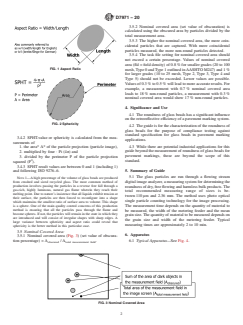
3.3.1 Aspect ratio, often referred to as b/l or w/l, is one of the several methods of determining roundness and is illustrated in
Fig. 1.
3.3.2 Aspect ratio will be the recommended method for the majority of roundness measurements, especially when there exists
a reasonable expectation that all of the particles being measured have rounded surfaces and mostly resemble the shape of a sphere.
3.4 Sphericity (also referred to as circularity):
3.4.1 Sphericity is one of a number of methods of determining roundness and is illustrated in Fig. 2.
3.4.2 SPHT-value or sphericity is calculated from the measurements of
1. the area* A* of the particle projection (particle image),
2. multiplied by four · Pi (4π) and
3. divided by the perimeter P of the particle projection squared (P ).
3.4.3 SPHT result values are between 0 and 1 (including 1) and following ISO 9276–6.
NOTE 1—A high percentage of the volume of glass beads are produced from crushed and sized recycled glass. The most common method of production
involves passing the particles in a reverse free fall through a gas-rich, highly luminous, natural gas flame wherein they reach their melting point. Due
to nature’s insistence that all liquids exhibit tension at their surface, the particles are then forced to reconfigure into a shape which maintains the smallest
ratio of surface area to volume. This shape is a sphere. One of the main quality control concerns of this production method is ensuring that all the particles
pass through the flame and become spheres. If not, the particles will remain in the state in which they are introduced and will consist of irregular shapes
with sharp edges. A large variance between sphericity and aspect ratio could reveal that sphericity is the better method in this particular case.
3.5 Nominal Covered Area:
3.5.1 Nominal covered area (Fig. 3) (set value of obscuration percentage) = A / A .
obscured total measurement field
3.5.2 Nominal covered area (set value of obscuration) is calculated using the obscured area by particles divided by the total
measurement area.
3.5.3 The higher the nominal covered area, the more coincidental particles that are captured. With more coincidental particles
measured, the more non-round particles detected.
3.5.4 The task file setting for nominal covered area should not exceed a certain percentage. Values of nominal covered area (fld
= field density) of 0.8 % for smaller grades (20 to 100 mesh, Type 0 and Type 1 outlined in AASHTO M247) and 1 % for larger
grades (10 to 25 mesh, Type 2, Type 3, Type 4 and Type 5) should not be exceeded. Lower values are possible. Values of 0.3 %
to 0.5 % will lead to more accurate results. For example, a measurement with 0.7 % nominal covered area leads to 18 % non-round
particles, a measurement with 0.3 % nominal covered area would show 17 % non-round particles.
4. Significance and Use
4.1 The roundness of glass beads has a significant influence on the retroreflective efficiency of a pavement marking system.
4.2 The guide is for the characterization of the roundness of glass beads for the purpose of compliance testing against standard
specification for glass beads in pavement marking applicatio
...