

ASTM E1783/E1783M-24
(Specification)Standard Specification for Preformed Architectural Strip Seals for Buildings and Parking Structures
General Information
- Abstract
ABSTRACT
This specification covers the physical requirements and movement capabilities of preformed architectural strip seals for use in sealing expansion joints in buildings and parking structures. However, this specification does not provide information on the durability of the architectural strip seals under actual service conditions, loading capability of the system, and the effects of a load on the functional parameters. Material covered by this specification consists of architectural strip seals extruded as a membrane or tubular, with frames, with flanges mechanically or chemically secured, used in interior or exterior application, and used in any construction of the building. The architectural strip seal shall be manufactured from a fully cured elastomeric alloy as a preformed extrusion free of defects such as holes and air bubbles, and with dimensions conforming to the requirements specified. Tests for tensile strength, elongation at break, hardness, ozone resistance, compression set, heat aging, tear resistance, brittleness temperature, and water absorption shall be performed and shall conform to the requirements specified.
SIGNIFICANCE AND USE
9.1 Architectural strip seals included in this specification shall be those:
9.1.1 Extruded as a membrane,
9.1.2 Extruded as tubular,
9.1.3 With frames,
9.1.4 With flanges mechanically secured,
9.1.5 With flanges chemically secured,
9.1.6 Used in interior or exterior applications, and
9.1.7 Used in any construction of the building.
9.2 This specification will give users, producers, building officials, code authorities, and others a basis for verifying material and performance characteristics of representative specimens under common test conditions. This specification will produce data on the following:
9.2.1 The physical properties of the fully cured elastomeric alloy, and
9.2.2 The movement capability in relation to the nominal joint width as defined under Test Method E1399/E1399M.
9.3 This specification compares similar architectural strip seals but is not intended to reflect the system's application. “Similar” refers to the same type of architectural strip seal within the same subsection under 9.1.
9.4 This specification does not provide information on the following:
9.4.1 Durability of the architectural strip seal under actual service conditions, including the effects of cycled temperature on the strip seal;
9.4.2 Loading capability of the system and the effects of a load on the functional parameters established by this specification;
9.4.3 Shear and rotational movements of the specimen;
9.4.4 Any other attributes of the specimen, such as fire resistance, wear resistance, chemical resistance, air infiltration, watertightness, and so forth; and
Note 3: This specification addresses fully cured elastomeric alloys. Test Methods D395, D573, D1052, and D1149 are tests better suited for evaluating thermoset materials.
9.4.5 Testing or compatibility of substrates.
9.5 This specification is intended to be used as only one element in the selection of an architectural strip seal for a particular application. It is not...
SCOPE
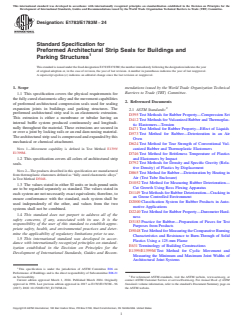
1.1 This specification covers the physical requirements for the fully cured elastomeric alloy and the movement capabilities of preformed architectural compression seals used for sealing expansion joints in buildings and parking structures. The preformed architectural strip seal is an elastomeric extrusion. This extrusion is either a membrane or tubular having an internal baffle system produced continuously and longitudinally throughout the material. These extrusions are secured in or over a joint by locking rails or an end dam nosing material. The architectural strip seal is compressed and expanded by this mechanical or chemical attachment.
Note 1: Movement capability is defined in Test Method E1399/E1399M.
1.2 This specification covers all colors of architectural strip seals.
No...
- Status
- Published
- Publication Date
- 29-Feb-2024
- Technical Committee
- E06 - Performance of Buildings
- Drafting Committee
- E06.21 - Serviceability
Buy Documents
ASTM E1783/E1783M-24 - Standard Specification for Preformed Architectural Strip Seals for Buildings and Parking Structures
REDLINE ASTM E1783/E1783M-24 - Standard Specification for Preformed Architectural Strip Seals for Buildings and Parking Structures
Overview
ASTM E1783/E1783M-24: Standard Specification for Preformed Architectural Strip Seals for Buildings and Parking Structures provides a comprehensive set of criteria for preformed architectural strip seals, specifically targeting their physical performance and movement capabilities in sealing expansion joints. Developed by ASTM, this standard is essential for professionals involved in the design, specification, manufacturing, and inspection of expansion joint seals used in buildings and parking structures.
The specification focuses primarily on fully cured elastomeric alloy strip seals, considering factors such as material quality, dimensional consistency, and attachment methods. It ensures a common baseline for quality and reliability, enabling architects, engineers, contractors, and code officials to verify product performance against established test methods.
Key Topics
Material Requirements: The standard covers preformed strip seals extruded as membranes or tubular forms made from fully cured elastomeric alloys. The material must be free of defects such as holes and air bubbles, and comply with strict requirements for tensile strength, elongation, and hardness.
Physical and Performance Properties: Tested properties include:
- Tensile strength and elongation at break
- Hardness (durometer values)
- Ozone resistance
- Compression set under heat and pressure
- Heat aging
- Tear resistance and brittleness temperature
- Water absorption
Movement Capabilities: Specifies how the strip seal accommodates joint movement, referencing ASTM E1399/E1399M for cyclic movement testing and joint width performance.
Product Types: Includes a variety of strip seal configurations:
- Membrane and tubular extrusions
- Seals with frames or flanges, mechanically or chemically secured
- Suitability for both interior and exterior applications, across all building types
Testing and Sampling: Outlines methods for selecting, preparing, and testing specimens to verify conformance with the standard.
Color and Finish: Allows for all color options, with final details to be determined between producer and purchaser.
Applications
Preformed architectural strip seals are critical for maintaining building envelope integrity, particularly at expansion joints that are subject to movement from thermal changes, structural settling, live loads, and seismic activity. Common areas of use include:
- Building expansion joints in concrete or steel structures
- Parking structure decks and ramps
- Exterior and interior joint applications
- New construction and retrofitting of existing joints
Utilizing ASTM E1783/E1783M-24 ensures that expansion joint seals meet high-quality standards, supporting long-term performance and reducing maintenance. It assists specifiers and purchasers in selecting appropriate seal products that deliver reliable sealing under normal joint movement conditions.
Related Standards
Several ASTM standards are referenced within ASTM E1783/E1783M-24 to guide testing and terminology:
- ASTM E1399/E1399M: Test Method for Cyclic Movement and Measuring the Minimum and Maximum Joint Widths of Architectural Joint Systems
- ASTM D412: Test Methods for Vulcanized Rubber and Thermoplastic Elastomers - Tension
- ASTM D2240: Test Method for Rubber Property - Durometer Hardness
- ASTM D471: Test Method for Rubber Property - Effect of Liquids
- ASTM D624: Test Method for Tear Strength
- ASTM D746: Test Method for Brittleness Temperature
- ASTM D792: Test Methods for Density and Specific Gravity
- ASTM D1052, D395, D1149, and others for specific material properties
Before final product selection, users should use ASTM E1783/E1783M-24 in conjunction with other relevant standards to ensure comprehensive coverage of performance and service conditions, especially regarding durability, compatibility, and resistance to environmental factors.
Keywords: architectural strip seal, expansion joints, parking structures, elastomeric seal, ASTM E1783, building envelope, joint sealing.
Relations
- Effective Date
- 01-Mar-2024
- Effective Date
- 01-Mar-2024
Buy Documents
ASTM E1783/E1783M-24 - Standard Specification for Preformed Architectural Strip Seals for Buildings and Parking Structures
REDLINE ASTM E1783/E1783M-24 - Standard Specification for Preformed Architectural Strip Seals for Buildings and Parking Structures
Get Certified
Connect with accredited certification bodies for this standard

DIBt (Deutsches Institut für Bautechnik)
German Institute for Building Technology.
DIN CERTCO
DIN Group product certification.
Zavod za gradbeništvo Slovenije (ZAG) - Inšpekcija
ZAG inspection body for construction products, structures, and materials.
Sponsored listings
Frequently Asked Questions
ASTM E1783/E1783M-24 is a technical specification published by ASTM International. Its full title is "Standard Specification for Preformed Architectural Strip Seals for Buildings and Parking Structures". This standard covers: ABSTRACT This specification covers the physical requirements and movement capabilities of preformed architectural strip seals for use in sealing expansion joints in buildings and parking structures. However, this specification does not provide information on the durability of the architectural strip seals under actual service conditions, loading capability of the system, and the effects of a load on the functional parameters. Material covered by this specification consists of architectural strip seals extruded as a membrane or tubular, with frames, with flanges mechanically or chemically secured, used in interior or exterior application, and used in any construction of the building. The architectural strip seal shall be manufactured from a fully cured elastomeric alloy as a preformed extrusion free of defects such as holes and air bubbles, and with dimensions conforming to the requirements specified. Tests for tensile strength, elongation at break, hardness, ozone resistance, compression set, heat aging, tear resistance, brittleness temperature, and water absorption shall be performed and shall conform to the requirements specified. SIGNIFICANCE AND USE 9.1 Architectural strip seals included in this specification shall be those: 9.1.1 Extruded as a membrane, 9.1.2 Extruded as tubular, 9.1.3 With frames, 9.1.4 With flanges mechanically secured, 9.1.5 With flanges chemically secured, 9.1.6 Used in interior or exterior applications, and 9.1.7 Used in any construction of the building. 9.2 This specification will give users, producers, building officials, code authorities, and others a basis for verifying material and performance characteristics of representative specimens under common test conditions. This specification will produce data on the following: 9.2.1 The physical properties of the fully cured elastomeric alloy, and 9.2.2 The movement capability in relation to the nominal joint width as defined under Test Method E1399/E1399M. 9.3 This specification compares similar architectural strip seals but is not intended to reflect the system's application. “Similar” refers to the same type of architectural strip seal within the same subsection under 9.1. 9.4 This specification does not provide information on the following: 9.4.1 Durability of the architectural strip seal under actual service conditions, including the effects of cycled temperature on the strip seal; 9.4.2 Loading capability of the system and the effects of a load on the functional parameters established by this specification; 9.4.3 Shear and rotational movements of the specimen; 9.4.4 Any other attributes of the specimen, such as fire resistance, wear resistance, chemical resistance, air infiltration, watertightness, and so forth; and Note 3: This specification addresses fully cured elastomeric alloys. Test Methods D395, D573, D1052, and D1149 are tests better suited for evaluating thermoset materials. 9.4.5 Testing or compatibility of substrates. 9.5 This specification is intended to be used as only one element in the selection of an architectural strip seal for a particular application. It is not... SCOPE 1.1 This specification covers the physical requirements for the fully cured elastomeric alloy and the movement capabilities of preformed architectural compression seals used for sealing expansion joints in buildings and parking structures. The preformed architectural strip seal is an elastomeric extrusion. This extrusion is either a membrane or tubular having an internal baffle system produced continuously and longitudinally throughout the material. These extrusions are secured in or over a joint by locking rails or an end dam nosing material. The architectural strip seal is compressed and expanded by this mechanical or chemical attachment. Note 1: Movement capability is defined in Test Method E1399/E1399M. 1.2 This specification covers all colors of architectural strip seals. No...
ABSTRACT This specification covers the physical requirements and movement capabilities of preformed architectural strip seals for use in sealing expansion joints in buildings and parking structures. However, this specification does not provide information on the durability of the architectural strip seals under actual service conditions, loading capability of the system, and the effects of a load on the functional parameters. Material covered by this specification consists of architectural strip seals extruded as a membrane or tubular, with frames, with flanges mechanically or chemically secured, used in interior or exterior application, and used in any construction of the building. The architectural strip seal shall be manufactured from a fully cured elastomeric alloy as a preformed extrusion free of defects such as holes and air bubbles, and with dimensions conforming to the requirements specified. Tests for tensile strength, elongation at break, hardness, ozone resistance, compression set, heat aging, tear resistance, brittleness temperature, and water absorption shall be performed and shall conform to the requirements specified. SIGNIFICANCE AND USE 9.1 Architectural strip seals included in this specification shall be those: 9.1.1 Extruded as a membrane, 9.1.2 Extruded as tubular, 9.1.3 With frames, 9.1.4 With flanges mechanically secured, 9.1.5 With flanges chemically secured, 9.1.6 Used in interior or exterior applications, and 9.1.7 Used in any construction of the building. 9.2 This specification will give users, producers, building officials, code authorities, and others a basis for verifying material and performance characteristics of representative specimens under common test conditions. This specification will produce data on the following: 9.2.1 The physical properties of the fully cured elastomeric alloy, and 9.2.2 The movement capability in relation to the nominal joint width as defined under Test Method E1399/E1399M. 9.3 This specification compares similar architectural strip seals but is not intended to reflect the system's application. “Similar” refers to the same type of architectural strip seal within the same subsection under 9.1. 9.4 This specification does not provide information on the following: 9.4.1 Durability of the architectural strip seal under actual service conditions, including the effects of cycled temperature on the strip seal; 9.4.2 Loading capability of the system and the effects of a load on the functional parameters established by this specification; 9.4.3 Shear and rotational movements of the specimen; 9.4.4 Any other attributes of the specimen, such as fire resistance, wear resistance, chemical resistance, air infiltration, watertightness, and so forth; and Note 3: This specification addresses fully cured elastomeric alloys. Test Methods D395, D573, D1052, and D1149 are tests better suited for evaluating thermoset materials. 9.4.5 Testing or compatibility of substrates. 9.5 This specification is intended to be used as only one element in the selection of an architectural strip seal for a particular application. It is not... SCOPE 1.1 This specification covers the physical requirements for the fully cured elastomeric alloy and the movement capabilities of preformed architectural compression seals used for sealing expansion joints in buildings and parking structures. The preformed architectural strip seal is an elastomeric extrusion. This extrusion is either a membrane or tubular having an internal baffle system produced continuously and longitudinally throughout the material. These extrusions are secured in or over a joint by locking rails or an end dam nosing material. The architectural strip seal is compressed and expanded by this mechanical or chemical attachment. Note 1: Movement capability is defined in Test Method E1399/E1399M. 1.2 This specification covers all colors of architectural strip seals. No...
ASTM E1783/E1783M-24 is classified under the following ICS (International Classification for Standards) categories: 91.100.50 - Binders. Sealing materials; 93.080.20 - Road construction materials. The ICS classification helps identify the subject area and facilitates finding related standards.
ASTM E1783/E1783M-24 has the following relationships with other standards: It is inter standard links to ASTM E1783/E1783M-96(2017), ASTM E631-15. Understanding these relationships helps ensure you are using the most current and applicable version of the standard.
ASTM E1783/E1783M-24 is available in PDF format for immediate download after purchase. The document can be added to your cart and obtained through the secure checkout process. Digital delivery ensures instant access to the complete standard document.
Standards Content (Sample)
This international standard was developed in accordance with internationally recognized principles on standardization established in the Decision on Principles for the
Development of International Standards, Guides and Recommendations issued by the World Trade Organization Technical Barriers to Trade (TBT) Committee.
Designation: E1783/E1783M − 24
Standard Specification for
Preformed Architectural Strip Seals for Buildings and
Parking Structures
This standard is issued under the fixed designation E1783/E1783M; the number immediately following the designation indicates the year
of original adoption or, in the case of revision, the year of last revision. A number in parentheses indicates the year of last reapproval.
A superscript epsilon (´) indicates an editorial change since the last revision or reapproval.
1. Scope mendations issued by the World Trade Organization Technical
Barriers to Trade (TBT) Committee.
1.1 This specification covers the physical requirements for
the fully cured elastomeric alloy and the movement capabilities
2. Referenced Documents
of preformed architectural compression seals used for sealing
expansion joints in buildings and parking structures. The
2.1 ASTM Standards:
preformed architectural strip seal is an elastomeric extrusion.
D395 Test Methods for Rubber Property—Compression Set
This extrusion is either a membrane or tubular having an
D412 Test Methods for Vulcanized Rubber and Thermoplas-
internal baffle system produced continuously and longitudi-
tic Elastomers—Tension
nally throughout the material. These extrusions are secured in
D471 Test Method for Rubber Property—Effect of Liquids
or over a joint by locking rails or an end dam nosing material.
D573 Test Method for Rubber—Deterioration in an Air
The architectural strip seal is compressed and expanded by this
Oven
mechanical or chemical attachment.
D624 Test Method for Tear Strength of Conventional Vul-
NOTE 1—Movement capability is defined in Test Method E1399/ canized Rubber and Thermoplastic Elastomers
E1399M.
D746 Test Method for Brittleness Temperature of Plastics
and Elastomers by Impact
1.2 This specification covers all colors of architectural strip
D792 Test Methods for Density and Specific Gravity (Rela-
seals.
tive Density) of Plastics by Displacement
NOTE 2—The products described in this specification are manufactured
D865 Test Method for Rubber—Deterioration by Heating in
from thermoplastic elastomers defined as “fully cured elastomeric alloys”
Air (Test Tube Enclosure)
in Test Method D5048.
D1052 Test Method for Measuring Rubber Deterioration—
1.3 The values stated in either SI units or inch-pound units
Cut Growth Using Ross Flexing Apparatus
are to be regarded separately as standard. The values stated in
D1149 Test Methods for Rubber Deterioration—Cracking in
each system are not necessarily exact equivalents; therefore, to
an Ozone Controlled Environment
ensure conformance with the standard, each system shall be
D2000 Classification System for Rubber Products in Auto-
used independently of the other, and values from the two
motive Applications
systems shall not be combined.
D2240 Test Method for Rubber Property—Durometer Hard-
1.4 This standard does not purport to address all of the
ness
safety concerns, if any, associated with its use. It is the
D3183 Practice for Rubber—Preparation of Pieces for Test
responsibility of the user of this standard to establish appro-
Purposes from Products
priate safety, health, and environmental practices and deter-
D5048 Test Method for Measuring the Comparative Burning
mine the applicability of regulatory limitations prior to use.
Characteristics and Resistance to Burn-Through of Solid
1.5 This international standard was developed in accor-
Plastics Using a 125-mm Flame
dance with internationally recognized principles on standard-
E631 Terminology of Building Constructions
ization established in the Decision on Principles for the
E1399/E1399M Test Method for Cyclic Movement and
Development of International Standards, Guides and Recom-
Measuring the Minimum and Maximum Joint Widths of
Architectural Joint Systems
This specification is under the jurisdiction of ASTM Committee E06 on
Performance of Buildings and is the direct responsibility of Subcommittee E06.21
on Serviceability. For referenced ASTM standards, visit the ASTM website, www.astm.org, or
Current edition approved March 1, 2024. Published March 2024. Originally contact ASTM Customer Service at service@astm.org. For Annual Book of ASTM
approved in 1996. Last previous edition approved in 2017 as E1783/E1783M – 96 Standards volume information, refer to the standard’s Document Summary page on
(2017). DOI: 10.1520/E1783_E1783M-24. the ASTM website.
Copyright © ASTM International, 100 Barr Harbor Drive, PO Box C700, West Conshohocken, PA 19428-2959. United States
E1783/E1783M − 24
3. Terminology 8.3.2 Produce 20 quality assurance test plaques in accor-
dance with Annex A2.
3.1 Definitions: Terms defined in Terminology E631 will
prevail for terms not defined in this document. 8.4 Strip Seal Specimens:
3.1.1 architectural strip seal, n—a preformed membrane or 8.4.1 Cut all test specimens from the architectural strip seal
tubular extrusion, manufactured from a fully cured elastomeric sample. Except as otherwise specified in the applicable speci-
alloy, having flanges or other means of mechanically or fications or test methods given in Table 2, prepare the test
chemically securing it. specimens in accordance with the requirements of Practice
D3183.
4. Materials and Manufacture
8.4.2 Prepare the test specimens for determining tensile
strength and elongation using Die C (Test Methods D412) or
4.1 The architectural strip seal shall be a preformed extru-
Die D when the flat sections of a seal are too small for Die C.
sion manufactured from a fully cured elastomeric alloy. This
However, the requirements of Table 2 shall apply regardless of
alloy shall be classified under Classification D2000.
the die used.
5. Physical Requirements
8.4.3 The grain or flow pattern for all specimens prepared
for tensile strength and elongation testing (Test Methods D412)
5.1 The fully cured elastomeric alloy supplied in plaque
shall be parallel to the length of the die.
form shall conform to the material requirements prescribed in
8.4.4 Prepare the test specimens for ozone resistance in
Table 1.
accordance with Method B Procedure B1 of Test Method
5.2 The finished architectural joint seal shall conform to the
D1149, and wipe them with toluene before testing to remove
material requirements prescribed in Table 2.
surface contamination.
5.3 The movement capabilities shall be established using
8.4.5 The grain or flow pattern for all specimens prepared
Test Method E1399/E1399M.
for tear resistance testing (Test Methods D624) shall be
perpendicular to the length of the die.
6. Dimensions, Mass, and Permissible Variations
9. Significance and Use
6.1 The size, shape, internal structure, and tolerances shall
9.1 Architectural strip seals included in this specification
be as agreed upon by the purchaser and the producer or
shall be those:
supplier.
9.1.1 Extruded as a membrane,
7. Workmanship, Color, and Appearance
9.1.2 Extruded as tubular,
9.1.3 With frames,
7.1 The architectural strip seal shall be free of defects in
9.1.4 With flanges mechanically secured,
workmanship. Defects in the extrusion consist of the follow-
9.1.5 With flanges chemically secured,
ing:
9.1.6 Used in interior or exterior applications, and
7.1.1 Holes,
9.1.7 Used in any construction of the building.
7.1.2 Air bubbles, and
7.1.3 Parts not conforming to 6.1.
9.2 This specification will give users, producers, building
officials, code authorities, and others a basis for verifying
7.2 The cross section of the seal shall be as agreed upon by
material and performance characteristics of representative
the purchaser and the producer or supplier.
specimens under common test conditions. This specification
7.3 The color of the seal shall be as agreed upon by the
will produce data on the following:
purchaser and the producer or supplier.
9.2.1 The physical properties of the fully cured elastomeric
alloy, and
8. Specimen Preparation
9.2.2 The movement capability in relation to the nominal
8.1 Maintain laboratory at a temperature of 23 °C 6 2 °C
joint width as defined under Test Method E1399/E1399M.
[73 °F 6 4 °F].
9.3 This specification compares similar architectural strip
8.2 Maintain laboratory at a relative humidity of 50 6 5 %.
seals but is not intended to reflect the system’s application.
8.3 Test Plaque Specimens: “Similar” refers to the same type of architectural strip seal
8.3.1 Use equipment in accordance with Annex A1. within the same subsection under 9.1.
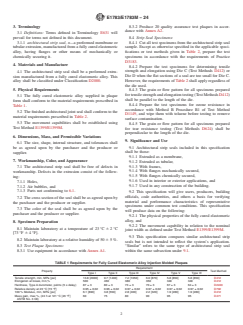
TABLE 1 Requirements for Fully Cured Elastomeric Alloy Injection Molded Plaques
Requirement
Property Test Method
Type I Type II Type III Type IV Type V Type VI
Tensile strength, min, MPa [psi] 13.8 [2000] 9.7 [1400] 7.2 [1050] 6.0 [870] 5.8 [850] 5.8 [850] D412
Elongation at break, min,% 500 460 380 350 340 340 D412
Hardness, Type A durometer, points (5 s delay) 87 ± 3 80 ± 3 73 ± 3 70 ± 3 67 ± 3 64 ± 3 D2240
Relative density at 23 °C [73 °F] 0.95 ± 0.02 0.96 ± 0.02 0.97 ± 0.02 0.97 ± 0.02 0.97 ± 0.02 0.97 ± 0.02 D792
100 % Modulus, min, MPa [psi] 6.1 [890] 3.8 [550] 2.8 [400] 2.2 [320] 1.9 [280] 1.9 [280] D412
Mass gain, max %, (24 h at 121 °C [23 °F] 60 75 80 90 95 95 D471
ASTM No. 3 Oil)
E1783/E1783M − 24
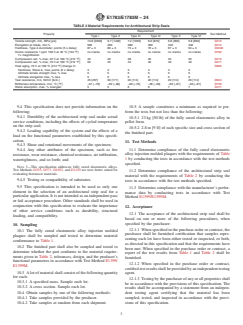
TABLE 2 Material Requirements for Architectural Strip Seals
Requirement
Property Test Method
Type I Type II Type III Type IV Type V Type VI
Tensile strength, min, MPa [psi] 13.8 [2000] 9.7 [1400] 7.2 [1050] 6.0 [870] 5.8 [850] 5.8 [850] D412
Elongation at break, min,% 500 460 380 350 340 340 D412
Hardness, Type A durometer, points (5 s delay) 87 ± 3 80 ± 3 73 ± 3 70 ± 3 67 ± 3 64 ± 3 D2240
Ozone resistance 1 ppm 100 h at 40 °C [104 °F] no cracks no cracks no cracks no cracks no cracks no cracks D792
7× magnification
Compression set, % max, 22 h at 100 °C [212 °F] 45 40 38 35 35 35 D412
Compression set, % max, 70 h at 100 °C [212 °F] 50 45 43 40 40 40 D471
Heat aging, 70 h at 100 °C [212 °F] change in: D865
Hardness, Shore A, max, points (5 s delay) 3 3 3 3 3 3
Ultimate tensile strength max, % loss 5 5 5 5 5 5
Ultimate elongation max, % loss 5 5 5 5 5 5
Tear resistance, min, N/mm [lb/in.] 45 [257] 30 [171] 20 [114] 20 [114] 20 [114] 20 [114] D624
Brittleness temperature, min, °C [°F] −61 [−78] −62 [−80] −60 [−76] −56 [−69] −63 [−81] −63 [−81] D746
Water absorption, max, % loss/gain 5 5 6 6 7 7 D471
9.4 This specification does not provide information on the 10.5 A sample constitutes a minimum as required to per-
following: form the tests but not less than the following:
9.4.1 Durabil
...
This document is not an ASTM standard and is intended only to provide the user of an ASTM standard an indication of what changes have been made to the previous version. Because
it may not be technically possible to adequately depict all changes accurately, ASTM recommends that users consult prior editions as appropriate. In all cases only the current version
of the standard as published by ASTM is to be considered the official document.
Designation: E1783/E1783M − 96 (Reapproved 2017) E1783/E1783M − 24
Standard Specification for
Preformed Architectural Strip Seals for Buildings and
Parking Structures
This standard is issued under the fixed designation E1783/E1783M; the number immediately following the designation indicates the year
of original adoption or, in the case of revision, the year of last revision. A number in parentheses indicates the year of last reapproval.
A superscript epsilon (´) indicates an editorial change since the last revision or reapproval.
1. Scope
1.1 This specification covers the physical requirements for the fully cured elastomeric alloy and the movement capabilities of
preformed architectural compression seals used for sealing expansion joints in buildings and parking structures. The preformed
architectural strip seal is an elastomeric extrusion. This extrusion is either a membrane or tubular having an internal baffle system
produced continuously and longitudinally throughout the material. These extrusions are secured in or over a joint by locking rails
or an end dam nosing material. The architectural strip seal is compressed and expanded by this mechanical or chemical attachment.
NOTE 1—Movement capability is defined in Test Method E1399/E1399M.
1.2 This specification covers all colors of architectural strip seals.
NOTE 2—The products described in this specification are manufactured from thermoplastic elastomers defined as “fully cured elastomeric alloys” in Test
Method D5048.
1.3 The values stated in either SI units or inch-pound units are to be regarded separately as standard. The values stated in each
system are not necessarily exact equivalents; therefore, to ensure conformance with the standard, each system shall be used
independently of the other, and values from the two systems shall not be combined.
1.4 This standard does not purport to address all of the safety concerns, if any, associated with its use. It is the responsibility
of the user of this standard to establish appropriate safety, health, and environmental practices and determine the applicability of
regulatory limitations prior to use.
1.5 This international standard was developed in accordance with internationally recognized principles on standardization
established in the Decision on Principles for the Development of International Standards, Guides and Recommendations issued
by the World Trade Organization Technical Barriers to Trade (TBT) Committee.
2. Referenced Documents
2.1 ASTM Standards:
D395 Test Methods for Rubber Property—Compression Set
D412 Test Methods for Vulcanized Rubber and Thermoplastic Elastomers—Tension
D471 Test Method for Rubber Property—Effect of Liquids
This specification is under the jurisdiction of ASTM Committee E06 on Performance of Buildings and is the direct responsibility of Subcommittee E06.21 on
Serviceability.
Current edition approved Sept. 1, 2017March 1, 2024. Published September 2017March 2024. Originally approved in 1996. Last previous edition approved in 20132017
ɛ1
as E1783 – 96 (2013)E1783/E1783M – 96 (2017). . DOI: 10.1520/E1783_E1783M-96R17.10.1520/E1783_E1783M-24.
For referenced ASTM standards, visit the ASTM website, www.astm.org, or contact ASTM Customer Service at service@astm.org. For Annual Book of ASTM Standards
volume information, refer to the standard’s Document Summary page on the ASTM website.
Copyright © ASTM International, 100 Barr Harbor Drive, PO Box C700, West Conshohocken, PA 19428-2959. United States
E1783/E1783M − 24
D518 Test Method for Rubber Deterioration—Surface Cracking (Withdrawn 2007)
D573 Test Method for Rubber—Deterioration in an Air Oven
D624 Test Method for Tear Strength of Conventional Vulcanized Rubber and Thermoplastic Elastomers
D746 Test Method for Brittleness Temperature of Plastics and Elastomers by Impact
D792 Test Methods for Density and Specific Gravity (Relative Density) of Plastics by Displacement
D865 Test Method for Rubber—Deterioration by Heating in Air (Test Tube Enclosure)
D1052 Test Method for Measuring Rubber Deterioration—Cut Growth Using Ross Flexing Apparatus
D1149 Test Methods for Rubber Deterioration—Cracking in an Ozone Controlled Environment
D2000 Classification System for Rubber Products in Automotive Applications
D2240 Test Method for Rubber Property—Durometer Hardness
D3183 Practice for Rubber—Preparation of Pieces for Test Purposes from Products
D5048 Test Method for Measuring the Comparative Burning Characteristics and Resistance to Burn-Through of Solid Plastics
Using a 125-mm Flame
E577 Guide for Dimensional Coordination of Rectilinear Building Parts and Systems (Withdrawn 2011)
E631 Terminology of Building Constructions
E1399/E1399M Test Method for Cyclic Movement and Measuring the Minimum and Maximum Joint Widths of Architectural
Joint Systems
3. Terminology
3.1 Definitions: Terms defined in Terminology E631 will prevail for terms not defined in this document.
3.1.1 architectural strip seal—seal, n—a preformed membrane or tubular extrusion, manufactured from a fully cured elastomeric
alloy, having flanges or other means of mechanically or chemically securing it.
3.1.1.1 Discussion—
Joint is defined in Guide E577.
4. Materials and Manufacture
4.1 The architectural strip seal shall be a preformed extrusion manufactured from a fully cured elastomeric alloy. This alloy shall
be classified under Classification D2000.
5. Physical Requirements
5.1 The fully cured elastomeric alloy supplied in plaque form shall conform to the material requirements prescribed in Table 1.
5.2 The finished architectural joint seal shall conform to the material requirements prescribed in Table 2.
5.3 The movement capabilities shall be established using Test Method E1399/E1399M.
6. Dimensions, Mass, and Permissible Variations
6.1 The size, shape, internal structure, and tolerances shall be as agreed upon by the purchaser and the producer or supplier.
7. Workmanship, Color, and Appearance
7.1 The architectural strip seal shall be free of defects in workmanship. Defects in the extrusion consist of the following:
TABLE 1 Requirements for Fully Cured Elastomeric Alloy Injection Molded Plaques
Requirement
Property Test Method
Type I Type II Type III Type IV Type V Type VI
Tensile strength, min, MPa [psi] 13.8 [2000] 9.7 [1400] 7.2 [1050] 6.0 [870] 5.8 [850] 5.8 [850] D412
Elongation at break, min,% 500 460 380 350 340 340 D412
Hardness, Type A durometer, points (5 s delay) 87 ± 3 80 ± 3 73 ± 3 70 ± 3 67 ± 3 64 ± 3 D2240
Relative density at 23 °C [73 °F] 0.95 ± 0.02 0.96 ± 0.02 0.97 ± 0.02 0.97 ± 0.02 0.97 ± 0.02 0.97 ± 0.02 D792
100 % Modulus, min, MPa [psi] 6.1 [890] 3.8 [550] 2.8 [400] 2.2 [320] 1.9 [280] 1.9 [280] D412
Mass gain, max %, (24 h at 121 °C [23 °F] 60 75 80 90 95 95 D471
ASTM No. 3 Oil)
E1783/E1783M − 24
TABLE 2 Material Requirements for Architectural Strip Seals
Requirement
Property Test Method
Type I Type II Type III Type IV Type V Type VI
Tensile strength, min, MPa [psi] 13.8 [2000] 9.7 [1400] 7.2 [1050] 6.0 [870] 5.8 [850] 5.8 [850] D412
Elongation at break, min,% 500 460 380 350 340 340 D412
Hardness, Type A durometer, points (5 s delay) 87 ± 3 80 ± 3 73 ± 3 70 ± 3 67 ± 3 64 ± 3 D2240
Ozone resistance 1 ppm 100 h at 40 °C [104 °F] no cracks no cracks no cracks no cracks no cracks no cracks D792
7× magnification
Compression set, % max, 22 h at 100 °C [212 °F] 45 40 38 35 35 35 D412
Compression set, % max, 70 h at 100 °C [212 °F] 50 45 43 40 40 40 D471
Heat aging, 70 h at 100 °C [212 °F] change in: D865
Hardness, Shore A, max, points (5 s delay) 3 3 3 3 3 3
Ultimate tensile strength max, % loss 5 5 5 5 5 5
Ultimate elongation max, % loss 5 5 5 5 5 5
Tear resistance, min, N/mm [lb/in.] 45 [257] 30 [171] 20 [114] 20 [114] 20 [114] 20 [114] D624
Brittleness temperature, min, °C [°F] −61 [−78] −62 [−80] −60 [−76] −56 [−69] −63 [−81] −63 [−81] D746
Water absorption, max, % loss/gain 5 5 6 6 7 7 D471
7.1.1 Holes,
7.1.2 Air bubbles, and
7.1.3 Parts not conforming to 6.1.
7.2 The cross section of the seal shall be as agreed upon by the purchaser and the producer or supplier.
7.3 The color of the seal shall be as agreed upon by the purchaser and the producer or supplier.
8. Specimen Preparation
8.1 Maintain laboratory at a temperature of 23 6 2 °C [73 6 4 °F].23 °C 6 2 °C [73 °F 6 4 °F].
8.2 Maintain laboratory at a relative humidity of 50 6 5 %.
8.3 Test Plaque Specimens:
8.3.1 Use equipment in accordance with Annex A1.
8.3.2 Produce 20 quality assurance test plaques in accordance with Annex A2.
8.4 Strip Seal Specimens:
8.4.1 Cut all test specimens from the architectural strip seal sample. Except as otherwise specified in the applicable specifications
or test methods given in Table 2, prepare the test specimens in accordance with the requirements of Practice D3183.
8.4.2 Prepare the test specimens for determining tensile strength and elongation using Die C (Test Methods D412) or Die D when
the flat sections of a seal are too small for Die C. However, the requirements of Table 2 shall apply regardless of the die used.
8.4.3 The grain or flow pattern for all specimens prepared for tensile strength and elongation testing (Test Methods D412) shall
be parallel to the length of the die.
8.4.4 Prepare the test specimens for ozone resistance in accordance with Procedure AMethod B Procedure B1 of Test Method
D518D1149, and wipe them with toluene before testing to remove surface contamination.
8.4.5 The grain or flow pattern for all specimens prepared for tear resistance testing (Test MethodMethods D624) shall be
perpendicular to the length of the die.
E1783/E1783M − 24
9. Significance and Use
9.1 Architectural strip seals included in this specification shall be those:
9.1.1 Extruded as a membrane,
9.1.2 Extruded as tubular,
9.1.3 With frames,
9.1.4 With flanges mechanically secured,
9.1.5 With flanges chemically secured,
9.1.6 Used in interior or exterior applications, and
9.1.7 Used in any construction of the building.
9.2 This specification will give users, producers, building officials, code authorities, and others a basis for verifying material and
performance characteristics of representative specimens under common test conditions. This specification will produce data on the
following:
9.2.1 The physical properties of the fully cured elastomeric alloy, and
9.2.2 The movement capability in relation to the nominal joint width as defined under Test Method E1399/E1399M.
9.3 This specification compares similar architectural strip seals but is not intended to reflect the system’s application. “Similar”
refers to the same type of architectural strip seal within the same subsection under 9.1.
9.4 This specification does not provide information on the fol
...