

ASTM F2417-23
(Specification)Standard Specification for Fire Safety for Candles
General Information
- Abstract
SCOPE
1.1 This specification is intended to prescribe minimum safety requirements for candles and candle ensembles to provide a reasonable degree of safety for normal use with candles, thereby improving personal safety and reducing fires, deaths, and injuries.
1.2 This specification is not intended to replace other important safety practices that should be in place, such as adult supervision, close monitoring, fire detection, alarm or suppression systems, and use of candles away from combustible materials.
1.3 This specification is used to measure and describe the response of materials, products, or assemblies to heat and flame under controlled conditions, but does not by itself incorporate all factors required for fire hazard or fire risk assessment of the materials, products, or assemblies under actual fire conditions.
1.4 This standard is used to predict or provide a quantitative measure of the fire hazard from a specified set of fire conditions involving specific materials, products, or assemblies. This assessment does not necessarily predict the hazard of actual fires which involve conditions other than those assumed in the analysis.
1.5 Fire testing is inherently hazardous. Adequate safeguards for personnel and property shall be employed in conducting these tests.
1.6 This specification states values in inch-pound units which are to be regarded as the standard. The values given in parenthesis are for information only.
1.7 This specification does not purport to address all of the safety concerns, if any, associated with its use. It is the responsibility of the user of this standard to establish appropriate safety, health, and environmental practices and determine the applicability of regulatory requirements prior to use.
1.8 This international standard was developed in accordance with internationally recognized principles on standardization established in the Decision on Principles for the Development of International Standards, Guides and Recommendations issued by the World Trade Organization Technical Barriers to Trade (TBT) Committee.
- Status
- Published
- Publication Date
- 31-Jul-2023
- Technical Committee
- F15 - Consumer Products
- Drafting Committee
- F15.45 - Candle Products
Overview
ASTM F2417-23: Standard Specification for Fire Safety for Candles is a key standard developed by ASTM International to improve the fire safety of candles and candle ensembles. This specification sets minimum safety requirements and test methods aimed at reducing fire hazards, personal injuries, and property damage associated with candle use. The document is applicable to various types of candles including freestanding, filled, tealight, religious/ceremonial, gel-containing candles, and candle-making kits.
By providing measurable criteria and clear testing procedures, ASTM F2417-23 supports manufacturers, retailers, and regulatory authorities in assessing and certifying fire safety features for candle products.
Key Topics
- Minimum Safety Requirements: Establishes strict limits for flame height, container integrity, stability, secondary ignition, flame impingement, wick behavior, and coatings.
- Test Procedures: Outlines methods for evaluating burning performance, stability on inclines, plastic container flammability, and more, all taking place under controlled, repeatable laboratory conditions.
- Product Classification: Defines candle types (e.g., freestanding, filled, tealight, votive, ceremonial, birthday, outdoor, and gel-containing), ensuring tailored safety protocols for each product segment.
- Candle Ensemble Safety: Provides guidance on evaluating accessories and kits, emphasizing complete consumer safety from assembly to end-of-useful-life.
- Terminology Standardization: Ensures uniform language for terms such as "burn cycle," "secondary ignition," "flame impingement," and "useful life."
Applications
ASTM F2417-23 is relevant across multiple stages of the candle supply chain and for various stakeholders:
- Manufacturers: Applies to product development, design, and quality assurance. Producers must ensure all new and existing candle products, including containers and coatings, meet the specified fire safety performance criteria. This includes testing for flame height, stability, and container integrity.
- Retailers and Importers: Useful for compliance verification and risk management when sourcing candle products from domestic and international suppliers.
- Testing Laboratories: Provides standardized test methods to evaluate fire safety, supporting third-party certification processes.
- Regulatory Agencies: Supports consumer product safety initiatives and hazard reduction policies by providing a recognized benchmark for candle fire safety.
- Consumers: Indirectly protects buyers by requiring strict safety measures for everyday and ceremonial candles, and by ensuring informative safety labeling through referenced standards.
Related Standards
ASTM F2417-23 references several complementary standards and codes:
- ASTM D92 & D93: Methods for determining flash points, critical for evaluating combustibility of candle ingredients.
- ASTM E136: Provides procedures for assessing material combustibility, relevant for validating noncombustible candle accessories.
- ASTM E176: Offers standardized fire terminology for clarity and consistency.
- ASTM F1972: Guide for terminology related to candles and accessories.
- ASTM F2058: Specification for candle fire safety labeling, supporting consumer awareness and hazard communication.
- NFPA 909: Code for the protection of cultural resources, applicable to religious and ceremonial candle use in sensitive environments.
Practical Value
ASTM F2417-23 advances candle fire safety by:
- Mitigating Fire Risks: Reduces the likelihood of candle-related fires, injuries, and property losses through comprehensive safety requirements and test procedures.
- Supporting Product Innovation: Facilitates safe development of new candle types, including gel-containing and various coated products.
- Enabling Global Compliance: Aligns with World Trade Organization recommendations, supporting international trade and interoperability.
- Enhancing Consumer Confidence: Ensures safer products reach the market, backed by standardized evaluation and clear safety labeling.
Keywords: candle fire safety, ASTM F2417-23, candle testing, flame height, candle standards, product safety, consumer protection, candle manufacturing, fire safety labeling, stability testing, gel candle safety.
Relations
- Effective Date
- 01-Mar-2024
- Effective Date
- 01-Feb-2024
- Effective Date
- 01-Jan-2024
- Effective Date
- 01-Aug-2020
- Refers
ASTM F1972-19 - Standard Guide for Terminology Relating to Candles and Associated Accessory Items - Effective Date
- 01-Apr-2019
- Effective Date
- 01-Feb-2019
- Effective Date
- 15-Dec-2018
- Effective Date
- 01-Mar-2018
- Effective Date
- 01-Nov-2016
- Refers
ASTM F1972-16 - Standard Guide for Terminology Relating to Candles and Associated Accessory Items - Effective Date
- 01-May-2016
- Effective Date
- 01-Jan-2016
- Effective Date
- 01-Aug-2015
- Effective Date
- 01-Aug-2015
- Effective Date
- 01-Feb-2015
- Effective Date
- 01-Oct-2014
Get Certified
Connect with accredited certification bodies for this standard

CIS Institut d.o.o.
Personal Protective Equipment (PPE) certification body. Notified Body NB-2890 for EU Regulation 2016/425 PPE.

Kiwa BDA Testing
Building and construction product certification.
Kmetijski inštitut Slovenije
Agricultural Institute of Slovenia. Soil testing, plant health, agricultural product analysis.
Sponsored listings
Frequently Asked Questions
ASTM F2417-23 is a technical specification published by ASTM International. Its full title is "Standard Specification for Fire Safety for Candles". This standard covers: SCOPE 1.1 This specification is intended to prescribe minimum safety requirements for candles and candle ensembles to provide a reasonable degree of safety for normal use with candles, thereby improving personal safety and reducing fires, deaths, and injuries. 1.2 This specification is not intended to replace other important safety practices that should be in place, such as adult supervision, close monitoring, fire detection, alarm or suppression systems, and use of candles away from combustible materials. 1.3 This specification is used to measure and describe the response of materials, products, or assemblies to heat and flame under controlled conditions, but does not by itself incorporate all factors required for fire hazard or fire risk assessment of the materials, products, or assemblies under actual fire conditions. 1.4 This standard is used to predict or provide a quantitative measure of the fire hazard from a specified set of fire conditions involving specific materials, products, or assemblies. This assessment does not necessarily predict the hazard of actual fires which involve conditions other than those assumed in the analysis. 1.5 Fire testing is inherently hazardous. Adequate safeguards for personnel and property shall be employed in conducting these tests. 1.6 This specification states values in inch-pound units which are to be regarded as the standard. The values given in parenthesis are for information only. 1.7 This specification does not purport to address all of the safety concerns, if any, associated with its use. It is the responsibility of the user of this standard to establish appropriate safety, health, and environmental practices and determine the applicability of regulatory requirements prior to use. 1.8 This international standard was developed in accordance with internationally recognized principles on standardization established in the Decision on Principles for the Development of International Standards, Guides and Recommendations issued by the World Trade Organization Technical Barriers to Trade (TBT) Committee.
SCOPE 1.1 This specification is intended to prescribe minimum safety requirements for candles and candle ensembles to provide a reasonable degree of safety for normal use with candles, thereby improving personal safety and reducing fires, deaths, and injuries. 1.2 This specification is not intended to replace other important safety practices that should be in place, such as adult supervision, close monitoring, fire detection, alarm or suppression systems, and use of candles away from combustible materials. 1.3 This specification is used to measure and describe the response of materials, products, or assemblies to heat and flame under controlled conditions, but does not by itself incorporate all factors required for fire hazard or fire risk assessment of the materials, products, or assemblies under actual fire conditions. 1.4 This standard is used to predict or provide a quantitative measure of the fire hazard from a specified set of fire conditions involving specific materials, products, or assemblies. This assessment does not necessarily predict the hazard of actual fires which involve conditions other than those assumed in the analysis. 1.5 Fire testing is inherently hazardous. Adequate safeguards for personnel and property shall be employed in conducting these tests. 1.6 This specification states values in inch-pound units which are to be regarded as the standard. The values given in parenthesis are for information only. 1.7 This specification does not purport to address all of the safety concerns, if any, associated with its use. It is the responsibility of the user of this standard to establish appropriate safety, health, and environmental practices and determine the applicability of regulatory requirements prior to use. 1.8 This international standard was developed in accordance with internationally recognized principles on standardization established in the Decision on Principles for the Development of International Standards, Guides and Recommendations issued by the World Trade Organization Technical Barriers to Trade (TBT) Committee.
ASTM F2417-23 is classified under the following ICS (International Classification for Standards) categories: 13.220.20 - Fire protection; 97.180 - Miscellaneous domestic and commercial equipment. The ICS classification helps identify the subject area and facilitates finding related standards.
ASTM F2417-23 has the following relationships with other standards: It is inter standard links to ASTM E136-24a, ASTM E136-24, ASTM E176-24, ASTM D93-20, ASTM F1972-19, ASTM E136-19, ASTM E176-18a, ASTM E176-18, ASTM E136-16a, ASTM F1972-16, ASTM E136-16, ASTM E176-15a, ASTM E176-15ae1, ASTM E176-15, ASTM E176-14c. Understanding these relationships helps ensure you are using the most current and applicable version of the standard.
ASTM F2417-23 is available in PDF format for immediate download after purchase. The document can be added to your cart and obtained through the secure checkout process. Digital delivery ensures instant access to the complete standard document.
Standards Content (Sample)
This international standard was developed in accordance with internationally recognized principles on standardization established in the Decision on Principles for the
Development of International Standards, Guides and Recommendations issued by the World Trade Organization Technical Barriers to Trade (TBT) Committee.
Designation: F2417 − 23
Standard Specification for
Fire Safety for Candles
This standard is issued under the fixed designation F2417; the number immediately following the designation indicates the year of
original adoption or, in the case of revision, the year of last revision. A number in parentheses indicates the year of last reapproval. A
superscript epsilon (´) indicates an editorial change since the last revision or reapproval.
1. Scope ization established in the Decision on Principles for the
Development of International Standards, Guides and Recom-
1.1 This specification is intended to prescribe minimum
mendations issued by the World Trade Organization Technical
safety requirements for candles and candle ensembles to
Barriers to Trade (TBT) Committee.
provide a reasonable degree of safety for normal use with
candles, thereby improving personal safety and reducing fires,
2. Referenced Documents
deaths, and injuries.
2.1 ASTM Standards:
1.2 This specification is not intended to replace other
D92 Test Method for Flash and Fire Points by Cleveland
important safety practices that should be in place, such as adult
Open Cup Tester
supervision, close monitoring, fire detection, alarm or suppres-
D93 Test Methods for Flash Point by Pensky-Martens
sion systems, and use of candles away from combustible
Closed Cup Tester
materials.
E136 Test Method for Assessing Combustibility of Materials
1.3 This specification is used to measure and describe the
Using a Vertical Tube Furnace at 750 °C
response of materials, products, or assemblies to heat and
E176 Terminology of Fire Standards
flame under controlled conditions, but does not by itself
F1972 Guide for Terminology Relating to Candles and
incorporate all factors required for fire hazard or fire risk
Associated Accessory Items
assessment of the materials, products, or assemblies under
F2058 Specification for Candle Fire Safety Labeling
actual fire conditions.
2.2 NFPA Standard:
1.4 This standard is used to predict or provide a quantitative
NFPA 909 Code for the Protection of Cultural Resources
measure of the fire hazard from a specified set of fire conditions
involving specific materials, products, or assemblies. This 3. Terminology
assessment does not necessarily predict the hazard of actual
3.1 Certain candle-related terminology is addressed in
fires which involve conditions other than those assumed in the
Guide F1972, and the reader is directed to that guide for
analysis.
definitions not found in 3.2. For definitions of terms associated
1.5 Fire testing is inherently hazardous. Adequate safe- with fire issues, see Terminology E176.
guards for personnel and property shall be employed in
3.2 Definitions: Candle Classification Terms:
conducting these tests.
3.2.1 candle, n—one or more combustible wicks supported
1.6 This specification states values in inch-pound units
by a material that constitutes a fuel which is solid, semi-solid,
which are to be regarded as the standard. The values given in or quasi-rigid at room temperature, 68 °F to 80 °F (20 °C to
parenthesis are for information only.
27 °C); it can also contain additives that are used for color,
scent, stability, or to modify the burning characteristics; the
1.7 This specification does not purport to address all of the
combined function of which is to sustain a light-producing
safety concerns, if any, associated with its use. It is the
flame.
responsibility of the user of this standard to establish appro-
priate safety, health, and environmental practices and deter- 3.2.2 candle-making kit, n—a set of ingredients and mate-
mine the applicability of regulatory requirements prior to use. rials packaged together that the end consumer uses to make a
1.8 This international standard was developed in accor- candle.
dance with internationally recognized principles on standard-
1 2
This specification is under the jurisdiction of ASTM Committee F15 on For referenced ASTM standards, visit the ASTM website, www.astm.org, or
Consumer Products and is the direct responsibility of Subcommittee F15.45 on contact ASTM Customer Service at service@astm.org. For Annual Book of ASTM
Candle Products. Standards volume information, refer to the standard’s Document Summary page on
Current edition approved Aug. 1, 2023. Published August 2023. Originally the ASTM website.
approved in 2002. Last previous edition approved in 2017 as F2417 – 17. DOI: Available from National Fire Protection Association (NFPA), 1 Batterymarch
10.1520/F2417-23. Park, Quincy, MA 02169-7471, http://www.nfpa.org.
Copyright © ASTM International, 100 Barr Harbor Drive, PO Box C700, West Conshohocken, PA 19428-2959. United States
F2417 − 23
3.2.2.1 Discussion—Not all materials necessary to make a 3.3.2 base material, n—the intended fuel source for the
candle are needed in a candle-making kit; for instance, fra- candle.
grance options may be sold separately.
3.3.3 burn cycle, n—the length of time a candle burns from
when it is lit to when it is manually extinguished or from when
3.2.3 extended use candle, n—a candle that is intended for
home use to be burned continuously for longer than 4 h, it is lit until it extinguishes on its own at end of useful life.
excluding tealight candles.
3.3.3.1 Discussion—Burn cycles for tealight candles are
until end of useful life; burn cycles for gel-containing candles
3.2.3.1 Discussion—Examples of extended use candles in-
are 8 h; burn cycles for extended use candles are as labeled or
clude religious candles, available to consumers, intended to be
intended; and burn cycles for all other candles are 4 h.
burned continuously for 24 h or multiple days.
3.3.4 burn time, n—the time a material supports sustained
3.2.4 filled candle, n—a candle produced and used within
flaming combustion after removal of the ignition source until
the same container or vessel.
all flaming ceases.
3.2.5 freestanding candle, n—a rigid candle that is intended
3.3.5 candle flashover, n—the condition where the base
to be burned outside a container and does not require a holder
material’s vapors ignite over the entire fuel pool.
to keep it upright, excluding votive candles.
3.3.6 coating—any material, other than wax based, which is
3.2.5.1 Discussion—Examples of freestanding candles in-
used to cover at least a portion of the candle.
clude pillar-shaped, column-shaped, and figurine candles.
3.3.6.1 Discussion—This material includes, but is not lim-
3.2.6 gel-containing candle, n—a candle where the primary
ited to, paint, glue, glitter, wood, plastic, or any other material
fuel is a liquid, such as mineral oil, terpene type chemicals, or
that is not wax-based (which is generally considered an
modified hydrocarbons that are not mineral oil based, which
overdip).
may or may not contain organic functional groups; it also
3.3.6.2 Discussion—Excludes product labeling on bottom
contains a chemical agent to increase the viscosity (thicken) to
a point where the candle has a quasi-rigid property. and any packaging meant to be removed prior to use.
3.3.7 diffusion flame, n—a type of flame where the fuel is
3.2.7 non-freestanding birthday candle, n—any candle or
not premixed with air or other oxygen source.
candle ensemble that does not include pyrotechnics and is
designed and marketed for use with birthday cakes and does
3.3.7.1 Discussion—Diffusion flames are typically red,
not comply with the applicable stability requirements.
yellow, or orange in color.
3.3.8 end of useful life, n—when the candle ceases to
3.2.7.1 Discussion—4.5 contains safety requirements for
support combustion and the candle flame(s) goes(go) out on its
stability.
own, as designed, and cannot be re-lit.
3.2.8 outdoor candle, n—a candle intended to be burned
3.3.9 ensemble, n—a candle and items physically packaged
outdoors.
together and intended for use with the candle for sale as one
3.2.9 religious/ceremonial candle, n—a candle that is pre-
unit at the retail level.
dominantly intended, constructed, packaged, and labeled for
3.3.10 flame height, n—the length of the candle flame from
use in a public venue during a religious or similar ceremony.
the base to the tip.
3.2.9.1 Discussion—Candles such as an Easter, Paschal,
3.3.11 flame impingement, n—the situation where the flame
sacramental, or altar (or some combination, for example
makes contact with a surface.
Easter/Paschal), generally 17 in. (43 cm) or more in length are
considered religious/ceremonial candles. These candles are 3.3.11.1 Discussion—Within this standard, the concern is
generally displayed and burned in the place of worship as the when a freestanding candle flame impinges on the supporting
focal candle during a ceremony, service, or event. These surface at the end of useful life.
candles may be adorned with symbols and ornamentation as 3.3.12 fuel pool, n—pool of molten base material.
required and deemed appropriate.
3.3.13 noncombustible, adj—not capable of igniting and
3.2.10 tealight candle, n—a cylindrical filled candle pro-
burning when subjected to a fire under specified conditions.
duced with a diameter and height of approximately 1.5 in. (38
3.3.13.1 Discussion—Materials that are reported as passing
mm) and 0.75 in. (19 mm) respectively.
Test Method E136 are considered noncombustible.
3.2.11 votive candle, n—a candle produced for use fully
3.3.14 place of worship, n—any building that functions
within a candle accessory, specifically, a votive holder.
primarily as a group meeting place for the practice of religion
3.3 Definitions: General Terms:
(see NFPA 909).
3.3.1 barrier technology, n—a functional design element of
3.3.14.1 Discussion—This includes, but is not limited to,
a candle accessory that minimizes the risk of the flame
churches, synagogues, cathedrals, temples, mosques, and meet-
spreading to combustible components of the candle accessory
ing halls.
as a result of foreseeable misuse or failure of the candle.
3.3.15 secondary ignition, n—a self-sustained flame other
3.3.1.1 Discussion—Examples include a durable, noncom- than that on the intended wick(s) that occurs during candle use,
bustible wall, or space absent of combustible objects. including candle flashover.
F2417 − 23
3.3.15.1 Discussion—If a wick curls over during the burn- 4.5.3.1 Freestanding candles shall not tip over on a level
ing of the candle such that the wick and the tip are both surface.
touching the melt pool but the wick only has one flame it is not
4.6 Safety Requirements for Plastic Containers:
to be interpreted as secondary ignition unless two or more
4.6.1 This requirement applies to all plastic containers used
separate flames can be distinguished on the same wick.
for candles. See X1.6.
3.3.16 self-sustained flame, n—a flame that continues to
4.6.2 Performance Requirement—When tested in accor-
burn until the fuel source is removed or depleted or requires
dance with the test method in 5.4:
manual extinguishing.
4.6.2.1 The total burn time for the ten plastic containers
3.3.17 useful life—total length of time a candle burns.
shall be less than or equal to 300 s.
4.6.2.2 No single burn time of a plastic container shall
3.3.18 wick, n—an object that delivers fuel to a flame
exceed 30 s.
through the process of capillary action.
4.6.2.3 No single plastic container shall be completely
4. Safety Requirements
consumed during testing.
4.1 Safety Requirements for Flame Height:
4.7 Safety Requirements for Coatings on Candles:
4.1.1 This safety requirement applies to all candles except
4.7.1 This safety requirement applies to all candles which
outdoor candles. See X1.1.
contain a coating (such as a painted surface) except non-
4.1.2 Performance Requirement—When tested in accor-
freestanding birthday candles, religious/ceremonial candles,
dance with test method in 5.2:
and filled candles where there is a noncombustible material,
4.1.2.1 Except as listed in 4.1.2.2, candle flame heights shall
such as glass, between the flame and the coated surface. See
not exceed 3.0 in. (76 mm).
X1.7.
4.1.2.2 Religious/ceremonial candle flame heights shall not
4.7.2 Performance Requirement—When a minimum of 24
exceed 3 ⁄4 in. (95 mm).
identical candles are tested in accordance with the test method
4.2 Safety Requirement for Candle Container Integrity:
in 5.2:
4.2.1 This safety requirement applies to filled candles, 4.7.2.1 Candle flame heights shall not exceed 3.0 in.
including tealights. See X1.2.
(76 mm), 4.1.2.1.
4.2.2 Performance Requirement—When tested in accor-
4.7.2.2 Secondary ignition shall not occur, 4.3.
dance with the test method in 5.2:
4.7.2.3 Freestanding candle flames shall not impinge on the
4.2.2.1 The container shall not crack or break.
supporting surface, 4.4.
4.7.2.4 Freestanding candles shall not tip over on a level
4.3 Safety Requirements for Secondary Ignition:
surface, 4.5.3.
4.3.1 This safety requirement applies to all candles and
ensembles except religious/ceremonial candles and non-
NOTE 1—There is no data to indicate that coatings on the exterior or
freestanding birthday candles. See X1.3.
filled containers are a concern; therefore they are excluded from the
coatings on candles requirements.
4.3.2 Performance Requirement—When tested in accor-
dance with the test method in 5.2.
4.8 Safety Requirements for Wick Migration and Wick
4.3.2.1 Secondary ignition shall not occur.
Leaning:
4.8.1 This requirement applies to all filled candles.
4.4 Safety Requirements for Flame Impingement:
4.8.2 Performance Requirement—When tested in accor-
4.4.1 This safety requirement applies to freestanding
dance with the test method in 5.2:
candles. See X1.4.
4.8.2.1 For all filled candles, the wick(s) of the candle shall
4.4.2 Performance Requirement—When tested in accor-
not migrate or lean from their original position such that the
dance with the test method in 5.2:
flame on a wick makes contact with the container for longer
4.4.2.1 Candle flames shall not impinge on the supporting
than a 5 s duration.
surface.
4.8.2.2 For multiple wick candles, the wicks of the candle
4.5 Safety Requirements for Stability:
shall not migrate or lean from their original positions such that
4.5.1 This safety requirement applies to freestanding
2 or more wicks come close enough to form a single flame for
candles and filled candles, including tealight candles and
longer than a 5 s duration.
ensembles. See X1.5.
4.5.2 Performance Requirement Before Burning—When
5. Test Methods
tested in accordance with the test method in 5.3:
4.5.2.1 Freestanding and filled including tealight candles 5.1 General:
5.1.1 These test methods are intended to monitor candle fire
and ensembles shall not tip over when placed at a 10.0° (–0.0°
/ +0.5°) incline from horizontal. safety issues including flame height, container integrity, sec-
ondary ignition, flame impingement, stability, and coating and
4.5.2.2 Asymmetrical candles and ensembles shall not tip
over when placed at a 10.0° (–0.0° / +0.5°) incline from container flammability.
5.1.2 Safety Hazards—Warning—There is an inherent risk
horizontal at any position when rotated around the vertical
axis. of working with and around open flames.
4.5.3 Performance Requirement While Burning—When 5.1.2.1 Use appropriate personal protective equipment and
tested in accordance with the test method in 5.2. practices that ensure a safe work environment.
F2417 − 23
5.1.2.2 Keep fire suppression equipment nearby that is
capable of mitigating fires associated with candle fire safety
testing.
5.1.3 Precision and Bias—No information is presented
about the precision or bias for any of the test methods in
Section 5.
5.2 Candle Burning Performance Test:
5.2.1 Summary of Test Method—Trim candle wicks if nec-
essary. Light candles and observe for flame height, container
FIG. 1 Flame Measurement Diagram
integrity, secondary ignition, flame impingement, and free-
standing candle stability at specified periods and record at the
end of each burn interval.
5.2.2 Apparatus:
5.2.2.1 Noncombustible measuring device graduated in 5.2.3.10 At the end of burn cycle, extinguish the candle and
inches (millimeters),
allow to cool.
5.2.3.11 Repeat 5.2.3.5 – 5.2.3.10 until the candle reaches
5.2.2.2 Candle holder/glass (if applicable),
the end of useful life.
5.2.2.3 Lighter, matches, or other source of ignition,
5.2.4 Record and Report Any Failure for:
5.2.2.4 Test surface-level, and
5.2.4.1 Maximum flame height, 4.1.
5.2.2.5 Wick-trimming device.
5.2.4.2 Container integrity, 4.2.
5.2.3 Procedure:
5.2.4.3 Secondary ignition, 4.3.
5.2.3.1 Remove all outer wrapping. Remove label(s) in
5.2.4.4 Flame impingement on the supporting surface, 4.4.
accordance with label instructions before initiating the burn
5.2.4.5 Freestanding candle stability, 4.5.3.
test.
5.3 Stability Test Method:
5.2.3.2 Keep the burn test area environmentally controlled
to 68 °F to 86 °F (20 °C to 30 °C) with minimal disturbance of 5.3.1 Summary of Test Method—Place candles and en-
the flames under test. Minimize drafts since they affect flame sembles on a 10° incline to determine if they remain in a stable,
heights. upright position without tipping over.
5.3.2 Apparatus:
5.2.3.3 Place candles at least 7 ⁄8 in. (20 cm) apart, mea-
5.3.2.1 An incline plane, fixed or adjustable, capable of
sured sidewall to sidewall, on test surface.
achieving a 10.0° (–0.0° / +0.5°) incline from horizontal. The
5.2.3.4 Test 24 identical candles when the candle has a
incline plane may use a stop with a maximum height of ⁄4 in.
coating on the exterior that is not separated from the flame of
(64 mm) to help prevent the candle accessory from slipping
the candle by barrier technology, see 4.7.
during this test.
5.2.3.5 Place candles with the wicks in a straight/upright
5.3.3 Procedure:
position. When appropriate, place candles in a holder and trim
5.3.3.1 Remove all outer wrapping. Remove label(s) in
wicks in accordance with the label. If no instructions are
accordance with label instructions.
provided, do not trim the candle wicks.
5.3.3.2 Place the prepared, unlit candle, or assembled en-
5.2.3.6 Light candles and avoid contaminating them with
semble on an incline apparatus in the orientation most likely to
carbon or debr
...
This document is not an ASTM standard and is intended only to provide the user of an ASTM standard an indication of what changes have been made to the previous version. Because
it may not be technically possible to adequately depict all changes accurately, ASTM recommends that users consult prior editions as appropriate. In all cases only the current version
of the standard as published by ASTM is to be considered the official document.
Designation: F2417 − 17 F2417 − 23
Standard Specification for
Fire Safety for Candles
This standard is issued under the fixed designation F2417; the number immediately following the designation indicates the year of
original adoption or, in the case of revision, the year of last revision. A number in parentheses indicates the year of last reapproval. A
superscript epsilon (´) indicates an editorial change since the last revision or reapproval.
1. Scope
1.1 This specification is intended to prescribe minimum safety requirements for candles and candle ensembles to provide a
reasonable degree of safety for normal use with candles, thereby improving personal safety and reducing fires, deaths, and injuries.
1.2 This specification is not intended to replace other important safety practices that should be in place, such as adult supervision,
close monitoring, fire detection, alarm or suppression systems, and use of candles away from combustible materials.
1.3 This specification is used to measure and describe the response of materials, products, or assemblies to heat and flame under
controlled conditions, but does not by itself incorporate all factors required for fire hazard or fire risk assessment of the materials,
products, or assemblies under actual fire conditions.
1.4 This standard is used to predict or provide a quantitative measure of the fire hazard from a specified set of fire conditions
involving specific materials, products, or assemblies. This assessment does not necessarily predict the hazard of actual fires which
involve conditions other than those assumed in the analysis.
1.5 Fire testing is inherently hazardous. Adequate safeguards for personnel and property shall be employed in conducting these
tests.
1.6 This specification states values in inch-pound units which are to be regarded as the standard. The values given in parenthesis
are for information only.
1.7 This specification does not purport to address all of the safety concerns, if any, associated with its use. It is the responsibility
of the user of this standard to establish appropriate safety, health, and environmental practices and determine the applicability of
regulatory requirements prior to use.
1.8 This international standard was developed in accordance with internationally recognized principles on standardization
established in the Decision on Principles for the Development of International Standards, Guides and Recommendations issued
by the World Trade Organization Technical Barriers to Trade (TBT) Committee.
2. Referenced Documents
2.1 ASTM Standards:
D92 Test Method for Flash and Fire Points by Cleveland Open Cup Tester
This specification is under the jurisdiction of ASTM Committee F15 on Consumer Products and is the direct responsibility of Subcommittee F15.45 on Candle Products.
Current edition approved Oct. 1, 2017Aug. 1, 2023. Published October 2017August 2023. Originally approved in 2002. Last previous edition approved in 20162017 as
F2417 – 16.F2417 – 17. DOI: 10.1520/F2417-17.10.1520/F2417-23.
For referenced ASTM standards, visit the ASTM website, www.astm.org, or contact ASTM Customer Service at service@astm.org. For Annual Book of ASTM Standards
volume information, refer to the standard’s Document Summary page on the ASTM website.
Copyright © ASTM International, 100 Barr Harbor Drive, PO Box C700, West Conshohocken, PA 19428-2959. United States
F2417 − 23
D93 Test Methods for Flash Point by Pensky-Martens Closed Cup Tester
E136 Test Method for Assessing Combustibility of Materials Using a Vertical Tube Furnace at 750 °C
E176 Terminology of Fire Standards
F1972 Guide for Terminology Relating to Candles and Associated Accessory Items
F2058 Specification for Candle Fire Safety Labeling
2.2 NFPA Standard:
NFPA 909 Code for the Protection of Cultural Resources
3. Terminology
3.1 Certain candle-related terminology is addressed in Guide F1972, and the reader is directed to that guide for definitions not
found in 3.2. For definitions of terms associated with fire issues, see Terminology E176.
3.2 Definitions: Candle Classification Terms:
3.2.1 candle, n—one or more combustible wicks supported by a material that constitutes a fuel which is solid, semi-solid, or
quasi-rigid at room temperature, 68 to 80°F (20 to 27°C);68 °F to 80 °F (20 °C to 27 °C); it can also contain additives that are used
for color, scent, stability, or to modify the burning characteristics; the combined function of which is to sustain a light-producing
flame.
3.2.2 candle-making kit, n—a set of ingredients and materials packaged together that the end consumer uses to make a candle.
3.2.2.1 Discussion—
Not all materials necessary to make a candle are needed in a candle-making kit; for instance, fragrance options may be sold
separately.
3.2.3 extended use candle, n—a candle that is intended for home use to be burned continuously for longer than 4 hours, 4 h,
excluding tealight candles.
3.2.3.1 Discussion—
Examples of extended use candles include religious candles, available to consumers, intended to be burned continuously for 24
hours 24 h or multiple days.
3.2.4 filled candle, n—a candle produced and used within the same container or vessel.
3.2.5 freestanding candle, n—a rigid candle that is intended to be burned outside a container and does not require a holder to keep
it upright, excluding votive candles.
3.2.5.1 Discussion—
Examples of freestanding candles include pillar-shaped, column-shaped, and figurine candles.
3.2.6 gel-containing candle, n—a candle where the primary fuel is a liquid, such as mineral oil, terpene type chemicals, or
modified hydrocarbons that are not mineral oil based, which may or may not contain organic functional groups; it also contains
a chemical agent to increase the viscosity (thicken) to a point where the candle has a quasi-rigid property.
3.2.7 non-freestanding birthday candle, n—any candle or candle ensemble that does not include pyrotechnics and is designed and
marketed for use with birthday cakes and does not comply with the applicable stability requirements.
3.2.7.1 Discussion—
4.5 contains safety requirements for stability.
3.2.8 outdoor candle, n—a candle intended to be burned outdoors.
3.2.9 religious/ceremonial candle, n—a candle that is predominantly intended, constructed, packaged, and labeled for use in a
public venue during a religious or similar ceremony.
3.2.9.1 Discussion—
Candles such as an Easter, Paschal, sacramental, or altar (or some combination, for example Easter/Paschal), generally 17 in. (43
Available from National Fire Protection Association (NFPA), 1 Batterymarch Park, Quincy, MA 02269-9101.02169-7471, http://www.nfpa.org.
F2417 − 23
cm) or more in length are considered religious/ceremonial candles. These candles are generally displayed and burned in the place
of worship as the focal candle during a ceremony, service, or event. These candles may be adorned with symbols and
ornamentation as required and deemed appropriate.
3.2.10 tealight candle, n—a cylindrical filled candle produced with a diameter and height of approximately 1.5 in. (38 mm) and
0.75 in. (19 mm) respectively.
3.2.11 votive candle, n—a candle produced for use fully within a candle accessory, specifically, a votive holder.
3.3 Definitions: General Terms:
3.3.1 barrier technology, n—a functional design element of a candle accessory that minimizes the risk of the flame spreading to
combustible components of the candle accessory as a result of foreseeable misuse or failure of the candle.
3.3.1.1 Discussion—
Examples include a durable, noncombustible wall, or space absent of combustible objects.
3.3.2 base material, n—the intended fuel source for the candle.
3.3.3 burn cycle, n—the length of time a candle burns from when it is lit to when it is manually extinguished or from when it is
lit until it extinguishes on its own at end of useful life.
3.3.3.1 Discussion—
Burn cycles for tealight candles are until end of useful life; burn cycles for gel-containing candles are 8 h; burn cycles for extended
use candles are as labeled or intended; and burn cycles for all other candles are 4 h.
3.3.4 burn time, n—the time a material supports sustained flaming combustion after removal of the ignition source until all flaming
ceases.
3.3.5 candle flashover, n—the condition where the base material’s vapors ignite over the entire fuel poolpool.
3.3.6 coating—any material, other than wax based, which is used to cover at least a portion of the candle.
3.3.6.1 Discussion—
This material includes, but is not limited to, paint, glue, glitter, wood, plastic, or any other material that is not wax-based (which
is generally considered an overdip).
3.3.6.2 Discussion—
Excludes product labeling on bottom and any packaging meant to be removed prior to use.
3.3.7 diffusion flame, n—a type of flame where the fuel is not premixed with air or other oxygen source.
3.3.7.1 Discussion—
Diffusion flames are typically red, yellow, or orange in color.
3.3.8 end of useful life, n—when the candle ceases to support combustion and the candle flame(s) goes(go) out on its own, as
designed, and cannot be re-lit.
3.3.9 ensemble, n—a candle and items physically packaged together and intended for use with the candle for sale as one unit at
the retail level.
3.3.10 flame height, n—the length of the candle flame from the base to the tip.
3.3.11 flame impingement, n—the situation where the flame makes contact with a surface.
3.3.11.1 Discussion—
Within this standard, the concern is when a freestanding candle flame impinges on the supporting surface at the end of useful life.
3.3.12 fuel pool, n—pool of molten base material.
F2417 − 23
3.3.13 noncombustible, adj—not capable of igniting and burning when subjected to a fire under specified conditions.
3.3.13.1 Discussion—
Materials that are reported as passing Test Method E136 are considered noncombustible.
3.3.14 place of worship, n—any building that functions primarily as a group meeting place for the practice of religion (see NFPA
909).
3.3.14.1 Discussion—
This includes, but is not limited to, churches, synagogues, cathedrals, temples, mosques, and meeting halls.
3.3.15 secondary ignition, n—a self-sustained flame other than that on the intended wick(s) that occurs during candle use,
including candle flashover.
3.3.15.1 Discussion—
If a wick curls over during the burning of the candle such that the wick and the tip are both touching the melt pool but the wick
only has one flame it is not to be interpreted as secondary ignition unless two or more separate flames can be distinguished on the
same wick.
3.3.16 self-sustained flame, n—a flame that continues to burn until the fuel source is removed or depleted or requires manual
extinguishing.
3.3.17 useful life—total length of time a candle burns.
3.3.18 wick, n—an object that delivers fuel to a flame through the process of capillary action.
4. Safety Requirements
4.1 Safety Requirements for Flame Height:
4.1.1 This safety requirement applies to all candles except outdoor candles. See X1.1.
4.1.2 Performance Requirement—When tested in accordance with test method in 5.2:
4.1.2.1 Except as listed in 4.1.2.2, candle flame heights shall not exceed 3.0 in. (76 mm).
4.1.2.2 Religious/ceremonial candle flame heights shall not exceed 3 ⁄4 in. (95 mm).
4.2 Safety Requirement for Candle Container Integrity:
4.2.1 This safety requirement applies to filled candles, including tealights. See X1.2.
4.2.2 Performance Requirement—When tested in accordance with the test method in 5.2:
4.2.2.1 The container shall not crack or break.
4.3 Safety Requirements for Secondary Ignition:
4.3.1 This safety requirement applies to all candles and ensembles except religious/ceremonial candles and non-freestanding
birthday candles. See X1.3.
4.3.2 Performance Requirement—When tested in accordance with the test method in 5.2.
4.3.2.1 Secondary ignition shall not occur.
4.4 Safety Requirements for Flame Impingement:
F2417 − 23
4.4.1 This safety requirement applies to freestanding candles. See X1.4.
4.4.2 Performance Requirement—When tested in accordance with the test method in 5.2:
4.4.2.1 Candle flames shall not impinge on the supporting surface.
4.5 Safety Requirements for Stability:
4.5.1 This safety requirement applies to freestanding candles and filled candles, including tealight candles and ensembles. See
X1.5.
4.5.2 Performance Requirement Before Burning—When tested in accordance with the test method in 5.3:
4.5.2.1 Freestanding and filled including tealight candles and ensembles shall not tip over when placed at a 10.0° (–0.0° / +0.5°)
incline from horizontal.
4.5.2.2 Asymmetrical candles and ensembles shall not tip over when placed at a 10.0° (–0.0° / +0.5°) incline from horizontal at
any position when rotated around the vertical axis.
4.5.3 Performance Requirement While Burning—When tested in accordance with the test method in 5.2.
4.5.3.1 Freestanding candles shall not tip over on a level surface.
4.6 Safety Requirements for Plastic Containers:
4.6.1 This requirement applies to all plastic containers used for candles. See X1.6.
4.6.2 Performance Requirement—When tested in accordance with the test method in 5.4:
4.6.2.1 The total burn time for the ten plastic containers shall be less than or equal to 300 s.
4.6.2.2 No single burn time of a plastic container shall exceed 30 s.
4.6.2.3 No single plastic container shall be completely consumed during testing.
4.7 Safety Requirements for Coatings on Candles:
4.7.1 This safety requirement applies to all candles which contain a coating (such as a painted surface) except non-freestanding
birthday candles, religious/ceremonial candles, and filled candles where there is a noncombustible material, such as glass, between
the flame and the coated surface. See X1.7.
4.7.2 Performance Requirement—When a minimum of 24 identical candles are tested in accordance with the test method in 5.2:
4.7.2.1 Candle flame heights shall not exceed 3.0 in. (76 mm), (76 mm), 4.1.2.1.
4.7.2.2 Secondary ignition shall not occur, 4.3.
4.7.2.3 Freestanding candle flames shall not impinge on the supporting surface, 4.4.
4.7.2.4 Freestanding candles shall not tip over on a level surface, 4.5.3.
NOTE 1—There is no data to indicate that coatings on the exterior or filled containers are a concern; therefore they are excluded from the coatings on
candles requirements.
4.8 Safety Requirements for Wick Migration and Wick Leaning:
F2417 − 23
4.8.1 This requirement applies to all filled candles.
4.8.2 Performance Requirement—When tested in accordance with the test method in 5.2:
4.8.2.1 For all filled candles, the wick(s) of the candle shall not migrate or lean from their original position such that the flame
on a wick makes contact with the container for longer than a 5 s duration.
4.8.2.2 For multiple wick candles, the wicks of the candle shall not migrate or lean from their original positions such that 2 or
more wicks come close enough to form a single flame for longer than a 5 s duration.
5. Test Methods
5.1 General:
5.1.1 These test methods are intended to monitor candle fire safety issues including flame height, container integrity, secondary
ignition, flame impingement, stability, and coating and container flammability.
5.1.2 Safety Hazards—Warning—There is an inherent risk of working with and around open flames.
5.1.2.1 Use appropriate personal protective equipment and practices that ensure a safe work environment.
5.1.2.2 Keep fire suppression equipment nearby that is capable of mitigating fires associated with candle fire safety testing.
5.1.3 Precision and Bias—No information is presented about the precision or bias for any of the test methods in Section 5.
5.2 Candle Burning Performance Test:
5.2.1 Summary of Test Method—Trim candle wicks if necessary. Light candles and observe for flame height, container integrity,
secondary ignition, flame impingement, and freestanding candle stability at specified periods and record at the end of each burn
interval.
5.2.2 Apparatus:
5.2.2.1 Noncombustible measuring device graduated in inches (millimeters),
5.2.2.2 Candle holder/glass (if applicable),
5.2.2.3 Lighter, matches, or other source of ignition,
5.2.2.4 Test surface-level, and
5.2.2.5 Wick-trimming device.
5.2.3 Procedure:
5.2.3.1 Remove all outer wrapping. Remove label(s) in accordance with label instructions before initiating the burn test.
5.2.3.2 Keep the burn test area environmentally controlled to 68 to 86°F (20 to 30°C)68 °F to 86 °F (20 °C to 30 °C) with minimal
disturbance of the flames under test. Minimize drafts since they affect flame heights.
5.2.3.3 Place candles at least 7 ⁄8 in. (20 cm) apart, measured sidewall to sidewall, on test surface.
5.2.3.4 Test 24 identical candles when the candle has a coating on the exterior that is not separated from the flame of the candle
by barrier technology, see 4.7.
5.2.3.5 Place candles with the wicks in a straight/upright position. When appropriate, place candles in a holder and trim wicks in
accordance with the label. If no instructions are provided, do not trim the candle wicks.
F2417 − 23
5.2.3.6 Light candles and avoid contaminating them with carbon or debris from the ignition surface.
5.2.3.7 Burn tealight candles and tealight ensembles to their end of useful life in one continuous burn. Burn gel-containing candles
for 8 h. Burn extended use candles for the prescribed length of time. Burn all other candles for 4 h.
5.2.3.8 Make visual observations after initial lighting and at least hourly intervals throughout the entire burn cycle. Measure and
record the flame height and the time of occurrence if a flame height appears to approach the maximum allowable flame height.
5.2.3.9 Measure and record flame height a minimum of every 4 h. For candles whose intended product life is less than 8 h, measure
and record the flame height a minimum of two times before the end of useful life. Measure flame with a nonflammable measuring
device. Carefully place the measuring device as close as possible behind the flame without disturbing the flame. Allow flame to
stabilize. Hold the measuring device in place for 5 s and record a maximum value (undisturbed flame). Measure the flame height
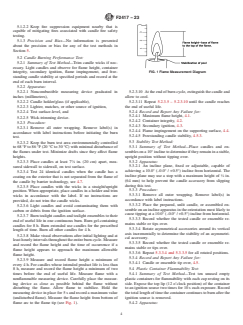
from bottom of flame arc to the flame tip (see Fig. 1).
5.2.3.10 At the end of burn cycle, extinguish the candle and allow to cool.
5.2.3.11 Repeat 5.2.3.5 – 5.2.3.10 until the candle re
...