

ASTM D5337-23
(Practice)Standard Practice for Setting and Verifying the Flow Rate of Personal Sampling Pumps
General Information
- Abstract
SIGNIFICANCE AND USE
5.1 Most occupational exposure assessment methods require the use of personal sampling pumps to collect air samples at typical sampling flow rates, with sampling volumes specified by (a) particular procedure(s). The precision and bias of these methods are directly affected by the precision and bias of the pumps used in the measurement of the air volume(s) sampled.
SCOPE
1.1 This practice describes the setting and verification of flow rate for sampling pumps commonly used for monitoring personal airborne exposures in the workplace.
1.2 This practice includes procedures for using working standard flow meters that are traceable to national or international standards, as well as those that are not. Traceable standards are preferred.
1.3 The values stated in SI units are to be regarded as standard. No other units of measurement are included in this standard.
1.4 This standard does not purport to address all of the safety concerns, if any, associated with its use. It is the responsibility of the user of this standard to establish appropriate safety, health, and environmental practices and determine the applicability of regulatory limitations prior to use.
1.5 This international standard was developed in accordance with internationally recognized principles on standardization established in the Decision on Principles for the Development of International Standards, Guides and Recommendations issued by the World Trade Organization Technical Barriers to Trade (TBT) Committee.
- Status
- Published
- Publication Date
- 30-Apr-2023
- Technical Committee
- D22 - Air Quality
- Drafting Committee
- D22.04 - Workplace Air Quality
Buy Documents
ASTM D5337-23 - Standard Practice for Setting and Verifying the Flow Rate of Personal Sampling Pumps
REDLINE ASTM D5337-23 - Standard Practice for Setting and Verifying the Flow Rate of Personal Sampling Pumps
Overview
ASTM D5337-23: Standard Practice for Setting and Verifying the Flow Rate of Personal Sampling Pumps specifies procedures for calibrating, setting, and verifying the flow rate of personal air sampling pumps in workplace environments. These pumps are essential tools in occupational exposure assessment, ensuring accurate collection of airborne contaminants for workplace air quality evaluation. The standard outlines best practices to maintain the precision and reliability of sampling equipment through traceable calibration methods and documentation.
By adhering to ASTM D5337-23, organizations can ensure that their air sampling results are accurate and reliable, supporting compliance with occupational health regulations and improving the protection of worker health.
Key Topics
- Flow Rate Calibration: Detailed steps for calibrating and verifying the flow rate of personal sampling pumps before and after workplace air sampling.
- Working Standard Flow Meters: Instructions for using both traceable and non-traceable working standard flow meters, with a preference for traceable devices.
- Traceability and Accreditation: Recommendations for ensuring calibration traceability to national or international standards, and the use of accredited laboratories.
- Measurement Devices: Guidance on implementing a variety of flow meters, such as bubble burettes, electronic near-frictionless piston meters, rotameters, and mass flow meters, for accurate volume measurements.
- Primary and Secondary Calibration: Procedures for both primary (traceable) and secondary (field) calibration devices, including establishment of calibration graphs.
- Quality Control: Requirements for pre- and post-sampling flow rate checks to identify potential deviations and ensure sampling integrity.
- Safety and Compliance: Emphasis on user responsibility in establishing proper safety, health, and environmental practices while applying the standard.
Applications
ASTM D5337-23 is crucial for a range of occupational hygiene and industrial hygiene applications:
- Workplace Air Monitoring: Ensures correct air sampling flow rates for accurate assessment of exposure to hazardous substances like dusts, fumes, vapors, and gases.
- Regulatory Compliance: Supports organizations in meeting occupational exposure limit requirements, and in preparing for regulatory inspections.
- Sampling Equipment Maintenance: Provides a consistent procedure for routine calibration, verification, and maintenance of personal sampling pumps to improve data quality.
- Health and Safety Programs: Enables professionals to establish reliable exposure monitoring programs that protect worker health and safety.
- Industrial and Laboratory Settings: Standardizes calibration procedures across different environments, from field sites to analytical laboratories, ensuring comparability of results.
Related Standards
The practice described in ASTM D5337-23 is closely linked or referenced by several international and national standards, facilitating comprehensive air monitoring strategies:
- ASTM D1356: Terminology Relating to Sampling and Analysis of Atmospheres
- ASTM D4532: Test Method for Respirable Dust in Workplace Atmospheres Using Cyclone Samplers
- ISO 13137: Workplace atmospheres - Pumps for personal sampling of chemical and biological agents - Requirements and test methods
- ISO/IEC 17025: General requirements for the competence of testing and calibration laboratories
- NIOSH NMAM 0600: Guidance for air sampling and analytical procedures (National Institute for Occupational Safety and Health)
- OSHA Analytical Methods Manual & Technical Manual: Comprehensive references for occupational air sampling standards
Keywords: ASTM D5337, personal sampling pumps, flow rate calibration, workplace air quality, air monitoring, traceable calibration, occupational exposure assessment, flow meters, industrial hygiene, calibration verification, workplace atmospheres, health and safety compliance
Relations
- Effective Date
- 01-Sep-2020
- Effective Date
- 15-Mar-2020
- Effective Date
- 15-Oct-2015
- Effective Date
- 01-Jul-2015
- Effective Date
- 01-Dec-2014
- Effective Date
- 01-May-2014
- Effective Date
- 15-Jan-2014
- Effective Date
- 01-Apr-2010
- Effective Date
- 01-Apr-2010
- Effective Date
- 01-May-2005
- Effective Date
- 10-Apr-2003
- Effective Date
- 10-Nov-2000
- Effective Date
- 10-Dec-1997
Buy Documents
ASTM D5337-23 - Standard Practice for Setting and Verifying the Flow Rate of Personal Sampling Pumps
REDLINE ASTM D5337-23 - Standard Practice for Setting and Verifying the Flow Rate of Personal Sampling Pumps
Get Certified
Connect with accredited certification bodies for this standard

Institut za varilstvo d.o.o. (Welding Institute)
Slovenia's leading welding institute since 1952. ISO 3834, EN 1090, pressure equipment certification, NDT personnel, welder qualification. Only IIW Au
Sponsored listings
Frequently Asked Questions
ASTM D5337-23 is a standard published by ASTM International. Its full title is "Standard Practice for Setting and Verifying the Flow Rate of Personal Sampling Pumps". This standard covers: SIGNIFICANCE AND USE 5.1 Most occupational exposure assessment methods require the use of personal sampling pumps to collect air samples at typical sampling flow rates, with sampling volumes specified by (a) particular procedure(s). The precision and bias of these methods are directly affected by the precision and bias of the pumps used in the measurement of the air volume(s) sampled. SCOPE 1.1 This practice describes the setting and verification of flow rate for sampling pumps commonly used for monitoring personal airborne exposures in the workplace. 1.2 This practice includes procedures for using working standard flow meters that are traceable to national or international standards, as well as those that are not. Traceable standards are preferred. 1.3 The values stated in SI units are to be regarded as standard. No other units of measurement are included in this standard. 1.4 This standard does not purport to address all of the safety concerns, if any, associated with its use. It is the responsibility of the user of this standard to establish appropriate safety, health, and environmental practices and determine the applicability of regulatory limitations prior to use. 1.5 This international standard was developed in accordance with internationally recognized principles on standardization established in the Decision on Principles for the Development of International Standards, Guides and Recommendations issued by the World Trade Organization Technical Barriers to Trade (TBT) Committee.
SIGNIFICANCE AND USE 5.1 Most occupational exposure assessment methods require the use of personal sampling pumps to collect air samples at typical sampling flow rates, with sampling volumes specified by (a) particular procedure(s). The precision and bias of these methods are directly affected by the precision and bias of the pumps used in the measurement of the air volume(s) sampled. SCOPE 1.1 This practice describes the setting and verification of flow rate for sampling pumps commonly used for monitoring personal airborne exposures in the workplace. 1.2 This practice includes procedures for using working standard flow meters that are traceable to national or international standards, as well as those that are not. Traceable standards are preferred. 1.3 The values stated in SI units are to be regarded as standard. No other units of measurement are included in this standard. 1.4 This standard does not purport to address all of the safety concerns, if any, associated with its use. It is the responsibility of the user of this standard to establish appropriate safety, health, and environmental practices and determine the applicability of regulatory limitations prior to use. 1.5 This international standard was developed in accordance with internationally recognized principles on standardization established in the Decision on Principles for the Development of International Standards, Guides and Recommendations issued by the World Trade Organization Technical Barriers to Trade (TBT) Committee.
ASTM D5337-23 is classified under the following ICS (International Classification for Standards) categories: 23.080 - Pumps. The ICS classification helps identify the subject area and facilitates finding related standards.
ASTM D5337-23 has the following relationships with other standards: It is inter standard links to ASTM D1356-20a, ASTM D1356-20, ASTM D1356-15a, ASTM D1356-15, ASTM D1356-14b, ASTM D1356-14a, ASTM D1356-14, ASTM D4532-10, ASTM D1356-05(2010), ASTM D1356-05, ASTM D4532-97(2003), ASTM D1356-00a, ASTM D4532-97. Understanding these relationships helps ensure you are using the most current and applicable version of the standard.
ASTM D5337-23 is available in PDF format for immediate download after purchase. The document can be added to your cart and obtained through the secure checkout process. Digital delivery ensures instant access to the complete standard document.
Standards Content (Sample)
This international standard was developed in accordance with internationally recognized principles on standardization established in the Decision on Principles for the
Development of International Standards, Guides and Recommendations issued by the World Trade Organization Technical Barriers to Trade (TBT) Committee.
Designation: D5337 − 23
Standard Practice for
Setting and Verifying the Flow Rate of Personal Sampling
Pumps
This standard is issued under the fixed designation D5337; the number immediately following the designation indicates the year of
original adoption or, in the case of revision, the year of last revision. A number in parentheses indicates the year of last reapproval. A
superscript epsilon (´) indicates an editorial change since the last revision or reapproval.
1. Scope D4532 Test Method for Respirable Dust in Workplace At-
mospheres Using Cyclone Samplers
1.1 This practice describes the setting and verification of
2.2 ISO Standards:
flow rate for sampling pumps commonly used for monitoring
ISO/IEC 17011 Conformity assessment – Requirements for
personal airborne exposures in the workplace.
accreditation bodies accrediting conformity assessment
1.2 This practice includes procedures for using working
bodies
standard flow meters that are traceable to national or interna-
ISO/IEC 17025 General requirements for the competence of
tional standards, as well as those that are not. Traceable
testing and calibration laboratories
standards are preferred.
ISO 13137 Workplace atmospheres – Pumps for personal
1.3 The values stated in SI units are to be regarded as
sampling of chemical and biological agents – Require-
standard. No other units of measurement are included in this
ments and test methods
standard.
2.3 NIOSH and OSHA Documents:
1.4 This standard does not purport to address all of the
HSM-99-71-31 Personal Sampling Pump for Charcoal
safety concerns, if any, associated with its use. It is the
Tubes; Final Report
th
responsibility of the user of this standard to establish appro-
NIOSH Manual of Analytical Methods (NMAM) 0600, 5
priate safety, health, and environmental practices and deter-
ed.
mine the applicability of regulatory limitations prior to use.
OSHA Analytical Methods Manual
1.5 This international standard was developed in accor-
OSHA Technical Manual (OTM)
dance with internationally recognized principles on standard-
ization established in the Decision on Principles for the
3. Terminology
Development of International Standards, Guides and Recom-
3.1 Definitions of Terms Specific to This Practice
mendations issued by the World Trade Organization Technical
(otherwise, refer to Terminology D1356):
Barriers to Trade (TBT) Committee.
3.1.1 traceability, n—property of a measurement result
whereby the result can be related to a reference through a
2. Referenced Documents
2.1 ASTM Standards:
D1356 Terminology Relating to Sampling and Analysis of 3
Available from American National Standards Institute (ANSI), 25 W. 43rd St.,
4th Floor, New York, NY 10036, http://www.ansi.org.
Atmospheres
Available from the U.S. Department of Commerce, National Technical Infor-
mation Service, Port Royal Road, Springfield, VA 22161.
Centers for Disease Control and Prevention (CDC), National Institute for
This practice is under the jurisdiction of ASTM Committee D22 on Air Quality Occupational Safety and Health (NIOSH), Cincinnati, Ohio (1994); Available from
and is the direct responsibility of Subcommittee D22.04 on Workplace Air Quality. NIOSH Publications, 4676 Columbia Parkway, Cincinnati, Ohio 45226;
Current edition approved May 1, 2023. Published June 2023. Originally www.cdc.gov/niosh/nmam/default.html.
approved in 1992. Last previous edition approved in 2016 as D5337 – 11 (2016). Occupational Safety and Health Administration, Salt Lake Technical Center,
DOI: 10.1520/D5337-23. Salt Lake City, Utah (1985); Available from OSHA Analytical Laboratory, 8660 S.
For referenced ASTM standards, visit the ASTM website, www.astm.org, or Sandy Parkway, Sandy, UT 84070; www.osha.gov/dts/sltc/methods.
contact ASTM Customer Service at service@astm.org. For Annual Book of ASTM Occupational Safety and Health Administration, Washington DC; Available
Standards volume information, refer to the standard’s Document Summary page on from OSHA website; www.osha.gov/otm/section-2-health-hazards/
the ASTM website. chapter1#appendix_II_6.
Copyright © ASTM International, 100 Barr Harbor Drive, PO Box C700, West Conshohocken, PA 19428-2959. United States
D5337 − 23
documented unbroken chain of calibrations, each contributing 6.4 Other Accessories—Pulsation dampener, tube holder
to the measurement uncertainty. with variable manifold.
NOTE 1—There are several electronic flow meters developed based on
4. Summary of Practice
different measurement principles, such as near-frictionless piston flow
meter (for example, automated bubble meter, dry piston), thermal mass
4.1 A flow meter is used for setting and verifying the flow
flow meter, and orifice flow meter. Any flow meter with traceability of
rate of personal sampling pumps. The practice is applicable to
calibration can be used.
systems using air sampling devices.
NOTE 2—Some flow meters recommend a pulsation dampener between
a sampling pump and the flow meter. Refer to the manufacturer’s
4.2 The verification of flow rates using equipment demon-
instructions.
strated to be traceable to national or international standards is
required, and the traceability of all measurement results in-
7. Procedure
volved in the determination of flow rate should be established
7.1 Set and verify the flow rates of the personal sampling
on a routine (generally annual) basis. Correction of measure-
pumps before each sampling period and verify after each
ment results is allowed, for example, for rotameters and mass
sampling period.
flow meters, where the results from sensors in the field
measurement of the parameters used in the corrections are also
7.2 Flow measurement devices with traceable calibration
traceable. Organizations which perform traceable calibration of
(as noted in 4.3, these are not traceable working standards
equipment should be accredited under ISO/IEC 17025 by an
unless the apparatus used in the calibration has been demon-
organization certified to do so under ISO/IEC 17011.
strated to be traceable to national and international standards
4.3 In older documents flow meters with traceable calibra- according to the appropriate schedule):
tions have been referred to as “primary standards,” and those 7.2.1 Bubble Meter Method (manual):
without as “secondary standards.” However, primary standard
7.2.1.1 Allow the pump to run 5 min before setting or
and secondary standard have different definitions in metrology,
verifying the flow rate, or both, to stabilize pump flow.
and so those terms should not be applied here. In metrology,
7.2.1.2 Connect the pump with the appropriate tubing and
both types of flow meters used in this practice are referred to
sampler. Sampling trains used for sampling with sorbent tubes,
as “working standards,” with or without traceability of calibra-
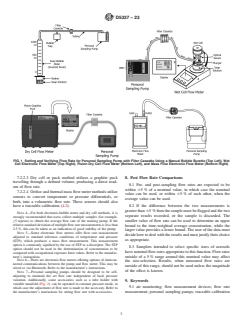
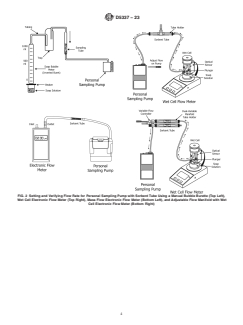
filter cassettes, and cyclones are shown in Figs. 1-3.
tion.
NOTE 3—In common practice in the United States, and specified in the
OSHA Technical Manual, a separate sampler loaded with a sampling
5. Significance and Use
substrate that is not used for the sample collection is utilized for all pre-
and post-sampling flow rate measurements. This has the advantage of
5.1 Most occupational exposure assessment methods re-
preventing contamination of a sample during the flow rate verification
quire the use of personal sampling pumps to collect air samples
procedure. However, it has the disadvantage of potentially not accounting
at typical sampling flow rates, with sampling volumes specified
for flow rate changes resulting from the build-up of sample. For this
by (a) particular procedure(s). The precision and bias of these reason, it is common practice in other jurisdictions such as in Europe to
use the actual sampler when setting and verifying flow rates.
methods are directly affec
...
This document is not an ASTM standard and is intended only to provide the user of an ASTM standard an indication of what changes have been made to the previous version. Because
it may not be technically possible to adequately depict all changes accurately, ASTM recommends that users consult prior editions as appropriate. In all cases only the current version
of the standard as published by ASTM is to be considered the official document.
Designation: D5337 − 11 (Reapproved 2016) D5337 − 23
Standard Practice for
Setting and Verifying the Flow Rate Adjustment of Personal
Sampling Pumps
This standard is issued under the fixed designation D5337; the number immediately following the designation indicates the year of
original adoption or, in the case of revision, the year of last revision. A number in parentheses indicates the year of last reapproval. A
superscript epsilon (´) indicates an editorial change since the last revision or reapproval.
1. Scope
1.1 This practice describes the calibration of setting and verification of flow rate for sampling pumps commonly used for
monitoring personal airborne exposures in the work-place.workplace.
1.2 This practice includes procedures for describing primary and secondary calibration techniques.using working standard flow
meters that are traceable to national or international standards, as well as those that are not. Traceable standards are preferred.
1.3 The values stated in SI units are to be regarded as standard. No other units of measurement are included in this standard.
1.4 This standard does not purport to address all of the safety concerns, if any, associated with its use. It is the responsibility
of the user of this standard to establish appropriate safety and healthsafety, health, and environmental practices and determine
the applicability of regulatory limitations prior to use.
1.5 This international standard was developed in accordance with internationally recognized principles on standardization
established in the Decision on Principles for the Development of International Standards, Guides and Recommendations issued
by the World Trade Organization Technical Barriers to Trade (TBT) Committee.
2. Referenced Documents
2.1 ASTM Standards:
D1356 Terminology Relating to Sampling and Analysis of Atmospheres
D4532 Test Method for Respirable Dust in Workplace Atmospheres Using Cyclone Samplers
2.2 ISO Standards:
ISO/IEC 17011 Conformity assessment – Requirements for accreditation bodies accrediting conformity assessment bodies
ISO/IEC 17025 General requirements for the competence of testing and calibration laboratories
ISO 13137 Workplace atmospheres – Pumps for personal sampling of chemical and biological agents – Requirements and test
methods
2.3 NIOSH and OSHA Documents:
HSM-99-71-31 Personal Sampling Pump for Charcoal Tubes; Final Report
th th 5
NIOSH Manual of Analytical Methods, 4Methods (NMAM) 0600, 5 ed.
This practice is under the jurisdiction of ASTM Committee D22 on Air Quality and is the direct responsibility of Subcommittee D22.04 on Workplace Air Quality.
Current edition approved Nov. 1, 2016May 1, 2023. Published November 2016June 2023. Originally approved in 1992. Last previous edition approved in 20112016 as
D5337 – 11.D5337 – 11 (2016). DOI: 10.1520/D5337-11R16.10.1520/D5337-23.
For referenced ASTM standards, visit the ASTM website, www.astm.org, or contact ASTM Customer Service at service@astm.org. For Annual Book of ASTM Standards
volume information, refer to the standard’s Document Summary page on the ASTM website.
Available from American National Standards Institute (ANSI), 25 W. 43rd St., 4th Floor, New York, NY 10036, http://www.ansi.org.
Available from the U.S. Department of Commerce, National Technical Information Service, Port Royal Road, Springfield, VA 22161.
Centers for Disease Control and Prevention (CDC), National Institute for Occupational Safety and Health (NIOSH), Cincinnati, Ohio (1994); Available from NIOSH
Publications, 4676 Columbia Parkway, Cincinnati, Ohio 45226; www.cdc.gov/niosh/nmam.www.cdc.gov/niosh/nmam/default.html.
Copyright © ASTM International, 100 Barr Harbor Drive, PO Box C700, West Conshohocken, PA 19428-2959. United States
D5337 − 23
OSHA Analytical Methods Manual
OSHA Technical Manual (OTM)
3. Terminology
3.1 For definitions of terms used in this practice, refer to Terminology D1356.
3.1 Definitions of Terms Specific to This Practice (otherwise, refer to Terminology D1356):
3.1.1 traceability, n—property of a measurement result whereby the result can be related to a reference through a documented
unbroken chain of calibrations, each contributing to the measurement uncertainty.
3.2 The term primary flow-rate calibration, as used in this practice, does not imply the calibration is traceable to a primary
standard, unless the apparatus used in the calibration (burets, stop-watches, etc.) has been demonstrated to be traceable to national
or international standards, and that this traceability is established on a routine (generally annual) basis. Traceability of calibration
is strongly recommended.
4. Summary of Practice
4.1 A bubble tube meter or electronic near-frictionless pump flow meter is used for primary calibrationsetting and verifying the
flow rate of personal sampling pumps. The practice is applicable to systems using air sampling devices. Provisions are made for
both manual and automated bubble meters.
4.2 The verification of flow rates using equipment demonstrated to be traceable to national or international standards is required,
and the traceability of all measurement results involved in the determination of flow rate should be established on a routine
(generally annual) basis. Correction of measurement results is allowed, for example, for rotameters and mass flow meters, where
the results from sensors in the field measurement of the parameters used in the corrections are also traceable. Organizations which
perform traceable calibration of equipment should be accredited under ISO/IEC 17025 by an organization certified to do so under
ISO/IEC 17011.
4.3 Secondary calibration procedures for field applications are also included in the practice (seeIn older documents flow meters
with traceable calibrations have been referred to as “primary standards,” and those without as “secondary standards.” However,
primary standard and secondary standard have different definitions in metrology, and so those terms should not be applied here.
In metrology, both types of flow meters used in this practice are referred to as “working standards,” with 7.3). or without
traceability of calibration.
5. Significance and Use
5.1 Most occupational exposure assessment methods require the use of personal sampling pumps to collect air samples at typical
workplace sampling flow rates, with sampling volumes specified by (a) particular procedure(s). The precision and bias of these
methods are directly affected by the precision and bias of the pumps used to measure in the measurement of the air volume(s)
sampled.
6. Apparatus
6.1 Sampling train, including a sampling pump, tubing, sampling substrate, and sampler (Test Method D4532), with either bubble
burette (6.2) or electronic flow meter (6.3) and other accessories as required (6.4).
6.2 Burets, Bubble burettes, 1-L1 L (for high flow) and 100-mL or 10 mL 100 mL or 10 mL (for low flow).
6.2.1 Bubble trap, to trap bubbles before reaching a sampler.
Occupational Safety and Health Administration, Salt Lake Technical Center, Salt Lake City, Utah (1985); Available from OSHA Analytical Laboratory, 8660 S. Sandy
Parkway, Sandy, UT 84070; www.osha.gov/dts/sltc/methods.
Occupational Safety and Health Administration, Washington DC; Available from OSHA website; www.osha.gov/otm/section-2-health-hazards/chapter1#appendix_II_6.
Joint Committee for Guides in Metrology (2012) International vocabulary of metrology — Basic and general concepts and associated terms (VIM) (International Bureau
of Weights and Measures (BIPM), Sèvres, France), 3rd Ed. BIPM, IEC, IFCC, ILAC, ISO, IUPAC, IUPAP and OIML, JCGM 200:2012 (2017 version with minor corrections
and informative annotations) Available at https://jcgm.bipm.org/vim/en/.
D5337 − 23
6.2.2 Beaker, 250 mL to place soap solution.
6.2.3 Bottle, 1 L for the use of cyclone sampler in the case that an adapter to set a flow rate is not available.
6.2.4 Stop-watch.
6.3 Manometer. Electronic flow meter.
6.3 Rotameter.
6.4 Stop Watch.
6.4 Other Accessories—Electronic Bubble Meter or Near-frictionless Piston Flowmeter (alternates),Pulsation dampener, tube
holder with variable manifold.
NOTE 1—There are several electronic flow meters developed based on different measurement principles, such as near-frictionless piston flow meter (for
example, automated bubble meter, dry piston), thermal mass flow meter, and orifice flow meter. Any flow meter with traceability of calibration can be
used.
NOTE 2—Some flow meters recommend a pulsation dampener between a sampling pump and the flow meter. Refer to the manufacturer’s
instructions.should have traceable calibration (see 3.2).
7. Procedure
7.1 Calibrate the Set and verify the flow rates of the personal sampling pumps before and measure after each day’s sampling.each
sampling period and verify after each sampling period.
7.2 Primary Flow-Rate Calibration Device(s) Flow measurement devices with traceable calibration (as noted in 3.24.3, these are
not primary traceable working standards unless the apparatus used in the calibration has been demonstrated to be traceable to
national and international standards):standards according to the appropriate schedule):
7.2.1 Bubble Meter Method: Method (manual):
7.2.1.1 Allow the pump to run five minutes prior to calibration to stabilize pump.5 min before setting or verifying the flow rate,
or both, to stabilize pump flow.
7.2.1.2 Connect pump to an appropriate sampling train. Sampling trains identical to that used in sampling f
...