

ASTM D7353-21
(Practice)Standard Practice for Sampling of Liquids in Waste Management Activities Using a Peristaltic Pump
General Information
- Abstract
SIGNIFICANCE AND USE
5.1 This practice can be used in sampling drums, tanks, and similar containers and in sampling monitoring and waste wells including small-diameter (2.5 cm (1 in.)) wells. The pump can collect samples from multiple depths. The samples can be high-viscosity fluids, aggressive and corrosive fluids, high-purity solutions, and abrasive fluids. The pump can be used to mix samples (see Guide D6063).
5.2 Peristaltic pumps use a vacuum to transport the samples. This vacuum may cause some degassing and loss of volatile organic compounds (VOCs) from the sample. When precise quantitative data for VOCs and dissolved gases are not required, peristaltic pumps may be used.
5.3 The pump is self-priming, runs dry without damage, and is completely isolated from the pumped fluid. A sample can be taken on the intake or discharge side of the pump.
5.4 Some additional advantages of the peristaltic pump are: decontamination of the pump motor is not necessary and the tubing in the pump is disposable and easy to replace. The pumps can be easily started and stopped and can pump fluids at a wide range of pressures and flow rates.
5.5 The place, quality and quantity, frequency, and time of sampling are dependent upon the decisions that are to be made (see Practice D6250), sampling design (see Guide D6311), the sample, the heterogeneity of the samples (see Guide D5956), how representative the sample is (see Guide D6044), and the parameters to be tested as determined by the data quality objectives (DQOs) (see Practice D5792).
SCOPE
1.1 This practice covers the use of a peristaltic pump for sampling liquids from multiple depths. It is applicable for a wide range of fluids including: high-viscosity fluids, aggressive and corrosive fluids, high-purity solutions, and abrasive fluids. It is especially useful for sampling liquids that require complete isolation from the pump.
1.2 This practice includes the determination of sample depth, pump setup, and collecting a sample to be analyzed.
1.3 This practice is not intended to give detailed instructions for running a peristaltic pump or to recommend which peristaltic pump to purchase. It instructs the field personnel how to connect the pump and collect a sample.
1.4 Units—The values stated in SI units are to be regarded as standard. No other units of measurement are included in this standard. All observed and calculated values shall conform to the guidelines for significant digits and rounding established in Practice D6026. Reporting of test results in units other than SI shall not be regarded as nonconformance with this standard.
1.5 This standard does not purport to address all of the safety concerns, if any, associated with its use. It is the responsibility of the user of this standard to establish appropriate safety, health, and environmental practices and determine the applicability of regulatory limitations prior to use.
1.6 This international standard was developed in accordance with internationally recognized principles on standardization established in the Decision on Principles for the Development of International Standards, Guides and Recommendations issued by the World Trade Organization Technical Barriers to Trade (TBT) Committee.
- Status
- Published
- Publication Date
- 30-Apr-2021
- Technical Committee
- D34 - Waste Management
- Drafting Committee
- D34.01.03 - Sampling Equipment
Buy Documents

ASTM D7353-21 - Standard Practice for Sampling of Liquids in Waste Management Activities Using a Peristaltic Pump
REDLINE ASTM D7353-21 - Standard Practice for Sampling of Liquids in Waste Management Activities Using a Peristaltic Pump
Overview
ASTM D7353-21: Standard Practice for Sampling of Liquids in Waste Management Activities Using a Peristaltic Pump provides a standardized procedure for collecting liquid samples from drums, tanks, wells, and other containers. This practice is widely used in environmental and waste management applications due to its adaptability for various fluid types, including high-viscosity, aggressive or corrosive, high-purity, and abrasive liquids. The standard details essential guidelines for using a peristaltic pump to obtain representative samples from multiple depths, especially where complete isolation from pump components is needed.
Key Topics
- Peristaltic Pump Application: Guidance on leveraging peristaltic pumps for liquid sampling, emphasizing their suitability for handling a broad spectrum of liquids without direct pump contact.
- Sample Integrity: Notes potential for degassing and volatilization, which may affect samples containing volatile organic compounds (VOCs) or dissolved gases.
- Sampling Procedures: Step-by-step instructions for preparing sampling equipment, collecting samples at targeted depths, and documenting procedures.
- Equipment Preparation:
- Use of disposable and easily replaced tubing to prevent cross-contamination
- Recommendations for pump setup and power sources
- Choice of tubing material compatible with sample type (e.g., PTFE for corrosive fluids)
- Data Documentation:
- Importance of thorough field logging, including equipment details and sampling records
- Quality assurance procedures such as field blanks, equipment blanks, and custody seals
Applications
This standard is essential for professionals involved in waste management, environmental monitoring, and compliance sampling. Primary use cases include:
- Sampling from Various Containers: Effective for drums, tanks, monitoring wells, and even small-diameter wells (as narrow as 2.5 cm).
- Depth-Resolved Sampling: Facilitates collection of liquid samples at specific depths, supporting environmental assessments and waste characterization.
- Difficult Sample Matrices: Designed to handle fluids that may be viscous, abrasive, corrosive, or require high purity, offering reliable results where other methods may falter.
- Field Flexibility: Portable peristaltic pumps can be easily deployed on-site, with minimal need for equipment decontamination due to disposable tubing.
- Sample Mixing: The pump can also be used to mix liquids within drums or tanks before or during sampling when homogeneous samples are required.
Limitations: The practice is not intended for quantifying VOCs or dissolved gases with high precision, as the pump’s vacuum action can cause some loss of these components.
Related Standards
ASTM D7353-21 references and aligns with several important ASTM standards to ensure comprehensive and robust sampling practices:
- ASTM D4448: Guide for Sampling Ground-Water Monitoring Wells
- ASTM D4687: Guide for General Planning of Waste Sampling
- ASTM D4840: Guide for Sample Chain-of-Custody Procedures
- ASTM D5956: Guide for Sampling Strategies for Heterogeneous Wastes
- ASTM D6063: Guide for Sampling Drums and Similar Containers by Field Personnel
- ASTM D5792: Practice for Generation of Environmental Data Related to Waste Management Activities
- ASTM D6311: Guide for Selection and Optimization of Sampling Design
These documents collectively address aspects such as data quality objectives, chain of custody, equipment selection, and strategies for collecting representative samples in diverse waste management contexts.
Keywords: peristaltic pump sampling, liquid sampling standard, waste management, environmental sampling, ASTM D7353-21, drums and tanks, monitoring wells, sample integrity, representative liquid samples
Relations
- Effective Date
- 01-Nov-2023
- Effective Date
- 01-Nov-2023
- Effective Date
- 01-Feb-2019
- Effective Date
- 01-Nov-2018
- Refers
ASTM D6063-11(2018) - Standard Guide for Sampling of Drums and Similar Containers by Field Personnel - Effective Date
- 01-Sep-2018
- Effective Date
- 15-Aug-2018
- Effective Date
- 01-Sep-2017
- Effective Date
- 01-Nov-2016
- Effective Date
- 01-Feb-2016
- Effective Date
- 01-Sep-2015
- Effective Date
- 01-Apr-2013
- Effective Date
- 01-Feb-2013
- Refers
ASTM D6063-11 - Standard Guide for Sampling of Drums and Similar Containers by Field Personnel - Effective Date
- 15-Nov-2011
- Effective Date
- 01-Dec-2010
- Effective Date
- 01-Feb-2010
Buy Documents
ASTM D7353-21 - Standard Practice for Sampling of Liquids in Waste Management Activities Using a Peristaltic Pump
REDLINE ASTM D7353-21 - Standard Practice for Sampling of Liquids in Waste Management Activities Using a Peristaltic Pump
Get Certified
Connect with accredited certification bodies for this standard

Institut za varilstvo d.o.o. (Welding Institute)
Slovenia's leading welding institute since 1952. ISO 3834, EN 1090, pressure equipment certification, NDT personnel, welder qualification. Only IIW Au
Sponsored listings
Frequently Asked Questions
ASTM D7353-21 is a standard published by ASTM International. Its full title is "Standard Practice for Sampling of Liquids in Waste Management Activities Using a Peristaltic Pump". This standard covers: SIGNIFICANCE AND USE 5.1 This practice can be used in sampling drums, tanks, and similar containers and in sampling monitoring and waste wells including small-diameter (2.5 cm (1 in.)) wells. The pump can collect samples from multiple depths. The samples can be high-viscosity fluids, aggressive and corrosive fluids, high-purity solutions, and abrasive fluids. The pump can be used to mix samples (see Guide D6063). 5.2 Peristaltic pumps use a vacuum to transport the samples. This vacuum may cause some degassing and loss of volatile organic compounds (VOCs) from the sample. When precise quantitative data for VOCs and dissolved gases are not required, peristaltic pumps may be used. 5.3 The pump is self-priming, runs dry without damage, and is completely isolated from the pumped fluid. A sample can be taken on the intake or discharge side of the pump. 5.4 Some additional advantages of the peristaltic pump are: decontamination of the pump motor is not necessary and the tubing in the pump is disposable and easy to replace. The pumps can be easily started and stopped and can pump fluids at a wide range of pressures and flow rates. 5.5 The place, quality and quantity, frequency, and time of sampling are dependent upon the decisions that are to be made (see Practice D6250), sampling design (see Guide D6311), the sample, the heterogeneity of the samples (see Guide D5956), how representative the sample is (see Guide D6044), and the parameters to be tested as determined by the data quality objectives (DQOs) (see Practice D5792). SCOPE 1.1 This practice covers the use of a peristaltic pump for sampling liquids from multiple depths. It is applicable for a wide range of fluids including: high-viscosity fluids, aggressive and corrosive fluids, high-purity solutions, and abrasive fluids. It is especially useful for sampling liquids that require complete isolation from the pump. 1.2 This practice includes the determination of sample depth, pump setup, and collecting a sample to be analyzed. 1.3 This practice is not intended to give detailed instructions for running a peristaltic pump or to recommend which peristaltic pump to purchase. It instructs the field personnel how to connect the pump and collect a sample. 1.4 Units—The values stated in SI units are to be regarded as standard. No other units of measurement are included in this standard. All observed and calculated values shall conform to the guidelines for significant digits and rounding established in Practice D6026. Reporting of test results in units other than SI shall not be regarded as nonconformance with this standard. 1.5 This standard does not purport to address all of the safety concerns, if any, associated with its use. It is the responsibility of the user of this standard to establish appropriate safety, health, and environmental practices and determine the applicability of regulatory limitations prior to use. 1.6 This international standard was developed in accordance with internationally recognized principles on standardization established in the Decision on Principles for the Development of International Standards, Guides and Recommendations issued by the World Trade Organization Technical Barriers to Trade (TBT) Committee.
SIGNIFICANCE AND USE 5.1 This practice can be used in sampling drums, tanks, and similar containers and in sampling monitoring and waste wells including small-diameter (2.5 cm (1 in.)) wells. The pump can collect samples from multiple depths. The samples can be high-viscosity fluids, aggressive and corrosive fluids, high-purity solutions, and abrasive fluids. The pump can be used to mix samples (see Guide D6063). 5.2 Peristaltic pumps use a vacuum to transport the samples. This vacuum may cause some degassing and loss of volatile organic compounds (VOCs) from the sample. When precise quantitative data for VOCs and dissolved gases are not required, peristaltic pumps may be used. 5.3 The pump is self-priming, runs dry without damage, and is completely isolated from the pumped fluid. A sample can be taken on the intake or discharge side of the pump. 5.4 Some additional advantages of the peristaltic pump are: decontamination of the pump motor is not necessary and the tubing in the pump is disposable and easy to replace. The pumps can be easily started and stopped and can pump fluids at a wide range of pressures and flow rates. 5.5 The place, quality and quantity, frequency, and time of sampling are dependent upon the decisions that are to be made (see Practice D6250), sampling design (see Guide D6311), the sample, the heterogeneity of the samples (see Guide D5956), how representative the sample is (see Guide D6044), and the parameters to be tested as determined by the data quality objectives (DQOs) (see Practice D5792). SCOPE 1.1 This practice covers the use of a peristaltic pump for sampling liquids from multiple depths. It is applicable for a wide range of fluids including: high-viscosity fluids, aggressive and corrosive fluids, high-purity solutions, and abrasive fluids. It is especially useful for sampling liquids that require complete isolation from the pump. 1.2 This practice includes the determination of sample depth, pump setup, and collecting a sample to be analyzed. 1.3 This practice is not intended to give detailed instructions for running a peristaltic pump or to recommend which peristaltic pump to purchase. It instructs the field personnel how to connect the pump and collect a sample. 1.4 Units—The values stated in SI units are to be regarded as standard. No other units of measurement are included in this standard. All observed and calculated values shall conform to the guidelines for significant digits and rounding established in Practice D6026. Reporting of test results in units other than SI shall not be regarded as nonconformance with this standard. 1.5 This standard does not purport to address all of the safety concerns, if any, associated with its use. It is the responsibility of the user of this standard to establish appropriate safety, health, and environmental practices and determine the applicability of regulatory limitations prior to use. 1.6 This international standard was developed in accordance with internationally recognized principles on standardization established in the Decision on Principles for the Development of International Standards, Guides and Recommendations issued by the World Trade Organization Technical Barriers to Trade (TBT) Committee.
ASTM D7353-21 is classified under the following ICS (International Classification for Standards) categories: 23.080 - Pumps. The ICS classification helps identify the subject area and facilitates finding related standards.
ASTM D7353-21 has the following relationships with other standards: It is inter standard links to ASTM D5681-23, ASTM D5792-10(2023), ASTM D4448-01(2019), ASTM D5681-18, ASTM D6063-11(2018), ASTM D4840-99(2018)e1, ASTM D5681-17, ASTM D5681-16a, ASTM D5681-16, ASTM D5792-10(2015), ASTM D4448-01(2013), ASTM D5681-13, ASTM D6063-11, ASTM D5792-10, ASTM D4840-99(2010). Understanding these relationships helps ensure you are using the most current and applicable version of the standard.
ASTM D7353-21 is available in PDF format for immediate download after purchase. The document can be added to your cart and obtained through the secure checkout process. Digital delivery ensures instant access to the complete standard document.
Standards Content (Sample)
This international standard was developed in accordance with internationally recognized principles on standardization established in the Decision on Principles for the
Development of International Standards, Guides and Recommendations issued by the World Trade Organization Technical Barriers to Trade (TBT) Committee.
Designation: D7353 − 21
Standard Practice for
Sampling of Liquids in Waste Management Activities Using
a Peristaltic Pump
This standard is issued under the fixed designation D7353; the number immediately following the designation indicates the year of
original adoption or, in the case of revision, the year of last revision. A number in parentheses indicates the year of last reapproval. A
superscript epsilon (´) indicates an editorial change since the last revision or reapproval.
1. Scope 2. Referenced Documents
1.1 This practice covers the use of a peristaltic pump for 2.1 ASTM Standards:
sampling liquids from multiple depths. It is applicable for a
D4448 Guide for Sampling Ground-Water Monitoring Wells
widerangeoffluidsincluding:high-viscosityfluids,aggressive
D4687 Guide for General Planning of Waste Sampling
and corrosive fluids, high-purity solutions, and abrasive fluids.
D4840 Guide for Sample Chain-of-Custody Procedures
It is especially useful for sampling liquids that require com-
D5681 Terminology for Waste and Waste Management
plete isolation from the pump.
D5792 Practice for Generation of Environmental Data Re-
lated to Waste Management Activities: Development of
1.2 This practice includes the determination of sample
Data Quality Objectives
depth, pump setup, and collecting a sample to be analyzed.
D5956 Guide for Sampling Strategies for Heterogeneous
1.3 Thispracticeisnotintendedtogivedetailedinstructions
Wastes
for running a peristaltic pump or to recommend which peri-
D6026 Practice for Using Significant Digits in Geotechnical
staltic pump to purchase. It instructs the field personnel how to
Data
connect the pump and collect a sample.
D6044 Guide for Representative Sampling for Management
of Waste and Contaminated Media
1.4 Units—The values stated in SI units are to be regarded
D6063 GuideforSamplingofDrumsandSimilarContainers
as standard. No other units of measurement are included in this
by Field Personnel
standard. All observed and calculated values shall conform to
D6232 Guide for Selection of Sampling Equipment for
the guidelines for significant digits and rounding established in
WasteandContaminatedMediaDataCollectionActivities
Practice D6026. Reporting of test results in units other than SI
D6250 Practice for Derivation of Decision Point and Confi-
shall not be regarded as nonconformance with this standard.
dence Limit for Statistical Testing of Mean Concentration
1.5 This standard does not purport to address all of the
in Waste Management Decisions (Withdrawn 2018)
safety concerns, if any, associated with its use. It is the
D6311 Guide for Generation of Environmental Data Related
responsibility of the user of this standard to establish appro-
to Waste ManagementActivities: Selection and Optimiza-
priate safety, health, and environmental practices and deter-
tion of Sampling Design
mine the applicability of regulatory limitations prior to use.
D6634 Guide for Selection of Purging and Sampling De-
1.6 This international standard was developed in accor-
vices for Groundwater Monitoring Wells
dance with internationally recognized principles on standard-
ization established in the Decision on Principles for the
3. Terminology
Development of International Standards, Guides and Recom-
mendations issued by the World Trade Organization Technical 3.1 Definitions—For definitions of terms used in this
Barriers to Trade (TBT) Committee. standard, see Terminology D5681.
1 2
This practice is under the jurisdiction of ASTM Committee D34 on Waste For referenced ASTM standards, visit the ASTM website, www.astm.org, or
Management and is the direct responsibility of Subcommittee D34.01.03 on contact ASTM Customer Service at service@astm.org. For Annual Book of ASTM
Sampling Equipment. Standards volume information, refer to the standard’s Document Summary page on
Current edition approved May 1, 2021. Published May 2021. Originally the ASTM website.
approved in 2007. Last previous edition approved in 2013 as D7353 – 07 (2013). The last approved version of this historical standard is referenced on
DOI: 10.1520/D7353-21. www.astm.org.
Copyright © ASTM International, 100 Barr Harbor Drive, PO Box C700, West Conshohocken, PA 19428-2959. United States
D7353 − 21
4. Summary of Practice how representative the sample is (see Guide D6044), and the
parameters to be tested as determined by the data quality
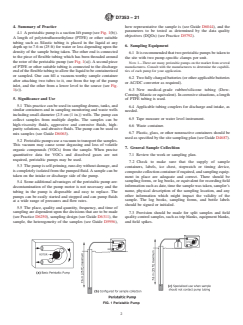
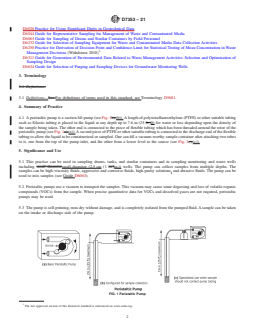
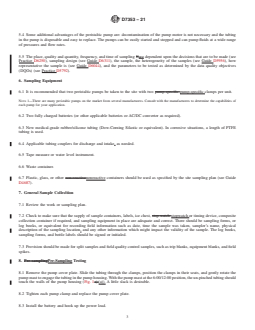
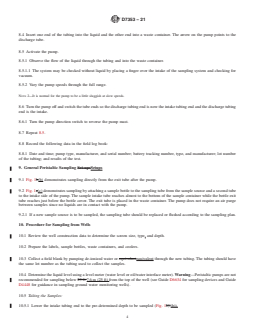
4.1 Aperistaltic pump is a suction lift pump (see Fig. 1(b)).
objectives (DQOs) (see Practice D5792).
A length of polytetrafluoroethylene (PTFE) or other suitable
tubing such as Silastic tubing is placed in the liquid at any
6. Sampling Equipment
depth up to 7.6 m (25 ft) for water or less depending upon the
density of the sample being taken. The other end is connected
6.1 Itisrecommendedthattwoperistalticpumpsbetakento
to the piece of flexible tubing which has been threaded around
the site with two pump-specific clamps per unit.
the rotor of the peristaltic pump (see Fig. 1(a)).Asecond piece
NOTE 1—There are many peristaltic pumps on the market from several
of PTFE or other suitable tubing is connected to the discharge
manufacturers. Consult with the manufacturers to determine the capabili-
ties of each pump for your application.
endoftheflexibletubingtoallowtheliquidtobecontainerized
or sampled. One can fill a vacuum-worthy sample container
6.2 Twofullychargedbatteries(orotherapplicablebatteries
after attaching two tubes to it, one from the top of the pump
or AC/DC converter as required).
inlet, and the other from a lower level to the source (see Fig.
6.3 New medical-grade rubber/silicone tubing (Dow-
1(c)).
CorningSilasticorequivalent).Incorrosivesituations,alength
5. Significance and Use of PTFE tubing is used.
5.1 This practice can be used in sampling drums, tanks, and
6.4 Applicable tubing couplers for discharge and intake, as
similar containers and in sampling monitoring and waste wells
needed.
including small-diameter (2.5 cm (1 in.)) wells. The pump can
6.5 Tape measure or water level instrument.
collect samples from multiple depths. The samples can be
high-viscosity fluids, aggressive and corrosive fluids, high-
6.6 Waste container.
purity solutions, and abrasive fluids. The pump can be used to
6.7 Plastic, glass, or other nonreactive containers should be
mix samples (see Guide D6063).
used as specified by the site sampling plan (see Guide D4687).
5.2 Peristalticpumpsuseavacuumtotransportthesamples.
This vacuum may cause some degassing and loss of volatile
7. General Sample Collecltion
organic compounds (VOCs) from the sample. When precise
quantitative data for VOCs and dissolved gases are not 7.1 Review the work or sampling plan.
required, peristaltic pumps may be used.
7.2 Check to make sure that the supply of sample
5.3 Thepumpisself-priming,runsdrywithoutdamage,and
containers, labels, ice chest, stopwatch or timing device,
is completely isolated from the pumped fluid.Asample can be
compositecollectioncontainerifrequired,andsamplingequip-
taken on the intake or discharge side of the pump.
ment in place are adequate and correct. There should be
sampling forms, or log books, or equivalent for recording field
5.4 Some additional advantages of the peristaltic pump are:
information such as date, time the sample was taken, sampler’s
decontamination of the pump motor is not necessary and the
name, physical description of the sampling location, and any
tubing in the pump is disposable and easy to replace. The
other information which might impact the validity of the
pumps can be easily started and stopped and can pump fluids
sample. The log books, sampling forms, and bottle labels
at a wide range of pressures and flow rates.
should be signed or initialed.
5.5 The place, quality and quantity, frequency, and time of
sampling are dependent upon the decisions that are to be made 7.3 Provision should be made for split samples and field
(see Practice D6250), sampling design (see Guide D6311), the quality control samples, such as trip blanks, equipment blanks,
sample, the heterogeneity of the samples (see Guide D5956), and field spikes.
FIG. 1 Peristaltic Pump
D7353 − 21
8. Pre-Sampling Testing 10.3 Collect a field blank by pumping de-ionized water or
equivalent through the new tubing. The tubing should have the
8.1 Remove the pump cover plate. Slide the tubing through
same lot number as the tubing used to collect the samples.
the clamps, position the clamps in their seats, and gently rotate
10.4 Determine the liquid level using a level meter (water
the pump mast to engage t
...
This document is not an ASTM standard and is intended only to provide the user of an ASTM standard an indication of what changes have been made to the previous version. Because
it may not be technically possible to adequately depict all changes accurately, ASTM recommends that users consult prior editions as appropriate. In all cases only the current version
of the standard as published by ASTM is to be considered the official document.
Designation: D7353 − 07 (Reapproved 2013) D7353 − 21
Standard Practice for
Sampling of Liquids in Waste Management Activities Using
a Peristaltic Pump
This standard is issued under the fixed designation D7353; the number immediately following the designation indicates the year of
original adoption or, in the case of revision, the year of last revision. A number in parentheses indicates the year of last reapproval. A
superscript epsilon (´) indicates an editorial change since the last revision or reapproval.
1. Scope
1.1 This practice covers the use of a peristaltic pump for sampling liquids from multiple depths. It is applicable for a wide range
of fluids including: high-viscosity fluids, aggressive and corrosive fluids, high-purity solutions, and abrasive fluids. It is especially
useful for sampling liquids that require complete isolation from the pump.
1.2 This practice includes the determination of sample depth, pump set up setup, and collecting a sample to be analyzed.
1.3 This practice is not intended to give detailed instructions for running a peristaltic pump or to recommend which peristaltic
pump to purchase. It instructs the field personnel how to connect the pump and collect a sample.
1.4 Units—The values stated in SI units are to be regarded as standard. No other units of measurement are included in this
standard. All observed and calculated values shall conform to the guidelines for significant digits and rounding established in
Practice D6026. Reporting of test results in units other than SI shall not be regarded as nonconformance with this standard.
1.5 This standard does not purport to address all of the safety concerns, if any, associated with its use. It is the responsibility
of the user of this standard to establish appropriate safety safety, health, and healthenvironmental practices and determine the
applicability of regulatory limitations prior to use.
1.6 This international standard was developed in accordance with internationally recognized principles on standardization
established in the Decision on Principles for the Development of International Standards, Guides and Recommendations issued
by the World Trade Organization Technical Barriers to Trade (TBT) Committee.
2. Referenced Documents
2.1 ASTM Standards:
D4448 Guide for Sampling Ground-Water Monitoring Wells
D4687 Guide for General Planning of Waste Sampling
D4840 Guide for Sample Chain-of-Custody Procedures
D5681 Terminology for Waste and Waste Management
D5792 Practice for Generation of Environmental Data Related to Waste Management Activities: Development of Data Quality
Objectives
D5956 Guide for Sampling Strategies for Heterogeneous Wastes
This practice is under the jurisdiction of ASTM Committee D34 on Waste Management and is the direct responsibility of Subcommittee D34.01.03 on Sampling
Equipment.
Current edition approved Feb. 1, 2013May 1, 2021. Published February 2013May 2021. Originally approved in 2007. Last previous edition approved in 20072013 as
D7353 – 07. 07 (2013). DOI: 10.1520/D7353-07R13.10.1520/D7353-21.
For referenced ASTM standards, visit the ASTM website, www.astm.org, or contact ASTM Customer Service at service@astm.org. For Annual Book of ASTM Standards
volume information, refer to the standard’s Document Summary page on the ASTM website.
Copyright © ASTM International, 100 Barr Harbor Drive, PO Box C700, West Conshohocken, PA 19428-2959. United States
D7353 − 21
D6026 Practice for Using Significant Digits in Geotechnical Data
D6044 Guide for Representative Sampling for Management of Waste and Contaminated Media
D6063 Guide for Sampling of Drums and Similar Containers by Field Personnel
D6232 Guide for Selection of Sampling Equipment for Waste and Contaminated Media Data Collection Activities
D6250 Practice for Derivation of Decision Point and Confidence Limit for Statistical Testing of Mean Concentration in Waste
Management Decisions (Withdrawn 2018)
D6311 Guide for Generation of Environmental Data Related to Waste Management Activities: Selection and Optimization of
Sampling Design
D6634 Guide for Selection of Purging and Sampling Devices for Groundwater Monitoring Wells
3. Terminology
3.1 Definitions:
3.1 Definitions—See For definitions of terms used in this standard, see Terminology D5681.
4. Summary of Practice
4.1 A peristaltic pump is a suction lift pump (see Fig. 1b).(b)). A length of polytetrafluoroethylene (PTFE) or other suitable tubing
such as Silastic tubing is placed in the liquid at any depth up to 7.6 m (25 ft.)ft) for water or less depending upon the density of
the sample being taken. The other end is connected to the piece of flexible tubing which has been threaded around the rotor of the
peristaltic pump (see Fig. 1a).(a)). A second piece of PTFE or other suitable tubing is connected to the discharge end of the flexible
tubing to allow the liquid to be containerized or sampled. One can fill a vacuum-worthy sample container after attaching two tubes
to it, one from the top of the pump inlet, and the other from a lower level to the source (see Fig. 1c).(c)).
5. Significance and Use
5.1 This practice can be used in sampling drums, tanks, and similar containers and in sampling monitoring and waste wells
including small diametersmall-diameter (2.5 cm (1 in.)in.)) wells. The pump can collect samples from multiple depths. The
samples can be high-viscosity fluids, aggressive and corrosive fluids, high-purity solutions, and abrasive fluids. The pump can be
used to mix samples (see Guide D6063).
5.2 Peristaltic pumps use a vacuum to transport the samples. This vacuum may cause some degassing and loss of volatile organic
compounds (VOCs) from the sample. When precise quantitative data for VOCs and dissolved gases are not required, peristaltic
pumps may be used.
5.3 The pump is self-priming, runs dry without damage, and is completely isolated from the pumped fluid. A sample can be taken
on the intake or discharge side of the pump.
FIG. 1 Peristaltic Pump
The last approved version of this historical standard is referenced on www.astm.org.
D7353 − 21
5.4 Some additional advantages of the peristaltic pump are: decontamination of the pump motor is not necessary and the tubing
in the pump is disposable and easy to replace. The pumps can be easily started and stopped and can pump fluids at a wide range
of pressures and flow rates.
5.5 The place, quality and quantity, frequency, and time of sampling isare dependent upon the decisions that are to be made (see
Practice D6250), sampling design (see Guide D6311), the sample, the heterogeneity of the samples (see Guide D5956), how
representative the sample is (see Guide D6044), and the parameters to be tested as determined by the data quality objectives
(DQOs) (see Practice D5792).
6. Sampling Equipment
6.1 It is recommended that two peristaltic pumps be taken to the site with two pump specific pump-specific clamps per unit.
NOTE 1—There are many peristaltic pumps on the market from several manufacturers. Consult with the manufacturers to determine the capabilities of
each pump for your application.
6.2 Two fully charged batteries (or other applicable batteries or AC/DC converter as required).
6.3 New medical-grade rubber/silicone tubing (Dow-Corning Silastic or equivalent). In corrosive situations, a length of PTFE
tubing is used.
6.4 Applicable tubing couplers for discharge and intake, as needed.
6.5 Tape measure or water level instrument.
6.6 Waste container.
6.7 Plastic, glass, or other non-reactivenonreactive containers should be used as specified by the site sampling plan (see Guide
D4687).
7. General Sample Collecltion
7.1 Review the work or sampling plan.
7.2 Check to make sure that the supply of sample containers, labels, ice chest, stop watch stopwatch or timing device, composite
collection container if required, and sampling equipment in place are adequate and correct. There should be sampling forms, or
log books, or equivalent for recording field information such as date, time the sample was taken, sampler’s name, physical
description of the sampling location, and any other information which might impact the validity of the sample. The log books,
sampling forms, and bottle labels should be signed or initialed.
7.3 Provision should be made for split samples and field quality control samples, such as trip blanks, equipment blanks, and field
spikes.
8. Pre-samplingPre-Sampling Testing
8.1 Remove the pump cover plate. Slide the tubing through the clamps, position the clamps in their seats, and gently rotate the
pump mast to engage the tubing in the pump housing. With the pump mast at the 6:00/12:00 position, the un-pinched tubing should
touch the walls of the pump housing (Fig. 1a).(a)). A little slack is desirable.
8.2 Tight
...