

ASTM E253-23a
(Terminology)Standard Terminology Relating to Sensory Evaluation of Materials and Products
General Information
- Abstract
- Status
- Published
- Publication Date
- 14-Jul-2023
- Technical Committee
- E18 - Sensory Evaluation
- Drafting Committee
- E18.01 - Terminology
Overview
ASTM E253-23a - Standard Terminology Relating to Sensory Evaluation of Materials and Products provides a comprehensive, internationally recognized vocabulary for the field of sensory evaluation. Developed by ASTM International's Committee E18, this standard promotes consistency and clarity in how sensory characteristics, evaluation methods, and results are described and interpreted across industries. By defining key terms and concepts, ASTM E253-23a enables professionals to communicate effectively, supports robust sensory research, and facilitates comparison and reproducibility of sensory tests in product development, quality control, and consumer research.
Key Topics
ASTM E253-23a encompasses terminology used throughout sensory evaluation methodologies, including but not limited to:
- Types of Sensory Tests: Definitions for discrimination tests (triangle, duo-trio, paired comparison), descriptive analysis, affective (hedonic) and preference tests.
- Attributes and Sensations: Clear explanations for core sensory attributes (sweet, sour, salty, bitter, umami), physical sensations (mouthfeel, texture), and perceptual phenomena (aroma, flavor, opacity, color).
- Assessment Methods: Standardized vocabulary for approaches such as central location test (CLT), home use test (HUT), sequential and simultaneous presentations, and scaling techniques (Likert, hedonic, just-about-right, labeled magnitude).
- Bias and Error: Definitions relating to common sources of error and bias in sensory evaluation (order effect, context effect, response bias, adaptation, drift).
- Measurement and Data Types: Explanation of data categories (nominal, ordinal, interval, ratio), power, repeatability, and quantitative versus qualitative profiles.
- Panel and Assessor Terms: Terms concerning panelists, trained assessors, expert assessors, and their roles and performance metrics.
Applications
Using ASTM E253-23a terminology brings recognized benefits across a broad range of industries and use cases, such as:
- Food & Beverage: Ensures consistency in reporting flavors, aromas, textures, and preferences during product development and sensory panel testing.
- Cosmetics & Personal Care: Standardizes language when describing tactile properties, afterfeel, fragrance, and consumer perception studies.
- Consumer Goods & Household Products: Aids in evaluating sensory attributes like color, gloss, scent, and texture during product innovation and quality control.
- Industrial Materials: Supports sensory evaluation of materials such as plastics, textiles, or coatings by providing clear descriptors for appearance, texture, and scent.
- Sensory Research & Training: Offers a foundational vocabulary for training assessors, designing robust studies, and publishing sensory evaluation results.
- Quality Assurance: Helps organizations reduce ambiguity and improve traceability in sensory testing protocols, leading to more reliable data for regulatory and market compliance.
By applying standardized sensory terminology, organizations can enhance communication among multidisciplinary teams, improve reproducibility of sensory studies, streamline product comparisons, and increase market acceptance.
Related Standards
For comprehensive sensory evaluation and appearance assessment, consider referencing these related standards:
ASTM E284 – Terminology of Appearance
Focuses on terminology related to visual appearance characteristics of materials and products.ISO 8586 – Sensory Analysis – General Guidelines for the Selection, Training, and Monitoring of Assessors
International standard for panelist selection and training procedures.ASTM E1871 – Guide for Conducting Sensory Evaluation of Products by Children and Minors
Provides best practices for sensory testing with younger populations.ASTM E1490 – Guide for Two- and Three-Point Ellis Methods for the Sensory Analysis of Products
Detailed guidance on conducting certain types of discrimination tests.
For further information and updates, visit the ASTM International website and search for Committee E18 standards on sensory evaluation. Use of ASTM E253-23a supports harmonized practices in sensory science worldwide, boosting the credibility and global acceptance of sensory data.
Relations
- Effective Date
- 01-Nov-2013
- Effective Date
- 01-Jun-2013
- Effective Date
- 01-Jan-2013
- Effective Date
- 01-Jul-2012
- Effective Date
- 01-Jun-2009
- Effective Date
- 01-Jan-2009
- Effective Date
- 01-Aug-2008
- Effective Date
- 15-Jul-2007
- Effective Date
- 01-Dec-2006
- Effective Date
- 15-Jul-2006
- Effective Date
- 15-Feb-2006
- Effective Date
- 15-Jun-2005
- Effective Date
- 01-Feb-2005
- Effective Date
- 01-Jun-2004
- Effective Date
- 10-Jul-2003
Get Certified
Connect with accredited certification bodies for this standard

BSI Group
BSI (British Standards Institution) is the business standards company that helps organizations make excellence a habit.

Bureau Veritas
Bureau Veritas is a world leader in laboratory testing, inspection and certification services.

DNV
DNV is an independent assurance and risk management provider.
Sponsored listings
Frequently Asked Questions
ASTM E253-23a is a standard published by ASTM International. Its full title is "Standard Terminology Relating to Sensory Evaluation of Materials and Products". This standard covers: Standard Terminology Relating to Sensory Evaluation of Materials and Products
Standard Terminology Relating to Sensory Evaluation of Materials and Products
ASTM E253-23a is classified under the following ICS (International Classification for Standards) categories: 01.040.67 - Food technology (Vocabularies); 67.240 - Sensory analysis. The ICS classification helps identify the subject area and facilitates finding related standards.
ASTM E253-23a has the following relationships with other standards: It is inter standard links to ASTM E284-13b, ASTM E284-13a, ASTM E284-13, ASTM E284-12, ASTM E284-09a, ASTM E284-09, ASTM E284-08, ASTM E284-07, ASTM E284-06b, ASTM E284-06a, ASTM E284-06, ASTM E284-05a, ASTM E284-05, ASTM E284-04, ASTM E284-03a. Understanding these relationships helps ensure you are using the most current and applicable version of the standard.
ASTM E253-23a is available in PDF format for immediate download after purchase. The document can be added to your cart and obtained through the secure checkout process. Digital delivery ensures instant access to the complete standard document.
Standards Content (Sample)
This international standard was developed in accordance with internationally recognized principles on standardization established in the Decision on Principles for the
Development of International Standards, Guides and Recommendations issued by the World Trade Organization Technical Barriers to Trade (TBT) Committee.
Designation: E253 − 23a
Standard Terminology Relating to
Sensory Evaluation of Materials and Products
This standard is issued under the fixed designation E253; the number immediately following the designation indicates the year of
original adoption or, in the case of revision, the year of last revision. A number in parentheses indicates the year of last reapproval. A
superscript epsilon (´) indicates an editorial change since the last revision or reapproval.
1. Referenced Documents alternative forced choice (AFC), n—method in which two,
three, or more stimuli are presented, and assessors are given
1.1 ASTM Standards:
a criterion by which they are required to select one stimulus.
E284 Terminology of Appearance
(2008)
2. Terminology DISCUSSION—Typical examples include 2-AFC (directional different
test) and 3-AFC (selecting the one stimulus among a set of three that
absolute judgment, n—an evaluation of a stimulus made
differs in a defined attribute).
without direct comparison to other stimuli. (2007)
alternative forced choice (AFC) test, n—method in which
acceptability/unacceptability, n—degree to which a stimulus
two, three, or more stimuli are presented, and assessors are
is judged to be favorable or unfavorable. (2006)
given a criterion by which they are required to select one
stimulus. (2008)
acuity, n—the ability to detect or discriminate sensory stimuli.
DISCUSSION—Typical examples include 2-AFC (directional difference
(2007)
test) and 3-AFC (selecting the one stimulus among a set of three that
differs in a defined attribute).
adaptation, sensory, n—a decrease in sensitivity to a given
stimulus which occurs as a result of exposure to that
anchoring point, n—a reference point against which other
stimulus. (2006)
items are judged. (1996)
affective test, n—any method to assess acceptance, liking,
anosmia, n—lack of sensitivity to odor stimuli. (1996)
preference, or emotions for a stimulus or stimuli. (2008)
A-not-A test, n—a method of discrimination testing comprised
after effects, n—total array of sensations that occur after
of at least two samples; at least one sample is a previously
removal of the stimulus from the sensing field (for example,
identified sample (“A”) and at least one is a test sample; all
with foods) or after application of the stimulus (for example,
samples are presented blindly, and the assessor’s task is to
with non-foods). (2008)
assign the label “A” or “not-A” to each of the samples.
(2001)
after feel, n—feel of the skin after application of a sample,
with or without touching, usually measured at a specified
antagonism, n—joint action of two or more stimuli whose
time point. (2008)
combination elicits a level of sensation lower than that
expected from combining the effects of each stimulus taken
aftertaste, n—the oral or nasal sensations that occur after the
separately. (1996)
stimulus has been removed from the oral cavity. (2007) (See
also after effects.)
aroma, n—perception resulting from stimulating the olfactory
receptors; in a broader sense, the term is sometimes used to
aguesia, n—lack of sensitivity to taste stimuli. (1996)
refer to the combination of sensations resulting from stimu-
α (alpha) risk, n—the probability of concluding that a percep-
lation of the entire nasal cavity. (1996)
DISCUSSION—Aroma, odor, and smell have the same basic meaning;
tible difference exists when, in reality, one does not. (2014)
however, in common usage they may have different connotations.
DISCUSSION—α risk also is known as Type 1 Error or significance
level.
aromatic, n—perception resulting from stimulating the olfac-
tory receptors retronasally. (2010)
This terminology is under the jurisdiction of ASTM Committee E18 on Sensory
Evaluation and is the direct responsibility of Subcommittee E18.01 on Terminology.
assessor, n—a general term for any individual responding to
Current edition approved July 15, 2023. Published August 2023. Originally
stimuli in a sensory test. (2006)
approved in 1965. Last previous edition approved in 2023 as E253 – 23. DOI:
DISCUSSION—The terms assessor, judge, panelist, panel member, and
10.1520/E0253-23A.
respondent all have the same basic meaning, although sometimes
For referenced ASTM standards, visit the ASTM website, www.astm.org, or
different connotations. Usage of these terms varies with the training and
contact ASTM Customer Service at service@astm.org. For Annual Book of ASTM
experience of the investigator, habit, tradition, personal preference, and
Standards volume information, refer to the standard’s Document Summary page on
the ASTM website. other factors.
Copyright © ASTM International, 100 Barr Harbor Drive, PO Box C700, West Conshohocken, PA 19428-2959. United States
E253 − 23a
assessor drift, n—a trend in which an assessor’s response to a calibration (trained assessor), n—the process of aligning
specific stimulus shifts over time even though the stimulus trained assessors’ responses to either established or agreed
has not changed. (2018) upon qualitative or quantitative references.
DISCUSSION—Drift happens over a long duration of time, usually DISCUSSION—Descriptive analysis methodologies may or may not
weeks or months. include trained assessor calibrations.
astringency, n—the complex of sensations due to shrinking,
central location test (CLT), n—a test where stimuli are
drawing, or puckering of the epithelium as a result of evaluated by consumers at a common designated location(s);
exposure to substances such as alums or tannins. (1996)
the stimuli preparation and presentation are controlled.
(2019) (See also home use test.)
attitude, n—a predisposition to respond in a characteristic way
DISCUSSION—Examples of designated locations include market re-
toward a class of objects, concepts, or stimuli. (1996)
search facilities, academic laboratories, grocery stores, or hotel confer-
ence rooms.
attitude scale, n—a means for eliciting indications of the
attitudes or opinions held, usually on a measuring system
check-all-that-apply (CATA) scale, n—a question format in
using marks or value designations. (1996)
which any number of items from a list may be selected to
indicate which items pertain to the stimulus being measured.
attribute, n—a perceived characteristic. (1996)
(2018)
audition, n—the sense of hearing. (1996)
DISCUSSION—Check-, choose-, and select-all-that-apply are used
interchangeably.
aversion, n—a predisposition to avoid a stimulus based on a
chemesthesis, n—perception derived from chemical stimula-
feeling of discomfort or dislike. (2011)
tion of the skin or other tissues, for example, menthol
β (beta) risk, n—the probability of concluding that no percep-
cooling, ammonia pungency. (2015)
tible difference exists when, in reality, one does. (2014)
DISCUSSION—β risk also is known as Type II Error. chroma, n—see color. (2001) (For consensus technical defi-
nition see chroma in Terminology E284).
bias, n—a systematic error manifested as a persistent positive
or negative deviation of the method average from its
color (of an object), n—the appearance of an object dependent
accepted true value. (2013) upon the spectral composition of radiant and incident light,
DISCUSSION—Bias is a general term for any systematic deviation in a
the spectral reflectance or transmittance of the object, and
method’s average from its accepted true value. In sensory, there are
the psychological response of the observer; the experience
several commonly used terms that relate to specific types or causes of
may be described in terms of three attributes: brightness,
bias. These include: sensory adaptation, context effect, contrast effect,
chroma, and hue. (2001) (For consensus technical definition
convergence effect, error of expectation, order effect, position effect,
see color in Terminology E284 as defined by Committee
and response bias.
E12.)
bipolar scale, n—scale where the end anchors are semantic
brightness, n—aspect of visual perception whereby an area
opposites and there is an implied or anchored mid-point.
appears to emit more or less light.
(2008)
DISCUSSION—Examples of semantic opposites are “too thin” to “too chroma, n—experienced as color purity, attribute of color
thick,” “dislike extremely” to “like extremely.”
used to indicate the degree of departure of the color from a gray
of the same brightness.
bite, chemical, n—stinging experienced primarily in the oral
hue, n—attribute of color related to the wavelength of
cavity as a result of exposure to substances such as highly
electromagnetic energy and experienced as “red,” “green,”
carbonated beverages. (1997)
“blue,” and other elements of the visible spectrum.
bitter, adj—pertaining to the taste produced by substances such
color blindness, n—total or partial inability to differentiate
as quinine or caffeine when in solution. (2012)
certain hues. (1997)
blinded, adj—an element of experimental control in which the
consumer, n—the user or potential user of a product or service,
identity or an aspect of a treatment, condition, or substance
is hidden from the participant (single blind) or both the who may participate in research tests to provide opinions of
products, concepts or services. (2010)
participant and the experimenter (double blind). (2008)
context effect, n—effect upon the perception of a stimulus
body (food), n—the quality of a food or beverage relating
either to its consistency, compactness of texture, fullness, arising from its interrelationship with other stimuli in a
presentation set, the test design, or the environment. (2023)
flavor, or combination thereof. (1997)
brightness, n—see color (of an object). (2001) (For consensus contrast, visual, n—the degree of dissimilarity in appearance
technical definition see brightness in Terminology E284.) of two parts of a field of view seen simultaneously or
successively. (1998)
burn, chemical, n—perception of irritation resulting from
exposure to substances such as ethyl alcohol, acetic acid, and contrast effect, n—special case of context effect in which the
benzoate; the sensation tends to persist after the stimulus is perceived degree of difference between stimuli is exagger-
removed. (2013) ated as a result of their interrelationship. (1997)
E253 − 23a
DISCUSSION—Experts often operate alone, not as a member of a
convergence, n—tendency of a stimulus to be perceived as
sensory panel. Examples of experts related to product assessment are
similar to prior stimulus or stimuli. (1997)
sommeliers and meat graders.
convergence effect, n—special case of context effect in which
expert assessor, n—an assessor with a high degree of sensory
the perceived degree of difference between stimuli is dimin-
acuity who has experience in the test procedure and estab-
ished as a result of their interrelationship. (1997)
lished ability to make consistent and repeatable sensory
assessments; an expert assessor functions as a member of a
cooling, chemical, n—sensation of reduced temperature expe-
rienced as a result of exposure to certain substances such as sensory panel. (1995) (See also assessor, expert.)
menthol or anise; the sensation usually persists after the
extended use testing, n—sensory or consumer testing of a
stimulus is removed. (1997)
product over a time period that allows for multiple usage
occasions.
cooling, physical, n—sensation of reduced temperature expe-
rienced as a result of exposure to thermally cold substances
flavor, n—(1) perception resulting from stimulating a combi-
(such as ice), to substances that evaporate rapidly (such as
nation of the taste buds, the olfactory organs, and chemes-
acetone or alcohol), or to substances that have a negative
thetic receptors within the oral cavity; (2) the combined
heat of solution (such as crystalline sorbitol); the duration of
effect of taste sensations, aromatics, and chemical feeling
the sensation is usually limited to the time of direct contact
factors evoked by a substance in the oral cavity. (2001)
with the stimulus. (1998)
fragrance, n—(1) see aroma; (2) an aromatic substance.
cutaneous sense, n—any of the senses whose receptors lie in
(2011)
the skin or immediately beneath it (or in the external mucous
DISCUSSION—The term fragrance is commonly used in household and
membranes), such as contact, pressure, warmth, cold, and
personal care industries.
pain. (1997)
free-choice profiling, n—a form of sensory profiling in which
descriptive analysis, n—any method to describe and quantify
each assessor independently generates attributes to evaluate
the sensory characteristics of stimuli by a panel of trained
a group of samples; the assessors’ attributes may be the same
assessors. (1998)
or may differ from sample to sample; the assessors’ sensory
profiles are combined statistically (for example, by Gener-
difference limen, n—see threshold, difference. (1997)
alized Procrustes Analysis) to produce a map of the samples.
directional difference test, n—a paired comparison or 2-AFC (2000)
(Alternative Forced Choice) method in which assessors
gloss, n—a shiny appearance resulting from the tendency of a
select the stimulus from a pair of stimuli that is perceived to
surface to reflect light energy at one angle more than at
be higher or lower in intensity of a specified sensory
others. (2000) (See reflectance, directional. For the consen-
attribute. (2009)
sus technical definition see gloss in Terminology E284.)
discrimination, n—the process of qualitatively or quantita-
gustation, n—the sense of taste. (2011)
tively differentiating among stimuli. (1998)
heat, chemical, n—sensation of increased temperature result-
discrimination test, n—any method to determine if differences
ing from exposure to substances such as capsaicin or hot
among stimuli are perceptible; for example, triangle tests,
peppers; the sensation tends to persist after the stimulus is
duo-trio tests, paired comparison tests, and so forth. (1998)
removed.
duo-trio test, n—a method of discrimination testing comprised
heat, physical, n—sensation experienced as a result of expo-
of two coded samples and one identified reference; one of
sure to thermally hot substances such as water above 120 °F;
the coded samples and the reference are samples of the same
the duration of the sensation is usually limited to the time of
stimulus; the other coded sample is a sample of one other
direct contact with the stimulus.
stimulus; the assessor is asked to select which of the two
coded samples is different from the reference or which of the
hedonic scale, n—a scale on which liking or disliking of a
two coded samples is the same as the reference. (2012)
stimulus is expressed. (2000)
DISCUSSION—Stimuli can represent different lots of products,
home use test (HUT), n—a test where stimuli are evaluated by
formulations, or processes, and so forth.
consumers at home or in the environment typical of the
end effect, n—effect where the end points of a scale are used
actual use situation; the stimuli preparation and presentation
less frequently than other scale points. (2014)
are self-administered. (2019) (See also central location
test.)
expectation, error of, n—a bias due to preconceived ideas that
DISCUSSION—HUT and in-home use test (iHUT) are used inter-
influences an assessor’s judgment. (1999)
changeably.
expert, n—an evaluator with extensive experience and knowl-
hue, n—see color (of an object). (2001) (For consensus
edge in a product category who makes judgments about the
technical definition see hue in Terminology E284.)
product’s qualities or value. (2020) (See also assessor,
expert assessor.) intensity, n—the perceived magnitude of a stimulus. (2000)
E253 − 23a
interval data, n—data obtained from a scale for which labeled magnitude scale (LMS), n—a semantic scale of
numerically identical differences on any part of the scale perceptual intensity characterized by approximately loga-
correspond to the same magnitude of difference of the rithmic spacing of verbal labels along a line scale. See Fig.
characteristic being measured. (2018) 2. (2020)
DISCUSSION—The numerical values of the scale are arbitrary as long
as the intervals remain the same. An example of interval data is the
numerals 1 to 9, which can be rescaled to –4 to +4 without changing the
information content of the data.
judge, n—see assessor. (2000)
just-about-right scale, n—bipolar scale used to measure the
level of an attribute relative to an assessor’s ideal level,
having a midpoint labeled “just about right” or “just right.”
(2007)
just noticeable difference, n—see threshold, difference.
(2000)
kinesthesis, n—perception of bodily movement or position.
(2015)
labeled affective magnitude scale (LAM), n—a type of
FIG. 2 Labeled Magnitude Scale
labeled magnitude scale, with verbal labels related to liking
and disliking; there is a neutral point in the center of the line
scale and the opposing end anchors are “greatest imaginable
DISCUSSION—The verbal anchors are spaced on the LMS based on
like” and “greatest imaginable dislike;” see Fig. 1. (2015)
calibration using ratio-scaling. It is critical that the spacing be main-
tained in order to accurately reflect the nonlinear relationship between
stimulus and sensation. Positions of the verbal anchors were deter-
mined by magnitude estimation to be (in terms of % of the scale):
“barely detectable,” 1.37; “weak,” 5.8; “moderate,” 16.2; “strong,” 33;
“very strong,” 50; and “strongest imaginable,” 96.
lexicon (sensory), n—a set of defined terms that describe the
sensory characteristics of stimuli. (2017)
Likert scale, n—as originally described, a five or seven point
bipolar scale that allows the assessors to express how much
5,6
they agree or disagree with a particular statement. (2016)
DISCUSSION—The original Likert scale used the following response
categories: strongly agree, agree, undecided (or neither agree nor
disagree), disagree, and strongly disagree. Modifications to the Likert
scale can be five, seven, or nine points, with or without a neutral
midpoint, and measure attitudes or opinions to responses such as
agreement, frequency, likelihood, and importance.
FIG. 1 Labeled Affective Magnitude Scale
magnitude estimation, n—process of assigning values to the
intensities of an attribute in such a way that the ratios
DISCUSSION—The remaining verbal anchors are equivalent to the
between pairs of assigned values are the same as between the
anchors used with the well-known, nine-point hedonic scale, from “like
magnitudes of the perceptions to which they correspond.
extremely” to “dislike extremely.” Positions of the verbal anchors were
(2003)
determined by magnitude estimation to be (in terms of % of the scale):
Greatest Imaginable Like 100.0
malodor, n—an odor that is unpleasant or disliked when
Like E
...
This document is not an ASTM standard and is intended only to provide the user of an ASTM standard an indication of what changes have been made to the previous version. Because
it may not be technically possible to adequately depict all changes accurately, ASTM recommends that users consult prior editions as appropriate. In all cases only the current version
of the standard as published by ASTM is to be considered the official document.
Designation: E253 − 23 E253 − 23a
Standard Terminology Relating to
Sensory Evaluation of Materials and Products
This standard is issued under the fixed designation E253; the number immediately following the designation indicates the year of
original adoption or, in the case of revision, the year of last revision. A number in parentheses indicates the year of last reapproval. A
superscript epsilon (´) indicates an editorial change since the last revision or reapproval.
1. Referenced Documents
1.1 ASTM Standards:
E284 Terminology of Appearance
2. Terminology
absolute judgment, n—an evaluation of a stimulus made without direct comparison to other stimuli. (2007)
acceptability/unacceptability, n—degree to which a stimulus is judged to be favorable or unfavorable. (2006)
acuity, n—the ability to detect or discriminate sensory stimuli. (2007)
adaptation, sensory, n—a decrease in sensitivity to a given stimulus which occurs as a result of exposure to that stimulus. (2006)
affective test, n—any method to assess acceptance, liking, preference, or emotions for a stimulus or stimuli. (2008)
after effects, n—total array of sensations that occur after removal of the stimulus from the sensing field (for example, with foods)
or after application of the stimulus (for example, with non-foods). (2008)
after feel, n—feel of the skin after application of a sample, with or without touching, usually measured at a specified time point.
(2008)
aftertaste, n—the oral or nasal sensations that occur after the stimulus has been removed from the oral cavity. (2007) (See also
after effects.)
aguesia, n—lack of sensitivity to taste stimuli. (1996)
α (alpha) risk, n—the probability of concluding that a perceptible difference exists when, in reality, one does not. (2014)
DISCUSSION—
α risk also is known as Type 1 Error or significance level.
This terminology is under the jurisdiction of ASTM Committee E18 on Sensory Evaluation and is the direct responsibility of Subcommittee E18.01 on Terminology.
Current edition approved Feb. 1, 2023July 15, 2023. Published February 2023August 2023. Originally approved in 1965. Last previous edition approved in 20222023 as
E253 – 22a.E253 – 23. DOI: 10.1520/E0253-23.10.1520/E0253-23A.
For referenced ASTM standards, visit the ASTM website, www.astm.org, or contact ASTM Customer Service at service@astm.org. For Annual Book of ASTM Standards
volume information, refer to the standard’s Document Summary page on the ASTM website.
Copyright © ASTM International, 100 Barr Harbor Drive, PO Box C700, West Conshohocken, PA 19428-2959. United States
E253 − 23a
alternative forced choice (AFC), n—method in which two, three, or more stimuli are presented, and assessors are given a
criterion by which they are required to select one stimulus. (2008)
DISCUSSION—
Typical examples include 2-AFC (directional different test) and 3-AFC (selecting the one stimulus among a set of three that differs in a defined
attribute).
alternative forced choice (AFC) test, n—method in which two, three, or more stimuli are presented, and assessors are given
a criterion by which they are required to select one stimulus. (2008)
DISCUSSION—
Typical examples include 2-AFC (directional difference test) and 3-AFC (selecting the one stimulus among a set of three that differs in a defined
attribute).
anchoring point, n—a reference point against which other items are judged. (1996)
anosmia, n—lack of sensitivity to odor stimuli. (1996)
A-not-A test, n—a method of discrimination testing comprised of at least two samples; at least one sample is a previously
identified sample (“A”) and at least one is a test sample; all samples are presented blindly, and the assessor’s task is to assign
the label “A” or “not-A” to each of the samples. (2001)
antagonism, n—joint action of two or more stimuli whose combination elicits a level of sensation lower than that expected from
combining the effects of each stimulus taken separately. (1996)
aroma, n—perception resulting from stimulating the olfactory receptors; in a broader sense, the term is sometimes used to refer
to the combination of sensations resulting from stimulation of the entire nasal cavity. (1996)
DISCUSSION—
Aroma, odor, and smell have the same basic meaning; however, in common usage they may have different connotations.
aromatic, n—perception resulting from stimulating the olfactory receptors retronasally. (2010)
assessor, n—a general term for any individual responding to stimuli in a sensory test. (2006)
DISCUSSION—
The terms assessor,judge,panelist,panel member, and respondent all have the same basic meaning, although sometimes different connotations. Usage
of these terms varies with the training and experience of the investigator, habit, tradition, personal preference, and other factors.
assessor drift, n—a trend in which an assessor’s response to a specific stimulus shifts over time even though the stimulus has
not changed. (2018)
DISCUSSION—
Drift happens over a long duration of time, usually weeks or months.
astringency, n—the complex of sensations due to shrinking, drawing, or puckering of the epithelium as a result of exposure to
substances such as alums or tannins. (1996)
attitude, n—a predisposition to respond in a characteristic way toward a class of objects, concepts, or stimuli. (1996)
attitude scale, n—a means for eliciting indications of the attitudes or opinions held, usually on a measuring system using marks
or value designations. (1996)
attribute, n—a perceived characteristic. (1996)
audition, n—the sense of hearing. (1996)
E253 − 23a
aversion, n—a predisposition to avoid a stimulus based on a feeling of discomfort or dislike. (2011)
β (beta) risk, n—the probability of concluding that no perceptible difference exists when, in reality, one does. (2014)
DISCUSSION—
β risk also is known as Type II Error.
bias, n—a systematic error manifested as a persistent positive or negative deviation of the method average from its accepted true
value. (2013)
DISCUSSION—
Bias is a general term for any systematic deviation in a method’s average from its accepted true value. In sensory, there are several commonly used
terms that relate to specific types or causes of bias. These include: sensory adaptation, context effect, contrast effect, convergence effect, error of
expectation, order effect, position effect, and response bias.
bipolar scale, n—scale where the end anchors are semantic opposites and there is an implied or anchored mid-point. (2008)
DISCUSSION—
Examples of semantic opposites are “too thin” to “too thick,” “dislike extremely” to “like extremely.”
bite, chemical, n—stinging experienced primarily in the oral cavity as a result of exposure to substances such as highly
carbonated beverages. (1997)
bitter, adj—pertaining to the taste produced by substances such as quinine or caffeine when in solution. (2012)
blinded, adj—an element of experimental control in which the identity or an aspect of a treatment, condition, or substance is
hidden from the participant (single blind) or both the participant and the experimenter (double blind). (2008)
body (food), n—the quality of a food or beverage relating either to its consistency, compactness of texture, fullness, flavor, or
combination thereof. (1997)
brightness, n—see color (of an object). (2001) (For consensus technical definition see brightness in Terminology E284.)
burn, chemical, n—perception of irritation resulting from exposure to substances such as ethyl alcohol, acetic acid, and
benzoate; the sensation tends to persist after the stimulus is removed. (2013)
calibration (trained assessor), n—the process of aligning trained assessors’ responses to either established or agreed upon
qualitative or quantitative references.
DISCUSSION—
Descriptive analysis methodologies may or may not include trained assessor calibrations.
central location test (CLT), n—a test where stimuli are evaluated by consumers at a common designated location(s); the stimuli
preparation and presentation are controlled. (2019) (See also home use test.)
DISCUSSION—
Examples of designated locations include market research facilities, academic laboratories, grocery stores, or hotel conference rooms.
check-all-that-apply (CATA) scale, n—a question format in which any number of items from a list may be selected to indicate
which items pertain to the stimulus being measured. (2018)
DISCUSSION—
Check-, choose-, and select-all-that-apply are used interchangeably.
chemesthesis, n—perception derived from chemical stimulation of the skin or other tissues, for example, menthol cooling,
ammonia pungency. (2015)
E253 − 23a
chroma, n—see color. (2001) (For consensus technical definition see chroma in Terminology E284).
color (of an object), n—the appearance of an object dependent upon the spectral composition of radiant and incident light, the
spectral reflectance or transmittance of the object, and the psychological response of the observer; the experience may be
described in terms of three attributes: brightness, chroma, and hue. (2001) (For consensus technical definition see color in
Terminology E284 as defined by Committee E12.)
brightness, n—aspect of visual perception whereby an area appears to emit more or less light.
chroma, n—experienced as color purity, attribute of color used to indicate the degree of departure of the color from a gray of
the same brightness.
hue, n—attribute of color related to the wavelength of electromagnetic energy and experienced as “red,” “green,” “blue,” and
other elements of the visible spectrum.
color blindness, n—total or partial inability to differentiate certain hues. (1997)
consumer, n—the user or potential user of a product or service, who may participate in research tests to provide opinions of
products, concepts or services. (2010)
context effect, n—effect upon the perception of a stimulus arising from its interrelationship with other stimuli in a presentation
set. (1997)set, the test design, or the environment. (2023)
contrast, visual, n—the degree of dissimilarity in appearance of two parts of a field of view seen simultaneously or successively.
(1998)
contrast effect, n—special case of context effect in which the perceived degree of difference between stimuli is exaggerated as
a result of their interrelationship. (1997)
convergence, n—tendency of a stimulus to be perceived as similar to prior stimulus or stimuli. (1997)
convergence effect, n—special case of context effect in which the perceived degree of difference between stimuli is diminished
as a result of their interrelationship. (1997)
cooling, chemical, n—sensation of reduced temperature experienced as a result of exposure to certain substances such as
menthol or anise; the sensation usually persists after the stimulus is removed. (1997)
cooling, physical, n—sensation of reduced temperature experienced as a result of exposure to thermally cold substances (such
as ice), to substances that evaporate rapidly (such as acetone or alcohol), or to substances that have a negative heat of solution
(such as crystalline sorbitol); the duration of the sensation is usually limited to the time of direct contact with the stimulus. (1998)
cutaneous sense, n—any of the senses whose receptors lie in the skin or immediately beneath it (or in the external mucous
membranes), such as contact, pressure, warmth, cold, and pain. (1997)
descriptive analysis, n—any method to describe and quantify the sensory characteristics of stimuli by a panel of trained
assessors. (1998)
difference limen, n—see threshold,difference. (1997)
directional difference test, n—a paired comparison or 2-AFC (Alternative Forced Choice) method in which assessors select the
stimulus from a pair of stimuli that is perceived to be higher or lower in intensity of a specified sensory attribute. (2009)
E253 − 23a
discrimination, n—the process of qualitatively or quantitatively differentiating among stimuli. (1998)
discrimination test, n—any method to determine if differences among stimuli are perceptible; for example, triangle tests,
duo-trio tests, paired comparison tests, and so forth. (1998)
duo-trio test, n—a method of discrimination testing comprised of two coded samples and one identified reference; one of the
coded samples and the reference are samples of the same stimulus; the other coded sample is a sample of one other stimulus;
the assessor is asked to select which of the two coded samples is different from the reference or which of the two coded samples
is the same as the reference. (2012)
DISCUSSION—
Stimuli can represent different lots of products, formulations, or processes, and so forth.
end effect, n—effect where the end points of a scale are used less frequently than other scale points. (2014)
expectation, error of, n—a bias due to preconceived ideas that influences an assessor’s judgment. (1999)
expert, n—an evaluator with extensive experience and knowledge in a product category who makes judgments about the
product’s qualities or value. (2020) (See also assessor,expert assessor.)
DISCUSSION—
Experts often operate alone, not as a member of a sensory panel. Examples of experts related to product assessment are sommeliers and meat graders.
expert assessor, n—an assessor with a high degree of sensory acuity who has experience in the test procedure and established
ability to make consistent and repeatable sensory assessments; an expert assessor functions as a member of a sensory panel.
(1995) (See also assessor,expert.)
extended use testing, n—sensory or consumer testing of a product over a time period that allows for multiple usage occasions.
flavor, n—(1) perception resulting from stimulating a combination of the taste buds, the olfactory organs, and chemesthetic
receptors within the oral cavity; (2) the combined effect of taste sensations, aromatics, and chemical feeling factors evoked by
a substance in the oral cavity. (2001)
fragrance, n—(1) see aroma; (2) an aromatic substance. (2011)
DISCUSSION—
The term fragrance is commonly used in household and personal care industries.
free-choice profiling, n—a form of sensory profiling in which each assessor independently generates attributes to evaluate a
group of samples; the assessors’ attributes may be the same or may differ from sample to sample; the assessors’ sensory profiles
are combined statistically (for example, by Generalized Procrustes Analysis) to produce a map of the samples. (2000)
gloss, n—a shiny appearance resulting from the tendency of a surface to reflect light energy at one angle more than at others.
(2000) (See reflectance, directional. For the consensus technical definition see gloss in Terminology E284.)
gustation, n—the sense of taste. (2011)
heat, chemical, n—sensation of increased temperature resulting from exposure to substances such as capsaicin or hot peppers;
the sensation tends to persist after the stimulus is removed.
heat, physical, n—sensation experienced as a result of exposure to thermally hot substances such as water above 120 °F; the
duration of the sensation is usually limited to the time of direct contact with the stimulus.
E253 − 23a
hedonic scale, n—a scale on which liking or disliking of a stimulus is expressed. (2000)
home use test (HUT), n—a test where stimuli are evaluated by consumers at home or in the environment typical of the actual
use situation; the stimuli preparation and presentation are self-administered. (2019) (See also central location test.)
DISCUSSION—
HUT and in-home use test (iHUT) are used interchangeably.
hue, n—see color (of an object). (2001) (For consensus technical definition see hue in Terminology E284.)
intensity, n—the perceived magnitude of a stimulus. (2000)
interval data, n—data obtained from a scale for which numerically identical differences on any part of the scale correspond to
the same magnitude of difference of the characteristic being measured. (2018)
DISCUSSION—
The numerical values of the scale are arbitrary as long as the intervals remain the same. An example of interval data is the numerals 1 to 9, which
can be rescaled to –4 to +4 without changing the information content of the data.
judge, n—see assessor. (2000)
just-about-right scale, n—bipolar scale used to measure the level of an attribute relative to an assessor’s ideal level, having a
midpoint labeled “just about right” or “just right.” (2007)
just noticeable difference, n—see threshold,difference. (2000)
kinesthesis, n—perception of bodily movement or position. (2015)
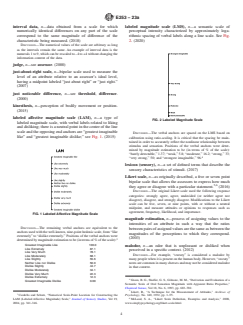
labeled affective magnitude scale (LAM), n—a type of labeled magnitude scale, with verbal labels related to liking and
disliking; there is a neutral point in the center of the line scale and the opposing end anchors are “greatest imaginable like” and
“greatest imaginable dislike;” see Fig. 1. (2015)
FIG. 1 Labeled Affective Magnitude Scale
DISCUSSION—
The remaining verbal anchors are equivalent to the anchors used with the well-known, nine-point hedonic scale, from “like extremely” to “dislike
extremely.” Positions of the verbal anchors were determined by magnitude estimation to be (in terms of % of the scale):
Greatest Imaginable Like 100.0
Like Extremely 87.1
Cardello and Schutz, “Numerical Scale-Point Location for Constructing the LAM (Labeled Affective Magnitude) Scale,” Journal of Sensory Studies, Vol 19, 2004, pp.
341–346.
E253 − 23a
Like Very Much 78.1
Like Moderately 68.1
Like Slightly 55.6
Neither Like nor Dislike 50.0
Dislike Slightly 44.7
Dislike Moderately 34.1
Dislike Very Much 22.3
Dislike Extremely 12.3
Greatest Imaginable Dislike 0.00
labeled magnitude scale (LMS), n—a semantic scale of perceptual intensity characterized by approximately logarithmic
spacing of verbal labels along a line scale. See Fig. 2. (2020)
FIG. 2 Labeled Magnitude Scale
DISCUSSION—
The verbal anchors are spaced on the LMS based on calibration using ratio-scaling. It is critical that the spacing be maintained in order to accurately
reflect the nonlinear relationship between stimulus and sensation. Positions of the verbal anchors were determined by magnitude estimation to be (in
terms of % of the scale): “barely detectable,” 1.37; “weak,” 5.8; “moderate,” 16.2; “strong,” 33; “very strong,” 50; and “strongest imaginable,” 96.
lexicon (sensory), n—a set of defined terms that describe the sensory characteristics of stimuli. (2017)
Likert scale, n—as originally described, a five or seven point bipolar scale that allows the assessors to express how much they
5,6
agree or disagree with a particular statement. (2016)
DISCUSSION—
The original Likert scale used the following response categories: strongly agree, agree, undecided (or neither agree nor disagree), disagree, and strongly
disagree. Modifications to the Likert scale can be five, seven, or nine points, with or without a neutral midpoint, and measure attitudes or o
...