

ASTM D5466-21
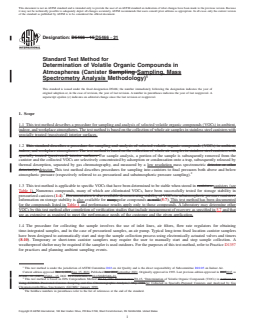
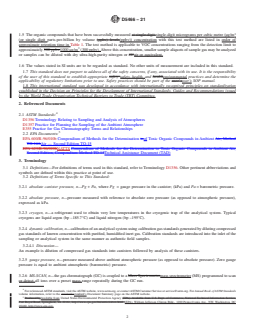
(Test Method)Standard Test Method for Determination of Volatile Organic Compounds in Atmospheres (Canister Sampling, Mass Spectrometry Analysis Methodology)
General Information
- Abstract
SIGNIFICANCE AND USE
5.1 VOCs are emitted into ambient, indoor, and workplace air from many different sources. These VOCs are of interest for a variety of reasons including participation in atmospheric chemistry and contributing to air toxics with their associated acute or chronic health impacts.
5.2 Canisters are particularly well suited for the collection and analysis of very volatile and volatile organic compounds because they collect whole gas samples.
5.3 Chemically stable selected VOCs have been successfully collected in passivated stainless steel canisters. Collection of atmospheric samples in canisters provides for: (1) convenient integration of air samples over a specific time period (for example, 8 to 24 h), (2) remote sampling and central laboratory analysis, (3) ease of storing and shipping samples, (4) unattended sample collection, (5) analysis of samples from multiple sites with one analytical system, (6) dilution or additional sample concentration to keep the sample size introduced into the analytical instrument within the calibration range, (7) collection of sufficient sample volume to allow assessment of measurement precision through replicate analyses of the same sample by one or several analytical systems, (8) sample collection using a vacuum regulator flow controller if electricity is not available, and (9) grab sample collection for survey or screening purposes.
5.4 Interior surfaces of the canisters may be treated by any of several proprietary passivation processes including an electropolishing process to remove or cover reactive metal sites on the interior surface of the vessel and a fused silica coating process.
5.5 For this test method, VOCs are defined as organic compounds that can be quantitatively recovered from the canisters having a vapor pressure greater than 10-2 kPa at 25ºC (see Table 1 for examples).
5.6 Target compound polarity is also a factor in compound recovery. Aliphatic and aromatic hydrocarbons from C1 to C13 have been successfull...
SCOPE
1.1 This test method describes a procedure for sampling and analysis of selected volatile organic compounds (VOCs) in ambient, indoor, and workplace atmospheres. The test method is based on the collection of whole air samples in stainless steel canisters with specially treated (passivated) interior surfaces.
1.2 For sample analysis, a portion of the sample is subsequently removed from the canister and the collected VOCs are selectively concentrated by adsorption or condensation onto a trap, subsequently released by thermal desorption, separated by gas chromatography, and measured by a low resolution mass spectrometric detector. This test method describes procedures for sampling into canisters to final pressures both above and below atmospheric pressure (respectively referred to as pressurized and subatmospheric pressure sampling).2
1.3 This test method is applicable to specific VOCs that have been determined to be stable when stored in canisters (see Table 1). Numerous compounds, many of which are chlorinated VOCs, have been successfully tested for storage stability in pressurized canisters (1-4).3 Information on storage stability is also available for polar compounds (5-7). This test method has been documented for the compounds listed in Table 1 and performance results apply only to those compounds. A laboratory may determine other VOCs by this test method after completion of verification studies that include measurement of recovery as specified in 5.7 and that are as extensive as required to meet the performance needs of the customer and the given application.
1.4 The procedure for collecting the sample involves the use of inlet lines, air filters, flow rate regulators for obtaining time-integrated samples, and in the case of pressurized samples, an air pump. Typical long-term fixed location canister samplers have been designed to automatically start and stop the sample collection process using electronically...
- Status
- Published
- Publication Date
- 14-Aug-2021
- Technical Committee
- D22 - Air Quality
- Drafting Committee
- D22.05 - Indoor Air
Buy Documents
ASTM D5466-21 - Standard Test Method for Determination of Volatile Organic Compounds in Atmospheres (Canister Sampling, Mass Spectrometry Analysis Methodology)
REDLINE ASTM D5466-21 - Standard Test Method for Determination of Volatile Organic Compounds in Atmospheres (Canister Sampling, Mass Spectrometry Analysis Methodology)
Overview
ASTM D5466-21: Standard Test Method for Determination of Volatile Organic Compounds in Atmospheres (Canister Sampling, Mass Spectrometry Analysis Methodology) provides a comprehensive methodology for sampling and analyzing volatile organic compounds (VOCs) in ambient, indoor, and workplace air. This widely recognized ASTM standard outlines the procedures for collecting air samples using specially treated (passivated) stainless steel canisters and analyzing the collected VOCs using gas chromatography coupled with mass spectrometry (GC/MS).
VOCs are emitted from a variety of sources and are of interest due to their role in atmospheric chemistry and potential health impacts. This standard ensures reliable and reproducible VOC measurement, aiding in environmental compliance, air quality assessment, and occupational health studies.
Key Topics
Canister Sampling Method:
- Use of stainless steel canisters with passivated interiors for collecting whole air samples.
- Applicable for both pressurized and subatmospheric pressure sampling, allowing flexibility for diverse environments and sampling needs.
- Canisters are suitable for a wide range of VOCs, including very volatile and volatile compounds.
Analytical Techniques:
- Samples are concentrated onto a trap, typically involving adsorption or condensation, followed by thermal desorption.
- Separation of compounds is performed by gas chromatography.
- Detection and quantification use a mass spectrometric detector, ensuring positive compound identification and quantitation.
Sample Handling and Storage:
- Emphasizes the importance of sample integrity, including proper cleaning of canisters and sample system components.
- Storage stability for specific VOCs is addressed; recovery studies must be conducted for additional compounds.
Scope and Limitations:
- Applies to a variety of VOCs, notably those with sufficient vapor pressure and demonstrated canister stability.
- Recognizes the effects of humidity and water management, especially for polar compounds.
- The method supports integration of duplicate analyses, shipping, and unattended or remote sample collection.
Applications
Environmental Monitoring:
- Ambient air quality assessment in urban, industrial, or rural settings.
- Monitoring of toxic air pollutants to meet regulatory or public health requirements.
- Measuring long-term trends in atmospheric VOC concentrations.
Indoor Air Quality:
- Evaluation of indoor environments for VOCs from building materials, cleaning agents, or occupant activities.
- Supports health and safety assessments in occupational settings where VOC exposure is a concern.
Industrial Hygiene and Workplace Safety:
- Ensures compliance with occupational exposure limits for VOCs.
- Identifies sources of chemical emissions and supports risk assessments.
Research and Regulatory Compliance:
- Fulfills requirements for comprehensive VOC monitoring in accordance with EPA and ASTM guidelines.
- Supports scientific studies on VOC transport, transformation, and fate in different environments.
Related Standards
- ASTM D1356 – Terminology Relating to Sampling and Analysis of Atmospheres
- ASTM D1357 – Practice for Planning the Sampling of the Ambient Atmosphere
- ASTM E355 – Practice for Gas Chromatography Terms and Relationships
- EPA TO-14A and TO-15 – Compendium of Methods for the Determination of Toxic Organic Compounds in Ambient Air
Practical Value
Implementing ASTM D5466-21 provides a robust, validated approach for VOC sampling and analysis. The methodology offers high sensitivity and specificity, supports a broad range of compounds, and is compatible with remote, unattended, and time-integrated sampling. Laboratories, environmental agencies, and industry professionals can rely on this standard for accurate VOC determination to ensure compliance, maintain workplace safety, and support environmental health initiatives.
For those seeking standardized solutions to air monitoring challenges, ASTM D5466-21 delivers proven reliability and consistent results across varied applications. Adherence to this standard can enhance data quality, facilitate regulatory acceptance, and improve decision-making for air quality management.
Relations
- Effective Date
- 01-Sep-2020
- Effective Date
- 15-Mar-2020
- Effective Date
- 01-Aug-2019
- Effective Date
- 15-Oct-2015
- Effective Date
- 01-Jul-2015
- Effective Date
- 01-Dec-2014
- Effective Date
- 01-May-2014
- Effective Date
- 15-Jan-2014
- Effective Date
- 01-Oct-2011
- Effective Date
- 01-Apr-2010
- Effective Date
- 01-Mar-2007
- Effective Date
- 01-May-2005
- Effective Date
- 01-Mar-2005
- Effective Date
- 01-Jan-2001
- Effective Date
- 01-Jan-2001
Buy Documents
ASTM D5466-21 - Standard Test Method for Determination of Volatile Organic Compounds in Atmospheres (Canister Sampling, Mass Spectrometry Analysis Methodology)
REDLINE ASTM D5466-21 - Standard Test Method for Determination of Volatile Organic Compounds in Atmospheres (Canister Sampling, Mass Spectrometry Analysis Methodology)
Get Certified
Connect with accredited certification bodies for this standard

CIS Institut d.o.o.
Personal Protective Equipment (PPE) certification body. Notified Body NB-2890 for EU Regulation 2016/425 PPE.

Kiwa BDA Testing
Building and construction product certification.
Kmetijski inštitut Slovenije
Agricultural Institute of Slovenia. Soil testing, plant health, agricultural product analysis.
Sponsored listings
Frequently Asked Questions
ASTM D5466-21 is a standard published by ASTM International. Its full title is "Standard Test Method for Determination of Volatile Organic Compounds in Atmospheres (Canister Sampling, Mass Spectrometry Analysis Methodology)". This standard covers: SIGNIFICANCE AND USE 5.1 VOCs are emitted into ambient, indoor, and workplace air from many different sources. These VOCs are of interest for a variety of reasons including participation in atmospheric chemistry and contributing to air toxics with their associated acute or chronic health impacts. 5.2 Canisters are particularly well suited for the collection and analysis of very volatile and volatile organic compounds because they collect whole gas samples. 5.3 Chemically stable selected VOCs have been successfully collected in passivated stainless steel canisters. Collection of atmospheric samples in canisters provides for: (1) convenient integration of air samples over a specific time period (for example, 8 to 24 h), (2) remote sampling and central laboratory analysis, (3) ease of storing and shipping samples, (4) unattended sample collection, (5) analysis of samples from multiple sites with one analytical system, (6) dilution or additional sample concentration to keep the sample size introduced into the analytical instrument within the calibration range, (7) collection of sufficient sample volume to allow assessment of measurement precision through replicate analyses of the same sample by one or several analytical systems, (8) sample collection using a vacuum regulator flow controller if electricity is not available, and (9) grab sample collection for survey or screening purposes. 5.4 Interior surfaces of the canisters may be treated by any of several proprietary passivation processes including an electropolishing process to remove or cover reactive metal sites on the interior surface of the vessel and a fused silica coating process. 5.5 For this test method, VOCs are defined as organic compounds that can be quantitatively recovered from the canisters having a vapor pressure greater than 10-2 kPa at 25ºC (see Table 1 for examples). 5.6 Target compound polarity is also a factor in compound recovery. Aliphatic and aromatic hydrocarbons from C1 to C13 have been successfull... SCOPE 1.1 This test method describes a procedure for sampling and analysis of selected volatile organic compounds (VOCs) in ambient, indoor, and workplace atmospheres. The test method is based on the collection of whole air samples in stainless steel canisters with specially treated (passivated) interior surfaces. 1.2 For sample analysis, a portion of the sample is subsequently removed from the canister and the collected VOCs are selectively concentrated by adsorption or condensation onto a trap, subsequently released by thermal desorption, separated by gas chromatography, and measured by a low resolution mass spectrometric detector. This test method describes procedures for sampling into canisters to final pressures both above and below atmospheric pressure (respectively referred to as pressurized and subatmospheric pressure sampling).2 1.3 This test method is applicable to specific VOCs that have been determined to be stable when stored in canisters (see Table 1). Numerous compounds, many of which are chlorinated VOCs, have been successfully tested for storage stability in pressurized canisters (1-4).3 Information on storage stability is also available for polar compounds (5-7). This test method has been documented for the compounds listed in Table 1 and performance results apply only to those compounds. A laboratory may determine other VOCs by this test method after completion of verification studies that include measurement of recovery as specified in 5.7 and that are as extensive as required to meet the performance needs of the customer and the given application. 1.4 The procedure for collecting the sample involves the use of inlet lines, air filters, flow rate regulators for obtaining time-integrated samples, and in the case of pressurized samples, an air pump. Typical long-term fixed location canister samplers have been designed to automatically start and stop the sample collection process using electronically...
SIGNIFICANCE AND USE 5.1 VOCs are emitted into ambient, indoor, and workplace air from many different sources. These VOCs are of interest for a variety of reasons including participation in atmospheric chemistry and contributing to air toxics with their associated acute or chronic health impacts. 5.2 Canisters are particularly well suited for the collection and analysis of very volatile and volatile organic compounds because they collect whole gas samples. 5.3 Chemically stable selected VOCs have been successfully collected in passivated stainless steel canisters. Collection of atmospheric samples in canisters provides for: (1) convenient integration of air samples over a specific time period (for example, 8 to 24 h), (2) remote sampling and central laboratory analysis, (3) ease of storing and shipping samples, (4) unattended sample collection, (5) analysis of samples from multiple sites with one analytical system, (6) dilution or additional sample concentration to keep the sample size introduced into the analytical instrument within the calibration range, (7) collection of sufficient sample volume to allow assessment of measurement precision through replicate analyses of the same sample by one or several analytical systems, (8) sample collection using a vacuum regulator flow controller if electricity is not available, and (9) grab sample collection for survey or screening purposes. 5.4 Interior surfaces of the canisters may be treated by any of several proprietary passivation processes including an electropolishing process to remove or cover reactive metal sites on the interior surface of the vessel and a fused silica coating process. 5.5 For this test method, VOCs are defined as organic compounds that can be quantitatively recovered from the canisters having a vapor pressure greater than 10-2 kPa at 25ºC (see Table 1 for examples). 5.6 Target compound polarity is also a factor in compound recovery. Aliphatic and aromatic hydrocarbons from C1 to C13 have been successfull... SCOPE 1.1 This test method describes a procedure for sampling and analysis of selected volatile organic compounds (VOCs) in ambient, indoor, and workplace atmospheres. The test method is based on the collection of whole air samples in stainless steel canisters with specially treated (passivated) interior surfaces. 1.2 For sample analysis, a portion of the sample is subsequently removed from the canister and the collected VOCs are selectively concentrated by adsorption or condensation onto a trap, subsequently released by thermal desorption, separated by gas chromatography, and measured by a low resolution mass spectrometric detector. This test method describes procedures for sampling into canisters to final pressures both above and below atmospheric pressure (respectively referred to as pressurized and subatmospheric pressure sampling).2 1.3 This test method is applicable to specific VOCs that have been determined to be stable when stored in canisters (see Table 1). Numerous compounds, many of which are chlorinated VOCs, have been successfully tested for storage stability in pressurized canisters (1-4).3 Information on storage stability is also available for polar compounds (5-7). This test method has been documented for the compounds listed in Table 1 and performance results apply only to those compounds. A laboratory may determine other VOCs by this test method after completion of verification studies that include measurement of recovery as specified in 5.7 and that are as extensive as required to meet the performance needs of the customer and the given application. 1.4 The procedure for collecting the sample involves the use of inlet lines, air filters, flow rate regulators for obtaining time-integrated samples, and in the case of pressurized samples, an air pump. Typical long-term fixed location canister samplers have been designed to automatically start and stop the sample collection process using electronically...
ASTM D5466-21 is classified under the following ICS (International Classification for Standards) categories: 13.040.01 - Air quality in general. The ICS classification helps identify the subject area and facilitates finding related standards.
ASTM D5466-21 has the following relationships with other standards: It is inter standard links to ASTM D1356-20a, ASTM D1356-20, ASTM D1357-95(2019), ASTM D1356-15a, ASTM D1356-15, ASTM D1356-14b, ASTM D1356-14a, ASTM D1356-14, ASTM D1357-95(2011), ASTM D1356-05(2010), ASTM E355-96(2007), ASTM D1356-05, ASTM D1357-95(2005), ASTM E355-96, ASTM E355-96(2001). Understanding these relationships helps ensure you are using the most current and applicable version of the standard.
ASTM D5466-21 is available in PDF format for immediate download after purchase. The document can be added to your cart and obtained through the secure checkout process. Digital delivery ensures instant access to the complete standard document.
Standards Content (Sample)
This international standard was developed in accordance with internationally recognized principles on standardization established in the Decision on Principles for the
Development of International Standards, Guides and Recommendations issued by the World Trade Organization Technical Barriers to Trade (TBT) Committee.
Designation: D5466 − 21
Standard Test Method for
Determination of Volatile Organic Compounds in
Atmospheres (Canister Sampling, Mass Spectrometry
Analysis Methodology)
This standard is issued under the fixed designation D5466; the number immediately following the designation indicates the year of
original adoption or, in the case of revision, the year of last revision.Anumber in parentheses indicates the year of last reapproval.A
superscript epsilon (´) indicates an editorial change since the last revision or reapproval.
1. Scope 1.4 Theprocedureforcollectingthesampleinvolvestheuse
of inlet lines, air filters, flow rate regulators for obtaining
1.1 Thistestmethoddescribesaprocedureforsamplingand
time-integrated samples, and in the case of pressurized
analysis of selected volatile organic compounds (VOCs) in
samples,anairpump.Typicallong-termfixedlocationcanister
ambient, indoor, and workplace atmospheres. The test method
samplershavebeendesignedtoautomaticallystartandstopthe
isbasedonthecollectionofwholeairsamplesinstainlesssteel
sample collection process using electronically actuated valves
canisters with specially treated (passivated) interior surfaces.
and timers (8-10). Temporary or short-term canister samplers
1.2 For sample analysis, a portion of the sample is subse-
may require the user to manually start and stop sample
quently removed from the canister and the collectedVOCs are
collection. A weatherproof shelter may be required if the
selectively concentrated by adsorption or condensation onto a
sampler is used outdoors. For the purposes of this test method,
trap,subsequentlyreleasedbythermaldesorption,separatedby
refer to Practice D1357 for practices and planning ambient
gas chromatography, and measured by a low resolution mass
sampling events.
spectrometric detector. This test method describes procedures
for sampling into canisters to final pressures both above and 1.5 The organic compounds that have been successfully
below atmospheric pressure (respectively referred to as pres- measured single-digit micrograms per cubic metre (µg/m (or
surized and subatmospheric pressure sampling). single digit parts-per-billion by volume (ppbv)) concentration
with this test method are listed in order of approximate
1.3 This test method is applicable to specific VOCs that
retentiontimeinTable1.ThetestmethodisapplicabletoVOC
havebeendeterminedtobestablewhenstoredincanisters(see
concentrations ranging from the detection limit to approxi-
Table 1). Numerous compounds, many of which are chlori-
mately 1000 µg/m (300 ppbv). Above this concentration,
natedVOCs,havebeensuccessfullytestedforstoragestability
smaller sample aliquots of sample gas may be analyzed or
in pressurized canisters (1-4). Information on storage stability
samples can be diluted with dry ultra-high-purity nitrogen or
is also available for polar compounds (5-7). This test method
air or equivalent.
has been documented for the compounds listed in Table 1 and
performance results apply only to those compounds.Alabora-
1.6 The values stated in SI units are to be regarded as
tory may determine other VOCs by this test method after
standard. No other units of measurement are included in this
completion of verification studies that include measurement of
standard.
recovery as specified in 5.7 and that are as extensive as
1.7 This standard does not purport to address all of the
requiredtomeettheperformanceneedsofthecustomerandthe
safety concerns, if any, associated with its use. It is the
given application.
responsibility of the user of this standard to establish appro-
priate safety, health, and environmental practices and deter-
This test method is under the jurisdiction of ASTM Committee D22 on Air
mine the applicability of regulatory limitations prior to use.
Quality and is the direct responsibility of Subcommittee D22.05 on Indoor Air.
Current edition approved Aug. 15, 2021. Published September 2021. Originally
Safety practices should be part of the user’s SOP manual.
approved in 1993. Last previous edition approved in 2015 as D5466–15. DOI:
1.8 This international standard was developed in accor-
10.1520/D5466-21.
dance with internationally recognized principles on standard-
ThistestmethodisbasedonEPACompendiumMethodTO-15,“Determination
of Volatile Organic Compounds (VOCs) in Air Collected in Specially-Prepared
ization established in the Decision on Principles for the
Canisters and Analyzed by Gas Chromatography/Mass Spectrometry (GC/MS)”
Development of International Standards, Guides and Recom-
January 1999.
mendations issued by the World Trade Organization Technical
Theboldfacenumbersinparenthesesrefertothelistofreferencesattheendof
the standard. Barriers to Trade (TBT) Committee.
Copyright © ASTM International, 100 Barr Harbor Drive, PO Box C700, West Conshohocken, PA 19428-2959. United States
D5466 − 21
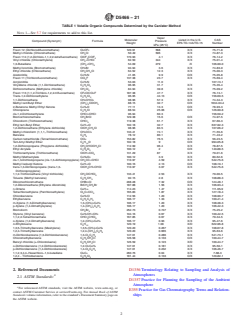
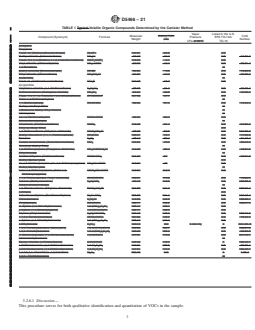
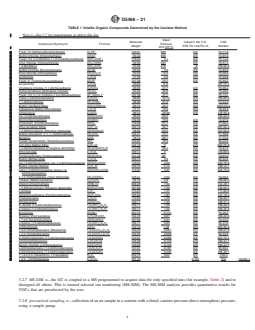
TABLE 1 Volatile Organic Compounds Determined by the Canister Method
NOTE 1—See 5.7 for requirements to add to this list.
Vaper
Molecular Listed in the U.S. CAS
Compound (Synonym) Formula Pressure
Weight EPA TO-14A/TO-15 Number
kPa (25°C)
Freon 12 (Dichlorodifluoromethane) Cl CF 120.91 568 X/X 75-71-8
2 2
Methyl chloride (Chloromethane) CH Cl 50.49 506 X/X 74-87-3
Freon 114 (1,2-Dichloro-1,1,2,2-tetrafluoroethane) ClCF CClF 170.93 4.1 X/X 76-14-2
2 2
Vinyl chloride (Chloroethylene) CH =CHCl 62.50 344 X/X 75-01-4
1,3-Butadiene (CH =CH) 54.09 279 /X 106-99-0
2 2
Methyl bromide (Bromomethane) CH Br 94.94 3.6 X/X 74-83-9
Ethyl chloride (Chloroethane) CH CH Cl 64.52 12.3 X/X 75-00-3
3 2
Acetonitrile C H N 41.05 9.9 O/X 75-05-8
2 3
Freon 11 (Trichlorofluoromethane) CCl F 137.38 23.7 X/X 75-69-4
Acrylonitrile C H N 53.03 11.0 107-13-1
2 3
Vinylidene chloride (1,1-Dichloroethene) C H Cl 96.95 31.7 X/X 75-35-4
2 2 2
Dichloromethane (Methylene chloride) CH Cl 84.94 39.8 X/X 75-09-2
2 2
Freon 113 (1,1,2-Trichloro-1,2,2-trifluoroethane) CF ClCCl F 187.38 47.7 X/X 76-13-1
2 2
Trans-1,2-Dichloroethylene C H CI 96.95 44.13 O/X 156-60-5
2 2 2
1,1-Dichloroethane CH CHCl 98.96 57.3 X/X 74-34-3
3 2
Methyl tert-Butyl Ether (CH ) COCH 88.15 32.7 O/X 1634-04-4
3 3 3
2-Butanone Methyl Ethyl Ketone C H O 77.11 13.3 O/X 78-93-3
4 e
Chloroprene C H Cl 88.54 25.06 O/X 126-99-8
4 5
cis-1,2-Dichloroethylene CHCl=CHCl 96.94 60.3 156-59-2
Bromochloromethane CH BrCl 129.38 15.6 O/X 74-97-5
Chloroform (Trichloromethane) CHCl 119.38 61.7 X/X 67-66-3
Ethyl tert-Butyl Ether C H O 102.18 32.7 X/X 637-92-3
6 14
1,2-Dichloroethane (Ethylene dichloride) ClCH CH Cl 98.96 83.5 X/X 107-06-2
2 2
Methyl chloroform (1,1,1,-Trichloroethane) CH CCl 133.41 74.1 X/X 71-55-6
3 3
Benzene C H 78.12 80.1 X/X 71-43-2
6 6
Carbon tetrachloride (Tetrachloromethane) CCl 153.82 76.5 X/X 56-23-5
Tert-Amyl Methyl Ether C H O 102.18 9 O/X 994-05-8
6 14
1,2-Dichloropropane (Propylene dichloride) CH CHClCH Cl 112.99 96.4 X/X 78-87-5
3 2
Ethyl Acrylate C H O 100.12 2 O/X 140-88-5
5 8 2
Trichloroethylene (Trichloroethene) ClCH=CCl 131.29 87 X/X 79-01-6
Methyl Methacrylate C H O 100.12 3.9 X/X 80-62-6
5 8 2
cis-1,3-Dichloropropene (cis-1,3-dichloropropylene) CH CC=CHCl 110.97 4.59 X/X 542-75-6
Methyl Isobutyl Ketone C H O 100.16 2.13 O/X 108-10-1
6 12
trans-1,3-Dichloropropene (trans-1,3- ClCH CH=CHCl 110.97 3.07 X/X 542-75-6
Dichloropropylene)
1,1,2-Trichloroethane (Vinyl trichloride) CH ClCHCl 133.41 2.53 X/X 79-00-5
2 2
Toluene (Methyl benzene) C H CH 92.15 2.8 X/X 108-88-3
6 5 3
Dibromochloromethane CHBr Cl 208.28 7.32 O/X 124-48-1
1,2-Dibromoethane (Ethylene dibromide) BrCH CH Br 187.88 1.56 X/X 106-93-4
2 2
n-Octane C H 114.23 1.47 X/X 111-65-9
8 18
Tetrachloroethylene (Perchloroethylene) Cl C=CCl 165.83 1.87 X/X 127-18-4
2 2
Chlorobenzene C H Cl 112.56 1.20 X/X 108-90-7
6 5
Ethylbenzene C H C H 106.17 1.33 X/X 100-41-4
6 5 2 5
m-Xylene (1,3-Dimethylbenzene) 1,3-(CH ) C H 106.17 1.20 X/X 108-38-3
3 2 6 4
p-Xylene (1,4-Dimethylxylene) 1,4-(CH ) C H 106.17 1.20 X/X 106-42-3
3 2 6 4
Bromoform CH Br 252.73 0.747 X/X 75-25-2
2 3
Styrene (Vinyl benzene) C H CH=CH 104.16 0.67 X/X 100-42-5
6 5 2
1,1,2,2-Tetrachloroethane CHCl CHCl 167.85 0.67 X/X 79-34-5
2 2
o-Xylene (1,2-Dimethylbenzene) 1,2-(CH ) C H 106.17 0.93 X/X 95-47-6
3 2 6 4
4-Ethyltoluene C H 120.19 1.38 X/O 622-96-8
9 12
1,3,5-Trimethylbenzene (Mesitylene) 1,3,5-(CH ) C H 120.20 0.267 X/X 108-67-8
3 3 6 6
1,2,4-Trimethylbenzene 1,2,4-(CH ) C H 120.20 0.665 X/X 95-63-6
3 3 6 6
m-Dichlorobenzene (1,3-Dichlorobenzene) 1,3-Cl C H 147.01 0.286 X/X 541-73-1
2 6 4
Chloromethylbenzene C H CH Cl 126.58 0.133 O/X 100-44-7
6 5 2
Benzyl chloride (α-Chlorotoluene) C H CH Cl 126.59 0.123 X/O 100-44-7
6 5 2
o-Dichlorobenzene (1,2-Dichlorobenzene) 1,2-Cl C H 147.01 0.181 X/X 95-50-1
2 6 4
p-Dichlorobenzene (1,4-Dichlorobenzene) 1,4-Cl C H 147.01 0.232 X/X 106-46-7
2 6 4
1,1,2,3,4,4–Hexachloro–1,3-butadiene Cl C 260.76 0.04 X/X 7-68-3
6 4
1,2,4 - Trichlorbenzene C H Cl 181.44 0.133 O/X 120-82-1
6 3 3
2. Referenced Documents D1356Terminology Relating to Sampling and Analysis of
Atmospheres
2.1 ASTM Standards:
D1357Practice for Planning the Sampling of the Ambient
Atmosphere
For referenced ASTM standards, visit the ASTM website, www.astm.org, or
E355PracticeforGasChromatographyTermsandRelation-
contact ASTM Customer Service at service@astm.org. For Annual Book of ASTM
Standards volume information, refer to the standard’s Document Summary page on ships
the ASTM website.
D5466 − 21
2.2 EPA Documents: 3.2.10 quantitative accuracy, n—the ability of an analytical
EPA600/R-96/010bCompendiumofMethodsfortheDeter- system to correctly measure the concentration of an identified
mination ofToxic Organic Compounds inAmbientAir — compound.
Second Edition TO-15
3.2.11 static calibration, n—calibration of an analytical
NATTSTechnical Assistance Document (TAD)
system using standards in a form that is different than the form
of the samples to be analyzed.
3. Terminology
3.2.11.1 Discussion—An example of a static calibration is
injection of a small volume of a high concentration standard
3.1 Definitions—For definitions of terms used in this
directly onto a GC column, bypassing the sample extraction
standard, refer to Terminology D1356. Other pertinent abbre-
and preconcentration portion of the analytical system.
viationsandsymbolsaredefinedwithinthispracticeatpointof
use.
3.2.12 subatmospheric sampling, n—collection of an air
3.2 Definitions of Terms Specific to This Standard:
sample in an evacuated canister to a (final) canister pressure
3.2.1 absolute canister pressure, n—Pg + Pa, where Pg below atmospheric pressure, with or without the assistance of
=gauge pressure in the canister; (kPa) and Pa=barometric a sampling pump.
pressure. 3.2.12.1 Discussion—The canister is filled as the internal
canister pressure increases to ambient or near ambient pres-
3.2.2 absolute pressure, n—pressure measured with refer-
sure. An auxiliary vacuum pump may be used as part of the
ence to absolute zero pressure (as opposed to atmospheric
sampling system to flush the inlet tubing prior to or during
pressure), expressed as kPa.
sample collection.
3.2.3 cryogen, n—a refrigerant used to obtain very low
3.2.13 verification, n—the process of demonstrating with
temperatures in the cryogenic trap of the analytical system.
humid zero air and humid calibration gases that the sampling
Typical cryogens are liquid argon (bp –185.7°C) and liquid
system components and the canister do not contribute positive
nitrogen (bp –195°C).
or negative bias to the analysis results.
3.2.4 dynamic calibration, n—calibration of an analytical
4. Summary of Test Method
system using calibration gas standards generated by diluting
compressed gas standards of known concentration with 4.1 The method is taken from published work (1-22) and is
purified, humidified inert gas. Calibration standards are intro-
thebasisofEPACompendiumMethodsTO-14AandTO-15.It
duced into the inlet of the sampling or analytical system in the hasbeenusedsincetheearly1980sinstudiestoestablishlong
same manner as authentic field samples.
term trends in certain atmospheric gases (11), to determine the
prevalence and extent of VOC contributions to ozone produc-
3.2.4.1 Discussion—An example is dilution of compressed
tion (12), and to determine the concentrations of selected
gas standards into canisters followed by analysis of these
VOCs in ambient air (13, 14).
canisters.
4.2 Bothsubatmosphericpressureandpressurizedsampling
3.2.5 gauge pressure, n—pressure measured above ambient
modes using a passivated, evacuated canister are described.
atmospheric pressure (as opposed to absolute pressure). Zero
4.2.1 Procedures are provided for canister cleaning and
gauge pressure is equal to ambient atmospheric (barometric)
performance evaluation.
pressure.
4.2.2 A sampling line less than2%ofthe volume of the
3.2.6 MS-SCAN, n—thegaschromatograph(GC)iscoupled
canister, or a pump-ventilated sample line, is used during
to a mass spectrometer (MS) programmed to scan or detect all
samplecollection.Asampleofairisdrawnthroughasampling
ions over a preset mass range repeatedly during the GC run.
train consisting of components that regulate the rate and
3.2.6.1 Discussion—This procedure serves for both qualita-
duration of sampling into a pre-cleaned and pre-evacuated
tive identification and quantitation of VOCs in the sample.
canister.
4.2.3 Pressurized sampling requires an additional pump to
3.2.7 MS-SIM, n—the GC is coupled to a MS programmed
provide positive pressure to the canister.
to acquire data for only specified ions (for example, Table 2)
and to disregard all others. This is termed selected ion
4.3 After the air sample is collected, the canister isolation
monitoring (MS-SIM). The MS-SIM analysis provides quan-
valve is closed, the canister is removed from the sampler, an
titative results for VOCs that are preselected by the user.
identification tag is attached to the canister, and the canister is
transported to a laboratory for analysis.
3.2.8 pressurized sampling, n—collection of an air sample
in a canister with a (final) canister pressure above atmospheric 4.4 Upon receipt at the laboratory, the canister is examined
pressure, using a sample pump. to verify the inlet valve is closed, there is no or insignificant
damage of the sample container, the chain of custody is
3.2.9 qualitative accuracy, n—the ability of an analytical
complete from the field, and the canister is attached to a
system to correctly identify compounds.
pressure gauge to accurately measure the final canister pres-
sure.
4.5 For analysis, VOCs are concentrated by collection in a
AvailablefromUnitedStatesEnvironmentalProtectionAgency(EPA),William
trap with or without cryogenic cooling. The VOCs are ther-
Jefferson Clinton Bldg., 1200 Pennsylvania Ave., NW, Washington, DC 20460,
http://www.epa.gov. mally desorbed from the trap into a small volume of carrier
D5466 − 21
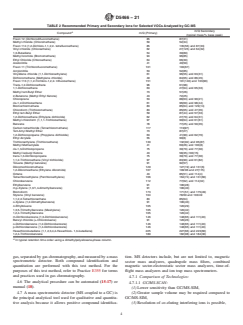
TABLE 2 Recommended Primary and Secondary Ions for Selected VOCs Analyzed by GC-MS
m/Q Secondary
A
Compound m/Q (Primary)
(typical mass/% base peak)
Freon 12 (Dichlorodifluoromethane) 85 87(31)
Methyl chloride (Chloromethane) 50 52(34)
Freon 114 (1,2-Dichloro-1,1,2,2- tetrafluoroethane) 85 135(56) and 87(33)
Vinyl chloride (Chloroethene) 62 27(125) and 64(32)
1,3-Butadiene 54 39(89)
Methyl bromide (Bromomethane) 94 96(85)
Ethyl Chloride (Chloroethane) 64 66(30)
Acetonitrile 41 40(50)
Freon 11 (Trichlorofluoromethane) 101 103(67)
Acrylonitrile 53 52(85)
Vinylidene chloride (1,1-Dichloroethylene) 61 96(55) and 63(31)
Dichloromethane (Methylene chloride) 49 84(65) and 86(45)
Freon 113 (1,1,2-Trichloro-1,2,2- trifluoroethane) 151 101(140) and 103(90)
Trans-1,2-Dichloroethene 96 61(98)
1,1-Dichloroethane 63 27(64) and 65(33)
Methyl tert-Butyl Ether 73 57(26)
2-Butanone (Methyl Ethyl Ketone) 43 72(25)
Chloroprene 53 88(63) and 90(21)
cis-1,2-Dichloroethene 61 96(60) and 98(44)
Bromochlormethane 83 85(64) and 129(14)
Chloroform (Trichloromethane) 83 85(65) and 47(35)
Ethyl tert-Butyl Ether 59 87(44) and 57(33)
1,2-Dichloroethane (Ethylene dichloride) 62 27(70) and 64(31)
Methyl chloroform (1,1,1-Trichloroethane) 97 99(64) and 61(61)
Benzene 78 77(25) and 50(35)
Carbon tetrachloride (Tetrachloromethane) 117 119(97)
Tert-Amyl Methyl Ether 73 87(27)
1,2-Dichloropropane (Propylene dichloride) 63 41(90) and 62(70)
Ethyl Acrylate 55 99(8)
Trichloroethylene (Trichloroethene) 130 132(92) and 95(87)
Methyl Methacrylate 41 69(26) and 100(8)
cis-1,3-Dichloropropene 75 39(70) and 77(30)
Methyl Isobutyl Ketone 43 58(35),100(15)
trans-1,3-Dichloropropene 75 39(70) and 77(30)
1,1,2-Trichloroethane (Vinyl trichloride) 97 83(90) and 61(82)
Toluene (Methyl benzene) 91 92(57)
Dibromochloromethane 129 127(19) and 131(6)
1,2-Dibromoethane (Ethylene dibromide) 107 109/96 and 27(115)
Octane 43 85(51) and 114(4)
Tetrachloroethylene (Perchloroethylene) 166 164(74) and 131(60)
Chlorobenzene 112 77(62) and 114(32)
Ethylbenzene 91 106(28)
m,p-Xylene (1,3/1,4-dimethylbenzene) 91 106(40)
Bromoform 173 171(51) and 175(49)
Styrene (Vinyl benzene) 104 78/60 and 103/49
1,1,2,2-Tetrachloroethane 83 85(64)
o-Xylene (1,2-Dimethylbenzene) 91 106(40)
4-Ethyltoluene 105 120(29)
1,3,5-Trimethylbenzene (Mesitylene) 105 120(42)
1,2,4-Trimethylbenzene 105 120(42)
m-Dichlorobenzene (1,3-Dichlorobenzene) 146 148(65) and 111(40)
Benzyl chloride (α-Chlorotoluene) 91 126(26)
o-Dichlorobenzene (1,2-Dichlorobenzene) 146 148(65) and 111(40)
p-Dichlorobenzene (1,4-Dichlorobenzene) 146 148(65) and 111(40)
Hexachlorobutadiene (1,1,2,3,4,4-Hexachloro- 1,3-butadiene) 225 227(66) and 223(60)
1,2,4-Trichlorobenzene 180 182(98) and 184(30)
A
In typical retention time order using a dimethylpolysiloxane-phase column.
gas,separatedbygaschromatography,andmeasuredbyamass tion. MS detectors include, but are not limited to, magnetic
spectrometric detector. Both compound identification and
sector mass analyzers, quadrupole mass filters, combined
quantitation are performed with this test method. For the
magnetic sector-electrostatic sector mass analyzers, time-of-
purposes of this test method, refer to Practice E355 for terms
flight mass analyzers and ion trap mass spectrometers.
and practices used in gas chromatography.
4.7.1 Comparison of Technologies:
4.6 The analytical procedure can be automated (15-17) or
4.7.1.1 GC/MS-SCAN:
manual (18).
(1)Lower sensitivity than GC/MS-SIM,
(2)Greater sample volume may be required compared to
4.7 Amass spectrometric detector (MS coupled to a GC) is
GC/MS-SIM,
the principal analytical tool used for qualitative and quantita-
tive analysis because it allows positive compound identifica- (3)Resolution of co-eluting interfering ions is possible,
D5466 − 21
(4)Positive target compound identification, the analytical instrument within the calibration range, (7)
(5)Non-target compound identification possible, collection of sufficient sample volume to allow assessment of
(6)Quantitative determination of calibrated compounds, measurement precision through replicate analyses of the same
and sample by one or several analytical systems, (8) sample
(7)Qualitativeandsemiquantitativedeterminationofcom- collection using a vacuum regulator flow controller if electric-
pounds not on calibration list. ityisnotavailable,and(9)grabsamplecollectionforsurveyor
4.7.1.2 GC/MS-SIM: screening purposes.
(1)Can’t identify non-target compounds,
5.4 Interior surfaces of the canisters may be treated by any
(2)Less operator interpretation,
of several proprietary passivation processes including an elec-
(3)Higher sensitivity than GC/MS-SCAN,
tropolishing process to remove or cover reactive metal sites on
(4)Less sample volume required to obtain same MDLs
the interior surface of the vessel and a fused silica coating
compared to GC/MS-SCAN, and
process.
(5)Quantitative determination of calibrated compounds.
5.5 For this test method, VOCs are defined as organic
4.7.1.3 GC/TOFMS:
compounds that can be quantitatively recovered from the
(1)Positive target compound identification,
-2
canistershavingavaporpressuregreaterthan10 kPaat25ºC
(2)Non-target compound identification possible,
(see Table 1 for examples).
(3)Resolution of co-eluting interfering ions is possible,
(4)SensitivityisequaltoorbetterthanGC/MS-SIMmode,
5.6 Target compound polarity is also a factor in compound
and
recovery.AliphaticandaromatichydrocarbonsfromC1toC13
(5)Quantitative determination of calibrated compounds.
have been successfully measured with this test method but are
4.7.2 The GC/MS-SCAN option uses a capillary column
not listed in Table 1 (21). Higher polarity target compounds
GC coupled to a MS operated in a scanning mode which
may interact with the canister surface or humidity on the
repeatedlyacquiresawidemassrangeofiondata;theacquired canister surface causing their apparent vapor pressure to
mass spectra are supported by spectral library search routines.
decrease. Polar VOCs such as ethers and esters have been
TheGC/TOFMSoptionusesacapillarycolumnGCcoupledto successfully measured by this test method and are listed in
a TOFMS which acquires wide mass range of ion fragment
Table 1.
data continuously; the mass spectra are supported by library
5.7 RecoverystudiesshallbeconductedonVOCsnotlisted
search routines. These options allow unambiguous compound
in Table 1 before expanding the use of this test method to
identification and cover a wide range of compounds as defined
include these additional compounds. Recovery from humidi-
by the completeness of the spectral libraries, with GC/TOFMS
fied spiked canisters shall agree with the spiked amount by
providing greater sensitivity in most cases. GC/MS-SIM mode
630 %. The laboratory shall be responsible for verifying the
islimitedtoasetofuser-selectedtargetcompounds;thismode
relevant method performance characteristics for each com-
is more sensitive than GC/MS-SCAN by virtue of the longer
pound added to the analyte list as agreed with their custom-
dwell times at the restricted number of m/z values. As the
er(s). The laboratory shall retain records of verification and
number of ions monitored simultaneously in a GC/MS-SIM
make them available to customers upon request.Added VOCs
analysis increases, the sensitivity of this technique approaches
(thatis,thosenotlistedinTable1)shallbeclearlyidentifiedin
GC/MS-SCAN. Maximum sensitivity for GC/MS-SIM is
customer reports
achieved when no more than 4 to 5 ions are monitored
simultaneously.
6. Interferences and Limitations
5. Significance and Use 6.1 Water management can be a significant analytical prob-
lem because VOC preconcentrators may accumulate water
5.1 VOCs are emitted into ambient, indoor, and workplace
vapor as well as VOCs, especially those preconcentrators that
airfrommanydifferentsources.TheseVOCsareofinterestfor
use reduced temperature condensation (for example dehydra-
a variety of reasons including participation in atmospheric
tion traps).
chemistry and contributing to air toxics with their associated
6.1.1 Water can restrict and even stop the sample air flow,
acute or chronic health impacts.
alter chromatography and GC retention times, remove dis-
5.2 Canisters are particularly well suited for the collection
solvedpolarspeciesandadverselyaffecttheoperationofmass
and analysis of very volatile and volatile organic compounds
spectrometric systems. Inline permeable membrane dryers
because they collect whole gas samples.
have historically been used prior to preconcentration and do
5.3 Chemically stable selected VOCs have been success- not produce artifacts for a number of nonpolarVOCs (19, 20).
fullycollectedinpassivatedstainlesssteelcanisters.Collection 6.1.2 Release of an air sample from a pressurized canister
of atmospheric samples in canisters provides for: (1) conve- that contains humid air will result in a systematic increase in
nient integration of air samples over a specific time period (for the humidity of the released sample air if condensed water
example,8to24h),(2)remotesamplingandcentrallaboratory remains on the canister interior (21).
analysis, (3) ease of storing and shipping samples, (4) unat- 6.1.3 In-line permeable dryers may contribute to the loss of
tendedsamplecollection,(5)analysisofsamplesfrommultiple polarspeciesasthesespeciesmayalsopartitionwiththewater
sites with one analytical system, (6) dilution or additional vapor. For those applications where a permeable membrane
sample concentration to keep the sample size introduced into dryerisused,interferencescanalsooccurinsampleanalysisif
D5466 − 21
moisture accumulates in the dryer (see 10.1.1.3). This can be evaluated forVOC testing in air (8-10). Several configurations
avoided by ensuring flow rates of the drying gas are high (for of standard hardware can be used successfully as canister
example, five to ten times the sample flow rate) and the drying sampling units.
gas has a dew point <–50°C. In extreme circumstances, an
7.2.1 Subatmospheric Pressure (see Fig. 1).
automated cleanup procedure that periodically heats the dryer
7.2.1.1 Inlet Line,stainlesssteelorsilicalinedstainlesssteel
toabout100°Cwhilepurgingwithzeroairoraninertgas(such
tubing to connect the sampler to the sample inlet.
as N or He) can help to remove moisture buildup. This
7.2.1.2 Canister, leak-free stainless steel pressure vessels of
procedure does not degrade sample integrity.
desired volume (for example, 6 L), with valve and passivated
interior surfaces.
NOTE 1—Removing moisture from samples may not be necessary with
GC/MS systems that are differentially pumped and that do not employ a
7.2.1.3 Vacuum/Pressure gauge, capable of measuring
membrane drying apparatus.
vacuum (–100 to 0 kPa) and pressure (0 to 200 kPa) in the
6.2 Contamination may occur in the sampling system if sampling system. Gauges shall be tested clean and leak tight.
canisters are not properly cleaned before use.Additionally, all
7.2.1.4 Mass Flow Meter and Controller, capable of main-
other sampling equipment (for example, pump and flow
taining a constant flow rate of less than 10 % change over a
controllers) shall be thoroughly cleaned to ensure that the
samplingperiodofupto24handunderconditionsofchanging
filling apparatus will not contaminate samples. Instructions for
temperature (20 to 40°C) and humidity.
cleaning the canisters and the field sampling system are
7.2.1.5 Filter, 2-µm sintered stainless-steel in-line filter.
described in 11.1 and 11.2, respectively. In addition, sufficient
7.2.1.6 Electronic Timer, capable of activating a solenoid
system and field blank samples shall be analyzed to detect
valve(see7.2.1.7)tostartandstopflowenteringacanister,for
contamination.
example, for unattended sample collection.
6.3 If the preconcentrator-GC/MS analytical system em-
7.2.1.7 Solenoid Valve, electrically operated, latching sole-
ploys a permeable membrane dryer or equivalent to remove
noid valve with fluoroelastomer seat and o-rings, or low
water vapor selectively from the sample stream, polar organic
temperature solenoid valve with fluoroelastomer seat and
compounds will permeate this membrane together with the
o-rings
water.Consequently,theanalystshallcalibratethesystemwith
7.2.1.8 Tubing and Fittings, chromatographic grade stain-
thetargetVOCs.Forquantitativeanalysisofpolarcompounds,
less steel tubing and fittings for interconnections. All such
analytical systems shall not employ permeable membrane
materials in contact with sample, analyte, and support gases
dryers.
priortoanalysisshallbechromatographicgradestainlesssteel.
6.4 The analysis methodology is based upon the identifica- 7.2.1.9 Heater, thermostatically controlled to maintain tem-
tion of aVOC by comparison of its chromatographic retention perature inside insulated sampling enclosure above ambient
time and mass spectrum to the retention time and mass temperature if needed.
spectrum of a pure standard run on the same system using the
7.2.1.10 Fan, for cooling sampling system, if needed.
same analytical conditions. Quantitation is based on pure
7.2.1.11 Thermostat, automatically regulates fan operation,
standard calibrations.
if needed.
6.4.1 Any components of the air matrix that interfere with
7.2.1.12 Maximum-minimum Thermometer, records highest
the ability to identify the mass spectrum, obtain accurate peak
and lowest temperatures during sampling period.
areas,orobtainanaccurateretentiontimeofaVOCwillaffect
7.2.1.13 Shut-off Valve, stainless steel—leak free, for
theperformanceoftheanalysis.Highconcentrationinterfering
vacuum/pressure gauge.
compounds generate distorted chromato-graphic peaks and
7.2.1.14 Auxiliary Vacuum Pump (optional), continuously
may affect detector response. Dilution or smaller sample
drawsairtobesampledthroughtheinletmanifoldat10L/min
injection size may resolve retention time uncertainty but may
or higher flow rate. Sample is extracted from the manifold at a
adversely affect the method sensitivity.
lower rate, and excess air is exhausted. The use of higher inlet
6.4.2 If a co-eluting compound is encountered, the mass
flowratesdilutescontaminationpresentintheinletandreduces
spectrum may allow deconvolution of compounds unless the
the possibility of sample contamination as a result of contact
co-eluting compound is an isomer of the compound of interest
with active adsorption sites on inlet walls. Pump is not
or the characteristic masses of the interferents and the target
necessary if the intake manifold volume represents less than 5
compound are the same. Reanalysis of the sample on a
% of the final sample volume.
different chromatographic column, analysis at higher mass
7.2.1.15 Elapsed Time Meter, capable of measuring the
resolution,oruseofanalternativecompoundselectivedetector
duration of sampling to the nearest second.
may aid in measurement of target and interfering VOC.
7.2.1.16 Optional Fixed Orifice, Capillary, Adjustable Mi-
crometering Valve, or Vacuum Regulator Manual Flow
7. Apparatus
Controllers, may be used in lieu of the electronic flow
7.1 Stainlesssteelcanisterswithinteriorsurfacespassivated
controller for grab samples or short duration time-integrated
by either electropolishing or silica coating, available from
samples. Such systems require manual activation and deacti-
various commercial sources.
vation. In this test method, application of a pumpless simple
7.2 Subatmospheric pressure and pressurized canister sam- orifice sampler is appropriate only in situations where samples
pling systems are commercially available and have been consume 60 % or less of the total capacity of the canister used
D5466 − 21
FIG. 1 Example Sampler Configuration for Subatmospheric Pressure Canister Sampling
for collection. Typically this limits the sample duration to a 7.3.1.4 Thermal Desorber/Preconcentrator,referto10.1.1.4
maximum of 24 h per 6 L canister or 72 h per 15 L canister. for complete description of the system. Thermal desorbers/
7.2.2 Pressurized Sampling Apparatus, see Fig. 2. preconcentration devices may be added to the GC/MS system
7.2.2.1 Sample Pump, stainless steel pump head, metal or built into the GC by the manufacturer.
bellows type capable of 200 kPa output pressure. Pump shall
7.3.1.5 Complete cryogenic preconcentrator units are com-
be free of leaks, clean, and uncontaminated by oil or organic
mercially available from several vendors. The characteristics
compounds.
ofcurrentconcentratorsincluderapid,“ballistic”heatingofthe
concentrator to release trapped VOC’s into a small carrier gas
NOTE 2—Several sampling systems have been developed that result in
pressurizing a canister with sample air. The system illustrated in Fig. 2 volume. This facilitates the separation of compounds on the
uses an auxiliary vacuum pump to flush the sample inlet. A non-
gas chromatographic column.
contaminating air pump pulls air from the inlet tubing, through a critical
7.3.1.6 Electronic Mass Flow Controllers, to maintain con-
orifice that regulates the flow into the canister.
stant flow for carrier gas and sample gas and to continuously
7.2.2.2 Other Supporting Materials,allothercomponentsof
monitor flow rates.
the pressurized sampling system are similar to components
7.3.1.7 Vacuum Pump, general purpose laboratory pump,
discussed in 7.2.1.1 – 7.2.1.16.
capable of drawing the desired sample volume through the
7.3 Sample Analysis Equipment:
thermal desorber/preconcentrator.
7.3.1 GC/MS-Analytical System (Full Mass Range Data
7.3.1.8 Chromatographic Grade Stainless Steel Tubing and
Acquisition and MS-SIM):
Stainless Steel Plumbing Fittings, Refer to 7.2.1.8 for descrip-
7.3.1.1 The GC/MS-SCAN analytical system shall be ca-
tion.
pableofacquiringandprocessingdataintheMS-SCANmode.
7.3.1.9 Chromatographic Column (see Table 3), to provide
The GC/MS-SIM analytical system shall be capable of acquir-
compound separation.
ing and processing data in the MS-SIM mode.
7.3.1.2 Gas Chromatograph, including standard features
NOTE 3—Columns other than those in Table 3 (for example, 6 %
such as gas flow regulators, automatic control of valves and
cyanopropylphenyl/94%dimethylpolysiloxane)canbeusedaslongasthe
oven parameters, etc. Sub ambient temperature programming system meets user needs. Wider megabore columns (that is, greater than
0.530 mm I.D.) are less susceptible to plugging as a result of trapped
and electronic carrier gas pressure control (EPC) are optional.
water, thus potentially eliminating the need for a permeable membrane
7.3.1.3 Chromatographic Detector, mass spectrometric de-
dryer or other water management procedures in the analytical system.
tector equipped with computer and appropriate software is
These columns have sample capacity approaching that of a packed
recommended. The GC/MS is operated in the SCAN or SIM
column, while retaining much of the peak resolution traits of narrower
mode. columns (that is, 0.32 mm I.D.). Multibed sorbent traps, cold trap
D5466 − 21
FIG. 2 Alternative Sampler Configuration for Pressurized Canister Sampling
TABLE 3 Example Preconcentration, GC, and MS Operating Conditions
System Component Alternative System Description
Preconcentrator Electrically cooled/Non-cryogen systems Cryogen systems
Focusing trap packing Multibed trap (for example, porous polymer/
graphitized carbon black/carbon molecular sieve)
Trap low temperature –40 to 25°C –150 to –178°C
Trap high temperature 280°C 200°C
Flow path temperature 160°C
Chromatography Column 60-m × 0.32-mm I.D. (1 to 1.8 µm film thickness) 50-m × 0.32-mm I.D. (17 µm film thickness) crosslinked
cyanopropylphenyl-dimethylpropylsiloxane 100 % dimethylpolysiloxane
Carrier Gas Constant pressure 10 p.s.i. Helium (2.0 cm /min at 250°C)
GC Oven Temperature Program
Initial Column Temperature 35 to 40°C –50°C
Initial Hold Time 5 mins 2 min
Program 5 to 8°C/min to 220°C 8°C/min to 220°C
Final Hold Time 5 min 5 min
Mass Spectrometer
Mass Range 3535 to 30300 am
Scan Time 1.5 s/scan
EI Condition 70 eV
Mass Scan Follow manufacturer’s instruction for selecting
Detector Mode mass selective detector (MS) and selected ion
Scan Time monitoring (MS-SIM) mode
EI Condition Multiple ion detection
dehydration or microscale purge and trap techniques for moisture man-
agement in conjunction with 0.32 mm I.D. columns have also been used
with no plugging from water.
D5466 − 21
FIG. 3 Canister Cleanup Apparatus
7.3.1.10 Stainless Steel Vacuum/Pressure Gauge (optional), 7.4.4 Stainless Steel Vacuum Gauge, capable of measuring
capable of measuring vacuum (–100 to 0 kPa) and pressure vacuum in the manifold to an absolute pressure of 0.0064 kPa,
(0–200 kPa) in the sampling system. Gauges shall be tested or less.
clean and leak tight.
7.4.5 Cryogenic Trap required only for those system using
7.3.1.11 Cylinder Pressure Stainless Steel Regulators, two-
oil-based vacuum pumps or gases that are not suffıcient to meet
stagecylinderregulatorswithpressuregaugesforhelium,zero
blank criteria), made of stainless steel U-shaped open tubular
air, nitrogen, and hydrogen gas cylinders as needed.
trap cooled with liquid nitrogen for air purification purposes to
7.3.1.12 Gas Purifiers (4),molecularsieveorcarbonusedto
prevent contamination from back diffusion of oil from vacuum
remove organic impurities and moisture from gas streams.
pump and to provide clean, zero air to sample canister(s).
7.3.1.13 Low Dead-Volume Tee or Press Fit Splitter
7.4.6 Stainless Steel Pressure Gauges (2), 0 to 350 kPa to
(optional), used to split the exit flow from the GC column.
monitor zero air pressure.
7.3.1.14 Dryer (optional), consisting of permeable mem-
7.4.7 Stainless Steel Flow Control Valve,to regulate flow of
brane tubing coaxially mounted within larger tubing, available
zero air into canister(s).
commercially. Refer to 10.1.1.3 for description.
7.4.8 Humidifier, consisting of pressurizable water bubbler,
7.3.1.15 Six-Port Gas Chromatographic Valve.
(typically a passivated canister with or without a dip tube and
7.4 Canister Cleaning System (see Fig. 3):
dual valves). Humidifier contains high performance liquid
7.4.1 Vacuum Pump, capable of evacuating sample canis-
chromatography (HPLC) grade deionized water.
ter(s) to an absolute pressure of less than 0.0064 kPa.
7.4.9 Isothermal Oven (optional), for heating canisters.
NOTE 4—Although oil based pumps can be used, the use of oil free
NOTE 5—Oven temperature shall not exceed the manufacturer’s rec-
pump systems is preferable as this eliminates the need of a cryogenic trap
ommendation during cleaning to avoid degradation of the passivated
while removing possible contamination from oil or VOCs of interest
canister surface on repeated cleaning.
accumulated in pump oil.
7.5 Calibration System and Manifold (see Fig. 4):
7.4.2 Manifold, made of stainless steel with connections for
simultaneously cleaning several canisters. 7.5.1 Calibration Manifold, chromatographic grade stain-
7.4.3 Shut-Off Valve(s), on-off toggle valves. less steel or glass manifold (125 mm I.D. by 660 mm), with
D5466 − 21
FIG. 4 Schematic of Calibration System and Manifold for (a) Analytical System Calibration, (b) Testing Canister Sampling System and
(c) Preparing Canister Transfer Standards
sampling ports and internal mixing for flow disturbance to 8.4 Liquid Argon (bp −185.7°C), for sample traps that are
ensure proper mixing. not actively controlled to –185.7°C.
7.5.2 Humidifier, 500-mL impinger flask containing HPLC
8.5 Gas Purifiers, molecular sieve or carbon, connected
grade deionized water or equivalent.
in-line between hydrogen, nitrogen, and zero air gas cylinders
7.5.3 Electronic Mass Flow Controllers, to control flow of
and system inlet line, to remove moisture and organic impuri-
standard/diluent gas with acceptable flow ranges (for example,
ties from gas streams.
one 0 to 5 L/min, one 0 to 50 mL/min).
8.6 Deionized Water, high performance liquid chromatogra-
7.5.4 PTFE–Fluorocarbon Filter(s), 47-mm TFE–Fluoro-
phy (HPLC) grade, ultrahigh purity (for humidifier).
carbon filter or sintered stainless steel filter capable of remov-
8.7 4-4-Bromofluorobenzene, used to check GC/MS tuning.
ing particulate matter greater than 2 µm in diameter.
8.8 Methanol, for cleaning sampling system components,
8. Reagents and Materials
reagent grade.
8.1 Gas cylinders of helium, hydrogen, nitrogen, and zero
9. Sampling System
air ultrahigh purity grade, as required.
9.1 System Description:
8.2 Gas Calibration Standards—cylinder(s) containing ap-
9.1.1 Subatmospheric Pressure Sampling—See Fig. 1.
proximately100ppbvto1.0ppmvofeachofthetargetVOCs.
9.1.1.1 In preparation for subatmospheric sample collection
Candidate VOCs are shown in Table 2. Gas calibration
in a canister, the canister is evacuated to 0.0064 kPa, or less.
standards shall be diluted with sufficient accuracy and preci-
When opened to the atmosphere containing the VOCs to be
sion to meet the performance requirements of the intended use
sampled, the differential pressure causes the sample to flow
of this test method at concentrations down to five times the
into the canister. Manual initiation and termination of canister
required method detection limit (MDL).
sampling can be conducted using a filter, vacuum gauge, and
8.2.1 The gas calibration cylinder(s) shall be traceable to a
massflowcontrollerorvacuumregulatorconnecteddirectlyto
National Institute of Standards and Technology (NIST) Stan-
the canister inlet. The canister valve is manually opened to
dard Reference Material (SRM), a NIST Traceable Reference
initiate sampling and closed after the duration is complete and
Material (NTRM), NIST Certified Reference Material (CRM),
canister is filled to approximately 88.1 kPa. This technique
or an EPAprotocol gas. The components may be purchased in
may be used to collect grab samples (duration of 10 to 30 s) or
one cylinder or may be separated into different cylinders.
time-integrated samples (duration of 12 to 24 h) taken through
8.3 Liquid Nitrogen (bp −195.8°C), used only for clean air a flow-restrictive inlet.
traps and GC oven coolant, and for sample concentration traps 9.1.1.2 With a critical orifice flow restrictor, the flow rate
requiring active control to maintain –185.7°C. decreases as the canister pressure approaches atmospheric
D5466 − 21
pressure. With a mass flow controller, the flow rate varies to 9.1.3.5 The connecting lines between the sample inlet and
compensate for reduced canister vacuum. For example, an the canister shall be as short as possible to minimize their
electronic flow controller with a flow rate range of 0 to 50 volume. The flow rate into the canister shall remain relatively
cc/mincanmaintainaconstant(lessthan5%change)flowrate constant over the entire sampling period (see 9.1.1.2).
of 5 cc/min from full vacuum to within 7 kPa below ambient
9.1.3.6 As an option, a second electronic timer (see 7.2.1.6)
pressure.
may be used to start the auxiliary pump prior to sampling and
9.1.2 Pressurized Sampling—See Fig. 2.
operate it for a sufficient period to flush and condition the inlet
9.1.2.1 Pressurized sampling is used when longer-term in-
line.
tegrated samples or higher volume samples are required. The
9.1.3.7 Prior to use, each sampling system shall pass a
sampleiscollectedinacanisterusingapumpandflowcontrol
humid zero air verification procedure (see 11.2).All plumbing
arrangement to achieve a typical 100–200 kPa final canister
shallbecheckedforleaks.Thecanistersshallmeetverification
pressure.Forexample,a6-Levacuatedcanistercanbefilledat
requirements as outlined in 11.1 before use.
7.1mL/minfor24htoachieveafinalpressureofabout67kPa.
9.2 Sampling Procedure:
NOTE 6—Collection of pressurized samples in humid environments
9.2.1 The sample canister shall be cleaned and tested
may result in condensation of water in canisters. The presence of
according to the procedure in 11.1.
condensed water may decrease the recovery of polar compounds from the
canister and adversely impact chromatography.
9.2.1.1 Immediately prior to sample collection, the canister
pressure shall be checked for leaks by connecting a low
9.1.2.2 In pressurized canister sampling, a metal bellows
resolution vacuum gauge. If leak tight, the pressure shall not
type pump draws in air from the sampling manifold to fill and
vary more than 613.8 kPa from the pressure listed on the
pressurize the canister.
canister tag or chain of custody sheet. Canisters failing this
9.1.3 All Samplers:
field leak check shall not be used for sample collection.
9.1.3.1 Aflowcontroldeviceisusedtomaintainarelatively
9.2.2 Asample collection system is assembled as shown in
constant flow into the canister over the desired sample period.
Fig. 1 (and Fig. 2) and shall meet verification requirements as
This flow rate is determined so the canister is filled (to about
outlined in 11.2.
88.1kPaforsubatmosphericpressuresamplingortoaboutone
atmosphere above ambient pressure for pressurized sampling)
NOTE 7—Sampling system shall be contained in an appropriate enclo-
overthedesiredsampleperiod.Theflowratecanbecalculated
sure for ambient air sampling.
by:
9.2.3 Prior to initiating a sampling program, samples col-
P 3 V
~ !
lected over a short period of time can be used as “screening
F 5 (1)
t 3 60
~ !
samples.” The information gathered from the screening
samples is used to determine the potential concentration range
where:
for analysis and
...
This document is not an ASTM standard and is intended only to provide the user of an ASTM standard an indication of what changes have been made to the previous version. Because
it may not be technically possible to adequately depict all changes accurately, ASTM recommends that users consult prior editions as appropriate. In all cases only the current version
of the standard as published by ASTM is to be considered the official document.
Designation: D5466 − 15 D5466 − 21
Standard Test Method for
Determination of Volatile Organic Compounds in
Atmospheres (Canister Sampling Sampling, Mass
Spectrometry Analysis Methodology)
This standard is issued under the fixed designation D5466; the number immediately following the designation indicates the year of
original adoption or, in the case of revision, the year of last revision. A number in parentheses indicates the year of last reapproval. A
superscript epsilon (´) indicates an editorial change since the last revision or reapproval.
1. Scope
1.1 This test method describes a procedure for sampling and analysis of selected volatile organic compounds (VOCs) in ambient,
indoor, and workplace atmospheres. The test method is based on the collection of whole air samples in stainless steel canisters with
specially treated (passivated) interior surfaces.
1.2 This standard describes a procedure for sampling and analysis of selected volatile organic compounds (VOCs) in ambient,
indoor, and workplace atmospheres. The test method is based on the collection of whole air samples in stainless steel canisters with
specially treated (passivated) interior surfaces. For sample analysis, a portion of the sample is subsequently removed from the
canister and the collected VOCs are selectively concentrated by adsorption or condensation onto a trap, subsequently released by
thermal desorption, separated by gas chromatography, and measured by a low resolution mass spectrometric detector or other
detector(s). detector. This test method describes procedures for sampling into canisters to final pressures both above and below
atmospheric pressure (respectively referred to as pressurized and subatmospheric pressure sampling).
1.3 This test method is applicable to specific VOCs that have been determined to be stable when stored in canisters. canisters (see
Table 1). Numerous compounds, many of which are chlorinated VOCs, have been successfully tested for storage stability in
pressurized canisters (1-4). Documentation is also available demonstrating stability of VOCs in subatmospheric pressure canisters.
Information on storage stability is also available for many polar compounds as well (5-7). This test method has been documented
for the compounds listed in Table 1 and performance results apply only to those compounds. A laboratory may determine other
VOCs by this test method after completion of verification studies that include measurement of recovery as specified in 5.7 and that
are as extensive as required to meet the performance needs of the customer and the given application.
1.4 The procedure for collecting the sample involves the use of inlet lines, air filters, flow rate regulators for obtaining
time-integrated samples, and in the case of pressurized samples, an air pump. Typical long-term fixed location canister samplers
have been designed to automatically start and stop the sample collection process using electronically actuated valves and timers
(8-10). Temporary or short-term canister samplers may require the user to manually start and stop sample collection. A
weatherproof shelter may be required if the sampler is used outdoors. For the purposes of this test method, refer to Practice D1357
for practices and planning ambient sampling events.
This test method is under the jurisdiction of ASTM Committee D22 on Air Quality and is the direct responsibility of Subcommittee D22.05 on Indoor Air.
Current edition approved Dec. 1, 2015Aug. 15, 2021. Published June 2016September 2021. Originally approved in 1993. Last previous edition approved in 20072015 as
D5466 – 01 (2007).D5466 – 15. DOI: 10.1520/D5466-15.10.1520/D5466-21.
This test method is based on EPA Compendium Method TO-14, “The Determination TO-15, “Determination of Volatile Organic Compounds (VOCs) in Ambient Air
Using SUMMA Passivated Canister Sampling and Gas Chromatographic Analysis,” May 1988.Air Collected in Specially-Prepared Canisters and Analyzed by Gas
Chromatography/Mass Spectrometry (GC/MS)” January 1999.
The boldface numbers in parentheses refer to the list of references at the end of the standard.
Copyright © ASTM International, 100 Barr Harbor Drive, PO Box C700, West Conshohocken, PA 19428-2959. United States
D5466 − 21
1.5 The organic compounds that have been successfully measured at single-digit single-digit micrograms per cubic metre (μg/m
(or single digit parts-per-billion by volume (ppbv) levels(ppbv)) concentration with this test method are listed in order of
approximate retention time in Table 1. The test method is applicable to VOC concentrations ranging from the detection limit to
approximately 300 ppbv.1000 μg/m (300 ppbv). Above this concentration, smaller sample aliquots of sample gas may be analyzed
or samples can be diluted with dry ultra-high-purity nitrogen or air.air or equivalent.
1.6 The values stated in SI units are to be regarded as standard. No other units of measurement are included in this standard.
1.7 This standard does not purport to address all of the safety concerns, if any, associated with its use. It is the responsibility
of the user of this standard to establish appropriate safety safety, health, and healthenvironmental practices and determine the
applicability of regulatory limitations prior to use. Safety practices should be part of the user’suser’s SOP manual.
1.8 This international standard was developed in accordance with internationally recognized principles on standardization
established in the Decision on Principles for the Development of International Standards, Guides and Recommendations issued
by the World Trade Organization Technical Barriers to Trade (TBT) Committee.
2. Referenced Documents
2.1 ASTM Standards:
D1356 Terminology Relating to Sampling and Analysis of Atmospheres
D1357 Practice for Planning the Sampling of the Ambient Atmosphere
E355 Practice for Gas Chromatography Terms and Relationships
2.2 EPA Documents:
EPA 600/R-96/010b Compendium of Methods for the Determination toof Toxic Organic Compounds in Ambient Air, Method
TO-14AAir — Second Edition TO-15
EPA 625/R-96/010bNATTS Compendium of Methods for the Determination to Toxic Organic Compounds in Ambient Air,
Second Edition, Compendium Method TO-15Technical Assistance Document (TAD)
3. Terminology
3.1 Definitions—For definitions of terms used in this standard, refer to Terminology D1356. Other pertinent abbreviations and
symbols are defined within this practice at point of use.
3.2 Definitions of Terms Specific to This Standard:
3.2.1 absolute canister pressure, n—Pg + Pa, where Pg = gauge pressure in the canister; (kPa) and Pa = barometric pressure.
3.2.2 absolute pressure, n—pressure measured with reference to absolute zero pressure (as opposed to atmospheric pressure),
expressed as kPa.
3.2.3 cryogen, n—a refrigerant used to obtain very low temperatures in the cryogenic trap of the analytical system. Typical
cryogens are liquid argon (bp –185.7°C) and liquid nitrogen (bp –195°C).
3.2.4 dynamic calibration, n—calibration of an analytical system using calibration gas standards generated by diluting compressed
gas standards of known concentration with purified, humidified inert gas. Calibration standards are introduced into the inlet of the
sampling or analytical system in the same manner as authentic field samples.
3.2.4.1 Discussion—
An example is dilution of compressed gas standards into canisters followed by analysis of these canisters.
3.2.5 gauge pressure, n—pressure measured above ambient atmospheric pressure (as opposed to absolute pressure). Zero gauge
pressure is equal to ambient atmospheric (barometric) pressure.
3.2.6 MS-SCAN, n—the gas chromatograph (GC) is coupled to a Mass Spectrometermass spectrometer (MS) programmed to scan
or detect all ions over a preset mass range repeatedly during the GC run.
For referenced ASTM standards, visit the ASTM website, www.astm.org, or contact ASTM Customer Service at service@astm.org. For Annual Book of ASTM Standards
volume information, refer to the standard’sstandard’s Document Summary page on the ASTM website.
Produced byAvailable from United States Environmental Protection Agency (EPA). Available from U.S. Dept. of Commerce, National Technical Information Service,
Port Royal Road, Springfield, VA 22161, http://www.cpa.gov/ttn/amtic/airtox.html. (EPA), William Jefferson Clinton Bldg., 1200 Pennsylvania Ave., NW, Washington, DC
20460, http://www.epa.gov.
D5466 − 21
TABLE 1 Typical Volatile Organic Compounds Determined by the Canister Method
Vaper Listed in the U.S.
Molecular Boiling Point CAS
Compound (Synonym) Formula Pressure EPA TO-14A/
Weight (°C) Number
kPa at 25°C TO-15
Acetylene
Propylene
Freon 12 (Dichlorodifluoromethane) Cl CF 120.91 −29.8 X/X
2 2
Methyl chloride (Chloromethane) CH Cl 50.49 −24.2 X/X 74-87-3
Freon 114 (1,2-Dichloro-1,1,2,2-tetrafluoroethane) ClCF CClF 170.93 4.1 X/X
2 2
Vinyl chloride (Chloroethylene) CH =CHCl 62.50 −13.4 X/X 75-01-4
1,3-Butadiene /X
Methyl bromide (Bromomethane) CH Br 94.94 3.6 X/X 74-83-9
Ethyl chloride (Chloroethane) CH CH Cl 64.52 12.3 X/X 75-00-3
3 2
Acetonitrile /X
Freon 11 (Trichlorofluoromethane) CCl F 137.38 23.7 X/X
Acrylonitrile
Vinylidene chloride (1,1-Dichloroethene) C H Cl 96.95 31.7 X/X 75-35-4
2 2 2
Dichloromethane (Methylene chloride) CH Cl 84.94 39.8 X/X 75-09-2
2 2
Freon 113 (1,1,2-Trichloro-1,2,2-trifluoroethane) CF ClCCl F 187.38 47.7 X/X
2 2
Trans-1,2-Dichloroethylene /X
1,1-Dichloroethane CH CHCl 98.96 57.3 X/X 74-34-3
3 2
Methyl tert-Butyl Ether /X
2-Butanone Methyl Ethyl Ketone /X
Chloroprene /X
cis-1,2-Dichloroethylene CHCl=CHCl 96.94 60.3 X/X
Bromochloromethane /X
Chloroform (Trichloromethane) CHCl 119.38 61.7 X/X 67-66-3
Ethyl tert-Butyl Ether X/X
1,2-Dichloroethane (Ethylene dichloride) ClCH CH Cl 98.96 83.5 X/X 107-06-2
2 2
Methyl chloroform (1,1,1,-Trichloroethane) CH CCl 133.41 74.1 X/X 71-55-6
3 3
Benzene C H 78.12 80.1 X/X 71-43-2
6 6
Carbon tetrachloride (Tetrachloromethane) CCl 153.82 76.5 X/X 56-23-5
Tert-Amyl Methyl Ether /X
1,2-Dichloropropane (Propylene dichloride) CH CHClCH Cl 112.99 96.4 X/X 78-87-5
3 2
Ethyl Acrylate /X
Trichloroethylene (Trichloroethene) ClCH=CCl 131.29 87 X/X 79-01-6
Methyl Methacrylate X/X
cis-1,3-Dichloropropene (cis-1,3-dichloropropylene) CH CC=CHCl 110.97 76 X/X
Methyl Methacrylate /X
trans-1,3-Dichloropropene (trans-1,3- ClCH CH=CHCl 110.97 112.0 X/X
Dichloropropylene)
1,1,2-Trichloroethane (Vinyl trichloride) CH ClCHCl 133.41 113.8 X/X 79-00-5
2 2
Toluene (Methyl benzene) C H CH 92.15 110.6 X/X 108-88-3
6 5 3
Dibromochloromethane /X
1,2-Dibromoethane (Ethylene dibromide) BrCH CH Br 187.88 131.3 X/X 106-93-4
2 2
n-Octane X/X
Tetrachloroethylene (Perchloroethylene) Cl C=CCl 165.83 121.1 X/X 127-18-4
2 2
Chlorobenzene C H Cl 112.56 132.0 X/X 108-90-7
6 5
Ethylbenzene C H C H 106.17 136.2 X/X 100-41-4
6 5 2 5
m-Xylene (1,3-Dimethylbenzene) 1,3-(CH ) C H 106.17 139.1 X/X
3 2 6 4
p-Xylene (1,4-Dimethylxylene) 1,4-(CH ) C H 106.17 138.3 X/X
3 2 6 4
Styrene (Vinyl benzene) C H CH=CH 104.16 145.2 X/X 100-42-5
6 5 2
1,1,2,2-Tetrachloroethane CHCl CHCl 167.85 146.2 X/X 79-34-5
2 2
o-Xylene (1,2-Dimethylbenzene) 1,2-(CH ) C H 106.17 144.4 X/X
3 2 6 4
4-Ethyltoluene C H 120.19 162 3 mm Hg X 622–96–8
9 12
1,3,5-Trimethylbenzene (Mesitylene) 1,3,5-(CH ) C H 120.20 164.7 X/X 108-67-8
3 3 6 6
1,2,4-Trimethylbenzene 1,2,4-(CH ) C H 120.20 169.3 X/X 95-63-6
3 3 6 6
m-Dichlorobenzene (1,3-Dichlorobenzene) 1,3-Cl C H 147.01 173.0 X/X 541-73-1
2 6 4
Chloromethylbenzene /X
Benzyl chloride (α-Chlorotoluene) C H CH Cl 126.59 179.3 X 100-44-7
6 5 2
o-Dichlorobenzene (1,2-Dichlorobenzene) 1,2-Cl C H 147.01 180.5 X/X 95-50-1
2 6 4
p-Dichlorobenzene (1,4-Dichlorobenzene) 1,4-Cl C H 147.01 174.0 X/X 106-46-7
2 6 4
1,1,2,3,4,4–Hexachloro–1,3-butadiene Cl C 260.76 215 X 7-68-3
6 4
1,2,4 - Trichlorbenzene /X
3.2.6.1 Discussion—
This procedure serves for both qualitative identification and quantitation of VOCs in the sample.
D5466 − 21
TABLE 1 Volatile Organic Compounds Determined by the Canister Method
NOTE 1—See 5.7 for requirements to add to this list.
Vaper
Molecular Listed in the U.S. CAS
Compound (Synonym) Formula Pressure
Weight EPA TO-14A/TO-15 Number
kPa (25°C)
Freon 12 (Dichlorodifluoromethane) Cl CF 120.91 568 X/X 75-71-8
2 2
Methyl chloride (Chloromethane) CH Cl 50.49 506 X/X 74-87-3
Freon 114 (1,2-Dichloro-1,1,2,2-tetrafluoroethane) ClCF CClF 170.93 4.1 X/X 76-14-2
2 2
Vinyl chloride (Chloroethylene) CH =CHCl 62.50 344 X/X 75-01-4
1,3-Butadiene (CH =CH) 54.09 279 /X 106-99-0
2 2
Methyl bromide (Bromomethane) CH Br 94.94 3.6 X/X 74-83-9
Ethyl chloride (Chloroethane) CH CH Cl 64.52 12.3 X/X 75-00-3
3 2
Acetonitrile C H N 41.05 9.9 O/X 75-05-8
2 3
Freon 11 (Trichlorofluoromethane) CCl F 137.38 23.7 X/X 75-69-4
Acrylonitrile C H N 53.03 11.0 107-13-1
2 3
Vinylidene chloride (1,1-Dichloroethene) C H Cl 96.95 31.7 X/X 75-35-4
2 2 2
Dichloromethane (Methylene chloride) CH Cl 84.94 39.8 X/X 75-09-2
2 2
Freon 113 (1,1,2-Trichloro-1,2,2-trifluoroethane) CF ClCCl F 187.38 47.7 X/X 76-13-1
2 2
Trans-1,2-Dichloroethylene C H CI 96.95 44.13 O/X 156-60-5
2 2 2
1,1-Dichloroethane CH CHCl 98.96 57.3 X/X 74-34-3
3 2
Methyl tert-Butyl Ether (CH ) COCH 88.15 32.7 O/X 1634-04-4
3 3 3
2-Butanone Methyl Ethyl Ketone C H O 77.11 13.3 O/X 78-93-3
4 e
Chloroprene C H Cl 88.54 25.06 O/X 126-99-8
4 5
cis-1,2-Dichloroethylene CHCl=CHCl 96.94 60.3 156-59-2
Bromochloromethane CH BrCl 129.38 15.6 O/X 74-97-5
Chloroform (Trichloromethane) CHCl 119.38 61.7 X/X 67-66-3
Ethyl tert-Butyl Ether C H O 102.18 32.7 X/X 637-92-3
6 14
1,2-Dichloroethane (Ethylene dichloride) ClCH CH Cl 98.96 83.5 X/X 107-06-2
2 2
Methyl chloroform (1,1,1,-Trichloroethane) CH CCl 133.41 74.1 X/X 71-55-6
3 3
Benzene C H 78.12 80.1 X/X 71-43-2
6 6
Carbon tetrachloride (Tetrachloromethane) CCl 153.82 76.5 X/X 56-23-5
Tert-Amyl Methyl Ether C H O 102.18 9 O/X 994-05-8
6 14
1,2-Dichloropropane (Propylene dichloride) CH CHClCH Cl 112.99 96.4 X/X 78-87-5
3 2
Ethyl Acrylate C H O 100.12 2 O/X 140-88-5
5 8 2
Trichloroethylene (Trichloroethene) ClCH=CCl 131.29 87 X/X 79-01-6
Methyl Methacrylate C H O 100.12 3.9 X/X 80-62-6
5 8 2
cis-1,3-Dichloropropene (cis-1,3-dichloropropylene) CH CC=CHCl 110.97 4.59 X/X 542-75-6
Methyl Isobutyl Ketone C H O 100.16 2.13 O/X 108-10-1
6 12
trans-1,3-Dichloropropene (trans-1,3- ClCH CH=CHCl 110.97 3.07 X/X 542-75-6
Dichloropropylene)
1,1,2-Trichloroethane (Vinyl trichloride) CH ClCHCl 133.41 2.53 X/X 79-00-5
2 2
Toluene (Methyl benzene) C H CH 92.15 2.8 X/X 108-88-3
6 5 3
Dibromochloromethane CHBr Cl 208.28 7.32 O/X 124-48-1
1,2-Dibromoethane (Ethylene dibromide) BrCH CH Br 187.88 1.56 X/X 106-93-4
2 2
n-Octane C H 114.23 1.47 X/X 111-65-9
8 18
Tetrachloroethylene (Perchloroethylene) Cl C=CCl 165.83 1.87 X/X 127-18-4
2 2
Chlorobenzene C H Cl 112.56 1.20 X/X 108-90-7
6 5
Ethylbenzene C H C H 106.17 1.33 X/X 100-41-4
6 5 2 5
m-Xylene (1,3-Dimethylbenzene) 1,3-(CH ) C H 106.17 1.20 X/X 108-38-3
3 2 6 4
p-Xylene (1,4-Dimethylxylene) 1,4-(CH ) C H 106.17 1.20 X/X 106-42-3
3 2 6 4
Bromoform CH Br 252.73 0.747 X/X 75-25-2
2 3
Styrene (Vinyl benzene) C H CH=CH 104.16 0.67 X/X 100-42-5
6 5 2
1,1,2,2-Tetrachloroethane CHCl CHCl 167.85 0.67 X/X 79-34-5
2 2
o-Xylene (1,2-Dimethylbenzene) 1,2-(CH ) C H 106.17 0.93 X/X 95-47-6
3 2 6 4
4-Ethyltoluene C H 120.19 1.38 X/O 622-96-8
9 12
1,3,5-Trimethylbenzene (Mesitylene) 1,3,5-(CH ) C H 120.20 0.267 X/X 108-67-8
3 3 6 6
1,2,4-Trimethylbenzene 1,2,4-(CH ) C H 120.20 0.665 X/X 95-63-6
3 3 6 6
m-Dichlorobenzene (1,3-Dichlorobenzene) 1,3-Cl C H 147.01 0.286 X/X 541-73-1
2 6 4
Chloromethylbenzene C H CH Cl 126.58 0.133 O/X 100-44-7
6 5 2
Benzyl chloride (α-Chlorotoluene) C H CH Cl 126.59 0.123 X/O 100-44-7
6 5 2
o-Dichlorobenzene (1,2-Dichlorobenzene) 1,2-Cl C H 147.01 0.181 X/X 95-50-1
2 6 4
p-Dichlorobenzene (1,4-Dichlorobenzene) 1,4-Cl C H 147.01 0.232 X/X 106-46-7
2 6 4
1,1,2,3,4,4–Hexachloro–1,3-butadiene Cl C 260.76 0.04 X/X 7-68-3
6 4
1,2,4 - Trichlorbenzene C H Cl 181.44 0.133 O/X 120-82-1
6 3 3
3.2.7 MS-SIM, n—the GC is coupled to a MS programmed to acquire data for only specified ions (for example, Table 2) and to
disregard all others. This is termed selected ion monitoring (MS-SIM). The MS-SIM analysis provides quantitative results for
VOCs that are preselected by the user.
3.2.8 pressurized sampling, n—collection of an air sample in a canister with a (final) canister pressure above atmospheric pressure,
using a sample pump.
D5466 − 21
TABLE 2 Recommended Primary and Secondary Ions for Selected VOCs Analyzed by GC-MS
m/z Secondary
A
Compound m/z (Primary)
(amu/% base peak)
m/Q Secondary
A
Compound m/Q (Primary)
(typical mass/% base peak)
Freon 12 (Dichlorodifluoromethane) 85 87(31)
Methyl chloride (Chloromethane) 50 52(34)
Freon 114 (1,2-Dichloro-1,1,2,2- tetrafluoroethane) 85 135(56) and 87(33)
Vinyl chloride (Chloroethene) 62 27(125) and 64(32)
1,3-Butadiene 54 39(89)
Methyl bromide (Bromomethane) 94 96(85)
Ethyl chloride (Chloroethane) 64 29(140 and 27(140)
Ethyl Chloride (Chloroethane) 64 66(30)
Acetonitrile 41 40(50)
Freon 11 (Trichlorofluoromethane) 101 103(67)
Acrylonitrile 53 52(85)
Vinylidene chloride (1,1-Dichloroethylene) 61 96(55) and 63(31)
Dichloromethane (Methylene chloride) 49 84(65) and 86(45)
Freon 113 (1,1,2-Trichloro-1,2,2- trifluoroethane) 151 101(140) and 103(90)
Trans-1,2-Dichloroethene 96 61(98)
1,1-Dichloroethane 63 27(64) and 65(33)
Trans-1,2-Dichloroethene 96 61(98)
Methyl tert-Butyl Ether 73 57(26)
2-Butanone (Methyl Ethyl Ketone) 43 72(25)
Chloroprene 53 88(63) and 90(21)
cis-1,2-Dichloroethene 61 96(60) and 98(44)
Bromochlormethane 83 85(64) and 129(14)
Chloroform (Trichloromethane) 83 85(65) and 47(35)
Ethyl tert-Butyl Ether 59 87(44) and 57(33)
1,2-Dichloroethane (Ethylene dichloride) 62 27(70) and 64(31)
Methyl chloroform (1,1,1-Trichloroethane) 97 99(64) and 61(61)
Benzene 78 77(25) and 50(35)
Carbon tetrachloride (Tetrachloromethane) 117 119(97)
Tert-Amyl Methyl Ether 73 87(27)
1,2-Dichloropropane (Propylene dichloride) 63 41(90) and 62(70)
Ethyl Acrylate 55 99(8)
Bromodichloromethane 83 85(64) and 129(14)
Trichloroethylene (Trichloroethene) 130 132(92) and 95(87)
Methyl Methacrylate 41 69(26) and 100(8)
cis-1,3-Dichloropropene 75 39(70) and 77(30)
Methyl Isobutyl Ketone 75 39(70) and 77(30)
Methyl Isobutyl Ketone 43 58(35),100(15)
trans-1,3-Dichloropropene 75 39(70) and 77(30)
1,1,2-Trichloroethane (Vinyl trichloride) 97 83(90) and 61(82)
Toluene (Methyl benzene) 91 92(57)
Dibromochloromethane 129 127(19) and 131(6)
1,2-Dibromoethane (Ethylene dibromide) 107 109/96 and 27(115)
Octane 43 85(51) and 114(4)
Tetrachloroethylene (Perchloroethylene) 166 164(74) and 131(60)
Chlorobenzene 112 77(62) and 114(32)
Ethylbenzene 91 106(28)
m,p-Xylene (1,3/1,4-dimethylbenzene) 91 106(40)
Bromoform 173 171(51) and 175(49)
Styrene (Vinyl benzene) 104 78/60 and 103/49
1,1,2,2-Tetrachloroethane 83 85(64)
o-Xylene (1,2-Dimethylbenzene) 91 106(40)
4-Ethyltoluene 105 120(29)
1,3,5-Trimethylbenzene (Mesitylene) 105 120(42)
1,2,4-Trimethylbenzene 105 120(42)
m-Dichlorobenzene (1,3-Dichlorobenzene) 146 148(65) and 111(40)
Benzyl chloride (-Chlorotoluene) 91 126(26)
Benzyl chloride (α-Chlorotoluene) 91 126(26)
p-Dichlorobenzene (1,4-Dichlorobenzene) 146 148(65) and 111(40)
o-Dichlorobenzene (1,2-Dichlorobenzene) 146 148(65) and 111(40)
1,2,4-Trichlorobenzene 180 182(98) and 184(30)
p-Dichlorobenzene (1,4-Dichlorobenzene) 146 148(65) and 111(40)
Hexachlorobutadiene (1,1,2,3,4,4-Hexachloro- 1,3-butadiene) 225 227(66) and 223(60)
1,2,4-Trichlorobenzene 180 182(98) and 184(30)
A
In typical retention time order using a dimethylpolysiloxane-phase columncolumn.
3.2.9 qualitative accuracy, n—the ability of an analytical system to correctly identify compounds.
D5466 − 21
3.2.10 quantitative accuracy, n—the ability of an analytical system to correctly measure the concentration of an identified
compound.
3.2.11 static calibration, n—calibration of an analytical system using standards in a form that is different than the form of the
samples to be analyzed.
3.2.11.1 Discussion—
An example of a static calibration is injection of a small volume of a high concentration standard directly onto a GC column,
bypassing the sample extraction and preconcentration portion of the analytical system.
3.2.12 subatmospheric sampling, n—collection of an air sample in an evacuated canister to a (final) canister pressure below
atmospheric pressure, with or without the assistance of a sampling pump.
3.2.12.1 Discussion—
The canister is filled as the internal canister pressure increases to ambient or near ambient pressure. An auxiliary vacuum pump
may be used as part of the sampling system to flush the inlet tubing prior to or during sample collection.
3.2.13 verification, n—the process of demonstrating with humid zero air and humid calibration gases that the sampling system
components and the canister do not contribute positive or negative bias to the analysis results.
4. Summary of Test Method
4.1 The method is taken from published work (1-22) and is the basis of EPA Compendium Methods TO-14A and TO-15. It has
been used since the early 1980s in studies to establish long term trends in certain atmospheric gases (11), to determine the
prevalence and extent of VOC contributions to ozone production (12), and to determine the concentrations of selected VOCs in
ambient air (13, 14).
4.2 Both subatmospheric pressure and pressurized sampling modes using a passivated, evacuated canister are described.
4.2.1 Procedures are provided for canister cleaning and performance evaluation.
4.2.2 A sampling line less than 2 % of the volume of the canister, or a pump-ventilated sample line, is used during sample
collection. A sample of air is drawn through a sampling train consisting of components that regulate the rate and duration of
sampling into a pre-cleaned and pre-evacuated canister.
4.2.3 Pressurized sampling requires an additional pump to provide positive pressure to the canister.
4.3 After the air sample is collected, the canister isolation valve is closed, the canister is removed from the sampler, an
identification tag is attached to the canister, and the canister is transported to a laboratory for analysis.
4.4 Upon receipt at the laboratory, the data on the canister tag are recorded canister is examined to verify the inlet valve is closed,
there is no or insignificant damage of the sample container, the chain of custody is complete from the field, and the canister is
attached to a pressure gauge to accurately measure the final canister pressure.
4.5 For analysis, VOCs are concentrated by collection in a trap with or without cryogenic cooling. The VOCs are thermally
desorbed from the trap into a small volume of carrier gas, separated by gas chromatography, and measured by a mass spectrometric
detector or other detector(s) such as a flame ionization detector (FID) or an electron capture detector (ECD). detector. Both
compound identification and quantitation are performed with this test method. For the purposes of this test method, refer to Practice
E355 for terms and practices used in gas chromatography.
4.6 The analytical procedure can be automated (15-17) or manual (18).
4.7 A mass spectrometric detector (MS coupled to a GC) is the principal analytical tool used for qualitative and quantitative
analysis because it allows positive compound identification. MS detectors include, but are not limited to, magnetic sector mass
analyzers, quadrupole mass filters, combined magnetic sector-electrostatic sector mass analyzers, time-of-flight mass analyzers and
ion trap mass spectrometers.
D5466 − 21
4.7.1 Comparison of GC/MS Technologies:
4.7.1.1 GC/MS–SCAN:GC/MS-SCAN:
(1) Lower sensitivity than GC/MS-SIM,
(2) Greater sample volume may be required compared to GC/MS-SIM,
(3) Resolution of co-eluting interfering ions is possible,
(4) Positive target compound identification,
(5) Positive non-target Non-target compound identification possible,
(6) Quantitative determination of calibrated compounds, and
(7) Qualitative and semiquantitative determination of compounds not on calibration list.
D5466 − 21
4.7.1.2 GC/MS-SIM:
(1) Can’tCan’t identify non-target compounds,
(2) Less operator interpretation,
(3) Higher sensitivity than GC/MS–SCAN,GC/MS-SCAN,
(4) Less sample volume required to obtain same MDLs compared to GC/MS-Scan,GC/MS-SCAN, and
(5) Quantitative determination of calibrated compounds.
4.7.1.3 GC/TOF MS: GC/TOFMS:
(1) Positive target compound identification,
(2) Positive non-target Non-target compound identification possible,
(3) Resolution of co-eluting interfering ions is possible and superior to GC-MS-Scan,possible,
(4) Sensitivity is equal to or better than GC/MS-SIM mode, or better,and
(5) Less sample volume required to obtain same MDLs compared to GC/MS-Scan,
(5) Quantitative determination of calibrated compounds, andcompounds.
(7) Qualitative determination of compounds not contained on calibration list.
4.7.2 The GC/MS–ScanGC/MS-SCAN option uses a capillary column GC coupled to a MS operated in a scanning mode which
repeatedly acquires a wide mass range of ion data; the acquired mass spectra are supported by spectral library search routines. The
GC/TOF MS GC/TOFMS option uses a capillary column GC coupled to a TOF MS TOFMS which acquires wide mass range of
ion fragment data continuously; the mass spectra are supported by library search routines. These options allow unambiguous
compound identification and cover a wide range of compounds as defined by the completeness of the spectral libraries, with
GC/TOF MS GC/TOFMS providing greater sensitivity in most cases. GC/MS-SIM mode is limited to a set of user-selected target
compounds; this mode is more sensitive than GC/MS-SCAN by virtue of the longer dwell times at the restricted number of m/z
values. As the number of ions monitored simultaneously in a GC/MS-SIM analysis increases, the sensitivity of this technique
approaches GC/MS-SCAN. Maximum sensitivity for GC/MS-SIM is achieved when no more than 4 to 5 ions are monitored
simultaneously.
5. Significance and Use
5.1 VOCs are emitted into ambient, indoor, and workplace air from many different sources. These VOCs are of interest for a
variety of reasons including participation in atmospheric chemistry and contributing to air toxics with their associated acute or
chronic human health impacts.
5.2 Canisters are particularly well suited for the collection and analysis of very volatile and volatile organic compounds. This test
method describes the collection and analysis of whole gas samples and is not subject to high volatility limitations. compounds
because they collect whole gas samples.
5.3 Chemically stable selected VOCs have been successfully collected in passivated stainless steel canisters. Collection of
atmospheric samples in canisters provides for: (1) convenient integration of air samples over a specific time period (for example,
8 to 24 h), (2) remote sampling and central laboratory analysis, (3) ease of storing and shipping samples, (4) unattended sample
collection, (5) analysis of samples from multiple sites with one analytical system, (6) dilution or additional sample concentration
to keep the sample size introduced into the analytical instrument within the calibration range, (7) collection of sufficient sample
volume to allow assessment of measurement precision through replicate analyses of the same sample by one or several analytical
systems, and (8) sample collection using a vacuum regulator flow controller if electricity is not available.available, and (9) grab
sample collection for survey or screening purposes.
5.4 Interior surfaces of the canisters may be treated by any of several proprietary passivation processes including an
electropolishing process to remove or cover reactive metal sites on the interior surface of the vessel and a fused silica coating
process.
5.5 For this standard, test method, VOCs are defined as organic compounds that can be quantitatively recovered from the canisters
-2
having a vapor pressure greater than 10 kPa at 25ºC and 760(see Table 1 mm Hg.for examples).
5.6 Target compound polarity is also a factor in compound recovery. Aliphatic and aromatic hydrocarbons from C1 to C13 have
been successfully measured with this standard test method but are not listed in Table 1 (21). Higher polarity target compounds may
D5466 − 21
interact with the canister surface or humidity on the canister surface causing their apparent vapor pressure to decrease. Polar VOCs
such as ethers and esters have been successfully measured by this test method and are listed in Table 1.
5.7 Recovery and stability studies shall be conducted on compoundsVOCs not listed in Table 1 before expanding the use of this
test method to additional compounds.include these additional compounds. Recovery from humidified spiked canisters shall agree
with the spiked amount by 630 %. The laboratory shall be responsible for verifying the relevant method performance
characteristics for each compound added to the analyte list as agreed with their customer(s). The laboratory shall retain records
of verification and make them available to customers upon request. Added VOCs (that is, those not listed in Table 1) shall be clearly
identified in customer reports
6. Interferences and Limitations
6.1 Water management is a significant analytical problem because VOC preconcentrators typically accumulate water vapor as well
as VOCs, especially those preconcentrators that use reduced temperature condensation (for example dehydration traps). The water
can restrict and even stop the sample air flow, alter chromatography and GC retention times, remove dissolved polar species and
adversely affect the operation of detector systems, especially mass spectrometric systems. In-line permeable membrane dryers have
historically been used prior to preconcentration and do not produce artifacts for a number of nonpolar VOCs (19, 20). However,
in-line permeable dryers may contribute to the loss of polar species as these species may also partition with the water vapor.
Release of an air sample from a pressurized canister that contains humid air will result in a systematic increase in the humidity
of the released sample air as long as condensed water remains on the canister interior (21).
6.1 For those applications where a membrane dryer is used, interferences can occur in sample analysis if moisture accumulates
in the dryer (see Water management can 10.1.1.3). This can be avoided by ensuring flow rates of the drying gas are high (for
example 5 to 10 times the sample flow rate) and the drying gas has a dew point <–50°C. In extreme circumstances, an automated
cleanup procedure that periodically heats the dryer to about 100°C while purging with zero air or an inert gas (such as Nbe a
significant analytical problem because VOC preconcentrators may accumulate water vapor as well as VOCs, especially those
preconcentrators that use reduced temperature condensation (for example dehydration traps). or He) can help to remove moisture
buildup. This procedure does not degrade sample integrity.
NOTE 1—Removing moisture from samples may not be necessary with GC/MS systems that are differentially pumped and that do not employ a membrane
drying apparatus.
6.1.1 Water can restrict and even stop the sample air flow, alter chromatography and GC retention times, remove dissolved polar
species and adversely affect the operation of mass spectrometric systems. Inline permeable membrane dryers have historically been
used prior to preconcentration and do not produce artifacts for a number of nonpolar VOCs (19, 20).
6.1.2 Release of an air sample from a pressurized canister that contains humid air will result in a systematic increase in the
humidity of the released sample air if condensed water remains on the canister interior (21).
6.1.3 In-line permeable dryers may contribute to the loss of polar species as these species may also partition with the water vapor.
For those applications where a permeable membrane dryer is used, interferences can also occur in sample analysis if moisture
accumulates in the dryer (see 10.1.1.3). This can be avoided by ensuring flow rates of the drying gas are high (for example, five
to ten times the sample flow rate) and the drying gas has a dew point <–50°C. In extreme circumstances, an automated cleanup
procedure that periodically heats the dryer to about 100°C while purging with zero air or an inert gas (such as N or He) can help
to remove moisture buildup. This procedure does not degrade sample integrity.
NOTE 1—Removing moisture from samples may not be necessary with GC/MS systems that are differentially pumped and that do not employ a membrane
drying apparatus.
6.2 Contamination may occur in the sampling system if canisters are not properly cleaned before use. Additionally, all other
sampling equipment (for example, pump and flow controllers) shall be thoroughly cleaned to ensure that the filling apparatus will
not contaminate samples. Instructions for cleaning the canisters and the field sampling system are described in 11.1 and 11.2,
respectively. In addition, sufficient system and field blank samples shall be analyzed to detect contamination.
6.3 If the concentrator-GC/MSpreconcentrator-GC/MS analytical system employs a permeable membrane dryer or equivalent to
D5466 − 21
remove water vapor selectively from the sample stream, polar organic compounds will permeate this membrane concurrentlyto-
gether with the water. Consequently, the analyst shall calibrate the system with the target VOCs. For quantitative analysis of polar
compounds, analytical systems shall not employ permeable membrane dryers.
6.4 The analysis methodology is based upon the identification of a VOC by comparison of its chromatographic retention time and
mass spectrum to the retention time and mass spectrum of a pure standard run on the same system using the same analytical
conditions. Quantitation is based on pure standard calibrations. Any elements of the air matrix that interfere with the ability to
identify the mass spectrum, obtain accurate peak areas, or obtain an accurate retention time of a VOC will affect the performance
of the analysis. High concentration interfering compounds generate distorted chromatographic peaks and may affect detector
response. Dilution or smaller sample injection size may resolve retention time uncertainty but may adversely affect the method
sensitivity. If a co-eluting compound is encountered, the mass spectrum may allow deconvolution of compounds unless the
co-eluting compound is an isomer of the compound of interest or the characteristic masses of the interferents and the target
compound are the same. Reanalysis of the sample on a different chromatographic column may aid in measurement of target and
interfering VOC.
6.4.1 Any components of the air matrix that interfere with the ability to identify the mass spectrum, obtain accurate peak areas,
or obtain an accurate retention time of a VOC will affect the performance of the analysis. High concentration interfering
compounds generate distorted chromato-graphic peaks and may affect detector response. Dilution or smaller sample injection size
may resolve retention time uncertainty but may adversely affect the method sensitivity.
6.4.2 If a co-eluting compound is encountered, the mass spectrum may allow deconvolution of compounds unless the co-eluting
compound is an isomer of the compound of interest or the characteristic masses of the interferents and the target compound are
the same. Reanalysis of the sample on a different chromatographic column, analysis at higher mass resolution, or use of an
alternative compound selective detector may aid in measurement of target and interfering VOC.
7. Apparatus
7.1 Stainless steel canisters with interior surfaces passivated by either electropolishing or silica coating, available from various
commercial sources.
7.2 Subatmospheric pressure and pressurized canister sampling systems are commercially available and have been evaluated for
VOC testing in air (8-10). Several configurations of standard hardware can be used successfully as canister sampling units.
7.2.1 Subatmospheric Pressure (see Fig. 1).
7.2.1.1 Inlet Line, stainless steel or silica lined stainless steel tubing to connect the sampler to the sample inlet.
7.2.1.2 Canister, leak-free stainless steel pressure vessels of desired volume (for example, 6 L), with valve and passivated interior
surfaces.
7.2.1.3 Vacuum/Pressure gauge, capable of measuring vacuum (–100 to 0 kPa) and pressure (0 to 200 kPa) in the sampling system.
Gauges shall be tested clean and leak tight.
7.2.1.4 Mass Flow Meter and Controller, capable of maintaining a constant flow rate (610 %) of less than 10 % change over a
sampling period of up to 24 h and under conditions of changing temperature (20 to 40°C) and humidity.
7.2.1.5 Filter, 2-μm sintered stainless-steel in-line filter.
7.2.1.6 Electronic Timer, capable of activating a solenoid valve (see 7.2.1.7) to start and stop flow entering a canister, for example,
for unattended sample collection.
7.2.1.7 Solenoid Valve, electrically operated, latching solenoid valve with fluoroelastomer seat and o-rings, or low temperature
solenoid valve with fluoroelastomer seat and o-rings
7.2.1.8 Tubing and Fittings, chromatographic grade stainless steel tubing and fittings for interconnections. All such materials in
contact with sample, analyte, and support gases prior to analysis shall be chromatographic grade stainless steel.
D5466 − 21
FIG. 1 Example Sampler Configuration for Subatmospheric Pressure Canister Sampling
7.2.1.9 Heater, thermostatically controlled to maintain temperature inside insulated sampling enclosure above ambient tempera-
ture if needed.
7.2.1.10 Fan, for cooling sampling system, if needed.
7.2.1.11 Thermostat, automatically regulates fan operation, if needed.
7.2.1.12 Maximum-MinimumMaximum-minimum Thermometer, records highest and lowest temperatures during sampling period.
7.2.1.13 Shut-OffShut-off Valve, stainless steel—leak free, for vacuum/pressure gauge.
7.2.1.14 Auxiliary Vacuum Pump (optional), continuously draws air to be sampled through the inlet manifold at 10 L/min or higher
flow rate. Sample is extracted from the manifold at a lower rate, and excess air is exhausted. The use of higher inlet flow rates
dilutes contamination present in the inlet and reduces the possibility of sample contamination as a result of contact with active
adsorption sites on inlet walls. Pump is not necessary if the intake manifold volume represents less than 5 % of the final sample
volume.
7.2.1.15 Elapsed Time Meter, capable of measuring the duration of sampling to the nearest second.
7.2.1.16 Optional Fixed Orifice, Capillary, Adjustable Micrometering Valve, or Vacuum Regulator Manual Flow Controllers, may
be used in lieu of the electronic flow controller for grab samples or short duration time-integrated samples. Such systems require
manual activation and deactivation. In this standard, test method, application of a pumpless simple orifice sampler is appropriate
only in situations where samples consume 60 % or less of the total capacity of the canister used for collection. Typically this limits
the sample duration to a maximum of 24 h per 6 L canister or 72 h per 15 L canister.
7.2.2 Pressurized Sampling Apparatus, see Fig. 2.
7.2.2.1 Sample Pump, stainless steel pump head, metal bellows type capable of 200 kPa output pressure. Pump shall be free of
leaks, clean, and uncontaminated by oil or organic compounds.
D5466 − 21
FIG. 2 Alternative Sampler Configuration for Pressurized Canister Sampling
NOTE 2—Several sampling systems have been developed that result in pressurizing a canister with sample air. The system illustrated in Fig. 2 uses an
auxiliary vacuum pump to flush the sample inlet. A non-contaminating air pump pulls air from the inlet tubing, through a critical orifice that regulates
the flow into the canister.
7.2.2.2 Other Supporting Materials, all other components of the pressurized sampling system are similar to components discussed
in 7.2.1.1 – 7.2.1.16.
7.3 Sample Analysis Equipment:
7.3.1 GC/MS-Analytical System (Full Mass Range Data Acquisition and MS-SIM):
7.3.1.1 The GC/MS-SCAN analytical system shall be capable of acquiring and processing data in the MS–SCANMS-SCAN
mode. The GC/MS-SIM analytical system shall be capable of acquiring and processing data in the MS-SIM mode.
7.3.1.2 Gas Chromatograph, including standard features such as gas flow regulators, automatic control of valves and oven
parameters, etc. Sub ambient temperature programming is and electronic carrier gas pressure control (EPC) are optional.
7.3.1.3 Chromatographic Detector, mass spectrometric detector equipped with computer and appropriate software. software is
recommended. The GC/MS is setoperated in the SCAN mode, where the MS screens the sample for identification and quantitation
of VOC species.or SIM mode.
7.3.1.4 Thermal Desorber/Preconcentrator, refer to 10.1.1.4 for complete description of the system. Thermal desorbers
/preconcentration desorbers/preconcentration devices may be added to the GC/MS system or built into the GC by the manufacturer.
D5466 − 21
TABLE 3 Example Preconcentration, GC, and MS Operating Condition GuidelinesConditions
System Component Alternative System Description
Preconcentrator Electrically cooled/Non Cryogen systems Cryogen systems
Preconcentrator Electrically cooled/Non-cryogen systems Cryogen systems
Focusing trap packing Multibed trap (for example, porous polymer/
graphitized carbon black/carbon molecular sieve)
Trap low temperature –40 to 25°C –150 to –178°C
Trap high temperature 280°C 200°C
Flow path temperature 160°C
Chromatography Column 60-m × 0.32-mm I.D. (1 to 1.8 μm film thickness) 50-m × 0.32-mm I.D. (17 μm film thickness) crosslinked
cyanopropylphenyl-dimethylpropylsiloxane 100 % dimethylpolysiloxane
Carrier Gas Constant pressure 68.9 kPa Helium (2.0 cm /min at 250°C)
Carrier Gas Constant pressure 10 p.s.i. Helium (2.0 cm /min at 250°C)
GC Oven Temperature Program
Initial Column Temperature 35 to 40°C –50°C
Initial Hold Time 5 mins 2 min
Program 5 to 8°C/min to 220°C 8°C/min to 220°C
Final Hold Time 5 min 5 min
Mass Spectrometer
Mass Range 3535 to 30300 am
Scan Time 1.5 s/scan
EI Condition 70 eV
Mass Scan Follow manufacturer’s instruction for selecting
Mass Scan mass selective detector (MS) and selected ion Follow manufacturer’s instruction for selecting mass
Detector Mode monitoring (MS-SIM) mode selective detector (MS) and selected ion monitoring (MS-
Scan Time SIM) mode
EI Condition Multiple ion detection
7.3.1.5 Complete cryogenic concentratorpreconcentrator units are commercially available from several vendors. The character-
istics of current concentrators include rapid, “ballistic” heating of the concentrator to release trapped VOC’s into a small carrier
gas volume. This facilitates the separation of compounds on the gas chromatographic column.
7.3.1.6 Electronic Mass Flow Controllers, to maintain constant flow for carrier gas and sample gas and to continuously monitor
flow rates.
7.3.1.7 Vacuum Pump, general purpose laboratory pump, capable of drawing the desired sample volume through the thermal
desorber/preconcentrator.
7.3.1.8 Chromatographic Grade Stainless Steel Tubing and Stainless Steel Plumbing Fittings, Refer to 7.2.1.8 for description.
7.3.1.9 Chromatographic Column (see Table 3), to provide compound separation.
NOTE 3—Columns other than those in Table 3 (for example, 6 % cyanopropylphenyl/94 % dimethylpolysiloxane) can be used as long as the system meets
user needs. Wider megabore columns (that is, greater than 0.530 mm I.D.) are less susceptible to plugging as a result of trapped water, thus potentially
eliminating the need for a permeable memb
...