

ASTM D4096-17(2023)
(Test Method)Standard Test Method for Determination of Total Suspended Particulate Matter in the Atmosphere (High–Volume Sampler Method)
General Information
- Abstract
SIGNIFICANCE AND USE
5.1 The Hi-Vol sampler is commonly used for the collection of the airborne particulate component of the atmosphere. Some physical and chemical parameters of the collected particulate matter are dependent upon the physical characteristics of the collection system and the choice of filter media. A variety of options available for the Hi-Vol sampler give it broad versatility and allow the user to develop information about the size and quantity of airborne particulate material and, using subsequent chemical analytical techniques, information about the chemical properties of the particulate matter.
5.2 This test method presents techniques that when uniformly applied, provide measurements suitable for intersite comparisons.
5.3 This test method measures the atmosphere presented to the sampler with good precision, but the actual dust levels in the atmosphere can vary widely from one location to another. This means that sampler location may be of paramount importance, and may impose far greater variability of results than any lack of precision in the method of measurement. In particular, localized dust sources may exert a major influence over a very limited area immediately adjacent to such sources. Examples include unpaved streets, vehicle traffic on roadways with a surface film of dust, building demolition and construction activity, or nearby industrial plants with dust emissions. In some cases, dust levels measured close to such sources may be several times the community wide levels exclusive of such localized effects (see Practice D1357).
SCOPE
1.1 This test method provides for sampling a large volume of atmosphere, 1600 m3 to 2400 m3 (55 000 ft3 to 85 000 ft3), by means of a high flow-rate vacuum pump at a rate of 1.13 m3/min to 1.70 m3/min (40 ft3/min to 60 ft3/min) (1-4).2
1.2 This flow rate allows suspended particles having diameters of less than 100 μm (stokes equivalent diameter) to be collected. However, the collection efficiencies for particles larger than 20 μm decreases with increasing particle size and it varies widely with the angle of the wind with respect to the roof ridge of the sampler shelter and with increasing speed (5). When glass fiber filters are used, particles within the size range of 100 μm to 0.1 μm diameters or less are ordinarily collected.
1.3 The upper limit of mass loading will be determined by plugging of the filter medium with sample material, which causes a significant decrease in flow rate (see 6.4). For very dusty atmospheres, shorter sampling periods will be necessary. The minimum amount of particulate matter detectable by this method is 3 mg (95 % confidence level). When the sampler is operated at an average flow rate of 1.70 m3/min (60 ft3/min) for 24 h, this is equivalent to 1 μg/m3 to 2 μg/m3 (3).
1.4 The sample that is collected may be subjected to further analyses by a variety of methods for specific constituents.
1.5 The values stated in SI units are to be regarded as standard. The values given in parentheses are mathematical conversions to inch-pound units that are provided for information only and are not considered standard.
1.6 This standard does not purport to address all of the safety concerns, if any, associated with its use. It is the responsibility of the user of this standard to establish appropriate safety, health, and environmental practices and determine the applicability of regulatory limitations prior to use.
1.7 This international standard was developed in accordance with internationally recognized principles on standardization established in the Decision on Principles for the Development of International Standards, Guides and Recommendations issued by the World Trade Organization Technical Barriers to Trade (TBT) Committee.
- Status
- Published
- Publication Date
- 31-Oct-2023
- Technical Committee
- D22 - Air Quality
- Drafting Committee
- D22.03 - Ambient Atmospheres and Source Emissions
Overview
ASTM D4096-17(2023), Standard Test Method for Determination of Total Suspended Particulate Matter in the Atmosphere (High–Volume Sampler Method), is an internationally recognized standard developed by ASTM International. This test method outlines a procedure for collecting and determining the concentration of total suspended particulate matter (TSP) in ambient air using a high–volume (Hi-Vol) air sampler. The method provides guidelines for sampling large volumes of air and capturing airborne particles for environmental monitoring, air quality assessment, and further laboratory analysis.
Key Topics
- High-Volume Sampler Method: Utilizes an electric motor-driven high-capacity air mover drawing air through a filter, where airborne particulate matter accumulates over a specified period.
- Filter Media Selection: Guidance on using glass fiber, silica fiber, and cellulose paper filters, each suitable for different analytical needs and resistant to moisture or chemical extraction.
- Sample Volume and Flow Rate: The method typically samples between 1600 m³ and 2400 m³ of air at a flow rate of 1.13 m³/min to 1.70 m³/min, enabling representative TSP measurements.
- Particle Size Range: Collects suspended particles less than 100 μm in diameter, with efficiency varying for larger particles and influenced by wind and sampler placement.
- Precision and Variability: Emphasizes the importance of sampler location-localized dust sources may significantly affect results more than instrument precision.
- Calibration and Quality Control: Describes calibration procedures with flow-rate standards, barometers, and thermometers for accurate and reliable air volume measurement.
- Sample Handling: Includes preparation, conditioning, weighing, and handling of filters before and after sampling to ensure data accuracy.
Applications
ASTM D4096-17(2023) is vital for a broad array of air quality monitoring and environmental compliance activities, including:
- Ambient Air Quality Assessment: Used by environmental agencies and laboratories to monitor and report airborne particulate concentrations in urban, industrial, and rural environments.
- Pollution Source Identification: Helps identify localized sources of particulate pollution, such as road dust, construction sites, and industrial emissions.
- Regulatory Compliance: Supports compliance with national and international air quality standards for public health and environmental protection.
- Research and Epidemiological Studies: Provides baseline data for evaluating the health impacts of particulate matter and for atmospheric science research.
- Filter-Based Chemical Analysis: Enables subsequent laboratory analysis of collected particles for specific chemical components using designated analytical methods.
Related Standards
The following notable referenced documents complement or expand upon ASTM D4096-17(2023):
- ASTM D1356: Terminology Relating to Sampling and Analysis of Atmospheres
- ASTM D1357: Practice for Planning the Sampling of the Ambient Atmosphere
- ASTM D3631: Test Methods for Measuring Surface Atmospheric Pressure
- ASTM E1: Specification for ASTM Liquid-in-Glass Thermometers
- EPA Methods (EPA-600/9-76-005 & EPA-600/4-77-027a): Quality Assurance Handbooks for Air Pollution Measurement Systems
These standards collectively establish robust methodologies for air sampling, ensure reliable data collection, and promote consistency in air quality monitoring practices.
Keywords: ASTM D4096, total suspended particulate matter, TSP, high-volume sampler, air quality sampling, airborne particles, ambient atmosphere, environmental monitoring, filter media, calibration, air pollution, regulatory compliance
Relations
- Effective Date
- 01-Nov-2023
- Effective Date
- 01-Nov-2023
- Effective Date
- 01-Nov-2023
Get Certified
Connect with accredited certification bodies for this standard

CIS Institut d.o.o.
Personal Protective Equipment (PPE) certification body. Notified Body NB-2890 for EU Regulation 2016/425 PPE.

Kiwa BDA Testing
Building and construction product certification.
Kmetijski inštitut Slovenije
Agricultural Institute of Slovenia. Soil testing, plant health, agricultural product analysis.
Sponsored listings
Frequently Asked Questions
ASTM D4096-17(2023) is a standard published by ASTM International. Its full title is "Standard Test Method for Determination of Total Suspended Particulate Matter in the Atmosphere (High–Volume Sampler Method)". This standard covers: SIGNIFICANCE AND USE 5.1 The Hi-Vol sampler is commonly used for the collection of the airborne particulate component of the atmosphere. Some physical and chemical parameters of the collected particulate matter are dependent upon the physical characteristics of the collection system and the choice of filter media. A variety of options available for the Hi-Vol sampler give it broad versatility and allow the user to develop information about the size and quantity of airborne particulate material and, using subsequent chemical analytical techniques, information about the chemical properties of the particulate matter. 5.2 This test method presents techniques that when uniformly applied, provide measurements suitable for intersite comparisons. 5.3 This test method measures the atmosphere presented to the sampler with good precision, but the actual dust levels in the atmosphere can vary widely from one location to another. This means that sampler location may be of paramount importance, and may impose far greater variability of results than any lack of precision in the method of measurement. In particular, localized dust sources may exert a major influence over a very limited area immediately adjacent to such sources. Examples include unpaved streets, vehicle traffic on roadways with a surface film of dust, building demolition and construction activity, or nearby industrial plants with dust emissions. In some cases, dust levels measured close to such sources may be several times the community wide levels exclusive of such localized effects (see Practice D1357). SCOPE 1.1 This test method provides for sampling a large volume of atmosphere, 1600 m3 to 2400 m3 (55 000 ft3 to 85 000 ft3), by means of a high flow-rate vacuum pump at a rate of 1.13 m3/min to 1.70 m3/min (40 ft3/min to 60 ft3/min) (1-4).2 1.2 This flow rate allows suspended particles having diameters of less than 100 μm (stokes equivalent diameter) to be collected. However, the collection efficiencies for particles larger than 20 μm decreases with increasing particle size and it varies widely with the angle of the wind with respect to the roof ridge of the sampler shelter and with increasing speed (5). When glass fiber filters are used, particles within the size range of 100 μm to 0.1 μm diameters or less are ordinarily collected. 1.3 The upper limit of mass loading will be determined by plugging of the filter medium with sample material, which causes a significant decrease in flow rate (see 6.4). For very dusty atmospheres, shorter sampling periods will be necessary. The minimum amount of particulate matter detectable by this method is 3 mg (95 % confidence level). When the sampler is operated at an average flow rate of 1.70 m3/min (60 ft3/min) for 24 h, this is equivalent to 1 μg/m3 to 2 μg/m3 (3). 1.4 The sample that is collected may be subjected to further analyses by a variety of methods for specific constituents. 1.5 The values stated in SI units are to be regarded as standard. The values given in parentheses are mathematical conversions to inch-pound units that are provided for information only and are not considered standard. 1.6 This standard does not purport to address all of the safety concerns, if any, associated with its use. It is the responsibility of the user of this standard to establish appropriate safety, health, and environmental practices and determine the applicability of regulatory limitations prior to use. 1.7 This international standard was developed in accordance with internationally recognized principles on standardization established in the Decision on Principles for the Development of International Standards, Guides and Recommendations issued by the World Trade Organization Technical Barriers to Trade (TBT) Committee.
SIGNIFICANCE AND USE 5.1 The Hi-Vol sampler is commonly used for the collection of the airborne particulate component of the atmosphere. Some physical and chemical parameters of the collected particulate matter are dependent upon the physical characteristics of the collection system and the choice of filter media. A variety of options available for the Hi-Vol sampler give it broad versatility and allow the user to develop information about the size and quantity of airborne particulate material and, using subsequent chemical analytical techniques, information about the chemical properties of the particulate matter. 5.2 This test method presents techniques that when uniformly applied, provide measurements suitable for intersite comparisons. 5.3 This test method measures the atmosphere presented to the sampler with good precision, but the actual dust levels in the atmosphere can vary widely from one location to another. This means that sampler location may be of paramount importance, and may impose far greater variability of results than any lack of precision in the method of measurement. In particular, localized dust sources may exert a major influence over a very limited area immediately adjacent to such sources. Examples include unpaved streets, vehicle traffic on roadways with a surface film of dust, building demolition and construction activity, or nearby industrial plants with dust emissions. In some cases, dust levels measured close to such sources may be several times the community wide levels exclusive of such localized effects (see Practice D1357). SCOPE 1.1 This test method provides for sampling a large volume of atmosphere, 1600 m3 to 2400 m3 (55 000 ft3 to 85 000 ft3), by means of a high flow-rate vacuum pump at a rate of 1.13 m3/min to 1.70 m3/min (40 ft3/min to 60 ft3/min) (1-4).2 1.2 This flow rate allows suspended particles having diameters of less than 100 μm (stokes equivalent diameter) to be collected. However, the collection efficiencies for particles larger than 20 μm decreases with increasing particle size and it varies widely with the angle of the wind with respect to the roof ridge of the sampler shelter and with increasing speed (5). When glass fiber filters are used, particles within the size range of 100 μm to 0.1 μm diameters or less are ordinarily collected. 1.3 The upper limit of mass loading will be determined by plugging of the filter medium with sample material, which causes a significant decrease in flow rate (see 6.4). For very dusty atmospheres, shorter sampling periods will be necessary. The minimum amount of particulate matter detectable by this method is 3 mg (95 % confidence level). When the sampler is operated at an average flow rate of 1.70 m3/min (60 ft3/min) for 24 h, this is equivalent to 1 μg/m3 to 2 μg/m3 (3). 1.4 The sample that is collected may be subjected to further analyses by a variety of methods for specific constituents. 1.5 The values stated in SI units are to be regarded as standard. The values given in parentheses are mathematical conversions to inch-pound units that are provided for information only and are not considered standard. 1.6 This standard does not purport to address all of the safety concerns, if any, associated with its use. It is the responsibility of the user of this standard to establish appropriate safety, health, and environmental practices and determine the applicability of regulatory limitations prior to use. 1.7 This international standard was developed in accordance with internationally recognized principles on standardization established in the Decision on Principles for the Development of International Standards, Guides and Recommendations issued by the World Trade Organization Technical Barriers to Trade (TBT) Committee.
ASTM D4096-17(2023) is classified under the following ICS (International Classification for Standards) categories: 13.040.01 - Air quality in general. The ICS classification helps identify the subject area and facilitates finding related standards.
ASTM D4096-17(2023) has the following relationships with other standards: It is inter standard links to ASTM D4096-17, ASTM D6552-06(2021), ASTM D1356-20a. Understanding these relationships helps ensure you are using the most current and applicable version of the standard.
ASTM D4096-17(2023) is available in PDF format for immediate download after purchase. The document can be added to your cart and obtained through the secure checkout process. Digital delivery ensures instant access to the complete standard document.
Standards Content (Sample)
This international standard was developed in accordance with internationally recognized principles on standardization established in the Decision on Principles for the
Development of International Standards, Guides and Recommendations issued by the World Trade Organization Technical Barriers to Trade (TBT) Committee.
Designation: D4096 − 17 (Reapproved 2023)
Standard Test Method for
Determination of Total Suspended Particulate Matter in the
Atmosphere (High–Volume Sampler Method)
This standard is issued under the fixed designation D4096; the number immediately following the designation indicates the year of
original adoption or, in the case of revision, the year of last revision. A number in parentheses indicates the year of last reapproval. A
superscript epsilon (´) indicates an editorial change since the last revision or reapproval.
1. Scope 1.7 This international standard was developed in accor-
dance with internationally recognized principles on standard-
1.1 This test method provides for sampling a large volume
3 3 3 3 ization established in the Decision on Principles for the
of atmosphere, 1600 m to 2400 m (55 000 ft to 85 000 ft ),
Development of International Standards, Guides and Recom-
by means of a high flow-rate vacuum pump at a rate of
3 3 3 3 2 mendations issued by the World Trade Organization Technical
1.13 m /min to 1.70 m /min (40 ft /min to 60 ft /min) (1-4).
Barriers to Trade (TBT) Committee.
1.2 This flow rate allows suspended particles having diam-
eters of less than 100 μm (stokes equivalent diameter) to be
2. Referenced Documents
collected. However, the collection efficiencies for particles
2.1 ASTM Standards:
larger than 20 μm decreases with increasing particle size and it
D1356 Terminology Relating to Sampling and Analysis of
varies widely with the angle of the wind with respect to the
Atmospheres
roof ridge of the sampler shelter and with increasing speed (5).
D1357 Practice for Planning the Sampling of the Ambient
When glass fiber filters are used, particles within the size range
Atmosphere
of 100 μm to 0.1 μm diameters or less are ordinarily collected.
D2986 Practice for Evaluation of Air Assay Media by the
1.3 The upper limit of mass loading will be determined by
Monodisperse DOP (Dioctyl Phthalate) Smoke Test
plugging of the filter medium with sample material, which
(Withdrawn 2004)
causes a significant decrease in flow rate (see 6.4). For very
D3631 Test Methods for Measuring Surface Atmospheric
dusty atmospheres, shorter sampling periods will be necessary.
Pressure
The minimum amount of particulate matter detectable by this
E1 Specification for ASTM Liquid-in-Glass Thermometers
method is 3 mg (95 % confidence level). When the sampler is
2.2 Other Documents:
3 3
operated at an average flow rate of 1.70 m /min (60 ft /min) for
EPA-600/9-76-005 Quality Assurance Handbook for Air
3 3
24 h, this is equivalent to 1 μg ⁄m to 2 μg ⁄m (3).
Pollution Measurement Systems, Vol I, Principles (De-
cember 1984 Rev.)
1.4 The sample that is collected may be subjected to further
EPA-600/4-77-027a Quality Assurance Handbook for Air
analyses by a variety of methods for specific constituents.
Pollution Measurement Systems, Vol II, Ambient Air
1.5 The values stated in SI units are to be regarded as
Specific Methods
standard. The values given in parentheses are mathematical
conversions to inch-pound units that are provided for informa-
3. Terminology
tion only and are not considered standard.
3.1 Definitions—For definitions of other terms used in this
1.6 This standard does not purport to address all of the
test method, refer to Terminology D1356.
safety concerns, if any, associated with its use. It is the
3.2 Definitions of Terms Specific to This Standard:
responsibility of the user of this standard to establish appro-
3.2.1 absolute filter, n—a filter or filter medium of ultra-high
priate safety, health, and environmental practices and deter-
collection efficiency for very small particles (submicrometre
mine the applicability of regulatory limitations prior to use.
For referenced ASTM standards, visit the ASTM website, www.astm.org, or
This test method is under the jurisdiction of ASTM Committee D22 on Air contact ASTM Customer Service at service@astm.org. For Annual Book of ASTM
Quality and is the direct responsibility of Subcommittee D22.03 on Ambient Standards volume information, refer to the standard’s Document Summary page on
Atmospheres and Source Emissions. the ASTM website.
Current edition approved Nov. 1, 2023. Published December 2023. Originally The last approved version of this historical standard is referenced on
approved in 1982. Last previous edition approved in 2017 as D4096 – 17. DOI: www.astm.org.
10.1520/D4096-17R23. Available from United States Environmental Protection Agency (EPA), William
The boldface numbers in parentheses refer to a list of references at the end of Jefferson Clinton Bldg., 1200 Pennsylvania Ave., NW, Washington, DC 20460,
this standard. http://www.epa.gov.
Copyright © ASTM International, 100 Barr Harbor Drive, PO Box C700, West Conshohocken, PA 19428-2959. United States
D4096 − 17 (2023)
size) so that essentially all particles of interest or of concern are physical and chemical parameters of the collected particulate
collected. Commonly, the efficiency is in the region of 99.95 % matter are dependent upon the physical characteristics of the
or higher for a standard aerosol of 0.3 μm diameter (see collection system and the choice of filter media. A variety of
Practice D2986). options available for the Hi-Vol sampler give it broad versa-
tility and allow the user to develop information about the size
3.2.2 constant flow high-volume sampler, n—a high volume
and quantity of airborne particulate material and, using subse-
sampler that is equipped with a constant flow control device.
quent chemical analytical techniques, information about the
3.2.3 Hi-Vol (the high-volume air sampler), n—a device for
chemical properties of the particulate matter.
sampling large volumes of an atmosphere, collection of the
contained particulate matter by filtration, and consisting of a
5.2 This test method presents techniques that when uni-
high-capacity air mover, a filter to collect suspended particles,
formly applied, provide measurements suitable for intersite
and means for measuring, or controlling, or both, the flow rate. comparisons.
3.2.4 primary flow-rate standard, n—a device or means of
5.3 This test method measures the atmosphere presented to
measuring flow rate based on direct primary observations, such
the sampler with good precision, but the actual dust levels in
as time and physical dimensions.
the atmosphere can vary widely from one location to another.
3.2.5 secondary flow-rate standard, n—a flow-rate-
This means that sampler location may be of paramount
measuring device, such as an orifice meter, that has been
importance, and may impose far greater variability of results
calibrated against a primary standard.
than any lack of precision in the method of measurement. In
particular, localized dust sources may exert a major influence
3.2.6 spirometer, n—a displacement gasometer consisting of
an inverted bell resting upon or sealed by liquid (or other over a very limited area immediately adjacent to such sources.
Examples include unpaved streets, vehicle traffic on roadways
means) and capable of showing the amount of gas added to or
withdrawn from the bell by the displacement (rise or fall) of the with a surface film of dust, building demolition and construc-
tion activity, or nearby industrial plants with dust emissions. In
bell.
some cases, dust levels measured close to such sources may be
3.2.7 working flow-rate standard, n—a flow rate measuring
several times the community wide levels exclusive of such
device, such as an orifice meter, that has been calibrated
localized effects (see Practice D1357).
against a secondary flow-rate standard. The working flow-rate
standard is used to calibrate a flow measuring or flow rate
6. Interferences
indicating instrument.
6.1 Large extraneous objects, such as insects, may be swept
4. Summary of Test Method
into the filter and become weighed unnoticed.
4.1 This test method describes typical equipment, opera-
6.2 Liquid aerosols, such as oil mists and fog droplets, are
tional procedures, and a means of calibration of the equipment
using an orifice flowrate meter. (See also Annex A1.) retained by the filter. If the amount of liquid so collected is
sizable, the filter can become wet and its function and mass
4.2 Air is drawn into a covered housing and through a filter
impaired.
by means of a high-flow-rate air mover, so that particulate
material collects on the filter surface.
6.3 Any gaseous or vaporous constituent of the atmosphere
under test that is reactive with or sorptive upon the filter or its
4.3 The amount of particulate matter accumulated on the
collected matter will be retained and weighed as particulate
filter over a specified period of time is measured by weighing
matter.
a preweighed filter after exposure. The flow rate of air sampled
is measured over the test period. The result is expressed in
6.4 As the filter becomes loaded with collected matter, the
terms of particulate mass collected (or loading) per unit volume
sampling rate is reduced. If a significant drop in flow rate
of air sampled, usually as micrograms per cubic metre (μg/m ).
occurs, the average of the initial and final flow rate calculated
The volume of air sampled is recorded by measurement of the
in 10.1 will not give an accurate estimate of total flow during
device flow rate(s).
the sampling period. The magnitude of such errors will depend
4.4 The volume of air sampled is determined by means of a
on the amount of reduction of airflow rate and on the variation
flow-rate indicator. The instrument flow-rate indicator is cali-
of the mass concentration of dust with time during the 24-h
brated against a reference orifice meter. The latter is a working
sampling period. As an approximate guideline, any sample
standard which, in turn, has been calibrated against a secondary
should be suspect if the final flow rate is less than one half the
flow meter certified by the U.S. National Institute of Standards
initial rate. A continuous record of flow rate will indicate the
and Technology.
occurrence of this problem, or a constant-flow high-volume
sampler may be used to eliminate the problem.
4.5 Airborne particulate matter retained on the filter may be
examined or analyzed by a variety of methods. Specific
6.5 The possibility of power failure or voltage change
procedures are not included in this method but are the subject
during the test period would lead to an error, depending on the
of separate standard methods.
extent and time duration of such failure. A continuous record of
flow rate is desirable.
5. Significance and Use
5.1 The Hi-Vol sampler is commonly used for the collection 6.6 The passive loading of the filter that can occur if it is left
of the airborne particulate component of the atmosphere. Some in place for any time prior to or following a sampling period
D4096 − 17 (2023)
can introduce significant error. For unattended operation, a five flow-control plates. These kits are available from most
sampler equipped with shutters shall be used. supply houses that deal in apparatus for air sampling and
analysis.
6.7 If two or more samplers are used at a given location,
they should be placed at least 2 m (6 ft) apart so that one
7.3 A large desiccator or air conditioned room is required
sampler will not affect the results of an adjacent sampler.
for filter conditioning, storage, and weighing. Filters must be
stored and conditioned at a temperature of 15 °C to 27 °C and
6.8 Wind tunnel studies have shown significant possible
a relative humidity between 0 % and 50 %.
sampling errors as a function of sampler orientation in atmo-
spheres containing high relative concentrations of large par-
7.4 An analytical balance capable of reading to 0.1 mg, and
ticles (5).
having a capacity of at least 5 g is necessary. It is very desirable
to have a weighing chamber of adequate size with a support
6.9 Metal dusts from motors, especially copper, may sig-
nificantly contaminate samples under some conditions. that is capable of accommodating the filter without rolling or
folding it or exposing it to drafts during the weighing opera-
6.10 Under some conditions, atmospheric SO and NO
2 x
tion.
may interfere with the total mass determination (6).
7.5 Barograph or Barometer, capable of measuring to the
7. Apparatus
nearest 0.1 kPa (1 mm Hg) meeting the requirements of Test
Methods D3631.
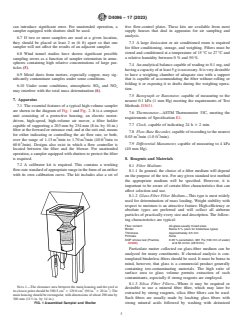
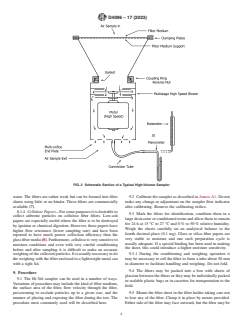
7.1 The essential features of a typical high-volume sampler
are shown in the diagram of Fig. 1 and Fig. 2. It is a compact
7.6 Thermometer—ASTM Thermometer 33C, meeting the
unit consisting of a protective housing, an electric motor-
requirements of Specification E1.
driven, high-speed, high-volume air mover, a filter holder
7.7 Clock, capable of indicating 24 h 6 2 min.
capable of supporting a 203 mm by 254 mm (8-in. by 10-in.)
filter at the forward or entrance end, and at the exit end, means
7.8 Flow-Rate Recorder, capable of recording to the nearest
for either indicating or controlling the air flow rate, or both, 3 3
0.03 m /min (1.0 ft /min).
3 3 3
over the range of 1.13 m /min to 1.70 m /min (40 ft /min to
7.9 Differential Manometer, capable of measuring to 4 kPa
60 ft /min). Designs also exist in which a flow controller is
(40 mm Hg).
located between the filter and the blower. For unattended
operation, a sampler equipped with shutters to protect the filter
8. Reagents and Materials
is required.
7.2 A calibrator kit is required. This contains a working
8.1 Filter Medium:
flow-rate standard of appropriate range in the form of an orifice
8.1.1 In general, the choice of a filter medium will depend
with its own calibration curve. The kit includes also a set of
on the purpose of the test. For any given standard test method
the appropriate medium will be specified. However, it is
important to be aware of certain filter characteristics that can
affect selection and use.
8.1.2 Glass-Fiber Filter Medium—This type is most widely
used for determination of mass loading. Weight stability with
respect to moisture is an attractive feature. High-efficiency or
absolute types are preferred and will collect all airborne
particles of practically every size and description. The follow-
ing characteristics are typical:
Fiber content All-glass-usually mixed sizes
Binder Below 5 % (zero for binderless types)
Thickness Approximately 0.5 mm
Pinholes None
DOP smoke test (Practice 0.05 % penetration, 981 Pa (100 mm of water)
D2986) at 8.53 m/min (28 ft/min)
Particulate matter collected on glass-fiber medium can be
analyzed for many constituents. If chemical analysis is con-
templated binderless filters should be used. It must be borne in
mind, however, that glass is a commercial product generally
containing test-contaminating materials. The high ratio of
surface area to glass volume permits extraction of such
contaminants, especially if strong reagents are employed.
8.1.3 Silica Fiber Filters—Where it may be required or
NOTE 1—The clearance area between the main housing and the roof at
desirable to use a mineral fiber filter, which may later be
2 2 2 2
its closest point should be 580.5 cm 6 129.0 cm (90 in. 6 20 in. ). The
extracted by strong reagents, silica fiber filters can be used.
main housing should be rectangular, with dimensions of about 290 mm by
Such fibers are usually made by leaching glass fibers with
360 mm (11 ⁄2 in. by 14 in.).
FIG. 1 Assembled Sampler and Shelter strong mineral acids followed by washing with deionized
D4096 − 17 (2023)
FIG. 2 Schematic Section of a Typical High-Volume Sampler
water. The fibers are rather weak but can be formed into filter 9.2 Calibrate the sampler as described in Annex A1. Do not
sheets using little or no binder. These filters are commercially make any change or adjustment on the sampler flow indicator
available (7).
after calibrating. Remove the calibrating orifice.
8.1.4 Cellulose Papers—For some purposes it is desirable to
9.3 Mark the filters for identification, condition them in a
collect airborne particles on cellulose fiber filters. Low-ash
large desiccator or conditioned room and allow them to remain
papers are especially useful where the filter is to be destroyed
for 24 h at 15 °C to 27 °C and 0 % to 50 % relative humidity.
by ignition or chemical digestion. However, these papers have
Weigh the sheets carefully on an analytical balance to the
higher flow resistance (lower sampling rate) and have been
fourth decimal place (0.1 mg). Glass or silica fiber papers are
reported to have much poorer collection efficiency than the
very stable to moisture and one such preparation cycle is
glass fiber media (8). Furthermore, cellulose is very sensitive to
usually adequate. If a special binding has been used in making
moisture conditions and even with very careful conditioning
the sheet, this could introduce a higher moisture sensitivity.
before and after sampling it is difficult to make an accurate
9.3.1 During the conditioning and weighing operation it
weighing of the collected particles. It is usually necessary to do
the weighing with the filter enclosed in a lightweight metal can may be necessary to roll the filter to form a tube about 50 mm
in diameter to facilitate handling and weighing. Do not fold.
with a tight lid.
9.4 The filters may be packed into a box with sheets
...