

ASTM D8141-22
(Guide)Standard Guide for Selecting Volatile Organic Compounds (VOCs) and Semi-Volatile Organic Compounds (SVOCs) Emission Testing Methods to Determine Emission Parameters for Modeling of Indoor Environments
General Information
- Abstract
SIGNIFICANCE AND USE
4.1 Emissions of VOCs are typically controlled by internal mass-transfer limitations (for example, diffusion through the material), while emissions of SVOCs are typically controlled by external mass-transfer limitations (migration through the air immediately above the material). The emission of some chemicals may be controlled by both internal and external mass-transfer limitations. In addition, due to their lower vapor pressure, SVOCs generally adsorb to different media (chamber walls, building materials, particles, and other surfaces) at greater rates than VOCs. This sorption can increase the amount of time required to reach steady-state SVOC concentrations using conventional VOC emission test methods to months for a single test (2).
4.2 Thus, existing methods for characterizing emissions of VOCs may not be appropriate or practical to properly characterize emission rates of SVOCs for use in modeling SVOC concentrations in indoor environments. A mass-transfer framework is needed to accurately assess emission rates of SVOCs when predicting the SVOC indoor air concentrations in indoor environments. The SVOC mass-transfer framework includes SVOC emission characteristics and its partition to multimedia including sorption to indoor surfaces, airborne particles, and settled dust. Once the SVOC emission parameters and partitioning coefficients have been determined, these values can be used to modeling SVOC indoor concentrations.
SCOPE
1.1 This guide is intended to serve as a foundation for understanding when to use emission testing methods designed for volatile organic compounds (VOCs) to determine area-specific emission rates that are typically used in modeling indoor air VOC concentrations and when to use emission testing methods designed for semi-volatile organic compounds (SVOCs) to determine mass transfer emission parameters that are typically used to model indoor air, dust, and surface SVOC concentrations.
1.2 This guide discusses how organic chemicals are conventionally categorized with respect to volatility.
1.3 This guide presents a simplified mass-transfer model describing organic chemical emissions from a material to bulk air. The values of the model parameters are shown to be specific to material/chemical/chamber combinations.
1.4 This guide shows how to use a mass-transfer model to estimate whether diffusion of the chemical within the material or convective mass transfer of the chemical from the surface of the material to the overlying air limits chemical emissions from the material surface.
1.5 This guide describes the range of different chambers that are available for emission testing. The chambers are classified as either dynamic or static and either conventional or sandwich. The chambers are categorized as being optimal to determine either the area-specific emission rate or mass-transfer emission parameters.
1.6 This guide discusses the roles sorption and convective mass-transfer coefficients play in selecting the appropriate emission chamber and analysis method to accurately and efficiently characterize emissions from indoor materials for use in modeling indoor chemical concentrations.
1.7 This guide recommends when to choose an emission test method that is optimized to determine either the area-specific emission rate or mass-transfer emission parameters. For chemicals where the controlling mass-transfer process is unknown, the guide outlines a procedure to determine if the chemical emission is controlled by convective mass transfer of the chemical from the material.
1.8 This guide does not provide specific guidance for measuring emission parameters or conducting indoor exposure modeling.
1.9 Mechanisms controlling emissions from wet and dry materials and products are different. This guide considers the emission of chemicals from dry materials and products. Examples of functional uses of VOCs and SVOCs that this guide applies to include blowing agents, ...
- Status
- Published
- Publication Date
- 31-Oct-2022
- Technical Committee
- D22 - Air Quality
- Drafting Committee
- D22.05 - Indoor Air
Buy Documents
ASTM D8141-22 - Standard Guide for Selecting Volatile Organic Compounds (VOCs) and Semi-Volatile Organic Compounds (SVOCs) Emission Testing Methods to Determine Emission Parameters for Modeling of Indoor Environments
REDLINE ASTM D8141-22 - Standard Guide for Selecting Volatile Organic Compounds (VOCs) and Semi-Volatile Organic Compounds (SVOCs) Emission Testing Methods to Determine Emission Parameters for Modeling of Indoor Environments
Overview
ASTM D8141-22 is a standard guide developed by ASTM International focused on the selection of emission testing methods for volatile organic compounds (VOCs) and semi-volatile organic compounds (SVOCs) in indoor environments. This standard assists professionals in determining appropriate emission test methods and parameters necessary for accurate indoor air quality modeling. The guide clarifies when to use VOC or SVOC-specific testing approaches based on the underlying mass transfer mechanisms influencing chemical emissions. This standard is under the jurisdiction of ASTM Committee D22 on Air Quality, Subcommittee D22.05 on Indoor Air.
Understanding the distinctive behaviors of VOC and SVOC emissions and selecting the correct measurement techniques ensures more accurate modeling of indoor chemical concentrations. This is essential for manufacturers, building professionals, and environmental health practitioners addressing sources of indoor air pollution.
Key Topics
Emission Mechanisms:
- VOC emissions are generally limited by internal mass transfer (diffusion through materials).
- SVOC emissions are typically ruled by external mass transfer (migration through surface air layers).
- Sorption of SVOCs to environmental surfaces significantly influences steady-state concentration times.
Mass Transfer Modeling:
- Introduces mass-transfer frameworks required to estimate emission rates for VOCs and SVOCs.
- Differentiates area-specific emission rates (typical for VOCs) and mass transfer emission parameters (typical for SVOCs).
Chamber Types for Emission Testing:
- Describes dynamic (airflow) and static (sealed) chambers.
- Classifies designs as conventional (single exposed surface) or sandwich (test material surfaces face each other to reduce sorption effects).
- Provides guidance on selecting optimal chamber types for VOC or SVOC measurements.
Selection of Testing Methods:
- Outlines criteria for when to use VOC or SVOC testing approaches by evaluating rate-limiting steps in emissions.
- Discusses the role of partition and mass-transfer coefficients in optimizing method selection.
- Recommends procedures when the dominant mass transfer mechanism is uncertain.
Applications
ASTM D8141-22 is valuable for:
- Indoor Air Quality Assessment: Enables precise modeling of chemical emissions from indoor building materials and products.
- Material & Product Testing: Provides foundational guidance to manufacturers testing emissions from dry materials such as adhesives, flame retardants, plasticizers, and more.
- Environmental Health & Safety: Supports the development of regulatory compliance and health-protective indoor environments by specifying reliable emission test methods.
- Research & Development: Guides scientists in selecting chambers and models appropriate for both volatile and semi-volatile compounds, ensuring robust data for emissions research.
By differentiating the emission behaviors and testing approaches for VOCs and SVOCs, the standard helps professionals address regulatory requirements, design healthier indoor spaces, and enhance product safety communications.
Related Standards
Professionals working with ASTM D8141-22 may reference or use in conjunction the following standards and methods:
- ASTM D5116: Small-Scale Environmental Chamber Determinations of Organic Emissions from Indoor Materials/Products
- ASTM D6007: Determining Formaldehyde Concentrations in Air from Wood Products Using a Small-Scale Chamber
- ASTM D6670: Full-Scale Chamber Determination of Volatile Organic Emissions from Indoor Materials/Products
- ASTM D8142: Emissions from Spray Polyurethane Foam Insulation Using Micro-Scale Chambers
- ISO 16000-6: Determination of VOCs in Indoor and Test Chamber Air by Active Sampling
- CDPH Standard Method V1.2: California Department of Public Health Standard Method for Testing VOC Emissions
These referenced standards provide complementary guidance for emission sampling, chamber testing, and analytical procedures for VOCs and SVOCs in indoor air environments.
Keywords: ASTM D8141-22, indoor air quality, VOC emission testing, SVOC emission modeling, mass transfer, environmental chamber, emission parameter, sorption, air quality standards.
Relations
- Effective Date
- 01-Sep-2023
- Effective Date
- 01-Sep-2023
- Effective Date
- 01-Sep-2020
- Effective Date
- 15-Mar-2020
- Effective Date
- 01-Mar-2020
- Effective Date
- 01-Nov-2019
- Effective Date
- 01-Sep-2018
- Effective Date
- 01-Nov-2017
- Effective Date
- 01-Oct-2017
- Effective Date
- 01-Oct-2017
- Effective Date
- 01-May-2017
- Effective Date
- 15-Oct-2015
- Effective Date
- 01-Jul-2015
- Effective Date
- 01-Dec-2014
- Effective Date
- 01-Nov-2014
Buy Documents
ASTM D8141-22 - Standard Guide for Selecting Volatile Organic Compounds (VOCs) and Semi-Volatile Organic Compounds (SVOCs) Emission Testing Methods to Determine Emission Parameters for Modeling of Indoor Environments
REDLINE ASTM D8141-22 - Standard Guide for Selecting Volatile Organic Compounds (VOCs) and Semi-Volatile Organic Compounds (SVOCs) Emission Testing Methods to Determine Emission Parameters for Modeling of Indoor Environments
Get Certified
Connect with accredited certification bodies for this standard

CIS Institut d.o.o.
Personal Protective Equipment (PPE) certification body. Notified Body NB-2890 for EU Regulation 2016/425 PPE.

Kiwa BDA Testing
Building and construction product certification.
Kmetijski inštitut Slovenije
Agricultural Institute of Slovenia. Soil testing, plant health, agricultural product analysis.
Sponsored listings
Frequently Asked Questions
ASTM D8141-22 is a guide published by ASTM International. Its full title is "Standard Guide for Selecting Volatile Organic Compounds (VOCs) and Semi-Volatile Organic Compounds (SVOCs) Emission Testing Methods to Determine Emission Parameters for Modeling of Indoor Environments". This standard covers: SIGNIFICANCE AND USE 4.1 Emissions of VOCs are typically controlled by internal mass-transfer limitations (for example, diffusion through the material), while emissions of SVOCs are typically controlled by external mass-transfer limitations (migration through the air immediately above the material). The emission of some chemicals may be controlled by both internal and external mass-transfer limitations. In addition, due to their lower vapor pressure, SVOCs generally adsorb to different media (chamber walls, building materials, particles, and other surfaces) at greater rates than VOCs. This sorption can increase the amount of time required to reach steady-state SVOC concentrations using conventional VOC emission test methods to months for a single test (2). 4.2 Thus, existing methods for characterizing emissions of VOCs may not be appropriate or practical to properly characterize emission rates of SVOCs for use in modeling SVOC concentrations in indoor environments. A mass-transfer framework is needed to accurately assess emission rates of SVOCs when predicting the SVOC indoor air concentrations in indoor environments. The SVOC mass-transfer framework includes SVOC emission characteristics and its partition to multimedia including sorption to indoor surfaces, airborne particles, and settled dust. Once the SVOC emission parameters and partitioning coefficients have been determined, these values can be used to modeling SVOC indoor concentrations. SCOPE 1.1 This guide is intended to serve as a foundation for understanding when to use emission testing methods designed for volatile organic compounds (VOCs) to determine area-specific emission rates that are typically used in modeling indoor air VOC concentrations and when to use emission testing methods designed for semi-volatile organic compounds (SVOCs) to determine mass transfer emission parameters that are typically used to model indoor air, dust, and surface SVOC concentrations. 1.2 This guide discusses how organic chemicals are conventionally categorized with respect to volatility. 1.3 This guide presents a simplified mass-transfer model describing organic chemical emissions from a material to bulk air. The values of the model parameters are shown to be specific to material/chemical/chamber combinations. 1.4 This guide shows how to use a mass-transfer model to estimate whether diffusion of the chemical within the material or convective mass transfer of the chemical from the surface of the material to the overlying air limits chemical emissions from the material surface. 1.5 This guide describes the range of different chambers that are available for emission testing. The chambers are classified as either dynamic or static and either conventional or sandwich. The chambers are categorized as being optimal to determine either the area-specific emission rate or mass-transfer emission parameters. 1.6 This guide discusses the roles sorption and convective mass-transfer coefficients play in selecting the appropriate emission chamber and analysis method to accurately and efficiently characterize emissions from indoor materials for use in modeling indoor chemical concentrations. 1.7 This guide recommends when to choose an emission test method that is optimized to determine either the area-specific emission rate or mass-transfer emission parameters. For chemicals where the controlling mass-transfer process is unknown, the guide outlines a procedure to determine if the chemical emission is controlled by convective mass transfer of the chemical from the material. 1.8 This guide does not provide specific guidance for measuring emission parameters or conducting indoor exposure modeling. 1.9 Mechanisms controlling emissions from wet and dry materials and products are different. This guide considers the emission of chemicals from dry materials and products. Examples of functional uses of VOCs and SVOCs that this guide applies to include blowing agents, ...
SIGNIFICANCE AND USE 4.1 Emissions of VOCs are typically controlled by internal mass-transfer limitations (for example, diffusion through the material), while emissions of SVOCs are typically controlled by external mass-transfer limitations (migration through the air immediately above the material). The emission of some chemicals may be controlled by both internal and external mass-transfer limitations. In addition, due to their lower vapor pressure, SVOCs generally adsorb to different media (chamber walls, building materials, particles, and other surfaces) at greater rates than VOCs. This sorption can increase the amount of time required to reach steady-state SVOC concentrations using conventional VOC emission test methods to months for a single test (2). 4.2 Thus, existing methods for characterizing emissions of VOCs may not be appropriate or practical to properly characterize emission rates of SVOCs for use in modeling SVOC concentrations in indoor environments. A mass-transfer framework is needed to accurately assess emission rates of SVOCs when predicting the SVOC indoor air concentrations in indoor environments. The SVOC mass-transfer framework includes SVOC emission characteristics and its partition to multimedia including sorption to indoor surfaces, airborne particles, and settled dust. Once the SVOC emission parameters and partitioning coefficients have been determined, these values can be used to modeling SVOC indoor concentrations. SCOPE 1.1 This guide is intended to serve as a foundation for understanding when to use emission testing methods designed for volatile organic compounds (VOCs) to determine area-specific emission rates that are typically used in modeling indoor air VOC concentrations and when to use emission testing methods designed for semi-volatile organic compounds (SVOCs) to determine mass transfer emission parameters that are typically used to model indoor air, dust, and surface SVOC concentrations. 1.2 This guide discusses how organic chemicals are conventionally categorized with respect to volatility. 1.3 This guide presents a simplified mass-transfer model describing organic chemical emissions from a material to bulk air. The values of the model parameters are shown to be specific to material/chemical/chamber combinations. 1.4 This guide shows how to use a mass-transfer model to estimate whether diffusion of the chemical within the material or convective mass transfer of the chemical from the surface of the material to the overlying air limits chemical emissions from the material surface. 1.5 This guide describes the range of different chambers that are available for emission testing. The chambers are classified as either dynamic or static and either conventional or sandwich. The chambers are categorized as being optimal to determine either the area-specific emission rate or mass-transfer emission parameters. 1.6 This guide discusses the roles sorption and convective mass-transfer coefficients play in selecting the appropriate emission chamber and analysis method to accurately and efficiently characterize emissions from indoor materials for use in modeling indoor chemical concentrations. 1.7 This guide recommends when to choose an emission test method that is optimized to determine either the area-specific emission rate or mass-transfer emission parameters. For chemicals where the controlling mass-transfer process is unknown, the guide outlines a procedure to determine if the chemical emission is controlled by convective mass transfer of the chemical from the material. 1.8 This guide does not provide specific guidance for measuring emission parameters or conducting indoor exposure modeling. 1.9 Mechanisms controlling emissions from wet and dry materials and products are different. This guide considers the emission of chemicals from dry materials and products. Examples of functional uses of VOCs and SVOCs that this guide applies to include blowing agents, ...
ASTM D8141-22 is classified under the following ICS (International Classification for Standards) categories: 13.040.01 - Air quality in general. The ICS classification helps identify the subject area and facilitates finding related standards.
ASTM D8141-22 has the following relationships with other standards: It is inter standard links to ASTM D7706-17(2023), ASTM D8142-23, ASTM D1356-20a, ASTM D1356-20, ASTM D6330-20, ASTM D6177-19, ASTM D6670-18, ASTM D5116-17, ASTM D8142-17e1, ASTM D8142-17, ASTM D7706-17, ASTM D1356-15a, ASTM D1356-15, ASTM D1356-14b, ASTM D6330-98(2014). Understanding these relationships helps ensure you are using the most current and applicable version of the standard.
ASTM D8141-22 is available in PDF format for immediate download after purchase. The document can be added to your cart and obtained through the secure checkout process. Digital delivery ensures instant access to the complete standard document.
Standards Content (Sample)
This international standard was developed in accordance with internationally recognized principles on standardization established in the Decision on Principles for the
Development of International Standards, Guides and Recommendations issued by the World Trade Organization Technical Barriers to Trade (TBT) Committee.
Designation: D8141 − 22
Standard Guide for
Selecting Volatile Organic Compounds (VOCs) and Semi-
Volatile Organic Compounds (SVOCs) Emission Testing
Methods to Determine Emission Parameters for Modeling of
Indoor Environments
This standard is issued under the fixed designation D8141; the number immediately following the designation indicates the year of
original adoption or, in the case of revision, the year of last revision. A number in parentheses indicates the year of last reapproval. A
superscript epsilon (´) indicates an editorial change since the last revision or reapproval.
1. Scope 1.7 Thisguiderecommendswhentochooseanemissiontest
method that is optimized to determine either the area-specific
1.1 This guide is intended to serve as a foundation for
emissionrateormass-transferemissionparameters.Forchemi-
understanding when to use emission testing methods designed
cals where the controlling mass-transfer process is unknown,
for volatile organic compounds (VOCs) to determine area-
the guide outlines a procedure to determine if the chemical
specific emission rates that are typically used in modeling
emission is controlled by convective mass transfer of the
indoor air VOC concentrations and when to use emission
chemical from the material.
testing methods designed for semi-volatile organic compounds
(SVOCs) to determine mass transfer emission parameters that
1.8 This guide does not provide specific guidance for
are typically used to model indoor air, dust, and surface SVOC measuring emission parameters or conducting indoor exposure
concentrations.
modeling.
1.2 Thisguidediscusseshoworganicchemicalsareconven-
1.9 Mechanisms controlling emissions from wet and dry
tionally categorized with respect to volatility.
materials and products are different. This guide considers the
emission of chemicals from dry materials and products. Ex-
1.3 This guide presents a simplified mass-transfer model
amples of functional uses of VOCs and SVOCs that this guide
describing organic chemical emissions from a material to bulk
applies to include blowing agents, flame retardants, adhesives,
air. The values of the model parameters are shown to be
plasticizers, solvents, antioxidants, preservatives, and coalesc-
specific to material/chemical/chamber combinations.
ing agents (1). Emission estimations for other VOC and
1.4 This guide shows how to use a mass-transfer model to
SVOC classes including those generated by incomplete
estimate whether diffusion of the chemical within the material
combustion, spray application, or application as a powder
orconvectivemasstransferofthechemicalfromthesurfaceof
(pesticides, termiticides, herbicides, stain repellents, sealants,
thematerialtotheoverlyingairlimitschemicalemissionsfrom
water repellants) (1) may require different approaches than
the material surface.
outlined in this guide because these processes can increase
1.5 Thisguidedescribestherangeofdifferentchambersthat
short-term concentrations of chemicals in the air independent
are available for emission testing. The chambers are classified
of the volatility of the chemical and its categorization as a
as either dynamic or static and either conventional or sand-
VVOC (very volatile organic compounds), VOC, SVOC, or
wich. The chambers are categorized as being optimal to
NVOC (non-volatile organic compounds).
determine either the area-specific emission rate or mass-
1.10 The effects of the emissions (for example, exposure,
transfer emission parameters.
and health effects on occupants) are not addressed and are
1.6 This guide discusses the roles sorption and convective
beyond the scope of this guide.
mass-transfer coefficients play in selecting the appropriate
1.11 The values stated in SI units are to be regarded as
emission chamber and analysis method to accurately and
standard. No other units of measurement are included in this
efficiently characterize emissions from indoor materials for use
standard.
in modeling indoor chemical concentrations.
1.12 This standard does not purport to address all of the
safety concerns, if any, associated with its use. It is the
This guide is under the jurisdiction of ASTM Committee D22 on Air Quality
and is the direct responsibility of Subcommittee D22.05 on Indoor Air.
Current edition approved Nov. 1, 2022. Published December 2022. Originally
approved in 2017. Last previous edition approved in 2017 as D8141 – 17. DOI: The boldface numbers in parentheses refer to the list of references at the end of
10.1520/D8141-22. this standard.
Copyright © ASTM International, 100 Barr Harbor Drive, PO Box C700, West Conshohocken, PA 19428-2959. United States
D8141 − 22
responsibility of the user of this standard to establish appro- 2017 Standard Method for the Testing and Evaluation of
priate safety, health, and environmental practices and deter- Volatile Organic Chemical Emissions from Indoor
mine the applicability of regulatory limitations prior to use. Sources using Environmental Chambers, IndoorAir Qual-
1.13 This international standard was developed in accor- ity Section, Environmental Health Laboratory Branch,
dance with internationally recognized principles on standard- Division of Environmental and Occupational Disease
ization established in the Decision on Principles for the Control, California Department of Public Health
Development of International Standards, Guides and Recom- I.S. EN 16402:2013 Paints and Varnishes—Assessment of
mendations issued by the World Trade Organization Technical Emissions of Substances from Coatings into IndoorAir—
Barriers to Trade (TBT) Committee. Sampling, Conditioning, and Testing
ISO 16000-6:2011 Indoor Air—Part 6: Determination of
2. Referenced Documents
Volatile Organic Compounds in Indoor and Test Chamber
Air by Active Sampling on Tenax TA Sorbent, Thermal
2.1 ASTM Standards:
Desorption and Gas Chromatography using MS or MS-
D1356 Terminology Relating to Sampling and Analysis of
FID
Atmospheres
ISO 12219-1 Interior Air of Road Vehicles—Part 1: Whole
D5116 Guide for Small-Scale Environmental Chamber De-
Vehicle Test Chamber—Specification and Method for the
terminations of Organic Emissions from Indoor Materials/
Determination of volatile Organic Compounds in Cabin
Products
Interiors
D6007 TestMethodforDeterminingFormaldehydeConcen-
trations in Air from Wood Products Using a Small-Scale
3. Terminology
Chamber
D6177 Practice for Determining Emission Profiles of Vola-
3.1 Definitions:
tile Organic Chemicals Emitted from Bedding Sets
3.1.1 For definitions of terms commonly used for sampling
D6330 Practice for Determination of Volatile Organic Com-
and analysis of atmospheres, refer to Terminology D1356. For
pounds(ExcludingFormaldehyde)EmissionsfromWood-
definitions and terms commonly used when testing materials
Based Panels Using Small Environmental Chambers Un-
andproductsforemissions,refertoGuideD5116andPractices
der Defined Test Conditions
D6670 and D7706.
D6345 Guide for Selection of Methods for Active, Integra-
3.2 Definitions of Terms Specific to This Standard:
tive Sampling of Volatile Organic Compounds in Air
3.2.1 conventional chamber, n—a chamber with test mate-
(Withdrawn 2018)
rials on one surface only.
D6670 Practice for Full-Scale Chamber Determination of
3.2.2 dynamic chamber, n—achamberwithinputandoutput
Volatile Organic Emissions from Indoor Materials/
airflow.
Products
D7706 Practice for Rapid Screening of VOC Emissions 3.2.3 sandwich chamber, n—a chamber with test materials
from Products Using Micro-Scale Chambers
on opposite surfaces (typically top and bottom); typically used
D8142 Test Method for Determining Chemical Emissions to reduce the surface-to-volume ratio to mitigate wall sorption
from Spray Polyurethane Foam (SPF) Insulation using
effects; sometimes these chambers are referred to as material-
Micro-Scale Environmental Test Chambers air-material chambers.
D8345 Test Method for Determination of an Emission Pa-
3.2.4 static chamber, n—a sealed chamber with no airflow.
rameter for Phthalate Esters and Other Non-Phthalate
Plasticizers from Planar Polyvinyl Chloride Indoor Mate-
4. Significance and Use
rials for Use in Mass Transfer Modeling Calculations
4.1 Emissions of VOCs are typically controlled by internal
E1333 Test Method for Determining Formaldehyde Concen-
mass-transfer limitations (for example, diffusion through the
trations in Air and Emission Rates from Wood Products
material), while emissions of SVOCs are typically controlled
Using a Large Chamber
byexternalmass-transferlimitations(migrationthroughtheair
2.2 Other Documents:
immediatelyabovethematerial).Theemissionofsomechemi-
Directive 2004/42/CE of the European Parliament and of the
cals may be controlled by both internal and external mass-
Council on the limitation of emissions of volatile organic
transfer limitations. In addition, due to their lower vapor
compounds due to the use of organic solvents in certain
pressure, SVOCs generally adsorb to different media (chamber
paints and varnishes and vehicle refinishing products and
walls, building materials, particles, and other surfaces) at
amending Directive 1999/13/EC
greaterratesthanVOCs.Thissorptioncanincreasetheamount
EmissionTestingMethodforCDPHStandardMethodV1.2.,
3 6
For referenced ASTM standards, visit the ASTM website, www.astm.org, or Available from Underwriters Laboratories (UL), UL Headquarters, 333 Pfing-
contact ASTM Customer Service at service@astm.org. For Annual Book of ASTM sten Road, Northbrook, IL, 60062, http://www.ul.com.
Standards volume information, refer to the standard’s Document Summary page on Available from European Committee for Standardization (CEN), Avenue
the ASTM website. Marnix 17, B-1000, Brussels, Belgium, http://www.cen.eu.
4 8
The last approved version of this historical standard is referenced on Available from International Organization for Standardization (ISO), ISO
www.astm.org. Central Secretariat, Chemin de Blandonnet 8, CP 401, 1214 Vernier, Geneva,
Available at https://www.legislation.gov.uk/. Switzerland, https://www.iso.org.
D8141 − 22
of time required to reach steady-state SVOC concentrations references.ThedatainTable1arenotprovidedasauthoritative
using conventional VOC emission test methods to months for definitions for VOC and SVOCs, but rather to inform the
a single test (2). reader to the extent of variation in accepted definitions for
these terms. As an example, the chemical properties used to
4.2 Thus, existing methods for characterizing emissions of
differentiatebetweenaVOCandanSVOCarelistedintherow
VOCs may not be appropriate or practical to properly charac-
between the VOC and SVOC rows. There are five different
terize emission rates of SVOCs for use in modeling SVOC
boiling points spanning a 107 °C range that have been used to
concentrations in indoor environments.Amass-transfer frame-
define the cut off between a VOC and an SVOC. The
work is needed to accurately assess emission rates of SVOCs
delineationbetweenVOCandSVOCisfurthercomplicatedby
when predicting the SVOC indoor air concentrations in indoor
the fact that some chemicals do not have an accurately
environments. The SVOC mass-transfer framework includes
measured boiling point or decompose prior to boiling.
SVOC emission characteristics and its partition to multimedia
Likewise, there are no universally accepted vapor pressure or
including sorption to indoor surfaces, airborne particles, and
chromatographic retention time delineations between VOCs
settled dust. Once the SVOC emission parameters and parti-
and SVOCs. The use of chromatographic retention time as a
tioning coefficients have been determined, these values can be
delineator is further complicated because retention times are
used to modeling SVOC indoor concentrations.
strongly influenced by chromatographic conditions such as the
5. Overview of Concepts Related to Organic Chemical choice of the column stationary phase polarity.
Emissions in Indoor Environments
5.1.1 Labeling chemicals as VVOCs, VOCs, SVOCs, or
NVOCs using chemical properties such as vapor pressure and
5.1 Semi-Volatile Organic Compound (SVOC)—There are
boiling point may have limited value when trying to describe
many physical property based definitions used to describe the
how chemicals emit from materials in indoor environments.
difference between a VVOC, a VOC, an SVOC, and a NVOC.
This is especially true for chemicals close to the edge of these
The definitions typically are based on the chemicals’ vapor
physical property definitions.
pressure at 25 °C, the chemical boiling point, or the relative
position (time) a chemical is observed on a chromatograph. 5.1.2 When modeling material emissions into an indoor
These definitions are useful to differentiate between chemicals environment, the classification (VOC, SVOC) is not as impor-
in laboratory settings and experiments. Table 1 lists the tant as defining the rate limiting step for the emission of the
different physical property-based definitions from ten different chemical. The rate limiting step is the slowest step in the
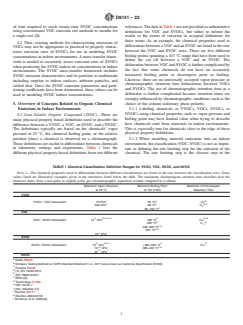
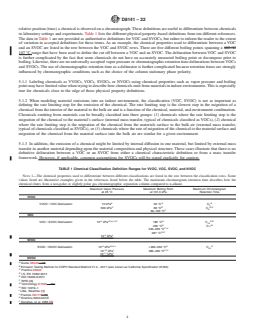
TABLE 1 Chemical Classification Definition Ranges for VVOC, VOC, SVOC, and NVOC
NOTE 1—The chemical properties used to differentiate between different classifications are listed in the row between the classification rows. Some
values listed are illustrative examples given in the references listed below the table. The maximum chromatogram retention time describes how the
chemical elutes from a non-polar or slightly polar gas chromatographic separation column compared to n-alkane.
Maximum Vapor Pressure Maximum Boiling Point Maximum Chromatogram
at 25 °C at 101.3 kPa Retention Time
VVOC
A A B
VVOC / VOC Delineation 15 kPa 30 °C C
C D E,D
500 kPa 68 °C C
F
50–100 °C
VOC
-2 G,H,I,J,C A E,D
VOC / SVOC Delineation 10 kPa 180 °C C
K B
250 °C C
F,H
240–260 °C
E,D
287 °C
-4 L
10 kPa
SVOC
-8 G,H,J A D
SVOC / NVOC Delineation 10 kPa >300–350 °C C
-12 I F,H
10 kPa 380–400 °C
-11 L
10 kPa
NVOC
A
Guide D6345
B
Emission Testing Method for CDPH Standard Method V1.2., 2017 (also known as California Specification 01350)
C
Practice D6330
D
I.S. EN 16402:2013
E
ISO 16000-6:2011
F
WHO (3)
G
Terminology D1356
H
ISO 12219–1
I
Little, Weschler (1)
J
Practice D6177
K
Directive 2004/42/CE
L
Donahue, et al. 2006 (4)
D8141 − 22
migration of a chemical from the interior of the material to the
C = the chemical concentration in the solid material at a
(x,t)
bulk air and is a function of the chemical, material, and
depth x at time t (µg/m ). For SVOCs, this parameter
environment combination. Chemicals emitting from materials
is often assumed to be constant over time (no
can be broadly classified into three groups: (1) chemicals
depletion) and throughout the material (6). Then,
where the rate limiting step is the migration of the chemical to C is replaced by C for 0 ≤ x ≤ L and t>0.
(x,t) 0
C = the chemical concentration on the surface of the
the material’s surface (internal mass transfer, typical of chemi-
(L,t)
solid material (x = L) at time t (µg/m ). For SVOCs,
cals classified as VOCs), (2) chemical where the rate limiting
this parameter is often assumed to equal C (6).
stepisthemigrationofthechemicalfromthematerialssurface 0
y = the chemical concentration in the bulk air at time t
(t)
to the bulk air (external mass transfer, typical of chemicals
(µg/m ).
classified as SVOCs), or (3) chemicals where the rate of
y = the chemical concentration in the air phase immedi-
o(t)
migrationofthechemicaltothematerialsurfaceandmigration
ate above the material surface at time t (µg/m ).
of the chemical from the material surface into the bulk air are
L = the thickness of the solid material (m).
similar for a given environment.
K = the material-air partition coefficient, that is, the ratio
ma
5.1.3 In addition, the emission of a chemical might be
of the chemical concentrations in the solid and air
limited by internal diffusion in one material, but limited by
phases when the chemical is in equilibrium across
external mass transfer in another material depending upon the the interface between the two phases (dimensionless
3 3
material composition and physical structure. These cases or m air 1/m material).
D = the diffusion constant for the chemical in the solid
illustrate that there is no definitive delineation between a VOC
m
material (resistance to movement through the mate-
or an SVOC from either a chemical characteristic definition or
rial) (m /s). For SVOCs, emission from solid mate-
from a mass transfer framework. However, if applicable,
rials is often assumed to be controlled only by
common assumptions for SVOCs will be stated explicitly for
externalmasstransfer(thatis,by h )andfurtheritis
m
context.
often assumed that C = C , the influence of D
(x,t) 0 m
5.2 Mass-Transfer Parameters—To understand how VOC
becomes negligible for SVOCs (6, 7).
and SVOC emissions differ, it is important to understand a h = the convective mass-transfer coefficient (resistance
m
to movement through the gaseous boundary layer,
mathematical model of mass transfer for a chemical moving
(m/s).
from the solid material phase to the air phase. Fig. 1 illustrates
asimplified,one-dimensionalmass-transfermodelforachemi-
5.2.1 Other parameters used in this guide include:
cal emitting from a material. This model is applicable to the
A = the surface area of the solid material of interest (m ),
emission of bothVOCs and SVOCs from a material. However,
h L
Bi = m
several simplifications of the model are often made if the m
Biot number for mass transfer, Bi 5
S D
m
D
m
model is applied to SVOCs. In this model, the following
(dimensionless), and
parameters are defined as:
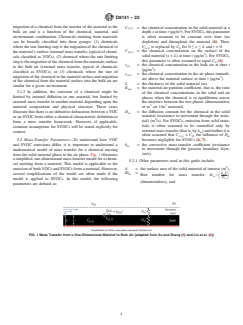
FIG. 1 Mass Transfer from a One-Dimensional Material to Bulk Air (adapted from Xu and Zhang (5) and Liu et al. (6))
D8141 − 22
6.5 Bi /K relates the two fundamental processes that
D t
Fo =
m m ma
m
Fourier number for mass transfer, Fo 5
m 2
L control the rate of emissions of organic chemicals from indoor
materials: diffusion within the material (represented by L/D
(dimensionless).
m
above), and convective mass transfer from the surface of the
material to the overlying air (represented by h /K above).
6. Choosing between VOC and SVOC Emission Test
m ma
For any given chemical/material/chamber combination, one of
Methods using a Mass Transfer Framework
these two processes will typically be the rate limiting step
6.1 Choosing the correct emission test method to determine
controlling the rate of chemical emissions from the material.
emission parameter values requires knowledge of how the
However, in some cases the emission rate is controlled by both
emission parameters are going to be used in a model. Many
processes.
mass-transfer models have been used to describe dry (diffu-
6.6 If Bi /K is greater than 35, then the rate of migration
m ma
sional) sources of VOCs and SVOCs (6, 8 and 9). The models
of the chemical from the surface to the bulk air is twenty times
differ in their assumptions and how they are solved
greater than the rate of migration of the chemical to the
(analytically, numerically, ordinary differential equations or
materials surface (valid for cases when the Fourier number for
partial differential equations). However, all the mass-transfer
D t
m -4
models require the surface area of the material of interest (A),
mass transfer, Fo 5 is equal to 10 ) (5, 6). Hence, the
m 2
L
the thickness of the material (L), the chemical partition
emission of the chemical in these cases will be controlled by
coefficient (K ), and the diffusion constant in the bulk
ma
the rate limiting diffusion of the chemical to the material’s
material (D ). Some of the models also require the initial
m
surface and not dependent on the airflow above the material. In
chemical concentration in the material of interest (C ), and
(L,0)
these cases, the modeled emission rate in an indoor environ-
the convective mass-transfer coefficient (h ). The values of
m
ment can be directly represented by a constant determined in a
these parameters can be used to determine which type of
conventional emission test chamber study. This emission rate
emission test method is appropriate for the chemical and
for modeling indoor environments is often referred to as the
material of interest.
area-specific emission rate (E , µg/(m h)) and is calculated
AS
from conventional emission chamber studies as follows:
6.2 Typically, the diffusion coefficient, D , varies from
m
-13 2 -11 2
10 m /s to 10 m /s.Approaches to estimate D are readily
m
Q y
~Chamber! ~SS 2 Chamber!
E 5 (3)
available (10). The convective mass-transfer coefficient, h ,
AS
m
A
~Chamber!
-4 -2
typically varies from 10 m/s to 10 m/s and estimation
where:
approachesarereadilyavailable (11).Thematerial-airpartition
1 13
coefficient, K , varies from 10 to 10 . While estimation
Q = the flow into the chamber (m /h),
ma
(Chamber)
approaches are available (12), material- and chemical-specific
y = the steady-state chemical concentration in the
(SS-Chamber)
experimental data are recommended to reduce uncertainty. air phase (µg/m ), and
Hence, the partition coefficient value can play an important A = the area of the source material (m ).
(Chamber)
role in determining the rate limiting step controlling emissions
6.7 Calculating the area-specific emission rate by means of
from materials for VOCs and SVOCs.
Eq 3 assumes that (1) there is no chemical concentration in the
inflow to the chamber, (2) the chemical has reached a steady-
6.3 The partition coefficient, K , describes the ratio of
ma
state concentration, and (3) sorption to chamber walls is
chemical concentrations in the solid and air phases when the
minimal or has reached a steady-state condition. In summary,
chemical is in equilibrium across the interface between the two
when Bi /K is greater than 35, the chamber determined
phases. Most models assume that equilibrium partitioning
m ma
area-specific emission rate (E ) can be used to estimate
across the interface is instantaneous. AS
emissions when modeling chemical concentrations in indoor
C
~eq!
environments.
K 5 (1)
ma
y
~eq!
6.8 IfBi /K islessthan1,thentherateofmigrationofthe
m ma
where:
chemicalfromthesurfacetothebulkairistheprimarylimiting
C = the equilibrium chemical concentration in the solid
mass-transfer process (6). The chemical’s emission will be
(eq)
material (µg/m ), and
controlled by the migration from the surface to the bulk air. In
y = the equilibrium chemical concentration in the air
(eq) these cases, internal diffusion becomes negligible and the
phase (µg/m ).
chemical emission rate in an indoor environment can be
modeledusingamass-transferapproach(E ,µg/(m h)).This
MT
6.4 The dimensionless Biot number for mass transfer (Bi )
m
approach is usually chosen for SVOCs. The modeled emission
divided by the partition coefficient (K ) can be used to
ma
rate (E ) can be represented by the product of the convective
MT
determine whether chemical emissions are controlled by the
mass-transfer coefficient (h ), and the difference between the
m
migration of the chemical to the materials surface (internal
gaseous concentration near the material surface (y ) and the
o(t)
mass transfer) or by the migration of the chemical from the
bulk air (y ):
(t)
materials surface to the bulk air (external mass transfer) (5).
E 5 h y 2 y (4)
~ !
MT m o t t
~ ! ~ !
h L
m
S D
Bi D L h
6.9 While the gaseous concentration near the material sur-
m m m
5 5 (2)
S DS D
K K D K face (y ) and the bulk air (y ) are the same in a chamber and
ma ma m ma o(t) (t)
D8141 − 22
the indoor environment (assuming the same temperature and 6.12 For situations where 1 < Bi /K < 35, the rates of the
m ma
relative humidity), the convective mass-transfer coefficient chemical’s migration from the surface to the bulk air and its
(h ), can be different for chamber systems and indoor envi-
rate of migration to the material’s surface will be similar. An
m
ronments.Hence,whenthechemicalemissionislimitedbythe
experimental approach like that outlined in 8.4 should be used
migration of the chemical from the materials surface to the
to determine how to best estimate emissions when modeling
bulk air, the emission rate calculated in Eq 4 may be different
indoor chemical concentrations.
in the chamber and in an indoor environment.
7. Chambers for Emission Testing to Determine Emission
6.10 For chemicals in dynamic flow environments (cham-
Modeling Parameters
bers and indoor environments) with emission rates that are
limited by external mass transfer (diffusion through the air
7.1 Once the best approach for estimating emissions in
boundary layer), the bulk air concentration, y , will not be
(t)
modeling of chemical concentrations in indoor environments
equal to the equilibrium concentration, y . In these cases, the
(eq)
(chamber area-specific emission rate or mass-transfer param-
chemical concentration in the air phase immediately above the
eters)isdetermined,theoptimalexperimentalchambermethod
material surface, y , is often assumed to be in equilibrium
0(t)
should be selected. There are wide variety of chambers and
C
L,0
~ !
with solid phase y 5 , Fig. 1) and constant (5, 9, 13). The
0 methodsusedtomeasurechemicalemissionsfrommaterialsin
K
ma
the literature (14). Chambers used for emission testing are
assumption of a constant y value is typically valid for
summarized in Table 2. Literature examples of products,
materials with large partition coefficients (for example, K >
10 ) and large initial concentrations (for example, >10 %) (9). materials, and chemical groups used for emission testing are
Further, for SVOCs it is often assumed that the chemical summarized in Table 3. Emission test chambers can be
concentration in the material is uniform and then C is
described by two major characteristics.
(L,0)
replaced by C .
7.1.1 First, chambers can be dynamic or static. Dynamic
chambershaveairflowthroughthechamber.Chemicalconcen-
6.11 In summary, when Bi K is less than 1, the mass-
m ma
trations are typically measured at the exhaust of the chamber.
transfer parameters (K , h , y , C ) should be used to
ma m 0 (L,0)
estimatetheemissionrate(E )whenmodelingindoorchemi- Static chambers have no airflow through them. Chemical
MT
cal concentrations. concentrations are measured by sampling in the chamber.
TABLE 2 Example Chamber Types Used to Measure Emissions from Materials
Possible Limitations in Using Chamber for
Typical Use for
Chamber Description Type Typical Volume Determining Emission Modeling Parameters Examples
A
Emission Modeling
of Typical SVOCs
3 3
Large chamber Dynamic, 20 m to 50 m E Sorption to chamber walls and sampling line Practice D6670
AS
Conventional Time to reach steady-state Test Method E1333
Practice D6177
3 3
Small chamber Dyn
...
This document is not an ASTM standard and is intended only to provide the user of an ASTM standard an indication of what changes have been made to the previous version. Because
it may not be technically possible to adequately depict all changes accurately, ASTM recommends that users consult prior editions as appropriate. In all cases only the current version
of the standard as published by ASTM is to be considered the official document.
Designation: D8141 − 17 D8141 − 22
Standard Guide for
Selecting Volatile Organic Compounds (VOCs) and Semi-
Volatile Organic Compounds (SVOCs) Emission Testing
Methods to Determine Emission Parameters for Modeling of
Indoor Environments
This standard is issued under the fixed designation D8141; the number immediately following the designation indicates the year of
original adoption or, in the case of revision, the year of last revision. A number in parentheses indicates the year of last reapproval. A
superscript epsilon (´) indicates an editorial change since the last revision or reapproval.
1. Scope
1.1 This guide is intended to serve as a foundation for understanding when to use emission testing methods designed for volatile
organic compounds (VOCs) to determine area-specific emission rates that are typically used in modeling indoor air VOC
concentrations and when to use emission testing methods designed for semi-volatile organic compounds (SVOCs) to determine
mass transfer emission parameters that are typically used to model indoor air, dust, and surface SVOC concentrations.
1.2 This guide discusses how organic chemicals are conventionally categorized with respect to volatility.
1.3 This guide presents a simplified mass transfer mass-transfer model describing organic chemical emissions from a material to
bulk air. The values of the model parameters are shown to be specific to material/chemical/chamber combinations.
1.4 This guide shows how to use a mass transfer mass-transfer model to estimate whether diffusion of the chemical within the
material or convective mass transfer of the chemical from the surface of the material to the overlying air limits chemical emissions
from the material surface.
1.5 This guide describes the range of different chambers that are available for emission testing. The chambers are classified as
either dynamic or static and either conventional or sandwich. The chambers are categorized as being optimal to determine either
the area-specific emission rate or mass transfer mass-transfer emission parameters.
1.6 This guide discusses the roles sorption and convective mass transfer mass-transfer coefficients play in selecting the
properappropriate emission chamber and analysis method to accurately and efficiently characterize emissions from indoor
materials for use in modeling indoor chemical concentrations.
1.7 This guide gives recommendations on recommends when to choose an emission test method that is optimized to determine
either the area-specific emission rate or mass transfer mass-transfer emission parameters. For chemicals where the controlling mass
transfer mass-transfer process is unknown, the guide outlines a procedure to determine if the chemical emission is controlled by
convective mass transfer of the chemical from the material.
This guide is under the jurisdiction of ASTM Committee D22 on Air Quality and is the direct responsibility of Subcommittee D22.05 on Indoor Air.
Current edition approved Oct. 1, 2017Nov. 1, 2022. Published October 2017December 2022. Originally approved in 2017. Last previous edition approved in 2017 as
D8141 – 17. DOI: 10.1520/D8141-17.10.1520/D8141-22.
Copyright © ASTM International, 100 Barr Harbor Drive, PO Box C700, West Conshohocken, PA 19428-2959. United States
D8141 − 22
1.8 This guide does not provide specific guidance for measuring emission parameters.parameters or conducting indoor exposure
modeling.
1.9 Mechanisms controlling emissions from wet and dry materials and products are different. This guide considers the emission
of chemicals from dry materials and products. Examples of functional uses of VOCs and SVOCs that this guide applies to include
blowing agents, flame retardants, adhesives, plasticizers, solvents, antioxidants, preservatives, and coalescing agents (1). Emission
estimations for other VOC and SVOC classes including those generated by incomplete combustion, sprayed, spray application, or
appliedapplication as a powder (pesticides, termiticides, herbicides, stain repellents, sealants, water repellants) (1) may require
different approaches than outlined in this guide.guide because these processes can increase short-term concentrations of chemicals
in the air independent of the volatility of the chemical and its categorization as a VVOC (very volatile organic compounds), VOC,
SVOC, or NVOC (non-volatile organic compounds).
1.10 The effects of the emissions (for example, exposure, and health effects on occupants) are not addressed and are beyond the
scope of this guide.
1.11 The values stated in SI units are to be regarded as standard. No other units of measurement are included in this standard.
1.12 This standard does not purport to address all of the safety concerns, if any, associated with its use. It is the responsibility
of the user of this standard to establish appropriate safety, health, and environmental practices and determine the applicability of
regulatory limitations prior to use.
1.13 This international standard was developed in accordance with internationally recognized principles on standardization
established in the Decision on Principles for the Development of International Standards, Guides and Recommendations issued
by the World Trade Organization Technical Barriers to Trade (TBT) Committee.
2. Referenced Documents
2.1 ASTM Standards:
D1356 Terminology Relating to Sampling and Analysis of Atmospheres
D5116 Guide for Small-Scale Environmental Chamber Determinations of Organic Emissions from Indoor Materials/Products
D6007 Test Method for Determining Formaldehyde Concentrations in Air from Wood Products Using a Small-Scale Chamber
D6177 Practice for Determining Emission Profiles of Volatile Organic Chemicals Emitted from Bedding Sets
D6330 Practice for Determination of Volatile Organic Compounds (Excluding Formaldehyde) Emissions from Wood-Based
Panels Using Small Environmental Chambers Under Defined Test Conditions
D6345 Guide for Selection of Methods for Active, Integrative Sampling of Volatile Organic Compounds in Air (Withdrawn
2018)
D6670 Practice for Full-Scale Chamber Determination of Volatile Organic Emissions from Indoor Materials/Products
D7706 Practice for Rapid Screening of VOC Emissions from Products Using Micro-Scale Chambers
D8142 Test Method for Determining Chemical Emissions from Spray Polyurethane Foam (SPF) Insulation using Micro-Scale
Environmental Test Chambers
D8345 Test Method for Determination of an Emission Parameter for Phthalate Esters and Other Non-Phthalate Plasticizers from
Planar Polyvinyl Chloride Indoor Materials for Use in Mass Transfer Modeling Calculations
E1333 Test Method for Determining Formaldehyde Concentrations in Air and Emission Rates from Wood Products Using a
Large Chamber
2.2 Other Documents:
Directive 2004/42/CE of the European Parliament and of the Council on the limitation of emissions of volatile organic
compounds due to the use of organic solvents in certain paints and varnishes and vehicle refinishing products and amending
Directive 1999/13/EC
The boldface numbers in parentheses refer to the list of references at the end of this standard.
For referenced ASTM standards, visit the ASTM website, www.astm.org, or contact ASTM Customer Service at service@astm.org. For Annual Book of ASTM Standards
volume information, refer to the standard’s Document Summary page on the ASTM website.
The last approved version of this historical standard is referenced on www.astm.org.
Available at https://www.legislation.gov.uk/.
D8141 − 22
Emission Testing Method for CDPH Standard Method V1.2., 2017 Standard Method for the Testing and Evaluation of Volatile
Organic Chemical Emissions from Indoor Sources using Environmental Chambers, Indoor Air Quality Section, Environmen-
tal Health Laboratory Branch, Division of Environmental and Occupational Disease Control, California Department of Public
Health
I.S. EN 16402:2013 Paints and Varnishes—Assessment of Emissions of Substances from Coatings into Indoor Air—Sampling,
Conditioning, and Testing
ISO 16000-6:2011 Indoor Air—Part 6: Determination of Volatile Organic Compounds in Indoor and Test Chamber Air by Active
Sampling on Tenax TA Sorbent, Thermal Desorption and Gas Chromatography using MS or MS-FID
ISO 12219-1 Interior Air of Road Vehicles—Part 1: Whole Vehicle Test Chamber—Specification and Method for the
Determination of volatile Organic Compounds in Cabin Interiors
3. Terminology
3.1 Definitions:
3.1.1 For definitions of terms commonly used for sampling and analysis of atmospheres, refer to Terminology D1356. For
definitions and terms commonly used when testing materials and products for emissions, refer to Guide D5116 and Practices
D6670 and D7706.
3.2 Definitions of Terms Specific to This Standard:
3.2.1 conventional chamber, n—a chamber with test materials on one surface only.
3.2.2 dynamic chamber, n—a chamber with input and output airflow.
3.2.3 sandwich chamber, n—a chamber with test materials on opposite surfaces (typically top and bottom); typically used to reduce
the surface-to-volume ratio to mitigate wall sorption effects; sometimes these chambers are referred to as material-air-material
chambers.
3.2.4 static chamber, n—a sealed chamber with no airflow.
4. Significance and Use
4.1 Emissions of VOCs are typically controlled by internal mass transfer mass-transfer limitations (for example, diffusion through
the material), while emissions of SVOCs are typically controlled by external mass transfer mass-transfer limitations (migration
through the air immediately above the material). The emission of some chemicals may be controlled by both internal and external
mass transfer mass-transfer limitations. In addition, due to their lower vapor pressure, SVOCs generally adsorb to different media
(chamber walls, building materials, particles, and other surfaces) at greater rates than VOCs. This sorption can increase the amount
of time required to reach steady-state SVOC concentrations using conventional VOC emission test methods to months for a single
test (2).
4.2 Thus, existing methods for characterizing emissions of VOCs may not be appropriate or practical to properly characterize
emission rates of SVOCs for use in modeling SVOC concentrations in indoor environments. A mass transfer mass-transfer
framework is needed to accurately assess emission rates of SVOCs when predicting the SVOC indoor air concentrations in indoor
environments. The SVOC mass transfer mass-transfer framework includes SVOC emission characteristics and its partition to
multimedia including sorption to indoor surfaces, airborne particles, and settled dust. Once the SVOC emission parameters and
partitioning coefficients have been determined, these values can be used to modeling SVOC indoor concentrations.
5. Overview of Concepts Related to Organic Chemical Emissions in Indoor Environments
5.1 Semi-Volatile Organic Compound (SVOC)—There are many physical property based definitions used to describe the difference
between a Very Volatile Organic Compound (VVOC), VVOC, a VOC, an SVOC, and a Non-Volatile Organic Compound (NVOC).
NVOC. The definitions typically are based on the chemicals’ vapor pressure at 25 °C, 25 °C, the chemical boiling point, or the
Available from Underwriters Laboratories (UL), UL Headquarters, 333 Pfingsten Road, Northbrook, IL, 60062, http://www.ul.com.
Available from European Committee for Standardization (CEN), Avenue Marnix 17, B-1000, Brussels, Belgium, http://www.cen.eu.
Available from International Organization for Standardization (ISO), ISO Central Secretariat, Chemin de Blandonnet 8, CP 401, 1214 Vernier, Geneva, Switzerland,
https://www.iso.org.
D8141 − 22
relative position (time) a chemical is observed on a chromatograph. These definitions are useful to differentiate between chemicals
in laboratory settings and experiments. Table 1 lists the different physical property-based definitions from ten different references.
The data in Table 1 are not provided as authoritative definitions for VOC and SVOCs, but rather to inform the reader to the extent
of variation in accepted definitions for these terms. As an example, the chemical properties used to differentiate between a VOC
and an SVOC are listed in the row between the VOC and SVOC rows. There are five different boiling points spanning a 107 °C
107 °C range that have been used to define the cut off between a VOC and an SVOC. The delineation between VOC and SVOC
is further complicated by the fact that some chemicals do not have an accurately measured boiling point or decompose prior to
boiling. Likewise, there are no universally accepted vapor pressure or chromatographic retention time delineations between VOCs
and SVOCs. The use of chromatographic retention time as a delineator is further complicated because retention times are strongly
influenced by chromatographic conditions such as the choice of the column stationary phase polarity.
5.1.1 Labeling chemicals as VVOCs, VOCs, SVOCs, or NVOCs using chemical properties such as vapor pressure and boiling
point may have limited value when trying to describe how chemicals emit from materials in indoor environments. This is especially
true for chemicals close to the edge of these physical property definitions.
5.1.2 When modeling material emissions into an indoor environment, the classification (VOC, SVOC) is not as important as
defining the rate limiting step for the emission of the chemical. The rate limiting step is the slowest step in the migration of a
chemical from the interior of the material to the bulk air and is a function of the chemical, material, and environment combination.
Chemicals emitting from materials can be broadly classified into three groups: (1) chemicals where the rate limiting step is the
migration of the chemical to the material’s surface (internal mass transfer, typical of chemicals classified as VOCs), (2) chemical
where the rate limiting step is the migration of the chemical from the materials surface to the bulk air (external mass transfer,
typical of chemicals classified as SVOCs), or (3) chemicals where the rate of migration of the chemical to the material surface and
migration of the chemical from the material surface into the bulk air are similar for a given environment.
5.1.3 In addition, the emission of a chemical might be limited by internal diffusion in one material, but limited by external mass
transfer in another material depending upon the material composition and physical structure. These cases illustrate that there is no
definitive delineation between a VOC or an SVOC from either a chemical characteristic definition or from a mass transfer
framework. However, if applicable, common assumptions for SVOCs will be stated explicitly for context.
TABLE 1 Chemical Classification Definition Ranges for VVOC, VOC, SVOC, and NVOC
NOTE 1—The chemical properties used to differentiate between different classifications are listed in the row between the classification rows. Some
values listed are illustrative examples given in the references listed below the table. The maximum chromatogram retention time describes how the
chemical elutes from a non-polar or slightly polar gas chromatographic separation column compared to n-alkane.
Maximum Vapor Pressure Maximum Boiling Point Maximum Chromatogram
at 25 °C at 101.3 kPa Retention Time
VVOC
A A B
VVOC / VOC Delineation 15 kPa 30 °C C
C D E,D
500 kPa 68 °C C
F
50–100 °C
VOC
-2 G,H,I,J,C A E,D
VOC / SVOC Delineation 10 kPa 180 °C C
K B
250 °C C
F,H
240–260 °C
E,D
287 °C
-4 L
10 kPa
SVOC
-8 G,H,J A D
SVOC / NVOC Delineation 10 kPa >300–350 °C C
-12 I F,H
10 kPa 380–400 °C
-11 L
10 kPa
NVOC
A
Guide D6345 – 10
B
Emission Testing Method for CDPH Standard Method V1.2., 2017 (also known as California Specification 01350)
C
Practice D6330
D
I.S. EN 16402:2013
E
ISO 16000-6:2011
F
WHO (3)
G
Terminology D1356 – 15b
H
ISO 12219–1
I
Little, Weschler (1)
J
Practice D6177 – 14
K
Directive 2004/42/CE
L
Donahue, et al. 2006 (4)
D8141 − 22
5.2 Mass Transfer Mass-Transfer Parameters—To understand how VOC and SVOC emissions differ, it is important to understand
a mathematical model of mass transfer for a chemical moving from the solid material phase to the air phase. Fig. 1 illustrates a
simplified, one dimensional mass transfer one-dimensional mass-transfer model for a chemical emitting from a material. This
model is applicable to the emission of both VOCs and SVOCs from a material. However, several simplifications of the model are
often made if the model is applied to SVOCs. In this model, the following parameters are defined as:
C = the chemical concentration in the solid material at a depth x at time t (μg/m )
(x,t)
C = the chemical concentration on the surface of the solid material (x = L) at time t (μg/m )
(L,t)
y = the chemical concentration in the bulk air at time t (μg/m )
(t)
y = the chemical concentration in the air phase immediate above the material surface at time t (μg/m )
o(t)
L = the thickness of the material (m)
K = the ratio of chemical concentrations in the solid and air phases when the chemical is in equilibrium across the interface
3 3
between the two phases (dimensionless or m air 1/m material)
D = the diffusion constant for the chemical in the bulk material (resistance to movement through the material (m /s)
h = the convective mass transfer coefficient (resistance to movement through the gaseous boundary layer, (m/s)
m
C = the chemical concentration in the solid material at a depth x at time t (μg/m ). For SVOCs, this parameter is often assumed
(x,t)
to be constant over time (no depletion) and throughout the material (6). Then, C is replaced by C for 0 ≤ x ≤ L and
(x,t) 0
t > 0.
C = the chemical concentration on the surface of the solid material (x = L) at time t (μg/m ). For SVOCs, this parameter is
(L,t)
often assumed to equal C (6).
y = the chemical concentration in the bulk air at time t (μg/m ).
(t)
y = the chemical concentration in the air phase immediate above the material surface at time t (μg/m ).
o(t)
L = the thickness of the solid material (m).
K = the material-air partition coefficient, that is, the ratio of the chemical concentrations in the solid and air phases when the
ma
3 3
chemical is in equilibrium across the interface between the two phases (dimensionless or m air 1/m material).
D = the diffusion constant for the chemical in the solid material (resistance to movement through the material) (m /s). For
m
SVOCs, emission from solid materials is often assumed to be controlled only by external mass transfer (that is, by h )
m
and further it is often assumed that C = C , the influence of D becomes negligible for SVOCs (6, 7).
(x,t) 0 m
h = the convective mass-transfer coefficient (resistance to movement through the gaseous boundary layer, (m/s).
m
5.2.1 Other parameters used in this guide include:
A = the surface area of the material of interest (m )
h L
Bi = m
m
Biot number for mass transfer, Bi 5 (dimensionless)
S D
m
D
Dt
Fo =
m
Fourier number for mass transfer, Fo 5 (dimensionless)
m
L
A = the surface area of the solid material of interest (m ),
h L
Bi = m
m
Biot number for mass transfer, Bi 5 (dimensionless), and
S D
m
D
m
D t
Fo =
m
m
Fourier number for mass transfer, Fo 5 (dimensionless).
m 2
L
6. Choosing between VOC and SVOC Emission Test Methods using a Mass Transfer Framework
6.1 Choosing the correct emission test method to determine emission parameter values requires knowledge of how the emission
parameters are going to be used in a model. Over twenty mass transfer Many mass-transfer models have been used to describe dry
(diffusional) sources of VOCs and SVOCs (6, 5-8 and 97). The models differ in their assumptions and how they are solved
FIG. 1 Mass Transfer from a One Dimensional One-Dimensional Material to Bulk Air (adapted from Xu and Zhang (45))) and Liu et al.
(6))
D8141 − 22
(analytically, numerically, ordinary differential equations or partial differential equations). However, all the mass transfer
mass-transfer models require the surface area of the material of interest (A), the thickness of the material (L), the chemical partition
coefficient (K ), and the diffusion constant in the bulk material (D ). Some of the models also require the initial chemical
ma m
concentration in the material of interest (C ), and the convective mass transfer mass-transfer coefficient (h ). The values of these
(L,0) m
parameters can be used to determine which type of emission test method is appropriate for the chemical and material of interest.
-13 2 -11 2
6.2 Typically, the variation in the diffusion coefficient (diffusion coefficient, D,D , varies from 10 m m /s to 10 m /s) or the
m
/s. Approaches to estimate D are readily available (10).convective mass transfer coefficient ( The convective mass-transfer
m
-4 -2
coefficient, h , typically varies from 10 m/s to 10 m/s) is relatively small compared to them/s and estimation approaches are
m
1 13
readily available variation(11). in the partition coefficient (The material-air partition coefficient, K,K , varies from 10 to 10 ).
ma
. While estimation approaches are available (12), material- and chemical-specific experimental data are recommended to reduce
uncertainty. Hence, the partition coefficient value can play an important role in determining the rate limiting step controlling
emissions from materials for VOCs and SVOCs.
6.3 The partition coefficient, K,K , describes the ratio of chemical concentrations in the solid and air phases when the chemical
ma
is in equilibrium across the interface between the two phases:phases. Most models assume that equilibrium partitioning across the
interface is instantaneous.
C
~eq!
K 5 (1)
y
~eq!
C
~eq!
K 5 (1)
ma
y
eq
~ !
where:
C = the equilibrium chemical concentration in the solid material (μg/m ), and
(eq)
y = the equilibrium chemical concentration in the air phase (μg/m ).
(eq)
6.4 The dimensionless Biot number for mass transfer (Bi ) divided by the partition coefficient (K ) can be used to determine
m ma
whether chemical emissions are controlled by the migration of the chemical to the materials surface (internal mass transfer) or by
the migration of the chemical from the materials surface to the bulk air (external mass transfer) (45).
h L
m
S D
Bi D L h
m m
5 5 (2)
S DS D
K K D K
h L
m
S D
Bi D L h
m m m
5 5 (2)
S DS D
K K D K
ma ma m ma
6.5 Bi /K relates the two fundamental processes that control the rate of emissions of organic chemicals from indoor materials:
m ma
diffusion within the material (represented by L/D above), and convective mass transfer from the surface of the material to the
m
overlying air (represented by h /K above). For any given chemical/material/chamber combination, one of these two processes
m ma
will typically be the rate limiting step controlling the rate of chemical emissions from the material. However, in some cases the
emission rate is controlled by both processes.
6.6 If Bi /K is greater than 35, then the rate of migration of the chemical from the surface to the bulk air is twenty times greater
m ma
than the rate of migration of the chemical to the materials surface (valid for cases when the Fourier number for mass transfer,
Dt D t
m -4
Fo 5 Fo 5 is equal to 10 ) (45, 6). Hence, the emission of the chemical in these cases will be controlled by the rate limiting
2 2
m m
L L
diffusion of the chemical to the material’s surface and not dependent on the air flow airflow above the material. In these cases, the
modeled emission rate in an indoor environment can be directly represented by a constant determined in a conventional emission
test chamber study. This emission rate for modeling indoor environments is often referred to as the area-specific emission rate (E ,
AS
μg/mμg/(m h)h)) and is calculated from conventional emission chamber studies as follows:
Q y
~Chamber! ~SS 2 Chamber!
E 5 (3)
AS
A
Chamber
~ !
D8141 − 22
where:
Q = the flow into the chamber (m /h),
(Chamber)
y = the steady state chemical concentration in the air phase (μg/m ), and
(SS-Chamber)
y = the steady-state chemical concentration in the air phase (μg/m ), and
(SS-Chamber)
A = the area of the source material (m ).
(Chamber)
6.7 Calculating the area-specific emission rate by means of Eq 3 assumes that (1) there is no chemical concentration in the inflow
to the chamber, (2) the chemical has reached a steady state steady-state concentration, and (3) sorption to chamber walls is minimal
or has reached a steady state steady-state condition. In summary, when Bi /K is greater than 35, the chamber determined
m ma
area-specific emission rate (E ) can be used to estimate emissions when modeling chemical concentrations in indoor
AS
environments.
6.8 If Bi /K is less than 1, then the rate of migration of the chemical from the surface to the bulk air is the primary limiting
m ma
mass transfer mass-transfer process (6). The chemical’s emission will be controlled by the migration from the surface to the bulk
air. In these cases, internal diffusion becomes negligible and the chemical emission rate in an indoor environment can be modeled
using a mass transfer mass-transfer approach (E , μg/mμg/(m h). h)). This approach is usually chosen for SVOCs. The modeled
MT
emission rate (E ) can be represented by the product of the convective mass transfer mass-transfer coefficient (h ), and the
MT m
difference between the gaseous concentration near the material surface (y ) and the bulk air (y ):
o(t) (t)
E 5 h y 2 y (4)
~ !
MTP m o t t
~ ! ~ !
E 5 h y 2 y (4)
~ !
MT m o t t
~ ! ~ !
6.9 While the gaseous concentration near the material surface (y ) and the bulk air (y ) are the same in a chamber and the indoor
o(t) (t)
environment (assuming the same temperature and relative humidity), the convective mass transfer mass-transfer coefficient (h ),
m
can be different for chamber systems and indoor environments. Hence, when the chemical emission is limited by the migration of
the chemical from the materials surface to the bulk air, the emission rate calculated in Eq 4 may be different in the chamber and
in an indoor environment.
6.10 For chemicals in dynamic flow environments (chambers and indoor environments) with emission rates that are limited by
external mass transfer (diffusion through the air boundary layer), the bulk air concentration, y , will not be equal to the equilibrium
(t)
concentration, y . In these cases, the chemical concentration in the air phase immediately above the material surface, y , is
(eq) o(t)0(t)
C C
~L , 0! ~L , 0!
often assumed to be in equilibrium with solid phase y 5 y 5 , Fig. 1) and constant (45, 79, 813). The assumption of a
o 0
K K
ma
constant y value is typically valid for materials with large partitioning coefficientpartition coefficients (for example, K > 10 ) and
o0
large initial concentrations (for example, > 10%) >10 %) (79). Further, for SVOCs it is often assumed that the chemical
concentration in the material is uniform and then C is replaced by C .
(L,0) 0
6.11 In summary, when Bi /K K is less than 1, the mass transfer mass-transfer parameters (K,K ,h ,y ,C ) should be used
m ma ma m o0 (L,0)
to estimate the emission rate (E ) when modeling indoor chemical concentrations.
mass transferMT
6.12 For situations where 1 < Bi /K < 35, the rates of the chemical’s migration from the surface to the bulk air and its rate of
m ma
migration to the material’s surface will be similar. An experimental approach like that outlined in 8.4 should be used to determine
how to best estimate emissions when modeling indoor chemical concentrations.
7. Chambers for Emission Testing to Determine Emission Modeling Parameters
7.1 Once the best approach for estimating emissions in modeling of chemical concentrations in indoor environments (chamber
area-specific emission rate or mass transfer mass-transfer parameters) is determined, the optimal experimental chamber method
should be selected. There are wide variety of chambers and methods used to measure chemical emissions from materials in the
literature (914). Chambers used for emission testing are summarized in Table 2. Literature examples of products, materials, and
chemical groups used for emission testing are summarized in Table 3. Emission test chambers can be described by two major
characteristics.
7.1.1 First, chambers can be dynamic or static. Dynamic chambers have airflow through the chamber. Chemical concentrations
are typically measured at the exhaust of the chamber. Static chambers have no airflow through them. Chemical concentrations are
measured by sampling in the chamber.
D8141 − 22
TABLE 2 Example Chamber Types Used to Measure Emissions from Materials
Possible Limitations in Using Chamber for
Typical Use for
Chamber Description Type Typical Volume Determining Emission Modeling Parameters Examples
A
Emission Modeling
of Typical SVOCs
Large chamber Dynamic, 30 m E Sorption to chamber w
...