

ASTM D8407-21
(Guide)Standard Guide for Measurement Techniques for Formaldehyde in Air
General Information
- Abstract
SIGNIFICANCE AND USE
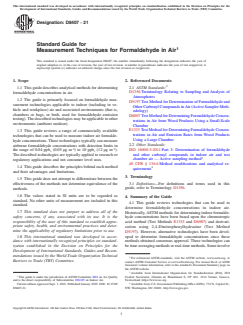
5.1 The objective of this guide is to provide the user with an information base on commercially available instruments and technologies that can be used to measure indoor air formaldehyde concentrations.
5.2 This guide is intended as a repository for formaldehyde measurement technologies that other approved ASTM methods can reference to meet ASTM indoor air formaldehyde quantification needs.
5.3 This guide does not discuss the equivalency of the technologies presented. Each technology may have positive or negative interferences that are unique to that technology. When using a new method, equivalence with old methods should be demonstrated for each matrix, measuring environment and media (that is, each type of wood for formaldehyde emission testing in chamber environments). This is especially true when the method is intended to generate regulatory compliance data. Demonstrating equivalence or compliance, or both, is beyond the scope of this method. For guidance equivalence see references such as 40 CFR § 136.6 and CEN Guide to the Demonstration of Equivalence of Ambient Air Monitoring Methods (1).5
SCOPE
1.1 This guide describes analytical methods for determining formaldehyde concentrations in air.
1.2 The guide is primarily focused on formaldehyde measurement technologies applicable to indoor (including in vehicle and workplace) air and associated environments (that is, chambers or bags, or both, used for formaldehyde emission testing). The described technologies may be applicable to other environments (ambient outdoor).
1.3 This guide reviews a range of commercially available technologies that can be used to measure indoor air formaldehyde concentrations. These technologies typically can measure airborne formaldehyde concentrations with detection limits in the range of 0.04 ppbv (0.05 µg m-3) to 10 ppbv (12 µg m-3). The described technologies are typically applied to research or regulatory applications and not consumer level uses.
1.4 This guide describes the principles behind each method and their advantages and limitations.
1.5 This guide does not attempt to differentiate between the effectiveness of the methods nor determine equivalence of the methods.
1.6 The values stated in SI units are to be regarded as standard. No other units of measurement are included in this standard.
1.7 This standard does not purport to address all of the safety concerns, if any, associated with its use. It is the responsibility of the user of this standard to establish appropriate safety, health, and environmental practices and determine the applicability of regulatory limitations prior to use.
1.8 This international standard was developed in accordance with internationally recognized principles on standardization established in the Decision on Principles for the Development of International Standards, Guides and Recommendations issued by the World Trade Organization Technical Barriers to Trade (TBT) Committee.
- Status
- Published
- Publication Date
- 31-Aug-2021
- Technical Committee
- D22 - Air Quality
- Drafting Committee
- D22.05 - Indoor Air
Overview
ASTM D8407-21 is the Standard Guide for Measurement Techniques for Formaldehyde in Air, published by ASTM International. The guide provides a comprehensive overview of commercially available technologies and analytical methods for determining formaldehyde concentrations in indoor air environments. These environments include residential, vehicle, workplace, and formaldehyde emission testing chambers or bags. While the guide is focused on indoor and associated environments, many of the technologies described may also be suitable for measuring formaldehyde in ambient outdoor air.
As a reference document, ASTM D8407-21 assists laboratories, researchers, and regulatory bodies in selecting fit-for-purpose methods for formaldehyde air quantification. It describes the principles, advantages, and limitations of each analytical method, supporting their application for both research and regulatory compliance in indoor air quality assessments.
Key Topics
- Range of Measurement Techniques: The guide summarizes widely used and emerging technologies for formaldehyde air monitoring, including wet chemistry (e.g., chromotropic acid, DNPH derivatization), advanced spectrometry (e.g., FTIR, cavity ringdown, photoacoustic), chemical ionization mass spectrometry, and laser-based analyzers.
- Analytical Performance: Core parameters such as detection limits (typically 0.04 ppbv to 10 ppbv), sampling times (from real-time seconds to 1-hour averages), and applicable concentration ranges are discussed for each method.
- Strengths and Limitations: Each technology is explained with its operational principles, training and safety considerations, chemical interferences, and suitability for steady-state or dynamic sampling.
- Laboratory vs. Field Use: Some methods (e.g., DNPH cartridges) involve off-site laboratory analysis, while others (e.g., photoacoustic, electrochemical sensors) are suitable for real-time, on-site measurements.
- Interference and Equivalence: The guide emphasizes the importance of method selection based on known and possible chemical interferences. It does not compare method effectiveness or equivalence, noting that equivalency demonstration is necessary when methods are used to produce regulatory data.
Applications
ASTM D8407-21 serves as a resource for choosing appropriate formaldehyde measurement methods in various settings, including:
- Indoor Air Quality Testing: In homes, offices, health facilities, and public buildings, to meet health guidelines and regulatory limits for indoor air formaldehyde exposure.
- Workplace Monitoring: To ensure compliance with occupational safety standards in factories, laboratories, or any facility where formaldehyde is produced or used.
- Product Emissions Testing: Including chamber-based testing of wood products or furnishings for regulatory compliance (e.g., emission labeling, third-party certifications).
- Research and Development: Providing researchers with validated measurement technologies for studying environmental exposure, mitigation strategies, and new materials.
- Regulatory Compliance: Supporting organizations and test laboratories in selecting ASTM-endorsed methods for formaldehyde quantification aligned with government and international requirements.
Related Standards
- ASTM D5197: Test Method for Determination of Formaldehyde and Other Carbonyl Compounds in Air (Active Sampler Methodology).
- ASTM D6007: Test Method for Determining Formaldehyde Concentrations in Air from Wood Products Using a Small-Scale Chamber.
- ASTM E1333: Test Method for Determining Formaldehyde Concentrations in Air and Emission Rates from Wood Products Using a Large Chamber.
- ISO 16000-3: Indoor air - Measurement of formaldehyde and other carbonyl compounds by active sampling.
- 40 CFR § 136.6: US EPA guidance on method modifications and analytical requirements.
- ASTM D1356: Terminology Relating to Sampling and Analysis of Atmospheres.
Practical Value
Implementing ASTM D8407-21 ensures that measurement of formaldehyde in air is performed using commercially available, well-characterized methods that are referenced by industry and regulatory bodies. The guide aids in the selection of appropriate technologies, enhances the comparability of results across laboratories, and supports efforts to improve indoor air quality and confirming regulatory compliance.
Relations
- Effective Date
- 01-Sep-2020
- Effective Date
- 15-Mar-2020
- Effective Date
- 15-Oct-2015
- Effective Date
- 01-Jul-2015
- Effective Date
- 01-Dec-2014
- Effective Date
- 01-May-2014
- Effective Date
- 15-Jan-2014
- Effective Date
- 01-May-2010
- Effective Date
- 01-Apr-2010
- Effective Date
- 01-Nov-2009
- Effective Date
- 01-Nov-2009
- Effective Date
- 01-Oct-2008
- Effective Date
- 01-May-2005
- Effective Date
- 10-Apr-2003
- Effective Date
- 10-Apr-2002
Get Certified
Connect with accredited certification bodies for this standard

CIS Institut d.o.o.
Personal Protective Equipment (PPE) certification body. Notified Body NB-2890 for EU Regulation 2016/425 PPE.

Kiwa BDA Testing
Building and construction product certification.
Kmetijski inštitut Slovenije
Agricultural Institute of Slovenia. Soil testing, plant health, agricultural product analysis.
Sponsored listings
Frequently Asked Questions
ASTM D8407-21 is a guide published by ASTM International. Its full title is "Standard Guide for Measurement Techniques for Formaldehyde in Air". This standard covers: SIGNIFICANCE AND USE 5.1 The objective of this guide is to provide the user with an information base on commercially available instruments and technologies that can be used to measure indoor air formaldehyde concentrations. 5.2 This guide is intended as a repository for formaldehyde measurement technologies that other approved ASTM methods can reference to meet ASTM indoor air formaldehyde quantification needs. 5.3 This guide does not discuss the equivalency of the technologies presented. Each technology may have positive or negative interferences that are unique to that technology. When using a new method, equivalence with old methods should be demonstrated for each matrix, measuring environment and media (that is, each type of wood for formaldehyde emission testing in chamber environments). This is especially true when the method is intended to generate regulatory compliance data. Demonstrating equivalence or compliance, or both, is beyond the scope of this method. For guidance equivalence see references such as 40 CFR § 136.6 and CEN Guide to the Demonstration of Equivalence of Ambient Air Monitoring Methods (1).5 SCOPE 1.1 This guide describes analytical methods for determining formaldehyde concentrations in air. 1.2 The guide is primarily focused on formaldehyde measurement technologies applicable to indoor (including in vehicle and workplace) air and associated environments (that is, chambers or bags, or both, used for formaldehyde emission testing). The described technologies may be applicable to other environments (ambient outdoor). 1.3 This guide reviews a range of commercially available technologies that can be used to measure indoor air formaldehyde concentrations. These technologies typically can measure airborne formaldehyde concentrations with detection limits in the range of 0.04 ppbv (0.05 µg m-3) to 10 ppbv (12 µg m-3). The described technologies are typically applied to research or regulatory applications and not consumer level uses. 1.4 This guide describes the principles behind each method and their advantages and limitations. 1.5 This guide does not attempt to differentiate between the effectiveness of the methods nor determine equivalence of the methods. 1.6 The values stated in SI units are to be regarded as standard. No other units of measurement are included in this standard. 1.7 This standard does not purport to address all of the safety concerns, if any, associated with its use. It is the responsibility of the user of this standard to establish appropriate safety, health, and environmental practices and determine the applicability of regulatory limitations prior to use. 1.8 This international standard was developed in accordance with internationally recognized principles on standardization established in the Decision on Principles for the Development of International Standards, Guides and Recommendations issued by the World Trade Organization Technical Barriers to Trade (TBT) Committee.
SIGNIFICANCE AND USE 5.1 The objective of this guide is to provide the user with an information base on commercially available instruments and technologies that can be used to measure indoor air formaldehyde concentrations. 5.2 This guide is intended as a repository for formaldehyde measurement technologies that other approved ASTM methods can reference to meet ASTM indoor air formaldehyde quantification needs. 5.3 This guide does not discuss the equivalency of the technologies presented. Each technology may have positive or negative interferences that are unique to that technology. When using a new method, equivalence with old methods should be demonstrated for each matrix, measuring environment and media (that is, each type of wood for formaldehyde emission testing in chamber environments). This is especially true when the method is intended to generate regulatory compliance data. Demonstrating equivalence or compliance, or both, is beyond the scope of this method. For guidance equivalence see references such as 40 CFR § 136.6 and CEN Guide to the Demonstration of Equivalence of Ambient Air Monitoring Methods (1).5 SCOPE 1.1 This guide describes analytical methods for determining formaldehyde concentrations in air. 1.2 The guide is primarily focused on formaldehyde measurement technologies applicable to indoor (including in vehicle and workplace) air and associated environments (that is, chambers or bags, or both, used for formaldehyde emission testing). The described technologies may be applicable to other environments (ambient outdoor). 1.3 This guide reviews a range of commercially available technologies that can be used to measure indoor air formaldehyde concentrations. These technologies typically can measure airborne formaldehyde concentrations with detection limits in the range of 0.04 ppbv (0.05 µg m-3) to 10 ppbv (12 µg m-3). The described technologies are typically applied to research or regulatory applications and not consumer level uses. 1.4 This guide describes the principles behind each method and their advantages and limitations. 1.5 This guide does not attempt to differentiate between the effectiveness of the methods nor determine equivalence of the methods. 1.6 The values stated in SI units are to be regarded as standard. No other units of measurement are included in this standard. 1.7 This standard does not purport to address all of the safety concerns, if any, associated with its use. It is the responsibility of the user of this standard to establish appropriate safety, health, and environmental practices and determine the applicability of regulatory limitations prior to use. 1.8 This international standard was developed in accordance with internationally recognized principles on standardization established in the Decision on Principles for the Development of International Standards, Guides and Recommendations issued by the World Trade Organization Technical Barriers to Trade (TBT) Committee.
ASTM D8407-21 is classified under the following ICS (International Classification for Standards) categories: 13.040.01 - Air quality in general. The ICS classification helps identify the subject area and facilitates finding related standards.
ASTM D8407-21 has the following relationships with other standards: It is inter standard links to ASTM D1356-20a, ASTM D1356-20, ASTM D1356-15a, ASTM D1356-15, ASTM D1356-14b, ASTM D1356-14a, ASTM D1356-14, ASTM E1333-10, ASTM D1356-05(2010), ASTM D5197-09, ASTM D5197-09e1, ASTM D6007-02(2008), ASTM D1356-05, ASTM D5197-03, ASTM D6007-96. Understanding these relationships helps ensure you are using the most current and applicable version of the standard.
ASTM D8407-21 is available in PDF format for immediate download after purchase. The document can be added to your cart and obtained through the secure checkout process. Digital delivery ensures instant access to the complete standard document.
Standards Content (Sample)
This international standard was developed in accordance with internationally recognized principles on standardization established in the Decision on Principles for the
Development of International Standards, Guides and Recommendations issued by the World Trade Organization Technical Barriers to Trade (TBT) Committee.
Designation: D8407 − 21
Standard Guide for
Measurement Techniques for Formaldehyde in Air
This standard is issued under the fixed designation D8407; the number immediately following the designation indicates the year of
original adoption or, in the case of revision, the year of last revision. A number in parentheses indicates the year of last reapproval. A
superscript epsilon (´) indicates an editorial change since the last revision or reapproval.
1. Scope 2. Referenced Documents
2.1 ASTM Standards:
1.1 This guide describes analytical methods for determining
D1356 Terminology Relating to Sampling and Analysis of
formaldehyde concentrations in air.
Atmospheres
1.2 The guide is primarily focused on formaldehyde mea-
D5197 Test Method for Determination of Formaldehyde and
surement technologies applicable to indoor (including in ve-
OtherCarbonylCompoundsinAir(ActiveSamplerMeth-
hicle and workplace) air and associated environments (that is,
odology)
chambers or bags, or both, used for formaldehyde emission
D6007 TestMethodforDeterminingFormaldehydeConcen-
testing).Thedescribedtechnologiesmaybeapplicabletoother
trations in Air from Wood Products Using a Small-Scale
environments (ambient outdoor).
Chamber
E1333 Test Method for Determining Formaldehyde Concen-
1.3 This guide reviews a range of commercially available
trations in Air and Emission Rates from Wood Products
technologies that can be used to measure indoor air formalde-
Using a Large Chamber
hyde concentrations.These technologies typically can measure
2.2 Other Standards:
airborne formaldehyde concentrations with detection limits in
-3 -3
ISO 16000-3:2011 Part 3: Determination of formaldehyde
the range of 0.04 ppb (0.05 µg m )to10ppb (12 µg m ).
v v
and other carbonyl compounds in indoor air and test
The described technologies are typically applied to research or
chamber air — Active sampling method
regulatory applications and not consumer level uses.
40 CFR § 136.6 Method modifications and analytical re-
1.4 This guide describes the principles behind each method 4
quirements
and their advantages and limitations.
3. Terminology
1.5 This guide does not attempt to differentiate between the
effectiveness of the methods nor determine equivalence of the 3.1 Definitions—For definitions and terms used in this
methods. guide, refer to Terminology D1356.
1.6 The values stated in SI units are to be regarded as
4. Summary of the Guide
standard. No other units of measurement are included in this
4.1 This guide reviews technologies that can be used to
standard.
determine formaldehyde concentrations in indoor air.
1.7 This standard does not purport to address all of the
Historically,ASTM methods for determining indoor formalde-
safety concerns, if any, associated with its use. It is the
hyde concentrations have been based upon the chromotropic
responsibility of the user of this standard to establish appro-
acid method (Test Methods E1333 and D6007) and derivati-
priate safety, health, and environmental practices and deter-
zation using 2,4-Dinitrophenylhydrazine (Test Method
mine the applicability of regulatory limitations prior to use.
D5197). However, alternative technologies have been devel-
1.8 This international standard was developed in accor- oped to determine formaldehyde concentrations since these
methods obtained consensus approval. These technologies can
dance with internationally recognized principles on standard-
ization established in the Decision on Principles for the betimeaveragingmethodsorreal-timemethods.Someinvolve
Development of International Standards, Guides and Recom-
mendations issued by the World Trade Organization Technical
For referenced ASTM standards, visit the ASTM website, www.astm.org, or
Barriers to Trade (TBT) Committee.
contact ASTM Customer Service at service@astm.org. For Annual Book of ASTM
Standards volume information, refer to the standard’s Document Summary page on
the ASTM website.
Available from International Organization for Standardization (ISO), ISO
This guide is under the jurisdiction of ASTM Committee D22 on Air Quality Central Secretariat, Chemin de Blandonnet 8, CP 401, 1214 Vernier, Geneva,
and is the direct responsibility of Subcommittee D22.05 on Indoor Air. Switzerland, https://www.iso.org.
Current edition approved Sept. 1, 2021. Published January 2022. DOI: 10.1520/ Available from U.S. Government Publishing Office (GPO), 732 N. Capitol St.,
D8407-21. NW, Washington, DC 20401, http://www.gpo.gov.
Copyright © ASTM International, 100 Barr Harbor Drive, PO Box C700, West Conshohocken, PA 19428-2959. United States
D8407 − 21
the use of wet chemicals for reactions or extractions. Other references such as 40 CFR § 136.6 and CEN Guide to the
methods rely on formaldehyde molecular response to differing Demonstration of Equivalence of Ambient Air Monitoring
energy inputs. The purpose of this guide is to examine the Methods (1).
range of methods that can be used and describe the advantages
6. Formaldehyde Quantification Methods
and limitations of each method.
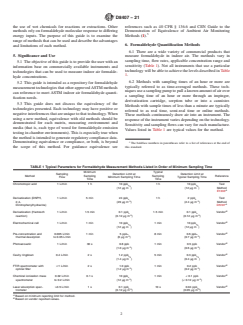
6.1 There are a wide variety of commercial products that
5. Significance and Use
measure formaldehyde in indoor air. The methods vary in
sampling time, flow rates, applicable concentration range and
5.1 The objective of this guide is to provide the user with an
sensitivity (Table 1). Not all instruments that use a particular
information base on commercially available instruments and
technologywillbeabletoachievethelevelsdescribedinTable
technologies that can be used to measure indoor air formalde-
1.
hyde concentrations.
6.2 Methods with sampling times of an hour or more are
5.2 This guide is intended as a repository for formaldehyde
typically referred to as time-averaged methods. These tech-
measurementtechnologiesthatotherapprovedASTMmethods
niquesuseasamplingpumptopullaknownamountofairover
can reference to meet ASTM indoor air formaldehyde quanti-
a sampling time of an hour or more through an impinger,
fication needs.
derivatization cartridge, sorption tube or into a cannister.
5.3 This guide does not discuss the equivalency of the
Methods with sample times of less than a minute are typically
technologies presented. Each technology may have positive or
referred to as real time, semi-real time or online methods.
negative interferences that are unique to that technology.When
These methods continuously draw air into an instrument. The
using a new method, equivalence with old methods should be
response of the instrument varies depending on the technology.
demonstrated for each matrix, measuring environment and
Sensitivity and sampling flows can vary for each manufacture.
media (that is, each type of wood for formaldehyde emission
Values listed in Table 1 are typical values for the method.
testing in chamber environments). This is especially true when
the method is intended to generate regulatory compliance data.
Demonstrating equivalence or compliance, or both, is beyond 5
The boldface numbers in parentheses refer to a list of references at the end of
the scope of this method. For guidance equivalence see this standard.
TABLE 1 Typical Parameters for Formaldehyde Measurement Methods Listed in Order of Minimum Sampling Time
Minimum Typical
Sampling Detection Limit at Detection Limit at
Method Sampling Sampling Reference
Flow Minimum Sampling Time Typical Sampling Time
Time Time
Chromotropic acid 1 L/min 1 h 10 ppb 1 h 10 ppb Test
v v
-3 -3
(12µgm ) (12µgm ) Method
A
E1333
Derivatization (DNPH, 1 L/min 5 min 24 ppb 1h 2ppb Test
v v
-3 -3
2,4- (29µgm ) (2.4 µg m ) Method
A
Dinitrophenylhydrazine) D5197
B
Derivatization (Hantzsch 1 L/min 1.5 min 0.1 ppb 1.5 min 0.1 ppb Vendor
v v
-3 -3
reaction) (0.12 µg m ) (0.12 µg m )
B
Electrochemical cell 1 L/min 1 min 10 ppb 1 min 10 ppb Vendor
v v
-3 -3
(12µgm ) (12µgm )
B
Pre-concentration and 0.005 L/min 1min 5ppb 8 min 0.6 ppb Vendor
v v
-3 -3
thermal desorption to 0.05 L/min (6 µg m ) (0.7 µg m )
B
Photoacoustic 1 L/min 30 s 0.8 ppb 1 min 0.5 ppb Vendor
-3 -3
(1.0 µg m ) (0.6 µg m )
B
Cavity ringdown 0.4 L/min 2 s 1.2 ppb 5 min 0.3 ppb Vendor
v v
-3 -3
(1.4 µg m ) (0.4 µg m )
B
FTIR spectrometer with $1L/min 2s 1.0ppb 1 min 0.2 ppb Vendor
-3 -3
optical filter (1.2 µg m ) (0.2 µg m )
B
Chemical ionization mass 0.02 L/min 0.1 s 10 ppb 1min <0.1ppb Vendor
v
-3 -3
spectrometer to 0.2 L/min (12µgm ) (< 0.12 µg m )
B
Laser absorption spec- >0.5 L/min 1 s 0.1 ppb 10 s 0.04 ppb Vendor
v v
-3 -3
trometer (0.12 µg m ) (0.05 µg m )
A
Based on minimum reporting limit for method.
B
Based on vendor reported values.
D8407 − 21
6.3 Sampling protocols varies between technologies (Table 6.7 Some methods have known interferents (aldehydes,
2). Some technologies require that the analytical instrument be alcohols, relative humidity, among others). Methods may also
present in the environment being sampled (onsite) or have a have unknown interferants present in indoor air. Some of the
direct connection to that environment that could include methods are relatively newly applied to analysis of indoor air
tubing,manifoldsorvalves.Onsitesystemscanbeusedinboth samplesandinterferentsforthesemethodsarenotexpectedbut
field and lab applications. Onsite collection requires the person could be present.
doing the sampling possess suitable training to use the instru-
6.8 The remainder of this guide outlines the scientific
ment. For other methods formaldehyde is derivatized or stored
principlesuponwhicheachmethodisbased,requiredmaterials
in sampling media or containers which are then shipped to a
and instruments, and the advantages and limitations of each
laboratory for quantification (offsite). Collection of offsite
method.
samples can require the use of calibrated pumps or flow
controllers. Collection of samples for offsite analysis can be
CHROMOTROPIC ACID
performed by personnel who are not familiar with the analyti-
6.9 How It Works—Air is pulled through an impinger
cal technique.
containing 20 mL of sodium bisulfite (NaHSO ) solution.
6.4 Methods requiring the handling and storage of strong
Chromotropic acid (C H O S Na · 2H O) is added to the
10 6 8 2 2 2
acids, solvents and other chemicals are typically referred to as
solution. In theory, two chromotrophic acid molecules are
wet chemistry methods (Table 2). These methods require
bound together by one formaldehyde molecule to form a
collected samples to be reacted with chemicals prior to
chemical that results in a red-purple color solution (2). The
analyses. Derivatization and wet chemistry methods are time
solution is typically shipped to a laboratory for analysis.
intensive and require consumables (wet chemicals, or car-
Formaldehydeconcentrationsarequantifiedwithaspectropho-
tridges).
tometer measuring absorption in the 570 nm to 580 nm range
and using standards made from a 37 % formaldehyde liquid
6.5 The type of training required varies for each method.
solution. Formaldehyde air concentrations are calculated using
For offsite methods, the person in the field can have a different
the concentration in the solution, the volume of sodium
type and level of training than the person operating the
bisulfate and volume of air sampled (EPA TO-11A (3)).
analytical equipment.
6.10 Requirements—Quantifying formaldehyde using chro-
6.6 Some technologies can simultaneously quantify other
motrophic acid requires the following:
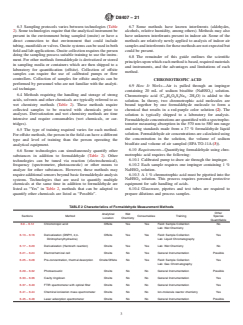
substances in addition to formaldehyde (Table 2). Other
6.10.1 Calibrated pump to draw air through the impinger.
technologies can be tuned via reaction (electrochemical),
6.10.2 Each sample requires one impinger containing 1 %
frequency (spectrometer, photoacoustic) or other means to
NaHSO solution.
analyze for other substances. However, these methods may
6.10.3 A 1 % chromotrophic acid must be pipetted into the
require additional sensors beyond basic formaldehyde analysis
systems. Technologies that are used to quantify multiple NaHSO solution. This process requires personal protective
equipment for safe handling of acids.
chemicals at the same time in addition to formaldehyde are
listed as “Yes” in Table 2, methods that can be adapted to 6.10.4 Glassware, pipettes and test tubes are required to
quantify other chemicals are listed as “Possible”. prepare dilutions and process samples.
TABLE 2 Characteristics of Formaldehyde Measurement Methods
Other
Analytical Wet
Sections Method Consumables Training Species
Location Chemistry
Quantifiable
6.9–6.12 Chromotropic acid Offsite Yes Yes Field: Sample Collection No
Lab: Wet Chemistry
6.13 – 6.16 Derivatization (DNPH, 2,4- Offsite Yes Yes Field: Sample Collection Yes
Dinitrophenylhydrazine) Lab: Liquid Chromatography
6.17 – 6.20 Derivatization (Hantzsch reaction) Onsite Yes Yes Lab: Wet Chemistry No
6.21 – 6.24 Electrochemical cell Onsite No Yes General Instrumentation Possible
6.25 – 6.28 Pre-concentration, thermal desorption Onsite/Offsite No Yes Field: Sample Collection Yes
Lab: Gas Chromatography
6.29 – 6.32 Photoacoustic Onsite No No General Instrumentation Possible
6.33 – 6.36 Cavity ringdown Onsite No No General Instrumentation Yes
6.37 – 6.40 FTIR spectrometer with optical filter Onsite No No General Instrumentation Yes
6.41 – 6.44 Chemical ionization mass spectrometer Onsite No No Ion-molecule reactor chemistry Yes
6.45 – 6.48 Laser adsorption spectrometer Onsite No No General Instrumentation Possible
D8407 − 21
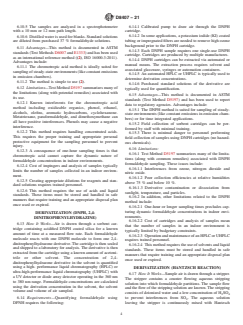
6.10.5 The samples are analyzed in a spectrophotometer 6.14.1 Calibrated pump to draw air through the DNPH
with a 10 mm or 12 mm path length. cartridge.
6.14.2 In some applications, a potassium iodide (KI) coated
6.10.6 Distilled water is used for blanks. Standard solutions
are diluted from purchased 37 % formaldehyde solutions. tubing or impregnated filters are needed to remove high ozone
background prior to the DNPH cartridge.
6.11 Advantages—This method is documented in ASTM
6.14.3 Each DNPH sample requires one single-use DNPH
standards (Test Methods D6007 and E1333) and has been used
cartridge. Cartridges are produced by multiple manufactures.
as an international reference method ((2), ISO 16000-3:2011).
6.14.4 DNPH cartridges can be extracted via automated or
Advantages include:
manual means. The extraction process requires solvent and
6.11.1 The chromotropic acid method is ideally suited for
associated glassware, syringes or automation containers.
samplingofsteady-stateenvironments(likeconstantemissions
6.14.5 An automated HPLC or UHPLC is typically used to
in emission chambers).
determine derivation concentrations.
6.11.2 The method is simple to use (2).
6.14.6 Purchased standard solutions of the derivative are
6.12 Limitations—Test Method D5197 summarizes many of
typically used for quantification.
the limitations (along with potential remedies) associated with
6.15 Advantages—This method is documented in ASTM
its use.
standards (Test Method D5197) and has been used to report
6.12.1 Known interferents for the chromotropic acid
data to regulatory agencies. Advantages include:
method including oxidizable organics, phenol, ethanol,
6.15.1 The DNPH method is suited for sampling of steady-
alcohols, olefins, aromatic hydrocarbons, cyclohexanone.
state environments (like constant emissions in emission cham-
Metatrioxane, paraformaldehyde, and dimethoxymethane can
bers) or for time integrated applications.
all have positive interferences. Phenols may cause a negative
6.15.2 Field collection of sorbent cartridges can be per-
interference.
formed by staff with minimal training.
6.12.2 This method requires handling concentrated acids.
6.15.3 There is minimal danger to personnel performing
This requires the proper training and appropriate personal
field collection of samples using DNPH cartridges (no hazard-
protective equipment for the sampling personnel to prevent
ous chemicals).
injury.
6.16 Limitations:
6.12.3 A consequence of one-hour sampling times is that
6.16.1 Test Method D5197 summarizes many of the limita-
chromotropic acid cannot capture the dynamic nature of
tions (along with common remedies) associated with DNPH
formaldehyde concentrations in indoor environments.
formaldehyde sampling. These issues include:
6.12.4 Cost of impingers and analysis of samples typically
6.16.1.1 Interferences from ozone, nitrogen dioxide and
limits the number of samples collected in an indoor environ-
nitric oxide.
ment.
6.16.1.2 Poor collection efficiencies at relative humidities
6.12.5 Creating appropriate dilutions for reagents and stan-
above 75 % and below 10 %.
dard solutions requires trained personnel.
6.16.1.3 Derivative contamination or dissociation from
6.12.6 This method requires the use of acids and liquid
sunlight, temperature, and particles.
standards. These items must be stored and handled in safe
6.16.2 In addition, other limitations related to the DNPH
manners that require training and an appropriate disposal plan
method include:
once used or expired.
6.16.2.1 One-hour or longer sampling times precludes cap-
turing dynamic formaldehyde concentrations in indoor envi-
DERIVATIZATION (DNPH, 2,4-
ronments.
DINITROPHENYLHYDRAZINE)
6.16.2.2 Cost of cartridges and analysis of samples mean
6.13 How It Works—Air is drawn through a sorbent car-
that the number of samples in an indoor environment is
tridge containing acidified DNPH coated silica for a known
typically limited by budgetary constraints.
amount of time at a measured flow rate. Each formaldehyde
6.16.2.3 OperationandmaintenanceofanHPLCorUHPLC
molecule reacts with one DNPH molecule to form one 2,4-
requires trained personnel.
dinitrophenylhydrazonederivative.Thecartridgeisthensealed
6.16.2.4 This method requires the use of solvents and liquid
and shipped to a laboratory for analysis. The derivative is then
standards. These items must be stored and handled in safe
extracted from the cartridge using a known amount of acetoni-
manners that require training and an appropriate disposal plan
trile or other solvent. The concentration of 2,4-
once used or expired.
dinitrophenylhydrazone derivative in the solvent is quantified
using a high- performance liquid chromatography (HPLC) or
DERIVATIZATION (HANTZSCH REACTION)
ultra-high-performance liquid chromatography (UHPLC) with
6.17 How It Works—Sample air is drawn through a stripper.
a UV detector or diode array detector operating in the 360 nm
The stripper contains a counter flowing aqueous stripping
to 380 nm range. Formaldehyde concentrations are calculated
solution into which formaldehyde partitions. The sample flow
using the derivation concentration in the solvent, the solvent
and the flow of the stripping solution are known. The stripping
volume and volume of air sampled.
consists of deionized water and a low concentration of H SO
2 4
6.14 Requirements—Quantifying formaldehyde using to prevent interferences from SO . The aqueous solution
DPNH requires the following: leaving the stripper is continuously mixed with Hantzsch
D8407 − 21
reagent in a reactor at elevated temperature. Each formalde- 6.22 Requirements—Quantifying formaldehyde by electro-
hyde molecule reacts with one acetone-acetyl (2,4-pentadione) chemical analyzers requires the following:
molecule to form one 3,5-diacetly-1,4-dihydrolutidine deriva- 6.22.1 External power source for extended operation.
tive (DDL). The concentration of DDL in the output of the
6.23 Advantages—Electrochemical cell analyzers share the
reactor is quantified by UV-fluorescence at 510 nm, where the
following advantages:
fluorescence light is detected with a photomultiplier. The
6.23.1 No sample cartridges or impingers are needed to
concentration of formaldehyde is calculated from the raw
collect samples.
fluorescence signal, the sample gas flow and the flow of the
6.23.2 Suitable for both steady-state testing and dynamic
strippingsolution.Thelinearrelationshipbetweentherawdata
testing when concentration changes happen at time scales
and the formaldehyde concentration is obtained with a known
greater than 1 minute.
formaldehyde solution and a blank.
6.23.3 Required operator training is limited to general
6.18 Requirements—Quantifying formaldehyde by the instrumentation.
Hantzsch reaction continuously requires the following:
6.24 Limitations—Electrochemical cell analyzers can have
6.18.1 3.5 L of Hantzsch-reagent and 5 L stripping solution
the following limitations:
for a week of continuous operation.
6.24.1 The lifetime of an electrochemical cell is dependent
6.18.2 A 0.01 Molar formaldehyde standard solution for
upon the total amount of formaldehyde to which it has been
calibration.
exposed.
6.18.3 Glassware, balance, pipettes are required for prepa-
6.24.2 Electrochemical cells can corrode.
ration of the solutions.
6.24.3 Electrochemical cell analyzers are most suited for
field monitoring due to diffusive nature of sampling.
6.19 Advantages—Advantages of the Hantzsch reaction
6.24.4 Known interferences at sub 50 ppbv levels include
method include:
acetaldehyde, chlorine gas, hydrogen sulfide, hydrochloric
6.19.1 The collection efficiency is independent of humidity.
acid, sulfur dioxide and nitrogen dioxide. Other interferents
6.19.2 The system can be directly calibrated with a liquid
include acetone, carbon monoxide, ethanol, glutaraldehyde,
standard.
hydrogen, isopropanol, methanol, methylethylketone,
6.19.3 The method can also be applied to liquid samples.
n-butanol, n-propanol, ammonia, nitrous oxide, phenol, and
6.19.4 Commercial products automate the process provid-
propionaldehyde.
ing continuous measurement.
6.24.5 Water vapor is a known interferent that has been
6.19.5 Required operator training is limited to wet chemis-
shown to prevent accurate indoor formaldehyde measurements
try processes.
at 45 % to 50 % relative humidity (4).
6.19.6 Suited for both steady-state testing and dynamic
testing when concentration changes happen at time scales PRE-CONCENTRATION, THERMAL DESORPTION
greater than 1.5 minutes.
6.25 How It Works—Air samples first pass through a water
6.19.7 Can be applied either in field automati
...