

ASTM E2295-21
(Practice)Standard Practice for Fire Assay Silver Corrections in Analysis of Metal Bearing Ores, Concentrates, and Related Metallurgical Materials by Silver Determination in Slags and Cupels
General Information
- Abstract
SIGNIFICANCE AND USE
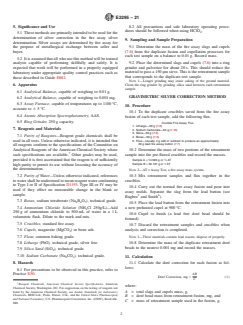
5.1 These methods are primarily intended to be used for the determination of silver correction in the fire assay silver determination. Silver assays are determined by fire assay for the purpose of metallurgical exchange between seller and buyer.
5.2 It is assumed that all who use this method will be trained analysts capable of performing skillfully and safely. It is expected that work will be performed in a properly equipped laboratory under appropriate quality control practices such as those described in Guide E882.
SCOPE
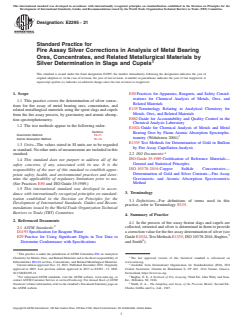
1.1 This practice covers the determination of silver corrections for fire assay of metal bearing ores, concentrates, and related metallurgical materials using the spent slags and cupels from the fire assay process, by gravimetry and atomic absorption spectrophotometry.
1.2 The test methods appear in the following order:
Sections
Gravimetric Method
10–11
Atomic Absorption Method
12–13
1.3 Units—The values stated in SI units are to be regarded as standard. No other units of measurement are included in this standard.
1.4 This standard does not purport to address all of the safety concerns, if any, associated with its use. It is the responsibility of the user of this standard to establish appropriate safety, health, and environmental practices and determine the applicability of regulatory limitations prior to use. (See Practices E50 and ISO Guide 35:1989.)
1.5 This international standard was developed in accordance with internationally recognized principles on standardization established in the Decision on Principles for the Development of International Standards, Guides and Recommendations issued by the World Trade Organization Technical Barriers to Trade (TBT) Committee.
- Status
- Published
- Publication Date
- 14-Nov-2021
- Technical Committee
- E01 - Analytical Chemistry for Metals, Ores, and Related Materials
- Drafting Committee
- E01.02 - Ores, Concentrates, and Related Metallurgical Materials
Buy Documents

ASTM E2295-21 - Standard Practice for Fire Assay Silver Corrections in Analysis of Metal Bearing Ores, Concentrates, and Related Metallurgical Materials by Silver Determination in Slags and Cupels
REDLINE ASTM E2295-21 - Standard Practice for Fire Assay Silver Corrections in Analysis of Metal Bearing Ores, Concentrates, and Related Metallurgical Materials by Silver Determination in Slags and Cupels
Overview
ASTM E2295-21, titled Standard Practice for Fire Assay Silver Corrections in Analysis of Metal Bearing Ores, Concentrates, and Related Metallurgical Materials by Silver Determination in Slags and Cupels, provides essential guidance for determining and correcting silver content in fire assay processes. This standard is critical for laboratories and professionals engaged in the metallurgical analysis of ores and concentrates, supporting accurate measurement of silver, which is vital for commercial transactions and metallurgical accounting between buyers and sellers. ASTM E2295-21 outlines procedures using gravimetric and atomic absorption spectrophotometry methods to determine residual silver in spent slags and cupels, enabling correction of fire assay results to achieve more precise silver determinations.
Key Topics
- Fire Assay Silver Corrections: This standard details methods for correcting silver results obtained from fire assays by accounting for residual silver remaining in slags and cupels after the assay process.
- Applicable Materials: Coverage includes metal bearing ores, concentrates, and related metallurgical materials frequently assessed in mineral processing and trading.
- Analytical Methods:
- Gravimetric Method: Involves retreatment and weighing of slags and cupels to ascertain lost silver.
- Atomic Absorption Spectrophotometry (AAS): Uses precise instrumental analysis for determining silver content in post-assay residues.
- Laboratory Requirements: Operators must be trained analysts using properly equipped laboratories with adherence to suitable quality control practices, such as those described in ASTM E882.
- Safety and Good Laboratory Practices: The standard emphasizes the importance of following appropriate safety, health, and environmental procedures.
Applications
ASTM E2295-21 is widely applied in:
- Metallurgical Laboratories: Essential for laboratories conducting precious metal analysis in mining, refining, and trading environments.
- Quality Control and Assurance: Used to ensure the reliability and accuracy of silver assay results, minimizing disputes in commercial exchanges.
- Metallurgical Accounting: Facilitates precise balance sheets for silver recovery in ore processing plants and smelters.
- International Trade: Provides a standardized approach to silver reporting for contracts and settlements between sellers and buyers of silver-bearing materials.
- Regulatory Compliance: Assists organizations in meeting industry and regulatory requirements for accurate assaying practices.
Related Standards
- ASTM E29: Practice for using significant digits in test data to determine conformance with specifications.
- ASTM E50: Practices for apparatus, reagents, and safety considerations for chemical analysis of metals, ores, and related materials.
- ASTM E135: Terminology relating to analytical chemistry for metals, ores, and related materials.
- ASTM E882: Guide for accountability and quality control in the chemical analysis laboratory.
- ASTM D1193: Specification for reagent water.
- ASTM E1024: Guide for chemical analysis of metals and metal bearing ores by atomic absorption spectrophotometry.
- ASTM E1335: Test methods for determination of gold in bullion by fire assay cupellation analysis.
- ISO 10378: Copper sulfide concentrates - determination of gold and silver contents - fire assay gravimetric and atomic absorption spectrometric method.
- ISO Guide 35: Certification of reference materials - general and statistical principles.
Practical Value
Compliance with ASTM E2295-21 ensures consistent, accurate silver assay corrections, supporting transparent commercial practices in the metals industry. The standard’s dual-method approach allows laboratories flexibility while delivering data quality essential for fair trade, process optimization, and compliance with recognized international practices. Accurate silver determination supports operational efficiency, risk mitigation in transactions, and regulatory adherence across the mining and metallurgical sectors.
Relations
- Effective Date
- 01-Jan-2020
- Effective Date
- 15-May-2019
- Effective Date
- 01-Sep-2017
- Effective Date
- 15-Jan-2017
- Effective Date
- 01-Dec-2016
- Effective Date
- 01-Dec-2016
- Effective Date
- 01-Aug-2016
- Effective Date
- 15-May-2016
- Effective Date
- 01-Jul-2015
- Effective Date
- 15-May-2015
- Effective Date
- 15-Aug-2014
- Effective Date
- 01-Apr-2014
- Effective Date
- 15-Feb-2014
- Effective Date
- 01-Dec-2013
- Effective Date
- 15-Oct-2011
Buy Documents
ASTM E2295-21 - Standard Practice for Fire Assay Silver Corrections in Analysis of Metal Bearing Ores, Concentrates, and Related Metallurgical Materials by Silver Determination in Slags and Cupels
REDLINE ASTM E2295-21 - Standard Practice for Fire Assay Silver Corrections in Analysis of Metal Bearing Ores, Concentrates, and Related Metallurgical Materials by Silver Determination in Slags and Cupels
Get Certified
Connect with accredited certification bodies for this standard

Bureau Veritas Chile
Bureau Veritas certification services in Chile.
Bureau Veritas Peru
Bureau Veritas certification services in Peru.
BVQI Peru
Bureau Veritas certification in Peru.
Sponsored listings
Frequently Asked Questions
ASTM E2295-21 is a standard published by ASTM International. Its full title is "Standard Practice for Fire Assay Silver Corrections in Analysis of Metal Bearing Ores, Concentrates, and Related Metallurgical Materials by Silver Determination in Slags and Cupels". This standard covers: SIGNIFICANCE AND USE 5.1 These methods are primarily intended to be used for the determination of silver correction in the fire assay silver determination. Silver assays are determined by fire assay for the purpose of metallurgical exchange between seller and buyer. 5.2 It is assumed that all who use this method will be trained analysts capable of performing skillfully and safely. It is expected that work will be performed in a properly equipped laboratory under appropriate quality control practices such as those described in Guide E882. SCOPE 1.1 This practice covers the determination of silver corrections for fire assay of metal bearing ores, concentrates, and related metallurgical materials using the spent slags and cupels from the fire assay process, by gravimetry and atomic absorption spectrophotometry. 1.2 The test methods appear in the following order: Sections Gravimetric Method 10–11 Atomic Absorption Method 12–13 1.3 Units—The values stated in SI units are to be regarded as standard. No other units of measurement are included in this standard. 1.4 This standard does not purport to address all of the safety concerns, if any, associated with its use. It is the responsibility of the user of this standard to establish appropriate safety, health, and environmental practices and determine the applicability of regulatory limitations prior to use. (See Practices E50 and ISO Guide 35:1989.) 1.5 This international standard was developed in accordance with internationally recognized principles on standardization established in the Decision on Principles for the Development of International Standards, Guides and Recommendations issued by the World Trade Organization Technical Barriers to Trade (TBT) Committee.
SIGNIFICANCE AND USE 5.1 These methods are primarily intended to be used for the determination of silver correction in the fire assay silver determination. Silver assays are determined by fire assay for the purpose of metallurgical exchange between seller and buyer. 5.2 It is assumed that all who use this method will be trained analysts capable of performing skillfully and safely. It is expected that work will be performed in a properly equipped laboratory under appropriate quality control practices such as those described in Guide E882. SCOPE 1.1 This practice covers the determination of silver corrections for fire assay of metal bearing ores, concentrates, and related metallurgical materials using the spent slags and cupels from the fire assay process, by gravimetry and atomic absorption spectrophotometry. 1.2 The test methods appear in the following order: Sections Gravimetric Method 10–11 Atomic Absorption Method 12–13 1.3 Units—The values stated in SI units are to be regarded as standard. No other units of measurement are included in this standard. 1.4 This standard does not purport to address all of the safety concerns, if any, associated with its use. It is the responsibility of the user of this standard to establish appropriate safety, health, and environmental practices and determine the applicability of regulatory limitations prior to use. (See Practices E50 and ISO Guide 35:1989.) 1.5 This international standard was developed in accordance with internationally recognized principles on standardization established in the Decision on Principles for the Development of International Standards, Guides and Recommendations issued by the World Trade Organization Technical Barriers to Trade (TBT) Committee.
ASTM E2295-21 is classified under the following ICS (International Classification for Standards) categories: 73.060.01 - Metalliferous minerals in general. The ICS classification helps identify the subject area and facilitates finding related standards.
ASTM E2295-21 has the following relationships with other standards: It is inter standard links to ASTM E135-20, ASTM E135-19, ASTM E50-17, ASTM E1335-08(2017), ASTM E882-10(2016)e1, ASTM E882-10(2016), ASTM E50-11(2016), ASTM E135-16, ASTM E135-15a, ASTM E135-15, ASTM E135-14b, ASTM E135-14a, ASTM E135-14, ASTM E135-13a, ASTM E50-11. Understanding these relationships helps ensure you are using the most current and applicable version of the standard.
ASTM E2295-21 is available in PDF format for immediate download after purchase. The document can be added to your cart and obtained through the secure checkout process. Digital delivery ensures instant access to the complete standard document.
Standards Content (Sample)
This international standard was developed in accordance with internationally recognized principles on standardization established in the Decision on Principles for the
Development of International Standards, Guides and Recommendations issued by the World Trade Organization Technical Barriers to Trade (TBT) Committee.
Designation: E2295 − 21
Standard Practice for
Fire Assay Silver Corrections in Analysis of Metal Bearing
Ores, Concentrates, and Related Metallurgical Materials by
Silver Determination in Slags and Cupels
This standard is issued under the fixed designation E2295; the number immediately following the designation indicates the year of
original adoption or, in the case of revision, the year of last revision. A number in parentheses indicates the year of last reapproval. A
superscript epsilon (´) indicates an editorial change since the last revision or reapproval.
1. Scope E50 Practices for Apparatus, Reagents, and Safety Consid-
erations for Chemical Analysis of Metals, Ores, and
1.1 This practice covers the determination of silver correc-
Related Materials
tions for fire assay of metal bearing ores, concentrates, and
E135 Terminology Relating to Analytical Chemistry for
related metallurgical materials using the spent slags and cupels
Metals, Ores, and Related Materials
from the fire assay process, by gravimetry and atomic absorp-
E882 Guide for Accountability and Quality Control in the
tion spectrophotometry.
Chemical Analysis Laboratory
1.2 The test methods appear in the following order:
E1024 Guide for Chemical Analysis of Metals and Metal
Sections
Bearing Ores by Flame Atomic Absorption Spectropho-
Gravimetric Method 10–11
tometry (Withdrawn 2004)
Atomic Absorption Method 12–13
E1335 Test Methods for Determination of Gold in Bullion
1.3 Units—The values stated in SI units are to be regarded
by Fire Assay Cupellation Analysis
as standard. No other units of measurement are included in this
standard. 2.2 ISO Documents:
ISO Guide 35:1989 Certification of Reference Materials—
1.4 This standard does not purport to address all of the
General and Statistical Principles
safety concerns, if any, associated with its use. It is the
ISO 10378:2016 Copper Sulfide Concentrates—
responsibility of the user of this standard to establish appro-
Determination of Gold and Silver Contents—Fire Assay
priate safety, health, and environmental practices and deter-
Gravimetric and Atomic Absorption Spectrometric
mine the applicability of regulatory limitations prior to use.
Method
(See Practices E50 and ISO Guide 35:1989.)
1.5 This international standard was developed in accor-
3. Terminology
dance with internationally recognized principles on standard-
ization established in the Decision on Principles for the
3.1 Definitions—For definitions of terms used in this
Development of International Standards, Guides and Recom-
practice, refer to Terminology E135.
mendations issued by the World Trade Organization Technical
Barriers to Trade (TBT) Committee.
4. Summary of Practice
2. Referenced Documents
4.1 In the process of fire assay fusion slags and cupels are
2.1 ASTM Standards: collected, retreated and silver is determined in them to provide
a correction value for the fire assay determination of silver (see
D1193 Specification for Reagent Water
E29 Practice for Using Significant Digits in Test Data to GuideE1024,TestMethodsE1335,ISO 10378:2016,Bugbee,
and Smith ).
Determine Conformance with Specifications
This practice is under the jurisdiction of ASTM Committee E01 on Analytical
Chemistry for Metals, Ores, and Related Materials and is the direct responsibility of The last approved version of this historical standard is referenced on
Subcommittee E01.02 on Ores, Concentrates, and Related Metallurgical Materials. www.astm.org.
Current edition approved Nov. 15, 2021. Published December 2021. Originally Available from International Organization for Standardization (ISO), ISO
approved in 2003. Last previous edition approved in 2013 as E2295 – 13. DOI: Central Secretariat, Chemin de Blandonnet 8, CP 401, 1214 Vernier, Geneva,
10.1520/E2295-21. Switzerland, https://www.iso.org.
2 5
For referenced ASTM standards, visit the ASTM website, www.astm.org, or Bugbee, E. E., A Textbook of Fire Assaying, Third Ed., John Wiley and Sons,
contact ASTM Customer Service at service@astm.org. For Annual Book of ASTM Inc., Hoboken, NJ, 1946.
Standards volume information, refer to the standard’s Document Summary page on Smith, E. A., The Sampling and Assay of the Precious Metals, Second Ed.,
the ASTM website. Charles Griffin and Co., Ltd., 1947.
Copyright © ASTM International, 100 Barr Harbor Drive, PO Box C700, West Conshohocken, PA 19428-2959. United States
E2295 − 21
5. Significance and Use 8.2 All precautions and safe laboratory operating proce-
dures should be followed when using HClO .
5.1 These methods are primarily intended to be used for the
determination of silver correction in the fire assay silver
9. Sampling and Sample Preparation
determination. Silver assays are determined by fire assay for
9.1 Determine the mass of the fire assay slags and cupels
the purpose of metallurgical exchange between seller and
(7.6) from the duplicate fusion and cupellation processes for
buyer.
each test sample on a balance to 0.01 g. Record mass.
5.2 Itisassumedthatallwhousethismethodwillbetrained
9.2 Place the determined slags and cupels (7.6) into a ring
analysts capable of performing skillfully and safely. It is
grinder and pulverize for about 20 s. This should reduce the
expected that work will be performed in a properly equipped
material to pass a 150 µm sieve. This is the retreatment sample
laboratory under appropriate quality control practices such as
that corresponds to the duplicate test sample.
those described in Guide E882.
NOTE 1—Longer grinding may cause caking of the ground material.
6. Apparatus Clean the ring grinder by grinding silica sand between each retreatment
sample.
6.1 Analytical Balance, capable of weighing to 0.01 g.
GRAVIMETRIC SILVER CORRECTION METHOD
6.2 Analytical Balance, capable of weighing to 0.001 mg.
6.3 Assay Furnace, capable of temperatures up to 1100 °C,
10. Procedure
accurate to 6 5 °C.
10.1 To the duplicate crucibles saved from the fire assay
6.4 Atomic Absorption Spectrophotometry, AAS.
fusion of each test sample, add the following flux.
6.5 Ring Grinder, 250 g capacity.
Crucible Fire Assay Flux
1. Litharge—50 g (7.8)
7. Reagents and Materials
2. Sodium Carbonate—50 g (7.10)
3. Silica—50 g (7.9)
7.1 Purity of Reagents—Reagent grade chemicals shall be
4. Borax—50 g (7.3)
used in all tests. Unless otherwise indicated, it is intended that 5. Flour—Usually 4 g add or subtract to produce an approximately
30 g lead fire assay button (7.7)
all reagents conform to the specifications of the Committee on
10.2 Determine the mass of two portions of the retreatment
Analytical Reagents of the American Chemical Society where
sample into the pre-fluxed crucibles and record the masses.
such specifications are available. Other grades may be used,
provided it is first ascertained that the reagent is of sufficiently
Sample A = 14.583 g or ⁄2 AT
Sample B = 29.167 g or 1 AT
high purity to permit its use without lessening the accuracy of
the determination.
NOTE 2—AT = Assay Ton, a fire assay mass system.
7.2 Purity of Water—Unless otherwise indicated, references 10.3 Mix retreatment samples and flux together in the
towatershallbeunderstoodtomeanreagentwaterconforming cruc
...
This document is not an ASTM standard and is intended only to provide the user of an ASTM standard an indication of what changes have been made to the previous version. Because
it may not be technically possible to adequately depict all changes accurately, ASTM recommends that users consult prior editions as appropriate. In all cases only the current version
of the standard as published by ASTM is to be considered the official document.
Designation: E2295 − 13 E2295 − 21
Standard Practice for
Fire Assay Silver Corrections in Analysis of Metal Bearing
Ores, Concentrates, and Related Metallurgical Materials by
Silver Determination in Slags and Cupels
This standard is issued under the fixed designation E2295; the number immediately following the designation indicates the year of
original adoption or, in the case of revision, the year of last revision. A number in parentheses indicates the year of last reapproval. A
superscript epsilon (´) indicates an editorial change since the last revision or reapproval.
1. Scope
1.1 This practice covers the determination of silver corrections for fire assay of metal bearing ores, concentrates, and related
metallurgical materials using the spent slags and cupels from the fire assay process, by gravimetry and atomic absorption
spectrophotometry.
1.2 The test methods appear in the following order:
Sections
Gravimetric Method 10–11
Atomic Absorption Method 12–13
1.3 Units—The values stated in SI units are to be regarded as standard. No other units of measurement are included in this
standard.
1.4 This standard does not purport to address all of the safety concerns, if any, associated with its use. It is the responsibility
of the user of this standard to establish appropriate safety safety, health, and healthenvironmental practices and determine the
applicability of regulatory limitations prior to use. (See Practices E50 and ISO Guide 35:1989.)
1.5 This international standard was developed in accordance with internationally recognized principles on standardization
established in the Decision on Principles for the Development of International Standards, Guides and Recommendations issued
by the World Trade Organization Technical Barriers to Trade (TBT) Committee.
2. Referenced Documents
2.1 ASTM Standards:
D1193 Specification for Reagent Water
E29 Practice for Using Significant Digits in Test Data to Determine Conformance with Specifications
E50 Practices for Apparatus, Reagents, and Safety Considerations for Chemical Analysis of Metals, Ores, and Related Materials
E135 Terminology Relating to Analytical Chemistry for Metals, Ores, and Related Materials
E882 Guide for Accountability and Quality Control in the Chemical Analysis Laboratory
This practice is under the jurisdiction of ASTM Committee E01 on Analytical Chemistry for Metals, Ores, and Related Materials and is the direct responsibility of
Subcommittee E01.02 on Ores, Concentrates, and Related Metallurgical Materials.
Current edition approved Nov. 1, 2013Nov. 15, 2021. Published December 2013December 2021. Originally approved in 2003. Last previous edition approved in 20082013
ε1
as E2295 – 03E2295 – 13. (Reapproved 2008) . DOI: 10.1520/E2295-13.10.1520/E2295-21.
For referenced ASTM standards, visit the ASTM website, www.astm.org, or contact ASTM Customer Service at service@astm.org. For Annual Book of ASTM Standards
volume information, refer to the standard’s Document Summary page on the ASTM website.
Copyright © ASTM International, 100 Barr Harbor Drive, PO Box C700, West Conshohocken, PA 19428-2959. United States
E2295 − 21
E1024 Guide for Chemical Analysis of Metals and Metal Bearing Ores by Flame Atomic Absorption Spectrophotometry
(Withdrawn 2004)
E1335 Test Methods for Determination of Gold in Bullion by Fire Assay Cupellation Analysis
2.2 ISO Documents:
ISO Guide 35:1989 Certification of Reference Materials—General and Statistical Principles
ISO 10378:1994ISO 10378:2016 Copper Sulfide Concentrates—Determination of Gold and Silver Contents—Fire Assay
Gravimetric and Atomic Absorption Spectrometric Method
3. Terminology
3.1 Definitions—For definitions of terms used in this practice, refer to Terminology E135.
4. Summary of Practice
4.1 In the process of fire assay fusion slags and cupels are collected, retreated and silver is determined in them to provide a
correction value for the fire assay determination of silver (see Guide E1024, Test Methods E1335, ISO 10378:1994,
5 6
ISO 10378:2016, Bugbee, and Smith ).
5. Significance and Use
5.1 These methods are primarily intended to be used for the determination of silver correction in the fire assay silver
determination. Silver assays are determined by fire assay for the purpose of metallurgical exchange between seller and buyer.
5.2 It is assumed that all who use this method will be trained analysts capable of performing skillfully and safely. It is expected
that work will be performed in a properly equipped laboratory under appropriate quality control practices such as those described
in Guide E882.
6. Apparatus
6.1 Analytical Balance, capable of weighing to 0.01 g.
6.2 Analytical Balance, capable of weighing to 0.001 mg.
6.3 Assay Furnace, capable of temperatures up to 1100 °C, accurate to 6 5 °C.
6.4 Atomic Absorption Spectrophotometry, AAS.
6.5 Ring Grinder, 250 g capacity.
7. Reagents and Materials
7.1 Purity of Reagents—Reagent grade chemicals shall be used in all tests. Unless otherwise indicated, it is intended that all
reagents conform to the specifications of the Committee on Analytical Reagents of the American Chemical Society where such
specifications are available. Other grades may be used, provided it is first ascertained that the reagent is of sufficiently high purity
to permit its use without lessening the accuracy of the determination.
7.2 Purity of Water—Unless otherwise indicated, references to water shall be understood to mean reagent water conforming to
Type I or II of Specification D1193. Type III or IV may be used if they effect no measurable change in the blank or sample.
The last approved version of this historical standard is referenced on www.astm.org.
Available from International Organization for Standardization (ISO), 1, ch. de la Voie-Creuse, Case postale 56, CH-1211, Geneva 20, Switzerland, http://www.iso.ch.ISO
Central Secretariat, Chemin de Blandonnet 8, CP 401, 1214 Vernier, Geneva, Switzerland, https://www.iso.org.
Bugbee, E. E., A Textbook of Fire Assaying, Third Ed., John Wiley and Sons, Inc., Hoboken, NJ, 1946.
Smith, E. A., The Sampling and Assay of the Precious Metals, Second Ed., Charles Griffin and Co., Ltd., 1947.
Reagent Chemicals, American Chemical Society Specifications, American Chemical Society, Washington, DC. For suggestions on the testing of reagents not listed by
the American Chemical Society, see Analar Standards for Laboratory Chemicals, BDH Ltd., Poole, Dorset, U.K., and the United States Pharmacopeia and National
Formulary, U.S. Pharmacopeial Convention, Inc. (USPC), Rockville, MD.
E2295 − 21
7.3 Borax, sodium tetraborate (Na B O ), technical grade.
2 4 7
7.4 Ammonium Chloride Solution (NH Cl 250g/L)—Add 250 g of ammonium chloride to 500 mL of water in a 1-L1 L volumetric
flask. Dilute to the mark and mix.
7.5 Crucibles, standard fire assay.
7.6 Cupels, magnesite (MgCO ) or bone ash.
7.7 Flour, common baking grade.
7.8 Litharge (PbO),technical grade, silver free.
7.9 Silica Sand (SiO ),technical grade.
7.10 Sodium Carbonate (Na CO ),technical grade.
2 3
8. Hazards
8.1 For precautions to be observed in this practice, refer to Practice E50.
8.2 All precautions and safe laboratory operating procedures should be followed when using HClO .
9. Sampling and Sample Preparation
9.1 Weigh the Determine the mass of the fire assay slags and cupels (7.6) from the duplicate fusion and cupellation processes for
each test sample on a balance to 0.
...