

ASTM E3330-22
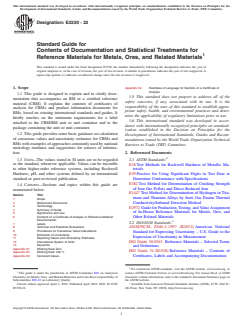
(Guide)Standard Guide for Contents of Documentation and Statistical Treatments for Reference Materials for Metals, Ores, and Related Materials
General Information
- Abstract
SIGNIFICANCE AND USE
5.1 This guide is intended for use by developers of RMs and CRMs for the metals and mining industries.
5.2 The guidance is related to uniform procedures and requirements and is intended to prevent the proliferation of widely varying documentation practices, definitions, and terminology. Where the statements in this guide are made as imperatives, it is because the stated practices are fundamental to chemical metrology, not to CRM/RM development.
5.3 The material in this guide is intended to supplement and to clarify the contents of ISO Guide 31 and to provide guidance specific to the needs of the metals and mining industries.
5.4 The documents described in this guide are intended to contain the minimum amount of information required for a user to understand the material, to help a user judge the quality of the product, and to help a user employ it in appropriate ways. Neither this guide nor resultant documents are meant to be encyclopedic.
5.5 Because this document is a standard guide, it is intended to educate those who are involved in laboratory operation, quality system development and maintenance, reference material development, and accreditation of laboratory operations within the scope of a quality system. It must be understood by all parties that the elements of this guide discuss optional practices having numerous choices for accomplishment and documentation. However, this guide does not constitute requirements for assessment and accreditation. An obvious example is statistical evaluation for consensus value and uncertainty calculations, which can take many forms with no single, correct choice for any given case.
5.6 When using this guide, CRM developers will set goals for the material under development, such as target uncertainties for homogeneity and for overall coverage intervals for assigned values. These choices are based on the intended uses of a CRM. The material, property values, and their uncertainties may or may not meet the set goals...
SCOPE
1.1 This guide is designed to explain and to clarify documentation that accompanies an RM or a certified reference material (CRM). It explains the contents of certificates of analysis for CRMs and product information documents for RMs, based on existing international standards and guides. It briefly touches on the minimum requirements for a label attached to the CRM/RM unit or unit container and to the package containing the unit or unit container.
1.2 This guide provides some basic guidance on calculation of consensus values and uncertainty estimates for CRMs and RMs with examples of approaches commonly used by national metrology institutes and suggestions for sources of information.
1.3 Units—The values stated in SI units are to be regarded as the standard, whenever applicable. Values can be traceable to other higher-order reference systems, including Rockwell Hardness, pH, and other systems defined by an international standard or peer-reviewed publication.
1.4 Contents—Sections and topics within this guide are enumerated below:
Section
Title
1
Scope
2
Referenced Documents
3
Terminology
4
Summary of Guide
5
Significance and Use
6
Contents of a Certificate of Analysis or Reference Material Documentation
7
Labels
8
Technical and Statistical Evaluations
9
Procedures for Consensus Value Calculations
10
Estimation of Uncertainty
11
Reporting Values and Uncertainty Estimates
12
International System of Units
13
Keywords
Appendix X1
Working Near Zero
Appendix X2
Working Near 100 %
Appendix X3
Censored Values
Appendix X4
Examples of Language for Sections of a Certificate of Analysis
1.5 This standard does not purport to address all of the safety concerns, if any, associated with its use. It is the responsibility of the user of this standard to establish appropriate safety, health, and enviro...
- Status
- Published
- Publication Date
- 31-Mar-2022
- Technical Committee
- E01 - Analytical Chemistry for Metals, Ores, and Related Materials
- Drafting Committee
- E01.22 - Laboratory Quality
Overview
ASTM E3330-22: Standard Guide for Contents of Documentation and Statistical Treatments for Reference Materials for Metals, Ores, and Related Materials is a comprehensive resource for developers, laboratories, and quality managers engaged in the production and use of reference materials (RMs) and certified reference materials (CRMs) in the metals and mining industries. Published by ASTM International, this standard promotes uniform documentation practices, clear definitions, and consistent terminology for reference materials, helping organizations ensure the reliability and comparability of analytical data globally.
The guide supplements key international standards, such as ISO Guide 31, and clarifies the minimum documentation requirements for RMs and CRMs, including the proper contents of certificates of analysis and product information sheets. It also addresses statistical practices for determining consensus values and uncertainty estimates, aiming to facilitate global acceptance and use of reference materials.
Key Topics
Purpose and Scope
- Provides guidance for documentation accompanying reference materials and certified reference materials.
- Intended for use by developers, laboratories, and quality system managers in the metals and mining sectors.
Documentation Requirements
- Details minimum and recommended contents for certificates of analysis (CRMs) and product information documents (RMs), such as:
- Title of document
- Unique identifier and name of the material
- Description, intended use, and key characteristics
- Assigned property values and associated uncertainties
- Metrological traceability and relevant test methods
- Storage instructions and period of validity
- Details minimum and recommended contents for certificates of analysis (CRMs) and product information documents (RMs), such as:
Statistical Treatments
- Offers guidance on methods for consensus value determination and estimation of uncertainty.
- Includes approaches commonly adopted by national metrology institutes.
- Provides suggestions on reporting certified values, handling censored data, and establishing confidence intervals.
Standardization and Terminology
- Encourages consistent use of terms as defined in relevant ISO Guides and international standards.
- Aims to reduce variability in documentation practices across organizations.
Applications
Reference Material Development
- Assists in developing standardized documentation for both in-house and commercially distributed RMs and CRMs.
- Supports quality assurance through clear assignment of property values, measurement uncertainty, and traceability.
Laboratory Operation and Accreditation
- Facilitates laboratory quality system development, documentation control, and compliance with international best practices.
- Clarifies requirements for certifying bodies and supports laboratory accreditation by defining the minimum information needed for understanding, evaluating, and utilizing reference materials.
Metals and Mining Industry
- Tailored guidance for producers and users of reference materials in metals, ores, and related materials.
- Enables harmonized quality control, proficiency testing, and interlaboratory comparisons across the industry.
Statistical Evaluation and Reporting
- Enhances consistency in statistical evaluation of laboratory data, assignment of consensus values, and estimation and reporting of measurement uncertainty.
Related Standards
ASTM Standards
- ASTM E29: Practice for Using Significant Digits in Test Data
- ASTM E2972: Guide for Production, Testing, and Value Assignment of In-House Reference Materials
- ASTM E18, E382, E1447: Various methods for specific materials and measurements
Key International Standards
- ISO Guide 30: Reference Materials - Selected Terms and Definitions
- ISO Guide 31: Reference Materials - Contents of Certificates and Accompanying Documentation
- ISO Guide 33: Good Practice in Using Reference Materials
- ISO Guide 35: Characterization and Assessment of Homogeneity and Stability
- ISO 17034: General Requirements for Reference Material Producers
Metrological Guidelines
- JCGM 100: Guide to the Expression of Uncertainty in Measurement (GUM)
- JCGM 200: International Vocabulary of Metrology (VIM)
Practical Value
ASTM E3330-22 ensures that documentation for reference materials is accurate, consistent, and internationally recognized. By aligning with this standard, producers and users of RMs and CRMs in the metals and mining industry can enhance data reliability, streamline quality assurance processes, and facilitate international trade and laboratory accreditation. Comprehensive guidance on documentation, statistical treatments, and labeling helps organizations maintain quality, meet customer expectations, and comply with global standards for metrological traceability and measurement uncertainty.
Relations
- Effective Date
- 15-Apr-2020
- Effective Date
- 01-Oct-2019
- Effective Date
- 01-Jul-2018
- Effective Date
- 01-Jul-2017
- Effective Date
- 15-Feb-2015
- Effective Date
- 01-Dec-2012
- Refers
ASTM E382-12 - Standard Test Method for Determination of Crushing Strength of Iron Ore Pellets - Effective Date
- 01-Jun-2012
- Effective Date
- 01-Nov-2011
- Effective Date
- 01-Mar-2009
- Effective Date
- 01-Oct-2008
- Effective Date
- 15-May-2008
- Effective Date
- 15-Jan-2008
- Refers
ASTM E382-07 - Standard Test Method for Determination of Crushing Strength of Iron Ore Pellets - Effective Date
- 01-Jun-2007
- Effective Date
- 01-Apr-2007
- Effective Date
- 15-Nov-2006
Get Certified
Connect with accredited certification bodies for this standard

Bureau Veritas Chile
Bureau Veritas certification services in Chile.
Bureau Veritas Peru
Bureau Veritas certification services in Peru.
BVQI Peru
Bureau Veritas certification in Peru.
Sponsored listings
Frequently Asked Questions
ASTM E3330-22 is a guide published by ASTM International. Its full title is "Standard Guide for Contents of Documentation and Statistical Treatments for Reference Materials for Metals, Ores, and Related Materials". This standard covers: SIGNIFICANCE AND USE 5.1 This guide is intended for use by developers of RMs and CRMs for the metals and mining industries. 5.2 The guidance is related to uniform procedures and requirements and is intended to prevent the proliferation of widely varying documentation practices, definitions, and terminology. Where the statements in this guide are made as imperatives, it is because the stated practices are fundamental to chemical metrology, not to CRM/RM development. 5.3 The material in this guide is intended to supplement and to clarify the contents of ISO Guide 31 and to provide guidance specific to the needs of the metals and mining industries. 5.4 The documents described in this guide are intended to contain the minimum amount of information required for a user to understand the material, to help a user judge the quality of the product, and to help a user employ it in appropriate ways. Neither this guide nor resultant documents are meant to be encyclopedic. 5.5 Because this document is a standard guide, it is intended to educate those who are involved in laboratory operation, quality system development and maintenance, reference material development, and accreditation of laboratory operations within the scope of a quality system. It must be understood by all parties that the elements of this guide discuss optional practices having numerous choices for accomplishment and documentation. However, this guide does not constitute requirements for assessment and accreditation. An obvious example is statistical evaluation for consensus value and uncertainty calculations, which can take many forms with no single, correct choice for any given case. 5.6 When using this guide, CRM developers will set goals for the material under development, such as target uncertainties for homogeneity and for overall coverage intervals for assigned values. These choices are based on the intended uses of a CRM. The material, property values, and their uncertainties may or may not meet the set goals... SCOPE 1.1 This guide is designed to explain and to clarify documentation that accompanies an RM or a certified reference material (CRM). It explains the contents of certificates of analysis for CRMs and product information documents for RMs, based on existing international standards and guides. It briefly touches on the minimum requirements for a label attached to the CRM/RM unit or unit container and to the package containing the unit or unit container. 1.2 This guide provides some basic guidance on calculation of consensus values and uncertainty estimates for CRMs and RMs with examples of approaches commonly used by national metrology institutes and suggestions for sources of information. 1.3 Units—The values stated in SI units are to be regarded as the standard, whenever applicable. Values can be traceable to other higher-order reference systems, including Rockwell Hardness, pH, and other systems defined by an international standard or peer-reviewed publication. 1.4 Contents—Sections and topics within this guide are enumerated below: Section Title 1 Scope 2 Referenced Documents 3 Terminology 4 Summary of Guide 5 Significance and Use 6 Contents of a Certificate of Analysis or Reference Material Documentation 7 Labels 8 Technical and Statistical Evaluations 9 Procedures for Consensus Value Calculations 10 Estimation of Uncertainty 11 Reporting Values and Uncertainty Estimates 12 International System of Units 13 Keywords Appendix X1 Working Near Zero Appendix X2 Working Near 100 % Appendix X3 Censored Values Appendix X4 Examples of Language for Sections of a Certificate of Analysis 1.5 This standard does not purport to address all of the safety concerns, if any, associated with its use. It is the responsibility of the user of this standard to establish appropriate safety, health, and enviro...
SIGNIFICANCE AND USE 5.1 This guide is intended for use by developers of RMs and CRMs for the metals and mining industries. 5.2 The guidance is related to uniform procedures and requirements and is intended to prevent the proliferation of widely varying documentation practices, definitions, and terminology. Where the statements in this guide are made as imperatives, it is because the stated practices are fundamental to chemical metrology, not to CRM/RM development. 5.3 The material in this guide is intended to supplement and to clarify the contents of ISO Guide 31 and to provide guidance specific to the needs of the metals and mining industries. 5.4 The documents described in this guide are intended to contain the minimum amount of information required for a user to understand the material, to help a user judge the quality of the product, and to help a user employ it in appropriate ways. Neither this guide nor resultant documents are meant to be encyclopedic. 5.5 Because this document is a standard guide, it is intended to educate those who are involved in laboratory operation, quality system development and maintenance, reference material development, and accreditation of laboratory operations within the scope of a quality system. It must be understood by all parties that the elements of this guide discuss optional practices having numerous choices for accomplishment and documentation. However, this guide does not constitute requirements for assessment and accreditation. An obvious example is statistical evaluation for consensus value and uncertainty calculations, which can take many forms with no single, correct choice for any given case. 5.6 When using this guide, CRM developers will set goals for the material under development, such as target uncertainties for homogeneity and for overall coverage intervals for assigned values. These choices are based on the intended uses of a CRM. The material, property values, and their uncertainties may or may not meet the set goals... SCOPE 1.1 This guide is designed to explain and to clarify documentation that accompanies an RM or a certified reference material (CRM). It explains the contents of certificates of analysis for CRMs and product information documents for RMs, based on existing international standards and guides. It briefly touches on the minimum requirements for a label attached to the CRM/RM unit or unit container and to the package containing the unit or unit container. 1.2 This guide provides some basic guidance on calculation of consensus values and uncertainty estimates for CRMs and RMs with examples of approaches commonly used by national metrology institutes and suggestions for sources of information. 1.3 Units—The values stated in SI units are to be regarded as the standard, whenever applicable. Values can be traceable to other higher-order reference systems, including Rockwell Hardness, pH, and other systems defined by an international standard or peer-reviewed publication. 1.4 Contents—Sections and topics within this guide are enumerated below: Section Title 1 Scope 2 Referenced Documents 3 Terminology 4 Summary of Guide 5 Significance and Use 6 Contents of a Certificate of Analysis or Reference Material Documentation 7 Labels 8 Technical and Statistical Evaluations 9 Procedures for Consensus Value Calculations 10 Estimation of Uncertainty 11 Reporting Values and Uncertainty Estimates 12 International System of Units 13 Keywords Appendix X1 Working Near Zero Appendix X2 Working Near 100 % Appendix X3 Censored Values Appendix X4 Examples of Language for Sections of a Certificate of Analysis 1.5 This standard does not purport to address all of the safety concerns, if any, associated with its use. It is the responsibility of the user of this standard to establish appropriate safety, health, and enviro...
ASTM E3330-22 is classified under the following ICS (International Classification for Standards) categories: 73.060.01 - Metalliferous minerals in general. The ICS classification helps identify the subject area and facilitates finding related standards.
ASTM E3330-22 has the following relationships with other standards: It is inter standard links to ASTM E382-20, ASTM E2972-15(2019), ASTM E18-18, ASTM E18-17, ASTM E2972-15, ASTM E18-12, ASTM E382-12, ASTM E18-11, ASTM E1447-09, ASTM E29-08, ASTM E18-08a, ASTM E18-08, ASTM E382-07, ASTM E18-07, ASTM E29-06b. Understanding these relationships helps ensure you are using the most current and applicable version of the standard.
ASTM E3330-22 is available in PDF format for immediate download after purchase. The document can be added to your cart and obtained through the secure checkout process. Digital delivery ensures instant access to the complete standard document.
Standards Content (Sample)
This international standard was developed in accordance with internationally recognized principles on standardization established in the Decision on Principles for the
Development of International Standards, Guides and Recommendations issued by the World Trade Organization Technical Barriers to Trade (TBT) Committee.
Designation: E3330 − 22
Standard Guide for
Contents of Documentation and Statistical Treatments for
Reference Materials for Metals, Ores, and Related Materials
This standard is issued under the fixed designation E3330; the number immediately following the designation indicates the year of
original adoption or, in the case of revision, the year of last revision. A number in parentheses indicates the year of last reapproval. A
superscript epsilon (´) indicates an editorial change since the last revision or reapproval.
1. Scope
Appendix X4 Examples of Language for Sections of a Certificate of
Analysis
1.1 This guide is designed to explain and to clarify docu-
1.5 This standard does not purport to address all of the
mentation that accompanies an RM or a certified reference
safety concerns, if any, associated with its use. It is the
material (CRM). It explains the contents of certificates of
responsibility of the user of this standard to establish appro-
analysis for CRMs and product information documents for
priate safety, health, and environmental practices and deter-
RMs, based on existing international standards and guides. It
mine the applicability of regulatory limitations prior to use.
briefly touches on the minimum requirements for a label
1.6 This international standard was developed in accor-
attached to the CRM/RM unit or unit container and to the
dance with internationally recognized principles on standard-
package containing the unit or unit container.
ization established in the Decision on Principles for the
1.2 This guide provides some basic guidance on calculation
Development of International Standards, Guides and Recom-
of consensus values and uncertainty estimates for CRMs and
mendations issued by the World Trade Organization Technical
RMs with examples of approaches commonly used by national
Barriers to Trade (TBT) Committee.
metrology institutes and suggestions for sources of informa-
tion.
2. Referenced Documents
1.3 Units—The values stated in SI units are to be regarded 2.1 ASTM Standards:
as the standard, whenever applicable. Values can be traceable
E18 Test Methods for Rockwell Hardness of Metallic Ma-
to other higher-order reference systems, including Rockwell terials
Hardness, pH, and other systems defined by an international
E29 Practice for Using Significant Digits in Test Data to
standard or peer-reviewed publication. Determine Conformance with Specifications
E382 Test Method for Determination of Crushing Strength
1.4 Contents—Sections and topics within this guide are
of Iron Ore Pellets and Direct-Reduced Iron
enumerated below:
E1447 Test Method for Determination of Hydrogen in Tita-
Section Title
nium and Titanium Alloys by Inert Gas Fusion Thermal
1 Scope
2 Referenced Documents
Conductivity/Infrared Detection Method
3 Terminology
E2972 Guide for Production,Testing, andValueAssignment
4 Summary of Guide
of In-House Reference Materials for Metals, Ores, and
5 Significance and Use
6 Contents of a Certificate of Analysis or Reference Material
Other Related Materials
Documentation
2.2 ISO/ANSI Standards:
7 Labels
8 Technical and Statistical Evaluations ANSI/NCSL Z540-2-1997 (R2012) American National
9 Procedures for Consensus Value Calculations
Standard for Expressing Uncertainty – U.S. Guide to the
10 Estimation of Uncertainty
Expression of Uncertainty in Measurement
11 Reporting Values and Uncertainty Estimates
12 International System of Units ISO Guide 30:2015 Reference Materials – Selected Terms
13 Keywords
and Definitions
Appendix X1 Working Near Zero
ISO Guide 31:2015(E) Reference Materials – Contents of
Appendix X2 Working Near 100 %
Appendix X3 Censored Values
Certificates, Labels and Accompanying Documentation
For referenced ASTM standards, visit the ASTM website, www.astm.org, or
This guide is under the jurisdiction of ASTM Committee E01 on Analytical contact ASTM Customer Service at service@astm.org. For Annual Book of ASTM
Chemistry for Metals, Ores, and Related Materials and is the direct responsibility of Standards volume information, refer to the standard’s Document Summary page on
Subcommittee E01.22 on Laboratory Quality. the ASTM website.
Current edition approved April 1, 2022. Published April 2022. DOI: 10.1520/ Available fromAmerican National Standards Institute (ANSI), 25 W. 43rd St.,
E3330-22. 4th Floor, New York, NY 10036, http://www.ansi.org.
Copyright © ASTM International, 100 Barr Harbor Drive, PO Box C700, West Conshohocken, PA 19428-2959. United States
E3330 − 22
ISO Guide 33:2015 Reference Materials – Good Practice in are never seen or never recorded.Truncation is not the same as
Using Reference Materials rounding (Appendix X3, X3.3). Types of censoring important
ISO Guide 35:2017 Reference Materials – Guidance for to RM development include the following:
Characterization and Assessment of Homogeneity and Left censoring—a result is below a certain value, but it is
Stability unknown by how much.
ISO Standard 17034:2016(E) General Requirements for the Right censoring—aresultisaboveacertainvalue,butitis
Competence of Reference Material Producers unknown by how much.
2.3 BIPM Standards: Interval censoring—a result is somewhere in an interval
between two values, which includes both a set of intervals
JCGM 100:2008 Evaluation of Measurement Data – Guide
to the Expression of Uncertainty in Measurement (GUM predefined prior to measurement and cases of rounding after
measurement.
1995 with Minor Corrections)
JCGM101:2008 EvaluationofMeasurementData–Supple-
3.2.2 non-operationally defined measurand, n—measurand
ment 1 to the “Guide to the Expression of Uncertainty in
defined independently of any specific measurement procedure.
Measurement” - Propagation of Distributions Using a
3.2.3 operationally defined measurand, n—measurand that
Monte Carlo Method
is defined by reference to a documented and widely accepted
JCGM 200:2012 International Vocabulary of Metrology –
measurement procedure to which only results obtained by the
Basic and General Concepts and Associated Terms;
same procedure can be compared. (See ISO 17034:2016(E), p
(VIM),3rdEdition,2008VersionwithMinorCorrections.
3.)
3. Terminology
4. Summary of Guide
3.1 Definitions—For the purposes of this guide, the terms
4.1 Thisguidediscussesstepsforimplementingaprocedure
and definitions given in ISO Guide 30, ISO Guide 31, and ISO
to document and label RMs and CRMs. Specifications for RM
Guide 35 are normative. Definitions in JCGM 200:2012 are
product information sheets, CRM certificates of analysis and
informative.
labels for unit containers discussed in this guide include those
3.2 Definitions of Terms Specific to This Standard:
mentionedintechnicalclausesofISOGuide30,Guide31,and
3.2.1 censored data, n—censoring of data is a condition in
Guide 33.
which the value of a measurement result is only partially
4.2 This guide includes guidance and suggestions for pro-
known, because the value either (1) is less than a limit of
cesses for critical evaluation of data created in development of
quantification or detection, (2) exceeds the upper limit of
RMs and in calculations of consensus values and uncertainty
observation of the instrument, (3) has been rounded severely
estimates and their presentation in certificates of analysis for
by the analyst, or (4) has been intentionally reported as falling
CRMs and product information documents for RMs.
within one of a set of predefined intervals.
3.2.1.1 Discussion—Case (1) refers to results that are not
5. Significance and Use
quantitative and may be reported as less than either the limit of
quantification or the limit of detection. Case (2) is exemplified 5.1 ThisguideisintendedforusebydevelopersofRMsand
CRMs for the metals and mining industries.
by using a balance with a capacity of 200 g to weigh a mass of
210 g.The result would be reported as > 200 g. More common
5.2 The guidance is related to uniform procedures and
inanalyticalchemistryiscase(3),theactofcensoringinwhich
requirements and is intended to prevent the proliferation of
thelaboratorydeliberatelyroundstheresulttoanextremeinan
widely varying documentation practices, definitions, and ter-
effort to be conservative with clients. For example, a test
minology. Where the statements in this guide are made as
methodmaybeabletogivequantitativeresultsto0.001 %,but
imperatives, it is because the stated practices are fundamental
the lab routinely reports values rounded to 0.01 %.This causes
to chemical metrology, not to CRM/RM development.
all values between 0.005 % and 0.014 % to be given the same
5.3 The material in this guide is intended to supplement and
value of 0.01 %. The true variance of the measured property is
toclarifythecontentsofISOGuide31andtoprovideguidance
obscured. Case (4) is nearly the same as case (3), except the
specific to the needs of the metals and mining industries.
method of reporting is predefined as placing results into a set
of categories, such as 1 to 10, 10 to 20, 20 to 30, etc. The 5.4 The documents described in this guide are intended to
containtheminimumamountofinformationrequiredforauser
problemofcensoreddata,inwhichtheobservedvalueofsome
variableispartiallyknown,isrelatedtotheproblemofmissing to understand the material, to help a user judge the quality of
data, where the observed value of some variable is unknown. the product, and to help a user employ it in appropriate ways.
Censoring should not be confused with the related idea of Neither this guide nor resultant documents are meant to be
truncation. With censoring, observations result either in know- encyclopedic.
ing the exact value that applies, or in knowing that the value
5.5 Becausethisdocumentisastandardguide,itisintended
lies within an interval. With truncation, observations never
to educate those who are involved in laboratory operation,
result in values outside a given range. Values outside the range
quality system development and maintenance, reference mate-
rial development, and accreditation of laboratory operations
within the scope of a quality system. It must be understood by
Available from International Bureau of Weights and Measures (BIPM),
https://www.bipm.org. all parties that the elements of this guide discuss optional
E3330 − 22
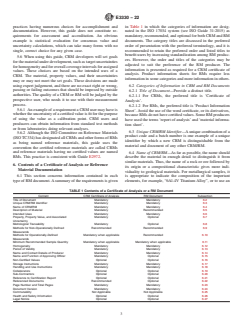
practices having numerous choices for accomplishment and in Table 1 in which the categories of information are desig-
documentation. However, this guide does not constitute re- nated in the ISO 17034 system (see ISO Guide 31:2015) as
quirements for assessment and accreditation. An obvious mandatory,recommended,andoptionalforbothCRMandRM
example is statistical evaluation for consensus value and documents. The category titles are discussed in the preferred
uncertainty calculations, which can take many forms with no order of presentation with the preferred terminology, and it is
single, correct choice for any given case. recommended to retain the preferred order and listed titles to
benefit users by increasing standardization among RM produc-
5.6 When using this guide, CRM developers will set goals
ers. However, the order and titles of the categories may be
forthematerialunderdevelopment,suchastargetuncertainties
adjusted to suit the preference of the RM producer. The
forhomogeneityandforoverallcoverageintervalsforassigned
information is presented as required for a CRM certificate of
values. These choices are based on the intended uses of a
analysis. Product information sheets for RMs require less
CRM. The material, property values, and their uncertainties
informationinsomecategoriesandmoreinformationinothers.
may or may not meet the set goals. These decisions are made
using expert judgement, and there are no exact right or wrong,
6.2 Categories of Information in CRM and RM Documents
passing or failing outcomes that should be imposed by outside
6.2.1 Title of Document—Provide a distinct title.
authorities.The quality of a CRM or RM will be judged by the
6.2.1.1 For CRMs, the preferred title is ‘Certificate of
prospective user, who needs it to use with their measurement
Analysis’.
process.
6.2.1.2 For RMs, the preferred title is ‘Product Information
5.6.1 AnexampleofarequirementaCRMusermayhaveis
Sheet’.Avoid the use of the word certificate, or its derivatives,
whethertheuncertaintyofacertifiedvalueisfitforthepurpose
becauseRMsdonothavecertifiedvalues.SomeRMproducers
of using the value as a calibration point. CRM users and
have used the terms ‘report of analysis’and ‘material informa-
producers can obtain information from standard test methods
tion sheet’.
or from laboratories doing relevant analyses.
6.3 Unique CRM/RM Identifier—Aunique combination of a
5.6.2 Although the ISO Committee on Reference Materials
product code and a batch number is one example of a unique
(ISOTC334)hasdesignatedallCRMsandotherformsofRMs
identifier by which a new CRM is distinguishable from the
as being named reference materials, this guide uses the
material and document of any other CRM/RM.
convention the certified reference materials are called CRMs
and reference materials having no certified values are named 6.4 Name of CRM/RM—As far as possible, the name should
RMs. This practice is consistent with Guide E2972. describe the material in enough detail to distinguish it from
similar materials. Thus, the name of a rock or ore followed by
6. Contents of a Certificate of Analysis or Reference
its origin or a compositional characteristic gives more indi-
Material Documentation
viduality to geological materials. For metallurgical samples, it
6.1 This section concerns information contained in each is appropriate to indicate the composition of the important
typeofRMdocument.Asummaryoftherequirementsisgiven elements, for example, “6Al-4V Titanium Alloy”, or to use an
TABLE 1 Contents of a Certificate of Analysis or a RM Document
Content CRM Certificate of Analysis RM Document Subsection
Title of Document Mandatory Mandatory 6.2
Unique CRM/RM Identifier Mandatory Mandatory 6.3
Name of CRM/RM Mandatory Mandatory 6.4
Description of Material Mandatory Recommended 6.5
Intended Uses Mandatory Mandatory 6.6
Property, Property Value, and Associated Mandatory Optional 6.7
Uncertainty
Metrological Traceability Mandatory Optional 6.8
Methods for Non-Operationally Defined Recommended Recommended 6.9
Measurands
Methods for Operationally-Defined Mandatory when applicable Recommended 6.10
Measurands
Minimum Recommended Sample Quantity Mandatory when applicable Mandatory when applicable 6.11
Homogeneity Mandatory Mandatory 6.12
Period of Validity Mandatory Mandatory 6.13
Name and Contact Details of Producer Mandatory Mandatory 6.14
Name and Function of Approving Officer Mandatory Optional 6.15
Non-Certified Values Optional Optional 6.16
Storage Instructions Mandatory Mandatory 6.17
Handling and Use Instructions Mandatory Mandatory 6.18
Collaborators Optional Optional 6.19
Sub-Contractors Optional Optional 6.20
Reference to Certification Report Optional Optional 6.21
Referenced Documents Recommended Optional 6.22
Page Number and Total Pages Mandatory Mandatory 6.23
Document Version Mandatory Mandatory 6.24
Commutability Not Applicable Not Applicable 6.25
Health and Safety Information Optional Optional 6.26
Legal Notice Optional Optional 6.27
E3330 − 22
industry standard alloy identification code, for example, from 6.6.2.1 Demonstrate control of a measurement process in a
the Unified Numbering System. If several similar CRMs are laboratory over time, also known as statistical process control;
available, the nominal level(s) of key constituent(s) can be
6.6.2.2 Check instrument operational performance, includ-
included, for example, SRM 2453a Hydrogen in Titanium
ing sensitivity and repeatability;
Alloy (Nominal Mass Fraction 125 mg/kg H). In cases where
6.6.2.3 Conduct reproducibility studies, that is, repeated use
two or more physical forms of a material are offered, it may
over an extended time, multiple instruments, multiple analysts,
help to include the form in the name, for example, SRM 1264a
etc.;
High-Carbon Steel (Modified) (disk form).
6.6.2.4 Confirm the degree of equivalence of measurement
6.5 Description of Material—A brief description of the
resultsfrommultiplelaboratories,orpromoteharmonization,if
material should be given in a certificate of analysis to provide
necessary;
amoredetailedexplanationofthename.Formaterialscertified
6.6.2.5 Investigate impacts of changes to environmental
for their chemical composition, the main characteristics of the
conditions (for example, temperature, humidity).
matrix may be of importance in applications to analytical
6.6.2.6 More information on RMs, in particular in-house
methods.
RMs, can be obtained from Guide E2972.
6.5.1 The physical description of the material should be
given, where appropriate, for example, particle size range, NOTE 1—While it is true that CRMs can be used for these same
functionsasRMs,itisgenerallydiscouraged,becauseCRMsaretypically
as-supplied dimensions of metal cylinders, rods, pins or disks,
harder to develop, more expensive, and rare. RMs suitable for these
and the nature of the container in which it is supplied, if
purposes can be developed without having to implement an accredited
applicable.
quality system and with far less analytical effort.
6.5.1.1 In cases of items consumed during use, the
6.7 Property, Property Value, and Associated
dimensions, quantity, mass, etc. would be listed for a sales or
Uncertainty—A CRM certificate should contain a clear state-
distribution unit.
ment of each constituent and property of interest, its assigned
6.5.2 Additional, optional details on the matrix composition
value and associated uncertainty (Note 2). A RM document
may be important. Consider including the information on the
most often will contain a statement of each constituent or
following, if appropriate:
property,alongwithitsassignedvalue.TheRMdocumentmay
6.5.2.1 Alloys custom-made to a modified alloy specifica-
or may not include an associated uncertainty for each value. In
tion;
some cases, a RM may not have an assigned value, when its
6.5.2.2 Whether analytes were spiked in or are naturally
purpose is research into one or more measurement processes.
present;
See also 10.2.
6.5.2.3 The presence or absence of interfering substances,
6.7.1 This document makes no distinction between quanti-
even if not quantified.
tative and nominal properties, nor between measurement and
6.6 Intended Use(s)—Potential users need to know the
examination.
intendedusesofaCRM/RM.Whentheprovidedpropertiesare
6.7.2 Eachconstituentorpropertyshouldbedescribedasits
independent of measurement procedure, this statement is not
measurand. Consider including a clear statement defining the
intended to restrict the use for other purposes. The CRM/RM
identity of each item measured and the matrix in which it is
document should provide enough information for the user to
found. When the measurand is defined by a standard that
decide whether the material meets their requirements (for
describes a system of units other than the SI or by a standard
example, matrix type, measurand, quantity level, uncertainty
method that defines the constituent or property, the definition
estimate, etc.). Because there may be uses for which the
will include the operation(s) necessary to realize the definition.
material is not appropriate or has not been characterized, the
See ISO Guide 35 for a brief discussion of measurands that are
document may include a statement explaining restrictions.
operationally-defined by a standard.
6.6.1 Examples of intended uses for a CRM include the
6.7.2.1 Forexample,anon-operationallydefinedmeasurand
following:
for iron in a nickel alloy could be described as follows: The
6.6.1.1 Confirm the degree of equivalence of measurement
measurand is the total amount of the element iron in a nickel
resultsfrommultiplelaboratories,orpromoteharmonization,if
matrix.
necessary;
6.6.1.2 Transfer of property values among different materi-
6.7.2.2 Another example of a non-operationally defined
als; measurand is hydrogen in titanium, which can be described as
6.6.1.3 Validation of analytical methods, especially regard-
follows: The measurand is the total amount of hydrogen in a
ing trueness; titanium matrix as realized using the inert gas fusion test
6.6.1.4 Calibration of instruments or measurement pro-
method in ASTM E1447 – 09(2016), calibrated using the
cesses; certified value for total H in NIST SRM 2453a Hydrogen in
6.6.1.5 Determination of the recovery factor of a matrix
Titanium Alloy (Nominal Mass Fraction 125 mg/kg H). Test
separation operation; Method E1447 has been validated as providing the total
6.6.1.6 Realization of a fixed point of a (international)
hydrogen content of Ti alloys (when properly implemented).
measurement scale. The statement of calibration using the NIST(National Institute
6.6.2 Examples of intended uses of an RM (other than a of Standards and Technology) SRM confirms that the identity
CRM) include the following (Note 1): of the measurand is non-operationally defined, because this
E3330 − 22
SRM was value assigned using both inert gas fusion and (1) An example can be taken from positive material iden-
prompt gamma-ray activation analysis – two independent test tification of alloys using a portable spectrometric technique. In
methods.
such methods, the spectrum of a sample of scrap may be
6.7.2.3 Possibly the best-known example of an compared to a library of spectra to identify the family of alloys
operationally-defined measurand in the metals industry is the orthespecificalloyofthesample.Thestatementofuncertainty
Rockwell C Hardness scale as defined in Test Methods E18.
can be as simple as the level of confidence is very high that the
6.7.2.4 An example of an operationally-defined measurand measured alloy is a type of Ni-Co alloy. This is a qualitative
in the mining industry is Test Method E382. The measurand statement without numerical attributes. See 11.2.
definition is stated as “crushing strength, n—average compres-
6.7.4.4 More than one type of uncertainty may be provided
sive load needed to break the pellets in the test sample
in the same document.Acertified value should always have an
completely.” The load is force expressed in the SI unit of
associated overall coverage interval. In addition, it may be
kilogram, which is not a force unit. However, the standard
important to provide an estimate of the standard deviation of
methodincludesnumerousoperationalrequirements,including
individual measurements for a material that will be used as a
a narrow range of iron ore pellet diameters to be agreed by the
calibration standard. An RM intended for process control
parties concerned, the requirement for a constant rate of force
measurements can be expected to be more useful if it has an
application, the requirement for the analyst to judge when the
estimateoftherepeatabilitystandarddeviationfromaproperly
pellet is broken, and no evaluations of precision and bias for
functioning instrument. There are test methods that require
themethod.Inaddition,thereisanotewarningthatresultsmay
multiple measurements to exhibit repeatability better than a
differ depending on the test machine used and the speed of
minimum requirement.
platen motion during force application, which is controlled
within 6 32 % relative to the nominal speed. NOTE 3—The terms coverage interval and expanded uncertainty are
interchangeable for practical purposes. Both provide a means to show a
NOTE 2—The term constituent is included in this discussion because it
range within which the assigned value is believed to be.
refers to a component, typically a chemical component, that is part of the
compositionofamaterial.Whiletheamountofaconstituentistechnically 6.7.5 It is important to briefly discuss the concept of true
a property of a material, the distinction is useful for chemical metrology
value as it applies to certified and non-certified values. At the
in which instrumental test methods are used to identify the presence of a
highest level of chemical metrology, a true value is the
chemicalconstituentandtoquantifytheamountpresent.Inthemetalsand
perfectly known number for the amount of substance or
mining industries, it is common for product testing activities to be
physical characteristic being measured.
differentiated between chemical and physical properties.
6.7.5.1 It is impossible to know a true value with complete
6.7.3 Certified values are required by ISO Guide 31 to be
certainty, because that requires perfection in all aspects of the
clearlyindicatedascertifiedvalues.Itisrecommendedpractice
measurement process and a perfect realization of the definition
to also keep certified and non-certified values separate within a
of the measurand. During reference material development, the
certificate, when both types of values are provided.
project staff will decide whether their processes are capable of
6.7.4 An associated uncertainty estimate must be provided
providing a consensus result that together with its uncertainty
for all assigned certified values. For the highest confidence in
interval is believed to include the true value with a high degree
estimates of the true value, it is better for the uncertainty to be
of confidence. The key to making this decision is deciding if
an overall uncertainty that contains contributions from all
the value assignment process includes all conceivable sources
important sources in the results used to calculate the assigned
of uncertainty and if all applied test methods for each constitu-
value. The associated uncertainty of each value should be
ent or property provide the same definition of the measurand,
reported according to the Guide to the Expression of Uncer-
perhaps with a component of uncertainty relating to the
taintyinMeasurement(JCGM100:2008)anditsSupplement1
definition.
(JCGM 101:2008). See Section 10 for in-depth discussion.
6.7.4.1 All uncertainty estimates must be accompanied by a 6.7.5.2 The alternative concept is that the value to be
assigned and its uncertainty interval cannot be claimed to
definition of the estimate. The definition should give the name
of the uncertainty, viz. standard deviation, combined standard include the true value. This situation could arise when a
uncertainty, coverage interval, expanded uncertainty (Note 3), development project does not include sufficient information
etc. If it is a coverage interval, that means the level of aboutthedifferentpossiblewaysofrealizingameasurementof
confidence and either the degrees of freedom, the coverage the defined amount of substance or property value. For
factor, or both. It is advisable, but optional, to make a brief example, the developing organization may have performed
statement of the components of uncertainty included in the measurements using only their implementation of a standard
stated uncertainty value. See Section 10 for discussion of test method. They may have performed measurements using
uncertainty components. several different analysts, each working with a different brand
6.7.4.2 The provision of a numerical uncertainty estimate of instrument. However, they may know that there are other
with a non-certified value is optional. choices of equipment, measurement conditions, reagents, etc.
6.7.4.3 For nominal properties and for non-certified values that have not been tested. In this case, the developers may
decide to state that their assigned value and its uncertainty
for which no numerical uncertainty estimate is provided, the
uncertainty estimate should take the form of a statement cover only the range of results expected with the material and
the test method employed, even when they believe metrologi-
describing the level of confidence the issuing body has in the
nominal or numerical value. cal traceability to a higher-order reference system has been
E3330 − 22
established. They may even decide to state that their assigned Bates-Guggenheim Convention define the pH scale. Another
value is for an operationally-defined measurand. example is the Rockwell C Hardness scale as defined in Test
Methods E18.
6.8 Metrological Traceability—This is a difficult concept,
6.8.6 It is not necessary for all test methods used for a given
requiring careful consideration of calibration standards,
measurandtobecapableofestablishingmetrologicaltraceabil-
whether uncertainty estimates include all necessary compo-
ity to the highest order reference system. That is ideal, but it
nents of uncertainty, and how the measurand is defined.
only takes one link.
According to international standards and guides on
certification, the information on metrological traceability that 6.9 Methods for Non-operationally Defined Measurands—
shall be stated in a CRM certificate of analysis is the higher
When the measurand is not defined by the measurement
order reference system, units or scale, to which the property process(es), it is not necessary to include the measurement
value is made traceable. Multiple measurands may be covered
processes in the documentation. However, the RMP may
by a single statement or multiple statements, as appropriate. choose to do so by listing the measurement method(s)/
6.8.1 For example, the traceability statement to be made
technique(s) of characterization, the approach for characteriza-
with the measurand defined in 6.7.2.1 could be as follows: The tion (for example, single method, multiple methods, etc.), and
certified value is traceable to the derived SI unit of mass
if applicable, the method(s) used for sample preparation for
fraction expressed as percent (%).
measurement.
6.8.2 For example, the traceability statement to be made
6.9.1 The two most recognizable means of establishing
with the measurand defined in 6.7.2.2 could be as follows: The
non-operationally defined measurands are (1) use of a mea-
certified value is traceable to the derived SI unit of mass
surement process independently confirmed as having minimal
fraction expressed as milligrams per kilogram (mg/kg).
bias with all sources of uncertainty taken into account, and (2)
6.8.3 The concept of metrological traceability covers the
use of multiple, independent measurement processes, where
relationship between values and their units of measurement.
the results from the multiple processes demonstrate a high
Values with units and uncertainty estimates are traceable to
enough level of equivalence and all sources of uncertainty are
other values with units and uncertainty estimates through
taken into account. In other words, any detected bias between
calibration of the measurement process(es) and definition of
the results is low enough that the overall uncertainty of a
the measurement scale.
consensus value is fit for the intended purpose(s) of the CRM.
6.8.4 Some CRM producers make incorrect statements of
The phrase ‘taken into account’ does not mean one must
traceability by referring only to the CRMs used in the project.
estimate every uncertainty component no matter how small. It
This is an oversimplification that leads to misunderstanding of
means the developer will ensure that nothing substantial was
the concept of traceability. A list of CRMs used in a certifica-
overlooked.
tion project does not constitute a statement of metrological
6.9.2 In a case where no bias is detected, the bias detection
traceability. It is not correct to state that a value is traceable to
limitmustbelowenoughtobefitforpurpose.Forguidanceon
a CRM or its producer or other organization, because values
estimation of bias detection limit, see ISO Guide 33.
are traceable to other values or to a measurement process that
6.10 Methods for Operationally-Defined Measurands—
defines a reference scale. See Note 4.
When the definition of a measurand depends on the measure-
6.8.4.1 It is not necessary to use a CRM to establish
mentmethod,thecertificateorreportdocumentshouldexplain,
metrological traceability to a system of measurement units. A
for example, by describing the method or giving a reference to
laboratory can establish traceability by calibrating their test
a publication in which the method is described. The same
method using a pure compound or pure element. The com-
principle applies in the case of nominal properties.
pound or element must have an assay with a stated uncertainty,
6.11 Minimum Recommended Sample Quantity—Whenever
either from the provider or developed by the user. There are
applicable, the minimum recommended sample quantity of the
papersonthetopicinthescientificliterature,forexamplethose
material should be based on heterogeneity or on other consid-
by Gotthard Staats on the realization of trueness (for example,
erations such as stability or a defined measurement process.
Ref (1).)
This should be accompanied by a statement that the property
6.8.4.2 Alaboratory using a classical test method, such as a
value and its associated uncertainty are only guaranteed if
gravimetric, coulometric or volumetric method, can establish
minimum sample quantity is respected. See the related discus-
traceability by using standardized reagents, calibrated
sionofheterogeneityin6.12.Examplesofthisquantityinclude
balances, calibrated power supplies, and calibrated glassware.
the following:
NOTE 4—A reference material producer (RMP) may provide a list of
6.11.1 A minimum mass used with one or more measure-
CRMs used in a certification project for the purpose of providing
ment processes that exhibited repeatability fit for purpose;
additional assurance to the user that appropriate materials were employed.
However, such a list does not serve as the statement of traceability. 6.11.2 A minimum area of measurement or a minimum
number of independent, measured locations by, for example,
6.8.5 A value can be traceable to a measurement process
X-ray fluorescence spectrometry and spark or laser ablation
that defines the scale of units for the measurand. One example
spectrometry methods, respectively.
is pH, where the Harned cell construction and its use with the
6.11.3 The CRM/RM document may specify a procedure to
ensure a representative subsample is used. See Note 5.
The boldface numbers in parentheses refer to a list of references at the end of
this standard. NOTE 5—It may be appropriate and important to communicate to the
E3330 − 22
user that, in cases where the test method cannot measure in a single
contamination, improper storage, failure to follow instructions
measurement a quantity of material greater than or equal to the minimum
for sampling, handling, and storage, or other serious issues.
recommended quantity, multiple measurements of smaller quantities, that
6.13.5 Ifthematerialoritsintendeduseissuchthatperiodic
together equal or exceed the minimum recommended amount with
recalibration or recertification is necessary, it is appropriate to
calculation of the mean result from the multiple measurements, may meet
the user’s need and still be consistent with the assigned value and its include an explanatory statement. When appropriate, some
uncertainty estimate.
CRM producers find it helpful to state that no recalibration or
recertification is needed to forestall questions and unnecessary
6.12 Heterogeneity—An assessment is required to establish
work by the users.
the degree of heterogeneity of the material with respect to the
6.13.6 For cases in which a material is such that each piece
property of interest and to ensure it is fit for the intended
purpose(s) of the material. It is recommended the description may be measured repeatedly by the user, it may be necessary
fortheproducertoaddresstheeffectsofrepeatedmeasurement
bebrief,especiallyiftheheterogeneityisfoundtobeverylow.
The developer of the material may wish to consider listing the on the stability or other aspects of utility of the piece of
material.Thisisnottechnicallyanissueofperiodofvalidityof
test method(s) used for characterization.
a CRM or RM. Rather, it is something that should be handled
6.12.1 An estimate of variance arising from compositional
through instructions for handling and use. See 6.18.2.
heterogeneity is a necessary component of uncertainty.
6.13.7 When circumstances require that a CRM certificate
6.12.1.1 Heterogeneity assessment includes variance within
or RM document be revised, the issuing RMPshould include a
an individual unit of the material and variance among units.
history of changes in the revised document.
The overall question is whether a user can expect to obtain the
same test result from two or more samples taken from a single
6.14 Name and Contact Details of the Producer—The name
packaged unit as well as two or more samples taken from
and contact details of the CRM/RM producer may include
different units.
postal address, telephone number, fax number, e-mail address,
6.12.1.2 If material composition variance is high in com-
and website.
parison to the repeatability capability of one or more measure-
6.15 Name and Function of Approving Offıcer—State the
ment processes within the scope of intended uses of a material,
name(s) and function(s) of an officer(s) representing the
it is necessary to include heterogeneity variance in the overall
producer and accepting responsibility for the contents of the
uncertainty analysis (the uncertainty budget) for the value of a
certificate of analysis.
constituent.
6.16 Non-Certified Values—The CRM/RM producer may
6.12.1.3 Ifvarianceislowincomparisontotherepeatability
include non-certified values.
capabilities of all measurement processes in the scope of
6.16.1 Examples of non-certified values include the follow-
intendeduses,astatementofthatfactisenough,andanexplicit
ing:
statement of an estimate of heterogeneity variance is not
necessary.
6.16.1.1 The approximate mass fraction of an analyte in a
complex matrix that does not fulfill the criteria established by
6.12.2 Analysisofvariance(ANOVA)isapowerfultoolfor
the issuing RMP for a certified property value;
the study of sources of variance in data sets. It is frequently
applied to the study of heterogeneity within and among 6.16.1.2 Individual results from each laboratory or analyst,
packaged units of reference materials. It often has practical whereresultsfromseverallaboratoriesoranalystswereusedto
limits. For example, in a case when the repeatability standard assign the property value(s).
deviation of all individual measurements is much less than the (1) Publishing individual results from collaborating labo-
standarddeviationrequiredforthematerialtobefitforpurpose ratories is allowed, but it should be done with great care. The
and the tested sample quantity is less than the smallest amount data may create confusion or reduce the trustworthiness of the
required for testing, the material is automatically deemed CRM, especially where some value(s) may be construed as
acceptable. It matters not what the ANOVA statistics show. discrepant. The data may also be misused by analysts, who
prefer one measurement method over others used in the
6.13 Period of Validity—A period of validity may take the
project.
form of an expiration date or a statement of indefinite validity.
(2) When individual laboratory results are published, the
The fitness for purpose of the material cannot be guaranteed
source organizations should not be linked to the results they
beyond the stated period.
provided.
6.13.1 The issuing organization is expected to monitor the
6.17 Storage Instructions—Storage conditions (for
material during its period of validity and to notify users of
example, temperature, exposure to light) necessary to maintain
substantive changes in a timely manner. It is recommended to
the validity of a CRM/RM material are important. If no special
include a statement of this commitment.
requirements apply, it is helpful to the user to state so.
6.13.2 It is not recommended to state the period of validity
as a function of the time since purchase.
6.18 Instructions for Handling and Use—Instructions for
6.13.3 It is appropriate to provide instructions for a material handling and use of the CRM/RM should be clear and concise.
that begins to change when the unit container is opened. Some
See also 6.12, which discusses how heterogeneity can affect
materials may require packaging in single-use containers. use.
6.13.4 It is recommended to include a statement that some 6.18.1 Examples of instructions for handling and use in-
circumstances will invalidate the certification, such as damage, clude:
E3330 − 22
6.18.1.1 Appropriate process to ensure homogenization of report or with a CRM as a certification report, obtainable on
container contents before and during use; request or otherwise accessible to interested parties.
6.18.1.2 Prescribed instructions for opening the container, if
6.22 Referenced Documents—Including an enumerated list
applicable;
of bibliographic references can be of service to users. Certain
6.18.1.3 Exact conditions for drying the material, if appli-
information in a document may require literature references to
cable;
pointausertosupportdocumentsusedorrecommendedbythe
(1) When the measurand is defined as being on a dry basis,
RMP, including white papers, quality standards, published test
the material is not usable without drying instructions. They
methods, statistical tools, legal documents, etc.
may be provided in a referenced document.
6.23 Page Number—It is self-evident that a CRM/RM
6.18.1.4 Where necessary, instructions for cleaning the
documentincludepagenumbersandthetotalnumberofpages.
material or preparation of its surface prior to a measurement;
6.24 Document Version—The version of the CRM/RM
6.18.1.5 Where necessary, instructions for further particle
document should be clearly indicated in one or more ways by,
size reduction;
for example, the approval or issue date of the document or a
6.18.1.6 Appropriate instructions for reconstitution of a
version number.
solution from a solid;
6.24.1 A history of the revisions made during the period of
6.18.1.7 Appropriate mathematical expression for calculat-
validity is a useful tool, especially for users with legal
ing the value of the property at time of use, for example, in the
traceability requirements.
case of material which is inherently unstable, such as radioac-
tive substances.
6.25 Commutability—When a measurand value for a
CRM/RM is asserted to be the best available estimate of the
6.18.2 For cases in which a material is such that each piece
may be measured repeatedly by the user, it may be necessary true value of the constituent in the material matrix, commut-
ability is not applicable. When a value is asserted to be
fortheproducertoaddresstheeffectsofrepeatedmeasurement
on the stability or other aspects of utility of the piece of operationally-defined, commutability is not applicable. In both
cases, the value of the property is anticipated to be determined
material. This should be handled through instructions for
handling and use. using test methods with which the measurand is clearly
defined. Hence, assessment of commutability is not required.
6.18.2.1 An example of this concept is the use of disk form
Assessment of commutability is required in situations where it
alloys for elemental analyses by spark source atomic emission
is known that the test method(s) has shortcomings that prevent
spectrometry. Users will grind a fresh surface on the disk to
the realization of estimates of the true value with some or all
prepare it for a new set of spark measurements.At some point,
materialswithinthemethodscope.Assessmentofcommutabil-
the disk will become too thin for the purpose. Questions to
ity is typically required for clinical testing where rapid,
consider include the following. Is the certification limited to
inexpensive testing methods are employed, for example. In
just a portion of the disk, perhaps due to increased heteroge-
such a case, the role of a RM/CRM is to provide comparability
neity of the unusable portion? Will the low mass of a thin disk
among such test methods.
adversely affect the accuracy of measurement?
6.25.1 In the metals and mining industries, test methods are
6.18.2.2 For materials more susceptible to damage through
designed to provide estimates of the total amounts of element
handling or measurement, is there an accumulation of damage
andcompoundconstituents.Standardtestmethodsmusthavea
that limits the number of viable measurements by a given
scope statement that defines the ranges of composition and
technique? An example is the measurement of plastics using
physicalcharacte
...