

ASTM C637-20
(Specification)Standard Specification for Aggregates for Radiation-Shielding Concrete
General Information
- Abstract
ABSTRACT
This specification covers special aggregates for use in radiation-shielding concretes in which composition or high specific gravity, or both, are of prime consideration. Aggregates covered by specification include the natural mineral aggregates of either high density or high fixed water content, or both. These include aggregates that contain or consist predominately of materials such as barite, magnetite, hematite, ilmenite, and serpentine. Also included are synthetic aggregates such as iron, steel, ferrophosphorus and boron frit or other boron compounds. Fine aggregate consisting of natural or manufactured sand including high-density minerals. Coarse aggregate may consist of crushed ore, crushed stone, or synthetic products, or combinations or mixture thereof. Aggregates shall meet the required uniformity of specific gravity and fixed water content. The materials shall also meet the required chemical composition for serpentine, limonite, goethite, barite, ilmenite, hematite, magnetite, iron, ferrophosphorus, boron frit, boron carbide, calcium carbide.
SCOPE
1.1 This specification covers special aggregates and/or high-density aggregates for use in radiation-shielding concretes in which composition or high specific gravity, or both, are of prime consideration.
1.2 The values stated in SI units are to be regarded as standard. No other units of measurement are included in this standard.
1.3 The text of this standard refers to notes and footnotes that provide explanatory material. These notes and footnotes (excluding those in tables and figures) shall not be considered as requirements of this standard.
1.4 The following precautionary caveat pertains only to the test method portion, Section 9, of this specification: This standard does not purport to address all of the safety concerns, if any, associated with its use. It is the responsibility of the user of this standard to establish appropriate safety, health, and environmental practices and determine the applicability of regulatory limitations prior to use.
1.5 This international standard was developed in accordance with internationally recognized principles on standardization established in the Decision on Principles for the Development of International Standards, Guides and Recommendations issued by the World Trade Organization Technical Barriers to Trade (TBT) Committee.
- Status
- Published
- Publication Date
- 31-Dec-2019
- Technical Committee
- C09 - Concrete and Concrete Aggregates
- Drafting Committee
- C09.20 - Aggregates
Buy Documents

ASTM C637-20 - Standard Specification for Aggregates for Radiation-Shielding Concrete
REDLINE ASTM C637-20 - Standard Specification for Aggregates for Radiation-Shielding Concrete
Overview
ASTM C637-20: Standard Specification for Aggregates for Radiation-Shielding Concrete is a critical international standard published by ASTM International. This specification establishes comprehensive requirements for special aggregates used in radiation-shielding concrete, focusing on their specific composition and high specific gravity. The standard includes both natural and synthetic aggregates that deliver effective attenuation of ionizing radiation, and it is widely recognized in nuclear, medical, and industrial environments where concrete radiation shields are essential.
Key Topics
Types of Aggregates:
- Natural minerals with high density or high fixed water content, such as barite, magnetite, hematite, ilmenite, and serpentine.
- Synthetic aggregates including iron, steel, ferrophosphorus, boron frit, boron carbide, calcium boride, and other boron compounds.
Aggregate Properties:
- Uniformity in specific gravity and fixed water content across shipments.
- Compliance with required chemical composition for each material type.
- Strict grading and fineness modulus parameters for both fine and coarse aggregates.
Performance Measures:
- Abrasion resistance for coarse aggregates to ensure durability.
- Limitations on deleterious substances to maintain concrete performance and long-term integrity.
- Water-soluble material restrictions for boron frit to prevent adverse chemical reactions.
Testing and Sampling:
- Adherence to established ASTM test methods for relative density, absorption, grading, and water content.
- Defined procedures for loss-on-ignition and train methods to measure fixed water content in hydrous aggregates.
Applications
ASTM C637-20 is indispensable wherever radiation-shielding concrete is required. Its practical value is seen in areas such as:
Nuclear Power Plants:
Ensures effective structural shielding around reactors and spent fuel pools to protect personnel and the environment from harmful ionizing radiation.Medical Facilities:
Used in the construction of radiation therapy rooms and diagnostic imaging suites, providing safe barriers against X-rays and gamma rays.Industrial Uses:
Supports radiation containment in research labs, isotope production, and materials testing facilities, by specifying aggregates that enhance concrete density.Research and Defense:
Specified in designing protective enclosures, hot cells, and vaults handling radioactive substances or equipment emitting radiation.
By enforcing stringent aggregate selection and testing, ASTM C637-20 contributes to the safety, reliability, and performance of radiation-shielding concrete. Compliance with this standard helps designers, specifiers, and contractors achieve consistent results that meet regulatory and project requirements.
Related Standards
Organizations and professionals referencing ASTM C637-20 should also be familiar with these related standards:
ASTM C33: Specification for Concrete Aggregates
Establishes general requirements for aggregates used in concrete.ASTM C125: Terminology Relating to Concrete and Concrete Aggregates
Provides standardized terminology for use across ASTM concrete standards.ASTM C127 & C128: Test Methods for Relative Density and Absorption
Specifies procedures for determining specific gravity and water absorption for coarse and fine aggregates.ASTM C131 & C535: Test Methods for Abrasion Resistance
Details methods to assess degradation of coarse aggregates.ASTM C638: Descriptive Nomenclature of Constituents of Aggregates for Radiation-Shielding Concrete
Offers detailed nomenclature for the materials covered by C637-20.
Familiarity with these standards ensures a comprehensive understanding and practical implementation of high-density and radiation-shielding concrete aggregates for all stakeholders involved in radiation protection design and construction.
Keywords: radiation-shielding concrete, high-density aggregates, boron frit, barite aggregates, ASTM C637, nuclear shielding, medical radiation protection, aggregate specifications.
Relations
- Effective Date
- 01-Jan-2020
- Effective Date
- 01-Apr-2024
- Effective Date
- 01-Aug-2020
- Effective Date
- 01-Apr-2020
- Effective Date
- 15-Dec-2019
- Effective Date
- 15-Nov-2019
- Effective Date
- 01-Jun-2019
- Effective Date
- 01-Jan-2019
- Effective Date
- 01-Oct-2018
- Effective Date
- 01-Jul-2018
- Effective Date
- 01-Jan-2018
- Effective Date
- 15-Dec-2016
- Effective Date
- 15-Jun-2016
- Effective Date
- 15-Dec-2015
- Effective Date
- 01-Jul-2015
Buy Documents
ASTM C637-20 - Standard Specification for Aggregates for Radiation-Shielding Concrete
REDLINE ASTM C637-20 - Standard Specification for Aggregates for Radiation-Shielding Concrete
Get Certified
Connect with accredited certification bodies for this standard

DIBt (Deutsches Institut für Bautechnik)
German Institute for Building Technology.
DIN CERTCO
DIN Group product certification.

Kiwa BDA Testing
Building and construction product certification.
Sponsored listings
Frequently Asked Questions
ASTM C637-20 is a technical specification published by ASTM International. Its full title is "Standard Specification for Aggregates for Radiation-Shielding Concrete". This standard covers: ABSTRACT This specification covers special aggregates for use in radiation-shielding concretes in which composition or high specific gravity, or both, are of prime consideration. Aggregates covered by specification include the natural mineral aggregates of either high density or high fixed water content, or both. These include aggregates that contain or consist predominately of materials such as barite, magnetite, hematite, ilmenite, and serpentine. Also included are synthetic aggregates such as iron, steel, ferrophosphorus and boron frit or other boron compounds. Fine aggregate consisting of natural or manufactured sand including high-density minerals. Coarse aggregate may consist of crushed ore, crushed stone, or synthetic products, or combinations or mixture thereof. Aggregates shall meet the required uniformity of specific gravity and fixed water content. The materials shall also meet the required chemical composition for serpentine, limonite, goethite, barite, ilmenite, hematite, magnetite, iron, ferrophosphorus, boron frit, boron carbide, calcium carbide. SCOPE 1.1 This specification covers special aggregates and/or high-density aggregates for use in radiation-shielding concretes in which composition or high specific gravity, or both, are of prime consideration. 1.2 The values stated in SI units are to be regarded as standard. No other units of measurement are included in this standard. 1.3 The text of this standard refers to notes and footnotes that provide explanatory material. These notes and footnotes (excluding those in tables and figures) shall not be considered as requirements of this standard. 1.4 The following precautionary caveat pertains only to the test method portion, Section 9, of this specification: This standard does not purport to address all of the safety concerns, if any, associated with its use. It is the responsibility of the user of this standard to establish appropriate safety, health, and environmental practices and determine the applicability of regulatory limitations prior to use. 1.5 This international standard was developed in accordance with internationally recognized principles on standardization established in the Decision on Principles for the Development of International Standards, Guides and Recommendations issued by the World Trade Organization Technical Barriers to Trade (TBT) Committee.
ABSTRACT This specification covers special aggregates for use in radiation-shielding concretes in which composition or high specific gravity, or both, are of prime consideration. Aggregates covered by specification include the natural mineral aggregates of either high density or high fixed water content, or both. These include aggregates that contain or consist predominately of materials such as barite, magnetite, hematite, ilmenite, and serpentine. Also included are synthetic aggregates such as iron, steel, ferrophosphorus and boron frit or other boron compounds. Fine aggregate consisting of natural or manufactured sand including high-density minerals. Coarse aggregate may consist of crushed ore, crushed stone, or synthetic products, or combinations or mixture thereof. Aggregates shall meet the required uniformity of specific gravity and fixed water content. The materials shall also meet the required chemical composition for serpentine, limonite, goethite, barite, ilmenite, hematite, magnetite, iron, ferrophosphorus, boron frit, boron carbide, calcium carbide. SCOPE 1.1 This specification covers special aggregates and/or high-density aggregates for use in radiation-shielding concretes in which composition or high specific gravity, or both, are of prime consideration. 1.2 The values stated in SI units are to be regarded as standard. No other units of measurement are included in this standard. 1.3 The text of this standard refers to notes and footnotes that provide explanatory material. These notes and footnotes (excluding those in tables and figures) shall not be considered as requirements of this standard. 1.4 The following precautionary caveat pertains only to the test method portion, Section 9, of this specification: This standard does not purport to address all of the safety concerns, if any, associated with its use. It is the responsibility of the user of this standard to establish appropriate safety, health, and environmental practices and determine the applicability of regulatory limitations prior to use. 1.5 This international standard was developed in accordance with internationally recognized principles on standardization established in the Decision on Principles for the Development of International Standards, Guides and Recommendations issued by the World Trade Organization Technical Barriers to Trade (TBT) Committee.
ASTM C637-20 is classified under the following ICS (International Classification for Standards) categories: 13.280 - Radiation protection; 91.100.30 - Concrete and concrete products. The ICS classification helps identify the subject area and facilitates finding related standards.
ASTM C637-20 has the following relationships with other standards: It is inter standard links to ASTM C637-14, ASTM C219-24, ASTM C219-20a, ASTM C219-20, ASTM C125-19a, ASTM C219-19a, ASTM C219-19, ASTM C125-19, ASTM C125-18b, ASTM C125-18a, ASTM C125-18, ASTM C125-16, ASTM C535-16, ASTM C125-15b, ASTM C125-15a. Understanding these relationships helps ensure you are using the most current and applicable version of the standard.
ASTM C637-20 is available in PDF format for immediate download after purchase. The document can be added to your cart and obtained through the secure checkout process. Digital delivery ensures instant access to the complete standard document.
Standards Content (Sample)
This international standard was developed in accordance with internationally recognized principles on standardization established in the Decision on Principles for the
Development of International Standards, Guides and Recommendations issued by the World Trade Organization Technical Barriers to Trade (TBT) Committee.
Designation:C637 −20
Standard Specification for
Aggregates for Radiation-Shielding Concrete
This standard is issued under the fixed designation C637; the number immediately following the designation indicates the year of
original adoption or, in the case of revision, the year of last revision. A number in parentheses indicates the year of last reapproval. A
superscript epsilon (´) indicates an editorial change since the last revision or reapproval.
1. Scope* C128 Test Method for Relative Density (Specific Gravity)
and Absorption of Fine Aggregate
1.1 Thisspecificationcoversspecialaggregatesand/orhigh-
C131 Test Method for Resistance to Degradation of Small-
density aggregates for use in radiation-shielding concretes in
Size CoarseAggregate byAbrasion and Impact in the Los
which composition or high specific gravity, or both, are of
Angeles Machine
prime consideration.
C136 Test Method for Sieve Analysis of Fine and Coarse
1.2 The values stated in SI units are to be regarded as
Aggregates
standard. No other units of measurement are included in this
C219 Terminology Relating to Hydraulic and Other Inor-
standard.
ganic Cements
C535 Test Method for Resistance to Degradation of Large-
1.3 The text of this standard refers to notes and footnotes
that provide explanatory material. These notes and footnotes Size CoarseAggregate byAbrasion and Impact in the Los
Angeles Machine
(excluding those in tables and figures) shall not be considered
as requirements of this standard. C638 Descriptive Nomenclature of Constituents of Aggre-
gates for Radiation-Shielding Concrete
1.4 The following precautionary caveat pertains only to the
test method portion, Section 9, of this specification: This
3. Terminology
standard does not purport to address all of the safety concerns,
if any, associated with its use. It is the responsibility of the user 3.1 Definitions:
of this standard to establish appropriate safety, health, and 3.1.1 For definitions of terms used in this standard, refer to
environmental practices and determine the applicability of Terminologies C125 and C219.
regulatory limitations prior to use.
1.5 This international standard was developed in accor- 4. Classification
dance with internationally recognized principles on standard-
4.1 Aggregates covered by this specification include:
ization established in the Decision on Principles for the
4.1.1 Natural mineral aggregates of either high density or
Development of International Standards, Guides and Recom-
highfixedwatercontent,orboth.Theseincludeaggregatesthat
mendations issued by the World Trade Organization Technical
contain or consist predominately of materials such as barite,
Barriers to Trade (TBT) Committee.
magnetite, hematite, ilmenite, and serpentine.
4.1.2 Synthetic aggregates such as iron, steel, ferrophospho-
2. Referenced Documents
rus and boron frit or other boron compounds (see Descriptive
2.1 ASTM Standards:
Nomenclature C638).
C33 Specification for Concrete Aggregates
4.1.3 Fine aggregate consisting of natural or manufactured
C125 Terminology Relating to Concrete and Concrete Ag-
sand including high-density minerals. Coarse aggregate may
gregates
consist of crushed ore, crushed stone, or synthetic products, or
C127 Test Method for Relative Density (Specific Gravity)
combinations or mixtures thereof.
and Absorption of Coarse Aggregate
5. Composition and Relative Density (Specific Gravity)
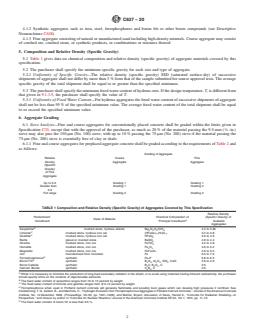
5.1 Table 1 gives data on chemical composition and relative
This specification is under the jurisdiction of ASTM Committee C09 on
density(specificgravity)ofaggregatematerialscoveredbythis
Concrete and ConcreteAggregates and is the direct responsibility of Subcommittee
C09.20 on Aggregates.
specification.
Current edition approved Jan. 1, 2020. Published February 2020. Originally
5.2 The purchaser shall specify the minimum specific grav-
approved in 1969. Last previous edition approved in 2014 as C637 – 14. DOI:
10.1520/C0637-20.
ity for each size and type of aggregate.
For referenced ASTM standards, visit the ASTM website, www.astm.org, or
5.2.1 Uniformity of Specific Gravity—The relative density
contact ASTM Customer Service at service@astm.org. For Annual Book of ASTM
(specific gravity) SSD (saturated surface-dry) of successive
Standards volume information, refer to the standard’s Document Summary page on
the ASTM website. shipments of aggregate shall not differ by more than 3 % from
*A Summary of Changes section appears at the end of this standard
Copyright © ASTM International, 100 Barr Harbor Drive, PO Box C700, West Conshohocken, PA 19428-2959. United States
C637−20
TABLE 1 Composition and Relative Density (Specific Gravity) of Aggregates Covered by This Specification
Relative Density
Predominant Chemical Composition of (Specific Gravity) of
Class of Material
A
Constituent Principal Constituent Available
Aggregates
B
Serpentine crushed stone, hydrous siliente Mg Si O (OH) 2.4to2.65
3 2 5 4
C
Limonite crushed stone, hydrous iron ore (HFeO ) (H O) 3.4to3.8
2 x 2 y
C
Goethite crushed stone, hydrous iron ore HFeO 3.5to4.5
Barite gravel or crushed stone BaSO 4.0to4.4
Ilmenite crushed stone, iron ore FeTiO 4.2to4.8
Hematite crushed stone, iron ore Fe O 4.6to5.2
2 3
Magnetite crushed stone, iron ore FeFe O 4.6to5.2
2 4
Iron manufactured from iron/steel Fe 6.5 to 7.5
D
Ferrophosphorous synthetic Fe P 5.8 to 6.3
n
E
Boron Frit synthetic B O ,Al O ,SiO , CaO 2.6 to 2.8
2 3 2 3 2
Boron Carbide synthetic B C, B O ,C 2.5
4 2 3
Calcium Boride synthetic C B ,C 2.5
a 6
A
When it is necessary to minimize the production of long-lived secondary radiation in the shield, or to avoid using materials having inherent radioactivity, the purchaser
should specify limits on the contents of objectionable elements.
B
The fixed water content of serpentine ranges from 10 to 13 percent by weight.
C
The fixed water content of limonite and goethite ranges from 8 to 12 percent by weight.
D
Ferrophosphorus when used in Portland cement concrete will generate flammable and possibly toxic gases which can develop high pressures if confined. See
Clendenning,T.G.,Kellam,B.,andMacInnis,C.,“HydrogenEvolutionfromFerrophosphorousAggregateinPortlandCementConcrete,”JournaloftheAmericanConcrete
Institute, No. 12,December 1968. (Proceedings, Vol 65, pp. 1021–1028), and Mather, Bryant, discussion of Davis, Harold S., “Concrete for Radiation Shielding—In
Perspective,” and closure by author in “Concrete for Nuclear Reactors,” Journal of the American Concrete Institute SP-34, Vol 1, 1972, pp. 11–13.
E
The fixed water content of boron frit is less than 0.5 %.
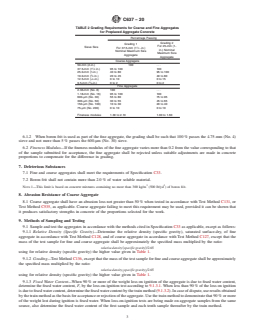
TABLE 2 Grading Requirements for Coarse and Fine Aggregates
for Preplaced Aggregate Concrete
that of the sample submitted for source approval tests. The
Percentage Passing
average specific gravity of the total shipment shall be equal to
Grading 2
Grading 1
or greater than the specified minimum.
For 25-mm (1-
Sieve Size 1
For 37.5-mm (1 ⁄2 -in.)
in.) Nominal
5.3 The purchaser shall specify the minimum fixed water Nominal Maximum Size
Maximum Size
Aggregate
content of hydrous ores. If the design temperature, T,is
Aggregate
different from that given in 9.1.3.5, the purchaser shall specify
Coarse Aggregate
50-mm (2-in.) 100 . . .
the value of T.
37.5-mm (1 ⁄2 in.) 95 to 100 100
5.3.1 Uniformity of Fixed Water Content—For hydrous
25.0-mm (1-in.) 40 to 80 95 to 100
aggregates the fixed water content of successive shipments of 3
19.0-mm ( ⁄4 in.) 20 to 45 40 to 80
12.5-mm ( ⁄2-in.) 0 to 10 0 to 15
aggregate shall not be less than 95 % of the specified minimum
9.5-mm ( ⁄8-in.) 0to2 0to2
value. The average fixed water content of the total shipment
Fine Aggregate
shall be equal to or exceed the specified minimum value.
2.36-mm (No. 8) 100 . . .
1.18-mm (No. 16) 95 to 100 100
600-µm (No. 30) 55 to 80 75 to 95
6. Aggregate Grading
300-µm (No. 50) 30 to 55 45 to 65
150-µm (No. 100) 10 to 30 20 to 40
6.1 Sieve Analysis—Fine and coarse aggregates for conven-
75-µm (No. 200) 0 to 10 0 to 10
tionally placed concrete shall be graded within the limits given
in Specification C33, except that with the approval of the
Fineness modulus 1.30 to 2.10 1.00 to 1.60
purchaser, as much as 20 % of the material passing the 9.5-mm
( ⁄8 -in.) sieve may also pass the 150-µm (No. 100) sieve, with
up to 10 % passing the 75-µm (No. 200) sieve if the material
passing the 75-µm (No. 200) sieve is essentially free of clay or 6.1.2 When boron frit is used as part of the fine aggregate,
shale.
the grading shall be such that 100 % passes the 4.75-mm (No.
6.1.1 Fine and coarse aggregates for preplaced aggregate 4) sieve and not more than 5 % passes the 600-µm (No. 30)
concreteshallbegradedaccordingtotherequirementsofTable
sieve.
2 and as follows:
6.2
...
This document is not an ASTM standard and is intended only to provide the user of an ASTM standard an indication of what changes have been made to the previous version. Because
it may not be technically possible to adequately depict all changes accurately, ASTM recommends that users consult prior editions as appropriate. In all cases only the current version
of the standard as published by ASTM is to be considered the official document.
Designation: C637 − 14 C637 − 20
Standard Specification for
Aggregates for Radiation-Shielding Concrete
This standard is issued under the fixed designation C637; the number immediately following the designation indicates the year of
original adoption or, in the case of revision, the year of last revision. A number in parentheses indicates the year of last reapproval. A
superscript epsilon (´) indicates an editorial change since the last revision or reapproval.
1. Scope*
1.1 This specification covers special aggregates and/or high-density aggregates for use in radiation-shielding concretes in which
composition or high specific gravity, or both, are of prime consideration.
1.2 The values stated in SI units are to be regarded as standard. No other units of measurement are included in this standard.
1.3 The text of this standard refers to notes and footnotes that provide explanatory material. These notes and footnotes
(excluding those in tables and figures) shall not be considered as requirements of this standard.
1.4 The following precautionary caveat pertains only to the test method portion, Section 9, of this specification: This standard
does not purport to address all of the safety concerns, if any, associated with its use. It is the responsibility of the user of this
standard to establish appropriate safety safety, health, and healthenvironmental practices and determine the applicability of
regulatory limitations prior to use.
1.5 This international standard was developed in accordance with internationally recognized principles on standardization
established in the Decision on Principles for the Development of International Standards, Guides and Recommendations issued
by the World Trade Organization Technical Barriers to Trade (TBT) Committee.
2. Referenced Documents
2.1 ASTM Standards:
C33 Specification for Concrete Aggregates
C125 Terminology Relating to Concrete and Concrete Aggregates
C127 Test Method for Relative Density (Specific Gravity) and Absorption of Coarse Aggregate
C128 Test Method for Relative Density (Specific Gravity) and Absorption of Fine Aggregate
C131 Test Method for Resistance to Degradation of Small-Size Coarse Aggregate by Abrasion and Impact in the Los Angeles
Machine
C136 Test Method for Sieve Analysis of Fine and Coarse Aggregates
C219 Terminology Relating to Hydraulic and Other Inorganic Cements
C535 Test Method for Resistance to Degradation of Large-Size Coarse Aggregate by Abrasion and Impact in the Los Angeles
Machine
C638 Descriptive Nomenclature of Constituents of Aggregates for Radiation-Shielding Concrete
3. Terminology
3.1 Definitions:
3.1.1 For definitions of terms used in this standard, refer to Terminologies C125 and C219.
4. Classification
4.1 Aggregates covered by this specification include:
4.1.1 Natural mineral aggregates of either high density or high fixed water content, or both. These include aggregates that
contain or consist predominately of materials such as barite, magnetite, hematite, ilmenite, and serpentine.
This specification is under the jurisdiction of ASTM Committee C09 on Concrete and Concrete Aggregates and is the direct responsibility of Subcommittee C09.20 on
Aggregates.
Current edition approved June 1, 2014Jan. 1, 2020. Published June 2014February 2020. Originally approved in 1969. Last previous edition approved in 20092014 as
C637 – 09.C637 – 14. DOI: 10.1520/C0637-14.10.1520/C0637-20.
For referenced ASTM standards, visit the ASTM website, www.astm.org, or contact ASTM Customer Service at service@astm.org. For Annual Book of ASTM Standards
volume information, refer to the standard’s Document Summary page on the ASTM website.
*A Summary of Changes section appears at the end of this standard
Copyright © ASTM International, 100 Barr Harbor Drive, PO Box C700, West Conshohocken, PA 19428-2959. United States
C637 − 20
4.1.2 Synthetic aggregates such as iron, steel, ferrophosphorus and boron frit or other boron compounds (see Descriptive
Nomenclature C638).
4.1.3 Fine aggregate consisting of natural or manufactured sand including high-density minerals. Coarse aggregate may consist
of crushed ore, crushed stone, or synthetic products, or combinations or mixtures thereof.
5. Composition and Relative Density (Specific Gravity)
5.1 Table 1 gives data on chemical composition and relative density (specific gravity) of aggregate materials covered by this
specification.
5.2 The purchaser shall specify the minimum specific gravity for each size and type of aggregate.
5.2.1 Uniformity of Specific Gravity—The relative density (specific gravity) SSD (saturated surface-dry) of successive
shipments of aggregate shall not differ by more than 3 % from that of the sample submitted for source approval tests. The average
specific gravity of the total shipment shall be equal to or greater than the specified minimum.
5.3 The purchaser shall specify the minimum fixed water content of hydrous ores. If the design temperature, T, is different from
that given in 9.1.3.5, the purchaser shall specify the value of T.
5.3.1 Uniformity of Fixed Water Content—For hydrous aggregates the fixed water content of successive shipments of aggregate
shall not be less than 95 % of the specified minimum value. The average fixed water content of the total shipment shall be equal
to or exceed the specified minimum value.
6. Aggregate Grading
6.1 Sieve Analysis—Fine and coarse aggregates for conventionally placed concrete shall be graded within the limits given in
Specification C33, except that with the approval of the purchaser, as much as 20 % of the material passing the 9.5-mm ( ⁄8 -in.)
sieve may also pass the 150-μm (No. 100) sieve, with up to 10 % passing the 75-μm (No. 200) sieve if the material passing the
75-μm (No. 200) sieve is essentially free of clay or shale.
6.1.1 Fine and coarse aggregates for preplaced aggregate concrete shall be graded according to the requirements of Table 2 and
as follows:
Grading of Aggregate
Relative Coarse Fine
Density Aggregate Aggregate
(Specific
Gravity)
of Fine
Aggregate
Up to 3.0 Grading 1 Grading 1
Greater than Grading 1 Grading 2
3.0
Full range Grading 2 Grading 2
TABLE 1 Composition and Relative Density (Specific Gravity) of Aggregates Covered by This Specification
Relative Density
Predominant Chemical Composition of (Specific Gravity) of
Class of Material
A
Constituent Principal Constituent Available
Aggregates
B
Serpentine crushed stone, hydrous siliente Mg Si O (OH) 2.4 to 2.65
3 2 5 4
C
Limonite crushed stone, hydrous iron ore (HFeO ) (H O) 3.4 to 3.8
2 x 2 y
C
Goethite crushed stone, hydrous iron ore HFeO 3.5 to 4.5
Barite gravel or crushed stone BaSO 4.0 to 4.4
Ilmenite crushed stone, iron ore FeTiO 4.2 to 4.8
Hematite crushed stone, iron ore Fe O 4.6 to 5.2
2 3
Magnetite crushed stone, iron ore FeFe O 4.6 to 5.2
2 4
Iron manufactured from iron/steel Fe 6.5 to 7.5
D
Ferrophosphorous synthetic Fe P 5.8 to 6.3
n
E
Boron Frit synthetic B O , Al O , SiO , CaO 2.6 to 2.8
2 3 2 3 2
Boron Carbide synthetic B C, B O , C 2.5
4 2 3
Calcium Boride synthetic C B , C 2.5
a 6
A
When it is necessary to minimize the production of long-lived secondary radiation in the shield, or to avoid using materials having inherent radioactivity, the purchaser
should specify limits on the contents of objectionable elements.
B
The fixed water content of serpentine ranges from 10 to 13 percent by weight.
C
The fixed water content of limonite and goethite ranges from 8 to 12 percent by weight.
D
Ferrophosphorus when used in Portland cement concrete will generate flammable and possibly toxic gases which can develop high pressures if confined. See
Clendenning, T. G., Kellam, B., and MacInnis, C., “Hydrogen Evolution from Ferrophosphorous Aggregate in Portland Cement Concrete,” Journal of the American Concrete
Institute, No. 12,December 1968. (Proceedings, Vol 65, pp. 1021–1028), and Mather, Bryant, discussion of Davis, Harold S., “Concrete for Radiation Shielding—In
Perspective,” and closure by author in “Concrete for Nuclear Reactors,”Journal of the American Concrete Institute SP-34, Vol 1, 1972, pp. 11–13.
E
The fixed water content of boron frit is less than 0.5 %.
C637 − 20
TABLE 2 Grading Requirements for Coarse and Fine Aggregates
for Preplaced Aggregate Concrete
Percentage Passing
Grading 2
Grading 1
For 25-mm (1-
Sieve Size 1
For 37.5-mm (1 ⁄2 -in.)
in.) Nominal
Nominal Maximum Size
Maximum Size
Aggregate
Aggregate
Coarse Aggregate
50-mm (2-in.) 100 . . .
37.5-mm (1 ⁄2 in.) 95 to 100 100
25.0-mm (1-in.) 40 to 80 95 to 100
19.0-mm ( ⁄4 in.) 20 to 45 40 to 80
12.5-mm ( ⁄2-in.) 0 to 10 0 to 15
9.5-mm ( ⁄8-in.) 0 to 2 0 to 2
Fine Aggregate
2.36-mm (No. 8) 100 . . .
1.18-mm (No. 16) 95 to 100 100
600-μm (No. 30) 55 to 80 75 to 95
300-μm (No. 50) 30
...