

ASTM D979/D979M-22
(Practice)Standard Practice for Sampling Asphalt Mixtures
General Information
- Abstract
SIGNIFICANCE AND USE
4.1 General:
4.1.1 Sampling is equally as important as the testing, and the sampler shall take every precaution to obtain samples that will yield an acceptable estimate of the nature and conditions of the materials which they represent.
4.1.2 Samples for the development of preliminary data are obtained by the party responsible for the development of the data. Samples for control of the product at the source of manufacture or storage, or at the site of use, are obtained by the manufacturer, contractor, or other parties responsible for accomplishing the work. Samples for tests to be used in acceptance or rejection decisions by the purchaser are obtained by the purchaser or his authorized representative.
4.1.3 This standard shall not be used for the sampling of compacted asphalt mixtures. Practice D5361/D5361M shall be used.
SCOPE
1.1 This practice covers sampling of asphalt mixtures at points of manufacture, storage, delivery, or in place.
1.2 The values stated in either SI units or inch-pound units are to be regarded separately as standard. The values stated in each system may not be exact equivalents; therefore, each system shall be used independently of the other. Combining values from the two systems may result in nonconformance with the standard.
1.3 This standard does not purport to address all of the safety concerns, if any, associated with its use. It is the responsibility of the user of this standard to establish appropriate safety, health, and environmental practices and determine the applicability of regulatory limitations prior to use.
1.4 This international standard was developed in accordance with internationally recognized principles on standardization established in the Decision on Principles for the Development of International Standards, Guides and Recommendations issued by the World Trade Organization Technical Barriers to Trade (TBT) Committee.
- Status
- Published
- Publication Date
- 31-Oct-2022
- Technical Committee
- D04 - Road and Paving Materials
- Drafting Committee
- D04.30 - Methods of Sampling

Overview
ASTM D979/D979M-22: Standard Practice for Sampling Asphalt Mixtures is an essential international standard developed by ASTM International. This practice sets guidelines for collecting representative samples of bituminous paving asphalt mixtures at different stages, including manufacture, storage, delivery, and in-place application. The primary aim is to ensure that sampling methods yield accurate and acceptable estimates of the material's nature and condition for subsequent testing and quality control.
Accurate sampling is as critical as testing itself, as it directly affects data reliability and the basis for construction decisions. The standard addresses practical procedures, safety, and the responsibilities of various parties involved in the sampling process. Note that this standard does not cover the sampling of compacted asphalt mixtures; for those applications, ASTM D5361/D5361M should be used.
Key Topics
Sample Collection Locations
- At the point of manufacture
- During storage or transportation (e.g., truck or conveyor belt)
- In place before compaction
Responsible Parties
- Developers for preliminary data
- Manufacturers or contractors for process control
- Purchasers or their representatives for acceptance or rejection
Sampling Methods
- Random selection procedures (referencing ASTM D3665)
- Specific practices for sampling from conveyor belts, trucks, roadways, skip conveyors, stockpiles, and funnel devices
Equipment and Tools
- Sampling tools (shovel, scoop, containers)
- Truck sampling devices
- Approved non-stick release agents
Quantities and Identification
- Field samples comprise multiple increments for representativeness
- Minimum sample quantities depend on aggregate size and tests to be performed
- Accurate labeling for traceability, including project and source information
Safety and Compliance
- Users must adhere to appropriate safety, health, and environmental protocols
- Independent use of SI and inch-pound units to prevent nonconformance
Applications
ASTM D979/D979M-22 is vital for numerous activities in the transportation infrastructure and road construction sectors, including:
Quality Control:
Verifying that asphalt mixtures meet project specifications during production and delivery enhances project reliability and durability.Acceptance Testing:
Providing representative samples for laboratory tests helps owners and agencies make informed decisions regarding acceptance or rejection of materials.Research and Development:
Collecting preliminary data on asphalt mixtures for mix design, performance analysis, and innovation in paving practices.Process Monitoring:
Enabling contractors and plant operators to maintain consistent product quality and identify process variability.
This standard is widely adopted by transportation agencies, contractors, quality assurance labs, and organizations involved in highway and pavement construction.
Related Standards
For a comprehensive approach to asphalt mixture sampling and testing, the following standards are commonly referenced alongside ASTM D979/D979M-22:
- ASTM D3665 - Practice for Random Sampling of Construction Materials
- ASTM D5361/D5361M - Sampling Compacted Asphalt Mixtures for Laboratory Testing
- ASTM D2041/D2041M - Theoretical Maximum Specific Gravity and Density of Asphalt Mixtures
- ASTM D2726/D2726M - Bulk Specific Gravity and Density of Non-Absorptive Compacted Asphalt Mixtures
- ASTM D6307 - Asphalt Content of Asphalt Mixture by Ignition Method
- AASHTO R 47 - Reducing Samples of Hot Mix Asphalt (HMA) to Testing Size
Adhering to ASTM D979/D979M-22 helps ensure consistent, reliable results in asphalt mixture testing, supporting high standards for roadway construction and maintenance across the industry.
Keywords:
asphalt mixture sampling, bituminous paving, ASTM D979/D979M-22, road construction, quality control, sample collection, pavement materials
Relations
- Effective Date
- 01-Dec-2023
- Effective Date
- 01-Nov-2023
- Effective Date
- 01-Jan-2020
- Effective Date
- 01-Dec-2019
- Effective Date
- 01-Aug-2019
- Effective Date
- 01-Jun-2019
- Refers
ASTM D6307-19 - Standard Test Method for Asphalt Content of Asphalt Mixture by Ignition Method - Effective Date
- 01-Jan-2019
- Effective Date
- 15-Dec-2018
- Effective Date
- 15-Aug-2018
- Effective Date
- 01-Jul-2018
- Effective Date
- 01-Apr-2018
- Effective Date
- 01-Feb-2018
- Effective Date
- 15-Oct-2017
- Effective Date
- 15-Jul-2017
- Effective Date
- 15-Jun-2017
Get Certified
Connect with accredited certification bodies for this standard

Zavod za gradbeništvo Slovenije (ZAG) - Inšpekcija
ZAG inspection body for construction products, structures, and materials.
Sponsored listings
Frequently Asked Questions
ASTM D979/D979M-22 is a standard published by ASTM International. Its full title is "Standard Practice for Sampling Asphalt Mixtures". This standard covers: SIGNIFICANCE AND USE 4.1 General: 4.1.1 Sampling is equally as important as the testing, and the sampler shall take every precaution to obtain samples that will yield an acceptable estimate of the nature and conditions of the materials which they represent. 4.1.2 Samples for the development of preliminary data are obtained by the party responsible for the development of the data. Samples for control of the product at the source of manufacture or storage, or at the site of use, are obtained by the manufacturer, contractor, or other parties responsible for accomplishing the work. Samples for tests to be used in acceptance or rejection decisions by the purchaser are obtained by the purchaser or his authorized representative. 4.1.3 This standard shall not be used for the sampling of compacted asphalt mixtures. Practice D5361/D5361M shall be used. SCOPE 1.1 This practice covers sampling of asphalt mixtures at points of manufacture, storage, delivery, or in place. 1.2 The values stated in either SI units or inch-pound units are to be regarded separately as standard. The values stated in each system may not be exact equivalents; therefore, each system shall be used independently of the other. Combining values from the two systems may result in nonconformance with the standard. 1.3 This standard does not purport to address all of the safety concerns, if any, associated with its use. It is the responsibility of the user of this standard to establish appropriate safety, health, and environmental practices and determine the applicability of regulatory limitations prior to use. 1.4 This international standard was developed in accordance with internationally recognized principles on standardization established in the Decision on Principles for the Development of International Standards, Guides and Recommendations issued by the World Trade Organization Technical Barriers to Trade (TBT) Committee.
SIGNIFICANCE AND USE 4.1 General: 4.1.1 Sampling is equally as important as the testing, and the sampler shall take every precaution to obtain samples that will yield an acceptable estimate of the nature and conditions of the materials which they represent. 4.1.2 Samples for the development of preliminary data are obtained by the party responsible for the development of the data. Samples for control of the product at the source of manufacture or storage, or at the site of use, are obtained by the manufacturer, contractor, or other parties responsible for accomplishing the work. Samples for tests to be used in acceptance or rejection decisions by the purchaser are obtained by the purchaser or his authorized representative. 4.1.3 This standard shall not be used for the sampling of compacted asphalt mixtures. Practice D5361/D5361M shall be used. SCOPE 1.1 This practice covers sampling of asphalt mixtures at points of manufacture, storage, delivery, or in place. 1.2 The values stated in either SI units or inch-pound units are to be regarded separately as standard. The values stated in each system may not be exact equivalents; therefore, each system shall be used independently of the other. Combining values from the two systems may result in nonconformance with the standard. 1.3 This standard does not purport to address all of the safety concerns, if any, associated with its use. It is the responsibility of the user of this standard to establish appropriate safety, health, and environmental practices and determine the applicability of regulatory limitations prior to use. 1.4 This international standard was developed in accordance with internationally recognized principles on standardization established in the Decision on Principles for the Development of International Standards, Guides and Recommendations issued by the World Trade Organization Technical Barriers to Trade (TBT) Committee.
ASTM D979/D979M-22 is classified under the following ICS (International Classification for Standards) categories: 93.080.10 - Road construction; 93.080.20 - Road construction materials. The ICS classification helps identify the subject area and facilitates finding related standards.
ASTM D979/D979M-22 has the following relationships with other standards: It is inter standard links to ASTM D6925-23, ASTM E141-10(2023), ASTM D6926-20, ASTM D2234/D2234M-19, ASTM D8-19, ASTM D2041/D2041M-19, ASTM D6307-19, ASTM D8-18c, ASTM D8-18b, ASTM D8-18a, ASTM E141-10(2018), ASTM D8-18, ASTM D2234/D2234M-17, ASTM D8-17c, ASTM D8-17b. Understanding these relationships helps ensure you are using the most current and applicable version of the standard.
ASTM D979/D979M-22 is available in PDF format for immediate download after purchase. The document can be added to your cart and obtained through the secure checkout process. Digital delivery ensures instant access to the complete standard document.
Standards Content (Sample)
This international standard was developed in accordance with internationally recognized principles on standardization established in the Decision on Principles for the
Development of International Standards, Guides and Recommendations issued by the World Trade Organization Technical Barriers to Trade (TBT) Committee.
Designation: D979/D979M − 22
Standard Practice for
Sampling Asphalt Mixtures
This standard is issued under the fixed designation D979/D979M; the number immediately following the designation indicates the year
of original adoption or, in the case of revision, the year of last revision. A number in parentheses indicates the year of last reapproval.
A superscript epsilon (´) indicates an editorial change since the last revision or reapproval.
This standard has been approved for use by agencies of the U.S. Department of Defense.
1. Scope D5361/D5361M Practice for Sampling Compacted Asphalt
Mixtures for Laboratory Testing
1.1 This practice covers sampling of asphalt mixtures at
D5444 Test Method for Mechanical Size Analysis of Ex-
points of manufacture, storage, delivery, or in place.
tracted Aggregate
1.2 The values stated in either SI units or inch-pound units
D6307 Test Method forAsphalt Content ofAsphalt Mixture
are to be regarded separately as standard. The values stated in
by Ignition Method
each system may not be exact equivalents; therefore, each
D6925 Test Method for Preparation and Determination of
system shall be used independently of the other. Combining
the Relative Density ofAsphalt Mix Specimens by Means
values from the two systems may result in nonconformance
of the Superpave Gyratory Compactor
with the standard.
D6926 Practice for Preparation of Asphalt Mixture Speci-
1.3 This standard does not purport to address all of the
mens Using Marshall Apparatus
safety concerns, if any, associated with its use. It is the D6927 Test Method for Marshall Stability and Flow of
responsibility of the user of this standard to establish appro-
Asphalt Mixtures
priate safety, health, and environmental practices and deter- E105 Guide for Probability Sampling of Materials
mine the applicability of regulatory limitations prior to use.
E122 Practice for Calculating Sample Size to Estimate,With
1.4 This international standard was developed in accor- Specified Precision, the Average for a Characteristic of a
dance with internationally recognized principles on standard-
Lot or Process
ization established in the Decision on Principles for the E141 Practice for Acceptance of Evidence Based on the
Development of International Standards, Guides and Recom-
Results of Probability Sampling
mendations issued by the World Trade Organization Technical 2.2 AASHTO Standard:
Barriers to Trade (TBT) Committee.
AASHTO R 47 Standard Practice for Reducing Samples of
Hot Mix Asphalt (HMA) to Testing Size
2. Referenced Documents
3. Terminology
2.1 ASTM Standards:
D8 Terminology Relating to Materials for Roads and Pave-
3.1 This standard uses terms as defined byTerminology D8.
ments
3.2 Definitions of Terms Specific to This Standard:
D2041/D2041M Test Method for Theoretical Maximum
3.2.1 field sample, n—a quantity of the material to be tested
Specific Gravity and Density of Asphalt Mixtures
of sufficient size to provide an acceptable estimate of the
D2234/D2234M Practice for Collection of a Gross Sample
average quality of a unit.
of Coal
3.2.2 increment, n—part of a sample.
D2726/D2726M Test Method for Bulk Specific Gravity and
Density of Non-Absorptive Compacted Asphalt Mixtures
3.2.3 lot, n—a sizable isolated quantity of bulk material
D3665 Practice for Random Sampling of Construction Ma- from a single source, assumed to have been produced by the
terials same process (for example, a day’s production or a specific
mass or volume).
This practice is under the jurisdiction of ASTM Committee D04 on Road and
3.2.4 test portion, n—a quantity of the material of sufficient
Paving Materials and is the direct responsibility of Subcommittee D04.30 on
size extracted from the larger field sample by a procedure
Methods of Sampling.
designed to ensure accurate representation of the field sample,
Current edition approved Nov. 1, 2022. Published November 2022. Originally
approved in 1948. Last previous edition approved in 2015 as D979/D979M – 15.
and thus of the unit sampled.
DOI: 10.1520/D0979_D0979M-22.
For referenced ASTM standards, visit the ASTM website, www.astm.org, or
contact ASTM Customer Service at service@astm.org. For Annual Book of ASTM Available from American Association of State Highway and Transportation
Standards volume information, refer to the standard’s Document Summary page on Officials (AASHTO), 444 N. Capitol St., NW, Suite 249, Washington, DC 20001,
the ASTM website. http://www.transportation.org.
Copyright © ASTM International, 100 Barr Harbor Drive, PO Box C700, West Conshohocken, PA 19428-2959. United States
D979/D979M − 22
3.2.5 unit, n—a batch or finite subdivision of a lot of bulk 6. Procedure
material (for example, a truck load or a specific area covered).
6.1 Inspection—The material shall be inspected to deter-
mine discernible variations.The seller shall provide equipment
4. Significance and Use
needed for safe and appropriate inspection and sampling.
4.1 General:
6.2 Release Agents—The user and producer of the asphalt
4.1.1 Sampling is equally as important as the testing, and
mixtures must mutually agree upon the use of a release agent.
the sampler shall take every precaution to obtain samples that
If used, the approved release agent shall be lightly applied to
will yield an acceptable estimate of the nature and conditions
the sampling tools and truck sampling device. Diesel fuel shall
of the materials which they represent.
not be used.
4.1.2 Samples for the development of preliminary data are
6.3 Sampling—The procedures for selecting locations or
obtained by the party responsible for the development of the
times for sampling are described in Practice D3665.
data. Samples for control of the product at the source of
6.3.1 Sampling from a Conveyor Belt—Stop the conveyor
manufactureorstorage,oratthesiteofuse,areobtainedbythe
belt. Randomly select at least three areas of approximately
manufacturer, contractor, or other parties responsible for ac-
equal size on the belt for sampling. In each of the locations to
complishing the work. Samples for tests to be used in accep-
be sampled, insert templates, the shapes of which conform to
tance or rejection decisions by the purchaser are obtained by
the shape of the belt. From the selected areas obtain approxi-
the purchaser or his authorized representative.
mately equal increments of material which will form a sample
4.1.3 This standard shall not be used for the sampling of
whose quantity equals or exceeds the minimum recommended
compacted asphalt mixtures. Practice D5361/D5361M shall be
in 6.4.2. Carefully scoop all material between templates into a
used.
suitable container.
6.3.2 Sampling from Truck Transports—By a random
5. Apparatus
method, select the units to be sampled from the production of
5.1 Container—A bucket, pan, box, or other vessel of a
materials delivered. Obtain at least three approximately equal
sufficient size to contain the sample.
increments. Avoid sampling the extreme top surface. Select at
random from the unit being sampled and combine to form a
5.2 Release Agent—A nonstick product that promotes an
field sample whose quantity equals or exceeds the minimum
easy separation of the asphalt mixture from the sampling tools
recommended in 6.4.2. The sample may be obtained by
without degrading the material being sampled.
collecting the increments with a truck sampling device, scoop,
5.3 Sampling Tool—Ashovel, scoop, or other device used to
or shovel.
obtain samples.
NOTE 1—Users should refer to the manufacturer’s instructions to learn
how to properly operate and maintain a truck sampling device, if used.
5.4 Truck Sampling Device (optional)—Amechanical appa-
ratus that enables the user to retrieve material from the bed of
6.3.3 Sampling from the Roadway Prior to Compaction—
a truck without standing in the bed of the truck.An example of
When only one sample is to be taken, obtain at least three
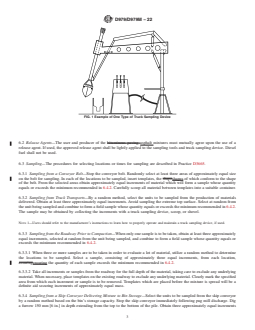
one type of truck sampling device is shown in Fig. 1.
approximately equal increments, selected at random from the
unit being sampled, and combine to form a field sample whose
quantity equals or exceeds the minimum recommended in
6.4.2.
6.3.3.1 When three or mo
...
This document is not an ASTM standard and is intended only to provide the user of an ASTM standard an indication of what changes have been made to the previous version. Because
it may not be technically possible to adequately depict all changes accurately, ASTM recommends that users consult prior editions as appropriate. In all cases only the current version
of the standard as published by ASTM is to be considered the official document.
Designation: D979/D979M − 15 D979/D979M − 22
Standard Practice for
Sampling Bituminous Paving Asphalt Mixtures
This standard is issued under the fixed designation D979/D979M; the number immediately following the designation indicates the year
of original adoption or, in the case of revision, the year of last revision. A number in parentheses indicates the year of last reapproval.
A superscript epsilon (´) indicates an editorial change since the last revision or reapproval.
This standard has been approved for use by agencies of the U.S. Department of Defense.
1. Scope
1.1 This practice covers sampling of bituminous paving asphalt mixtures at points of manufacture, storage, delivery, or in place.
1.2 The values stated in either SI units or inch-pound units are to be regarded separately as standard. The values stated in each
system may not be exact equivalents; therefore, each system shall be used independently of the other. Combining values from the
two systems may result in non-conformancenonconformance with the standard.
1.3 This standard does not purport to address all of the safety concerns, if any, associated with its use. It is the responsibility
of the user of this standard to establish appropriate safety safety, health, and healthenvironmental practices and determine the
applicability of regulatory limitations prior to use.
1.4 This international standard was developed in accordance with internationally recognized principles on standardization
established in the Decision on Principles for the Development of International Standards, Guides and Recommendations issued
by the World Trade Organization Technical Barriers to Trade (TBT) Committee.
2. Referenced Documents
2.1 ASTM Standards:
D8 Terminology Relating to Materials for Roads and Pavements
D2041D2041/D2041M Test Method for Theoretical Maximum Specific Gravity and Density of Asphalt Mixtures
D2234/D2234M Practice for Collection of a Gross Sample of Coal
D2726D2726/D2726M Test Method for Bulk Specific Gravity and Density of Non-Absorptive Compacted Asphalt Mixtures
D3665 Practice for Random Sampling of Construction Materials
D5361D5361/D5361M Practice for Sampling Compacted Asphalt Mixtures for Laboratory Testing
D5444 Test Method for Mechanical Size Analysis of Extracted Aggregate
D6307 Test Method for Asphalt Content of Asphalt Mixture by Ignition Method
D6925 Test Method for Preparation and Determination of the Relative Density of Asphalt Mix Specimens by Means of the
Superpave Gyratory Compactor
D6926 Practice for Preparation of Asphalt Mixture Specimens Using Marshall Apparatus
D6927 Test Method for Marshall Stability and Flow of Asphalt Mixtures
E105 Guide for Probability Sampling of Materials
E122 Practice for Calculating Sample Size to Estimate, With Specified Precision, the Average for a Characteristic of a Lot or
Process
This practice is under the jurisdiction of ASTM Committee D04 on Road and Paving Materials and areis the direct responsibility of Subcommittee D04.30 on Methods
of Sampling.
Current edition approved June 1, 2015Nov. 1, 2022. Published August 2015November 2022. Originally approved in 1948. Last previous edition approved in 20122015
as D979/D979M – 12.D979/D979M – 15. DOI: 10.1520/D0979_D0979M-15.10.1520/D0979_D0979M-22.
For referenced ASTM standards, visit the ASTM website, www.astm.org, or contact ASTM Customer Service at service@astm.org. For Annual Book of ASTM Standards
volume information, refer to the standard’s Document Summary page on the ASTM website.
Copyright © ASTM International, 100 Barr Harbor Drive, PO Box C700, West Conshohocken, PA 19428-2959. United States
D979/D979M − 22
E141 Practice for Acceptance of Evidence Based on the Results of Probability Sampling
2.2 AASHTO Standard:
AASHTO R 47 Standard Practice for Reducing Samples of Hot Mix Asphalt (HMA) to Testing Size
3. Terminology
3.1 This standard uses terms as defined by Terminology D8.
3.2 Definitions of Terms Specific to This Standard:
3.2.1 field sample, n—a quantity of the material to be tested of sufficient size to provide an acceptable estimate of the average
quality of a unit.
3.2.2 increment, n—part of a sample.
3.2.3 lot, n—a sizable isolated quantity of bulk material from a single source, assumed to have been produced by the same process
(for example, a day’s production or a specific mass or volume).
3.2.4 test portion, n—a quantity of the material of sufficient size extracted from the larger field sample by a procedure designed
to ensure accurate representation of the field sample, and thus of the unit sampled.
3.2.5 unit, n—a batch or finite subdivision of a lot of bulk material (for example, a truck load or a specific area covered).
4. Significance and Use
4.1 General:
4.1.1 Sampling is equally as important as the testing, and the sampler shall take every precaution to obtain samples that will yield
an acceptable estimate of the nature and conditions of the materials which they represent.
4.1.2 Samples for the development of preliminary data are obtained by the party responsible for the development of the data.
Samples for control of the product at the source of manufacture or storage, or at the site of use, are obtained by the manufacturer,
contractor, or other parties responsible for accomplishing the work. Samples for tests to be used in acceptance or rejection decisions
by the purchaser are obtained by the purchaser or his authorized representative.
4.1.3 This standard shall not be used for the sampling of compacted bituminous paving asphalt mixtures. Practice D5361D5361/
D5361M shall be used.
5. Apparatus
5.1 Container—A bucket, pan, box, or other vessel of a sufficient size to contain the sample.
5.2 Release Agent—A non-sticknonstick product that promotes an easy separation of the bituminous paving asphalt mixture from
the sampling tools without degrading the material being sampled.
5.3 Sampling Tool—A shovel, scoop, or other device used to obtain samples.
5.4 Truck Sampling Device (optional)—A mechanical apparatus that enables the user to retrieve material from the bed of a truck
without standing in the bed of the truck. An example of one type of truck sampling device is shown in Fig. 1.
6. Procedure
6.1 Inspection—The material shall be inspected to determine discernible variations. The seller shall provide equipment needed for
safe and appropriate inspection and sampling.
Available from American Association of State Highway and Transportation Officials (AASHTO), 444 N. Capitol St., NW, Suite 249, Washington, DC 20001,
http://www.transportation.org.
D979/D979M − 22
FIG. 1 Example of One Type of Truck Sampling Device
6.2 Release Agents—The user and producer of the bituminous paving asphalt mixtures must mutually agree upon the use of a
release agent. If used, the approved release agent shall be lightly applied to the sampling tools and truck sampling device. Diesel
fuel shall not be used.
6.3 Sampling—The procedures for selecting locations or times for sampling are described in Practice D3665.
6.3.1 Sampling from a Conveyor Belt—Stop the conveyor belt. Randomly select at least three areas of approximately equal size
on the belt for sampling. In each of the locations to be sampled, insert templates, the shapeshapes of which conform to the shape
of the belt. From the selected areas obtain approximately equal increments of material which will form a sample whose quantity
equals or exceeds the minimum recommended in 6.4.2. Carefully scoop all material between templates into a suitable container.
6.3.2 Sampling from Truck Transports—By a random method, select the units to be sampled from the production of materials
delivered. Obtain at least three approximately equal increments. Avoid sampling the extreme top surface. Select at random from
the unit being sampled and combine to form a field sample whose quantity equals or exceeds the minimum recommended in 6.4.2.
The sample may be obtained by collecting the increments with a truck sampling device, scoop, or shovel.
NOTE 1—Users should refer to the manufacturer’s instructions to learn how to properly operate and maintain a truck sampling device, if used.
6.3.3 Sampling from the Roadway Prior to Compaction—When only one sample is to be taken, obtain at least three approximately
equal increments, selected at random from the unit being sampled, and combine to form a field sample whose quantity equals or
exceeds the minimum recommended in 6.4.2.
6.3.3.1 When three or more samples are to be taken in order to evaluate a
...