

ASTM D3744/D3744M-18
(Test Method)Standard Test Method for Aggregate Durability Index
General Information
- Abstract
SIGNIFICANCE AND USE
4.1 This test method assigns an empirical value to the relative amount, fineness, and character of clay-like material that may be generated in an aggregate when subjected to mechanical degradation.
4.2 The procedure has been used in limited geographical areas of the United States, and the results have been correlated with aggregate performance in various construction applications, including: aggregate base, permeable material for backfill, fine concrete aggregate, and riprap for rock slope protection.3,4
4.3 A minimum durability index is permitted to be specified to prohibit the use of an aggregate in various construction applications that is prone to degradation, resulting in generation of clay-like fines.
4.4 This test method provides a rapid test for evaluation of the quality of a new aggregate source. Research has indicated it may also be suitable for use instead of the sodium sulfate soundness test for evaluating the durability characteristics of fine aggregate for use in portland cement concrete, thereby reducing the need for time-consuming and expensive soundness tests.3
4.5 Although the application of this method has been limited to aggregates for specific construction uses, the possibility exists for expanding the application of this method to control the quality of aggregates used in other areas of construction, such as aggregates for use in bituminous paving mixtures, coarse aggregate for use in portland cement concrete, and aggregate for use as railroad ballast.
Note 1: The text of this test method references notes and footnotes which provide explanatory material. These notes and footnotes (excluding those in tables and figures) shall not be considered as requirements of the test method.
Note 2: The quality of the results produced by this standard are dependent on the competence of the personnel performing the procedure and the capability, calibration, and maintenance of the equipment used. Agencies that meet the criteria of Specification...
SCOPE
1.1 This test method covers the determination of a durability index of an aggregate. The calculated durability index is a value indicating the relative resistance of an aggregate to production of detrimental clay-like fines when subjected to the prescribed mechanical methods of degradation.
1.2 Units—The values stated in either SI units or inch-pound units are to be regarded separately as standard. The values stated in each system may not be exact equivalents; therefore, each system shall be used independently of the other. Combining values from the two systems may result in nonconformance with the standard.
1.2.1 Measurements of volume and mass are only given in SI units because they are the only units typically used in practice when performing this test method.
1.2.2 Measurements in Section 11, Section 15, Eq 3, Eq 4, and Table 1 are only given in inch-pound units because the equipment used in these sections is only manufactured using the inch-pound system.
1.3 This standard does not purport to address all of the safety concerns, if any, associated with its use. It is the responsibility of the user of this standard to establish appropriate safety, health, and environmental practices and determine the applicability of regulatory limitations prior to use.
1.4 This international standard was developed in accordance with internationally recognized principles on standardization established in the Decision on Principles for the Development of International Standards, Guides and Recommendations issued by the World Trade Organization Technical Barriers to Trade (TBT) Committee.
- Status
- Published
- Publication Date
- 31-Aug-2018
- Technical Committee
- D04 - Road and Paving Materials
- Drafting Committee
- D04.51 - Aggregate Tests
Overview
ASTM D3744/D3744M-18, titled "Standard Test Method for Aggregate Durability Index," is a widely recognized ASTM standard that specifies a rapid and empirical test to determine the durability index of construction aggregates. The test assesses an aggregate's relative resistance to the production of clay-like fines under mechanical degradation, offering crucial insight into the quality and long-term performance of these materials in civil engineering and construction projects.
The importance of aggregate durability directly impacts the longevity and structural integrity of materials used in roadways, concrete, backfill, permeable bases, and slope protection. This standard provides a practical and cost-effective methodology for prequalification, comparison, and quality control of new and existing aggregate sources.
Key Topics
- Aggregate Durability Index: The main parameter measured, reflecting the relative resistance of aggregates to generate detrimental clay-like fines when subjected to specified mechanical procedures.
- Test Scope: Applies to both coarse and fine aggregate fractions utilizing tailored procedures, and is suitable for a range of aggregate types, including well-graded aggregates and those too fine or too coarse for other standard tests.
- Empirical Value Assignment: Results in an index value that can be used to specify minimum durability requirements for aggregates in construction, thereby restricting the use of rapidly degrading materials.
- Practical Testing: Provides a considerably faster alternative to more time-consuming durability assessments, such as the sodium sulfate soundness test, especially for fine aggregates used in portland cement concrete.
- Testing Procedures: Outlines clear procedures for sample preparation, mechanical agitation, sediment measurement, and calculation of durability indices.
Applications
The ASTM D3744/D3744M-18 test method supports engineers, specifiers, and material producers in a variety of construction-related applications:
- Aggregate base and subbase layers: Ensures that materials used beneath pavements have sufficient resistance to mechanical breakdown, reducing maintenance and failures.
- Permeable backfill materials: Assesses the tendency of aggregates to generate fines that could reduce drainage capabilities.
- Fine aggregates for concrete: Offers a reliable test to avoid using aggregates prone to clay-like fines, which can negatively impact concrete workability and strength.
- Riprap and slope protection: Evaluates aggregates for use in erosion control applications where durability against degradation is critical.
- Potential expansion of scope: Beyond its current applications, the method can also be used to evaluate aggregates for bituminous paving mixtures, railroad ballast, and coarse concrete applications.
Related Standards
ASTM D3744/D3744M-18 references and complements several other essential ASTM standards for aggregate and construction materials testing, including:
- ASTM C127: Test Method for Relative Density and Absorption of Coarse Aggregate
- ASTM C136/C136M: Test Method for Sieve Analysis of Fine and Coarse Aggregates
- ASTM D2419: Test Method for Sand Equivalent Value of Soils and Fine Aggregate
- ASTM D3666: Specification for Minimum Requirements for Agencies Testing and Inspecting Road and Paving Materials
- ASTM D75/D75M: Practice for Sampling Aggregates
- ASTM E11: Specification for Woven Wire Test Sieve Cloth and Test Sieves
Practical Value
By implementing ASTM D3744/D3744M-18, construction teams and quality control laboratories gain:
- Rapid aggregate durability assessment, supporting timely qualification of new sources.
- Prevention of structural issues related to rapidly degrading aggregates, especially where clay-like fines would be detrimental.
- Potential to optimize cost and testing time by replacing or supplementing more involved soundness tests.
- Standardization of reporting, ensuring consistent, comparable results across projects and regions.
Using this test method in accordance with ASTM guidelines improves the reliability and performance of construction projects by ensuring the use of durable, long-lasting aggregates, contributing to the overall quality of infrastructure.
Relations
- Effective Date
- 01-Sep-2018
- Effective Date
- 01-Feb-2024
- Effective Date
- 01-Nov-2019
- Effective Date
- 01-Oct-2016
- Effective Date
- 01-May-2015
- Effective Date
- 15-Dec-2013
- Effective Date
- 01-Dec-2013
- Effective Date
- 01-Oct-2013
- Effective Date
- 01-Apr-2012
- Effective Date
- 01-Dec-2011
- Effective Date
- 01-Aug-2011
- Effective Date
- 01-Dec-2009
- Effective Date
- 01-Jun-2009
- Effective Date
- 01-May-2009
- Effective Date
- 01-Aug-2007
Get Certified
Connect with accredited certification bodies for this standard

Zavod za gradbeništvo Slovenije (ZAG) - Inšpekcija
ZAG inspection body for construction products, structures, and materials.
Sponsored listings
Frequently Asked Questions
ASTM D3744/D3744M-18 is a standard published by ASTM International. Its full title is "Standard Test Method for Aggregate Durability Index". This standard covers: SIGNIFICANCE AND USE 4.1 This test method assigns an empirical value to the relative amount, fineness, and character of clay-like material that may be generated in an aggregate when subjected to mechanical degradation. 4.2 The procedure has been used in limited geographical areas of the United States, and the results have been correlated with aggregate performance in various construction applications, including: aggregate base, permeable material for backfill, fine concrete aggregate, and riprap for rock slope protection.3,4 4.3 A minimum durability index is permitted to be specified to prohibit the use of an aggregate in various construction applications that is prone to degradation, resulting in generation of clay-like fines. 4.4 This test method provides a rapid test for evaluation of the quality of a new aggregate source. Research has indicated it may also be suitable for use instead of the sodium sulfate soundness test for evaluating the durability characteristics of fine aggregate for use in portland cement concrete, thereby reducing the need for time-consuming and expensive soundness tests.3 4.5 Although the application of this method has been limited to aggregates for specific construction uses, the possibility exists for expanding the application of this method to control the quality of aggregates used in other areas of construction, such as aggregates for use in bituminous paving mixtures, coarse aggregate for use in portland cement concrete, and aggregate for use as railroad ballast. Note 1: The text of this test method references notes and footnotes which provide explanatory material. These notes and footnotes (excluding those in tables and figures) shall not be considered as requirements of the test method. Note 2: The quality of the results produced by this standard are dependent on the competence of the personnel performing the procedure and the capability, calibration, and maintenance of the equipment used. Agencies that meet the criteria of Specification... SCOPE 1.1 This test method covers the determination of a durability index of an aggregate. The calculated durability index is a value indicating the relative resistance of an aggregate to production of detrimental clay-like fines when subjected to the prescribed mechanical methods of degradation. 1.2 Units—The values stated in either SI units or inch-pound units are to be regarded separately as standard. The values stated in each system may not be exact equivalents; therefore, each system shall be used independently of the other. Combining values from the two systems may result in nonconformance with the standard. 1.2.1 Measurements of volume and mass are only given in SI units because they are the only units typically used in practice when performing this test method. 1.2.2 Measurements in Section 11, Section 15, Eq 3, Eq 4, and Table 1 are only given in inch-pound units because the equipment used in these sections is only manufactured using the inch-pound system. 1.3 This standard does not purport to address all of the safety concerns, if any, associated with its use. It is the responsibility of the user of this standard to establish appropriate safety, health, and environmental practices and determine the applicability of regulatory limitations prior to use. 1.4 This international standard was developed in accordance with internationally recognized principles on standardization established in the Decision on Principles for the Development of International Standards, Guides and Recommendations issued by the World Trade Organization Technical Barriers to Trade (TBT) Committee.
SIGNIFICANCE AND USE 4.1 This test method assigns an empirical value to the relative amount, fineness, and character of clay-like material that may be generated in an aggregate when subjected to mechanical degradation. 4.2 The procedure has been used in limited geographical areas of the United States, and the results have been correlated with aggregate performance in various construction applications, including: aggregate base, permeable material for backfill, fine concrete aggregate, and riprap for rock slope protection.3,4 4.3 A minimum durability index is permitted to be specified to prohibit the use of an aggregate in various construction applications that is prone to degradation, resulting in generation of clay-like fines. 4.4 This test method provides a rapid test for evaluation of the quality of a new aggregate source. Research has indicated it may also be suitable for use instead of the sodium sulfate soundness test for evaluating the durability characteristics of fine aggregate for use in portland cement concrete, thereby reducing the need for time-consuming and expensive soundness tests.3 4.5 Although the application of this method has been limited to aggregates for specific construction uses, the possibility exists for expanding the application of this method to control the quality of aggregates used in other areas of construction, such as aggregates for use in bituminous paving mixtures, coarse aggregate for use in portland cement concrete, and aggregate for use as railroad ballast. Note 1: The text of this test method references notes and footnotes which provide explanatory material. These notes and footnotes (excluding those in tables and figures) shall not be considered as requirements of the test method. Note 2: The quality of the results produced by this standard are dependent on the competence of the personnel performing the procedure and the capability, calibration, and maintenance of the equipment used. Agencies that meet the criteria of Specification... SCOPE 1.1 This test method covers the determination of a durability index of an aggregate. The calculated durability index is a value indicating the relative resistance of an aggregate to production of detrimental clay-like fines when subjected to the prescribed mechanical methods of degradation. 1.2 Units—The values stated in either SI units or inch-pound units are to be regarded separately as standard. The values stated in each system may not be exact equivalents; therefore, each system shall be used independently of the other. Combining values from the two systems may result in nonconformance with the standard. 1.2.1 Measurements of volume and mass are only given in SI units because they are the only units typically used in practice when performing this test method. 1.2.2 Measurements in Section 11, Section 15, Eq 3, Eq 4, and Table 1 are only given in inch-pound units because the equipment used in these sections is only manufactured using the inch-pound system. 1.3 This standard does not purport to address all of the safety concerns, if any, associated with its use. It is the responsibility of the user of this standard to establish appropriate safety, health, and environmental practices and determine the applicability of regulatory limitations prior to use. 1.4 This international standard was developed in accordance with internationally recognized principles on standardization established in the Decision on Principles for the Development of International Standards, Guides and Recommendations issued by the World Trade Organization Technical Barriers to Trade (TBT) Committee.
ASTM D3744/D3744M-18 is classified under the following ICS (International Classification for Standards) categories: 93.080.10 - Road construction; 93.080.20 - Road construction materials. The ICS classification helps identify the subject area and facilitates finding related standards.
ASTM D3744/D3744M-18 has the following relationships with other standards: It is inter standard links to ASTM D3744/D3744M-11a, ASTM D4753-24, ASTM D75/D75M-19, ASTM D3666-16, ASTM D4753-15, ASTM D75/D75M-13, ASTM D3666-13, ASTM E11-13, ASTM C127-12, ASTM D3666-11, ASTM C702/C702M-11, ASTM D3666-09a, ASTM D2419-09, ASTM E11-09e1, ASTM C127-07. Understanding these relationships helps ensure you are using the most current and applicable version of the standard.
ASTM D3744/D3744M-18 is available in PDF format for immediate download after purchase. The document can be added to your cart and obtained through the secure checkout process. Digital delivery ensures instant access to the complete standard document.
Standards Content (Sample)
This international standard was developed in accordance with internationally recognized principles on standardization established in the Decision on Principles for the
Development of International Standards, Guides and Recommendations issued by the World Trade Organization Technical Barriers to Trade (TBT) Committee.
Designation: D3744/D3744M − 18
Standard Test Method for
Aggregate Durability Index
This standard is issued under the fixed designation D3744/D3744M; the number immediately following the designation indicates the
year of original adoption or, in the case of revision, the year of last revision. A number in parentheses indicates the year of last
reapproval. A superscript epsilon (´) indicates an editorial change since the last revision or reapproval.
1. Scope C127Test Method for Relative Density (Specific Gravity)
and Absorption of Coarse Aggregate
1.1 Thistestmethodcoversthedeterminationofadurability
C136/C136MTest Method for Sieve Analysis of Fine and
index of an aggregate. The calculated durability index is a
Coarse Aggregates
value indicating the relative resistance of an aggregate to
C702/C702MPractice for Reducing Samples of Aggregate
production of detrimental clay-like fines when subjected to the
to Testing Size
prescribed mechanical methods of degradation.
D75/D75MPractice for Sampling Aggregates
1.2 Units—The values stated in either SI units or inch-
D2419Test Method for Sand Equivalent Value of Soils and
pound units are to be regarded separately as standard. The
Fine Aggregate
values stated in each system may not be exact equivalents;
D3666Specification for Minimum Requirements for Agen-
therefore,eachsystemshallbeusedindependentlyoftheother.
cies Testing and Inspecting Road and Paving Materials
Combining values from the two systems may result in noncon-
D4753Guide for Evaluating, Selecting, and Specifying Bal-
formance with the standard.
ances and Standard Masses for Use in Soil, Rock, and
1.2.1 Measurements of volume and mass are only given in
Construction Materials Testing
SI units because they are the only units typically used in
E11Specification forWovenWireTest Sieve Cloth andTest
practice when performing this test method.
Sieves
1.2.2 Measurements in Section 11, Section 15, Eq 3, Eq 4,
and Table 1 are only given in inch-pound units because the
3. Summary of Test Method
equipment used in these sections is only manufactured using
the inch-pound system. 3.1 This test method was developed to permit prequalifica-
tion of aggregates proposed for use in the construction of
1.3 This standard does not purport to address all of the
transportation facilities. This test establishes an aggregate’s
safety concerns, if any, associated with its use. It is the
resistance to generating fines when agitated in the presence of
responsibility of the user of this standard to establish appro-
water. Separate and different test procedures are used to
priate safety, health, and environmental practices and deter-
evaluate the coarse and the fine portions of an aggregate.
mine the applicability of regulatory limitations prior to use.
1.4 This international standard was developed in accor-
3.2 A sample of coarse aggregate is prepared to a specific
dance with internationally recognized principles on standard-
grading and then washed in a washing vessel secured in a
ization established in the Decision on Principles for the
mechanical agitator for 2 min. After discarding the minus
Development of International Standards, Guides and Recom-
4.75-mm (No. 4) material, dry the washed test sample.
mendations issued by the World Trade Organization Technical
3.3 The coarse aggregate test sample is then mechanically
Barriers to Trade (TBT) Committee.
agitated in the washing vessel for a period of 10 min. A
representative portion of the resulting wash water and minus
2. Referenced Documents
75-µm (No. 200) size fines is collected and mixed with a stock
2.1 ASTM Standards:
calciumchloridesolutionandplacedinaplasticcylinder.After
a 20-min sedimentation time, the level of the sediment column
is read. The height of the sediment value is then used to
This test method is under the jurisdiction of ASTM Committee D04 on Road
calculate the durability index of the coarse aggregate (D ).
and Paving Materials and is the direct responsibility of Subcommittee D04.51 on c
Aggregate Tests.
3.4 The fine aggregate sample is prepared by washing a
Current edition approved Sept. 1, 2018. Published September 2018. Originally
specific quantity of the material in the washing vessel secured
approvedin1979.Lastpreviouseditionapprovedin2011asD3744/D3744M–11a.
DOI: 10.1520/D3744_D3744M-18.
in a mechanical agitator for 2 min.All minus 75-µm (No. 200)
For referenced ASTM standards, visit the ASTM website, www.astm.org, or
size material is washed from the sample through a 75-µm (No.
contact ASTM Customer Service at service@astm.org. For Annual Book of ASTM
200) sieve and discarded.The plus 75-µm (No. 200) fraction is
Standards volume information, refer to the standard’s Document Summary page on
the ASTM website. dried.
Copyright © ASTM International, 100 Barr Harbor Drive, PO Box C700, West Conshohocken, PA 19428-2959. United States
D3744/D3744M − 18
those in tables and figures) shall not be considered as requirements of the
3.5 The fine aggregate test sample is tested by the standard
test method.
sand equivalent test method (Test Method D2419) except for
NOTE 2—The quality of the results produced by this standard are
modificationstothetestsamplepreparationanddurationofthe
dependent on the competence of the personnel performing the procedure
shaking time. The mechanical shaker method is required. A
and the capability, calibration, and maintenance of the equipment used.
shaking time of 10 min instead of 45 s is used.
Agencies that meet the criteria of Specification D3666 are generally
considered capable of competent and objective testing, sampling,
3.6 This test method includes procedures for testing aggre-
inspection, etc. Users of this standard are cautioned that compliance with
gates exhibiting a wide range in specific gravity, including
Specification D3666 alone does not completely ensure reliable results.
lightweight and porous coarse aggregates, and also procedures Reliable results depend on many factors; following the suggestions of
Specification D3666 or some similar acceptable guideline provides a
for testing small maximum-size aggregate which is too fine to
means of evaluating and controlling some of those factors.
test as a coarse aggregate and too coarse to consider as a fine
aggregate, such as a pea gravel or a very coarse sand.
5. Apparatus
3.7 Thedurabilityindexforcoarseaggregate(D )orforfine
c
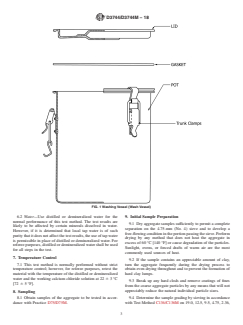
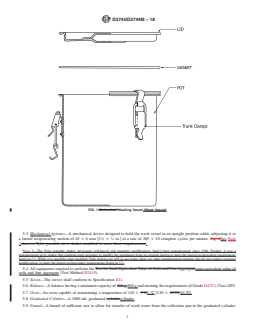
5.1 Washing Vessel or Wash Vessel (Pot)—A flat-bottomed,
aggregate (D) is calculated, as applicable, by appropriate
f
straight-sided cylindrical vessel similar to the design shown in
equations presented in the method. The durability index of a
Fig. 1, with a volume of approximately 7 Land inner diameter
well-gradedaggregatecontainingbothcoarseandfinefractions
of approximately 200 mm [8 in.]. The vessel lid must be
isdefinedasthelowestofthetwovalues,D orD,obtainedby
c f
equipped with a rubber gasket or another means of preventing
the test.This value is recommended to be the controlling value
leaks during agitation.
for specification purposes.
5.2 CollectionPan—Aroundpan(atleast230mm[9in.]in
4. Significance and Use
diameter and approximately 100 mm [4 in.] deep), suitable to
collect the wash water from the washed sample. The pan shall
4.1 This test method assigns an empirical value to the
have vertical or nearly vertical sides and shall be equipped as
relative amount, fineness, and character of clay-like material
necessary to hold the wire mesh of a 200-mm [8-in.] diameter
that may be generated in an aggregate when subjected to
sieve at least 75 mm [3 in.] above the bottom.An adaptor that
mechanical degradation.
will not allow loss of fines or wash water may be used to nest
4.2 The procedure has been used in limited geographical
the sieve with the container, or the sieve may be nested with a
areas of the United States, and the results have been correlated
blank sieve frame resting in the bottom of the pan.
with aggregate performance in various construction
5.3 Mechanical Agitator—Amechanical device designed to
applications, including: aggregate base, permeable material for
hold the wash vessel in an upright position while subjecting it
backfill, fine concrete aggregate, and riprap for rock slope
3,4 3 1
to a lateral reciprocating motion of 45 66mm[1 ⁄4 6 ⁄4 in.]
protection.
at a rate of 285 6 10 complete cycles per minute. See Note 3.
4.3 Aminimum durability index is permitted to be specified
NOTE3—TheTylerportableshakerpreviouslyreferencedandrequiring
to prohibit the use of an aggregate in various construction
modifications hasn’t been manufactured since 1986. Further, it was a
applications that is prone to degradation, resulting in genera-
manufactured sieve shaker that required each customer to modify the
tion of clay-like fines.
equipment from its original design to meet the lateral reciprocating
requirements listed in 5.3. While it is possible some modified Tyler
4.4 This test method provides a rapid test for evaluation of
shakersarestillinusetoday,thereareothermanufacturedagitatorsthatdo
the quality of a new aggregate source. Research has indicated
not require customer modifications to meet the lateral reciprocating
it may also be suitable for use instead of the sodium sulfate
requirements listed in 5.3.
soundness test for evaluating the durability characteristics of
5.4 All equipment required to perform the sand equivalent
fine aggregate for use in portland cement concrete, thereby
value of soils and fine aggregate (Test Method D2419).
reducing the need for time-consuming and expensive sound-
ness tests. 5.5 Sieves—The sieves shall conform to Specification E11.
4.5 Although the application of this method has been 5.6 Balance—A balance having a minimum capacity of
limited to aggregates for specific construction uses, the possi- 500g and meeting the requirements of Guide D4753, Class
bility exists for expanding the application of this method to GP5.
control the quality of aggregates used in other areas of
5.7 Oven—Anovencapableofmaintainingatemperatureof
construction, such as aggregates for use in bituminous paving
110 6 5°C [230 6 10°F].
mixtures,coarseaggregateforuseinportlandcementconcrete,
5.8 Graduated Cylinder—A 1000-mL graduated cylinder.
and aggregate for use as railroad ballast.
NOTE 1—The text of this test method references notes and footnotes
5.9 Funnel—Afunnel of sufficient size to allow for transfer
whichprovideexplanatorymaterial.Thesenotesandfootnotes(excluding
of wash water from the collection pan to the graduated
cylinder.
Hamilton, R. D., Smith, R. E., and Sherman, G. B., “Factors Influencing the
6. Reagents and Materials
DurabilityofAggregates,”ResearchReport633476,StateofCalifornia,Divisionof
Highways, Materials and Research Department, June 1971.
6.1 Calcium Chloride Solutions—Use stock and working
Hveem, F. N., and Smith, T. N., “Durability ofAggregates,” Research Report,
calcium chloride solutions as specified in the Reagents and
State of California, Division of Highways, Materials and Research Department,
January 1964. Materials section of Test Method D2419.
D3744/D3744M − 18
FIG. 1 Washing Vessel (Wash Vessel)
6.2 Water—Use distilled or demineralized water for the 9. Initial Sample Preparation
normal performance of this test method. The test results are
9.1 Dry aggregate samples sufficiently to permit a complete
likely to be affected by certain minerals dissolved in water.
separation on the 4.75-mm (No. 4) sieve and to develop a
However, if it is determined that local tap water is of such
free-flowingconditionintheportionpassingthesieve.Perform
puritythatitdoesnotaffectthetestresults,theuseoftapwater
drying by any method that does not heat the aggregate in
is permissible in place of distilled or demineralized water. For
excess of 60°C [140°F] or cause degradation of the particles.
refereepurposes,distilledordemineralizedwatershallbeused
Sunlight, ovens, or forced drafts of warm air are the most
for all steps in the test.
commonly used sources of heat.
7. Temperature Control
9.2 If the sample contains an appreciable amount of clay,
7.1 This test method is normally performed without strict turn the aggregate frequently during the drying process to
temperature control; however, for referee purposes, retest the obtain even drying throughout and to prevent the formation of
material with the temperature of the distilled or demineralized hard clay lumps.
water and the working calcium chloride solution at 22 63°C
9.3 Break up any hard clods and remove coatings of fines
[72 6 5°F].
from the coarse aggregate particles by any means that will not
appreciably reduce the natural individual particle sizes.
8. Sampling
8.1 Obtain samples of the aggregate to be tested in accor- 9.4 Determine the sample grading by sieving in accordance
dance with Practice D75/D75M. with Test Method C136/C136M on 19.0, 12.5, 9.5, 4.75, 2.36,
D3744/D3744M − 18
3 1 3
and 1.18-mm ( ⁄4, ⁄2, and ⁄8-in. and Nos. 4, 8, and 16) sieves. Testing of these materials will require adjustment of the test
Discard any material that is retained on the 19.0-mm ( ⁄4-in.) specimenmassorvolumeofbothwashandtestwater,orboth.
sieve.
10.3.1 Wash all materials that are not completely inundated
when 1000 mL of water is added to the test sample and test
9.5 Determinethetestprocedurestobeusedforestablishing
with adjusted sample masses and water volumes.
thedurabilityindexoftheaggregatebaseduponthegradingof
10.3.2 Determine the bulk, oven-dry specific gravity, and
the aggregate as determined in 9.4.
percentage of absorption of the aggregate in accordance with
9.5.1 If less than 10% of the aggregate passes the 4.75-mm
Test Method C127.
(No. 4) sieve, test coarse aggregate (Procedure A) only.
10.3.3 Adjust the total mass of the test sample using the
9.5.2 If less than 10% of the aggregate is coarser than the
following equation:
4.75-mm (No. 4) sieve, test fine aggregate (Procedure B) only.
9.5.3 When both coarse and fine aggregate fractions are
specificgravityofaggregate
Adjustedsamplemass, g 5 3W (1)
each present in quantities equal to or greater than 10% and if
2.65
the percent passing the 1.18-mm (No. 16) sieve is greater than
where:
10%, use both Procedures A and B on the appropriate
W = mass of oven-dried test sample, g.
aggregate sizes. If the percent passing the 1.18-mm (No. 16)
sieve is less than or equal to 10%, use Procedure A or
Adjust the mass of material in each size fraction proportion-
Procedure C.
ally to the masses specified in 10.1.
9.5.4 If most of the aggregate (75 to 80%) is retained
10.3.4 Adjust the volume of test water using the following
between the 9.5 and 1.18-mm ( ⁄8-in. and No. 16) sieves, use
equation:
Procedure C only.
Adjustedwater 5 10001 A 3W 250 (2)
~ !
PROCEDURE A – COARSE AGGREGATE
where:
A = absorption of aggregate,% (expressed as a decimal
10. Test Sample Preparation
fraction), and
10.1 Prepare a 2550 6 25-g (air-dry) preliminary test
W = mass of oven-dried test sample, g.
sample using the grading given below:
10.4 Clamp the vessel lid on the wash vessel and secure in
Aggregate Size Air-Dry Mass, g
the mechanical agitator. Begin agitation after a time of 1 min
3 1
19.0to12.5mm( ⁄4 to ⁄2 in.) 1070 ± 10
1 3
(60 6 10 s) has elapsed from the introduction of the wash
12.5 to 9.5 mm ( ⁄2 to ⁄8 in.) 570 ± 10
9.5to4.75mm( ⁄8 in. to No. 4) 910 ± 5
water. Agitate the wash vessel in the mechanical agitator for
2550 ± 25
2min (120 6 5 s).
Formaterialswithlessthan10%inanyofthesizefractions
10.5 After the 2-min (120 6 5 s) agitation time is
given in 10.1, prepare the test sample using the actual
completed, remove the washing vessel from the mechanical
percentage for the deficient fraction and proportionally in-
agitator,unclampthelid,andpourthecontentsontoa4.75-mm
creasethemassoftheremainingfractionstoobtainthe2550-g
(No. 4) sieve. Rinse any remaining fines from the wash vessel
test sample. Two examples follow.
onto the sieve and direct water (from a flexible hose attached
3 1
Example 1—Less than 10 % in 19.0 to 12.5 mm ( ⁄4 to ⁄2 in.) fraction
to a faucet) onto the aggregate until the water passing through
Aggregate Size Percent Calculation Air-Dry Mass, g the sieve comes out clear.
3 1
19.0to12.5mm( ⁄4 to ⁄2 in.) 6 0.06 × 2550 153 ± 10
1 3
12.5 to 9.5 mm ( ⁄2 to ⁄8 in) 26 570 (2550 − 153) 923 ± 10 10.6 Dry the fraction retained on the 4.75-mm (No. 4) sieve
570 + 910
toconstantmassatatemperatureof110 65°C[230 610°F]
9.5to4.75mm( ⁄8 to No. 4) 68 910 (2550 − 153) 1474 ± 5
and weigh. Calculate the loss in mass due to washing in
570 + 910
accordance with 10.2, 10.3, 10.4, and 10.5. If it’s equal to or
Totals 100 2550 ± 25
lessthan75g,atestsamplesuitableforfurthertestinghasbeen
Example 2—Less than 10 % in two fractions
prepared and the procedures in 10.7 – 10.12 are omitted. If the
loss in mass exceeds 75 g, the preliminary test sample is
Aggregate Size Percent Calculation Air-Dry
Mass, g
permitted to be retained and used if a second sample is washed
3 1
19.0to12.5mm( ⁄4 to ⁄2 in.) 4 0.04 × 2550 102 ± 10
by the same procedure and the two samples are combined
1 3
12.5 to 9.5 mm ( ⁄2 to ⁄8 in) 7 0.07 × 2550 179 ± 10
3 according to the specified masses to provide the desired test
9.5to4.75mm( ⁄8 to No. 4) 89 2550 − (102 + 179) 2269 ± 5
Totals 100 2550 ± 25
sample.
10.2 Placethepreliminarytestsampleinthewashingvessel
10.7 Determine the grading to be used in preparing the
and add 1000 6 5 mL of distilled or demineralized water.
preliminary test sample as follows:
10.3 Because of the low specific gravity or high absorption 10.7.1 If each of the aggregate sizes listed in the following
rate, or both, of some aggregates, the proportions of aggregate table represents 10% or more of the 19.0-mm to 4.75-mm
to water will not provide the intended interparticle abrasion. ( ⁄4-in. to No. 4) portion, as determined from the masses
D3744/D3744M − 18
recorded in 9.4, use the oven-dry masses of material specified 11.3.2 When a concentration of the material is retained on
below for preparing the preliminary test sample. the75-µm(No.200)sieve,re-rinsethefinematerialbypouring
the wash water through the sieve again. To re-rinse the
Aggregate Size Oven-Dry Mass,
g
material:
3 1
19.0to12.5mm( ⁄4 to ⁄2 in.) 1050 ± 10
11.3.2.1 Allow the wash water to stand undisturbed in the
1 3
12.5 to 9.5 mm ( ⁄2 to ⁄8 in.) 550 ± 10
9.5to4.75mm( ⁄8 in. to No. 4) 900 ± 5
...
This document is not an ASTM standard and is intended only to provide the user of an ASTM standard an indication of what changes have been made to the previous version. Because
it may not be technically possible to adequately depict all changes accurately, ASTM recommends that users consult prior editions as appropriate. In all cases only the current version
of the standard as published by ASTM is to be considered the official document.
Designation: D3744/D3744M − 11a D3744/D3744M − 18
Standard Test Method for
Aggregate Durability Index
This standard is issued under the fixed designation D3744/D3744M; the number immediately following the designation indicates the
year of original adoption or, in the case of revision, the year of last revision. A number in parentheses indicates the year of last
reapproval. A superscript epsilon (´) indicates an editorial change since the last revision or reapproval.
1. Scope
1.1 This test method covers the determination of a durability index of an aggregate. The calculated durability index is a value
indicating the relative resistance of an aggregate to production of detrimental clay-like fines when subjected to the prescribed
mechanical methods of degradation.
1.2 Units—The values stated in either SI units or inch-pound units are to be regarded separately as standard. The values stated
in each system may not be exact equivalents; therefore, each system shall be used independently of the other. Combining values
from the two systems may result in non-conformancenonconformance with the standard.
1.2.1 Measurements of volume and mass are only given in SI units because they are the only units typically used in practice
when performing this test method.
1.2.2 Measurements in Section 11, Section 15, Eq 3Equation, Eq 43, Equation 4, Table 1, and Figure 2, and Table 1 are only
given in inch-pound units because the equipment used in these sections is only manufactured using the inch-pound system.
1.3 This standard does not purport to address all of the safety concerns, if any, associated with its use. It is the responsibility
of the user of this standard to establish appropriate safety safety, health, and healthenvironmental practices and determine the
applicability of regulatory limitations prior to use.
1.4 This international standard was developed in accordance with internationally recognized principles on standardization
established in the Decision on Principles for the Development of International Standards, Guides and Recommendations issued
by the World Trade Organization Technical Barriers to Trade (TBT) Committee.
2. Referenced Documents
2.1 ASTM Standards:
C127 Test Method for Relative Density (Specific Gravity) and Absorption of Coarse Aggregate
C136C136/C136M Test Method for Sieve Analysis of Fine and Coarse Aggregates
C702C702/C702M Practice for Reducing Samples of Aggregate to Testing Size
D75D75/D75M Practice for Sampling Aggregates
D2419 Test Method for Sand Equivalent Value of Soils and Fine Aggregate
D3666 Specification for Minimum Requirements for Agencies Testing and Inspecting Road and Paving Materials
D4753 Guide for Evaluating, Selecting, and Specifying Balances and Standard Masses for Use in Soil, Rock, and Construction
Materials Testing
E11 Specification for Woven Wire Test Sieve Cloth and Test Sieves
3. Summary of Test Method
3.1 This test method was developed to permit prequalification of aggregates proposed for use in the construction of
transportation facilities. Basically, the This test establishes an aggregate’s resistance to generating fines when agitated in the
presence of water. Separate and different test procedures are used to evaluate the coarse and the fine portions of a material.an
aggregate.
3.2 A sample of coarse aggregate is prepared to a specific grading and then washed in a mechanical washing vessel for a 2-min
agitation time. secured in a mechanical agitator for 2 min. After discarding the minus 4.75-mm (No. 4) material, dry the washed
test sample.
This test method is under the jurisdiction of ASTM Committee D04 on Road and Paving Materials and is the direct responsibility of Subcommittee D04.51 on Aggregate
Tests.
Current edition approved Dec. 1, 2011Sept. 1, 2018. Published December 2011September 2018. Originally approved in 1979. Last previous edition approved in 2011 as
D3744 – 11.D3744/D3744M – 11a. DOI: 10.1520/D3744_D3744_D3744M–11A10.1520/D3744_D3744M-18.
For referenced ASTM standards, visit the ASTM website, www.astm.org, or contact ASTM Customer Service at service@astm.org. For Annual Book of ASTM Standards
volume information, refer to the standard’s Document Summary page on the ASTM website.
Copyright © ASTM International, 100 Barr Harbor Drive, PO Box C700, West Conshohocken, PA 19428-2959. United States
D3744/D3744M − 18
3.3 The coarse aggregate test sample is then mechanically agitated in the mechanical washing vessel for a period of 10 min.
A representative portion of the resulting wash water and minus 75-μm (No. 200) size fines is collected and mixed with a stock
calcium chloride solution and placed in a plastic cylinder. After a 20-min sedimentation time, the level of the sediment column
is read. The height of the sediment value is then used to calculate the durability index of the coarse aggregate (D ).
cc
3.4 The fine aggregate sample is prepared by washing a specific quantity of the material in the mechanical washing vessel for
a 2-min agitation period. secured in a mechanical agitator for 2 min. All minus 75-μm (No. 200) size material is washed from the
sample through a 75-μm (No. 200) sieve and discarded. The plus 75-μm (No. 200) fraction is dried.
3.5 The fine aggregate test sample is tested by the Standard Sand Equivalent Test Methodstandard sand equivalent test method
(Test Method D2419) except for modifications to the test sample preparation and duration of the shaking time. The mechanical
shaker method is required. A shaking time of 10 min instead of 45 s is used.
3.6 This test method includes procedures for testing aggregates exhibiting a wide range in specific gravity, including lightweight
and porous coarse aggregates, and also procedures for testing small maximum size maximum-size aggregate which is too fine to
test as a coarse aggregate and too coarse to consider as a fine aggregate, such as a pea gravel or a very coarse sand.
3.7 The durability index for coarse aggregate (D ) or for fine aggregate (D ) is calculated, as applicable, by appropriate
cc ff
equations presented in the method. The durability index of a well-graded aggregate containing both coarse and fine fractions is
defined as the lowest of the two values, D or D , obtained by the test. This value is recommended to be the controlling value for
cc f
specification purposes.
4. Significance and Use
4.1 This test method assigns an empirical value to the relative amount, fineness, and character of clay-like material that may
be generated in an aggregate when subjected to mechanical degradation.
4.2 The procedure has been used in limited geographical areas of the United States, and the results have been correlated with
aggregate performance in various construction applications, including: aggregate base, permeable material for backfill, fine
3,4
concrete aggregate, and riprap for rock slope protection.
4.3 A minimum durability index is permitted to be specified to prohibit the use of an aggregate in various construction
applications that is prone to degradation, resulting in generation of clay-like fines.
4.4 This test method provides a rapid test for evaluation of the quality of a new aggregate source. Research has indicated it may
also be suitable for use instead of the sodium sulfate soundness test for evaluating the durability characteristics of fine aggregate
for use in portland-cement portland cement concrete, thereby reducing the need for time-consuming and expensive soundness
tests.
4.5 Although the application of this method has been limited to aggregates for specific construction uses, the possibility exists
for expanding the application of this method to control the quality of aggregates used in other areas of construction, such as
aggregates for use in bituminous paving mixtures, coarse aggregate for use in portland-cement portland cement concrete, and
aggregate for use as railroad ballast.
NOTE 1—The text of this test method references notes and footnotes which provide explanatory material. These notes and footnotes (excluding those
in tables and figures) shall not be considered as requirements of the test method.
NOTE 2—The quality of the results produced by this standard are dependent on the competence of the personnel performing the procedure and the
capability, calibration, and maintenance of the equipment used. Agencies that meet the criteria of PracticeSpecification D3666 are generally considered
capable of competent and objective testing/sampling/inspection/etc. testing, sampling, inspection, etc. Users of this standard are cautioned that compliance
with PracticeSpecification D3666 alone does not completely assureensure reliable results. Reliable results depend on many factors; following the
suggestions of PracticeSpecification D3666 or some similar acceptable guideline provides a means of evaluating and controlling some of those factors.
5. Apparatus
5.1 Mechanical Washing Vessel or Wash Vessel (Pot)—A flat-bottomed, straight-sided cylindrical vessel similar to the design
shown in Fig. 1, with a volume of approximately 7 litersL and inner diameter of approximately 200 mm [8 in.]. The vessel lid must
be equipped with a rubber gasket or another means of preventing leaks during agitation.
5.2 Collection Pan—A round pan (at least 230 mm [9 in.] in diameter and approximately 100 mm [4 in.] deep), suitable to
collect the wash water from the washed sample. The pan shall have vertical or nearly vertical sides and shall be equipped as
necessary to hold the wire mesh of a 200-mm [8-in.] diameter sieve at least 75 mm [3 in.] above the bottom. An adaptor that will
not allow loss of fines or wash water may be used to nest the sieve with the container, or the sieve may be nested with a blank
sieve frame resting in the bottom of the pan.
Hamilton, R. D., Smith, R. E., and Sherman, G. B., “Factors Influencing the Durability of Aggregates,” Research Report 633476, State of California, Division of
Highways, Materials and Research Department, June 1971.
Hveem, F. N., and Smith, T. N., “Durability of Aggregates,” Research Report, State of California, Division of Highways, Materials and Research Department, January
1964.
D3744/D3744M − 18
FIG. 1 Mechanical Washing Vessel (Wash Vessel)
5.3 Mechanical Agitator—A mechanical device designed to hold the wash vessel in an upright position while subjecting it to
3 1
a lateral reciprocating motion of 45 6 6 mm [1 ⁄4 6 ⁄4 in.] at a rate of 285 6 10 complete cycles per minute. Fig. 2See Note
3shows a Tyler portable sieve shaker modified to meet these requirements.
NOTE 3—The Tyler portable shaker previously referenced and requiring modifications hasn’t been manufactured since 1986. Further, it was a
manufactured sieve shaker that required each customer to modify the equipment from its original design to meet the lateral reciprocating requirements
listed in 5.3. While it is possible some modified Tyler shakers are still in use today, there are other manufactured agitators that do not require customer
modifications to meet the lateral reciprocating requirements listed in 5.3.
5.4 All equipment required to perform the Test for Sand Equivalent Value of Soils and Fine Aggregatesand equivalent value of
soils and fine aggregate (Test Method D2419).
5.5 Sieves—The sieves shall conform to Specification E11.
5.6 Balance—A balance having a minimum capacity of 500 g 500 g and meeting the requirements of Guide D4753, Class GP5.
5.7 Oven—An oven capable of maintaining a temperature of 110 6 5°C5 °C [230 6 10°F].10 °F].
5.8 Graduated Cylinder—A 1000-mL graduated cylindercylinder.
5.9 Funnel—A funnel of sufficient size to allow for transfer of wash water from the collection pan to the graduated cylinder.
D3744/D3744M − 18
6. Reagents and Materials
6.1 Calcium Chloride Solutions—Use stock and working calcium chloride solutions as specified in the Reagents and Materials
section of Test Method D2419.
6.2 Water—Use distilled or demineralized water for the normal performance of this test method. The test results are likely to
be affected by certain minerals dissolved in water. However, if it is determined that local tap water is of such purity that it does
not affect the test results, the use of tap water is permissible in place of distilled or demineralized water. For referee purposes,
distilled or demineralized water shall be used for all steps in the test.
7. Temperature Control
7.1 This test method is normally performed without strict temperature control; however, for referee purposes, retest the material
with the temperature of the distilled or demineralized water and the working calcium chloride solution at 22 6 3°C3 °C [72 6
5°F].5 °F].
8. Sampling
8.1 Obtain samples of the aggregate to be tested in accordance with Practice D75D75/D75M.
9. Initial Sample Preparation
9.1 Dry aggregate samples sufficiently to permit a complete separation on the 4.75-mm (No. 4) sieve and to develop a
free-flowing condition in the portion passing the sieve. Perform drying by any method that does not heat the aggregate in excess
of 60°C [140°F]60 °C [140 °F] or cause degradation of the particles. Sunlight, ovens, or forced drafts of warm air are the most
commonly used sources of heat.
9.2 If the sample contains an appreciable amount of clay, turn the aggregate frequently during the drying process to obtain even
drying throughout and to prevent the formation of hard clay lumps.
9.3 Break up any hard clods and remove coatings of fines from the coarse aggregate particles by any means that will not
appreciably reduce the natural individual particle sizes.
9.4 Determine the sample grading by sieving in accordance with Test Method C136C136/C136M on 19.0, 12.5, 9.5, 4.75, 2.36,
3 1 3 3
and 1.18-mm ( ⁄4, ⁄2, and ⁄8-in. and Nos. 4, 8, and 16) sieves. Discard any material that is retained on the 19.0-mm ( ⁄4-in.) sieve.
9.5 Determine the test procedures to be used for establishing the durability index of the aggregate based upon the grading of
the aggregate as determined in 9.4.
9.5.1 If less than 10 % of the aggregate passes the 4.75-mm (No. 4) sieve, test coarse aggregate (Procedure A) only.
9.5.2 If less than 10 % of the aggregate is coarser than the 4.75-mm (No. 4) sieve, test fine aggregate (Procedure B) only.
9.5.3 When both coarse and fine aggregate fractions are each present in quantities equal to or greater than 10 % and if the
percent passing the 1.18-mm (No. 16) sieve is greater than 10 %, use both Procedures A and B on the appropriate aggregate sizes.
If the percent passing the 1.18-mm (No. 16) sieve is less than or equal to 10 %, use Procedure A or Procedure C.
9.5.4 If most of the aggregate (75 to 80 %) is retained between the 9.5 and 1.18-mm ( ⁄8-in. and No. 16) sieves, use Procedure
C only.
PROCEDURE A—COARSE AGGREGATE
PROCEDURE A – COARSE AGGREGATE
10. Test Sample Preparation
10.1 Prepare a 2550 6 25-g (air-dry) preliminary test sample using the grading given below:
Aggregate Size Air Dry Mass, g
Aggregate Size Air-Dry Mass, g
3 1
19.0 to 12.5 mm ( ⁄4 to ⁄2 in.) 1070 ± 10
1 3
12.5 to 9.5 mm ( ⁄2 to ⁄8 in.) 570 ± 10
9.5 to 4.75 mm ( ⁄8 in. to No. 4) 910 ± 5
2550 ± 25
For materials with less than 10 % in any of the size fractions given in 10.1, prepare the test sample using the actual percentage
for the deficient fraction and proportionally increase the mass of the remaining fractions to obtain the 2550 g 2550-g test sample.
Two examples follow.
3 1
Example 1—Less than 10 % in 19.0 to 12.5 mm ( ⁄4 to ⁄2 in.) fraction
Aggregate Size Percent Calculation Air Dry Mass, g
Aggregate Size Percent Calculation Air-Dry Mass, g
3 1
19.0 to 12.5 mm ( ⁄4 to ⁄2 in.) 6 0.06 × 2550 153 ± 10
1 3
12.5 to 9.5 mm ( ⁄2 to ⁄8 in) 26 570 (2550 − 153) 923 ± 10
570 + 910
D3744/D3744M − 18
9.5 to 4.75 mm ( ⁄8 to No. 4) 68 910 (2550 − 153) 1474 ± 5
570 + 910
Totals 100 2550 ± 25
Example 2—Less than 10 % in two fractions
Aggregate Size Percent Calculation Air Dry
Mass, g
Aggregate Size Percent Calculation Air-Dry
Mass, g
3 1
19.0 to 12.5 mm ( ⁄4 to ⁄2 in.) 4 0.04 × 2550 102 ± 10
1 3
12.5 to 9.5 mm ( ⁄2 to ⁄8 in) 7 0.07 × 2550 179 ± 10
9.5 to 4.75 mm ( ⁄8 to No. 4) 89 2550 − (102 + 179) 2269 ± 5
Totals 100 2550 ± 25
10.2 Place the preliminary test sample in the mechanical washing vessel and add 1000 6 5 mlmL of distilled or demineralized
water.
10.3 Because of the low specific gravity or high absorption rate, or both, of some aggregates, the proportions of aggregate to
water will not provide the intended interparticle abrasion. Testing of these materials will require adjustment of the test specimen
mass or volume of both wash and test water, or both.
10.3.1 Wash all materials that are not completely inundated when 1000 mlmL of water areis added to the test sample and test
with adjusted sample masses and water volumes.
10.3.2 Determine the bulk, oven-dry specific gravity, and percentage of absorption of the aggregate in accordance with Test
Method C127.
10.3.3 Adjust the total mass of the test sample using the following equation:
specific gravity of aggregate
Adjusted sample mass, g5 3W (1)
2.65
where:
W = mass of oven-dried test sample, g.
Adjust the mass of material in each size fraction proportionally to the masses specified in 10.1.
10.3.4 Adjust the volume of test water using the following equation:
Adjusted water 5 10001~A 3W! 2 50 (2)
where:
A = absorption of aggregate, % (expressed as a decimal fraction), and
W = mass of oven-dried test sample, g.
10.4 Clamp the vessel lid in place, on the wash vessel and secure the vessel in the sieve shaker.mechanical agitator. Begin
agitation after a time of 60 1 min (60 6 10 ss) has elapsed from the introduction of the wash water. Agitate the wash vessel in
the sieve shaker for 120 mechanical agitator for 2 min (120 6 5 s.s).
10.5 After the 2-min (120 6 5 s) agitation time is completed, remove the washing vessel from the shaker, mechanical agitator,
unclamp the lid, and pour the contents onto a 4.75-mm (No. 4) sieve. Rinse any remaining fines from the wash vessel onto the
sieve and direct water (from a flexible hose attached to a faucet) onto the aggregate until the water passing through the sieve comes
out clear.
10.6 Dry the fraction retained on the 4.75-mm (No. 4) sieve to constant mass at a temperature of 110 6 5°C5 °C [230 6
10°F]10 °F] and weigh. IfCalculate the loss in mass due to washing in accordance with 10.2, 10.3, 10.4, and 10.5 is . If it’s equal
to or less than 75 g, a test sample suitable for further testing has been prepared and the procedures in 10.7 – 10.12 are omitted.
If the loss in mass exceeds 75 g, the preliminary test sample is permitted to be retained and used if a second sample is washed
by the same procedure and the two samples are combined according to the specified masses to provide the desired test sample.
10.7 Determine the grading to be used in preparing the preliminary test sample as follows:
10.7.1 If each of the aggregate sizes listed in the following table represents 10 % or more of the 19.0-mm to 4.75-mm ( ⁄4-in.
to No. 4) portion, as determined from the masses recorded in 9.4, use the oven-dry masses of material specified below for preparing
the preliminary test sample.
Aggregate Size Oven-Dry Mass,
g
3 1
19.0 to 12.5 mm ( ⁄4 to ⁄2 in.) 1050 ± 10
1 3
12.5 to 9.5 mm ( ⁄2 to ⁄8 in.) 550 ± 10
9.5 to 4.75 mm ( ⁄8 in. to No. 4) 900 ± 5
2500 ± 25
10.8 Prepare a 2500-g preliminary test sample using the prescribed grading. Dry the test sample to constant mass at a
temperature of 110 6 5°C5 °C [230 6 10°F].10 °F].
...