

ASTM D2950/D2950M-22
(Test Method)Standard Test Method for Density of Asphalt Mixtures in Place by Nuclear Methods
General Information
- Abstract
SIGNIFICANCE AND USE
4.1 The test method described is useful as a rapid, nondestructive technique for determining the in-place density of compacted asphalt mixtures.
4.2 With proper calibration and confirmation testing, the test method is suitable for quality control and acceptance testing of compacted asphalt mixtures.
4.3 The test method can be used to establish the proper rolling effort and pattern to achieve the required density.
4.4 The nondestructive nature of the test allows repetitive measurements to be made at a single test location between roller passes and to monitor changes in density.
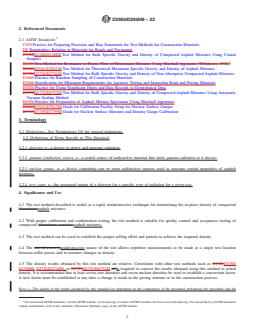
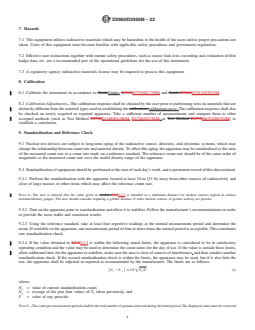
4.5 The density results obtained by this test method are relative. Correlation with other test methods such as D1188/D1188M, D2726/D2726M, or D6752/D6752M is required to convert the results obtained using this method to actual density. It is recommended that at least seven core densities and seven nuclear densities be used to establish a conversion factor. A new factor must be established at any time a change is made in the paving mixture or in the construction process.
Note 1: The quality of the results produced by this standard are dependent on the competence of the personnel performing the procedure and the capability, calibration, and maintenance of the equipment used. Agencies that meet the criteria of Specification D3666 are generally considered capable of competent and objective testing, sampling, inspection, etc. Users of this standard are cautioned that compliance with Specification D3666 alone does not completely ensure reliable results. Reliable results depend on many factors; following the suggestions of Specification D3666 or some similar acceptable guideline provides a means of evaluating and controlling some of those factors.
SCOPE
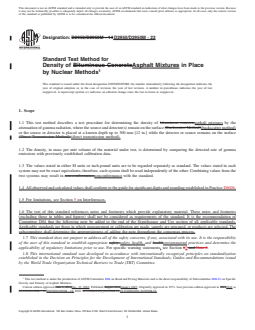
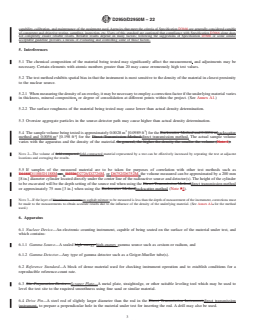
1.1 This test method describes a test procedure for determining the density of asphalt mixtures by the attenuation of gamma radiation, where the source and detector(s) remain on the surface (backscatter method) or the source or detector is placed at a known depth up to 300 mm [12 in.] while the detector or source remains on the surface (direct transmission method).
1.2 The density, in mass per unit volume of the material under test, is determined by comparing the detected rate of gamma emissions with previously established calibration data.
1.3 The values stated in either SI units or inch-pound units are to be regarded separately as standard. The values stated in each system may not be exact equivalents; therefore, each system shall be used independently of the other. Combining values from the two systems may result in nonconformance with the standard.
1.4 All observed and calculated values shall conform to the guide for significant digits and rounding established in Practice D6026.
1.5 For limitations, see Section 5 on Interferences.
1.6 The text of this standard references notes and footnotes which provide explanatory material. These notes and footnotes (excluding those in tables and figures) shall not be considered as requirements of the standard. It is the recommendation of Committee D04 that the following note be added to the end of the Significance and Use section of all applicable standards. Applicable standards are those in which measurement or calibration are made, sample are procured, or products are selected. The subcommittee shall determine the appropriateness of adding the note throughout the consensus process.
1.7 This standard does not purport to address all of the safety concerns, if any, associated with its use. It is the responsibility of the user of this standard to establish appropriate safety, health, and environmental practices and determine the applicability of regulatory limitations prior to use. For specific warning statements, see Section 7.
1.8 This international standard was developed in accordance with internationally recognized principles on standardization established in the Decision on Principles for the Develo...
- Status
- Published
- Publication Date
- 14-Dec-2022
- Technical Committee
- D04 - Road and Paving Materials
- Drafting Committee
- D04.21 - Specific Gravity and Density of Asphalt Mixtures
Buy Documents
ASTM D2950/D2950M-22 - Standard Test Method for Density of Asphalt Mixtures in Place by Nuclear Methods
REDLINE ASTM D2950/D2950M-22 - Standard Test Method for Density of Asphalt Mixtures in Place by Nuclear Methods
Overview
ASTM D2950/D2950M-22: Standard Test Method for Density of Asphalt Mixtures in Place by Nuclear Methods provides a standardized procedure for rapidly and non-destructively determining the in-place density of compacted asphalt mixtures using nuclear gauge devices. This test method is widely valued in quality control and acceptance testing for pavement construction, as it provides immediate feedback on the compaction quality of asphalt surfaces without damaging the material. The density measurements achieved through this method are essential for ensuring pavement durability and performance according to project specifications.
Key Topics
Nuclear Test Methods
The standard describes two primary nuclear measurement modes:- Backscatter Method: Both the source and detector remain at the surface.
- Direct Transmission Method: Either the source or detector is inserted to a controlled depth (up to 300 mm), while the other remains on the surface.
Calibration and Standardization
- Proper calibration of the nuclear gauge with reference to established standards is required to ensure reliable results.
- Daily standardization checks are necessary to account for equipment aging and source decay.
- Typically, results from seven nuclear and seven core density measurements are correlated to establish a project-specific conversion factor.
Quality Control and Acceptance
- Enables repetitive, non-destructive measurements at the same or different locations, supporting continuous monitoring throughout the paving process.
- Results are relative and should be confirmed or correlated using traditional core sampling methods (e.g., ASTM D1188/D1188M, D2726/D2726M, D6752/D6752M).
Reliability and Safety
- Measurement accuracy depends on proper equipment maintenance, operator competence, and adherence to safety protocols concerning radioactive materials.
- Regulatory compliance for radioactive material handling is required.
Applications
Pavement Construction and Maintenance
- Ensures the required in-place density for new asphalt paving, crucial for long-term road performance and lifespan.
- Helps determine the optimal rolling effort and pattern, reducing risks of premature pavement failure due to under or over-compaction.
Quality Assurance/Quality Control (QA/QC)
- Used extensively by contractors, agencies, and testing laboratories for acceptance testing during road construction projects.
- Supports rapid decision-making and process adjustments during paving operations.
Research and Continuous Improvement
- Enables detailed studies on the relationship between compaction techniques and in-place density.
- Facilitates evaluation of new materials, mixtures, or pavement technologies without destructive sampling.
Regulatory Compliance
- Meets requirements for in-situ density measurement set by transportation and infrastructure authorities.
- Supports documentation and reporting for project acceptance and audits.
Related Standards
For correlation, calibration, and complementary testing, the following ASTM standards are commonly referenced alongside ASTM D2950/D2950M:
- ASTM D1188/D1188M: Bulk Specific Gravity and Density of Compacted Asphalt Mixtures Using Coated Samples
- ASTM D2726/D2726M: Bulk Specific Gravity and Density of Non-Absorptive Compacted Asphalt Mixtures
- ASTM D6752/D6752M: Bulk Specific Gravity and Density of Compacted Asphalt Mixtures Using Automatic Vacuum Sealing Method
- ASTM D3666: Specification for Minimum Requirements for Agencies Testing and Inspecting Road and Paving Materials
- ASTM D7013/D7013M: Guide for Calibration Facility Setup for Nuclear Surface Gauges
- ASTM D7759/D7759M: Guide for Nuclear Surface Moisture and Density Gauge Calibration
By adhering to ASTM D2950/D2950M-22 and its related standards, pavement professionals ensure high-quality asphalt compaction and compliance with industry best practices.
Relations
- Effective Date
- 01-Feb-2024
- Effective Date
- 01-Jan-2024
- Effective Date
- 01-Nov-2023
- Effective Date
- 01-Jan-2020
- Effective Date
- 01-Aug-2019
- Effective Date
- 01-Jun-2019
- Effective Date
- 15-Dec-2018
- Effective Date
- 15-Aug-2018
- Effective Date
- 15-Aug-2018
- Effective Date
- 01-Jul-2018
- Effective Date
- 01-Feb-2018
- Effective Date
- 15-Jul-2017
- Effective Date
- 15-Jun-2017
- Effective Date
- 01-Jun-2017
- Effective Date
- 01-Jun-2017
Buy Documents
ASTM D2950/D2950M-22 - Standard Test Method for Density of Asphalt Mixtures in Place by Nuclear Methods
REDLINE ASTM D2950/D2950M-22 - Standard Test Method for Density of Asphalt Mixtures in Place by Nuclear Methods
Get Certified
Connect with accredited certification bodies for this standard

Zavod za gradbeništvo Slovenije (ZAG) - Inšpekcija
ZAG inspection body for construction products, structures, and materials.
Sponsored listings
Frequently Asked Questions
ASTM D2950/D2950M-22 is a standard published by ASTM International. Its full title is "Standard Test Method for Density of Asphalt Mixtures in Place by Nuclear Methods". This standard covers: SIGNIFICANCE AND USE 4.1 The test method described is useful as a rapid, nondestructive technique for determining the in-place density of compacted asphalt mixtures. 4.2 With proper calibration and confirmation testing, the test method is suitable for quality control and acceptance testing of compacted asphalt mixtures. 4.3 The test method can be used to establish the proper rolling effort and pattern to achieve the required density. 4.4 The nondestructive nature of the test allows repetitive measurements to be made at a single test location between roller passes and to monitor changes in density. 4.5 The density results obtained by this test method are relative. Correlation with other test methods such as D1188/D1188M, D2726/D2726M, or D6752/D6752M is required to convert the results obtained using this method to actual density. It is recommended that at least seven core densities and seven nuclear densities be used to establish a conversion factor. A new factor must be established at any time a change is made in the paving mixture or in the construction process. Note 1: The quality of the results produced by this standard are dependent on the competence of the personnel performing the procedure and the capability, calibration, and maintenance of the equipment used. Agencies that meet the criteria of Specification D3666 are generally considered capable of competent and objective testing, sampling, inspection, etc. Users of this standard are cautioned that compliance with Specification D3666 alone does not completely ensure reliable results. Reliable results depend on many factors; following the suggestions of Specification D3666 or some similar acceptable guideline provides a means of evaluating and controlling some of those factors. SCOPE 1.1 This test method describes a test procedure for determining the density of asphalt mixtures by the attenuation of gamma radiation, where the source and detector(s) remain on the surface (backscatter method) or the source or detector is placed at a known depth up to 300 mm [12 in.] while the detector or source remains on the surface (direct transmission method). 1.2 The density, in mass per unit volume of the material under test, is determined by comparing the detected rate of gamma emissions with previously established calibration data. 1.3 The values stated in either SI units or inch-pound units are to be regarded separately as standard. The values stated in each system may not be exact equivalents; therefore, each system shall be used independently of the other. Combining values from the two systems may result in nonconformance with the standard. 1.4 All observed and calculated values shall conform to the guide for significant digits and rounding established in Practice D6026. 1.5 For limitations, see Section 5 on Interferences. 1.6 The text of this standard references notes and footnotes which provide explanatory material. These notes and footnotes (excluding those in tables and figures) shall not be considered as requirements of the standard. It is the recommendation of Committee D04 that the following note be added to the end of the Significance and Use section of all applicable standards. Applicable standards are those in which measurement or calibration are made, sample are procured, or products are selected. The subcommittee shall determine the appropriateness of adding the note throughout the consensus process. 1.7 This standard does not purport to address all of the safety concerns, if any, associated with its use. It is the responsibility of the user of this standard to establish appropriate safety, health, and environmental practices and determine the applicability of regulatory limitations prior to use. For specific warning statements, see Section 7. 1.8 This international standard was developed in accordance with internationally recognized principles on standardization established in the Decision on Principles for the Develo...
SIGNIFICANCE AND USE 4.1 The test method described is useful as a rapid, nondestructive technique for determining the in-place density of compacted asphalt mixtures. 4.2 With proper calibration and confirmation testing, the test method is suitable for quality control and acceptance testing of compacted asphalt mixtures. 4.3 The test method can be used to establish the proper rolling effort and pattern to achieve the required density. 4.4 The nondestructive nature of the test allows repetitive measurements to be made at a single test location between roller passes and to monitor changes in density. 4.5 The density results obtained by this test method are relative. Correlation with other test methods such as D1188/D1188M, D2726/D2726M, or D6752/D6752M is required to convert the results obtained using this method to actual density. It is recommended that at least seven core densities and seven nuclear densities be used to establish a conversion factor. A new factor must be established at any time a change is made in the paving mixture or in the construction process. Note 1: The quality of the results produced by this standard are dependent on the competence of the personnel performing the procedure and the capability, calibration, and maintenance of the equipment used. Agencies that meet the criteria of Specification D3666 are generally considered capable of competent and objective testing, sampling, inspection, etc. Users of this standard are cautioned that compliance with Specification D3666 alone does not completely ensure reliable results. Reliable results depend on many factors; following the suggestions of Specification D3666 or some similar acceptable guideline provides a means of evaluating and controlling some of those factors. SCOPE 1.1 This test method describes a test procedure for determining the density of asphalt mixtures by the attenuation of gamma radiation, where the source and detector(s) remain on the surface (backscatter method) or the source or detector is placed at a known depth up to 300 mm [12 in.] while the detector or source remains on the surface (direct transmission method). 1.2 The density, in mass per unit volume of the material under test, is determined by comparing the detected rate of gamma emissions with previously established calibration data. 1.3 The values stated in either SI units or inch-pound units are to be regarded separately as standard. The values stated in each system may not be exact equivalents; therefore, each system shall be used independently of the other. Combining values from the two systems may result in nonconformance with the standard. 1.4 All observed and calculated values shall conform to the guide for significant digits and rounding established in Practice D6026. 1.5 For limitations, see Section 5 on Interferences. 1.6 The text of this standard references notes and footnotes which provide explanatory material. These notes and footnotes (excluding those in tables and figures) shall not be considered as requirements of the standard. It is the recommendation of Committee D04 that the following note be added to the end of the Significance and Use section of all applicable standards. Applicable standards are those in which measurement or calibration are made, sample are procured, or products are selected. The subcommittee shall determine the appropriateness of adding the note throughout the consensus process. 1.7 This standard does not purport to address all of the safety concerns, if any, associated with its use. It is the responsibility of the user of this standard to establish appropriate safety, health, and environmental practices and determine the applicability of regulatory limitations prior to use. For specific warning statements, see Section 7. 1.8 This international standard was developed in accordance with internationally recognized principles on standardization established in the Decision on Principles for the Develo...
ASTM D2950/D2950M-22 is classified under the following ICS (International Classification for Standards) categories: 93.080.10 - Road construction; 93.080.20 - Road construction materials. The ICS classification helps identify the subject area and facilitates finding related standards.
ASTM D2950/D2950M-22 has the following relationships with other standards: It is inter standard links to ASTM C670-24a, ASTM C670-24, ASTM D6752/D6752M-23, ASTM D6926-20, ASTM D8-19, ASTM D2041/D2041M-19, ASTM D8-18c, ASTM D6752/D6752M-18, ASTM D8-18b, ASTM D8-18a, ASTM D8-18, ASTM D8-17c, ASTM D8-17b, ASTM D6752/D6752M-17, ASTM D2726/D2726M-17. Understanding these relationships helps ensure you are using the most current and applicable version of the standard.
ASTM D2950/D2950M-22 is available in PDF format for immediate download after purchase. The document can be added to your cart and obtained through the secure checkout process. Digital delivery ensures instant access to the complete standard document.
Standards Content (Sample)
This international standard was developed in accordance with internationally recognized principles on standardization established in the Decision on Principles for the
Development of International Standards, Guides and Recommendations issued by the World Trade Organization Technical Barriers to Trade (TBT) Committee.
Designation: D2950/D2950M − 22
Standard Test Method for
Density of Asphalt Mixtures in Place by Nuclear Methods
This standard is issued under the fixed designation D2950/D2950M; the number immediately following the designation indicates the
year of original adoption or, in the case of revision, the year of last revision. A number in parentheses indicates the year of last
reapproval. A superscript epsilon (´) indicates an editorial change since the last revision or reapproval.
1. Scope mine the applicability of regulatory limitations prior to use.
For specific warning statements, see Section 7.
1.1 This test method describes a test procedure for deter-
1.8 This international standard was developed in accor-
mining the density of asphalt mixtures by the attenuation of
dance with internationally recognized principles on standard-
gamma radiation, where the source and detector(s) remain on
ization established in the Decision on Principles for the
the surface (backscatter method) or the source or detector is
placed at a known depth up to 300 mm [12 in.] while the Development of International Standards, Guides and Recom-
detector or source remains on the surface (direct transmission mendations issued by the World Trade Organization Technical
method). Barriers to Trade (TBT) Committee.
1.2 The density, in mass per unit volume of the material
2. Referenced Documents
under test, is determined by comparing the detected rate of
gamma emissions with previously established calibration data.
2.1 ASTM Standards:
1.3 The values stated in either SI units or inch-pound units C670 Practice for Preparing Precision and Bias Statements
for Test Methods for Construction Materials
are to be regarded separately as standard. The values stated in
each system may not be exact equivalents; therefore, each D8 Terminology Relating to Materials for Roads and Pave-
system shall be used independently of the other. Combining ments
values from the two systems may result in nonconformance
D1188/D1188M Test Method for Bulk Specific Gravity and
with the standard.
Density of Compacted Asphalt Mixtures Using Coated
Samples
1.4 All observed and calculated values shall conform to the
D2041/D2041M Test Method for Theoretical Maximum
guide for significant digits and rounding established in Practice
Specific Gravity and Density of Asphalt Mixtures
D6026.
D2726/D2726M Test Method for Bulk Specific Gravity and
1.5 For limitations, see Section 5 on Interferences.
Density of Non-Absorptive Compacted Asphalt Mixtures
1.6 The text of this standard references notes and footnotes
D3665 Practice for Random Sampling of Construction Ma-
which provide explanatory material. These notes and footnotes
terials
(excluding those in tables and figures) shall not be considered
D3666 Specification for Minimum Requirements for Agen-
as requirements of the standard. It is the recommendation of
cies Testing and Inspecting Road and Paving Materials
Committee D04 that the following note be added to the end of
D6026 Practice for Using Significant Digits and Data Re-
the Significance and Use section of all applicable standards.
cords in Geotechnical Data
Applicable standards are those in which measurement or
D6752/D6752M Test Method for Bulk Specific Gravity and
calibration are made, sample are procured, or products are
Density of CompactedAsphalt Mixtures UsingAutomatic
selected. The subcommittee shall determine the appropriate-
Vacuum Sealing Method
ness of adding the note throughout the consensus process.
D6926 Practice for Preparation of Asphalt Mixture Speci-
1.7 This standard does not purport to address all of the
mens Using Marshall Apparatus
safety concerns, if any, associated with its use. It is the
D7013/D7013M Guide for Calibration Facility Setup for
responsibility of the user of this standard to establish appro-
Nuclear Surface Gauges
priate safety, health, and environmental practices and deter-
D7759/D7759M Guide for Nuclear Surface Moisture and
Density Gauge Calibration
This test method is under the jurisdiction of ASTM Committee D04 on Road
and Paving Materials and is the direct responsibility of Subcommittee D04.21 on
Specific Gravity and Density of Asphalt Mixtures. For referenced ASTM standards, visit the ASTM website, www.astm.org, or
Current edition approved Dec. 15, 2022. Published January 2023. Originally contact ASTM Customer Service at service@astm.org. For Annual Book of ASTM
approved in 1971. Last previous edition approved in 2014 as D2950/D2950M – 14. Standards volume information, refer to the standard’s Document Summary page on
DOI: 10.1520/D2950_D2950M-22. the ASTM website.
Copyright © ASTM International, 100 Barr Harbor Drive, PO Box C700, West Conshohocken, PA 19428-2959. United States
D2950/D2950M − 22
3. Terminology 5.2.2 The surface roughness of the material being tested
may cause lower than actual density determination.
3.1 Definitions—See Terminology D8 for general defini-
tions. 5.3 Oversize aggregate particles in the source-detector path
may cause higher than actual density determination.
3.2 Definitions of Terms Specific to This Standard:
3.2.1 detector, n—a device to detect and measure radiation. 5.4 The sample volume being tested is approximately
3 3
0.0028 m [0.0989 ft ] for the backscatter method and
3.2.2 gamma (radiation) source, n—a sealed source of
3 3
0.0056 m [0.198 ft ] for the direct transmission method. The
radioactive material that emits gamma radiation as it decays.
actual sample volume varies with the apparatus and the density
3.2.3 nuclear gauge, n—a device containing one or more
of the material.
radioactive sources used to measure certain properties of
NOTE 2—The volume of field-compacted material represented by a test
asphalt mixtures.
can be effectively increased by repeating the test at adjacent locations and
3.2.4 test count, n—the measured output of a detector for a
averaging the results.
specific type of radiation for a given test.
5.5 If samples of the measured material are to be taken for
purposes of correlation with other test methods such as
4. Significance and Use
D1188/D1188M, D2726/D2726M,or D6752/D6752M, the
4.1 The test method described is useful as a rapid, nonde-
volume measured can be approximated by a 200 mm [8 in.]
structive technique for determining the in-place density of
diameter cylinder located directly under the center line of the
compacted asphalt mixtures.
radioactivesourceanddetector(s).Theheightofthecylinderto
4.2 Withpropercalibrationandconfirmationtesting,thetest
be excavated will be the depth setting of the source rod when
method is suitable for quality control and acceptance testing of
using the direct transmission method or approximately 75 mm
compacted asphalt mixtures.
[3 in.] when using the backscatter method (Note 3).
4.3 The test method can be used to establish the proper
NOTE 3—If the layer of an asphalt mixture to be measured is less than
rolling effort and pattern to achieve the required density.
the depth of measurement of the instrument, corrections must be made to
the measurements to obtain accurate results due to the influence of the
4.4 The nondestructive nature of the test allows repetitive
density of the underlying material. (See Annex A1 for the method used.)
measurements to be made at a single test location between
roller passes and to monitor changes in density.
6. Apparatus
4.5 The density results obtained by this test method are
6.1 Nuclear Device—An electronic counting instrument,
relative. Correlation with other test methods such as D1188/
capable of being seated on the surface of the material under
D1188M, D2726/D2726M,or D6752/D6752M is required to
test, and which contains:
converttheresultsobtainedusingthismethodtoactualdensity.
6.1.1 Gamma Source—Asealed high-energy gamma source
It is recommended that at least seven core densities and seven
such as cesium or radium, and
nuclear densities be used to establish a conversion factor. A
6.1.2 Gamma Detector—Any type of gamma detector such
new factor must be established at any time a change is made in
as a Geiger-Mueller tube(s).
the paving mixture or in the construction process.
6.2 Reference Standard—Ablock of dense material used for
NOTE 1—The quality of the results produced by this standard are
checking instrument operation and to establish conditions for a
dependent on the competence of the personnel performing the procedure
reproducible reference-count rate.
and the capability, calibration, and maintenance of the equipment used.
6.3 Scraper Plate—A metal plate, straightedge, or other
Agencies that meet the criteria of Specification D3666 are generally
considered capable of competent and objective testing, sampling,
suitable leveling tool which may be used to level the test site
inspection, etc. Users of this standard are cautioned that compliance with
to the required smoothness using fine sand or similar material.
Specification D3666 alone does not completely ensure reliable results.
Reliable results depend on many factors; following the suggestions of
6.4 Drive Pin—A steel rod of slightly larger diameter than
Specification D3666 or some similar acceptable guideline provides a
the rod in the direct transmission instrument, to prepare a
means of evaluating and controlling some of those factors.
perpendicular hole in the material under test for inserting the
rod. A drill may also be used.
5. Interferences
5.1 The chemical composition of the material being tested
7. Hazards
maysignificantlyaffectthemeasurement,andadjustmentsmay
7.1 Thisequipmentutilizesradioactivematerialswhichmay
be necessary. Certain elements with atomic numbers greater
be hazardous to the health of the users unless proper precau-
than 20 may cause erroneously high test values.
tions are taken. Users of this equipment must become familiar
5.2 The test method exhibits spatial bias in that the instru-
with applicable safety procedures and government regulations.
ment is most sensitive to the density of the material in closest
7.2 Effective user instructions together with routine safety
proximity to the nuclear source.
procedures, such as source leak tests, recording and evaluation
5.2.1 When measuring the density of an overlay, it may be
of film badge data, etc. are a recommended part of the
necessary to employ a correction factor if the underlying
operational guidelines for the use of this instrument.
material varies in thickness, mineral composition, or degree of
consolidation at different points within the project. (See Annex 7.3 A regulatory agency radioactive materials license may
A1.) be required to possess this equipment.
D2950/D2950M − 22
8. Calibration
N = average of the past four values of N taken previously,
o s
and
8.1 Calibrate the instrument in accordance to Guides
F = value of any prescale.
D7759/D7759M and D7013/D7013M.
NOTE 5—The count per measurement periods shall be the total number
8.2 Calibration Adjustments—The calibration response
of gammas detected during the timed period. The displayed value must be
corrected for any prescaling which is built into the instrument. The
shall be checked by the user prior to performing tests on
prescale value (F) is a divisor which reduces the actual value for the
materials that are distinctly different from the material types
purpose of display. The manufacturer will supply this value if other than
used in establishing the calibration curve. The calibration
1.0.
response shall also be checked on newly acquired or repaired
9.3 Use the value of N to determine the count ratios for the
s
apparatus. Take a sufficient number of measurements and
current day’s use of the instrument. If for any reason the
compare them to other accepted methods (such as Test Method
measured density becomes suspect during the day’s use,
D1188/D1188M, D2726/D2726M,or D6752/D6752M)toes-
perform another standardization check.
tablish a correlation.
NOTE 6—See Annex A2 for more information on evaluating gauge
standardization.
9. Standardization and Reference Check
9.1 Nuclear test devices are subject to long-term aging of
10. Procedure
theradioactivesource,detectors,andelectronicsystems,which
10.1 In order to provide more stable and consistent results:
may change the relationship between count rate and material
(1) turn the instrument on prior to use to allow it to stabilize,
density.To offset this aging, the apparatus may be standardized
and (2) leave the power on during the day’s testing.
as the ratio of the measured count rate to a count rate made on
a reference standard. The reference count rate should be of the
10.2 Standardize the apparatus.
same order of magnitude as the measured count rate over the
10.3 Select a test location in accordance with the project
useful density range of the apparatus.
specifications,or,ifnototherwisespecified,inaccordancewith
9.2 Standardization of equipment should be performed at
Practice D3665. If the instrument will be closer than 1 m [3 ft]
the start of each day’s work, and a permanent record of this
to any vertical mass that may influence the result, follow the
data retained.
instrument manufacturer’s correction procedure.
9.2.1 Perform the standardization with the apparatus located
10.4 Maximum contact between the base of the instrument
at least 10 m [33 ft] away from other sources of radioactivity
and the surface of the material under test is critical. The
and clear of large masses or other items which may affect the
maximum void shall not exceed 6 mm [ ⁄4 in.]. Use native fines
reference count rate.
or fine sand to fill the voids and level with the guide/scraper
plate.
NOTE 4—The user is advised that the value given in 9.2.1 is intended as
a minimum distance for nuclear sources typical in surface moisture/
10.5 For the direct transmission method, use the guide/
density gauges. The user should consider requiring a greater distance if
scraper plate and drive the drive pin to a depth of at least
other nuclear sources of greater activity are present.
25 mm [1 in.] deeper than the desired measurement depth.
9.2.2 Turn on the apparatus prior to
...
This document is not an ASTM standard and is intended only to provide the user of an ASTM standard an indication of what changes have been made to the previous version. Because
it may not be technically possible to adequately depict all changes accurately, ASTM recommends that users consult prior editions as appropriate. In all cases only the current version
of the standard as published by ASTM is to be considered the official document.
Designation: D2950/D2950M − 14 D2950/D2950M − 22
Standard Test Method for
Density of Bituminous ConcreteAsphalt Mixtures in Place
by Nuclear Methods
This standard is issued under the fixed designation D2950/D2950M; the number immediately following the designation indicates the
year of original adoption or, in the case of revision, the year of last revision. A number in parentheses indicates the year of last
reapproval. A superscript epsilon (´) indicates an editorial change since the last revision or reapproval.
1. Scope
1.1 This test method describes a test procedure for determining the density of bituminous concreteasphalt mixtures by the
attenuation of gamma radiation, where the source and detector(s) remain on the surface (Backscatter Method)(backscatter method)
or the source or detector is placed at a known depth up to 300 mm [12 in.] while the detector or source remains on the surface
(Direct Transmission Method).(direct transmission method).
1.2 The density, in mass per unit volume of the material under test, is determined by comparing the detected rate of gamma
emissions with previously established calibration data.
1.3 The values stated in either SI units or inch-pound units are to be regarded separately as standard. The values stated in each
system may not be exact equivalents; therefore, each system shall be used independently of the other. Combining values from the
two systems may result in non-conformancenonconformance with the standard.
1.4 All observed and calculated values shall conform to the guide for significant digits and rounding established in Practice D6026.
1.5 For limitations, see Section 5 on Interferences.
1.6 The text of this standard references notes and footnotes which provide explanatory material. These notes and footnotes
(excluding those in tables and figures) shall not be considered as requirements of the standard. It is the recommendation of
Committee D04 that the following note be added to the end of the Significance and Use section of all applicable standards.
Applicable standards are those in which measurement or calibration are made, sample are procured, or products are selected. The
subcommittee shall determine the appropriateness of adding the note throughout the consensus process.
1.7 This standard does not purport to address all of the safety concerns, if any, associated with its use. It is the responsibility
of the user of this standard to establish appropriate safety safety, health, and healthenvironmental practices and determine the
applicability of regulatory limitations prior to use. For specific warning statements, see Section 67 and Note 5.
1.8 This international standard was developed in accordance with internationally recognized principles on standardization
established in the Decision on Principles for the Development of International Standards, Guides and Recommendations issued
by the World Trade Organization Technical Barriers to Trade (TBT) Committee.
This test method is under the jurisdiction of ASTM Committee D04 on Road and Paving Materials and is the direct responsibility of Subcommittee D04.21 on Specific
Gravity and Density of Asphalt Mixtures.
Current edition approved June 1, 2014Dec. 15, 2022. Published August 2014January 2023. Originally approved in 1971. Last previous edition approved in 20112014 as
D2950/D2950M – 11.D2950/D2950M – 14. DOI: 10.1520/D2950_D2950M-14.10.1520/D2950_D2950M-22.
Copyright © ASTM International, 100 Barr Harbor Drive, PO Box C700, West Conshohocken, PA 19428-2959. United States
D2950/D2950M − 22
2. Referenced Documents
2.1 ASTM Standards:
C670 Practice for Preparing Precision and Bias Statements for Test Methods for Construction Materials
D8 Terminology Relating to Materials for Roads and Pavements
D1188D1188/D1188M Test Method for Bulk Specific Gravity and Density of Compacted Asphalt Mixtures Using Coated
Samples
D1559 Test Method for Resistance to Plastic Flow of Bituminous Mixtures Using Marshall Apparatus (Withdrawn 1998)
D2041D2041/D2041M Test Method for Theoretical Maximum Specific Gravity and Density of Asphalt Mixtures
D2726D2726/D2726M Test Method for Bulk Specific Gravity and Density of Non-Absorptive Compacted Asphalt Mixtures
D3665 Practice for Random Sampling of Construction Materials
D3666 Specification for Minimum Requirements for Agencies Testing and Inspecting Road and Paving Materials
D6026 Practice for Using Significant Digits and Data Records in Geotechnical Data
D6752D6752/D6752M Test Method for Bulk Specific Gravity and Density of Compacted Asphalt Mixtures Using Automatic
Vacuum Sealing Method
D6926 Practice for Preparation of Asphalt Mixture Specimens Using Marshall Apparatus
D7013D7013/D7013M Guide for Calibration Facility Setup for Nuclear Surface Gauges
D7759D7759/D7759M Guide for Nuclear Surface Moisture and Density Gauge Calibration
3. Terminology
3.1 Definitions—See Terminology D8 for general definitions.
3.2 Definitions of Terms Specific to This Standard:
3.2.1 detector, n—a device to detect and measure radiation.
3.2.2 gamma (radiation) source, n—a sealed source of radioactive material that emits gamma radiation as it decays.
3.2.3 nuclear gauge, n—a device containing one or more radioactive sources used to measure certain properties of asphalt
mixtures.
3.2.4 test count, n—the measured output of a detector for a specific type of radiation for a given test.
4. Significance and Use
4.1 The test method described is useful as a rapid, nondestructive technique for determining the in-place density of compacted
bituminousasphalt mixtures.
4.2 With proper calibration and confirmation testing, the test method is suitable for quality control and acceptance testing of
compacted bituminous concrete.asphalt mixtures.
4.3 The test method can be used to establish the proper rolling effort and pattern to achieve the required density.
4.4 The non-destructivenondestructive nature of the test allows repetitive measurements to be made at a single test location
between roller passes and to monitor changes in density.
4.5 The density results obtained by this test method are relative. Correlation with other test methods such as D1188D1188/
D1188M, D2726/D2726M, or D2726D6752/D6752M areis required to convert the results obtained using this method to actual
density. It is recommended that at least seven core densities and seven nuclear densities be used to establish a conversion factor.
A new factor must be established at any time a change is made in the paving mixture or in the construction process.
NOTE 1—The quality of the results produced by this standard are dependent on the competence of the personnel performing the procedure and the
For referenced ASTM standards, visit the ASTM website, www.astm.org, or contact ASTM Customer Service at service@astm.org. For Annual Book of ASTM Standards
volume information, refer to the standard’s Document Summary page on the ASTM website.
D2950/D2950M − 22
capability, calibration, and maintenance of the equipment used. Agencies that meet the criteria of Specification D3666 are generally considered capable
of competent and objective testing, sampling, inspection, etc. Users of this standard are cautioned that compliance with Specification D3666 alone does
not completely ensure reliable results. Reliable results depend on many factors; following the suggestions of Specification D3666 or some similar
acceptable guideline provides a means of evaluating and controlling some of those factors.
5. Interferences
5.1 The chemical composition of the material being tested may significantly affect the measurement, and adjustments may be
necessary. Certain elements with atomic numbers greater than 20 may cause erroneously high test values.
5.2 The test method exhibits spatial bias in that the instrument is most sensitive to the density of the material in closest proximity
to the nuclear source.
5.2.1 When measuring the density of an overlay, it may be necessary to employ a correction factor if the underlying material varies
in thickness, mineral composition, or degree of consolidation at different points within the project. (See Annex A1.)
5.2.2 The surface roughness of the material being tested may cause lower than actual density determination.
5.3 Oversize aggregate particles in the source-detector path may cause higher than actual density determination.
3 3
5.4 The sample volume being tested is approximately 0.0028 m [0.0989 ft ] for the Backscatter Method and 0.0056 mbackscatter
3 3
method and 0.0056 m [0.198 ft ] for the Direct Transmission Method.direct transmission method. The actual sample volume
varies with the apparatus and the density of the material. In general, the higher the density the smaller the volume (Note 1).
NOTE 2—The volume of field compacted field-compacted material represented by a test can be effectively increased by repeating the test at adjacent
locations and averaging the results.
5.5 If samples of the measured material are to be taken for purposes of correlation with other test methods such as
D1188D1188/D1188M or , D2726D2726/D2726M, or D6752/D6752M, the volume measured can be approximated by a 200 mm
[8 in.] diameter cylinder located directly under the center line of the radioactive source and detector(s). The height of the cylinder
to be excavated will be the depth setting of the source rod when using the Direct Transmission Methoddirect transmission method
or approximately 75 mm [3 in.] when using the Backscatter Methodbackscatter method (Note 23).
NOTE 3—If the layer of bituminous concrete an asphalt mixture to be measured is less than the depth of measurement of the instrument, corrections must
be made to the measurements to obtain accurate results due to the influence of the density of the underlying material. (See Annex A1. for the method
used.)
6. Apparatus
6.1 Nuclear Device—An electronic counting instrument, capable of being seated on the surface of the material under test, and
which contains:
6.1.1 Gamma Source—A sealed high energy high-energy gamma source such as cesium or radium, and
6.1.2 Gamma Detector—Any type of gamma detector such as a Geiger-Mueller tube(s).
6.2 Reference Standard—A block of dense material used for checking instrument operation and to establish conditions for a
reproducible reference-count rate.
6.3 Site Preparation Device—Scraper Plate—A metal plate, straightedge, or other suitable leveling tool which may be used to
level the test site to the required smoothness using fine sand or similar material.
6.4 Drive Pin—A steel rod of slightly larger diameter than the rod in the Direct Transmission Instrument,direct transmission
instrument, to prepare a perpendicular hole in the material under test for inserting the rod. A drill may also be used.
D2950/D2950M − 22
7. Hazards
7.1 This equipment utilizes radioactive materials which may be hazardous to the health of the users unless proper precautions are
taken. Users of this equipment must become familiar with applicable safety procedures and government regulations.
7.2 Effective user instructions together with routine safety procedures, such as source leak tests, recording and evaluation of film
badge data, etc. are a recommended part of the operational guidelines for the use of this instrument.
7.3 A regulatory agency radioactive materials license may be required to possess this equipment.
8. Calibration
8.1 Calibrate the instrument in accordance to GuideGuides D7759D7759/D7759M and Guide D7013D7013/D7013M.
8.2 Calibration Adjustments—The calibration response shall be checked by the user prior to performing tests on materials that are
distinctly different from the material types used in establishing the calibration. calibration curve. The calibration response shall also
be checked on newly acquired or repaired apparatus. Take a sufficient number of measurements and compare them to other
accepted methods (such as Test Method D2726D1188/D1188M, D2726/D2726M, or Test Method D6752D6752/D6752M) to
establish a correlation.
9. Standardization and Reference Check
9.1 Nuclear test devices are subject to long-term aging of the radioactive source, detectors, and electronic systems, which may
change the relationship between count rate and material density. To offset this aging, the apparatus may be standardized as the ratio
of the measured count rate to a count rate made on a reference standard. The reference count rate should be of the same order of
magnitude as the measured count rate over the useful density range of the apparatus.
9.2 Standardization of equipment should be performed at the start of each day’s work, and a permanent record of this data retained.
9.2.1 Perform the standardization with the apparatus located at least 10 m [33 ft] away from other sources of radioactivity and
clear of large masses or other items which may affect the reference count rate.
NOTE 4—The user is advised that the value given in section 8.2.19.2.1 is intended as a minimum distance for nuclear sources typical in surface
moisture/density gauges. The user should consider requiring a greater distance if other nuclear sources of greater activity are present.
9.2.2 Turn on the apparatus prior to standardization and allow it to stabilize. Follow the manufacturer’s recommendations in order
to provide the most stable and consistent results.
9.2.3 Using the reference standard, take at least four repetitive readings at the normal measurement period and determine the
mean. If available on the apparatus, one measurement period of four or more times the normal period is acceptable. This constitutes
one standardization check.
9.2.4 If the value obtained in 8.2.39.2.3 is within the following stated limits, the apparatus is considered to be in satisfactory
operating condition and the value may be used to determine the count ratios for the day of use. If the value is outside these limits,
allow additional time for the apparatus to stabilize, make sure the area is clear of sources of interference, and then conduct another
standardization check. If the second standardization check is within the limits, the apparatus may be used, but if it also fails the
test, the apparatus shall be adjusted or repaired as recommended by the manufacturer. The limits are as follows:
N 2 N # 2.0 =N /F (1)
s o o
? ?
where:
N = value of current standardization count,
s
N = average of the past four values of N taken previously, and
o s
F = value of any prescale.
NOTE 5—The count per measurement periods shall be the total number of gammas detected during the timed period. The displayed value must be corrected
D2950/D2950M − 22
for any prescaling which is built into the instrument. The prescale value (F) is a divisor which reduces the actual value for the purpose of display. The
manufacturer will supply this value if other than 1.0.
9.3 Use the value of
...