

ASTM D8005-23
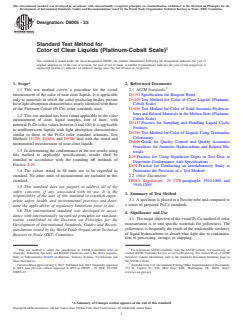
(Test Method)Standard Test Method for Color of Clear Liquids (Platinum-Cobalt Scale)
General Information
- Abstract
SIGNIFICANCE AND USE
4.1 The major objective of the visual Pt-Co method of color measurement is to rate specific materials for yellowness. The yellowness is frequently the result of the undesirable tendency of liquid hydrocarbons to absorb blue light due to contamination in processing, storage, or shipping.
SCOPE
1.1 This test method covers a procedure for the visual measurement of the color of near clear liquids. It is applicable only to materials in which the color-producing bodies present have light absorption characteristics nearly identical with those of the Platinum-Cobalt (Pt-Co) color standards used.
1.2 This test method has been found applicable to the color measurement of clear, liquid samples, free of haze, with nominal Pt-Co color values between 0 and 100. It is applicable to nonfluorescent liquids with light absorption characteristics similar to those of the Pt-Co color standard solutions. Test Methods D1209, D1686, and D5386 deal with the visual and instrumental measurement of near-clear liquids.
1.3 In determining the conformance of the test results using this method to applicable specifications, results shall be rounded in accordance with the rounding off methods of Practice E29.
1.4 The values stated in SI units are to be regarded as standard. No other units of measurement are included in this standard.
1.5 This standard does not purport to address all of the safety concerns, if any, associated with its use. It is the responsibility of the user of this standard to establish appropriate safety, health, and environmental practices and determine the applicability of regulatory limitations prior to use.
1.6 This international standard was developed in accordance with internationally recognized principles on standardization established in the Decision on Principles for the Development of International Standards, Guides and Recommendations issued by the World Trade Organization Technical Barriers to Trade (TBT) Committee.
- Status
- Published
- Publication Date
- 30-Jun-2023
- Technical Committee
- D16 - Aromatic, Industrial, Specialty and Related Chemicals
- Drafting Committee
- D16.01 - Benzene, Toluene, Xylenes, Cyclohexane and Their Derivatives

Overview
ASTM D8005-23: Standard Test Method for Color of Clear Liquids (Platinum-Cobalt Scale) provides a universally recognized procedure for visually measuring the color of near-clear, nonfluorescent liquids using the Platinum-Cobalt (Pt-Co) color scale. This test method is especially valuable for materials where a yellow tint is of particular concern, such as liquid hydrocarbons and other industrial chemicals. The method relies on comparing the test specimen with pre-prepared Platinum-Cobalt standard solutions, making it suitable for assessing color consistency and detecting contamination.
This standard is published by ASTM International and is executed in accordance with globally recognized principles for developing international standards. It is applicable to samples free of haze, with a Pt-Co color value between 0 and 100, and uses SI units as the standard of measurement.
Key Topics
- Measurement Range: The test applies to clear liquids with Pt-Co color values from 0 to 100.
- Method Principle: Comparison is made visually between the test sample and standard Pt-Co color solutions using matched Nessler tubes and a color comparator.
- Sample Compatibility: Intended for nonfluorescent clear liquids with light absorption characteristics similar to the Pt-Co standards.
- Repeatability and Reproducibility: Includes guidelines on the precision of results and interlaboratory comparability.
- Quality Assurance: Encourages the use of established statistical quality control practices and recommends verification of performance using quality control samples.
- Safety and Compliance: Advises users to adhere to relevant safety, health, and environmental regulations, and to consult supplier Safety Data Sheets and OSHA regulations.
Applications
The ASTM D8005-23 test method is crucial in industries where color determination of clear liquids plays a significant role in product quality and regulatory compliance. Typical applications include:
- Hydrocarbon Processing: Evaluation of yellowness due to contamination in fuels, solvents, and aromatics during production, storage, or transportation.
- Industrial Chemicals: Monitoring the clarity of reagents, diluents, and other clear liquid chemicals.
- Quality Control Laboratories: Routine batch testing to ensure product consistency and conformance to specifications.
- Supplier-Customer Transactions: Used as an acceptance criterion for the color quality of clear liquid products.
The test provides a standardized approach to assess and control the undesirable yellow color that may signal contamination. This early indicator can protect against product rejections, help troubleshoot processing issues, and maintain overall product integrity.
Related Standards
ASTM D8005-23 is part of a broader set of standards that address color measurement and quality in clear liquids and related materials. Key related ASTM standards include:
- ASTM D1209: Test Method for Color of Clear Liquids (Platinum-Cobalt Scale) - addresses both visual and instrumental techniques.
- ASTM D1686: Test Method for Color of Solid Aromatic Hydrocarbons and Related Materials in the Molten State (Platinum-Cobalt Scale).
- ASTM D3437: Practice for Sampling and Handling Liquid Cyclic Products - guidance for proper sampling to avoid contamination or changes in color.
- ASTM D5386: Test Method for Color of Liquids Using Tristimulus Colorimetry - for instrumental color analysis.
- ASTM D6809: Guide for Quality Control and Quality Assurance Procedures for Aromatic Hydrocarbons and Related Materials.
- ASTM E29: Practice for Using Significant Digits in Test Data to Determine Conformance with Specifications.
- ASTM E691: Practice for Conducting an Interlaboratory Study to Determine the Precision of a Test Method.
Keywords: Platinum-Cobalt color scale, Pt-Co, clear liquids color test, visual color measurement, yellowness, ASTM D8005, liquid hydrocarbons, industrial chemicals, quality control, standard color determination.
By applying ASTM D8005-23, laboratories and industries can achieve standardized, reliable results for assessing the yellowness of clear liquids, ensuring product quality and meeting regulatory requirements.
Relations
- Effective Date
- 01-Nov-2016
- Effective Date
- 01-May-2013
- Effective Date
- 01-Nov-2011
- Effective Date
- 01-Jan-2011
- Effective Date
- 01-Jun-2010
- Effective Date
- 01-Jan-2010
- Effective Date
- 01-Jan-2010
- Effective Date
- 01-Oct-2008
- Effective Date
- 01-Oct-2008
- Effective Date
- 01-Jun-2008
- Effective Date
- 01-Jun-2007
- Effective Date
- 15-Nov-2006
- Effective Date
- 15-Sep-2006
- Effective Date
- 01-May-2006
- Effective Date
- 01-Mar-2006
Get Certified
Connect with accredited certification bodies for this standard

BSMI (Bureau of Standards, Metrology and Inspection)
Taiwan's standards and inspection authority.
Sponsored listings
Frequently Asked Questions
ASTM D8005-23 is a standard published by ASTM International. Its full title is "Standard Test Method for Color of Clear Liquids (Platinum-Cobalt Scale)". This standard covers: SIGNIFICANCE AND USE 4.1 The major objective of the visual Pt-Co method of color measurement is to rate specific materials for yellowness. The yellowness is frequently the result of the undesirable tendency of liquid hydrocarbons to absorb blue light due to contamination in processing, storage, or shipping. SCOPE 1.1 This test method covers a procedure for the visual measurement of the color of near clear liquids. It is applicable only to materials in which the color-producing bodies present have light absorption characteristics nearly identical with those of the Platinum-Cobalt (Pt-Co) color standards used. 1.2 This test method has been found applicable to the color measurement of clear, liquid samples, free of haze, with nominal Pt-Co color values between 0 and 100. It is applicable to nonfluorescent liquids with light absorption characteristics similar to those of the Pt-Co color standard solutions. Test Methods D1209, D1686, and D5386 deal with the visual and instrumental measurement of near-clear liquids. 1.3 In determining the conformance of the test results using this method to applicable specifications, results shall be rounded in accordance with the rounding off methods of Practice E29. 1.4 The values stated in SI units are to be regarded as standard. No other units of measurement are included in this standard. 1.5 This standard does not purport to address all of the safety concerns, if any, associated with its use. It is the responsibility of the user of this standard to establish appropriate safety, health, and environmental practices and determine the applicability of regulatory limitations prior to use. 1.6 This international standard was developed in accordance with internationally recognized principles on standardization established in the Decision on Principles for the Development of International Standards, Guides and Recommendations issued by the World Trade Organization Technical Barriers to Trade (TBT) Committee.
SIGNIFICANCE AND USE 4.1 The major objective of the visual Pt-Co method of color measurement is to rate specific materials for yellowness. The yellowness is frequently the result of the undesirable tendency of liquid hydrocarbons to absorb blue light due to contamination in processing, storage, or shipping. SCOPE 1.1 This test method covers a procedure for the visual measurement of the color of near clear liquids. It is applicable only to materials in which the color-producing bodies present have light absorption characteristics nearly identical with those of the Platinum-Cobalt (Pt-Co) color standards used. 1.2 This test method has been found applicable to the color measurement of clear, liquid samples, free of haze, with nominal Pt-Co color values between 0 and 100. It is applicable to nonfluorescent liquids with light absorption characteristics similar to those of the Pt-Co color standard solutions. Test Methods D1209, D1686, and D5386 deal with the visual and instrumental measurement of near-clear liquids. 1.3 In determining the conformance of the test results using this method to applicable specifications, results shall be rounded in accordance with the rounding off methods of Practice E29. 1.4 The values stated in SI units are to be regarded as standard. No other units of measurement are included in this standard. 1.5 This standard does not purport to address all of the safety concerns, if any, associated with its use. It is the responsibility of the user of this standard to establish appropriate safety, health, and environmental practices and determine the applicability of regulatory limitations prior to use. 1.6 This international standard was developed in accordance with internationally recognized principles on standardization established in the Decision on Principles for the Development of International Standards, Guides and Recommendations issued by the World Trade Organization Technical Barriers to Trade (TBT) Committee.
ASTM D8005-23 is classified under the following ICS (International Classification for Standards) categories: 17.180.20 - Colours and measurement of light; 87.060.20 - Binders. The ICS classification helps identify the subject area and facilitates finding related standards.
ASTM D8005-23 has the following relationships with other standards: It is inter standard links to ASTM D6809-02(2016), ASTM E691-13, ASTM E691-11, ASTM D3437-11, ASTM D3437-10, ASTM D5386-10, ASTM D1686-10, ASTM E29-08, ASTM E691-08, ASTM D3437-08, ASTM D6809-02(2007), ASTM E29-06b, ASTM E29-06a, ASTM E29-06, ASTM D1193-06. Understanding these relationships helps ensure you are using the most current and applicable version of the standard.
ASTM D8005-23 is available in PDF format for immediate download after purchase. The document can be added to your cart and obtained through the secure checkout process. Digital delivery ensures instant access to the complete standard document.
Standards Content (Sample)
This international standard was developed in accordance with internationally recognized principles on standardization established in the Decision on Principles for the
Development of International Standards, Guides and Recommendations issued by the World Trade Organization Technical Barriers to Trade (TBT) Committee.
Designation: D8005 − 23
Standard Test Method for
Color of Clear Liquids (Platinum-Cobalt Scale)
This standard is issued under the fixed designation D8005; the number immediately following the designation indicates the year of
original adoption or, in the case of revision, the year of last revision. A number in parentheses indicates the year of last reapproval. A
superscript epsilon (´) indicates an editorial change since the last revision or reapproval.
1. Scope* 2. Referenced Documents
1.1 This test method covers a procedure for the visual 2.1 ASTM Standards:
measurement of the color of near clear liquids. It is applicable D1193 Specification for Reagent Water
only to materials in which the color-producing bodies present D1209 Test Method for Color of Clear Liquids (Platinum-
have light absorption characteristics nearly identical with those Cobalt Scale)
of the Platinum-Cobalt (Pt-Co) color standards used. D1686 Test Method for Color of Solid Aromatic Hydrocar-
bons and Related Materials in the Molten State (Platinum-
1.2 This test method has been found applicable to the color
Cobalt Scale)
measurement of clear, liquid samples, free of haze, with
D3437 Practice for Sampling and Handling Liquid Cyclic
nominal Pt-Co color values between 0 and 100. It is applicable
Products
to nonfluorescent liquids with light absorption characteristics
D5386 Test Method for Color of Liquids Using Tristimulus
similar to those of the Pt-Co color standard solutions. Test
Colorimetry
Methods D1209, D1686, and D5386 deal with the visual and
D6809 Guide for Quality Control and Quality Assurance
instrumental measurement of near-clear liquids.
Procedures for Aromatic Hydrocarbons and Related Ma-
1.3 In determining the conformance of the test results using
terials
this method to applicable specifications, results shall be
E29 Practice for Using Significant Digits in Test Data to
rounded in accordance with the rounding off methods of
Determine Conformance with Specifications
Practice E29.
E691 Practice for Conducting an Interlaboratory Study to
1.4 The values stated in SI units are to be regarded as Determine the Precision of a Test Method
2.2 Other Documents:
standard. No other units of measurement are included in this
OSHA Regulations, 29 CFR paragraphs 1910.1000 and
standard.
1910.1200
1.5 This standard does not purport to address all of the
safety concerns, if any, associated with its use. It is the
3. Summary of Test Method
responsibility of the user of this standard to establish appro-
3.1 A specimen is placed in a Nessler tube and compared to
priate safety, health, and environmental practices and deter-
a series of prepared Pt-Co standards.
mine the applicability of regulatory limitations prior to use.
1.6 This international standard was developed in accor-
4. Significance and Use
dance with internationally recognized principles on standard-
4.1 The major objective of the visual Pt-Co method of color
ization established in the Decision on Principles for the
measurement is to rate specific materials for yellowness. The
Development of International Standards, Guides and Recom-
yellowness is frequently the result of the undesirable tendency
mendations issued by the World Trade Organization Technical
of liquid hydrocarbons to absorb blue light due to contamina-
Barriers to Trade (TBT) Committee.
tion in processing, storage, or shipping.
1 2
This test method is under the jurisdiction of ASTM Committee D16 on For referenced ASTM standards, visit the ASTM website, www.astm.org, or
Aromatic, Industrial, Specialty and Related Chemicals and is the direct responsi- contact ASTM Customer Service at service@astm.org. For Annual Book of ASTM
bility of Subcommittee D16.01 on Benzene, Toluene, Xylenes, Cyclohexane and Standards volume information, refer to the standard’s Document Summary page on
Their Derivatives. the ASTM website.
Current edition approved July 1, 2023. Published July 2023. Originally approved Available from U.S. Government Printing Office Superintendent of Documents,
in 2015. Last previous edition approved in 2018 as D8005 – 18. DOI: 10.1520/ 732 N. Capitol St., NW, Mail Stop: SDE, Washington, DC 20401, http://
D8005-23. www.access.gpo.gov.
*A Summary of Changes section appears at the end of this standard
Copyright © ASTM International, 100 Barr Harbor Drive, PO Box C700, West Conshohocken, PA 19428-2959. United States
D8005 − 23
TABLE 1 Absorbance Tolerance Limits for No. 500 Platinum-
5. Apparatus
Cobalt Stock Solution
5.1 Spectrophotometer, equipped for liquid samples and for
Wavelength, nm Absorbance
measurements in the visible region.
430 0.100 to 0.120
5.1.1 The spectrophotometer used must be clean and in
455 0.130 to 0.145
first-class operating condition. The instrument should be cali- 480 0.105 to 0.120
510 0.055 to 0.065
brated in accordance with the instructions in the Standards for
Checking and Calibration of Spectrophotometers (200 cm to
1000 cm).
5.2 Spectrophotometer Cells, matched having a 10 mm light
path. 10 mm light path, with reagent water in a matched cell as the
reference solution, must fall within the limits given in Table 1.
5.3 Color Comparison Tubes—Matched 100 mL, tall-form
NOTE 1—This stock solution is commercially available from reputable
Nessler tubes, provided with ground-on, optically clear, glass
chemical suppliers.
caps. Tubes should be selected so that the height of the 100 mL
6.7 Pt-Co Standards—From the stock solution, prepare
graduation mark is 275 mm to 295 mm above the bottom of the
color standards in accordance with Table 2 and Table 3 by
tube.
diluting the required volumes to 100 mL with water in the
5.4 Color Comparator—A color comparator constructed to
Nessler tubes. Cap the tubes and seal the caps with shellac or
permit visual comparison of light transmitted through tall-form
a waterproof cement. D16 PTP results show significant
100 mL Nessler tubes in the direction of their longitudinal
changes in the standards. Standards should be replaced within
axes. The comparator should be constructed so that white light
a year.
is passed through or reflected off a white glass plate and
directed with equal intensity through the tubes, and should be
7. Hazards
shielded so that no light enters the tubes from the side.
7.1 Consult current OSHA regulations, supplier’s Safety
Data Sheets, and local regulations for all materials used in this
6. Reagents
test method.
6.1 Purity of Reagents—Reagent grade chemicals shall be
used in all tests. Unless otherwise indicated, it is intended that
8. Sampling and Handling
all reagents shall conform to the specifications of the Commit-
8.1 Refer to Practice D3437 for proper sampling and han-
tee on Analytical Reagents of the American Chemical Society,
dling of liquid hydrocarbons analyzed by this test method.
where such specifications are available. Other grades may be
used, provided it is first ascertained that the agent is of
9. Procedure
sufficiently high purity to permit its use without lessening the
accuracy of the determination.
9.1 Introduce 100 mL of specimen into a Nessler tube,
passing the specimen through a filter if it has any visible
6.2 Purity of Water—References to water shall be under-
turbidity. Cap the tube, place in the comparator, and compare
stood to mean reagent water conforming to Type I or II of
with the standards.
Specification D1193.
9.1.1 For samples between 1 a
...
This document is not an ASTM standard and is intended only to provide the user of an ASTM standard an indication of what changes have been made to the previous version. Because
it may not be technically possible to adequately depict all changes accurately, ASTM recommends that users consult prior editions as appropriate. In all cases only the current version
of the standard as published by ASTM is to be considered the official document.
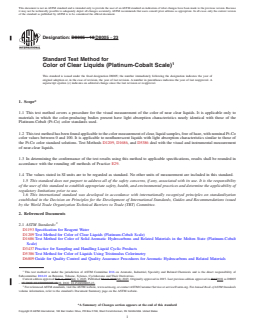
Designation: D8005 − 18 D8005 − 23
Standard Test Method for
Color of Clear Liquids (Platinum-Cobalt Scale)
This standard is issued under the fixed designation D8005; the number immediately following the designation indicates the year of
original adoption or, in the case of revision, the year of last revision. A number in parentheses indicates the year of last reapproval. A
superscript epsilon (´) indicates an editorial change since the last revision or reapproval.
1. Scope*
1.1 This test method covers a procedure for the visual measurement of the color of near clear liquids. It is applicable only to
materials in which the color-producing bodies present have light absorption characteristics nearly identical with those of the
Platinum-Cobalt (Pt-Co) color standards used.
1.2 This test method has been found applicable to the color measurement of clear, liquid samples, free of haze, with nominal Pt-Co
color values between 0 and 100. It is applicable to nonfluorescent liquids with light absorption characteristics similar to those of
the Pt-Co color standard solutions. Test Methods D1209, D1686, and D5386 deal with the visual and instrumental measurement
of near-clear liquids.
1.3 In determining the conformance of the test results using this method to applicable specifications, results shall be rounded in
accordance with the rounding off methods of Practice E29.
1.4 The values stated in SI units are to be regarded as standard. No other units of measurement are included in this standard.
1.5 This standard does not purport to address all of the safety concerns, if any, associated with its use. It is the responsibility
of the user of this standard to establish appropriate safety, health, and environmental practices and determine the applicability of
regulatory limitations prior to use.
1.6 This international standard was developed in accordance with internationally recognized principles on standardization
established in the Decision on Principles for the Development of International Standards, Guides and Recommendations issued
by the World Trade Organization Technical Barriers to Trade (TBT) Committee.
2. Referenced Documents
2.1 ASTM Standards:
D1193 Specification for Reagent Water
D1209 Test Method for Color of Clear Liquids (Platinum-Cobalt Scale)
D1686 Test Method for Color of Solid Aromatic Hydrocarbons and Related Materials in the Molten State (Platinum-Cobalt
Scale)
D3437 Practice for Sampling and Handling Liquid Cyclic Products
D5386 Test Method for Color of Liquids Using Tristimulus Colorimetry
D6809 Guide for Quality Control and Quality Assurance Procedures for Aromatic Hydrocarbons and Related Materials
This test method is under the jurisdiction of ASTM Committee D16 on Aromatic, Industrial, Specialty and Related Chemicals and is the direct responsibility of
Subcommittee D16.01 on Benzene, Toluene, Xylenes, Cyclohexane and Their Derivatives.
Current edition approved Feb. 1, 2018July 1, 2023. Published March 2018July 2023. Originally approved in 2015. Last previous edition approved in 20152018 as D8005
– 15. DOI: 10.1520/D8005-18.18. DOI: 10.1520/D8005-23.
For referenced ASTM standards, visit the ASTM website, www.astm.org, or contact ASTM Customer Service at service@astm.org. For Annual Book of ASTM Standards
volume information, refer to the standard’s Document Summary page on the ASTM website.
*A Summary of Changes section appears at the end of this standard
Copyright © ASTM International, 100 Barr Harbor Drive, PO Box C700, West Conshohocken, PA 19428-2959. United States
D8005 − 23
E29 Practice for Using Significant Digits in Test Data to Determine Conformance with Specifications
E691 Practice for Conducting an Interlaboratory Study to Determine the Precision of a Test Method
2.2 Other Documents:
OSHA Regulations, 29 CFR paragraphs 1910.1000 and 1910.1200
3. Summary of Test Method
3.1 A specimen is placed in a Nessler tube and compared to a series of prepared Pt-Co standards.
4. Significance and Use
4.1 The major objective of the visual Pt-Co method of color measurement is to rate specific materials for yellowness. The
yellowness is frequently the result of the undesirable tendency of liquid hydrocarbons to absorb blue light due to contamination
in processing, storage, or shipping.
5. Apparatus
5.1 Spectrophotometer, equipped for liquid samples and for measurements in the visible region.
5.1.1 The spectrophotometer used must be clean and in first-class operating condition. The instrument should be calibrated in
accordance with the instructions in the Standards for Checking and Calibration of Spectrophotometers (200(200 cm to 1000 cm).
5.2 Spectrophotometer Cells, matched having a 10-mm10 mm light path.
5.3 Color Comparison Tubes—Matched 100-mL,100 mL, tall-form Nessler tubes, provided with ground-on, optically clear, glass
caps. Tubes should be selected so that the height of the 100-mL100 mL graduation mark is 275275 mm to 295 mm above the
bottom of the tube.
5.4 Color Comparator—A color comparator constructed to permit visual comparison of light transmitted through tall-form
100-mL100 mL Nessler tubes in the direction of their longitudinal axes. The comparator should be constructed so that white light
is passed through or reflected off a white glass plate and directed with equal intensity through the tubes, and should be shielded
so that no light enters the tubes from the side.
6. Reagents
6.1 Purity of Reagents—Reagent grade chemicals shall be used in all tests. Unless otherwise indicated, it is intended that all
reagents shall conform to the specifications of the Committee on Analytical Reagents of the American Chemical Society, where
such specifications are available. Other grades may be used, provided it is first ascertained that the agent is of sufficiently high
purity to permit its use without lessening the accuracy of the determination.
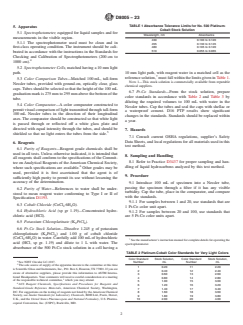
TABLE 1 Absorbance Tolerance Limits for No. 500 Platinum-
Cobalt Stock Solution
Wavelength, nm Absorbance
430 0.100 to 0.120
455 0.130 to 0.145
480 0.105 to 0.120
510 0.055 to 0.065
Available from U.S. Government Printing Office Superintendent of Documents, 732 N. Capitol St., NW, Mail Stop: SDE, Washington, DC 20401, http://
www.access.gpo.gov.
See NIST Circular LC-1017.
The sole source of supply of the apparatus known to the committee at this time is Scientific Glass and Instruments, Inc., P.O. Box 6, Houston, TX 77001. If you are
aware of alternative suppliers, please provide this information to ASTM International Headquarters. Your comments will receive careful consideration at a meeting of the
responsible technical committee, which you may attend.
Reagent Chemicals, American Chemical Society Specifications,ACS Reagent Chemicals, Specifications and Procedures for Reagents and Standard-Grade Reference
Materials, American Chemical Society, Washington, DC. For suggestions on the testing of reagents not listed by the American Chemical Society, see Analar Standards for
Laboratory Chemicals, BDH Ltd., Poole, Dorset, U.K., and the United States Pharmacopeia and National Formulary, U.S. Pharmacopeial Convention, Inc. (USPC),
Rockville, MD.
D8005 − 23
6.2 Purity of Water—References to water shall be understood to mean reagent water conforming to Type IV I or II of Specification
D1193.
6.3 Cobalt Chloride (CoCl ·6H O).
2 2
6.4 Hydrochloric Acid (sp gr 1.19)—Concentrated hydrochloric acid (HCI).
6.5 Potassium Chloroplatinate (K PtCl ).).
2 6
6.6 Pt-Co Stock Solution—Dissolve 1.245 g of potassium chloroplatinate (K PtCl ) and 1.00 g of cobalt ch
...