

ASTM D1981-11(2020)e1
(Test Method)Standard Test Method for Measuring Color After Heating of Tall Oil Fatty Acids
General Information
- Abstract
SIGNIFICANCE AND USE
3.1 The color of a tall oil fatty acid is readily affected by heat and oxidization. Variations in degree of heat, time of heat, and exposure to atmosphere during heating have a marked effect on the color obtained; therefore, conformity to the equipment and procedure outlined in this test method is essential to accuracy and precision.
SCOPE
1.1 This test method covers the measurement of the Gardner color of tall oil fatty acids after heating in an atmosphere of nitrogen at 205°C for one or two hours, depending on whether its iodine value is over or under 15, respectively. The specimen may be heated using either an aluminum heating block or an oil bath. This method is applicable to all tall oil fatty acids. Applicability of this method to other types of fatty acids has not been determined.
1.2 The values stated in SI units are to be regarded as the standard. The values given in parentheses are for information only.
1.3 This standard does not purport to address all of the safety concerns, if any, associated with its use. It is the responsibility of the user of this standard to establish appropriate safety, health, and environmental practices and determine the applicability of regulatory limitations prior to use.
1.4 This international standard was developed in accordance with internationally recognized principles on standardization established in the Decision on Principles for the Development of International Standards, Guides and Recommendations issued by the World Trade Organization Technical Barriers to Trade (TBT) Committee.
- Status
- Published
- Publication Date
- 31-Aug-2020
- Technical Committee
- D01 - Paint and Related Coatings, Materials, and Applications
- Drafting Committee
- D01.34 - Pine Chemicals and Hydrocarbon Resins

Overview
ASTM D1981-11(2020)e1 is a widely recognized standard test method established by ASTM International for the measurement of the color of tall oil fatty acids after subjecting them to specific heating conditions. The test determines the Gardner color of these organic acids after heating in an atmosphere of nitrogen at a controlled temperature, providing valuable guidance to manufacturers and quality assurance professionals in the pine chemicals sector. The protocol accounts for the significant influence of heat, heating time, and atmospheric exposure on the color outcome of tall oil fatty acids, helping ensure accuracy, reproducibility, and precise color measurement in industrial processes.
Key Topics
- Purpose of Testing: Evaluates the change in color of tall oil fatty acids due to heating and oxidation, critical for quality control in production and processing.
- Test Conditions: Specimens are heated at 205°C in a nitrogen atmosphere, using either an aluminum block or an oil bath. The heating duration varies based on the fatty acid’s iodine value-one hour for iodine value greater than 15, two hours for 15 or less.
- Applicability: Specifically designed and validated for tall oil fatty acids. Its use with other fatty acid types has not been established.
- Measurement Method: Gardner color is determined using standardized test methods (ASTM D1544 or D6166).
- Precision and Reproducibility: Strict adherence to the specified equipment and testing protocol is essential for accurate, consistent results.
- Units: SI units are regarded as standard within ASTM D1981-11(2020)e1.
Applications
The test method is essential for industries that manufacture, refine, or use tall oil fatty acids as raw materials, including:
- Pine Chemical Manufacturing: Ensuring processed fatty acids meet color specifications for further use in adhesives, inks, soaps, and coatings.
- Quality Assurance: Facilitates routine quality control checks, verifying that heating processes do not adversely affect product color, which can indicate unwanted chemical changes.
- Product Development: Provides a standardized basis for comparing the heat stability and color retention properties of different tall oil fatty acid lots or batches.
- Research and Technical Analysis: Enables reliable comparison of the impacts of different processing conditions on the color of tall oil-derived products.
Related Standards
Professionals using ASTM D1981-11(2020)e1 may also reference related color measurement and analytical standards, including:
- ASTM D1544: Test Method for Color of Transparent Liquids (Gardner Color Scale)
- ASTM D6166: Test Method for Color of Pine Chemicals and Related Products (Instrumental Determination of Gardner Color)
- ASTM E1: Specification for ASTM Liquid-in-Glass Thermometers (used for precise temperature measurements during the heating step)
Practical Value
Conformity with ASTM D1981-11(2020)e1 ensures comparability of color assessments across laboratories and between trading partners, facilitating regulatory compliance and supporting the integrity of supply chains involving tall oil derivatives. By following standardized procedures for measuring color after heating, companies can:
- Prevent batch-to-batch variability
- Assure customers of consistent product quality
- Meet international trade and product specification requirements
ASTM D1981-11(2020)e1 provides an authoritative method for measuring color changes in tall oil fatty acids, essential for maintaining manufacturing quality and facilitating business transactions within the global specialty chemicals market.
Relations
- Effective Date
- 01-May-2013
- Effective Date
- 01-Nov-2012
- Refers
ASTM D1544-04(2010) - Standard Test Method for Color of Transparent Liquids (Gardner Color Scale) - Effective Date
- 01-Jun-2010
- Effective Date
- 01-Jul-2008
- Effective Date
- 01-Nov-2007
- Effective Date
- 01-Nov-2005
- Effective Date
- 01-Jun-2004
- Effective Date
- 01-Nov-2003
- Effective Date
- 10-Jul-2003
- Effective Date
- 10-May-2003
- Effective Date
- 10-Oct-2001
- Effective Date
- 10-Oct-2001
- Effective Date
- 10-Oct-2001
- Effective Date
- 10-Jan-1998
Get Certified
Connect with accredited certification bodies for this standard

BSMI (Bureau of Standards, Metrology and Inspection)
Taiwan's standards and inspection authority.
Sponsored listings
Frequently Asked Questions
ASTM D1981-11(2020)e1 is a standard published by ASTM International. Its full title is "Standard Test Method for Measuring Color After Heating of Tall Oil Fatty Acids". This standard covers: SIGNIFICANCE AND USE 3.1 The color of a tall oil fatty acid is readily affected by heat and oxidization. Variations in degree of heat, time of heat, and exposure to atmosphere during heating have a marked effect on the color obtained; therefore, conformity to the equipment and procedure outlined in this test method is essential to accuracy and precision. SCOPE 1.1 This test method covers the measurement of the Gardner color of tall oil fatty acids after heating in an atmosphere of nitrogen at 205°C for one or two hours, depending on whether its iodine value is over or under 15, respectively. The specimen may be heated using either an aluminum heating block or an oil bath. This method is applicable to all tall oil fatty acids. Applicability of this method to other types of fatty acids has not been determined. 1.2 The values stated in SI units are to be regarded as the standard. The values given in parentheses are for information only. 1.3 This standard does not purport to address all of the safety concerns, if any, associated with its use. It is the responsibility of the user of this standard to establish appropriate safety, health, and environmental practices and determine the applicability of regulatory limitations prior to use. 1.4 This international standard was developed in accordance with internationally recognized principles on standardization established in the Decision on Principles for the Development of International Standards, Guides and Recommendations issued by the World Trade Organization Technical Barriers to Trade (TBT) Committee.
SIGNIFICANCE AND USE 3.1 The color of a tall oil fatty acid is readily affected by heat and oxidization. Variations in degree of heat, time of heat, and exposure to atmosphere during heating have a marked effect on the color obtained; therefore, conformity to the equipment and procedure outlined in this test method is essential to accuracy and precision. SCOPE 1.1 This test method covers the measurement of the Gardner color of tall oil fatty acids after heating in an atmosphere of nitrogen at 205°C for one or two hours, depending on whether its iodine value is over or under 15, respectively. The specimen may be heated using either an aluminum heating block or an oil bath. This method is applicable to all tall oil fatty acids. Applicability of this method to other types of fatty acids has not been determined. 1.2 The values stated in SI units are to be regarded as the standard. The values given in parentheses are for information only. 1.3 This standard does not purport to address all of the safety concerns, if any, associated with its use. It is the responsibility of the user of this standard to establish appropriate safety, health, and environmental practices and determine the applicability of regulatory limitations prior to use. 1.4 This international standard was developed in accordance with internationally recognized principles on standardization established in the Decision on Principles for the Development of International Standards, Guides and Recommendations issued by the World Trade Organization Technical Barriers to Trade (TBT) Committee.
ASTM D1981-11(2020)e1 is classified under the following ICS (International Classification for Standards) categories: 17.180.20 - Colours and measurement of light; 87.060.20 - Binders. The ICS classification helps identify the subject area and facilitates finding related standards.
ASTM D1981-11(2020)e1 has the following relationships with other standards: It is inter standard links to ASTM E1-13, ASTM D6166-12, ASTM D1544-04(2010), ASTM D6166-08, ASTM E1-07, ASTM E1-05, ASTM D1544-04, ASTM E1-03a, ASTM D6166-97(2003), ASTM E1-03, ASTM E1-01, ASTM E1-98e1, ASTM E1-98, ASTM D1544-98. Understanding these relationships helps ensure you are using the most current and applicable version of the standard.
ASTM D1981-11(2020)e1 is available in PDF format for immediate download after purchase. The document can be added to your cart and obtained through the secure checkout process. Digital delivery ensures instant access to the complete standard document.
Standards Content (Sample)
This international standard was developed in accordance with internationally recognized principles on standardization established in the Decision on Principles for the
Development of International Standards, Guides and Recommendations issued by the World Trade Organization Technical Barriers to Trade (TBT) Committee.
´1
Designation: D1981 − 11 (Reapproved 2020)
Standard Test Method for
Measuring Color After Heating of Tall Oil Fatty Acids
This standard is issued under the fixed designation D1981; the number immediately following the designation indicates the year of
original adoption or, in the case of revision, the year of last revision. A number in parentheses indicates the year of last reapproval. A
superscript epsilon (´) indicates an editorial change since the last revision or reapproval.
ε NOTE—Editorial changes were made in subsections 7.3 and 8.3 in September 2020.
1. Scope 3. Significance and Use
1.1 ThistestmethodcoversthemeasurementoftheGardner 3.1 The color of a tall oil fatty acid is readily affected by
color of tall oil fatty acids after heating in an atmosphere of heat and oxidization. Variations in degree of heat, time of heat,
nitrogen at 205°C for one or two hours, depending on whether and exposure to atmosphere during heating have a marked
its iodine value is over or under 15, respectively.The specimen effect on the color obtained; therefore, conformity to the
maybeheatedusingeitheranaluminumheatingblockoranoil equipment and procedure outlined in this test method is
bath. This method is applicable to all tall oil fatty acids. essential to accuracy and precision.
Applicability of this method to other types of fatty acids has
4. Heating Apparatus—Method A, Aluminum Block
not been determined.
4.1 Forced Draft Oven, maintained at 205 6 2°C.
1.2 The values stated in SI units are to be regarded as the
standard. The values given in parentheses are for information
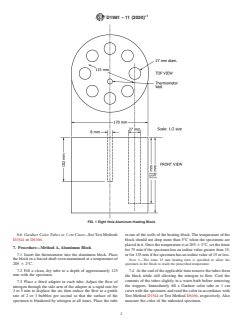
4.2 Aluminum Heating Block (see Fig. 1). Wrap the outer
only.
surface with an appropriate insulating material.
1.3 This standard does not purport to address all of the
5. Heating Apparatus—Method B, Oil Bath
safety concerns, if any, associated with its use. It is the
responsibility of the user of this standard to establish appro-
5.1 Oil Bath—A5-L steel beaker equipped with a mechani-
priate safety, health, and environmental practices and deter-
cal stirrer and containing any light-colored alkali-refined oil
mine the applicability of regulatory limitations prior to use.
such as hydrogenated cottonseed oil.
1.4 This international standard was developed in accor-
5.2 Heat Source—An electric immersion heater with suit-
dance with internationally recognized principles on standard-
able thermostatic control may be used. The heater shall be of
ization established in the Decision on Principles for the
sufficient capacity so that when placing several tubes in the
Development of International Standards, Guides and Recom-
bath, the bath temperature does not drop by more than 5°C
mendations issued by the World Trade Organization Technical
below the minimum bath temperature and the recovery time to
Barriers to Trade (TBT) Committee.
reach 205°C does not exceed 5 min.
2. Referenced Documents
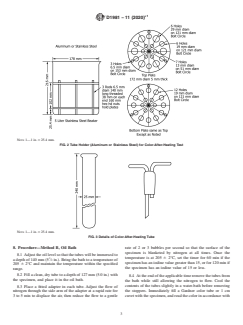
5.3 Test Tube Holder (see Fig. 2).
2.1 ASTM Standards:
6. Materials
D1544 Test Method for Color of Transparent Liquids (Gard-
ner Color Scale)
6.1 Thermometer Measuring Device—A thermometer con-
D6166 Test Method for Color of Pine Chemicals and Re-
forming to the requirements of Specification E1 or an elec-
lated Products (Instrumental Determination of Gardner
tronic temperature measuring device, such as a resistance
Color)
thermometer or thermocouple. The device must exhibit the
E1 Specification for ASTM Liquid-in-Glass Thermometers
same temperature response as the thermometers specified in
Specification E1.
1 1
This test method is under the jurisdiction of ASTM Committee D01 on Paint 6.2 Tubes, 25 mm (1 in.) in diameter, 240 mm (9 ⁄2 in.) in
and Related Coatings, Materials, andApplications and is the direct responsibility of
length with ground-glass joints (see Fig. 3) and adapter.
Subcommittee D01.34 on Pine Chemicals and Hydrocarbon Resins.
Current edition approved Sept. 1, 2020. Published September 2020. Originally 6.3 Timer, capable of registering up to 135 min.
approved in 1961. Last previous edition approved in 2015 as D1981 – 11 (2015).
6.4 Nitrogen, a source of nitrogen capable of being regu-
DOI: 10.1520/D1981-11R20E01.
For referenced ASTM standards, visit the ASTM website, www.astm.org, or lated to a pressure of 7 to 14 kPa (1 to 2 psi).
contact ASTM Customer Service at service@astm.org. For Annual Book of ASTM
6.5 BubbleCounterforNitrogen—As a liquid, use a portion
Standards volume information, refer to the standard’s Document Summary page on
the ASTM website. of tall oil fatty acid, instead of water or mercury.
Copyright © ASTM International, 100 Barr Harbor Drive, PO Box C700, West Conshohocken, PA 19428-2959. United States
...