

ASTM F3080-21
(Practice)Standard Practice for Laser Technologies for Measurement of Cross-Sectional Shape of Pipeline and Conduit by Non-Rotating Laser Projector, Infrared Measurement, and CCTV Camera System
General Information
- Abstract
SIGNIFICANCE AND USE
4.1 Laser profiling assessment is a quality control tool for identifying and quantifying deformation, physical damage, and other pipe anomalies after installation, providing means and methods for determining the quality of workmanship and compliance with project specifications. Laser profiling can be used for:
4.1.1 Measurement of the structural shape, cross sectional area and defects;
4.1.2 Collection of data needed for pipe rehabilitation or replacement design; and
4.1.3 Post rehabilitation, replacement or new construction workmanship verification.
4.2 A laser profile pre-acceptance and condition assessment survey provides significant information in a clear and concise manner, including but not limited to graphs and still frame digital images of pipe condition prior to acceptance, thereby providing objective data on the installed quality and percentage ovality, deformation, deflection or deviation, that is often not possible from an inspection by either a mandrel or CCTV only survey.
SCOPE
1.1 Laser profiling is a non-contact inspection method used to create a pipe wall profile and internal measurement using a standard CCTV pipe inspection system, 360 degree laser light projector, a measurement by means of infrared sensors and geometrical profiling software. This practice covers the procedure for the measurement to determine any deviation of the internal surface of installed pipe compared to the design. The measurements may be used to verify that the installation has met design requirements for acceptance or to collect data that will facilitate an assessment of the condition of pipe or conduit due to structural deviations or deterioration. This standard practice provides minimum requirements on means and methods for laser profiling to meet the needs of engineers, contractors, owners, regulatory agencies, and financing institutions.
1.2 This practice applies to all types of pipe material, all types of construction, and pipe shapes.
1.3 This practice applies to depressurized and gravity flow storm sewers, drains, sanitary sewers, and combined sewers with diameters from 6 in. to 72 in. (150 mm and 1800 mm).
1.4 This standard does not include all aspects of pipe inspection, such as joint gaps, soil/water infiltration in joints, cracks, holes, surface damage, repairs, corrosion, and structural problems associated with these conditions.
1.5 The values stated in inch-pound units are to be regarded as standard. The values given in parentheses are mathematical conversions to SI units that are provided for information only and are not considered standard.
1.6 The profiling process may require physical access to lines, entry manholes, and operations along roadways that may include safety hazards.
1.7 This standard does not purport to address all of the safety concerns, if any, associated with its use. It is the responsibility of the user of this standard to establish appropriate safety, health, and environmental practices and determine the applicability of regulatory limitations prior to use. There are no safety hazards specifically, however, associated with the use of the laser ring profiler specified (listed and labeled as specified in 1.3).
1.8 This international standard was developed in accordance with internationally recognized principles on standardization established in the Decision on Principles for the Development of International Standards, Guides and Recommendations issued by the World Trade Organization Technical Barriers to Trade (TBT) Committee.
- Status
- Published
- Publication Date
- 28-Feb-2021
- Technical Committee
- F36 - Technology and Underground Utilities
- Drafting Committee
- F36.20 - Inspection and Renewal of Water and Wastewater Infrastructure
Buy Documents
ASTM F3080-21 - Standard Practice for Laser Technologies for Measurement of Cross-Sectional Shape of Pipeline and Conduit by Non-Rotating Laser Projector, Infrared Measurement, and CCTV Camera System


REDLINE ASTM F3080-21 - Standard Practice for Laser Technologies for Measurement of Cross-Sectional Shape of Pipeline and Conduit by Non-Rotating Laser Projector, Infrared Measurement, and CCTV Camera System
Overview
ASTM F3080-21 is the Standard Practice for Laser Technologies for Measurement of Cross-Sectional Shape of Pipeline and Conduit by Non-Rotating Laser Projector, Infrared Measurement, and CCTV Camera System. Issued by ASTM International, this standard outlines methods and requirements for accurately assessing the cross-sectional shape and condition of pipelines and conduits using advanced laser and infrared profiling in combination with CCTV inspection systems.
The primary aim is to provide a non-contact, objective means of identifying deformations, structural defects, and verifying workmanship after installation, rehabilitation, or replacement of storm sewers, sanitary sewers, gravity flow drains, and combined sewers. The standard covers a broad range of pipe materials and shapes with diameters from 6 in. to 72 in. (150 mm to 1800 mm).
Key Topics
Laser and Infrared Profiling: Specifies procedures for utilizing 360-degree non-rotating laser projectors and infrared sensors in conjunction with CCTV camera systems to capture internal pipe wall profiles and measure deviations from planned dimensions.
Data Collection and Analysis: Outlines requirements for the digital recording, processing, and reporting of pipe profile data, including the use of geometrical profiling software for comprehensive condition assessment.
Quality Control in Inspection: Emphasizes the importance of equipment calibration, precise measurement practices, and operator certification. Requires verification of calibration certificates, adherence to software accuracy standards, and the use of reference images for calibration validation.
Workmanship Verification: Details objective methods for verifying pipe installation against project specifications, including measurement of ovality, deflection, and deformation that are not easily identified through traditional inspection techniques.
Reporting Standards: Requires deliverables such as digital and hard copy reports, line graphs indicating deformation, and overlay images to confirm calibration and data integrity.
Applicability: This standard applies to all pipe materials and construction types within specified diameter ranges used in storm water, sanitary, and combined sewer systems operating under gravity flow or depressurized conditions.
Applications
ASTM F3080-21 is widely used in several practical contexts:
Post-Installation Inspection: Contractors and utility owners use laser profiling to ensure newly installed pipelines meet specified shape and dimensional tolerances, detect early signs of deformation, and verify project compliance.
Condition Assessment for Rehabilitation: Engineers collect objective data on the structural integrity of existing pipes to plan effective rehabilitation or replacement solutions, thus supporting asset management and capital planning.
Quality Assurance in Cured-in-Place Pipe (CIPP) and Trenchless Technologies: Laser and infrared assessments provide accurate verification of ovality and deflection in liners and other trenchless repair solutions, supporting validation of installation effectiveness.
Regulatory and Funding Compliance: The use of standardized, verifiable inspection data helps utilities demonstrate compliance with regulatory requirements and provides assurance for public or private infrastructure funding.
Objective Documentation: The generation of graphs, digital images, and statistical reports creates a comprehensive record of pipeline conditions before project acceptance, facilitating clear communication with stakeholders.
Related Standards
ASTM F3080-21 references and aligns with several important standards to ensure accurate and safe profiling practices:
- ASTM E177 - Practice for Use of the Terms Precision and Bias in ASTM Test Methods
- ASTM E691 - Practice for Conducting an Interlaboratory Study to Determine the Precision of a Test Method
- ASTM F1216 - Practice for Rehabilitation of Existing Pipelines and Conduits by the Inversion and Curing of a Resin-Impregnated Tube
- IEC 60825-1 - Safety of Laser Products – Part 1: Equipment Classification and Requirements
- CDRH Regulations CFR 21 - U.S. requirements for laser product safety
Summary
By employing non-contact laser and infrared profiling technologies as described in ASTM F3080-21, pipeline professionals can achieve high precision in assessing the physical condition, structural integrity, and compliance of underground utilities. This standard supports quality assurance, efficient maintenance programming, and improved lifecycle management for critical infrastructure assets.
Relations
- Effective Date
- 01-May-2014
- Effective Date
- 01-May-2013
- Effective Date
- 01-May-2013
- Effective Date
- 01-Nov-2011
- Effective Date
- 01-Oct-2010
- Effective Date
- 01-Mar-2009
- Effective Date
- 01-Nov-2008
- Effective Date
- 01-Oct-2008
- Effective Date
- 01-Oct-2008
- Effective Date
- 01-Jun-2007
- Effective Date
- 01-Mar-2007
- Effective Date
- 01-Jan-2007
- Refers
ASTM E177-06b - Standard Practice for Use of the Terms Precision and Bias in ASTM Test Methods - Effective Date
- 15-Nov-2006
- Refers
ASTM E177-06a - Standard Practice for Use of the Terms Precision and Bias in ASTM Test Methods - Effective Date
- 01-Nov-2006
- Effective Date
- 15-Aug-2006
Buy Documents
ASTM F3080-21 - Standard Practice for Laser Technologies for Measurement of Cross-Sectional Shape of Pipeline and Conduit by Non-Rotating Laser Projector, Infrared Measurement, and CCTV Camera System
REDLINE ASTM F3080-21 - Standard Practice for Laser Technologies for Measurement of Cross-Sectional Shape of Pipeline and Conduit by Non-Rotating Laser Projector, Infrared Measurement, and CCTV Camera System
Get Certified
Connect with accredited certification bodies for this standard

Zavod za gradbeništvo Slovenije (ZAG) - Inšpekcija
ZAG inspection body for construction products, structures, and materials.
Sponsored listings
Frequently Asked Questions
ASTM F3080-21 is a standard published by ASTM International. Its full title is "Standard Practice for Laser Technologies for Measurement of Cross-Sectional Shape of Pipeline and Conduit by Non-Rotating Laser Projector, Infrared Measurement, and CCTV Camera System". This standard covers: SIGNIFICANCE AND USE 4.1 Laser profiling assessment is a quality control tool for identifying and quantifying deformation, physical damage, and other pipe anomalies after installation, providing means and methods for determining the quality of workmanship and compliance with project specifications. Laser profiling can be used for: 4.1.1 Measurement of the structural shape, cross sectional area and defects; 4.1.2 Collection of data needed for pipe rehabilitation or replacement design; and 4.1.3 Post rehabilitation, replacement or new construction workmanship verification. 4.2 A laser profile pre-acceptance and condition assessment survey provides significant information in a clear and concise manner, including but not limited to graphs and still frame digital images of pipe condition prior to acceptance, thereby providing objective data on the installed quality and percentage ovality, deformation, deflection or deviation, that is often not possible from an inspection by either a mandrel or CCTV only survey. SCOPE 1.1 Laser profiling is a non-contact inspection method used to create a pipe wall profile and internal measurement using a standard CCTV pipe inspection system, 360 degree laser light projector, a measurement by means of infrared sensors and geometrical profiling software. This practice covers the procedure for the measurement to determine any deviation of the internal surface of installed pipe compared to the design. The measurements may be used to verify that the installation has met design requirements for acceptance or to collect data that will facilitate an assessment of the condition of pipe or conduit due to structural deviations or deterioration. This standard practice provides minimum requirements on means and methods for laser profiling to meet the needs of engineers, contractors, owners, regulatory agencies, and financing institutions. 1.2 This practice applies to all types of pipe material, all types of construction, and pipe shapes. 1.3 This practice applies to depressurized and gravity flow storm sewers, drains, sanitary sewers, and combined sewers with diameters from 6 in. to 72 in. (150 mm and 1800 mm). 1.4 This standard does not include all aspects of pipe inspection, such as joint gaps, soil/water infiltration in joints, cracks, holes, surface damage, repairs, corrosion, and structural problems associated with these conditions. 1.5 The values stated in inch-pound units are to be regarded as standard. The values given in parentheses are mathematical conversions to SI units that are provided for information only and are not considered standard. 1.6 The profiling process may require physical access to lines, entry manholes, and operations along roadways that may include safety hazards. 1.7 This standard does not purport to address all of the safety concerns, if any, associated with its use. It is the responsibility of the user of this standard to establish appropriate safety, health, and environmental practices and determine the applicability of regulatory limitations prior to use. There are no safety hazards specifically, however, associated with the use of the laser ring profiler specified (listed and labeled as specified in 1.3). 1.8 This international standard was developed in accordance with internationally recognized principles on standardization established in the Decision on Principles for the Development of International Standards, Guides and Recommendations issued by the World Trade Organization Technical Barriers to Trade (TBT) Committee.
SIGNIFICANCE AND USE 4.1 Laser profiling assessment is a quality control tool for identifying and quantifying deformation, physical damage, and other pipe anomalies after installation, providing means and methods for determining the quality of workmanship and compliance with project specifications. Laser profiling can be used for: 4.1.1 Measurement of the structural shape, cross sectional area and defects; 4.1.2 Collection of data needed for pipe rehabilitation or replacement design; and 4.1.3 Post rehabilitation, replacement or new construction workmanship verification. 4.2 A laser profile pre-acceptance and condition assessment survey provides significant information in a clear and concise manner, including but not limited to graphs and still frame digital images of pipe condition prior to acceptance, thereby providing objective data on the installed quality and percentage ovality, deformation, deflection or deviation, that is often not possible from an inspection by either a mandrel or CCTV only survey. SCOPE 1.1 Laser profiling is a non-contact inspection method used to create a pipe wall profile and internal measurement using a standard CCTV pipe inspection system, 360 degree laser light projector, a measurement by means of infrared sensors and geometrical profiling software. This practice covers the procedure for the measurement to determine any deviation of the internal surface of installed pipe compared to the design. The measurements may be used to verify that the installation has met design requirements for acceptance or to collect data that will facilitate an assessment of the condition of pipe or conduit due to structural deviations or deterioration. This standard practice provides minimum requirements on means and methods for laser profiling to meet the needs of engineers, contractors, owners, regulatory agencies, and financing institutions. 1.2 This practice applies to all types of pipe material, all types of construction, and pipe shapes. 1.3 This practice applies to depressurized and gravity flow storm sewers, drains, sanitary sewers, and combined sewers with diameters from 6 in. to 72 in. (150 mm and 1800 mm). 1.4 This standard does not include all aspects of pipe inspection, such as joint gaps, soil/water infiltration in joints, cracks, holes, surface damage, repairs, corrosion, and structural problems associated with these conditions. 1.5 The values stated in inch-pound units are to be regarded as standard. The values given in parentheses are mathematical conversions to SI units that are provided for information only and are not considered standard. 1.6 The profiling process may require physical access to lines, entry manholes, and operations along roadways that may include safety hazards. 1.7 This standard does not purport to address all of the safety concerns, if any, associated with its use. It is the responsibility of the user of this standard to establish appropriate safety, health, and environmental practices and determine the applicability of regulatory limitations prior to use. There are no safety hazards specifically, however, associated with the use of the laser ring profiler specified (listed and labeled as specified in 1.3). 1.8 This international standard was developed in accordance with internationally recognized principles on standardization established in the Decision on Principles for the Development of International Standards, Guides and Recommendations issued by the World Trade Organization Technical Barriers to Trade (TBT) Committee.
ASTM F3080-21 is classified under the following ICS (International Classification for Standards) categories: 31.260 - Optoelectronics. Laser equipment; 93.030 - External sewage systems. The ICS classification helps identify the subject area and facilitates finding related standards.
ASTM F3080-21 has the following relationships with other standards: It is inter standard links to ASTM E177-14, ASTM E177-13, ASTM E691-13, ASTM E691-11, ASTM E177-10, ASTM F1216-09, ASTM F1216-08, ASTM E177-08, ASTM E691-08, ASTM F1216-07b, ASTM F1216-07a, ASTM F1216-07, ASTM E177-06b, ASTM E177-06a, ASTM F1216-06. Understanding these relationships helps ensure you are using the most current and applicable version of the standard.
ASTM F3080-21 is available in PDF format for immediate download after purchase. The document can be added to your cart and obtained through the secure checkout process. Digital delivery ensures instant access to the complete standard document.
Standards Content (Sample)
This international standard was developed in accordance with internationally recognized principles on standardization established in the Decision on Principles for the
Development of International Standards, Guides and Recommendations issued by the World Trade Organization Technical Barriers to Trade (TBT) Committee.
Designation: F3080 − 21
Standard Practice for
Laser Technologies for Measurement of Cross-Sectional
Shape of Pipeline and Conduit by Non-Rotating Laser
Projector, Infrared Measurement, and CCTV Camera
System
This standard is issued under the fixed designation F3080; the number immediately following the designation indicates the year of
original adoption or, in the case of revision, the year of last revision. A number in parentheses indicates the year of last reapproval. A
superscript epsilon (´) indicates an editorial change since the last revision or reapproval.
1. Scope* 1.7 This standard does not purport to address all of the
safety concerns, if any, associated with its use. It is the
1.1 Laser profiling is a non-contact inspection method used
responsibility of the user of this standard to establish appro-
to create a pipe wall profile and internal measurement using a
priate safety, health, and environmental practices and deter-
standard CCTV pipe inspection system, 360 degree laser light
mine the applicability of regulatory limitations prior to use.
projector, a measurement by means of infrared sensors and
There are no safety hazards specifically, however, associated
geometrical profiling software. This practice covers the proce-
with the use of the laser ring profiler specified (listed and
dure for the measurement to determine any deviation of the
labeled as specified in 1.3).
internal surface of installed pipe compared to the design. The
1.8 This international standard was developed in accor-
measurements may be used to verify that the installation has
dance with internationally recognized principles on standard-
met design requirements for acceptance or to collect data that
ization established in the Decision on Principles for the
will facilitate an assessment of the condition of pipe or conduit
Development of International Standards, Guides and Recom-
due to structural deviations or deterioration. This standard
mendations issued by the World Trade Organization Technical
practice provides minimum requirements on means and meth-
Barriers to Trade (TBT) Committee.
ods for laser profiling to meet the needs of engineers,
contractors, owners, regulatory agencies, and financing insti-
2. Referenced Documents
tutions.
2.1 ASTM Standards:
1.2 This practice applies to all types of pipe material, all
E177 Practice for Use of the Terms Precision and Bias in
types of construction, and pipe shapes.
ASTM Test Methods
1.3 This practice applies to depressurized and gravity flow
E691 Practice for Conducting an Interlaboratory Study to
storm sewers, drains, sanitary sewers, and combined sewers
Determine the Precision of a Test Method
with diameters from 6 in. to 72 in. (150 mm and 1800 mm).
F1216 Practice for Rehabilitation of Existing Pipelines and
1.4 This standard does not include all aspects of pipe Conduits by the Inversion and Curing of a Resin-
inspection, such as joint gaps, soil/water infiltration in joints, Impregnated Tube
cracks,holes,surfacedamage,repairs,corrosion,andstructural
2.2 Other Standards:
problems associated with these conditions.
IEC 60825-1 Safety of Laser Products – Part 1: Equipment
1.5 The values stated in inch-pound units are to be regarded Classification and Requirements, Jan 2011.
as standard. The values given in parentheses are mathematical CDRH Regulations CFR 21, Section I, Subchapter J, Parts
1002 to 1040.11
conversions to SI units that are provided for information only
and are not considered standard.
1.6 The profiling process may require physical access to
lines, entry manholes, and operations along roadways that may For referenced ASTM standards, visit the ASTM website, www.astm.org, or
contact ASTM Customer Service at service@astm.org. For Annual Book of ASTM
include safety hazards.
Standards volume information, refer to the standard’s Document Summary page on
the ASTM website.
1 3
This practice is under the jurisdiction ofASTM Committee F36 on Technology Available from International Electrotechnical Commission (IEC), 3, rue de
and Underground Utilities and is the direct responsibility of Subcommittee F36.20 Varembé, 1st Floor, P.O. Box 131, CH-1211 Geneva 20, Switzerland, http://
on Inspection and Renewal of Water and Wastewater Infrastructure. www.iec.ch.
Current edition approved March 1, 2021. Published March 2021. Originally Available from Center for Devices and Radiological Health (CDRH), Food and
approved in 2014. Last previous edition approved in 2017 as F3080-17a. DOI: Drug Administration, 10903 New Hampshire Avenue, WO66-4621, Silver Spring,
10.1520/F3080-21. MD 20993, http://www.fda.gov.
*A Summary of Changes section appears at the end of this standard
Copyright © ASTM International, 100 Barr Harbor Drive, PO Box C700, West Conshohocken, PA 19428-2959. United States
F3080 − 21
3. Terminology 3.1.15 profiling software—the software that analyzes the
collected data from a laser or infrared profiling survey into
3.1 Definitions of Terms Specific to This Standard:
cross sectional profiles along the pipe of conduit alignment.
3.1.1 authority, n—party responsible for the generation and
3.1.16 survey calibrator—a calibrated measurement refer-
verification of performance to job specification(s) and contract
ence placed and recorded on the same plane and distance from
requirements.
the CCTV camera as the projected laser light ring or infrared
3.1.2 barrel distortion—distortion of an image produced by
sensor during the profiling survey.
an optical system that causes straight lines at image margins to
bulge outwards.
4. Significance and Use
3.1.3 barrel distortion correction confirmation target—an
4.1 Laser profiling assessment is a quality control tool for
X-Y axis grid patterned for the post processing verification of
identifying and quantifying deformation, physical damage, and
“fisheye distortion” lens correction within the processing
other pipe anomalies after installation, providing means and
software.
methods for determining the quality of workmanship and
3.1.4 CCTV, n—aclosedcircuitpipelineandconduitinspec-
compliance with project specifications. Laser profiling can be
tion television system including an NTSC or PAL camera,
used for:
camera transporter, integrated lighting, central control system,
4.1.1 Measurement of the structural shape, cross sectional
video monitor and recording device.
area and defects;
3.1.5 CCTV camera transporter—the device that provides
4.1.2 Collection of data needed for pipe rehabilitation or
mobility for the CCTV camera to move transverse to the pipe
replacement design; and
alignment once it enters the inside of the pipe through
4.1.3 Post rehabilitation, replacement or new construction
manholes and/or other line access openings.
workmanship verification.
3.1.6 CCTV pipeline and conduit inspection system—CCTV
4.2 Alaser profile pre-acceptance and condition assessment
inspection system is composed of CCTV camera, transporter,
survey provides significant information in a clear and concise
controller and video recording unit.
manner, including but not limited to graphs and still frame
digital images of pipe condition prior to acceptance, thereby
3.1.7 deflection—any change in the inside diameter of the
providingobjectivedataontheinstalledqualityandpercentage
pipe resulting from installation and imposed loads. Deflection
ovality, deformation, deflection or deviation, that is often not
may be either vertical or horizontal and is usually reported as
possible from an inspection by either a mandrel or CCTV only
a percentage of the base (undeflected) inside pipe diameter.
survey.
3.1.8 laser, n—a solid state device that produces a mono-
chromatic and coherent beam of visible light in an intense,
5. Contract Responsibilities
narrow 360 degree beam.
5.1 Apartfromtheprovisionsgenerallyincludedinatesting
3.1.9 laser profile—the spatial intensity profile of a laser
and certification contract, the laser profiling survey contract
beamataparticularplanethatisperpendiculartothetrajectory
shall define and assign responsibilities for the following items:
of the laser device along the axis of the pipe.
5.1.1 Access to the survey site to be provided to the extent
3.1.10 laser profiling survey—a survey composed of taking
that the contracting authority can provide such access.
measurements of the cross sectional shape of the pipe at a rate
5.1.2 The utility owner shall ensure that all lines to be
greater than 24 images per second along its alignment, pro-
profiled and free of debris, obstructions and cleaned within
cessing the recorded data using compatible software and
24 h prior to the profiling inspection and survey. If the pipe
producing a condition assessment report, including deviation,
condition is the cause for unacceptable results then the re-
using laser profiling or infrared technology, or both.
inspection shall be borne by the client of the inspection
3.1.11 laser projector assembly—a 360 degree laser light
provider. Standing or flowing water or debris shall not exceed
projector assembly composed of two primary components:
10 %ofthenominalpipediameter,or6in.indepth,whichever
laser signal modulation unit.
is the lesser.
3.1.12 non-rotating laser projector, n—a mobile, certified
6. Equipment
“eye safe” laser light source and internal optics capable of
projecting a 360 degree narrow beam of laser light onto an
6.1 The laser profiling or infrared sensor equipment, includ-
internal pipe wall in pipes from 6 in. to 72 in. (150 mm to
ing laser projector, infrared sensors, and CCTV inspection
1800 mm) in diameter regardless of material, design, or shape.
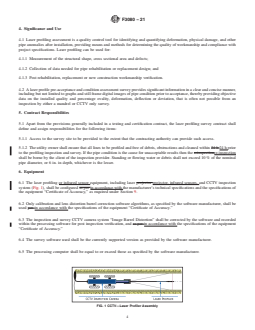
system (Fig. 1), shall be configured in accordance with the
manufacturer’s technical specifications and the specifications
3.1.13 ovality, n—percentage of shape deflection in circular
of the equipment “Certificate of Accuracy,” as required under
and noncircular pipes as calculated in accordance with Practice
Section 9.
F1216 as defined in Annex A1.
3.1.14 PAL—Phase Alternating Line—A color encoding 6.2 Only calibration and lens distortion barrel correction
system for analog television not used in North America softwarealgorithms,asspecifiedbythesoftwaremanufacturer,
containing 25 half frames, 50 frames per second. Each frame shall be used in accordance with the specifications of the
contains 625 lines. equipment “Certificate of Accuracy.”
F3080 − 21
FIG. 1 CCTV—Laser Profiler Assembly
6.3 The inspection and survey CCTV camera system “Im- 7.6 For non circular designed pipes, the deviation of the
age Barrel Distortion” shall be corrected by the software and observed inspection from the original pipe design shall be
recorded within the processing software for post inspection calculated in accordance with the software manufacturer’s
verification, and in accordance with the specifications of the shape algorithm.
equipment “Certificate of Accuracy.”
7.7 The accuracy of the system must be maintained to meet
6.4 The survey software used shall be the currently sup-
the requirements of 9.1 if sensors are removed or water
ported version as provided by the software manufacturer.
impedes the measurement of a sensor(s) and be so tested
pursuant to 9.1 that accuracy is maintained with each number
6.5 The processing computer shall be equal to or exceed
of sensors removed.
those as specified by the software manufacturer.
8. Procedure
7. Software
7.1 The recorded pipeline and conduit survey video shall be
8.1 The pipe shall be precleaned and free of debris that
loaded onto a computer with CCTV pipeline, conduit inspec-
would prevent the CCTV camera and laser projector assembly,
tion profiling processing software, meeting the technical re-
shown in Fig. 1, from moving through the pipe, or adversely
quirements as stated herein installed.
affect the accuracy of the survey. Flow or debris, within the
line, shall be less than 10 % of the nominal pipe diameter or
7.2 The applicable camera “barrel distortion” correction
6 in. in depth, whichever is the lesser.
shallbeselectedandverifiedbasedontheactualCCTVcamera
andlensasusedinrecordingthelaserorinfraredimagingdata.
8.2 ACCTVpipelineandconduitinspectionsystemshallbe
placed into the pipeline and conduit to be surveyed.Arecorded
7.3 Horizontalandverticalcalibrationshallbeperformedas
inspection header shall contain complete pipe data including
stipulated by the manufacturer of the software.
map location, pipe type, pipe size, and date of inspection. The
7.4 The profile software shall have the capability to analyze
CCTVdistancecountershallbesettozeroanddisplayedinthe
the laser image or infrared sensor measurement of each
video without overlapping or distorting the video image.ATV
recorded video frame. The image center shall be calculated by
only line inspection shall be recorded on a digital storage as
the processing software for each recorded video frame. A
agreed between the contractor and the client. The contractor
minimum of 1080 radius data points shall be interrogated per
shall consult the manufacturer for prior conversion approval if
video frame. The distance from each usable data point shall be
the standard format other than that required.
automat
...
This document is not an ASTM standard and is intended only to provide the user of an ASTM standard an indication of what changes have been made to the previous version. Because
it may not be technically possible to adequately depict all changes accurately, ASTM recommends that users consult prior editions as appropriate. In all cases only the current version
of the standard as published by ASTM is to be considered the official document.
Designation: F3080 − 17a F3080 − 21
Standard Practice for
Laser Technologies for Measurement of Cross-Sectional
Shape of Pipeline and Conduit by Non-Rotating Laser
Projector Projector, Infrared Measurement, and CCTV
Camera System
This standard is issued under the fixed designation F3080; the number immediately following the designation indicates the year of
original adoption or, in the case of revision, the year of last revision. A number in parentheses indicates the year of last reapproval. A
superscript epsilon (´) indicates an editorial change since the last revision or reapproval.
1. Scope*
1.1 Laser profiling is a non-contact inspection method used to create a pipe wall profile and internal measurement using a standard
CCTV pipe inspection system, 360 degree laser light projector, and special a measurement by means of infrared sensors and
geometrical profiling software. This practice covers the procedure for the measurement to determine any deviation of the internal
surface of installed pipe compared to the design. The measurements may be used to verify that the installation has met design
requirements for acceptance or to collect data that will facilitate an assessment of the condition of pipe or conduit due to structural
deviations or deterioration. This standard practice provides minimum requirements on means and methods for laser profiling to
meet the needs of engineers, contractors, owners, regulatory agencies, and financing institutions.
1.2 This practice applies to all types of pipe material, all types of construction, and pipe shapes.
1.3 This practice applies to depressurized and gravity flow storm sewers, drains, sanitary sewers, and combined sewers with
diameters from 66 in. to 72 in. (150(150 mm and 1800 mm).
1.4 This standard does not include all aspects of pipe inspection, such as joint gaps, soil/water infiltration in joints, cracks, holes,
surface damage, repairs, corrosion, and structural problems associated with these conditions.
1.5 The values stated in inch-pound units are to be regarded as standard. The values given in parentheses are mathematical
conversions to SI units that are provided for information only and are not considered standard.
1.6 The profiling process may require physical access to lines, entry manholes, and operations along roadways that may include
safety hazards.
1.7 This standard does not purport to address all of the safety concerns, if any, associated with its use. It is the responsibility
of the user of this standard to establish appropriate safety, health, and environmental practices and determine the applicability of
regulatory limitations prior to use. There are no safety hazards specifically, however, associated with the use of the laser ring
profiler specified (listed and labeled as specified in 1.3).
1.8 This international standard was developed in accordance with internationally recognized principles on standardization
established in the Decision on Principles for the Development of International Standards, Guides and Recommendations issued
by the World Trade Organization Technical Barriers to Trade (TBT) Committee.
This practice is under the jurisdiction of ASTM Committee F36 on Technology and Underground Utilities and is the direct responsibility of Subcommittee F36.20 on
Inspection and Renewal of Water and Wastewater Infrastructure.
Current edition approved Dec. 1, 2017March 1, 2021. Published December 2017March 2021. Originally approved in 2014. Last previous edition approved in 2017 as
F3080-17.-17a. DOI: 10.1520/F3080-17A.10.1520/F3080-21.
*A Summary of Changes section appears at the end of this standard
Copyright © ASTM International, 100 Barr Harbor Drive, PO Box C700, West Conshohocken, PA 19428-2959. United States
F3080 − 21
2. Referenced Documents
2.1 ASTM Standards:
E177 Practice for Use of the Terms Precision and Bias in ASTM Test Methods
E691 Practice for Conducting an Interlaboratory Study to Determine the Precision of a Test Method
F1216 Practice for Rehabilitation of Existing Pipelines and Conduits by the Inversion and Curing of a Resin-Impregnated Tube
2.2 Other Standards:
IEC 60825-1 Safety of Laser Products – Part 1: Equipment Classification and Requirements, Jan 2011.
CDRH Regulations CFR 21, Section I, Subchapter J, Parts 1002 to 1040.11
For referenced ASTM standards, visit the ASTM website, www.astm.org, or contact ASTM Customer Service at service@astm.org. For Annual Book of ASTM Standards
volume information, refer to the standard’sstandard’s Document Summary page on the ASTM website.
Available from International Electrotechnical Commission (IEC), 3, rue de Varembé, 1st Floor, P.O. Box 131, CH-1211 Geneva 20, Switzerland, http://www.iec.ch.
Available from Center for Devices and Radiological Health (CDRH), Food and Drug Administration, 10903 New Hampshire Avenue, WO66-4621, Silver Spring, MD
20993, http://www.fda.gov.
F3080 − 21
3. Terminology
3.1 Definitions of Terms Specific to This Standard:
3.1.1 authority, n—party responsible for the generation and verification of performance to job specification(s) and contract
requirements.
3.1.2 barrel distortion—distortion of an image produced by an optical system that causes straight lines at image margins to bulge
outwards.
3.1.3 barrel distortion correction confirmation target—an X-Y axis grid patterned for the post processing verification of “fisheye
distortion” lens correction within the processing software.
3.1.4 CCTV, n—a closed circuit pipeline and conduit inspection television system including an NTSC or PAL camera, camera
transporter, integrated lighting, central control system, video monitor and recording device.
3.1.5 CCTV camera transporter—the device that provides mobility for the CCTV camera to move transverse to the pipe alignment
once it enters the inside of the pipe through manholes and/or other line access openings.
3.1.6 CCTV pipeline and conduit inspection system—CCTV inspection system is composed of CCTV camera, transporter,
controller and video recording unit.
3.1.7 deflection—any change in the inside diameter of the pipe resulting from installation and imposed loads. Deflection may be
either vertical or horizontal and is usually reported as a percentage of the base (undeflected) inside pipe diameter.
3.1.8 laser, n—a solid state device that produces a monochromatic and coherent beam of visible light in an intense, narrow 360
degree beam.
3.1.9 laser profile—the spatial intensity profile of a laser beam at a particular plane that is perpendicular to the trajectory of the
laser device along the axis of the pipe.
3.1.10 laser profiling survey—a survey composed of taking measurements of the cross sectional shape of the pipe at a rate greater
than 24 images per second along its alignment, processing the recorded data using compatible software and producing a condition
assessment report, including deviation, using laser profiling technology.or infrared technology, or both.
3.1.11 laser projector assembly—a 360 degree laser light projector assembly composed of two primary components: laser signal
modulation unit.
3.1.12 non-rotating laser projector, n—a mobile, certified “eye safe” laser light source and internal optics capable of projecting
a 360 degree narrow beam of laser light onto an internal pipe wall in pipes from 66 in. to 72 in. (150(150 mm to 1800 mm)
1800 mm) in diameter regardless of material, design, or shape.
3.1.13 ovality, n—percentage of shape deflection in circular and noncircular pipes as calculated per in accordance with Practice
F1216 as defined in Annex A1.
3.1.14 PAL—Phase Alternating Line—A color encoding system for analog television not used in North America containing 25 half
frames, 50 frames per second. Each frame contains 625 lines.
3.1.15 profiling software—the software that analyzes the collected data from a laser or infrared profiling survey into cross sectional
profiles along the pipe of conduit alignment.
3.1.16 survey calibrator—a calibrated measurement reference placed and recorded on the same plane and distance from the CCTV
camera as the projected laser light ring or infrared sensor during the profiling survey.
F3080 − 21
4. Significance and Use
4.1 Laser profiling assessment is a quality control tool for identifying and quantifying deformation, physical damage, and other
pipe anomalies after installation, providing means and methods for determining the quality of workmanship and compliance with
project specifications. Laser profiling can be used for:
4.1.1 Measurement of the structural shape, cross sectional area and defects;
4.1.2 Collection of data needed for pipe rehabilitation or replacement design; and
4.1.3 Post rehabilitation, replacement or new construction workmanship verification.
4.2 A laser profile pre-acceptance and condition assessment survey provides significant information in a clear and concise manner,
including but not limited to graphs and still frame digital images of pipe condition prior to acceptance, thereby providing objective
data on the installed quality and percentage ovality, deformation, deflection or deviation, that is often not possible from an
inspection by either a mandrel or CCTV only survey.
5. Contract Responsibilities
5.1 Apart from the provisions generally included in a testing and certification contract, the laser profiling survey contract shall
define and assign responsibilities for the following items:
5.1.1 Access to the survey site to be provided to the extent that the contracting authority can provide such access.
5.1.2 The utility owner shall ensure that all lines to be profiled and free of debris, obstructions and cleaned within 24 h 24 h prior
to the profiling inspection and survey. If the pipe condition is the cause for unacceptable results then the reinspectionre-inspection
shall be borne by the client of the inspection provider. Standing or flowing water or debris shall not exceed 10 % of the nominal
pipe diameter, or 6 in. in depth, whichever is the lesser.
6. Equipment
6.1 The laser profiling or infrared sensor equipment, including laser projector projector, infrared sensors, and CCTV inspection
system (Fig. 1), shall be configured as per in accordance with the manufacturer’s technical specifications and the specifications of
the equipment “Certificate of Accuracy,” as required under Section 9.
6.2 Only calibration and lens distortion barrel correction software algorithms, as specified by the software manufacturer, shall be
used per in accordance with the specifications of the equipment “Certificate of Accuracy.”
6.3 The inspection and survey CCTV camera system “Image Barrel Distortion” shall be corrected by the software and recorded
within the processing software for post inspection verification, and as per in accordance with the specifications of the equipment
“Certificate of Accuracy.”
6.4 The survey software used shall be the currently supported version as provided by the software manufacturer.
6.5 The processing computer shall be equal to or exceed those as specified by the software manufacturer.
FIG. 1 CCTV—Laser Profiler Assembly
F3080 − 21
7. Software
7.1 The recorded pipeline and conduit survey video shall be loaded onto a computer with CCTV pipeline, conduit inspection
profiling processing software, meeting the technical requirements as stated herein installed.
7.2 The applicable camera “barrel distortion” correction shall be selected and verified based on the actual CCTV camera and lens
as used in recording the laser or infrared imaging data.
7.3 Horizontal and vertical calibration shall be performed as stipulated by the manufacturer of the software.
7.4 The profile software shall have the capability to analyze the laser image or infrared sensor measurement of each recorded video
frame. The image center shall be calculated by the processing software for each recorded video frame. A minimum of 1080 radius
data points shall be interrogated per video frame. The distance from each usable data point shall be automatically calculated and
stored. Using the stored measurement data, the pipeline and conduit median diameter shall be calculated and established as the
diameter for calculating percentage deviation from line ovality (deformation). Data points affected or impaired by water, debris,
fog, etc., shall be discarded and not used in the calculation of line ovality and deformation.
7.5 The ovality shall be calculated per in accordance with Practice F1216 as given in Annex A1 for all pipe shapes. If the shape
of the original pipe deviates significantly (more than 10 % 10 % from the nominal diameter) from that of an equivalent circle when
the flow area is masked, changes in curvature shall be considered as a better measure of the degree of pipe deformation. For CIPP
installation, the ovality shall be calculated in accordance with Practice F1216 as given in Annex A1 for all pipe shapes. If the shape
of the original pipe deviates significantly (more than 10 % from the normal diameter) from that of an equivalent circle when the
flow area is masked, changes in curvature shall be considered as a better measure of the degree of pipe deformation.
7.6 For non circular designed pipes, the deviation of the observed inspection from the original pipe design shall be calculated per
in accordance with the software manufacturer’s shape algorithm.
7.7 The accuracy of the system must be maintained to meet the requirements of 9.1 if sensors are removed or water impedes the
measurement of a sensor(s) and be so tested pursuant to 9.1 that accuracy is maintained with each number of sensors removed.
8. Procedure
8.1 The pipe shall be precleaned and free of debris that would prevent the CCTV camera and laser projector assembly, shown in
Fig. 1, from moving through the pipe, or adversely affect the accuracy of the survey. Flow or debris, within the line, shall be less
than 10 % of the
...