

ASTM C1249-18(2023)
(Guide)Standard Guide for Secondary Seal for Sealed Insulating Glass Units for Structural Sealant Glazing Applications
General Information
- Abstract
SIGNIFICANCE AND USE
4.1 It should be realized that the design of an IG unit edge seal for use in SSG systems is a collaborative effort of at least the IG unit fabricator, sealant manufacturer, and design professional, among others.
4.2 This guide provides information on silicone sealants that are used for the secondary seal of IG units that are glazed into SSG systems.
4.3 Information is also provided on the other major components of the IG unit edge seal, compatibility of components, durability, and quality assurance (QA).
SCOPE
1.1 This guide covers design and fabrication considerations for the edge seal of conventionally sealed insulating glass units, herein referred to as IG units. The IG units described are used in structural silicone sealant glazing systems, herein referred to as SSG systems. SSG systems typically are either two or four sided, glazed with a structural sealant. Other conditions such as one, three, five, six sided may be used.
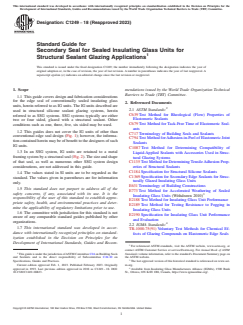
1.2 This guides does not cover the IG units of other than conventional edge seal design (Fig. 1); however, the information contained herein may be of benefit to the designers of such IG units.
FIG. 1 Sealed IG Edge Seal: Basic Components
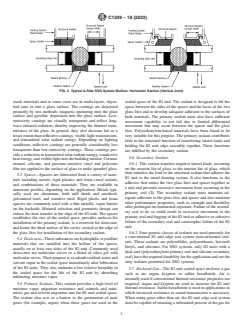
1.3 In an SSG system, IG units are retained to a metal framing system by a structural seal (Fig. 2). The size and shape of that seal, as well as numerous other SSG system design considerations, are not addressed in this guide.
FIG. 2 Typical A-Side SSG System Mullion: Horizontal Section (Vertical Joint)
1.4 The values stated in SI units are to be regarded as the standard. The values given in parentheses are for information only.
1.5 This standard does not purport to address all of the safety concerns, if any, associated with its use. It is the responsibility of the user of this standard to establish appropriate safety, health, and environmental practices and determine the applicability of regulatory limitations prior to use.
1.6 The committee with jurisdiction for this standard is not aware of any comparable standard guides published by other organizations.
1.7 This international standard was developed in accordance with internationally recognized principles on standardization established in the Decision on Principles for the Development of International Standards, Guides and Recommendations issued by the World Trade Organization Technical Barriers to Trade (TBT) Committee.
- Status
- Published
- Publication Date
- 31-Jan-2023
- Technical Committee
- C24 - Building Seals and Sealants
- Drafting Committee
- C24.10 - Specifications, Guides and Practices
Overview
ASTM C1249-18(2023), titled Standard Guide for Secondary Seal for Sealed Insulating Glass Units for Structural Sealant Glazing Applications, is an internationally recognized guide developed by ASTM. This standard outlines the design and fabrication considerations for the edge seal of insulating glass (IG) units specifically used in structural silicone sealant glazing (SSG) systems. These systems are commonly used in building facades, curtain walls, and window assemblies where glass units are mechanically supported and structurally bonded to framing elements using silicone sealants.
The primary goal of ASTM C1249 is to ensure the long-term durability, compatibility, and performance of secondary seals in IG units when employed within SSG systems. It provides guidance on material selection, design methodology, and quality assurance practices essential for professionals involved in manufacturing, specifying, and installing sealed insulating glass in structural applications.
Key Topics
- Collaborative Design: Emphasizes the importance of input and coordination among the IG unit fabricator, sealant manufacturer, and design professionals to achieve optimal edge seal performance.
- Secondary Seal Application: Focuses on silicone sealants as preferred materials for the secondary seal in dual-seal IG units used in SSG systems. The secondary seal unites the glass lites and spacer and transfers loads between them.
- Component Compatibility: Discusses the need to evaluate and ensure compatibility between sealants, spacers, desiccants, glass coatings, and accessories to avoid premature failure or aesthetic issues.
- Durability Considerations: Addresses factors influencing the long-term performance of the secondary seal, including environmental exposure (e.g., moisture, UV radiation, temperature fluctuations), desiccant efficiency, and adherence to best glazing practices.
- Quality Assurance (QA): Covers the importance of robust QA procedures for manufacturing and field installation to maintain seal integrity and consistent adhesion over the IG unit's service life.
- Edge Seal Materials and Properties:
- Spacer types and material selection
- Role and characteristics of primary and secondary sealants
- Use of desiccants and architectural glass coatings
Applications
ASTM C1249 is widely applicable to:
- Building Facades and Curtain Walls: Ensures that IG units installed in high-rise and commercial buildings using SSG systems meet stringent structural and durability requirements.
- Window and Glazing System Manufacturing: Guides manufacturers in selecting suitable materials and following best practices for producing long-lasting, high-performance IG units.
- Architectural Design: Assists architects and engineers in specifying compliant products and designing for compatibility and reliability in structural glazing projects.
- Quality Control and Inspection: Provides the foundation for inspection procedures and the evaluation of installed IG units for long-term weatherability and performance.
- Repairs and Retrofits: Offers guidance for evaluating existing installations, particularly when replacing failed IG units or updating glazing systems.
Related Standards
For comprehensive design, testing, and performance evaluation, ASTM C1249 references several key standards, including:
- ASTM C1184: Specification for Structural Silicone Sealants – defines performance requirements for sealants used in structural glazing.
- ASTM C1369: Specification for Secondary Edge Sealants for Structurally Glazed Insulating Glass Units.
- ASTM C794: Test Method for Adhesion-in-Peel of Elastomeric Joint Sealants.
- ASTM C1087: Test Method for Determining Compatibility of Liquid-Applied Sealants with Accessories Used in Structural Glazing Systems.
- ASTM C1135: Test Method for Determining Tensile Adhesion Properties of Structural Sealants.
- ASTM E2190: Specification for Insulating Glass Unit Performance and Evaluation.
- NFRC 706: Requirements for Participating Insulating Glass Certification Programs.
By adhering to ASTM C1249 and its referenced standards, industry professionals can enhance the reliability, safety, and longevity of IG units used in structural sealant glazing applications, meeting both aesthetic and performance objectives in modern building envelopes.
Relations
- Refers
ASTM C639-15(2020) - Standard Test Method for Rheological (Flow) Properties of Elastomeric Sealants - Effective Date
- 01-May-2020
- Effective Date
- 01-May-2019
- Refers
ASTM E2189-19 - Standard Test Method for Testing Resistance to Fogging in Insulating Glass Units - Effective Date
- 01-Apr-2019
- Effective Date
- 01-Apr-2019
- Effective Date
- 01-Apr-2019
- Effective Date
- 01-Mar-2019
- Effective Date
- 01-Jan-2019
- Effective Date
- 01-Jun-2018
- Effective Date
- 01-Mar-2018
- Effective Date
- 01-Nov-2017
- Effective Date
- 01-Jan-2017
- Effective Date
- 15-Nov-2016
- Effective Date
- 01-Sep-2016
- Effective Date
- 01-Dec-2015
- Effective Date
- 01-Jul-2015
Frequently Asked Questions
ASTM C1249-18(2023) is a guide published by ASTM International. Its full title is "Standard Guide for Secondary Seal for Sealed Insulating Glass Units for Structural Sealant Glazing Applications". This standard covers: SIGNIFICANCE AND USE 4.1 It should be realized that the design of an IG unit edge seal for use in SSG systems is a collaborative effort of at least the IG unit fabricator, sealant manufacturer, and design professional, among others. 4.2 This guide provides information on silicone sealants that are used for the secondary seal of IG units that are glazed into SSG systems. 4.3 Information is also provided on the other major components of the IG unit edge seal, compatibility of components, durability, and quality assurance (QA). SCOPE 1.1 This guide covers design and fabrication considerations for the edge seal of conventionally sealed insulating glass units, herein referred to as IG units. The IG units described are used in structural silicone sealant glazing systems, herein referred to as SSG systems. SSG systems typically are either two or four sided, glazed with a structural sealant. Other conditions such as one, three, five, six sided may be used. 1.2 This guides does not cover the IG units of other than conventional edge seal design (Fig. 1); however, the information contained herein may be of benefit to the designers of such IG units. FIG. 1 Sealed IG Edge Seal: Basic Components 1.3 In an SSG system, IG units are retained to a metal framing system by a structural seal (Fig. 2). The size and shape of that seal, as well as numerous other SSG system design considerations, are not addressed in this guide. FIG. 2 Typical A-Side SSG System Mullion: Horizontal Section (Vertical Joint) 1.4 The values stated in SI units are to be regarded as the standard. The values given in parentheses are for information only. 1.5 This standard does not purport to address all of the safety concerns, if any, associated with its use. It is the responsibility of the user of this standard to establish appropriate safety, health, and environmental practices and determine the applicability of regulatory limitations prior to use. 1.6 The committee with jurisdiction for this standard is not aware of any comparable standard guides published by other organizations. 1.7 This international standard was developed in accordance with internationally recognized principles on standardization established in the Decision on Principles for the Development of International Standards, Guides and Recommendations issued by the World Trade Organization Technical Barriers to Trade (TBT) Committee.
SIGNIFICANCE AND USE 4.1 It should be realized that the design of an IG unit edge seal for use in SSG systems is a collaborative effort of at least the IG unit fabricator, sealant manufacturer, and design professional, among others. 4.2 This guide provides information on silicone sealants that are used for the secondary seal of IG units that are glazed into SSG systems. 4.3 Information is also provided on the other major components of the IG unit edge seal, compatibility of components, durability, and quality assurance (QA). SCOPE 1.1 This guide covers design and fabrication considerations for the edge seal of conventionally sealed insulating glass units, herein referred to as IG units. The IG units described are used in structural silicone sealant glazing systems, herein referred to as SSG systems. SSG systems typically are either two or four sided, glazed with a structural sealant. Other conditions such as one, three, five, six sided may be used. 1.2 This guides does not cover the IG units of other than conventional edge seal design (Fig. 1); however, the information contained herein may be of benefit to the designers of such IG units. FIG. 1 Sealed IG Edge Seal: Basic Components 1.3 In an SSG system, IG units are retained to a metal framing system by a structural seal (Fig. 2). The size and shape of that seal, as well as numerous other SSG system design considerations, are not addressed in this guide. FIG. 2 Typical A-Side SSG System Mullion: Horizontal Section (Vertical Joint) 1.4 The values stated in SI units are to be regarded as the standard. The values given in parentheses are for information only. 1.5 This standard does not purport to address all of the safety concerns, if any, associated with its use. It is the responsibility of the user of this standard to establish appropriate safety, health, and environmental practices and determine the applicability of regulatory limitations prior to use. 1.6 The committee with jurisdiction for this standard is not aware of any comparable standard guides published by other organizations. 1.7 This international standard was developed in accordance with internationally recognized principles on standardization established in the Decision on Principles for the Development of International Standards, Guides and Recommendations issued by the World Trade Organization Technical Barriers to Trade (TBT) Committee.
ASTM C1249-18(2023) is classified under the following ICS (International Classification for Standards) categories: 81.040.20 - Glass in building. The ICS classification helps identify the subject area and facilitates finding related standards.
ASTM C1249-18(2023) has the following relationships with other standards: It is inter standard links to ASTM C639-15(2020), ASTM C1135-19, ASTM E2189-19, ASTM E2190-19, ASTM E2188-19, ASTM C717-19, ASTM C1369-19, ASTM C1184-18, ASTM C717-18, ASTM C717-17a, ASTM C717-17, ASTM C717-16a, ASTM C717-16, ASTM C1135-15, ASTM C794-15a. Understanding these relationships helps ensure you are using the most current and applicable version of the standard.
ASTM C1249-18(2023) is available in PDF format for immediate download after purchase. The document can be added to your cart and obtained through the secure checkout process. Digital delivery ensures instant access to the complete standard document.
Standards Content (Sample)
This international standard was developed in accordance with internationally recognized principles on standardization established in the Decision on Principles for the
Development of International Standards, Guides and Recommendations issued by the World Trade Organization Technical Barriers to Trade (TBT) Committee.
Designation: C1249 − 18 (Reapproved 2023)
Standard Guide for
Secondary Seal for Sealed Insulating Glass Units for
Structural Sealant Glazing Applications
This standard is issued under the fixed designation C1249; the number immediately following the designation indicates the year of
original adoption or, in the case of revision, the year of last revision. A number in parentheses indicates the year of last reapproval. A
superscript epsilon (´) indicates an editorial change since the last revision or reapproval.
1. Scope mendations issued by the World Trade Organization Technical
Barriers to Trade (TBT) Committee.
1.1 This guide covers design and fabrication considerations
for the edge seal of conventionally sealed insulating glass
2. Referenced Documents
units, herein referred to as IG units. The IG units described are
2.1 ASTM Standards:
used in structural silicone sealant glazing systems, herein
C639 Test Method for Rheological (Flow) Properties of
referred to as SSG systems. SSG systems typically are either
Elastomeric Sealants
two or four sided, glazed with a structural sealant. Other
C679 Test Method for Tack-Free Time of Elastomeric Seal-
conditions such as one, three, five, six sided may be used.
ants
1.2 This guides does not cover the IG units of other than
C717 Terminology of Building Seals and Sealants
conventional edge seal design (Fig. 1); however, the informa-
C794 Test Method for Adhesion-in-Peel of Elastomeric Joint
tion contained herein may be of benefit to the designers of such
Sealants
IG units.
C1087 Test Method for Determining Compatibility of
1.3 In an SSG system, IG units are retained to a metal Liquid-Applied Sealants with Accessories Used in Struc-
framing system by a structural seal (Fig. 2). The size and shape
tural Glazing Systems
of that seal, as well as numerous other SSG system design C1135 Test Method for Determining Tensile Adhesion Prop-
considerations, are not addressed in this guide.
erties of Structural Sealants
C1184 Specification for Structural Silicone Sealants
1.4 The values stated in SI units are to be regarded as the
C1369 Specification for Secondary Edge Sealants for Struc-
standard. The values given in parentheses are for information
turally Glazed Insulating Glass Units
only.
E631 Terminology of Building Constructions
1.5 This standard does not purport to address all of the
E773 Test Method for Accelerated Weathering of Sealed
safety concerns, if any, associated with its use. It is the
Insulating Glass Units (Withdrawn 2010)
responsibility of the user of this standard to establish appro-
E2188 Test Method for Insulating Glass Unit Performance
priate safety, health, and environmental practices and deter-
E2189 Test Method for Testing Resistance to Fogging in
mine the applicability of regulatory limitations prior to use.
Insulating Glass Units
1.6 The committee with jurisdiction for this standard is not
E2190 Specification for Insulating Glass Unit Performance
aware of any comparable standard guides published by other
and Evaluation
organizations.
2.2 IGMA Standards:
1.7 This international standard was developed in accor-
TR-1000-75(91) Voluntary Test Methods for Chemical Ef-
dance with internationally recognized principles on standard-
fects of Glazing Compounds on Elastomeric Edge Seals
ization established in the Decision on Principles for the
Development of International Standards, Guides and Recom-
For referenced ASTM standards, visit the ASTM website, www.astm.org, or
contact ASTM Customer Service at service@astm.org. For Annual Book of ASTM
This guide is under the jurisdiction of ASTM Committee C24 on Building Seals Standards volume information, refer to the standard’s Document Summary page on
and Sealants and is the direct responsibility of Subcommittee C24.10 on the ASTM website.
Specifications, Guides and Practices. The last approved version of this historical standard is referenced on www.ast-
Current edition approved Feb. 1, 2023. Published February 2023. Originally m.org.
approved in 1993. Last previous edition approved in 2018 as C1249 – 18. DOI: Available from Insulating Glass Manufacturers Alliance (IGMA), 1500 Bank
10.1520/C1249-18R23. St., Ottawa, ON K1H 1B8, Canada, https://www.igmaonline.org/.
Copyright © ASTM International, 100 Barr Harbor Drive, PO Box C700, West Conshohocken, PA 19428-2959. United States
C1249 − 18 (2023)
3.2.5 structural seal—a joint seal of which the sealant
structurally adheres an IG unit to a metal framing system (see
Fig. 2).
3.2.5.1 Discussion—The structural seal transfers applied
loads to the framing system as well as accommodates differ-
ential movements between the IG unit and the framing system.
3.3 Symbols:
2 2
3.3.1 A = area, m (in. ).
3.3.2 C = sealant contact width, shear, mm (in.).
s
3.3.3 C = sealant contact width, tension, mm (in.).
t
3.3.4 D = design factor, dimensionless.
3.3.5 F = allowable shear stress, Pa (psi).
s
3.3.6 F = allowable tensile stress, Pa (psi).
t
FIG. 1 Sealed IG Edge Seal: Basic Components
3.3.7 F = yield stress, Pa (psi).
y
3.3.8 H = height, m (ft).
3.3.9 L = perimeter length, m (ft).
2 2
3.3.10 M = mass per unit area, N/m (lb/ft ).
TM-4000 Insulating Glass Manufacturing Quality Proce-
3.3.11 P = applied load, Pa (lbf/ft ).
dures
3.3.12 W = width, m (ft).
2.3 NFRC Document:
NFRC 706 Requirements for Participating Insulating Glass
4. Significance and Use
Certification Programs
4.1 It should be realized that the design of an IG unit edge
seal for use in SSG systems is a collaborative effort of at least
3. Terminology
the IG unit fabricator, sealant manufacturer, and design
3.1 Definitions:
professional, among others.
3.1.1 Refer to Terminology C717 for definitions of the
4.2 This guide provides information on silicone sealants that
following terms used in this guide: adhesive failure, bead,
are used for the secondary seal of IG units that are glazed into
cohesive failure, compatibility, cure, elongation, gasket,
SSG systems.
glazing, joint, lite, modulus, non-sag sealant, seal, sealant,
sealant backing, setting block, shelf-life, silicone sealant, 4.3 Information is also provided on the other major compo-
nents of the IG unit edge seal, compatibility of components,
spacer, structural sealant, substrate, tooling, and working life.
Refer to Terminology E631 for the definition of sealed insu- durability, and quality assurance (QA).
lating glass as used in this guide.
5. Insulating Glass Unit
3.2 Definitions of Terms Specific to This Standard:
3.2.1 desiccant—a hygroscopic material that adsorbs water
5.1 Insulating Glass Unit Components—The edge seal of an
or may adsorb solvent vapors, or both (see Fig. 1).
SSG system IG unit consists of the two lites of glass, spacer,
3.2.1.1 Discussion—The desiccant maintains a low relative
desiccant, primary sealant, and secondary sealant (Fig. 1) (1).
humidity in sealed insulating glass.
This type of IG unit is referred to commonly as a dual-seal unit
3.2.2 primary seal—A joint seal of which the sealant resists in that it has separate primary and secondary seals. A single-
moisture vapor permeation into the desiccated space of sealed seal IG unit is inappropriate at this time for SSG systems and
insulating glass (see Fig. 1). should not be used. The following sections describe the
3.2.2.1 Discussion—It also resists inert gas permeation (for components of a dual-seal IG unit briefly.
example, argon) from the IG unit sealed space if the intent is to
5.2 Glass and Architectural Coatings:
use an inert gas.
5.2.1 Glass—All types of glass have been used in the
3.2.3 secondary seal—a joint seal of which the sealant
fabrication of IG units, including monolithic, laminated,
structurally unites the two glass lites and spacer of sealed
tempered, heat-strengthened, tinted, heat-absorbing, light
insulating glass (see Fig. 1).
reducing, patterned, and wired. Almost all glass is produced by
the float manufacturing process, in which the glass ribbon that
3.2.4 spacer—a fabricated shape that creates an appropriate
emerges from the furnace is floated on a bath of molten tin,
distance between two lites of glass in sealed insulating glass
allowing gravity to produce essentially flat parallel surfaces.
(see Fig. 1).
5.2.2 Architectural Coatings—These coatings, which are
3.2.4.1 Discussion—As a component of the edge seal
applied to the surface of the glass prior to IG unit fabrication,
system, the spacer also resists vapor migration into sealed
are generally grouped into one of two categories: low-
insulating glass and provides a container for a desiccant.
emissivity or reflective. They are both metallic or metallic
Available from National Fenestration Rating Council (NFRC), 6305 Ivy Ln.,
Suite 140, Greenbelt, MD 20770, https://www.nfrccommunity.org/page/ The boldface numbers in parentheses refer to the list of references at the end of
ProgramDocs. this guide.
C1249 − 18 (2023)
FIG. 2 Typical A-Side SSG System Mullion: Horizontal Section (Vertical Joint)
oxide materials and in some cases are in multi-layers, depos- sealed space of the IG unit. The sealant is designed to fill the
ited onto or into a glass surface. The coatings are deposited space between the sides of the spacer and the faces of the two
primarily by two methods: magnetic sputtering onto the glass glass lites and to develop adequate adhesion to the surfaces of
surface and pyrolitic deposition into the glass surface. Low-
both materials. The primary sealant must also have sufficient
emissivity coatings are visually transparent and reflect long- movement capability to not fail due to limited differential
wave infrared radiation, thereby improving the thermal trans-
movement that may occur between the spacer and the glass
mittance of the glass. In general, they also decrease but to a
lites. Polyisobutylene-based materials have been found to be
lesser extent than reflective coatings, visible light transmission,
very suitable for this purpose. The primary sealant contributes
and transmitted solar radiant energy. Depending on lighting
little to the structural function of transferring lateral loads and
conditions, reflective coatings are generally considerably less
holding the IG unit edge assembly together. These functions
transparent than low-emissivity coatings. These coatings pro-
are fulfilled by the secondary sealant.
vide a reduction in transmitted solar radiant energy, conductive
5.6 Secondary Sealant:
heat energy, and visible light into the building interior. Ceramic
5.6.1 This sealant transfers negative lateral loads, occurring
enamel, silicone, and pressure-sensitive vinyl and polyester
on the exterior lite of glass, to the interior lite of glass, which
film are applied to the surface of glass to make spandrel glass.
then transfers the load to the structural sealant that adheres the
5.3 Spacer—Spacers are fabricated from a variety of mate-
IG unit to the metal framing system. It also functions as the
rials including metals, rigid plastics and foam cured sealant,
adhesive that unites the two glass lites and spacer together as
and combinations of these materials. They are available in
a unit and prevents excessive movement from occurring in the
numerous profiles, depending on the application. Metals typi-
primary seal (2). The secondary sealant must maintain ad-
cally used are aluminum, both mill finish and anodized,
equate adhesion to the glass lites and spacer and also maintain
galvanized steel, and stainless steel. Rigid plastic and foam
other performance properties, such as strength and flexibility
spacers are commonly used with a thin metallic vapor barrier
after prolonged environmental exposure. Failure of the second-
on the backside. Material selection and geometric design can
ary seal to do so could result in excessive movement in the
reduce the heat transfer at the edge of the IG unit. The spacer
primary seal and fogging of the IG unit or adhesive or cohesive
establishes the size of the sealed space, provides surfaces for
failure of the secondary seal and catastrophic failure of the IG
installation of the primary sealant, is a reservoir for desiccant,
unit.
and forms the third surface of the cavity created at the edge of
the glass lites for installation of the secondary sealant. 5.6.2 Four generic classes of sealants are used presently for
a conventional IG unit edge seal system (non-structural seal-
5.4 Desiccant—These substances are hydrophilic crystalline
ant). These sealants are polysulfides, polyurethanes, hot-melt
materials that are installed into the hollow of the spacer,
butyls, and silicones. For SSG systems, only IG units with a
usually on at least two sides of the IG unit. Commonly used
dual-seal (polyisobutylene primary seal and silicone secondary
desiccants are molecular sieves or a blend of silica gel with
seal) have the required durability for the application and are the
molecular sieves. Their purpose is to adsorb residual water and
only sealants permitted for SSG systems.
solvent vapor in the sealed space immediately after fabrication
of the IG units. They also maintain a low relative humidity in
5.7 Enclosed Gas—The IG unit sealed space encloses a gas
the sealed space for the life of the IG unit by absorbing
such as air, argon, krypton, or sulfur hexafloride. Air is
infiltrating moisture vapor.
normally used if conventional thermal resistance properties are
5.5 Primary Sealant—This sealant provides a high level of required. Argon and krypton are used to increase the IG unit
thermal resistance. Sulfur hexafloride is used in applications in
moisture vapor migration resistance and controls and mini-
mizes gas and solvent migration into the IG unit sealed space. which increased resistance to sound transmission is necessary.
The sealant also acts as a barrier to the permeation of inert When using gases other than air, the IG unit edge seal system
gases (for example, argon) when these gases are used in the must be capable of retaining a substantial percent of the gas for
C1249 − 18 (2023)
the life of the IG unit; otherwise, thermal or sound transmission factor (D) of 4.0, and substituting these values into (Eq 1),
performance will decrease to an unacceptable level. results in the following:
5.8 Breather and Capillary Tubes: F 5 559/4.0 5 138 kPa (2)
t
5.8.1 Breather Tube—A breather tube is a small tube or hole
or
that is factory-placed through the spacer of the IG unit to
F 5 80/4.0 5 20 psi (3)
accommodate an increase in sealed air space pressure when an
t
IG unit is shipped to a higher elevation than where fabricated.
6.3.3 Current industry practice for the structural seal of an
The breather tube allows the sealed air space pressure to
SSG system, which was determined empirically, is to limit the
equalize to the atmospheric pressure at the installation site. The
value of F to 138 kPa (20 psi). The SSG system structural seal
t
breather tube is sealed prior to the IG unit installation. Special
contact width (Fig. 2) is usually established using the applied
sealed space gases (see 5.7) cannot be used in IG units that
lateral load, acting in tension, in conjunction with the 138 kPa
have breather tubes.
(20 psi) tensile stress. Additional contributory stresses from,
5.8.2 Capillary Tube—A capillary tube is a very thin bore
for example, thermal movement, dead load (see 6.6), sealant
tube of specific length and inside diameter that is factory-
cross-section dimension, non-linear glass deflection under
placed through the spacer of the IG unit. A capillary tube
load, internal sealant stress due to cure shrinkage, prestress in
fulfills the same function as a breather tube and, in addition, is
sealant due to differential building component movement, and
left open during transportation to permit the sealed space of the
variation in sealant physical properties can also influence this
IG unit to continue to pressure equalize with fluctuating
value. If these additional factors are a significant concern, an
ambient air pressure. Capillary tubes should be sealed with a
allowable tensile stress (F ) of below 138 kPa (20 psi) may be
t
high performance sealant specified by the IG fabricator at the
appropriate for the SSG system structural seal sealant.
final destination immediately before installation. Special sealed
6.3.4 Regarding the secondary sealant for IG units, some IG
space gases (see 5.7) cannot be used in IG units that have
unit fabricators recommend using values for F such as 207 kPa
t
capillary tubes.
(30 psi) in lieu of the more conservative 138 kPa (20 psi) value
used for the SSG system structural seal. The rationale for using
SECONDARY SEALANT DESIGN CONSIDERATIONS
higher values for F is the already high quality of the fabrica-
t
tor’s QA program for fabricating the IG unit edge seal. Better
6. Structural Properties
QA results in more consistent adhesion of the secondary
6.1 General:
sealant, and higher values for F can therefore be maintained
t
6.1.1 The design of an IG unit edge seal parallels the
reliably. In addition, the cladding design load is usually chosen
methodology used for the design of the SSG system structural
as the maximum to occur in a 50 or sometimes 100-year return
joint that adheres an IG unit to a framing system. SSG system
period. Because of this, the actual tensile stress on the
structural sealants must meet the requirements of Specification
secondary sealant is typically a lower value and in some areas
C1184. IG sealants used for SSG systems must meet the
a relatively small percentage of the F value. If a value of F in
u t
requirements of Specification C1369, which is modeled after
excess of 138 kPa (20 psi) is proposed, it must be evaluated
Specification C1184.
carefully. This careful evaluation is especially significant since
6.1.2 The following sections provide the design profes-
F does not give significance to the additional stress factors
t
sional with information on the design of the IG unit edge seal
discussed in 6.3.3.
secondary sealant regarding the following: allowable tensile
6.3.5 Presently, for the IG unit secondary sealant, the stress
strength; modulus properties; appropriate design factors; and
in the secondary sealant is usually limited to 138 kPa (20 psi).
design of the secondary sealant for the effects of shear stress,
The applied lateral load, which is shared between the two lites
tensile stress, and combined stresses.
of glass of the IG unit, in conjunction with the 138 kPa (20 psi)
6.2 Sealant Yield Stress—The minimum sealant yield stress
limit, is used to calculate the secondary sealant contact width
(F ) (or tensile adhesion value) is determined by Test Method
u
required to resist the applied lateral load (see 6.7). This equal
C1135 by pulling to failure small laboratory specimens of
load sharing is applied only when the two lites are of equal
sealant having a cross-section similar (but not necessarily
thickness.
identical) to that used in a structural seal. Sealant manufactur-
6.3.6 It is not within the scope of this guide to specify a
ers usually report this value in a table of performance criteria
particular tensile stress (F ) for the IG unit secondary sealant.
t
for a particular sealant. An example of a sealant manufacturer’s
This should be an informed decision made by the design
reported value for F would be 896 kPa (130 psi) for a two-part
u
professional, in conjunction with the structural sealant manu-
high-modulus sealant.
facturer and IG unit fabricator, considering, among other
6.3 Sealant Tensile Stress:
factors: building code requirements, degree of risk, and the
6.3.1 The allowable sealant tensile stress (F ) for SSG
t particular SSG system and IG unit requirements.
system structural seals is determined by dividing the ultimate
6.4 Design Factor:
stress (F ) by an appropriate design factor (D) ((Eq 1)).
u
6.4.1 For SSG system structural seals, a factor ranging from
F 5 F /D (1)
t u
4 to 12 was originally selected for the structural sealant during
6.3.2 For example, using a manufacturer’s published ulti- the beginnings of SSG technology. This range recognized the
mate stress (F ) for a sealant of 559 kPa (80 psi), with a design many variables and unknowns, such as determining applied
y
C1249 − 18 (2023)
loads and load distribution accurately, the relatively poor tear 6.6.1 Good glazing practices require that glass, including IG
strength if three-sided adhesion occurred, and the difficulty of units, be supported by two setting blocks located at approxi-
determining the actual sealant stress. This approach is consis- mately the ⁄4 points of the glass width. See the Glass
tent with traditional engineering practice, in which uncertainty Association of North America (GANA) Glazing Manual, page
52, for a typical detail. Although not generally recommended,
and unknowns are mitigated to a certain extent by using a
design factor, sometimes referred to as a safety factor. The installations are occasionally designed in which the glass or IG
unit is not supported by setting blocks (Fig. 3). Contact the
design factor can be determined by using (Eq 1) and solving for
D. It should be noted, however, that higher-strength sealants do sealant and IG manufacturer for specific recommendations.
The dead load of the IG unit is supported by the SSG system
not improve the probability of attaining and maintaining
structural seal with such installations. This will result in a
long-term sealant adhesion. Adhesion concerns are decreased
constant dead load shear (Fig. 3) stress (F ) on the sealant and
by lower design stress (f ). Since adhesion is one of the primary
s
t
the potential of a downward movement of the IG unit under the
concerns in every aspect of structural glazing, a higher design
influence of gravity (4). Because of special considerations, in
factor is best achieved by using smaller design stresses (F ).
t
some unusual situations some sealant and IG manufacturers
6.4.2 For example, for a sealant in which F = 896 kPa (130
u
have approved specific installations with no setting blocks. If
psi), with a value of F = 138 kPa (20 psi), the value of D will
t
this is ever done, the sealant and glass manufacturer and design
be 6.5. If a different sealant, in which F is 345 kPa (50 psi),
u
professional must review the design and details, and the dead
is used with a value of 2.5 for D, F will be 138 kPa (20 psi).
t
load shear stress (F ) on the SSG system structural sealant is
s
Presently, a lower-limit design factor (D) of 2.5 is being used
limited to no more than 6895 Pa (1 psi) and often considerably
for SSG system structural sealants. This lower limit is based on
less (for example, 3400 Pa or 0.5 psi).
the following: the successful performance of SSG system
6.6.2 With such installations, the secondary seal of the IG
structural sealants since approximately 1972, advances that
unit must also be designed to resist shearing stress and
have occurred in adhesion technology, and the implementation
potential movement induced by the dead load of the outer lite
of QA programs. Higher design factors are not to be construed
of glass. Unacceptable differential movement of the two lites
as rationale to change the design stress (f ) to values above 138
t
could cause a seal failure in the primary sealant, resulting in
kPa (20 psi).
fogging of the enclosed space. The minimum sealant contact
6.4.3 It is not within the scope of this guide to specify a
width required due to dead load shear stress, assuming no
particular design factor for the IG unit secondary sealant. This
contribution from the primary seal, can be determined using
should be an informed decision made by the design
(Eq 4).
professional, in conjunction with the structural sealant manu-
C 5 ~M*A!/~F *L! (4)
facturer and IG unit fabricator, considering, among other
s s
factors: building code requirements, degree of risk, and the
particular SSG system and IG unit requirements.
Available from Glass Association of North America (GANA), 777 East
6.5 Sealant Modulus and Joint Stiffness:
Eisenhower Parkway, Ann Arbor, MI 48108.
6.5.1 The design of the structural seal in SSG systems
should consider the relationships of joint shape, joint stiffness,
and sealant modulus so that the outward movement of the
peripheral edge of the IG unit, by an applied lateral load, is no
more than 1.6 mm ( ⁄16 in.) for a glass lite nominal thickness of
6 mm ( ⁄4 in.). Test Method C1135 can be used to determine
that the elongation of the structural sealant at 138 kPa (20 psi)
1 1
is less than 1.6 mm ( ⁄16 in.). The 1.6-mm ( ⁄16-in.) movement
or sealant elongation is related to the position and support
provided to the outer lite of the IG unit by setting blocks that
are recessed from its outer face, usually by one-half the
nominal glass thickness. If outward movement is excessive and
the IG unit outer lite drops off the setting blocks, it could cause
a failure of the IG unit edge seal.
6.5.2 From the above discussion, it should also be apparent
that the outward, and in some cases downward (see 6.6),
movement of the outer glass lite of an IG unit relative to the
inner lite, under the influence of the applied lateral load, must
also be limited. Detrimental movement or change in the
secondary seal shape (3) could cause a seal failure in the
primary sealant, resulting in fogging of the enclosed space. The
modulus of the secondary sealant, as well as the shape and size
of the secondary seal, should be evaluated.
FIG. 3 Dead Load Movement of IG Unit: Vertical Section (Hori-
6.6 Sealant Contact Width for Shear Stress: zontal Joint)
C1249 − 18 (2023)
6.6.3 For example (Fig. 4), for an IG unit with W = 1.219 or
2 2
m (4 ft), H = 1.829 m (6 ft), M = 311.22 N/m (6.5 lb/ft ), L
C 5 ~15*2!/~20*12! 5 0.125 in. (9)
t
= 6.096 m (20 ft), and F = 6895 Pa (1 psi), the contact width
s
If the lites are of unequal thickness, equal load sharing
for the secondary sealant would be determined as follows.
cannot be employed, and appropriately higher values are to be
Only the weight of the exterior lite of glass will cause a
used.
shearing stress in the secondary sealant, so one-half of the
6.7.3 If it has been determined that an unsupported IG unit
weight of the IG unit is used in the calculation. Substituting
is allowable in a given situation and both the deal load and
into (Eq 4) results in the following:
wind load calculations are performed, the largest of the
C 5 ~155.61*2.2296!/~6895*6.096! 5 8.25 mm (5)
s
calculated contact widths must be used.
or
6.8 Combined Stresses:
C 5 3.25*24 / 1*20*12 5 0.325 in. (6) 6.8.1 Depending on, among other factors, loading condi-
~ ! ~ !
s
tions (that is, tensile and shear loads), IG unit shape and size,
6.7 Sealant Contact Width for Tensile Stress:
secondary sealant, and secondary seal shape and size, the
6.7.1 The minimum secondary sealant contact width (C )
t
effects of combined stresses on the secondary sealant may
required to resist the applied lateral tensile load can be
require consideration (7).
determined using (Eq 7), which is based on trapezoidal load
6.8.2 It should also be realized that the final secondary
distribution theory. Other load distribution theories may be
sealant contact width may have to be greater than as deter-
applicable, depending on, among other factors, IG unit shape
mined by calculation. Other factors, such as spacer geometry
and size (5). Any influence from the primary seal is not
(8), fabrication procedures, and fabrication tolerances, may
considered.
have to be considered to determine a minimum acceptable
C 5 ~P*W/2!/F (7)
t t
secondary sealant contact width.
6.7.2 For example (Fig. 4), for an IG unit with W = 1.219
7. Adhesion
m (4 ft), H = 1.829 m (6 ft), P = 1436 Pa (30 lbf/ft ), and
F = 138 kPa (20 psi), the contact width for the secondary
t 7.1 General:
sealant would be determined as follows. With a sealed IG unit,
7.1.1 Adhesion of the secondary seal to the IG unit edge seal
there is load sharing between the two lites of glass. If both lites
components is one of the most critical functions of the sealant.
are of the same thickness, the lateral load (P) is shared almost
The secondary sealant adheres the glass, with or without a
equally; and, if of unequal thickness, the load shared by each
glass coating, and spacer into a rigid yet flexible system, and,
lite will vary, depending on the difference in thicknesses (6).
in addition, transfers applied lateral loads from the outer lite to
For the following example, both lites are the same thickness,
the inner lite of the IG unit. Poor sealant adhesion to any of the
and the secondary seal therefore experiences approximately
IG unit edge seal components can have adverse effects on IG
one-half the applied load. Substituting into (Eq 7), using the
unit performance.
least dimension, which is the width (W) of the IG unit, results
7.1.2 Time, temperature, water and water vapor, ultra-violet
in the following:
radiation, and foreign chemicals can affect the adhesion and
performance of the secondary seal. The following sections
C 5 ~718*0.6096!/138 5 3.2 mm (8)
t
address adhesion issues related to glass, glass coatings, and
spacers, among other factors, that commonly occur with IG
units.
7.2 Glass and Architectural Coatings:
7.2.1 Glass—Adhesion of a silicone secondary sealant to a
properly prepared, uncoated glass surface has proven to be
tenacious. To develop adequate adhesion, the glass surface
must be properly cleaned (see 7.4) immediately prior to sealant
application.
7.2.2 Architectural Coatings—A wide variety of glass coat-
ings are currently available for architectural glass. Adhesion of
the sealant to these coatings depends on the type of architec-
tural coating and its particular type of top coat, such as titanium
dioxide or silicon dioxide, among other types, and the coating
application technique, such as a pyrolitic or magnetic sputter-
ing process. No generalized statement can be made regarding
sealant adhesion to the many available architectural coatings,
since variations may occur even for a given type of coating and
application process due to process conditions. The adhesion of
the sealant to an architectural coating on glass must be verified
on samples of actual manufactured specimens for each job by
FIG. 4 Elevation of a Four-Sided Structural Sealant Glazed IG
Unit the sealant manufacturer. The adhesion of some architectural
C1249 − 18 (2023)
coatings to glass may degrade with time, and coating deletion 8. Compatibility
(removal) may be required.
8.1 General—The incompatibility of materials in contact
7.2.3 Coating Deletion—This is usually performed by
with or close proximity to the secondary sealant of the IG unit
abrasion, with an abrasive wheel, or by burning the coating off
will usually result in a color change, a lessening of the adhesive
with a high-temperature flame. Any coating deletion technique
strength or a complete loss of adhesion of the secondary
will result in a glass surface that is chemically and physically
sealant. Time, elevated temperature, and other environmental
different from a normal glass surface. Adequate adhesion of the factors such as ultra-violet radiation can influence compatibil-
sealant to this glass surface should be verified. A representative ity. Incompatibility is not desirable since sealant adhesive
failure can result in fogging of the IG unit or detachment of the
sample should be submitted to the sealant manufacturer.
Statements regarding the durability and adhesion of the archi- outboard lite of glass from the IG unit. Color change is
undesirable as it affects the aesthetics of the façade. Test
tectural coating to a glass surface can be made only by the
Method C1087 can be used to determine whether a secondary
insulating glass fabricator or coating applicator.
sealant and another material are compatible. Metal
7.3 Spacer—Adhesion of the secondary sealant to the spacer
components, sealants, or any combination of materials used in
is required to prevent “walking” or displacement of the spacer
the construction of the IG unit, as well as components of the
into the vision area of the IG unit and potential edge seal failure
SSG system that can influence the edge seal, must have their
and fogging. Different secondary seal sealants will develop
compatibility with the secondary sealant verified by appropri-
various levels of adhesion to the vast array of available spacer
ate testing. This compatibility testing may vary in degree,
materials. For example, some sealants may develop excellent
depending on system configuration, that is, two or four sided
long-term adhesion to an anodized spacer, whereas others may
structurally glazed. The degree of compatibility testing, de-
not. Long-term adhesion can be verified by many different
pending on system configuration, has not been agreed to by the
standard test methods. The sealant manufacturer can suggest
SSG industry and varies from manufacturer to manufacturer.
and perform various tests, such as those found in Test Methods
8.2 Structural Sealants:
C794, E773, and C1135, to predict the long-term adhesion
...