

ASTM E2141-21
(Test Method)Standard Test Method for Accelerated Aging of Electrochromic Devices in Sealed Insulating Glass Units
General Information
- Abstract
SIGNIFICANCE AND USE
4.1 EC glazings perform a number of important functions in a building envelope including: minimizing the solar energy heat gain; providing for passive solar energy gain; controlling a variable visual connection with the outside world; enhancing human comfort (heat gain), illumination, and glare control; and providing for architectural expression. It is therefore important to understand the relative serviceability of these glazings.
4.2 This test method is intended to provide a means for evaluating the relative serviceability of EC Glazings as described in Section 1.
4.3 The procedures in this test method include (a) rapid but realistic current-voltage cycling tests emphasizing the electrical properties, and (b) environmental test parameters that are typically used in weatherability tests by standards organizations and are realistic for the intended use of large-area EC IGUs.
SCOPE
1.1 This test method covers the accelerated aging of electrochromic devices (ECD) integrated in insulating glass units.
1.2 The test method is applicable for any electrochromic device incorporated into sealed insulating glass units (IGUs) fabricated for vision glass (superstrate and substrate) areas for use in buildings, such as sliding doors, windows, skylights, and exterior wall systems. The layers used for constructing the EC device and electrochromically changing the optical properties may be inorganic or organic materials.
1.3 The electrochromic (EC) glazings used in this test method are exposed to environmental conditions, including solar radiation. They are employed to control the amount of transmitted radiation by absorption and reflection and, thus, limit the solar heat gain and amount of solar radiation that is transmitted into the building.
1.4 The test method is not applicable to other chromogenic devices, such as, photochromic and thermochromic devices which do not respond to electrical stimulus.
1.5 The test method is not applicable to electrochromic (EC) glazings that are constructed from superstrate or substrate materials other than glass.
1.6 The test method referenced herein is a laboratory test conducted under specified conditions. The test is intended to simulate and, in some cases, to also accelerate actual in-service use of the electrochromic glazing. Results from these tests cannot be used to predict the performance with time of in-service units unless actual corresponding in-service tests have been conducted and appropriate analyses have been conducted to show how performance can be predicted from the accelerated aging tests.
1.7 The values stated in SI units are to be regarded as standard. No other units of measurement are included in this standard.
1.8 This standard does not purport to address all of the safety concerns, if any, associated with its use. It is the responsibility of the user of this standard to establish appropriate safety, health, and environmental practices and determine the applicability of regulatory limitations prior to use.
1.9 This international standard was developed in accordance with internationally recognized principles on standardization established in the Decision on Principles for the Development of International Standards, Guides and Recommendations issued by the World Trade Organization Technical Barriers to Trade (TBT) Committee.
- Status
- Published
- Publication Date
- 14-Oct-2021
- Technical Committee
- E06 - Performance of Buildings
- Drafting Committee
- E06.22 - Durability Performance of Building Constructions
Buy Documents
ASTM E2141-21 - Standard Test Method for Accelerated Aging of Electrochromic Devices in Sealed Insulating Glass Units
REDLINE ASTM E2141-21 - Standard Test Method for Accelerated Aging of Electrochromic Devices in Sealed Insulating Glass Units
Overview
ASTM E2141-21 is the Standard Test Method for Accelerated Aging of Electrochromic Devices in Sealed Insulating Glass Units, published by ASTM International. This standard specifies laboratory procedures to simulate and accelerate the environmental exposure and operational cycling experienced by electrochromic (EC) devices integrated within insulating glass units (IGUs) intended for building use. Electrochromic glazings in IGUs are designed to manage solar heat gain, provide dynamic light control, improve occupant comfort, and enhance architectural aesthetics.
This accelerated aging test is critical for evaluating the serviceability-or long-term durability and performance-of EC IGUs under realistic building exposure scenarios. As demand for energy-efficient, dynamic window technologies grows, ASTM E2141-21 provides manufacturers, builders, and specifiers with a credible basis for assessing product reliability.
Key Topics
Scope
- Applies to EC devices integrated in sealed glass IGUs for building applications, such as windows, doors, and skylights.
- Excludes photochromic and thermochromic devices and EC glazings using non-glass substrates.
- The standard is based exclusively on SI units.
Test Methodology
- Accelerated Aging: EC IGUs are subjected to rapid but realistic current-voltage cycling and environmental conditions mimicking solar exposure and temperature extremes.
- Environmental Simulation: The test covers exposure to filtered xenon-arc lamp radiation, controlled temperature, and limited humidity, simulating natural weathering.
- Performance Monitoring: Optical transmittance is measured throughout cycling to determine changes in performance, such as maximum and minimum visible light transmission, switching speed, and uniformity.
Analysis and Reporting
- Observations include optical data, visible degradation, specimen breakage, and performance changes after cycling.
- The test provides repeatable laboratory conditions but is not intended to directly predict in-service lifetimes without additional analysis.
Applications
Design and Specification
- Architectural and façade engineers, product manufacturers, and glass processors use this standard to qualify electrochromic IGUs for building projects.
- Ensures compliance with durability requirements in building envelope systems (windows, curtain walls, skylights).
Product Comparison and Quality Assurance
- Enables comparison of different EC glazing products for performance and durability under accelerated conditions.
- Supports quality assurance programs through repeatable, standardized tests.
Building Performance and Certification
- Facilitates documentation needed for green building certifications and energy efficiency programs, which often require verification of advanced glazing performance.
- Assists facility managers and architects in selecting dynamic glass solutions with validated service life expectations.
R&D and Product Improvement
- Provides research teams with a benchmark method for improving the durability and operational reliability of electrochromic coatings and IGU assemblies.
Related Standards
- ASTM E2953 - Specification for Evaluating Accelerated Aging Performance of Electrochromic Devices in Sealed Insulating Glass Units.
- ASTM G155 - Practice for Operating Xenon Arc Lamp Apparatus for Exposure of Materials.
- ISO 9050 - Glass in building – Determination of light transmittance, solar direct transmittance, total solar energy transmittance, ultraviolet transmittance, and related glazing factors.
- ASTM C168, E631, G113 - Terminologies and practices used for referencing materials and test conditions.
By following ASTM E2141-21, industry professionals can ensure the reliability, performance, and longevity of electrochromic glass products for sustainable, high-performance building applications. Use of this test standard helps drive innovation while reducing risks related to long-term product degradation or failure.
Relations
- Effective Date
- 15-Apr-2024
- Effective Date
- 01-Jul-2020
- Effective Date
- 15-Apr-2018
- Effective Date
- 01-Jun-2017
- Effective Date
- 15-Oct-2015
- Effective Date
- 01-Jun-2015
- Effective Date
- 01-Mar-2015
- Effective Date
- 01-Dec-2014
- Effective Date
- 01-Nov-2014
- Effective Date
- 01-May-2014
- Effective Date
- 01-Mar-2014
- Effective Date
- 01-May-2013
- Effective Date
- 01-May-2013
- Effective Date
- 01-Apr-2013
- Effective Date
- 01-Nov-2011
Buy Documents
ASTM E2141-21 - Standard Test Method for Accelerated Aging of Electrochromic Devices in Sealed Insulating Glass Units
REDLINE ASTM E2141-21 - Standard Test Method for Accelerated Aging of Electrochromic Devices in Sealed Insulating Glass Units
Frequently Asked Questions
ASTM E2141-21 is a standard published by ASTM International. Its full title is "Standard Test Method for Accelerated Aging of Electrochromic Devices in Sealed Insulating Glass Units". This standard covers: SIGNIFICANCE AND USE 4.1 EC glazings perform a number of important functions in a building envelope including: minimizing the solar energy heat gain; providing for passive solar energy gain; controlling a variable visual connection with the outside world; enhancing human comfort (heat gain), illumination, and glare control; and providing for architectural expression. It is therefore important to understand the relative serviceability of these glazings. 4.2 This test method is intended to provide a means for evaluating the relative serviceability of EC Glazings as described in Section 1. 4.3 The procedures in this test method include (a) rapid but realistic current-voltage cycling tests emphasizing the electrical properties, and (b) environmental test parameters that are typically used in weatherability tests by standards organizations and are realistic for the intended use of large-area EC IGUs. SCOPE 1.1 This test method covers the accelerated aging of electrochromic devices (ECD) integrated in insulating glass units. 1.2 The test method is applicable for any electrochromic device incorporated into sealed insulating glass units (IGUs) fabricated for vision glass (superstrate and substrate) areas for use in buildings, such as sliding doors, windows, skylights, and exterior wall systems. The layers used for constructing the EC device and electrochromically changing the optical properties may be inorganic or organic materials. 1.3 The electrochromic (EC) glazings used in this test method are exposed to environmental conditions, including solar radiation. They are employed to control the amount of transmitted radiation by absorption and reflection and, thus, limit the solar heat gain and amount of solar radiation that is transmitted into the building. 1.4 The test method is not applicable to other chromogenic devices, such as, photochromic and thermochromic devices which do not respond to electrical stimulus. 1.5 The test method is not applicable to electrochromic (EC) glazings that are constructed from superstrate or substrate materials other than glass. 1.6 The test method referenced herein is a laboratory test conducted under specified conditions. The test is intended to simulate and, in some cases, to also accelerate actual in-service use of the electrochromic glazing. Results from these tests cannot be used to predict the performance with time of in-service units unless actual corresponding in-service tests have been conducted and appropriate analyses have been conducted to show how performance can be predicted from the accelerated aging tests. 1.7 The values stated in SI units are to be regarded as standard. No other units of measurement are included in this standard. 1.8 This standard does not purport to address all of the safety concerns, if any, associated with its use. It is the responsibility of the user of this standard to establish appropriate safety, health, and environmental practices and determine the applicability of regulatory limitations prior to use. 1.9 This international standard was developed in accordance with internationally recognized principles on standardization established in the Decision on Principles for the Development of International Standards, Guides and Recommendations issued by the World Trade Organization Technical Barriers to Trade (TBT) Committee.
SIGNIFICANCE AND USE 4.1 EC glazings perform a number of important functions in a building envelope including: minimizing the solar energy heat gain; providing for passive solar energy gain; controlling a variable visual connection with the outside world; enhancing human comfort (heat gain), illumination, and glare control; and providing for architectural expression. It is therefore important to understand the relative serviceability of these glazings. 4.2 This test method is intended to provide a means for evaluating the relative serviceability of EC Glazings as described in Section 1. 4.3 The procedures in this test method include (a) rapid but realistic current-voltage cycling tests emphasizing the electrical properties, and (b) environmental test parameters that are typically used in weatherability tests by standards organizations and are realistic for the intended use of large-area EC IGUs. SCOPE 1.1 This test method covers the accelerated aging of electrochromic devices (ECD) integrated in insulating glass units. 1.2 The test method is applicable for any electrochromic device incorporated into sealed insulating glass units (IGUs) fabricated for vision glass (superstrate and substrate) areas for use in buildings, such as sliding doors, windows, skylights, and exterior wall systems. The layers used for constructing the EC device and electrochromically changing the optical properties may be inorganic or organic materials. 1.3 The electrochromic (EC) glazings used in this test method are exposed to environmental conditions, including solar radiation. They are employed to control the amount of transmitted radiation by absorption and reflection and, thus, limit the solar heat gain and amount of solar radiation that is transmitted into the building. 1.4 The test method is not applicable to other chromogenic devices, such as, photochromic and thermochromic devices which do not respond to electrical stimulus. 1.5 The test method is not applicable to electrochromic (EC) glazings that are constructed from superstrate or substrate materials other than glass. 1.6 The test method referenced herein is a laboratory test conducted under specified conditions. The test is intended to simulate and, in some cases, to also accelerate actual in-service use of the electrochromic glazing. Results from these tests cannot be used to predict the performance with time of in-service units unless actual corresponding in-service tests have been conducted and appropriate analyses have been conducted to show how performance can be predicted from the accelerated aging tests. 1.7 The values stated in SI units are to be regarded as standard. No other units of measurement are included in this standard. 1.8 This standard does not purport to address all of the safety concerns, if any, associated with its use. It is the responsibility of the user of this standard to establish appropriate safety, health, and environmental practices and determine the applicability of regulatory limitations prior to use. 1.9 This international standard was developed in accordance with internationally recognized principles on standardization established in the Decision on Principles for the Development of International Standards, Guides and Recommendations issued by the World Trade Organization Technical Barriers to Trade (TBT) Committee.
ASTM E2141-21 is classified under the following ICS (International Classification for Standards) categories: 81.040.20 - Glass in building. The ICS classification helps identify the subject area and facilitates finding related standards.
ASTM E2141-21 has the following relationships with other standards: It is inter standard links to ASTM C168-24, ASTM E2953-14(2020)e1, ASTM C168-18, ASTM C168-17, ASTM C168-15a, ASTM C168-15, ASTM E631-15, ASTM E2953-14, ASTM E631-14, ASTM E177-14, ASTM G113-14, ASTM E177-13, ASTM E691-13, ASTM C168-13, ASTM E691-11. Understanding these relationships helps ensure you are using the most current and applicable version of the standard.
ASTM E2141-21 is available in PDF format for immediate download after purchase. The document can be added to your cart and obtained through the secure checkout process. Digital delivery ensures instant access to the complete standard document.
Standards Content (Sample)
This international standard was developed in accordance with internationally recognized principles on standardization established in the Decision on Principles for the
Development of International Standards, Guides and Recommendations issued by the World Trade Organization Technical Barriers to Trade (TBT) Committee.
Designation: E2141 − 21
Standard Test Method for
Accelerated Aging of Electrochromic Devices in Sealed
Insulating Glass Units
This standard is issued under the fixed designation E2141; the number immediately following the designation indicates the year of
original adoption or, in the case of revision, the year of last revision.Anumber in parentheses indicates the year of last reapproval.A
superscript epsilon (´) indicates an editorial change since the last revision or reapproval.
1. Scope 1.8 This standard does not purport to address all of the
safety concerns, if any, associated with its use. It is the
1.1 This test method covers the accelerated aging of elec-
responsibility of the user of this standard to establish appro-
trochromic devices (ECD) integrated in insulating glass units.
priate safety, health, and environmental practices and deter-
1.2 The test method is applicable for any electrochromic
mine the applicability of regulatory limitations prior to use.
device incorporated into sealed insulating glass units (IGUs)
1.9 This international standard was developed in accor-
fabricated for vision glass (superstrate and substrate) areas for
dance with internationally recognized principles on standard-
useinbuildings,suchasslidingdoors,windows,skylights,and
ization established in the Decision on Principles for the
exterior wall systems. The layers used for constructing the EC
Development of International Standards, Guides and Recom-
device and electrochromically changing the optical properties
mendations issued by the World Trade Organization Technical
may be inorganic or organic materials.
Barriers to Trade (TBT) Committee.
1.3 The electrochromic (EC) glazings used in this test
method are exposed to environmental conditions, including
2. Referenced Documents
solar radiation. They are employed to control the amount of
2.1 ASTM Standards:
transmitted radiation by absorption and reflection and, thus,
C168Terminology Relating to Thermal Insulation
limit the solar heat gain and amount of solar radiation that is
E177Practice for Use of the Terms Precision and Bias in
transmitted into the building.
ASTM Test Methods
1.4 The test method is not applicable to other chromogenic
E631Terminology of Building Constructions
devices, such as, photochromic and thermochromic devices
E691Practice for Conducting an Interlaboratory Study to
which do not respond to electrical stimulus.
Determine the Precision of a Test Method
E2953Specification for Evaluating Accelerated Aging Per-
1.5 Thetestmethodisnotapplicabletoelectrochromic(EC)
formance of Electrochromic Devices in Sealed Insulating
glazings that are constructed from superstrate or substrate
Glass Units
materials other than glass.
G113Terminology Relating to Natural andArtificial Weath-
1.6 The test method referenced herein is a laboratory test
ering Tests of Nonmetallic Materials
conducted under specified conditions. The test is intended to
G155PracticeforOperatingXenonArcLampApparatusfor
simulateand,insomecases,toalsoaccelerateactualin-service
Exposure of Materials
use of the electrochromic glazing. Results from these tests
G173TablesforReferenceSolarSpectralIrradiances:Direct
cannot be used to predict the performance with time of
Normal and Hemispherical on 37° Tilted Surface
in-service units unless actual corresponding in-service tests
2.2 ISO Standard:
have been conducted and appropriate analyses have been
ISO 9050 Glass in building - Determination of light
conductedtoshowhowperformancecanbepredictedfromthe
transmittance,solardirecttransmittance,totalsolarenergy
accelerated aging tests.
transmittance, ultraviolet transmittance and related glaz-
1.7 The values stated in SI units are to be regarded as
ing factors
standard. No other units of measurement are included in this
standard.
For referenced ASTM standards, visit the ASTM website, www.astm.org, or
This test method is under the jurisdiction of ASTM Committee E06 on contact ASTM Customer Service at service@astm.org. For Annual Book of ASTM
Performance of Buildings and is the direct responsibility of Subcommittee E06.22 Standards volume information, refer to the standard’s Document Summary page on
on Durability Performance of Building Constructions. the ASTM website.
Current edition approved Oct. 15, 2021. Published December 2021. Originally Available from International Organization for Standardization (ISO), ISO
approved in 2001. Last previous edition approved in 2014 as E2141–14. DOI: Central Secretariat, Chemin de Blandonnet 8, CP 401, 1214 Vernier, Geneva,
10.1520/E2141-21. Switzerland, https://www.iso.org.
Copyright © ASTM International, 100 Barr Harbor Drive, PO Box C700, West Conshohocken, PA 19428-2959. United States
E2141 − 21
3. Terminology light transmittance range starting at one end of the range (at τ
H
or τ ) and ending back at the same point. For example, one
L
3.1 Definitions—Fordefinitionsofgeneraltermsusedinthis
switching cycle can be a transition from the highest transmit-
testmethodrelatedtobuildingconstruction,thermalinsulating
tance state to the lowest transmittance state and back to the
materials and natural and artificial weathering tests for nonme-
highest transmittance state, or a transition from the lowest
tallic materials, refer to Terminologies E631, C168 and G113,
transmittance state to the highest transmittance state and back
respectively.
to the lowest transmittance state.
3.2 Definitions of Terms Specific to This Standard:
3.2.15 switching times T and T ,n—switching time,T ,is
H L H
3.2.1 accelerated aging test, n—a test in which the rate of
thetimeittakesfortheECglazingtotransitionfromitshighest
degradation of building components or materials is intention-
transmittance state over 80% of its initial dynamic range
ally increased from that expected in actual service.
(where dynamic range is τ -τ ). Switching time (T)isthe
H L L
3.2.2 electrochromic device (ECD), n—a combination of
time it takes for the EC glazing to transition from its lowest
materials that include materials in which the transmittance,
transmittance state across 80% of its dynamic range (where
reflectance, and absorptance properties can be altered in
dynamic range is τ -τ ).
H L
response to an applied electrical voltage or current.
3.3 Abbreviations:
3.2.3 electrochromic (EC) glazing, n—glazing installed in a
3.3.1 AM—air mass
building that consists of an ECD with layer(s) of materials in
3.3.2 AWU—accelerated weathering unit
which the optical properties can change in response to an
applied electrical field.
3.3.3 DBT—dry-bulb temperature
3.2.4 electrochromic layer(s), n—in an ECD, the layer(s) of
3.3.4 DPM—digital panel meters
material(s) in which the optical properties can change in
3.3.5 ECD—electrochromic device
response to application of an electrical voltage or current, or
both.
3.3.6 IG—insulating glass
3.2.5 electro-optic cycling, n—the process of applying re-
3.3.7 IGU(s)—insulating glass unit(s)
petitivevoltagesorcurrents,orboth,toanECDforthepurpose
3.3.8 NIR—near-infrared (radiation)
of reversibly changing the optical properties of the EC glazing
from the highest to the lowest transmittance state.
3.3.9 PTR—photopic transmittance ratio
3.2.6 highest transmittance state, n—also referred to as the
3.3.10 τ —specular (regular) transmittance in the highest
H
clear state or bleached state, a descriptor for an EC glazing
transmittance state
when it is in the transmittance state with the highest photopic
3.3.11 τ —specular (regular) transmittance in the lowest
L
specular light transmittance.
transmittance state
3.2.7 lateral uniformity, n—the degree of variation in the
3.3.12 T —time to switch from the highest transmittance
amount of irradiance in the x and y directions in the test plane H
state to a transmittance of τ – 0.8 (τ -τ )
used for exposing an EC glazing. H H L
3.3.13 T —time to switch from the lowest transmittance
3.2.8 lowest transmittance state, n—also referred to as the
L
state to a transmittance of τ + 0.8 (τ -τ )
tinted state, dark state or colored state, a descriptor for an EC
L H L
glazing when it is in the transmittance state with the lowest
3.3.14 UV—ultraviolet (radiation)
photopic specular light transmittance.
3.2.9 photopic transmittance ratio (PTR), n—photopic 4. Significance and Use
transmittance ratio or PTR = τ /τ . The photopic transmit-
H L
4.1 ECglazingsperformanumberofimportantfunctionsin
tances (τ , τ ) are obtained by integrating the spectra in the
H L
a building envelope including: minimizing the solar energy
wavelengthrangeof380to780nmusingthespectralphotopic
heat gain; providing for passive solar energy gain; controlling
efficiency Ip (CIE, 1924) as the weighting factor.
a variable visual connection with the outside world; enhancing
3.2.10 room temperature, n—ca 22°C.
humancomfort(heatgain),illumination,andglarecontrol;and
providing for architectural expression. It is therefore important
3.2.11 serviceability, n—the capability of a building
to understand the relative serviceability of these glazings.
product, component, assembly, or construction to perform the
function(s) for which it was designed and constructed.
4.2 This test method is intended to provide a means for
3.2.12 solar irradiance, n—as related to natural weathering
evaluating the relative serviceability of EC Glazings as de-
of materials, the irradiance of the sun incident on the earth’s
scribed in Section 1.
surface, having wavelengths between 295nm and 4050nm.
4.3 The procedures in this test method include (a) rapid but
3.2.13 specular (regular) transmittance, n—the optical
realistic current-voltage cycling tests emphasizing the electri-
transmittance that does not include light with a diffuse com-
cal properties, and (b) environmental test parameters that are
ponent.
typically used in weatherability tests by standards organiza-
3.2.14 switching cycle, n—a transition in visible light trans- tions and are realistic for the intended use of large-area EC
mittance through the whole or part of the EC-IGU’s visible IGUs.
E2141 − 21
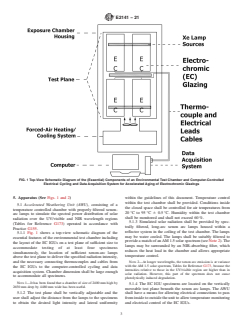
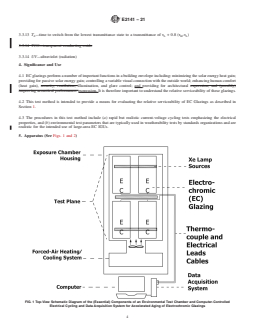
FIG. 1 Top-View Schematic Diagram of the (Essential) Components of an Environmental Test Chamber and Computer-Controlled
Electrical Cycling and Data Acquisition System for Accelerated Aging of Electrochromic Glazings
5. Apparatus (See Figs. 1 and 2) within the guidelines of this document. Temperature control
within the test chamber shall be provided. Conditions inside
5.1 Accelerated Weathering Unit (AWU), consisting of a
the closed space shall be controlled for air temperatures from
temperature controlled chamber with properly filtered xenon-
20°C to 95°C 6 0.5°C. Humidity within the test chamber
arc lamps to simulate the spectral power distribution of solar
shall be monitored and shall not exceed 60%.
radiation over the UV/visible and NIR wavelength regions
5.1.3 Simulated solar radiation shall be provided by spec-
(Tables for Reference G173) operated in accordance with
trally filtered, long-arc xenon arc lamps housed within a
Practice G155.
reflector system in the ceiling of the test chamber. The lamps
5.1.1 Fig. 1 shows a top-view schematic diagram of the
may be water cooled. The lamps shall be suitably filtered to
essential features of the environmental test chamber including
provideamatchofanAM1.5solarspectrum(seeNote2).The
the layout of the EC IGUs on a test plane of sufficient size to
lamps may be surrounded by an NIR-absorbing filter, which
accommodate testing of at least four specimens
reduces the heat load in the chamber and allows appropriate
simultaneously, the location of sufficient xenon-arc lamps
temperature control.
above the test plane to deliver the specified radiation intensity,
and the necessary connecting thermocouples and cables from
NOTE 2—At longer wavelengths, the xenon arc emission is at variance
with theAM 1.5 solar spectrum, Tables for Reference G173, because the
the EC IGUs to the computer-controlled cycling and data
intensities relative to those in the UV/visible region are higher than in
acquisition system. Chamber dimension shall be large enough
solar radiation. However, this part of the spectrum does not cause
to accommodate all specimens.
photolytically induced degradation.
NOTE 1—It has been found that a chamber of size of 2400mm high by
5.1.4 The EC IGU specimens are located on the vertically
2650mm deep by 4480mm wide has been useful.
moveable test plane beneath the xenon arc lamps. The AWU
5.1.2 The test plane shall be vertically adjustable and the shall have a means for allowing electrical connections to pass
user shall adjust the distance from the lamps to the specimens frominsidetooutsidetheunittoallowtemperaturemonitoring
to obtain the desired light intensity and lateral uniformity and electrical control of the EC IGUs.
E2141 − 21
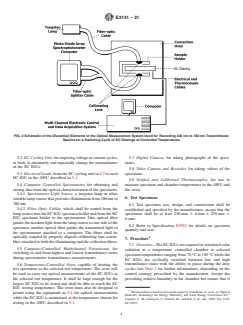
FIG. 2 Schematic of the (Essential) Elements of the Optical Measurement System Used for Recording 300 nm to 780 nm Transmittance
Spectra for a Switching Cycle of EC Glazings at Controlled Temperatures
5.2 EC Cycling Unit,forimposingvoltageorcurrentcycles, 5.7 Digital Camera, for taking photographs of the speci-
or both, to alternately and repeatedly change the transmittance mens.
of the EC IGUs.
5.8 Video Camera and Recorder, for taking videos of the
5.3 Electrical Leads,fromtheECcyclingunitin5.2toeach specimens.
EC IGU in the AWU described in 5.1.
5.9 Verified and Calibrated Thermocouples, for use to
5.4 Computer Controlled Spectrometer, for obtaining and measure specimen and chamber temperatures in theAWU and
storingdatafromtheopticalcharacterizationofthespecimens. the oven.
5.4.1 Spectrometer Light Source, a tungsten lamp or other
6. Test Specimens
suitablelampsourcethatprovidesilluminationfrom380nmto
780nm.
6.1 Test specimen size, design, and construction shall be
5.4.2 Fiber Optic Cables, which shall be routed from the
established and specified by the manufacturer, except that the
lampsourceintotheECIGUspecimenholderandfromtheEC
specimens shall be at least 250mm 6 6mm × 250mm 6
IGU specimen holder to the spectrometer. One optical fiber
6mm.
guidestheincidentlightfromthelampsourcetoonesideofthe
6.2 Refer to Specification E2953 for details on specimen
specimen; another optical fiber guides the transmitted light to
quantity and size.
the spectrometer attached to a computer. The fibers shall be
optically coupled by properly aligned collimating lens assem-
7. Procedure
bliesattachedtoboththeilluminatingandthecollectionfibers.
7.1 Overview—TheECIGUsareexposedtosimulatedsolar
5.5 Computer-Controlled, Multichannel Potentiostat, for
radiation in a temperature controlled chamber at selected
switching to and from highest and lowest transmittance states
specimentemperaturesrangingfrom70°Cto105°Cwhilethe
during spectrometer transmittance measurements.
EC IGUs are cyclically switched between low and high
5.6 Temperature-Controlled Oven, capable of heating the transmittance states with the ability to pause during the duty
cycles (see Note 3 for further information), depending on the
test specimens to the selected test temperature. The oven will
be used to carry out optical measurements of the EC-IGUs at control strategy prescribed by the manufacturer. Accept the
prevailing relative humidity in the chamber but ensure that it
the selected test temperature. It shall be large enough for the
largest EC IGU to be tested and shall be able to reach the EC
IGU testing temperature. The oven must also be designed to
TheprocedureisbasedinpartonthepaperbyCzanderna,A.,etal.,in“Optical
permit using the equipment in 5.4 for optical measurements
Materials Technology for Energy Efficiency and Solar Energy Conversion XV,”
while the EC IGU is maintained at the temperature chosen for
Lampert, C. M. Granqvist, C., Grätzel, M., and Deb, S. K. eds., SPIE, Vol. 3138,
testing in the AWU described in 5.1. 68 (1997).
E2141 − 21
does not exceed 60%. The EC IGU specimens are initially 7.3.5.2 The photopic transmittance of the devices shall be
characterizedopticallyatroomtemperaturetodetermineinitial obtained by integrating the spectra in the wavelength range of
performance. Then they are optically characterized in an oven 380nm to 780nm using the spectral photopic efficiency Ip (λ)
at the selected test temperature in order to determine the time (CIE, 1924) as the weighting factor. The procedure for
during which the specimens will be in or switching to the integration can be found in ISO 9050.
lowest transmittance state and the time during which the 7.3.5.3 Allow the samples to reach their lowest transmit-
specimens will be in or switching to the highest transmittance tance and highest transmittance states during these measure-
state. This is because some EC products have temperature ments. Wait for 30 min from the start of the transition for the
dependent switching times. The same equipment is used for specimens to reach their extreme states or until the rate of
both room and high temperature optical characterization mea- changeoftransmittanceislessthan0.4%Tpermin,whichever
surements. After exposure in the AWU, the specimens are yields the shortest time.
again optically characterized at room temperature as they were 7.3.5.4 Plot the transmittance spectra measured during
initially to provide after-aging EC-IGU performance data. switching as a function of wavelength. Typical transmittance
NOTE3—Controldutycyclereferstothefractionofthetotalcycletime
spectrarecordedduringafullswitchingcycleareshowninFig.
over which the specimen has a voltage or current, or both, applied that
3, in which the optical spectra of the glazings are plotted as a
reduces the transmittance of the specimen.A50% duty cycle means that
function of wavelength.
a voltage or current, or both, that causes a reduction in transmittance is
appliedfor50%ofthetotalcycletime.Duringtheremaining50%ofthe
7.4 Use the oven and spectrometer to measure the optical
cycle time, a voltage or current, or both, that causes an increase in the
transmittance as a function of time of the specimens at the
transmittance is applied. The applied voltages or currents, or both, to
selected test temperature.
increase and decrease transmittance are as specified in 7.3.4.
7.4.1 The magnitudes of the voltages or currents, or both,
7.2 When received, inspect the EC IGUs visually at room
usedforswitchingtheECglazingbetweentransmittancestates
temperature, take photographs of any obvious defects or
duringthelong-termcyclingtestsattemperaturesrangingfrom
aberrations of the EC specimens in the highest transmittance
70°Cto105°C,shallbeappliedasspecifiedbytheECglazing
stateorlowesttransmittancestate,whicheveristheunpowered
manufacturer.
state, and note and record your observations.
7.4.2 Heat each EC IGU in a convection oven at the
specified specimen test temperature. Determine the switching
7.3 Carry out the initial optical characterization of the EC
IGUs at room temperature: times for obtaining a PTR of at least 5, starting from and
returning to the highest transmittance state by measuring the
7.3.1 Measure the optical transmittance between 380nm
transmittance as a function of time using the spectrometer as
and 780nm of all EC IGUs at room temperature in the
described in 7.3.5. For specimens that have a PTR lower than
convection oven, as shown schematically in Fig. 2.
5, determine the switching time to transition through 85% of
7.3.2 The convection oven shall be allowed to equilibrate
thespecimen’sdynamicrange(wheredynamicrangeis τ -τ ).
with room temperature for measurements at ca. 22°C. The H L
7.4.3 Use these switching times to program the multichan-
temperature of the EC IGU shall be monitored with a thermo-
nel potentiostat with specific voltage or current profiles, or
couple (or other appropriate surface temperature probe or
both,forcyclictestingatthetesttemperatureintheAWU.The
device) attached to the lite that contains the EC layers. The
control duty cycle shall be 50% with a voltage or current, or
placement should be located on every sample on the center of
both, applied that causes an increase in transmittance or in the
the outer surface of the glass containing the EC layers with a
highesttransmittancestate,and50%withavoltageorcurrent,
tape having an emissivity close to that of glass.
or both, applied that causes a decrease in transmittance or in
7.3.3 Measure transmittances per the spectrometer manu-
the lowest transmittance state (see Note 3).
facturer’s instructions ensuring that reference spectra for
100% and 0% transmittance are taken before each measure-
7.5 Set up the AWU.
mentandusingatleast5nmincrements.Thesampleshouldbe
7.5.1 Adjust the lamp to specimen distance to obtain a
positioned or marked at the center of the outer surface of the
reading of 1000 W/m over the spectral range 300nm to
lite containing the EC device such that the same spot on the
3000nm on the digital panel meter (DPM) to representa1sun
sample is measured before and after exposure.
illumination. Ensure that the uniformity of the illumination at
7.3.4 The magnitudes of the voltages or currents, or both,
thetestplaneofthespecimensisatleast 68%.SeeAnnexA1
used for switching the EC glazing between transmittance
for a description of how to adjust the illumination uniformity.
states, shall be applied as specified by the EC glazing manu-
7.5.2 Adjust the chamber temperature to obtain the desired
facturer.
testing temperature of the EC IGU (see 7.7 for definition of
7.3.5 Determine the highest (τ ) and lowest (τ ) transmit-
testingtemperature).Forexample,withachamberairtempera-
H L
tance and the switching speed of the EC-IGUs.
tureof60°C,theaverageECIGUsurfacetemperaturereaches
7.3.5.1 The optical transmittance of the specimen shall be
a steady-state temperature of about 85°C depending on the
measured over a spectral range covering at least 380nm to specimen size, optical PTR-ratio reached during EC cycling,
780nm in successive intervals during the process of cycling
between highest and lowest transmittance states. A time inter-
valofafractionofthetotalcycletimefortakingeachspectrum
Kingslake, R., Applied Optics and Optical Engineering: Volume 1 Light: Its
should be adequate for recording the optical properties of each
Generation and Modification, Table II, Chapter 1,Academic Press, NewYork, NY,
EC IGU. 1965.
E2141 − 21
FIG. 3 Example Transmittance Spectra When Transitioning Reversibly Between Highest and Lowest Transmittance States at Intervals
Ranging from t /20tot /60 for an Example EC IGU
cycle cycle
location of the glazing in the test plane, and the EC IGU 7.7.1 Before cycling at the test temperature, electro-
construction.Ensurethattherelativehumiditydoesnotexceed optically cycle all the EC IGU specimens in theAWU at room
60%.
temperature to verify the integrity of the electronic control and
data acquisition system, as well as the continuity of the
7.6 Mount the EC IGUs in the AWU.
electrical and thermocouple connections.
7.6.1 PlacetheECIGUspecimenshorizontallyontothetest
plane. The IGU shall be oriented such that the exterior lite, as 7.7.2 With the specimen in the highest transmittance state,
installed in the field, is facing the light source. Make suitable
activate the Xenon arc lamps and adjust the dry-bulb tempera-
electrical connections from the EC cycling unit and data
ture (DBT) to adjust the chamber air temperature and thus
acquisition system to the wires of each EC glazing.
provide adjustment of the specimen temperature.
7.7.2.1 The DBTserves as the controlling parameter for the
NOTE 4—Specimens may be raised from the surface of the test plane to
allow for proper air circulation if required to maintain adequate tempera-
internal forced-air heating
...
This document is not an ASTM standard and is intended only to provide the user of an ASTM standard an indication of what changes have been made to the previous version. Because
it may not be technically possible to adequately depict all changes accurately, ASTM recommends that users consult prior editions as appropriate. In all cases only the current version
of the standard as published by ASTM is to be considered the official document.
Designation: E2141 − 14 E2141 − 21
Standard Test Method for
Accelerated Aging of Electrochromic Devices in Sealed
Insulating Glass Units
This standard is issued under the fixed designation E2141; the number immediately following the designation indicates the year of
original adoption or, in the case of revision, the year of last revision. A number in parentheses indicates the year of last reapproval. A
superscript epsilon (´) indicates an editorial change since the last revision or reapproval.
1. Scope
1.1 This test method covers the accelerated aging of electrochromic devices (ECD) integrated in insulating glass units.
1.2 The test method is applicable for any electrochromic device incorporated into sealed insulating glass units (IGUs) fabricated
for vision glass (superstrate and substrate) areas for use in buildings, such as sliding doors, windows, skylights, and exterior wall
systems. The layers used for constructing the EC device and electrochromically changing the optical properties may be inorganic
or organic materials.
1.3 The electrochromic (EC) glazings used in this test method are exposed under use conditions to solar radiation and are
deployedto environmental conditions, including solar radiation. They are employed to control the amount of transmitted radiation
by absorption and reflection and, thus, limit the solar heat gain and amount of solar radiation that is transmitted into the building.
1.4 The test method is not applicable to other chromogenic devices, such as, photochromic and thermochromic devices which do
not respond to electrical stimulus.
1.5 The test method is not applicable to electrochromic (EC) glazings that are constructed from superstrate or substrate materials
other than glass.
1.6 The test method referenced herein is a laboratory test conducted under specified conditions. The test is intended to simulate
and, in some cases, to also accelerate actual in-service use of the electrochromic windows.glazing. Results from these tests cannot
be used to predict the performance with time of in-service units unless actual corresponding in-service tests have been conducted
and appropriate analyses have been conducted to show how performance can be predicted from the accelerated aging tests.
1.7 The values stated in SI units are to be regarded as standard. No other units of measurement are included in this standard.
1.7.1 Exception—Inch-pound units are used 7.6.2.
1.8 This standard does not purport to address all of the safety concerns, if any, associated with its use. It is the responsibility
of the user of this standard to establish appropriate safety safety, health, and healthenvironmental practices and determine the
applicability of regulatory limitations prior to use.
This test method is under the jurisdiction of ASTM Committee E06 on Performance of Buildings and is the direct responsibility of Subcommittee E06.22 on Durability
Performance of Building Constructions.
Current edition approved Dec. 1, 2014Oct. 15, 2021. Published February 2015December 2021. Originally approved in 2001. Last previous edition approved in 20122014
as E2141 – 12.E2141 – 14. DOI: 10.1520/E2141-14.10.1520/E2141-21.
Copyright © ASTM International, 100 Barr Harbor Drive, PO Box C700, West Conshohocken, PA 19428-2959. United States
E2141 − 21
1.9 This international standard was developed in accordance with internationally recognized principles on standardization
established in the Decision on Principles for the Development of International Standards, Guides and Recommendations issued
by the World Trade Organization Technical Barriers to Trade (TBT) Committee.
2. Referenced Documents
2.1 ASTM Standards:
C168 Terminology Relating to Thermal Insulation
E177 Practice for Use of the Terms Precision and Bias in ASTM Test Methods
E631 Terminology of Building Constructions
E691 Practice for Conducting an Interlaboratory Study to Determine the Precision of a Test Method
E2953 Specification for Evaluating Accelerated Aging Performance of Electrochromic Devices in Sealed Insulating Glass Units
G113 Terminology Relating to Natural and Artificial Weathering Tests of Nonmetallic Materials
G155 Practice for Operating Xenon Arc Lamp Apparatus for Exposure of Materials
G173 Tables for Reference Solar Spectral Irradiances: Direct Normal and Hemispherical on 37° Tilted Surface
2.2 ISO Standard:
ISO 9050 Glass in building - Determination of light transmittance, solar direct transmittance, total solar energy transmittance,
ultraviolet transmittance and related glazing factors
3. Terminology
3.1 Definitions—For definitions of general terms used in this test method related to building construction, thermal insulating
materials and natural and artificial weathering tests for nonmetallic materials, refer to Terminologies E631, C168 and G113,
respectively.
3.2 Definitions of Terms Specific to This Standard:
3.2.1 accelerated aging test, n—a test in which the rate of degradation of building components or materials is intentionally
increased from that expected in actual service.
3.2.2 electrochromic device (ECD), n—a combination of materials that include materials in which the transmittance, reflectance,
and absorptance properties can be altered, and other layers, such as transparent conducting oxide (TCO) layers for altering the
optical properties (for example, transmittance, reflectance, absorptance) of the device, altered in response to an applied electrical
voltage or current.
3.2.3 electrochromic (EC) glazing, n—in a prepared opening of a building, the material installed which glazing installed in a
building that consists of an ECD with layer(s) of materials in which the optical properties can change in response to an applied
electrical field, attendant materials, and one or more lites of glass.field.
3.2.4 electrochromic layer(s), n—in an ECD, the layer(s) of material(s) in which the optical properties can change in response to
application of an electrical voltage and/or current.or current, or both.
3.2.5 electro-optic cycling, n—the process of applying repetitive positive and negative voltages and/or currents voltages or
currents, or both, to an ECD for the purpose of reversibly changing the optical properties of the EC glazing from the highest to
the lowest transmittance state.
3.2.6 highest transmittance state, n—also referred to as the clear state or bleached state, a descriptor for an EC glazing when it
is in the transmittance state with the highest photopic specular light transmittance.
3.2.7 lateral uniformity, n—the degree of variation in the amount of irradiance in the x and y directions in the test plane used for
exposing an EC glazing.
For referenced ASTM standards, visit the ASTM website, www.astm.org, or contact ASTM Customer Service at service@astm.org. For Annual Book of ASTM Standards
volume information, refer to the standard’sstandard’s Document Summary page on the ASTM website.
Available from International Organization for Standardization (ISO), 1, ch. de la Voie-Creuse, CP 56, CH-1211 Geneva 20, Switzerland, http://www.iso.org.ISO Central
Secretariat, Chemin de Blandonnet 8, CP 401, 1214 Vernier, Geneva, Switzerland, https://www.iso.org.
E2141 − 21
3.2.8 lowest transmittance state, n—also referred to as the tinted state, dark state or colored state, a descriptor for an EC glazing
when it is in the transmittance state with the lowest photopic specular light transmittance.
3.2.9 photopic transmittance ratio (PTR), n—photopic transmittance ratio or PTR = τ /τ . The photopic transmittances (τ , τ )
H L H L
are obtained by integrating the spectra in the wavelength range of 380 to 780 nm using the spectral photopic efficiency Ip (CIE,
1924) as the weighting factor.
3.2.10 room temperature, n—ca 22°C22 °C.
3.2.11 serviceability, n—the capability of a building product, component, assembly, or construction to perform the function(s) for
which it was designed and constructed.
3.2.12 solar irradiance, n—as related to natural weathering of materials, the irradiance of the sun incident on the earth’s surface,
having wavelengths between 295 nm and 4050 nm.
3.2.13 specular (regular) transmittance, n—the optical transmittance that does not include light with a diffuse component.
3.2.14 switching cycle, n—a transition in visible light transmittance through the whole or part of the EC-IGU’s visible light
transmittance range starting at one end of the range (at τ or τ ) and ending back at the same point. For example, one switching
H L
cycle can be a transition from the highest transmittance state to the lowest transmittance state and back to the highest transmittance
state, or a transition from the lowest transmittance state to the highest transmittance state and back to the lowest transmittance state.
3.2.15 switching times T and T , n—switching time, T , is the time it takes for the EC glazing to transition from its highest
H L H
transmittance state over 80 % of its initial dynamic range (where dynamic range is τ -τ ). Switching time (T ) is the time it takes
H L L
for the EC glazing to transition from its lowest transmittance state across 80 % of its dynamic range (where dynamic range is
τ -τ ).
H L
3.3 Acronyms:Abbreviations:
3.3.1 AM—air mass
3.3.2 AWU—accelerated weathering unit
3.3.3 DBT—dry-bulb temperature
3.3.4 DPM—digital panel meters
3.3.5 ECD—Electrochromicelectrochromic device
3.3.6 IG—insulating glass
3.3.7 IGU(s)—insulating glass unit(s)
3.3.8 NIR—near-infrared (radiation)
3.3.9 PTR—photopic transmittance ratio
3.3.10 τ —specular (regular) transmittance in the highest transmittance state
H
3.3.11 τ —specular (regular) transmittance in the lowest transmittance state
L
3.3.12 T —time to switch from the highest transmittance state to a transmittance of τ – 0.8 (τ -τ )
H H H L
E2141 − 21
3.3.13 T —time to switch from the lowest transmittance state to a transmittance of τ + 0.8 (τ -τ )
L L H L
3.3.14 TCO—transparent conducting oxide
3.3.14 UV—ultraviolet (radiation)
4. Significance and Use
4.1 EC glazings perform a number of important functions in a building envelope including: minimizing the solar energy heat gain;
providing for passive solar energy gain; controlling a variable visual connection with the outside world; enhancing human comfort
(heat gain), security, ventilation, illumination, and glare control; and providing for architectural expression, and (possibly)
improving acoustical performance. expression. It is therefore important to understand the relative serviceability of these glazings.
4.2 This test method is intended to provide a means for evaluating the relative serviceability of EC Glazings as described in
Section 1.
4.3 The procedures in this test method include (a) rapid but realistic current-voltage cycling tests emphasizing the electrical
properties, and (b) environmental test parameters that are typically used in weatherability tests by standards organizations and are
realistic for the intended use of large-area EC IGUs.
5. Apparatus (See Figs. 1 and 2)
FIG. 1 Top-View Schematic Diagram of the (Essential) Components of an Environmental Test Chamber and Computer-Controlled
Electrical Cycling and Data Acquisition System for Accelerated Aging of Electrochromic Glazings
E2141 − 21
FIG. 2 Schematic of the (Essential) Elements of the Optical Measurement System Used for Recording 300300 nm to 780 nm Transmit-
tance
Spectra for a Switching Cycle of EC Glazings at Controlled Temperatures
5.1 Accelerated Weathering Unit (AWU), consisting of a temperature controlled chamber with properly filtered xenon-arc lamps
to simulate the spectral power distribution of solar radiation over the UV/visible and NIR wavelength regions ((Tables for
Reference G173).) operated in accordance with Practice G155.
5.1.1 Fig. 1 shows a top-view schematic diagram of the essential features of the environmental test chamber including the layout
of the EC IGUs on a 1220 by 1830 mm test plane, test plane of sufficient size to accommodate testing of at least four specimens
simultaneously, the location of foursufficient xenon-arc lamps above the test plane, plane to deliver the specified radiation intensity,
and the necessary connecting thermocouples and cables from the EC IGUs to the computer-controlled cycling and data acquisition
system. Chamber dimension shall be large enough to accommodate all specimens. It has been found that a chamber of size of
2400 mm high by 2650 mm deep by 4480 mm wide has been useful.
NOTE 1—It has been found that a chamber of size of 2400 mm high by 2650 mm deep by 4480 mm wide has been useful.
5.1.2 The test plane shall be vertically adjustable and the user shall adjust the distance from the lamps to the specimens to obtain
the desired light intensity and lateral uniformity within the guidelines of this document. Temperature control within the test
chamber shall be provided. Conditions inside the closed space shall be controlled for air temperatures from 20 to 95°C. 20 °C to
95 °C 6 0.5 °C. Humidity within the test chamber shall be monitored and shall not exceed 60 %.
5.1.3 Simulated solar radiation shall be provided by spectrally filtered and water-cooled 6500-W, filtered, long-arc xenon arc
lamps housed within a reflector system in the ceiling of the test chamber. The lamps may be water cooled. The lamps shall be
suitably filtered to provide a match of an AM 1.5 solar spectrum from 300 to 900 nm (see Note 12). The water-cooled lamps are
may be surrounded by an NIR-absorbing filter, which reduces the heat load. The EC IGU specimens are located on the vertically
moveable test plane beneath the xenon arc lamps. The AWU shall have a means for allowing electrical connections to pass from
inside to outside the unit to allow temperature monitoring and electrical control of the EC IGUs.load in the chamber and allows
appropriate temperature control.
NOTE 2—At longer wavelengths, the xenon arc emission is at variance with the AM 1.5 solar spectrum spectrum, Tables for Reference G173, because
the intensities relative to those in the UV/visible region are higher than in solar radiation. However, this part of the spectrum does not cause photolytically
induced degradation.
E2141 − 21
5.1.4 The EC IGU specimens are located on the vertically moveable test plane beneath the xenon arc lamps. The AWU shall have
a means for allowing electrical connections to pass from inside to outside the unit to allow temperature monitoring and electrical
control of the EC IGUs.
5.2 EC Cycling Unit, for imposing voltage and/or current cycles or current cycles, or both, to alternately and repeatedly change
the transmittance of the EC IGUs.
5.3 Electrical Leads, from the EC cycling unit in 5.2 to each EC IGU in the AWU described in 5.1.
5.4 Computer Controlled Spectrometer, for obtaining and storing data from the optical characterization of the specimens.
5.4.1 Spectrometer Light Source, a tungsten lamp or other suitable lamp source that provides illumination from 380380 nm to
780 nm.
5.4.2 Fiber Optic Cables, which shall be routed from the lamp source into the EC IGU specimen holder and from the EC IGU
specimen holder to the spectrometer. One optical fiber guides the incident light from the lamp source to one side of the specimen;
another optical fiber guides the transmitted light to the spectrometer attached to a computer. The fibers shall be optically coupled
by properly aligned collimating lens assemblies attached to both the illuminating and the collection fibers.
5.5 Computer-Controlled, Multichannel Potentiostat, for switching to and from highest and lowest transmittance states during
spectrometer transmittance measurements.
5.6 Temperature-Controlled Oven, capable of heating the test specimens to the selected test temperature. The oven will be used
to carry out optical measurements of the EC-IGUs at the selected test temperature. It shall be large enough for the largest EC IGU
to be tested and shall be able to reach the EC IGU testing temperature. The oven must also be designed to permit using the
equipment in 5.4 for optical measurements while the EC IGU is maintained at the temperature chosen for testing in the AWU
described in 5.1.
5.7 Digital Camera.Camera, for taking photographs of the specimens.
5.8 Video Camera and Recorder.Recorder, for taking videos of the specimens.
5.9 Verified and Calibrated Thermocouples, for use to measure specimen and chamber temperatures in the AWU and the oven.
6. Test Specimens
6.1 Test specimen size, design, and construction shall be established and specified by the manufacturer, except that the specimens
shall be at least 250250 mm 6 6 mm × 250250 mm 6 6 mm.
6.2 Refer to Specification E2953 for details on specimen quantity and size.
7. Procedure
7.1 Overview—The EC IGUs are exposed to simulated solar radiation in a temperature controlled chamber at selected specimen
temperatures ranging from 70 °C to 105°C105 °C while the EC IGUs are cyclically switched between low and high transmittance
states with the ability to pause during the duty cycles (see Note 23 for further information), depending on the control strategy
prescribed by the manufacturer. Accept the prevailing relative humidity in the chamber but ensure that it does not exceed 60 %.
The EC IGU specimens are initially characterized optically at room temperature to determine initial performance. Then they are
The sole source of supply of the apparatus known to the committee at this time is Atlas Material Testing Technology LLC, 4114 North Ravenswood Avenue, Chicago,
IL 60613, Phone: +1-773-327-4520 | Fax: +1-773-327-5787, Email: atlas.info@ametek.com. If you are aware of alternative suppliers, please provide this information to
ASTM International Headquarters. Your comments will receive careful consideration at a meeting of the responsible technical committee, which you may attend.
The procedure is based in part on the paper by Czanderna, A., et al., in “Optical Materials Technology for Energy Efficiency and Solar Energy Conversion XV,” Lampert,
C. M. Granqvist, C., Grätzel, M., and Deb, S. K. eds., SPIE Vol. 3138, 68 (1997).The procedure is based in part on the paper by Czanderna, A., et al., in “Optical Materials
Technology for Energy Efficiency and Solar Energy Conversion XV,” Lampert, C. M. Granqvist, C., Grätzel, M., and Deb, S. K. eds., SPIE, Vol. 3138, 68 (1997).
E2141 − 21
optically characterized in an oven at the selected test temperature in order to determine the time during which the specimens will
be in or switching to the lowest transmittance state and the time during which the specimens will be in or switching to the highest
transmittance state. This is because some EC products have temperature dependent switching times. The same equipment is used
for both room and high temperature optical characterization measurements. After exposure in the AWU, the specimens are again
optically characterized at room temperature as they were initially to provide after-aging EC-IGU performance data.
NOTE 3—Control duty cycle refers to the fraction of the total cycle time over which the specimen has a voltage and/or current applied whichor current,
or both, applied that reduces the transmittance of the specimen. A 50 % duty cycle means that a voltage and/or current which or current, or both, that
causes a reduction in transmittance is applied for 50 % of the total cycle time. During the remaining 50 % of the cycle time, a voltage and/or current which
or current, or both, that causes an increase in the transmittance is applied. The applied voltages and/or currents or currents, or both, to increase and
decrease transmittance are as specified in 7.3.4.
7.2 When received, inspect the EC IGUs visually, visually at room temperature, take photographs of any obvious defects or
aberrations of the EC specimens in the highest transmittance state or lowest transmittance state, whichever is the unpowered state,
and note and record your observations.
7.3 Carry out the initial optical characterization of the EC IGUs at room temperature:
7.3.1 Measure the optical transmittance between 380380 nm and 780 nm of all EC IGUs at room temperature in the convection
oven, as shown schematically in Fig. 2.
7.3.2 The convection oven shall be allowed to equilibrate with room temperature for measurements at ca. 22°C.22 °C. The
temperature of the EC IGU shall be monitored with a thermocouple (or other appropriate surface temperature probe or device)
attached to the lite that contains the EC layers. The placement should be located on every sample on the center of the outer surface
of the glass containing the EC layers with a highly reflective tape (for example, aluminum or silver) tape having an emissivity close
to that of glass.
7.3.3 Measure transmittances per the spectrometer manufacturer’s instructions ensuring that reference spectra for 100 % and 0 %
transmittance are taken before each measurement and using at least 5 nm increments. The sample should be positioned or marked
at the center of the outer surface of the lite containing the EC device such that the same spot on the sample is measured before
and after exposure.
7.3.4 The magnitudes of the voltages and/or currents or currents, or both, used for switching the EC glazing between transmittance
states, shall be applied as specified by the EC glazing manufacturer.
7.3.5 Determine the highest (τ ) and lowest (τ ) transmittance and the switching speed of the EC-IGUs.
H L
7.3.5.1 The optical transmittance of the specimen shall be measured over a spectral range covering at least 380380 nm to 780 nm
in successive intervals during the process of cycling between highest and lowest transmittance states. A time interval of a fraction
of the total cycle time for taking each spectrum should be adequate for recording the optical properties of each EC IGU.
7.3.5.2 The photopic transmittance of the devices shall be obtained by integrating the spectra in the wavelength range of
380380 nm to 780 nm using the spectral photopic efficiency Ip (λ) (CIE, 1924) as the weighting factor. The procedure for
integration can be found in ISO 9050.
7.3.5.3 Allow the samples to reach their lowest transmittance and highest transmittance states during these measurements. Wait
for 30 min from the start of the transition for the specimens to reach their extreme states or until the rate of change of transmittance
is less than 0.4 %T per min, whichever yields the shortest time.
7.3.5.4 Plot the transmittance spectra measured during switching as a function of wavelength. Typical transmittance spectra
recorded during a full switching cycle are shown in Fig. 3, in which the optical spectra of the glazings are plotted as a function
of wavelength.
7.4 Use the oven and spectrometer to measure the optical transmittance as a function of time of the specimens at the selected test
temperature.
Kingslake, R., “Applied Optics and Optical Engineering,” in Vol. 1, Light: Its Generation and Modification, Academic Press, New York, NY, 1965, Table II, Chapter
1.Kingslake, R., Applied Optics and Optical Engineering: Volume 1 Light: Its Generation and Modification, Table II, Chapter 1, Academic Press, New York, NY, 1965.
E2141 − 21
FIG. 3 Example Transmittance Spectra When Transitioning Reversibly Between Highest and Lowest Transmittance States at Intervals
Ranging from t /20 to t /60 for an Example EC IGU
cycle cycle
7.4.1 The magnitudes of the voltages and/or currents or currents, or both, used for switching the EC glazing between transmittance
states during the long-term cycling tests at temperatures ranging from 7070 °C to 105°C,105 °C, shall be applied as specified by
the EC glazing manufacturer.
7.4.2 Heat each EC IGU in a convection oven at the specified specimen test temperature. Determine the switching times for
obtaining a PTR of at least 5, starting from and returning to the highest transmittance state by measuring the transmittance as a
function of time using the spectrometer as described in 7.3.5. For specimens that have a PTR lower than 5, determine the switching
time to transition through 85 % of the specimen’s dynamic range (where dynamic range is τ -τ ).
H L
7.4.3 Use these switching times to program the multichannel potentiostat with specific voltage and/or current profiles or current
profiles, or both, for cyclic testing at the test temperature in the AWU. The control duty cycle shall be 50 % with a voltage and/or
current applied whichor current, or both, applied that causes an increase in transmittance or in the highest transmittance state, and
50 % with a voltage and/or current applied whichor current, or both, applied that causes a decrease in transmittance or in the lowest
transmittance state (see Note 23).
7.5 Set up the AWU.
7.5.1 Adjust the lamp to specimen distance to obtain a reading of 1000 W/m over the spectral range 300300 nm to 3000 nm on
the digital panel meter (DPM) to represent a 1 sun illumination. Ensure that the uniformity of the illumination at the test plane of
the specimens is at least 68 %. See Annex A1 for a description of how to adjust the illumination uniformity.
7.5.2 Adjust the chamber temperature to obtain the desired testing temperature of the EC IGU (see 7.7 for definition of testing
temperature). For example, with a chamber air temperature of 60°C,60 °C, the average EC IGU surface temperature reaches a
steady-state temperature of about 85°C85 °C depending on the specimen size, optical PTR-ratio reached during EC cycling,
location of the
...