

ASTM E2431-12(2020)
(Practice)Standard Practice for Determining the Resistance of Single Glazed Annealed Architectural Flat Glass to Thermal Loadings
General Information
- Abstract
SIGNIFICANCE AND USE
5.1 Use of this practice assumes:
5.1.1 the glass edges shall be free from damage,
5.1.2 the glass shall be properly glazed,
5.1.3 the glass shall not have been subjected to abuse, and
5.1.4 the glass edge support allows in-plane movement of the glass due to thermal expansion and contraction.
5.2 This practice does not address all factors that cause thermally induced stresses in annealed glass. Factors that are not addressed include: transient thermal stresses, HVAC registers, thermally insulating window coverings, drop ceilings and other heat traps, increased solar irradiance caused by exterior reflections, variations in heat transfer coefficients other than those assumed for the steady state analysis described herein, and stresses induced by thermal sources other than the sun. Factors other than those listed above may also induce thermal stress.
5.3 Many other factors shall be considered in glass selection. These factors include, but are not limited to, mechanically induced stresses, wind effects, windborne debris impacts, excessive deflections, seismic effects, heat flow, noise abatement, potential post-breakage consequences, and so forth. In addition, considerations set forth in building codes along with criteria presented in safety glazing standards and site specific concerns may control the ultimate glass type and thickness selection.
5.4 The proper use of this practice is intended to reduce the risk of thermally induced breakage of annealed window glass in buildings.
SCOPE
1.1 This practice covers a procedure to determine the resistance of annealed architectural flat glass to thermally induced stresses caused by exposure to sun and shadows for a specified probability of breakage (Pb). Proper use of this procedure is intended to reduce the possibility of thermal breakage of annealed glass in buildings.
1.2 This practice applies to vertical or sloped glazing in buildings.
1.3 This practice applies to monolithic and laminated glass of rectangular shape and assumes that all glass edges are simply supported.
1.4 This practice applies only to annealed flat soda-lime silica glass with clean cut, seamed, flat ground, or ground and polished edges that are free from damage. The glass may be clear or tinted as well as coated (not including coatings that reduce emissivity of the glass).
1.5 This practice does not apply to any form of wired, patterned, etched, sandblasted, drilled, notched, or grooved glass or glass with surface and edge treatments, other than those described in 1.4, that alter the glass strength.
1.6 This practice does not address uniform loads such as wind and snow loads, safety requirements, fire, or impact resistance.
1.7 The values stated in SI units are to be regarded as standard. The values given in parentheses after SI units are provided for information only and are not considered standard. For conversion of quantities in various systems of measurements to SI units, refer to IEEE/ASTM SI-10.
1.8 This standard does not purport to address all of the safety concerns, if any, associated with its use. It is the responsibility of the user of this standard to establish appropriate safety, health, and environmental practices and determine the applicability of regulatory limitations prior to use.
1.9 This international standard was developed in accordance with internationally recognized principles on standardization established in the Decision on Principles for the Development of International Standards, Guides and Recommendations issued by the World Trade Organization Technical Barriers to Trade (TBT) Committee.
- Status
- Published
- Publication Date
- 30-Jun-2020
- Technical Committee
- E06 - Performance of Buildings
- Drafting Committee
- E06.52 - Glass Use in Buildings
Overview
ASTM E2431-12(2020), issued by ASTM International, is the Standard Practice for Determining the Resistance of Single Glazed Annealed Architectural Flat Glass to Thermal Loadings. This standard establishes a uniform methodology for evaluating the resistance of annealed soda-lime silica glass (flat, monolithic, or laminated) to thermally induced stresses in architectural applications, particularly those resulting from exposure to sun and shadow. Using the procedures in this practice helps minimize the risk of thermal breakage in flat architectural glass, supporting safer and more resilient building designs.
Key Topics
Scope of Application:
- Applies to vertical or sloped glass glazing in buildings.
- Covers monolithic and laminated rectangular glass panels with simply supported and undamaged edges.
- Applicable to clear, tinted, or certain coated annealed flat glass (excluding coatings that reduce emissivity).
Assessment Assumptions:
- Glass must be free from edge damage and properly glazed.
- Edge support should allow for in-plane movement due to thermal expansion and contraction.
- The practice does not consider transient thermal stresses, HVAC effects, thermally insulating window coverings, heat traps, or stressors from sources other than sunlight.
Limitations:
- Not meant for patterned, sandblasted, wired, etched, or otherwise treated glass that changes glass strength.
- Excludes performance assessment under uniform loads (wind, snow), impact resistance, or fire safety criteria.
Evaluation Process:
- Involves analyzing specific project details such as glass dimensions, type, edge bite, frame type, solar absorptance, and incident solar irradiance.
- Considers shading and shadowing effects to determine the probability of thermal breakage.
Applications
- Building Design and Safety: Provides architects, engineers, and glaziers with a structured approach to assess thermal stress risk in architectural glass. This is especially important for large glass facades, windows in high-sun environments, and buildings using single glazed annealed glass.
- Product Selection: Assists in selecting the appropriate glass type and thickness, factoring in the effects of solar absorption and edge support.
- Compliance and Risk Mitigation: Supports compliance with building codes and safety standards, helping reduce the likelihood of in-service glass breakage due to solar thermal loadings.
- Residential and Commercial Use: Equally relevant for both commercial applications (such as large office complexes) and residential installations, where solar exposure and shadow patterns may cause risk of thermal breakage.
Related Standards
- ASTM C162 - Terminology of Glass and Glass Products: Provides standard terminology related to the practice.
- ASTM E631 - Terminology of Building Constructions: Useful for consistent use of building construction terms.
- IEEE/ASTM SI-10 - Use of the International System of Units (SI): Ensures standard measurement units in calculations.
- ASHRAE Handbook Fundamentals: Offers guidance on determining solar irradiance values for analysis.
Practical Value
Implementing ASTM E2431-12(2020) in glass selection and installation processes increases the longevity and safety of architectural glazing. By using this standard, professionals can identify where annealed glass may require strengthening, alternate installation approaches, or modifications to the building design, thereby enhancing occupant safety and reducing maintenance or replacement costs. This practice streamlines coordination with glazing suppliers, building regulators, and safety professionals by ensuring a consistent evaluation method for thermal risks in glass.
Keywords: ASTM E2431, thermal breakage, annealed glass, architectural flat glass, thermal loading, glass stress analysis, soda-lime silica glass, building safety, glazing standards, solar absorption, probability of breakage, building codes compliance.
Relations
- Effective Date
- 01-Jul-2020
- Effective Date
- 01-Oct-2023
- Effective Date
- 01-Nov-2015
- Effective Date
- 01-Mar-2015
- Effective Date
- 01-Nov-2014
- Effective Date
- 01-Jun-2006
- Effective Date
- 01-Oct-2005
- Effective Date
- 01-Oct-2005
- Effective Date
- 01-Jun-2004
- Effective Date
- 10-Jul-2003
- Effective Date
- 28-Jul-2000
- Effective Date
- 10-May-1999
- Effective Date
- 01-Jul-2020
Frequently Asked Questions
ASTM E2431-12(2020) is a standard published by ASTM International. Its full title is "Standard Practice for Determining the Resistance of Single Glazed Annealed Architectural Flat Glass to Thermal Loadings". This standard covers: SIGNIFICANCE AND USE 5.1 Use of this practice assumes: 5.1.1 the glass edges shall be free from damage, 5.1.2 the glass shall be properly glazed, 5.1.3 the glass shall not have been subjected to abuse, and 5.1.4 the glass edge support allows in-plane movement of the glass due to thermal expansion and contraction. 5.2 This practice does not address all factors that cause thermally induced stresses in annealed glass. Factors that are not addressed include: transient thermal stresses, HVAC registers, thermally insulating window coverings, drop ceilings and other heat traps, increased solar irradiance caused by exterior reflections, variations in heat transfer coefficients other than those assumed for the steady state analysis described herein, and stresses induced by thermal sources other than the sun. Factors other than those listed above may also induce thermal stress. 5.3 Many other factors shall be considered in glass selection. These factors include, but are not limited to, mechanically induced stresses, wind effects, windborne debris impacts, excessive deflections, seismic effects, heat flow, noise abatement, potential post-breakage consequences, and so forth. In addition, considerations set forth in building codes along with criteria presented in safety glazing standards and site specific concerns may control the ultimate glass type and thickness selection. 5.4 The proper use of this practice is intended to reduce the risk of thermally induced breakage of annealed window glass in buildings. SCOPE 1.1 This practice covers a procedure to determine the resistance of annealed architectural flat glass to thermally induced stresses caused by exposure to sun and shadows for a specified probability of breakage (Pb). Proper use of this procedure is intended to reduce the possibility of thermal breakage of annealed glass in buildings. 1.2 This practice applies to vertical or sloped glazing in buildings. 1.3 This practice applies to monolithic and laminated glass of rectangular shape and assumes that all glass edges are simply supported. 1.4 This practice applies only to annealed flat soda-lime silica glass with clean cut, seamed, flat ground, or ground and polished edges that are free from damage. The glass may be clear or tinted as well as coated (not including coatings that reduce emissivity of the glass). 1.5 This practice does not apply to any form of wired, patterned, etched, sandblasted, drilled, notched, or grooved glass or glass with surface and edge treatments, other than those described in 1.4, that alter the glass strength. 1.6 This practice does not address uniform loads such as wind and snow loads, safety requirements, fire, or impact resistance. 1.7 The values stated in SI units are to be regarded as standard. The values given in parentheses after SI units are provided for information only and are not considered standard. For conversion of quantities in various systems of measurements to SI units, refer to IEEE/ASTM SI-10. 1.8 This standard does not purport to address all of the safety concerns, if any, associated with its use. It is the responsibility of the user of this standard to establish appropriate safety, health, and environmental practices and determine the applicability of regulatory limitations prior to use. 1.9 This international standard was developed in accordance with internationally recognized principles on standardization established in the Decision on Principles for the Development of International Standards, Guides and Recommendations issued by the World Trade Organization Technical Barriers to Trade (TBT) Committee.
SIGNIFICANCE AND USE 5.1 Use of this practice assumes: 5.1.1 the glass edges shall be free from damage, 5.1.2 the glass shall be properly glazed, 5.1.3 the glass shall not have been subjected to abuse, and 5.1.4 the glass edge support allows in-plane movement of the glass due to thermal expansion and contraction. 5.2 This practice does not address all factors that cause thermally induced stresses in annealed glass. Factors that are not addressed include: transient thermal stresses, HVAC registers, thermally insulating window coverings, drop ceilings and other heat traps, increased solar irradiance caused by exterior reflections, variations in heat transfer coefficients other than those assumed for the steady state analysis described herein, and stresses induced by thermal sources other than the sun. Factors other than those listed above may also induce thermal stress. 5.3 Many other factors shall be considered in glass selection. These factors include, but are not limited to, mechanically induced stresses, wind effects, windborne debris impacts, excessive deflections, seismic effects, heat flow, noise abatement, potential post-breakage consequences, and so forth. In addition, considerations set forth in building codes along with criteria presented in safety glazing standards and site specific concerns may control the ultimate glass type and thickness selection. 5.4 The proper use of this practice is intended to reduce the risk of thermally induced breakage of annealed window glass in buildings. SCOPE 1.1 This practice covers a procedure to determine the resistance of annealed architectural flat glass to thermally induced stresses caused by exposure to sun and shadows for a specified probability of breakage (Pb). Proper use of this procedure is intended to reduce the possibility of thermal breakage of annealed glass in buildings. 1.2 This practice applies to vertical or sloped glazing in buildings. 1.3 This practice applies to monolithic and laminated glass of rectangular shape and assumes that all glass edges are simply supported. 1.4 This practice applies only to annealed flat soda-lime silica glass with clean cut, seamed, flat ground, or ground and polished edges that are free from damage. The glass may be clear or tinted as well as coated (not including coatings that reduce emissivity of the glass). 1.5 This practice does not apply to any form of wired, patterned, etched, sandblasted, drilled, notched, or grooved glass or glass with surface and edge treatments, other than those described in 1.4, that alter the glass strength. 1.6 This practice does not address uniform loads such as wind and snow loads, safety requirements, fire, or impact resistance. 1.7 The values stated in SI units are to be regarded as standard. The values given in parentheses after SI units are provided for information only and are not considered standard. For conversion of quantities in various systems of measurements to SI units, refer to IEEE/ASTM SI-10. 1.8 This standard does not purport to address all of the safety concerns, if any, associated with its use. It is the responsibility of the user of this standard to establish appropriate safety, health, and environmental practices and determine the applicability of regulatory limitations prior to use. 1.9 This international standard was developed in accordance with internationally recognized principles on standardization established in the Decision on Principles for the Development of International Standards, Guides and Recommendations issued by the World Trade Organization Technical Barriers to Trade (TBT) Committee.
ASTM E2431-12(2020) is classified under the following ICS (International Classification for Standards) categories: 81.040.20 - Glass in building. The ICS classification helps identify the subject area and facilitates finding related standards.
ASTM E2431-12(2020) has the following relationships with other standards: It is inter standard links to ASTM E2431-12, ASTM C162-23, ASTM C162-05(2015), ASTM E631-15, ASTM E631-14, ASTM E631-06, ASTM C162-05, ASTM C162-05(2010), ASTM C162-04, ASTM C162-03, ASTM E631-93a(1998)e1, ASTM C162-99, ASTM C1401-23. Understanding these relationships helps ensure you are using the most current and applicable version of the standard.
ASTM E2431-12(2020) is available in PDF format for immediate download after purchase. The document can be added to your cart and obtained through the secure checkout process. Digital delivery ensures instant access to the complete standard document.
Standards Content (Sample)
This international standard was developed in accordance with internationally recognized principles on standardization established in the Decision on Principles for the
Development of International Standards, Guides and Recommendations issued by the World Trade Organization Technical Barriers to Trade (TBT) Committee.
Designation: E2431 − 12 (Reapproved 2020)
Standard Practice for
Determining the Resistance of Single Glazed Annealed
Architectural Flat Glass to Thermal Loadings
This standard is issued under the fixed designation E2431; the number immediately following the designation indicates the year of
original adoption or, in the case of revision, the year of last revision. A number in parentheses indicates the year of last reapproval. A
superscript epsilon (´) indicates an editorial change since the last revision or reapproval.
1. Scope 1.9 This international standard was developed in accor-
dance with internationally recognized principles on standard-
1.1 This practice covers a procedure to determine the
ization established in the Decision on Principles for the
resistance of annealed architectural flat glass to thermally
Development of International Standards, Guides and Recom-
induced stresses caused by exposure to sun and shadows for a
mendations issued by the World Trade Organization Technical
specified probability of breakage (P ). Proper use of this
b
Barriers to Trade (TBT) Committee.
procedure is intended to reduce the possibility of thermal
breakage of annealed glass in buildings.
2. Referenced Documents
1.2 This practice applies to vertical or sloped glazing in
buildings. 2.1 ASTM Documents:
C162 Terminology of Glass and Glass Products
1.3 This practice applies to monolithic and laminated glass
E631 Terminology of Building Constructions
of rectangular shape and assumes that all glass edges are
IEEE/ASTM SI-10 Use of the International System of Units
simply supported.
(SI) (the Modernized Metric System)
1.4 This practice applies only to annealed flat soda-lime
2.2 Other Document:
silica glass with clean cut, seamed, flat ground, or ground and
2005 ASHRAE Handbook Fundamentals
polished edges that are free from damage. The glass may be
clear or tinted as well as coated (not including coatings that
3. Terminology
reduce emissivity of the glass).
3.1 Definitions:
1.5 This practice does not apply to any form of wired,
3.1.1 For definitions of general terms related to building
patterned, etched, sandblasted, drilled, notched, or grooved
construction used in this test method refer to Terminology
glass or glass with surface and edge treatments, other than
E631, and for general terms related to glass and glass products,
those described in 1.4, that alter the glass strength.
refer to Terminology C162.
1.6 This practice does not address uniform loads such as
3.2 Definitions of Terms Specific to This Standard:
wind and snow loads, safety requirements, fire, or impact
3.2.1 edge bite, n—the width of the glass edge (measured
resistance.
perpendicular to the cut edge, in the plane of the glass) that is
1.7 The values stated in SI units are to be regarded as protected from direct exposure to solar irradiance by the
window frame edge conditions expressed in mm (in.) (see
standard. The values given in parentheses after SI units are
provided for information only and are not considered standard. Table 1).
For conversion of quantities in various systems of measure-
3.2.2 edge thermal stress factor (TSF ),n—the ratio of
edge
ments to SI units, refer to IEEE/ASTM SI-10.
induced thermal stress to the solar load, SL, as the result of the
edge bite condition expressed in MPa/(W/m ).
1.8 This standard does not purport to address all of the
safety concerns, if any, associated with its use. It is the
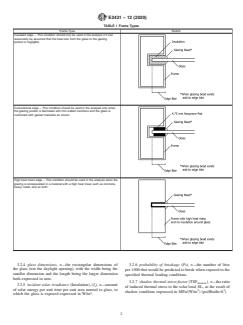
3.2.3 frame type, n—the manner in which the edges of the
responsibility of the user of this standard to establish appro-
glass are supported in the window frame (see Table 1).
priate safety, health, and environmental practices and deter-
mine the applicability of regulatory limitations prior to use.
For referenced ASTM standards, visit the ASTM website, www.astm.org, or
This practice is under the jurisdiction of ASTM Committee E06 on Perfor- contact ASTM Customer Service at service@astm.org. For Annual Book of ASTM
mance of Buildings and is the direct responsibility of Subcommittee E06.52 on Standards volume information, refer to the standard’s Document Summary page on
Glass Use in Buildings. the ASTM website.
Current edition approved July 1, 2020. Published July 2020. Originally approved Available from American Society of Heating, Refrigerating, and Air-
in 2006. Last previous edition approved in 2012 as E2431 – 12. DOI: 10.1520/ Conditioning Engineers, Inc. (ASHRAE), 1791 Tullie Circle, NE, Atlanta, GA
E2431-12R20. 30329, http://www.ashrae.org.
Copyright © ASTM International, 100 Barr Harbor Drive, PO Box C700, West Conshohocken, PA 19428-2959. United States
E2431 − 12 (2020)
TABLE 1 Frame Types
Frame Type Sketch
Insulated edge -- This condition should only be used in the analysis if it can
reasonably be assumed that the heat loss from the glass to the glazing
pocket is negligible.
Conventional edge -- This condition should be used in the analysis only when
the glazing pocket is fabricated with thin walled members and the glass is
cushioned with gasket materials as shown.
High heat mass edge -- This condition should be used in the analysis when the
glazing is encapsulated in a material with a high heat mass such as concrete,
heavy metal, and so forth.
3.2.4 glass dimensions, n—the rectangular dimensions of 3.2.6 probability of breakage (P ),n—the number of lites
b
the glass (not the daylight opening), with the width being the per 1000 that would be predicted to break when exposed to the
smaller dimension and the length being the larger dimension
specified thermal loading conditions.
both expressed in mm.
3.2.7 shadow thermal stress factor (TSF ),n—the ratio
shadow
3.2.5 incident solar irradiance (Insolation), (I ),n—amount
s
of induced thermal stress to the solar load, SL, as the result of
of solar energy per unit time per unit area normal to glass, to
2 2
shadow condition expressed in MPa/(W/m ) (psi/Btu/hr·ft ).
which the glass is exposed expressed in W/m .
E2431 − 12 (2020)
TABLE 2 Shadow Thermal Stress Factors to be Used with Fig. 2
3.2.8 solar load (SL),n—the total amount of solar irradi-
ance absorbed by the glass expressed in W/m . Shadow Condition Maximum TSF
shadow
kPa/(W/sq m)
3.2.9 solar load adjustment factor for interior shading
Linear shadow 15.3
Angular shadow 31.9
devices (SLA),n—nondimensional factor that is used to
L-Shaped shadow 20.8
account for the increase in thermal stress caused by the
Corner shadow 23.0
reflection of solar irradiance from an interior shading device.
3.2.10 solar reflectance of shading device (R ),n—decimal
s
fraction of incident solar irradiation reflected from the device
used as an interior shade.
5.3 Many other factors shall be considered in glass selec-
tion.These factors include, but are not limited to, mechanically
3.2.11 solar transmittance (T ),n—the amount of solar
s
induced stresses, wind effects, windborne debris impacts,
irradiance transmitted by the glass expressed as a fraction that
excessive deflections, seismic effects, heat flow, noise
ranges between 0.00 and 1.00.
abatement, potential post-breakage consequences, and so forth.
3.2.12 thermal stress, n—edge tensile stress (MPa) induced
In addition, considerations set forth in building codes along
in glass by solar irradiance.
with criteria presented in safety glazing standards and site
3.2.13 total solar absorptance (A ),n—the amount of solar
s
specific concerns may control the ultimate glass type and
irradiance absorbed by the glass expressed as a fraction that
thickness selection.
ranges between 0.00 and 1.00.
5.4 The proper use of this practice is intended to reduce the
3.2.14 total thermal stress factor (TSF ),n—the ratio of
tot
risk of thermally induced breakage of annealed window glass
total thermal stress induced in the glass by the combination of
in buildings.
edge conditions and shadow conditions to the solar load
expressed in MPa/(W/m ).
6. Procedure
6.1 Obtain the following information from the data supplied
4. Summary of Practice
by the specifier:
4.1 The specifying authority shall provide the glass width,
6.1.1 The edge bite condition that most closely represents
length, and nominal thickness; solar absorption of the glass
the project conditions from Table 1;
construction (can be obtained from manufacturer’s data);
6.1.2 The total solar transmittance (T ) of the specified
s
incident solar irradiance (can be determined from 2005
glass;
ASHRAE Handbook Fundamentals or other documented
6.1.3 The total solar absorptance (A ) of the specified glass:
s
source); the frame type and edge bite; description of exterior
A 5 1.00 2 T 2 R (1)
s s s
shading conditions; and interior shading devices.
where:
4.2 The procedure described in this practice shall be used to
R = total solar reflectance
determine if the glass can resist the calculated thermal stresses s
for a specified probability of breakage.
6.1.4 The solar reflectance of the shading device (RSD), if
used;
5. Significance and Use
6.1.5 The incident solar irradiance (I ) for this analysis; and
s
6.1.6 The specified acceptable probability of glass breakage
5.1 Use of this practice assumes:
(P ) for this analysis.
5.1.1 the glass edges shall be free from damage, b
5.1.2 the glass shall be properly glazed,
6.2 Multiply the incident solar irradiance (I ) by the solar
s
5.1.3 the glass shall not have been subjected to abuse, and
absorptance (A ) to determine the solar load (SL).
S
5.1.4 the glass edge support allows in-plane movement of
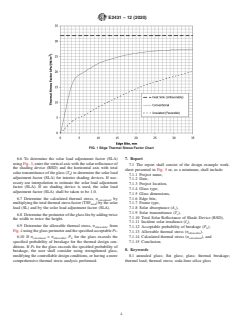
6.3 Determine the edge thermal stress factor (TSF ) from
edge
the glass due to thermal expansion and contraction.
Fig. 1, given the edge bite and edge bite condition.
5.2 This practice does not address all factors that cause
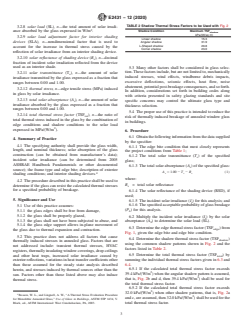
6.4 Determine the shadow thermal stress factor (TSF )
shadow
thermally induced stresses in annealed glass. Factors that are
using the common shadow patterns shown in Fig. 2 and the
not addressed include: transient thermal stresses, HVAC
factors listed in Table 2.
registers, thermally insulating window coverings, drop ceilings
6.5 Determine the total thermal stress factor (TSF )by
and other heat traps, increased solar irradiance caused by
total
summing the individual thermal stress factors given in 6.3 and
exteriorreflections,variationsinheattransfercoefficientsother
6.4.
than those assumed for the steady state analysis described
6.5.1 If the calculated total thermal stress factor exceeds
herein, and stresses induced by thermal sources other than the
39.4 kPa/(W/m ) when the angular shadow pattern is assumed,
sun. Factors other than those listed above may also induce
that is, Fig. 2b and d, then 39.4 kPa/(W/m ) shall be used for
thermal stress.
the total thermal stress factor.
6.5.2 If the calculated total thermal stress factor exceeds
32.0 kPa/(W/m ) when other shadow patterns, that is, Fig. 2a
Beason, W. L., and Lingnell, A. W., “A Thermal Stress Evaluation Procedure
and c, are assumed, then 32.0 kPa/(W/m ) shall be used for the
for Monolithic Annealed Glass,” Use of Glass in Buildings, ASTM STP 1434, V.
Block, ed., ASTM International: West Conshohocken, PA, 2003. total thermal stress factor.
E2431 − 12 (2020)
FIG. 1 Edge Thermal Stress Factor Chart
6.6 To determine the solar load adjustment factor (SLA) 7. Report
using Fig. 3, enter the vertical axis with the solar reflectance of
7.1 The report shall consist of the design example work-
the shading device (RSD) and the horizontal axis with total
sheet presented in Fig. 5 or, as a minimum, shall include:
solar transmittance of the glass (T ) to determine the solar load
S
7.1.1 Project name,
adjustment factor (SLA) for interior shading devices. If nec-
7.1.2 Date,
essary use interpolation to estimate the solar load adjustment
7.1.3 Project location,
factor (SLA). If no shading device is used, the solar load
7.1.4 Glass type,
adjustment factor (SLA) shall be taken to be 1.0.
7.1.5 Glass dimensions,
6.7 Determine the calculated thermal stress, σ ,by 7.1.6 Edge bite,
calculated
multiplyingthetotalthermalstressfactor(TSF )bythesolar 7.1.7 Frame type,
total
load (SL) and by the solar load adjustment factor (SLA). 7.1.8 Solar absorptance (A ),
s
7.1.9 Solar transmittance (T ),
s
6.8 Determinetheperimeteroftheglasslitebyaddingtwice
7.1.10 Total Solar Reflectance of Shade Device (RSD),
the width to twice the height.
7.1.11 Incident solar irradiance (I ),
s
6.9 Determine the allowable thermal stress, σ , from
allowable
7.1.12 Acceptable probability of breakage (P ),
b
Fig.4usingtheglassperimeterandthespecifiedacceptable P .
b
7.1.13 Allowable thermal stress (σ ),
allowable
7.1.14 Calculated thermal stress (σ ), and
6.10 If σ > σ , P for the glass exceeds the
calculated allowable b calculated
specified probability of breakage for the thermal design con- 7.1.15 Conclusion.
ditions. If P for
...