

ASTM E3119-19
(Test Method)Standard Test Method for Accelerated Aging of Environmentally Controlled Dynamic Glazing
General Information
- Abstract
SIGNIFICANCE AND USE
4.1 ECDG perform a number of important functions in a building envelope including: reducing the solar energy heat gain; providing a variable visual connection with the outside world; enhancing human comfort (heat gain), security, illumination, and glare control; providing for architectural expression, and (possibly) improving acoustical performance. It is therefore important to understand the relative serviceability of these glazings.
4.2 This test method is intended to provide a means for assessing the relative serviceability of ECDGs, as described in Section 1.
4.3 The test method is intended to simulate in-service use and accelerate aging of the environmentally controlled dynamic glazings.
4.4 Results from these tests cannot be used to predict the performance over time of in-service units unless actual corresponding in-service tests have been conducted and appropriate analyses have been conducted to show how performance can be predicted from the accelerated aging tests.
4.5 The procedure in this test method includes environmental test parameters that are typically used in weatherability tests by standards organizations and are realistic for the intended use of large-area ECDG units.
SCOPE
1.1 This test method covers the accelerated aging and monitoring of the time-dependent performance of environmentally controlled dynamic glazings such as thermochromic (TC) thermotropic, photochromic glazings. and combinations thereof.
1.2 The test method is applicable only for environmentally controlled dynamic glazings. These glazings may be either monolithic glass, monolithic laminated glass, or sealed insulating glass units fabricated for use in buildings, such as exterior doors, windows, skylights, and wall systems.
1.3 During use, the environmentally controlled dynamic glazings tested according to this method are exposed to environmental conditions, including solar radiation and are employed to control the amount of transmitted radiation by absorption and reflection and thus, limit the amount of solar radiation that is transmitted into a building.
1.4 The test method is not applicable to electronically controlled chromogenic devices, such as electrochromic devices.
1.5 The test method is not applicable to environmentally controlled dynamic glazings that are constructed from superstrate or substrate materials other than glass.
1.6 The test method referenced herein is a laboratory test conducted under specified conditions.
1.7 The values stated in SI units are to be regarded as standard. No other units of measurement are included in this standard.
1.8 This standard does not purport to address all of the safety concerns, if any, associated with its use. It is the responsibility of the user of this standard to establish appropriate safety, health, and environmental practices and determine the applicability of regulatory limitations prior to use.
1.9 This international standard was developed in accordance with internationally recognized principles on standardization established in the Decision on Principles for the Development of International Standards, Guides and Recommendations issued by the World Trade Organization Technical Barriers to Trade (TBT) Committee.
- Status
- Published
- Publication Date
- 31-Jul-2019
- Technical Committee
- E06 - Performance of Buildings
- Drafting Committee
- E06.22 - Durability Performance of Building Constructions
Buy Documents
ASTM E3119-19 - Standard Test Method for Accelerated Aging of Environmentally Controlled Dynamic Glazing

REDLINE ASTM E3119-19 - Standard Test Method for Accelerated Aging of Environmentally Controlled Dynamic Glazing
Overview
ASTM E3119-19: Standard Test Method for Accelerated Aging of Environmentally Controlled Dynamic Glazing is a crucial international standard developed by ASTM International. This test method outlines procedures for assessing the time-dependent durability and serviceability of environmentally controlled dynamic glazings (ECDGs) such as thermochromic, thermotropic, and photochromic glazings. These advanced fenestration products play a vital role in modern building envelopes by controlling solar energy heat gain, visual transmissivity, and enhancing occupant comfort.
The standard applies specifically to glass-based ECDGs used in architectural features like windows, doors, skylights, and facade wall systems. By exposing test specimens to simulated environmental conditions in a controlled laboratory setting, ASTM E3119-19 provides a systematic approach for accelerated aging and performance monitoring. This helps manufacturers, architects, and building owners make informed decisions about the suitability and expected longevity of innovative dynamic glazing technologies.
Key Topics
- Scope of Application: Covers glass-based, environmentally controlled dynamic glazings including monolithic, laminated, and insulated glass units. Excludes electronically controlled devices (such as electrochromic glass) and non-glass materials.
- Accelerated Aging Simulation: Specifies exposure to simulated solar radiation and controlled temperature/humidity cycles to mimic field conditions and speed up the aging process.
- Performance Monitoring: Involves periodic optical and visual characterization, focusing on photopic specular transmittance, visual degradation, and physical stability during and after testing.
- Environmental Parameters: Outlines realistic test conditions using spectrally filtered xenon-arc lamps to replicate solar exposure and temperature chambers to maintain specific test temperatures.
- Reporting Requirements: Details the necessary data collection, such as initial and post-aging optical performance, visual observations, and test conditions, ensuring transparency and repeatability.
Applications
ASTM E3119-19 is widely applicable in the following areas:
- Product Development and Quality Assurance: Enables manufacturers to evaluate and benchmark the long-term durability and performance of new or existing ECDG products under controlled accelerated aging tests.
- Building Design and Specification: Provides architects and engineers with reliable data for specifying ECDGs in projects prioritizing energy efficiency, comfort, daylighting, and glare control.
- Performance Validation and Warranty Claims: Offers a standardized basis for assessing claims related to durability, serviceability, and end-of-life characteristics of dynamic glazing products.
- Research and Innovation: Supports material scientists and industry researchers in analyzing the impact of variable environmental exposure on the optical and physical properties of smart fenestration solutions.
Related Standards
Building professionals often use ASTM E3119-19 alongside several related standards and terminology documents, including:
- ASTM E230/E230M: Temperature-Electromotive Force (emf) Tables for Standardized Thermocouples
- ASTM E631: Terminology of Building Constructions
- ASTM E3120: Specification for Evaluating Accelerated Aging Performance of Environmentally Controlled Dynamic Glazings
- ASTM G151 & G155: Weathering practices for nonmetallic materials and xenon arc apparatus operation
- ISO 9050: Glass in building - Determination of light and solar transmittance and related factors
By referencing and aligning with these documents, ASTM E3119-19 ensures that accelerated aging test results are accurate, repeatable, and fit for comparing the service life of innovative environmentally controlled dynamic glazings in real-world building applications.
Keywords: ASTM E3119-19, dynamic glazing, thermochromic glazing, photochromic glazing, accelerated aging test, ECDG, fenestration products, building envelope, durability testing, serviceability, energy-efficient glass, weathering standards.
Relations
- Effective Date
- 01-Aug-2019
- Effective Date
- 01-Nov-2023
- Effective Date
- 01-May-2023
- Effective Date
- 01-Sep-2017
- Effective Date
- 01-Mar-2015
- Effective Date
- 01-Nov-2014
- Effective Date
- 01-Mar-2014
- Effective Date
- 15-Nov-2012
- Effective Date
- 15-May-2011
- Effective Date
- 15-May-2011
- Effective Date
- 01-Apr-2010
- Effective Date
- 01-Jul-2009
- Effective Date
- 15-Jun-2009
- Effective Date
- 01-Aug-2008
- Effective Date
- 01-Jun-2008
Buy Documents
ASTM E3119-19 - Standard Test Method for Accelerated Aging of Environmentally Controlled Dynamic Glazing
REDLINE ASTM E3119-19 - Standard Test Method for Accelerated Aging of Environmentally Controlled Dynamic Glazing
Frequently Asked Questions
ASTM E3119-19 is a standard published by ASTM International. Its full title is "Standard Test Method for Accelerated Aging of Environmentally Controlled Dynamic Glazing". This standard covers: SIGNIFICANCE AND USE 4.1 ECDG perform a number of important functions in a building envelope including: reducing the solar energy heat gain; providing a variable visual connection with the outside world; enhancing human comfort (heat gain), security, illumination, and glare control; providing for architectural expression, and (possibly) improving acoustical performance. It is therefore important to understand the relative serviceability of these glazings. 4.2 This test method is intended to provide a means for assessing the relative serviceability of ECDGs, as described in Section 1. 4.3 The test method is intended to simulate in-service use and accelerate aging of the environmentally controlled dynamic glazings. 4.4 Results from these tests cannot be used to predict the performance over time of in-service units unless actual corresponding in-service tests have been conducted and appropriate analyses have been conducted to show how performance can be predicted from the accelerated aging tests. 4.5 The procedure in this test method includes environmental test parameters that are typically used in weatherability tests by standards organizations and are realistic for the intended use of large-area ECDG units. SCOPE 1.1 This test method covers the accelerated aging and monitoring of the time-dependent performance of environmentally controlled dynamic glazings such as thermochromic (TC) thermotropic, photochromic glazings. and combinations thereof. 1.2 The test method is applicable only for environmentally controlled dynamic glazings. These glazings may be either monolithic glass, monolithic laminated glass, or sealed insulating glass units fabricated for use in buildings, such as exterior doors, windows, skylights, and wall systems. 1.3 During use, the environmentally controlled dynamic glazings tested according to this method are exposed to environmental conditions, including solar radiation and are employed to control the amount of transmitted radiation by absorption and reflection and thus, limit the amount of solar radiation that is transmitted into a building. 1.4 The test method is not applicable to electronically controlled chromogenic devices, such as electrochromic devices. 1.5 The test method is not applicable to environmentally controlled dynamic glazings that are constructed from superstrate or substrate materials other than glass. 1.6 The test method referenced herein is a laboratory test conducted under specified conditions. 1.7 The values stated in SI units are to be regarded as standard. No other units of measurement are included in this standard. 1.8 This standard does not purport to address all of the safety concerns, if any, associated with its use. It is the responsibility of the user of this standard to establish appropriate safety, health, and environmental practices and determine the applicability of regulatory limitations prior to use. 1.9 This international standard was developed in accordance with internationally recognized principles on standardization established in the Decision on Principles for the Development of International Standards, Guides and Recommendations issued by the World Trade Organization Technical Barriers to Trade (TBT) Committee.
SIGNIFICANCE AND USE 4.1 ECDG perform a number of important functions in a building envelope including: reducing the solar energy heat gain; providing a variable visual connection with the outside world; enhancing human comfort (heat gain), security, illumination, and glare control; providing for architectural expression, and (possibly) improving acoustical performance. It is therefore important to understand the relative serviceability of these glazings. 4.2 This test method is intended to provide a means for assessing the relative serviceability of ECDGs, as described in Section 1. 4.3 The test method is intended to simulate in-service use and accelerate aging of the environmentally controlled dynamic glazings. 4.4 Results from these tests cannot be used to predict the performance over time of in-service units unless actual corresponding in-service tests have been conducted and appropriate analyses have been conducted to show how performance can be predicted from the accelerated aging tests. 4.5 The procedure in this test method includes environmental test parameters that are typically used in weatherability tests by standards organizations and are realistic for the intended use of large-area ECDG units. SCOPE 1.1 This test method covers the accelerated aging and monitoring of the time-dependent performance of environmentally controlled dynamic glazings such as thermochromic (TC) thermotropic, photochromic glazings. and combinations thereof. 1.2 The test method is applicable only for environmentally controlled dynamic glazings. These glazings may be either monolithic glass, monolithic laminated glass, or sealed insulating glass units fabricated for use in buildings, such as exterior doors, windows, skylights, and wall systems. 1.3 During use, the environmentally controlled dynamic glazings tested according to this method are exposed to environmental conditions, including solar radiation and are employed to control the amount of transmitted radiation by absorption and reflection and thus, limit the amount of solar radiation that is transmitted into a building. 1.4 The test method is not applicable to electronically controlled chromogenic devices, such as electrochromic devices. 1.5 The test method is not applicable to environmentally controlled dynamic glazings that are constructed from superstrate or substrate materials other than glass. 1.6 The test method referenced herein is a laboratory test conducted under specified conditions. 1.7 The values stated in SI units are to be regarded as standard. No other units of measurement are included in this standard. 1.8 This standard does not purport to address all of the safety concerns, if any, associated with its use. It is the responsibility of the user of this standard to establish appropriate safety, health, and environmental practices and determine the applicability of regulatory limitations prior to use. 1.9 This international standard was developed in accordance with internationally recognized principles on standardization established in the Decision on Principles for the Development of International Standards, Guides and Recommendations issued by the World Trade Organization Technical Barriers to Trade (TBT) Committee.
ASTM E3119-19 is classified under the following ICS (International Classification for Standards) categories: 81.040.20 - Glass in building. The ICS classification helps identify the subject area and facilitates finding related standards.
ASTM E3119-19 has the following relationships with other standards: It is inter standard links to ASTM E3119-17e1, ASTM E230/E230M-23a, ASTM E230/E230M-23, ASTM E3120-17, ASTM E631-15, ASTM E631-14, ASTM G113-14, ASTM E2141-12, ASTM E230/E230M-11, ASTM E230/E230M-11e1, ASTM G151-10, ASTM G151-09, ASTM G113-09, ASTM G113-08, ASTM G173-03(2008). Understanding these relationships helps ensure you are using the most current and applicable version of the standard.
ASTM E3119-19 is available in PDF format for immediate download after purchase. The document can be added to your cart and obtained through the secure checkout process. Digital delivery ensures instant access to the complete standard document.
Standards Content (Sample)
This international standard was developed in accordance with internationally recognized principles on standardization established in the Decision on Principles for the
Development of International Standards, Guides and Recommendations issued by the World Trade Organization Technical Barriers to Trade (TBT) Committee.
Designation: E3119 − 19
Standard Test Method for
Accelerated Aging of Environmentally Controlled Dynamic
Glazing
This standard is issued under the fixed designation E3119; the number immediately following the designation indicates the year of
original adoption or, in the case of revision, the year of last revision. A number in parentheses indicates the year of last reapproval. A
superscript epsilon (´) indicates an editorial change since the last revision or reapproval.
1. Scope 1.9 This international standard was developed in accor-
dance with internationally recognized principles on standard-
1.1 This test method covers the accelerated aging and
ization established in the Decision on Principles for the
monitoring of the time-dependent performance of environmen-
Development of International Standards, Guides and Recom-
tally controlled dynamic glazings such as thermochromic (TC)
mendations issued by the World Trade Organization Technical
thermotropic, photochromic glazings. and combinations
Barriers to Trade (TBT) Committee.
thereof.
1.2 The test method is applicable only for environmentally
2. Referenced Documents
controlled dynamic glazings. These glazings may be either
2.1 ASTM Standards:
monolithic glass, monolithic laminated glass, or sealed insu-
E230/E230M Specification for Temperature-Electromotive
lating glass units fabricated for use in buildings, such as
Force (emf) Tables for Standardized Thermocouples
exterior doors, windows, skylights, and wall systems.
E631 Terminology of Building Constructions
1.3 During use, the environmentally controlled dynamic
E2141 Test Method for Accelerated Aging of Electrochro-
glazings tested according to this method are exposed to
mic Devices in Sealed Insulating Glass Units
environmental conditions, including solar radiation and are
E3120 Specification for Evaluating Accelerated Aging Per-
employed to control the amount of transmitted radiation by
formance of Environmentally Controlled Dynamic Glaz-
absorption and reflection and thus, limit the amount of solar
ings
radiation that is transmitted into a building.
G113 Terminology Relating to Natural andArtificial Weath-
ering Tests of Nonmetallic Materials
1.4 The test method is not applicable to electronically
controlled chromogenic devices, such as electrochromic de- G151 Practice for Exposing Nonmetallic Materials inAccel-
erated Test Devices that Use Laboratory Light Sources
vices.
G155 Practice for Operating XenonArc LightApparatus for
1.5 The test method is not applicable to environmentally
Exposure of Non-Metallic Materials
controlled dynamic glazings that are constructed from super-
G173 TablesforReferenceSolarSpectralIrradiances:Direct
strate or substrate materials other than glass.
Normal and Hemispherical on 37° Tilted Surface
1.6 The test method referenced herein is a laboratory test
2.2 ISO Standard:
conducted under specified conditions.
ISO 9050 Glass in building–Determination of light
1.7 The values stated in SI units are to be regarded as
transmittance,solardirecttransmittance,totalsolarenergy
standard. No other units of measurement are included in this
transmittance, ultraviolet transmittance and related factors
standard.
1.8 This standard does not purport to address all of the 3. Terminology
safety concerns, if any, associated with its use. It is the
3.1 Definitions—Refer to Terminology in E631 and G113
responsibility of the user of this standard to establish appro-
for descriptions of general terms.
priate safety, health, and environmental practices and deter-
mine the applicability of regulatory limitations prior to use.
For referenced ASTM standards, visit the ASTM website, www.astm.org, or
This test method is under the jurisdiction of ASTM Committee E06 on contact ASTM Customer Service at service@astm.org. For Annual Book of ASTM
Performance of Buildings and is the direct responsibility of Subcommittee E06.22 Standards volume information, refer to the standard’s Document Summary page on
on Durability Performance of Building Constructions. the ASTM website.
Current edition approved Aug. 1, 2019. Published September 2019. Originally Available from International Organization for Standardization (ISO), ISO
ɛ1
approved in 2017. Last previous edition approved in 2017 as E3119–17 . DOI: Central Secretariat, BIBC II, Chemin de Blandonnet 8, CP 401, 1214 Vernier,
10.1520/E3119–19. Geneva, Switzerland, http://www.iso.org.
Copyright © ASTM International, 100 Barr Harbor Drive, PO Box C700, West Conshohocken, PA 19428-2959. United States
E3119 − 19
3.2 Definitions of Terms Specific to This Standard: 3.3.4 NIR—near-infrared (radiation).
3.2.1 accelerated aging test, n—a test in which the rate of
3.3.5 T —highest specified temperature for recording
H
degradation of building components or materials is intention-
specular transmittance.
ally increased from that expected in actual service.
3.3.6 T —lowest specified temperature for recording specu-
L
3.2.2 environmentally controlled dynamic glazing (ECDG),
lar transmittance.
n—in a prepared opening of a building, the glazing material
3.3.7 T —midrange specified temperature for recording
M
installed in which the optical properties can change in response
specular transmittance.
to environmental stimuli such as sunlight and/or temperature.
3.3.8 UV—ultraviolet (radiation).
3.2.3 highest transmittance state, n—also referred to as the
clear state or bleached state, a descriptor for an ECDG glazing
4. Significance and Use
when it is in the transmittance state with the highest photopic
4.1 ECDG perform a number of important functions in a
specular light transmittance.
building envelope including: reducing the solar energy heat
3.2.4 lateral uniformity, n—the degree of variation in the
gain; providing a variable visual connection with the outside
amount of irradiance in the x and y directions in the test plane
world; enhancing human comfort (heat gain), security,
used for exposing an ECDG glazing.
illumination, and glare control; providing for architectural
3.2.5 layer temperature, n—the temperature, as measured expression, and (possibly) improving acoustical performance.
by a thermocouple, of the lite having environmentally respon- It is therefore important to understand the relative serviceabil-
sive properties. ity of these glazings.
3.2.6 photochromic glazing, n—an environmentally con- 4.2 This test method is intended to provide a means for
trolled dynamic glazing which changes its optical properties in
assessing the relative serviceability of ECDGs, as described in
response to exposure to solar radiation. Section 1.
3.2.7 photopic tranmission, n—a function of the spectral
4.3 The test method is intended to simulate in-service use
transmittance of a specimen weighted by the corresponding and accelerate aging of the environmentally controlled dy-
ordinates of the spectral luminous efficiency for photopic namic glazings.
vision V(λ) and the spectral intensity of standard illuminant
4.4 Results from these tests cannot be used to predict the
D65. ISO 9050
performance over time of in-service units unless actual corre-
3.2.8 serviceability, n—the capability of a building product,
sponding in-service tests have been conducted and appropriate
component, assembly, or construction to perform the func-
analyses have been conducted to show how performance can
tion(s) for which it was designed and constructed.
be predicted from the accelerated aging tests.
3.2.9 solar irradiance, n—as related to natural weathering
4.5 The procedure in this test method includes environmen-
of materials, the irradiance of the sun incident on the earth’s
taltestparametersthataretypicallyusedinweatherabilitytests
surface, having wavelengths between 295 nm and 4050 nm.
bystandardsorganizationsandarerealisticfortheintendeduse
of large-area ECDG units.
3.2.10 specular (regular) transmittance, n—the optical
transmittance that does not include light with a diffuse com-
5. Apparatus
ponent.
5.1 Accelerated Weathering Unit (AWU), consisting of a
3.2.11 thermochromic glazing, n—an environmentally con-
temperature controlled chamber with properly filtered xenon-
trolled dynamic glazing which changes its optical properties in
arc lamp(s) to simulate the spectral power distribution of solar
response to exposure to a broad range of temperatures
radiation over the UV/Visible and NIR wavelength region
(≥10 °C).
(Tables for Reference G173) operated in accordance with
3.2.12 thermotropic glazing, n—an environmentally con-
Practice G155.
trolled dynamic glazing which changes its optical properties at
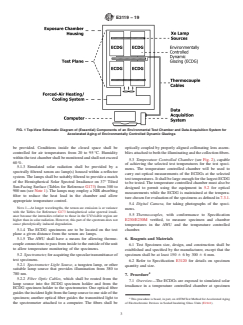
5.1.1 Fig. 1 shows a top-view schematic diagram of the
a discrete temperature or over a small range of temperatures
essential features of the environmental test chamber including
(that is, <10 °C).
the layout of the ECDG on a test plane of sufficient size to test
3.2.13 transition temperature, n—specifically in thermo-
at least four specimens simultaneously, the location of a
tropic ECDG, it is temperature at which the optical properties
sufficient number of xenon-arc lamps above the test plane to
ofagivenglazingswitchesbetweenhighesttransmittancestate
deliver the specified radiation intensity, and the necessary
and lowest transmittance state.
connecting thermocouple cables from the ECDGs to the
3.2.13.1 Discussion—In thermochromic glazing, the optical computer-controlled data acquisition system.
properties change continuously over a broad temperature range 5.1.2 Some means of adjusting the light intensity and
(that is, ≥10 °C) and so do not have a transition temperature.
uniformityonthetestplaneshallbeprovidedinordertoobtain
the desired light intensity and lateral uniformity within the
3.3 Acronyms:
guidelines of this document. This can be provided through
3.3.1 AWU—accelerated weathering unit.
adjustment of the position of the test plane relative to the
3.3.2 ECDG—environmentally controlled dynamic glazing.
lamp(s) or through adjustment of the output of the lamps
3.3.3 IGU(s)—insulating glass unit(s). themselves. Temperature control within the test chamber shall
E3119 − 19
FIG. 1 Top-View Schematic Diagram of (Essential) Components of an Environmental Test Chamber and Data Acquisition System for
Accelerated Aging of Environmentally Controlled Dynamic Glazings
be provided. Conditions inside the closed space shall be optically coupled by properly aligned collimating lens assem-
controlled for air temperatures from 20 to 95 °C. Humidity blies attached to both the illuminating and the collection fibers.
withinthetestchambershallbemonitoredandshallnotexceed
5.3 Temperature Controlled Chamber (see Fig. 2), capable
60 %.
of achieving the selected test temperatures for the test speci-
5.1.3 Simulated solar radiation shall be provided by a
mens. The temperature controlled chamber will be used to
spectrally filtered xenon arc lamp(s) housed within a reflector
carry out optical measurements of the ECDGs at the selected
system. The lamps shall be suitably filtered to provide a match
testtemperatures.ItshallbelargeenoughforthelargestECDG
of the Hemispherical Solar Spectral Irradiance on 37° Tilted
to be tested. The temperature controlled chamber must also be
Sun-Facing Surface (Tables for Reference G173) from 300 to
designed to permit using the equipment in 5.2 for optical
900 nm (see Note 1). The lamps may employ a NIR absorbing
measurements while the ECDG is maintained at the tempera-
filter to reduce the heat load in the chamber and allow
ture chosen for evaluation of the specimens as defined in 7.3.1.
appropriate temperature control.
5.4 Digital Camera, for taking photographs of the speci-
NOTE 1—At longer wavelengths, the xenon arc emission is at variance
mens.
with the Tables for Reference G173 hemispherical solar spectral irradi-
5.5 Thermocouples, with conformance to Specification
ance because the intensities relative to those in the UV/visible region are
higher than in solar radiation. However, this part of the spectrum does not
E230/E230M verified, to measure specimen and chamber
cause photolytically induced degradation.
temperatures in the AWU and the temperature controlled
5.1.4 The ECDG specimens are to be located on the test chamber.
plane a given distance from the xenon arc lamps.
6. Reagents and Materials
5.1.5 The AWU shall have a means for allowing thermo-
coupleconnectionstopassfrominsidetotheoutsideoftheunit
6.1 Test Specimen siz
...
This document is not an ASTM standard and is intended only to provide the user of an ASTM standard an indication of what changes have been made to the previous version. Because
it may not be technically possible to adequately depict all changes accurately, ASTM recommends that users consult prior editions as appropriate. In all cases only the current version
of the standard as published by ASTM is to be considered the official document.
´1
Designation: E3119 − 17 E3119 − 19
Standard Test Method for
Accelerated Aging of Environmentally Controlled Dynamic
Glazing
This standard is issued under the fixed designation E3119; the number immediately following the designation indicates the year of
original adoption or, in the case of revision, the year of last revision. A number in parentheses indicates the year of last reapproval. A
superscript epsilon (´) indicates an editorial change since the last revision or reapproval.
ε NOTE—Section 6.1 was corrected editorially in April 2018.
1. Scope
1.1 This test method covers the accelerated aging and monitoring of the time-dependent performance of environmentally
controlled dynamic glazings such as thermochromic (TC) thermotropic, photochromic glazings. and combinations thereof.
1.2 The test method is applicable only for environmentally controlled dynamic glazings. These glazings may be either
monolithic glass, monolithic laminated glass, or sealed insulating glass units fabricated for use in buildings, such as exterior doors,
windows, skylights, and wall systems.
1.3 During use, the environmentally controlled dynamic glazings tested according to this method are exposed to environmental
conditions, including solar radiation and are employed to control the amount of transmitted radiation by absorption and reflection
and thus, limit the amount of solar radiation that is transmitted into a building.
1.4 The test method is not applicable to electronically controlled chromogenic devices, such as electrochromic devices.
1.5 The test method is not applicable to environmentally controlled dynamic glazings that are constructed from superstrate or
substrate materials other than glass.
1.6 The test method referenced herein is a laboratory test conducted under specified conditions.
1.7 The values stated in SI units are to be regarded as standard. No other units of measurement are included in this standard.
1.8 This standard does not purport to address all of the safety concerns, if any, associated with its use. It is the responsibility
of the user of this standard to establish appropriate safety, health, and environmental practices and determine the applicability of
regulatory limitations prior to use.
1.9 This international standard was developed in accordance with internationally recognized principles on standardization
established in the Decision on Principles for the Development of International Standards, Guides and Recommendations issued
by the World Trade Organization Technical Barriers to Trade (TBT) Committee.
2. Referenced Documents
2.1 ASTM Standards:
E230/E230M Specification for Temperature-Electromotive Force (emf) Tables for Standardized Thermocouples
E631 Terminology of Building Constructions
E2141 Test Method for Accelerated Aging of Electrochromic Devices in Sealed Insulating Glass Units
E3120 Specification for Evaluating Accelerated Aging Performance of Environmentally Controlled Dynamic Glazings
G113 Terminology Relating to Natural and Artificial Weathering Tests of Nonmetallic Materials
G151 Practice for Exposing Nonmetallic Materials in Accelerated Test Devices that Use Laboratory Light Sources
G155 Practice for Operating Xenon Arc Light Apparatus for Exposure of Non-Metallic Materials
G173 Tables for Reference Solar Spectral Irradiances: Direct Normal and Hemispherical on 37° Tilted Surface
This test method is under the jurisdiction of ASTM Committee E06 on Performance of Buildings and is the direct responsibility of Subcommittee E06.22 on Durability
Performance of Building Constructions.
Current edition approved Nov. 1, 2017Aug. 1, 2019. Published December 2017September 2019. Originally approved in 2017. Last previous edition approved in 2017 as
ɛ1
E3119–17 . DOI: 10.1520/E3119-17E01.10.1520/E3119–19.
For referenced ASTM standards, visit the ASTM website, www.astm.org, or contact ASTM Customer Service at service@astm.org. For Annual Book of ASTM Standards
volume information, refer to the standard’s Document Summary page on the ASTM website.
Copyright © ASTM International, 100 Barr Harbor Drive, PO Box C700, West Conshohocken, PA 19428-2959. United States
E3119 − 19
2.2 ISO Standard:
ISO 9050 Glass in building–Determination of light transmittance, solar direct transmittance, total solar energy transmittance,
ultraviolet transmittance and related factors
3. Terminology
3.1 Definitions—Refer to Terminology in E631 and G113 for descriptions of general terms.
Available from International Organization for Standardization (ISO), ISO Central Secretariat, BIBC II, Chemin de Blandonnet 8, CP 401, 1214 Vernier, Geneva,
Switzerland, http://www.iso.org.
E3119 − 19
3.2 Definitions of Terms Specific to This Standard:
3.2.1 accelerated aging test, n—a test in which the rate of degradation of building components or materials is intentionally
increased from that expected in actual service.
3.2.2 environmentally controlled dynamic glazing (ECDG), n—in a prepared opening of a building, the glazing material
installed in which the optical properties can change in response to environmental stimuli such as sunlight and/or temperature.
3.2.3 highest transmittance state, n—also referred to as the clear state or bleached state, a descriptor for an ECDG glazing when
it is in the transmittance state with the highest photopic specular light transmittance.
3.2.4 lateral uniformity, n—the degree of variation in the amount of irradiance in the x and y directions in the test plane used
for exposing an ECDG glazing.
3.2.5 layer temperature, n—the temperature, as measured by a thermocouple, of the lite having environmentally responsive
properties.
3.2.6 photochromic glazing, n—an environmentally controlled dynamic glazing which changes its optical properties in response
to exposure to solar radiation.
3.2.7 photopic tranmission, n—a function of the spectral transmittance of a specimen weighted by the corresponding ordinates
of the spectral luminous efficiency for photopic vision V(λ) and the spectral intensity of standard illuminant D65. ISO 9050
3.2.8 serviceability, n—the capability of a building product, component, assembly, or construction to perform the function(s) for
which it was designed and constructed.
3.2.9 solar irradiance, n—as related to natural weathering of materials, the irradiance of the sun incident on the earth’s surface,
having wavelengths between 295 nm and 4050 nm.
3.2.10 specular (regular) transmittance, n—the optical transmittance that does not include light with a diffuse component.
3.2.11 thermochromic glazing, n—an environmentally controlled dynamic glazing which changes its optical properties in
response to exposure to a broad range of temperatures (≥10 °C).
3.2.12 thermotropic glazing, n—an environmentally controlled dynamic glazing which changes its optical properties at a
discrete temperature or over a small range of temperatures (that is, <10 °C).
3.2.13 transition temperature, n—specifically in thermotropic ECDG, it is temperature at which the optical properties of a given
glazing switches between highest transmittance state and lowest transmittance state.
3.2.13.1 Discussion—
In thermochromic glazing, the optical properties change continuously over a broad temperature range (that is, ≥10 °C) and so do
not have a transition temperature.
3.3 Acronyms:
3.3.1 AWU—accelerated weathering unit.
3.3.2 ECDG—environmentally controlled dynamic glazing.
3.3.3 IGU(s)—insulating glass unit(s).
3.3.4 NIR—near-infrared (radiation).
3.3.5 T —highest specified temperature for recording specular transmittance.
H
3.3.6 T —lowest specified temperature for recording specular transmittance.
L
3.3.7 T —midrange specified temperature for recording specular transmittance.
M
3.3.8 UV—ultraviolet (radiation).
4. Significance and Use
4.1 ECDG perform a number of important functions in a building envelope including: reducing the solar energy heat gain;
providing a variable visual connection with the outside world; enhancing human comfort (heat gain), security, illumination, and
glare control; providing for architectural expression, and (possibly) improving acoustical performance. It is therefore important to
understand the relative serviceability of these glazings.
4.2 This test method is intended to provide a means for assessing the relative serviceability of ECDGs, as described in Section
1.
4.3 The test method is intended to simulate in-service use and accelerate aging of the environmentally controlled dynamic
glazings.
4.4 Results from these tests cannot be used to predict the performance over time of in-service units unless actual corresponding
in-service tests have been conducted and appropriate analyses have been conducted to show how performance can be predicted
from the accelerated aging tests.
E3119 − 19
4.5 The procedure in this test method includes environmental test parameters that are typically used in weatherability tests by
standards organizations and are realistic for the intended use of large-area ECDG units.
5. Apparatus
5.1 Accelerated Weathering Unit (AWU), consisting of a temperature controlled chamber with properly filtered xenon-arc
lamp(s) to simulate the spectral power distribution of solar radiation over the UV/Visible and NIR wavelength region (Tables for
Reference G173) operated in accordance with Practice G155.
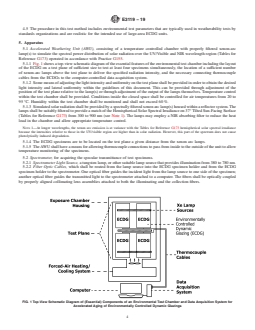
5.1.1 Fig. 1 shows a top-view schematic diagram of the essential features of the environmental test chamber including the layout
of the ECDG on a test plane of sufficient size to test at least four specimens simultaneously, the location of a sufficient number
of xenon-arc lamps above the test plane to deliver the specified radiation intensity, and the necessary connecting thermocouple
cables from the ECDGs to the computer-controlled data acquisition system.
5.1.2 Some means of adjusting the light intensity and uniformity on the test plane shall be provided in order to obtain the desired
light intensity and lateral uniformity within the guidelines of this document. This can be provided through adjustment of the
position of the test plane relative to the lamp(s) or through adjustment of the output of the lamps themselves. Temperature control
within the test chamber shall be provided. Conditions inside the closed space shall be controlled for air temperatures from 20 to
95 °C. Humidity within the test chamber shall be monitored and shall not exceed 60 %.
5.1.3 Simulated solar radiation shall be provided by a spectrally filtered xenon arc lamp(s) housed within a reflector system. The
lamps shall be suitably filtered to provide a match of the Hemispherical Solar Spectral Irradiance on 37° Tilted Sun-Facing Surface
(Tables for Reference G173) from 300 to 900 nm (see Note 1). The lamps may employ a NIR absorbing filter to reduce the heat
load in the chamber and allow appropriate temperature control.
NOTE 1—At longer wavelengths, the xenon arc emission is at variance with the Tables for Reference G173 hemispherical solar spectral irradiance
because the intensities relative to those in the UV/visible region are higher than in solar radiation. However, this part of the spectrum does not cause
photolytically induced degradation.
5.1.4 The ECDG specimens are to be located on the test plane a given distance from the xenon arc lamps.
5.1.5 The AWU shall have a means for allowing thermocouple connections to pass from inside to the outside of the unit to allow
temperature monitoring of the specimens.
5.2 Spectrometer, for acquiring the specular transmittance of test specimens.
5.2.1 Spectrometer Light Source, a tungsten lamp, or other suitable lamp source that provides illumination from 380 to 780 nm.
5.2.2 Fiber Optic Cables, which shall be routed from the lamp source into the ECDG specimen holder and from the ECDG
specimen holder to the spectrometer. One optical fiber guides the incident light from the lamp source to one side of the specimen;
another optical fiber guides the transmitted light to the spectrometer attached to a computer. The fibers shall be optically coupled
by properly aligned collimating lens assemblies attached to both the illuminating and the collection fibers.
FIG. 1 Top-View Schematic Diagram of (Essential) Components of an Environmental Test Chamber and Data Acquisition System for
Accelerated Aging of Environmentally Controlled Dynamic Glazings
E3119 − 19
5.3 Temperature C
...