

ASTM C1369-19
(Specification)Standard Specification for Secondary Edge Sealants for Structurally Glazed Insulating Glass Units
General Information
- Abstract
ABSTRACT
This specification covers cold, liquid-applied, single or multi-component, chemically curing, elastomeric secondary edge sealants for sealed structurally glazed insulating glass units. Only the minimum acceptable test requirements for and the durability of these materials are described by this specification. A sealant that qualifies under this specification is classified into two types according to the number of components and into two uses according to application. Sealants should conform to the required values of extrudability, rheology, hardness, heat aging, weight loss, cracking, chalking, durability, tensile strength, and minimum shelf life.
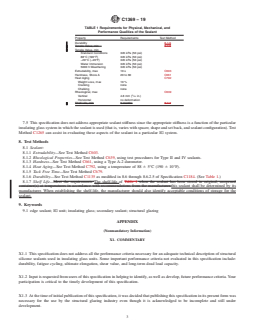
SIGNIFICANCE AND USE
7.1 Not all sealants meeting this specification should be presumed to be suitable for all applications and all substrates. This specification assists in selecting sealants that meet certain minimum standards of performance.
7.2 This specification does not evaluate the adhesion of the secondary sealant to the IG unit spacer. Adhesion of the secondary sealant to the spacer is generally considered necessary for the successful performance of the IG unit edge seal.
7.3 When specifying a sealant using this specification, it is essential that the applicable type and use also be included in the requirements. This will ensure that the proper sealant is provided for the intended use.
7.4 IG units qualified by this specification shall have a low moisture vapor transmission sealant for a primary seal and a structural silicone sealant for a secondary seal.
7.5 This specification does not address appropriate sealant stiffness since the appropriate stiffness is a function of the particular insulating glass system in which the sealant is used (that is, varies with spacer, shape and set back, and sealant configuration). Test Method C1265 can assist in evaluating these aspects of the sealant in a particular IG system.
SCOPE
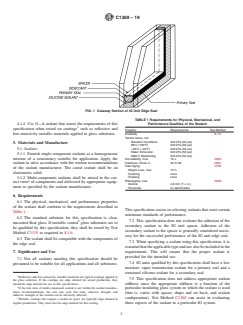
1.1 This specification describes the properties of cold, liquid-applied, single or multi-component, chemically curing, elastomeric sealants used as the secondary seal of sealed insulating glass units, hereinafter referred to as the “sealant” (see Fig. 1). These sealants are intended to be a structural component of sealed insulating glass (IG) units used in structural sealant glazing (hereinafter referred to as SSG). Typical designs and considerations can be found in Guide C1249. Presently only certain silicone sealants are recognized as having the necessary durability for use as secondary sealant in IG units in SSG applications.
FIG. 1 Cutaway Section of IG Unit Edge Seal
1.2 This specification does not describe all of the necessary properties of the sealant. Only those properties for which there are ASTM test methods and industry-agreed-upon minimum acceptable test requirements are described by this specification. Additional properties will be added as ASTM test methods for these properties become available.
1.3 This specification only addresses the durability of the secondary edge sealants for structurally glazed insulating glass units. Durability of sealed insulating glass units can be found in specifications and guides that reside within ASTM Committee E06.
1.4 The committee with jurisdiction for this standard is not aware of any comparable standard published by other organizations.
1.5 The values stated in SI units are to be regarded as the standard. The values given in parentheses are for information purposes only.
1.6 This international standard was developed in accordance with internationally recognized principles on standardization established in the Decision on Principles for the Development of International Standards, Guides and Recommendations issued by the World Trade Organization Technical Barriers to Trade (TBT) Committee.
- Status
- Published
- Publication Date
- 31-Dec-2018
- Technical Committee
- C24 - Building Seals and Sealants
- Drafting Committee
- C24.10 - Specifications, Guides and Practices
Buy Documents


ASTM C1369-19 - Standard Specification for Secondary Edge Sealants for Structurally Glazed Insulating Glass Units

REDLINE ASTM C1369-19 - Standard Specification for Secondary Edge Sealants for Structurally Glazed Insulating Glass Units
Overview
ASTM C1369-19: Standard Specification for Secondary Edge Sealants for Structurally Glazed Insulating Glass Units establishes minimum requirements for cold, liquid-applied, single or multi-component, chemically curing, elastomeric secondary edge sealants used in insulating glass (IG) units for structural glazing applications. This standard supports the selection of appropriate secondary edge sealants to ensure the durability and performance of structurally glazed IG units, which play a key role in modern curtain walls and building envelopes.
ASTM C1369-19 is maintained by ASTM International and specifies the essential physical, mechanical, and performance requirements for secondary sealants, including tensile strength, durability, hardness, rheology, extrudability, shelf life, heat aging, and other critical properties impacting long-term performance and reliability.
Key Topics
- Sealant Classification: Defines two types-Type S (single component) and Type M (multi-component)-and categorizes uses-Use G (clear, uncoated float glass substrates) and Use O (coated glass substrates such as reflective or low-emissivity glass).
- Scope of Coverage: Addresses only those properties with established ASTM test methods and industry-agreed minimum requirements; does not cover all performance aspects or adhesion to IG unit spacers.
- Performance Requirements: Includes standardized testing for:
- Extrudability
- Rheological (Flow) Properties
- Hardness (Shore A)
- Heat Aging
- Tensile Strength
- Durability
- Weight Loss, Cracking, and Chalking
- Shelf Life
- Substrate Compatibility: Stresses the importance of testing sealants with relevant glass types and substrate coatings. Compatibility with edge-seal components must also be confirmed.
- Application Guidance: Calls for compliance with sealant manufacturer instructions, ensuring proper mixing for multi-component sealants and correct application procedures for consistent curing and structural performance.
Applications
ASTM C1369-19 is widely applicable in the commercial and residential construction sectors where structurally glazed insulating glass units are specified. Appropriate use cases include:
- Curtain Wall Systems: Ensures reliable secondary edge sealing, critical for integrity and energy efficiency in high-rise buildings and glazed facades.
- Storefronts and Commercial Entrances: Provides standards for secondary sealants in IG units exposed to structural loads and varying environmental conditions.
- Architectural Glazing: Used in projects requiring structurally glazed IG units, particularly where silicone sealants are specified for superior durability and moisture resistance.
- Building Retrofit and Remediation: Supports quality assurance where replacement or repair of IG unit edge seals is necessary in existing buildings.
The specification assists architects, builders, glazing contractors, and quality assurance professionals in selecting and qualifying sealants that meet recognized industry standards, minimizing risk and enhancing performance.
Related Standards
For comprehensive implementation, ASTM C1369-19 references several related ASTM standards, including:
- ASTM C1184: Specification for Structural Silicone Sealants
- ASTM C1249: Guide for Secondary Seal for Sealed Insulating Glass Units for Structural Sealant Glazing
- ASTM C603: Test Method for Extrusion Rate and Application Life of Elastomeric Sealants
- ASTM C639: Test Method for Rheological Properties of Elastomeric Sealants
- ASTM C661: Test Method for Indentation Hardness of Elastomeric-Type Sealants
- ASTM C792: Test Method for Effects of Heat Aging on Weight Loss, Cracking, and Chalking of Elastomeric Sealants
- ASTM C1135: Test Method for Determining Tensile Adhesion Properties of Structural Sealants
- ASTM C1265: Test Method for Determining the Tensile Properties of an Insulating Glass Edge Seal for Structural Glazing Applications
These interconnected standards provide a complete framework for specifying, testing, and evaluating sealants and related materials in insulating glass unit construction and structural glazing systems.
Keywords: insulating glass, secondary edge sealant, structural glazing, ASTM C1369-19, IG unit, silicone sealant, curtain wall, building envelope, durability, construction standards.
Relations
- Effective Date
- 01-Jan-2019
- Refers
ASTM C639-15(2020) - Standard Test Method for Rheological (Flow) Properties of Elastomeric Sealants - Effective Date
- 01-May-2020
- Effective Date
- 01-May-2019
- Effective Date
- 01-Mar-2019
- Effective Date
- 01-Jan-2019
- Effective Date
- 01-Jun-2018
- Effective Date
- 01-Mar-2018
- Effective Date
- 01-Nov-2017
- Effective Date
- 01-Jan-2017
- Effective Date
- 15-Nov-2016
- Effective Date
- 01-Sep-2016
- Effective Date
- 01-Dec-2015
- Effective Date
- 01-Jun-2015
- Effective Date
- 15-Mar-2015
- Effective Date
- 01-Jun-2014
Buy Documents
ASTM C1369-19 - Standard Specification for Secondary Edge Sealants for Structurally Glazed Insulating Glass Units
REDLINE ASTM C1369-19 - Standard Specification for Secondary Edge Sealants for Structurally Glazed Insulating Glass Units
Get Certified
Connect with accredited certification bodies for this standard

DIBt (Deutsches Institut für Bautechnik)
German Institute for Building Technology.
DIN CERTCO
DIN Group product certification.

Aboma Certification B.V.
Specialized in construction, metal, and transport sectors.
Sponsored listings
Frequently Asked Questions
ASTM C1369-19 is a technical specification published by ASTM International. Its full title is "Standard Specification for Secondary Edge Sealants for Structurally Glazed Insulating Glass Units". This standard covers: ABSTRACT This specification covers cold, liquid-applied, single or multi-component, chemically curing, elastomeric secondary edge sealants for sealed structurally glazed insulating glass units. Only the minimum acceptable test requirements for and the durability of these materials are described by this specification. A sealant that qualifies under this specification is classified into two types according to the number of components and into two uses according to application. Sealants should conform to the required values of extrudability, rheology, hardness, heat aging, weight loss, cracking, chalking, durability, tensile strength, and minimum shelf life. SIGNIFICANCE AND USE 7.1 Not all sealants meeting this specification should be presumed to be suitable for all applications and all substrates. This specification assists in selecting sealants that meet certain minimum standards of performance. 7.2 This specification does not evaluate the adhesion of the secondary sealant to the IG unit spacer. Adhesion of the secondary sealant to the spacer is generally considered necessary for the successful performance of the IG unit edge seal. 7.3 When specifying a sealant using this specification, it is essential that the applicable type and use also be included in the requirements. This will ensure that the proper sealant is provided for the intended use. 7.4 IG units qualified by this specification shall have a low moisture vapor transmission sealant for a primary seal and a structural silicone sealant for a secondary seal. 7.5 This specification does not address appropriate sealant stiffness since the appropriate stiffness is a function of the particular insulating glass system in which the sealant is used (that is, varies with spacer, shape and set back, and sealant configuration). Test Method C1265 can assist in evaluating these aspects of the sealant in a particular IG system. SCOPE 1.1 This specification describes the properties of cold, liquid-applied, single or multi-component, chemically curing, elastomeric sealants used as the secondary seal of sealed insulating glass units, hereinafter referred to as the “sealant” (see Fig. 1). These sealants are intended to be a structural component of sealed insulating glass (IG) units used in structural sealant glazing (hereinafter referred to as SSG). Typical designs and considerations can be found in Guide C1249. Presently only certain silicone sealants are recognized as having the necessary durability for use as secondary sealant in IG units in SSG applications. FIG. 1 Cutaway Section of IG Unit Edge Seal 1.2 This specification does not describe all of the necessary properties of the sealant. Only those properties for which there are ASTM test methods and industry-agreed-upon minimum acceptable test requirements are described by this specification. Additional properties will be added as ASTM test methods for these properties become available. 1.3 This specification only addresses the durability of the secondary edge sealants for structurally glazed insulating glass units. Durability of sealed insulating glass units can be found in specifications and guides that reside within ASTM Committee E06. 1.4 The committee with jurisdiction for this standard is not aware of any comparable standard published by other organizations. 1.5 The values stated in SI units are to be regarded as the standard. The values given in parentheses are for information purposes only. 1.6 This international standard was developed in accordance with internationally recognized principles on standardization established in the Decision on Principles for the Development of International Standards, Guides and Recommendations issued by the World Trade Organization Technical Barriers to Trade (TBT) Committee.
ABSTRACT This specification covers cold, liquid-applied, single or multi-component, chemically curing, elastomeric secondary edge sealants for sealed structurally glazed insulating glass units. Only the minimum acceptable test requirements for and the durability of these materials are described by this specification. A sealant that qualifies under this specification is classified into two types according to the number of components and into two uses according to application. Sealants should conform to the required values of extrudability, rheology, hardness, heat aging, weight loss, cracking, chalking, durability, tensile strength, and minimum shelf life. SIGNIFICANCE AND USE 7.1 Not all sealants meeting this specification should be presumed to be suitable for all applications and all substrates. This specification assists in selecting sealants that meet certain minimum standards of performance. 7.2 This specification does not evaluate the adhesion of the secondary sealant to the IG unit spacer. Adhesion of the secondary sealant to the spacer is generally considered necessary for the successful performance of the IG unit edge seal. 7.3 When specifying a sealant using this specification, it is essential that the applicable type and use also be included in the requirements. This will ensure that the proper sealant is provided for the intended use. 7.4 IG units qualified by this specification shall have a low moisture vapor transmission sealant for a primary seal and a structural silicone sealant for a secondary seal. 7.5 This specification does not address appropriate sealant stiffness since the appropriate stiffness is a function of the particular insulating glass system in which the sealant is used (that is, varies with spacer, shape and set back, and sealant configuration). Test Method C1265 can assist in evaluating these aspects of the sealant in a particular IG system. SCOPE 1.1 This specification describes the properties of cold, liquid-applied, single or multi-component, chemically curing, elastomeric sealants used as the secondary seal of sealed insulating glass units, hereinafter referred to as the “sealant” (see Fig. 1). These sealants are intended to be a structural component of sealed insulating glass (IG) units used in structural sealant glazing (hereinafter referred to as SSG). Typical designs and considerations can be found in Guide C1249. Presently only certain silicone sealants are recognized as having the necessary durability for use as secondary sealant in IG units in SSG applications. FIG. 1 Cutaway Section of IG Unit Edge Seal 1.2 This specification does not describe all of the necessary properties of the sealant. Only those properties for which there are ASTM test methods and industry-agreed-upon minimum acceptable test requirements are described by this specification. Additional properties will be added as ASTM test methods for these properties become available. 1.3 This specification only addresses the durability of the secondary edge sealants for structurally glazed insulating glass units. Durability of sealed insulating glass units can be found in specifications and guides that reside within ASTM Committee E06. 1.4 The committee with jurisdiction for this standard is not aware of any comparable standard published by other organizations. 1.5 The values stated in SI units are to be regarded as the standard. The values given in parentheses are for information purposes only. 1.6 This international standard was developed in accordance with internationally recognized principles on standardization established in the Decision on Principles for the Development of International Standards, Guides and Recommendations issued by the World Trade Organization Technical Barriers to Trade (TBT) Committee.
ASTM C1369-19 is classified under the following ICS (International Classification for Standards) categories: 91.100.50 - Binders. Sealing materials. The ICS classification helps identify the subject area and facilitates finding related standards.
ASTM C1369-19 has the following relationships with other standards: It is inter standard links to ASTM C1369-07(2014), ASTM C639-15(2020), ASTM C1135-19, ASTM C717-19, ASTM C603-14(2019), ASTM C1184-18, ASTM C717-18, ASTM C717-17a, ASTM C717-17, ASTM C717-16a, ASTM C717-16, ASTM C1135-15, ASTM C639-15, ASTM C792-15, ASTM C1184-14. Understanding these relationships helps ensure you are using the most current and applicable version of the standard.
ASTM C1369-19 is available in PDF format for immediate download after purchase. The document can be added to your cart and obtained through the secure checkout process. Digital delivery ensures instant access to the complete standard document.
Standards Content (Sample)
This international standard was developed in accordance with internationally recognized principles on standardization established in the Decision on Principles for the
Development of International Standards, Guides and Recommendations issued by the World Trade Organization Technical Barriers to Trade (TBT) Committee.
Designation:C1369 −19
Standard Specification for
Secondary Edge Sealants for Structurally Glazed Insulating
Glass Units
This standard is issued under the fixed designation C1369; the number immediately following the designation indicates the year of
original adoption or, in the case of revision, the year of last revision. A number in parentheses indicates the year of last reapproval. A
superscript epsilon (´) indicates an editorial change since the last revision or reapproval.
1. Scope 2. Referenced Documents
1.1 This specification describes the properties of cold, 2.1 ASTM Standards:
liquid-applied, single or multi-component, chemically curing, C603 Test Method for Extrusion Rate and Application Life
elastomeric sealants used as the secondary seal of sealed of Elastomeric Sealants
insulating glass units, hereinafter referred to as the “sealant” C639 Test Method for Rheological (Flow) Properties of
(see Fig. 1). These sealants are intended to be a structural Elastomeric Sealants
component of sealed insulating glass (IG) units used in C661 Test Method for Indentation Hardness of Elastomeric-
structural sealant glazing (hereinafter referred to as SSG). Type Sealants by Means of a Durometer
Typical designs and considerations can be found in Guide C679 Test Method for Tack-Free Time of Elastomeric Seal-
C1249. Presently only certain silicone sealants are recognized ants
as having the necessary durability for use as secondary sealant C717 Terminology of Building Seals and Sealants
in IG units in SSG applications. C792 TestMethodforEffectsofHeatAgingonWeightLoss,
Cracking, and Chalking of Elastomeric Sealants
1.2 This specification does not describe all of the necessary
C1135 Test Method for DeterminingTensileAdhesion Prop-
properties of the sealant. Only those properties for which there
erties of Structural Sealants
are ASTM test methods and industry-agreed-upon minimum
C1184 Specification for Structural Silicone Sealants
acceptabletestrequirementsaredescribedbythisspecification.
C1249 Guide for Secondary Seal for Sealed Insulating Glass
Additional properties will be added asASTM test methods for
Units for Structural Sealant Glazing Applications
these properties become available.
C1265 Test Method for Determining the Tensile Properties
1.3 This specification only addresses the durability of the
of an Insulating Glass Edge Seal for Structural Glazing
secondary edge sealants for structurally glazed insulating glass
Applications
units.Durabilityofsealedinsulatingglassunitscanbefoundin
specifications and guides that reside within ASTM Committee
3. Terminology
E06.
3.1 Definitions—Refer to Terminology C717 for definitions
1.4 The committee with jurisdiction for this standard is not
of the following terms used in this specification: chemically
aware of any comparable standard published by other organi-
curing sealant, compatibility, cure, cured, elastomeric,
zations.
hardness, non-sag sealant, sealant, shelf-life, silicone sealant,
and substrate.
1.5 The values stated in SI units are to be regarded as the
standard. The values given in parentheses are for information
4. Classification of Sealants
purposes only.
4.1 A sealant qualifying under this specification shall be
1.6 This international standard was developed in accor-
classified as to type and use as follows:
dance with internationally recognized principles on standard-
4.1.1 Type S—A single-component sealant.
ization established in the Decision on Principles for the
4.1.2 Type M—A multi-component sealant.
Development of International Standards, Guides and Recom-
4.1.3 Use G—A sealant that meets the requirements of this
mendations issued by the World Trade Organization Technical
specification when tested on clear, uncoated float glass sub-
Barriers to Trade (TBT) Committee.
strates.
This specification is under the jurisdiction of ASTM Committee C24 on
Building Seals and Sealants and is the direct responsibility of Subcommittee C24.10
on Specifications, Guides and Practices. For referenced ASTM standards, visit the ASTM website, www.astm.org, or
Current edition approved Jan. 1, 2019. Published January 2019. Originally contact ASTM Customer Service at service@astm.org. For Annual Book of ASTM
approved in 1997. Last previous edition approved in 2014 as C1369–07 (2014). Standards volume information, refer to the standard’s Document Summary page on
DOI: 10.1520/C1369-19. the ASTM website.
Copyright © ASTM International, 100 Barr Harbor Drive, PO Box C700, West Conshohocken, PA 19428-2959. United States
C1369−19
FIG. 1 Cutaway Section of IG Unit Edge Seal
TABLE 1 Requirements for Physical, Mechanical, and
4.1.4 Use O—A sealant that meets the requirements of this Performance Qualities of the Sealant
specification when tested on coatings such as reflective and
Property Requirements Test Method
low-emissivity metallic materials applied to glass substrates.
Durability 8.1.6
Tensile Value, min
Standard Conditions 345 kPa (50 psi)
5. Materials and Manufacture
88°C (190°F) 345 kPa (50 psi)
5.1 Sealant: −29°C (−20°F) 345 kPa (50 psi)
Water Immersion 345 kPa (50 psi)
5.1.1 Furnish single-component sealants as a homogeneous
5000 h Weathering 345 kPa (50 psi)
mixture of a consistency suitable for application. Apply the
Extrudability, max 10 s C603
Hardness, Shore A 20 to 60 C661
sealant in strict accordance with the written recommendations
Heat Aging C792
of the sealant manufacturer. The cured sealant shall be an
Weight Loss, max 10 %
el
...
This document is not an ASTM standard and is intended only to provide the user of an ASTM standard an indication of what changes have been made to the previous version. Because
it may not be technically possible to adequately depict all changes accurately, ASTM recommends that users consult prior editions as appropriate. In all cases only the current version
of the standard as published by ASTM is to be considered the official document.
Designation: C1369 − 07 (Reapproved 2014) C1369 − 19
Standard Specification for
Secondary Edge Sealants for Structurally Glazed Insulating
Glass Units
This standard is issued under the fixed designation C1369; the number immediately following the designation indicates the year of
original adoption or, in the case of revision, the year of last revision. A number in parentheses indicates the year of last reapproval. A
superscript epsilon (´) indicates an editorial change since the last revision or reapproval.
1. Scope
1.1 This specification describes the properties of cold, liquid-applied, single or multi-component, chemically curing, elastomeric
sealants used as the secondary seal of sealed insulating glass units, hereinafter referred to as the “sealant” (see Fig. 1). These
sealants are intended to be a structural component of sealed insulating glass (IG) units used in structural sealant glazing (hereinafter
referred to as SSG). Typical designs and considerations can be found in Guide C1249. Presently only certain silicone sealants are
recognized as having the necessary durability for use as secondary sealant in IG units in SSG applications.
1.2 This specification does not describe all of the necessary properties of the sealant. Only those properties for which there are
ASTM test methods and industry-agreed-upon minimum acceptable test requirements are described by this specification.
Additional properties will be added as ASTM test methods for these properties become available.
1.3 This specification only addresses the durability of the secondary edge sealants for structurally glazed insulating glass units.
Durability of sealed insulating glass units can be found in specifications and guides that reside within ASTM Committee E06.
1.4 The committee with jurisdiction for this standard is not aware of any comparable standard published by other organizations.
1.5 The values stated in SI units are to be regarded as the standard. The values given in parentheses are for information purposes
only.
1.6 This international standard was developed in accordance with internationally recognized principles on standardization
established in the Decision on Principles for the Development of International Standards, Guides and Recommendations issued
by the World Trade Organization Technical Barriers to Trade (TBT) Committee.
2. Referenced Documents
2.1 ASTM Standards:
C603 Test Method for Extrusion Rate and Application Life of Elastomeric Sealants
C639 Test Method for Rheological (Flow) Properties of Elastomeric Sealants
C661 Test Method for Indentation Hardness of Elastomeric-Type Sealants by Means of a Durometer
C679 Test Method for Tack-Free Time of Elastomeric Sealants
C717 Terminology of Building Seals and Sealants
C792 Test Method for Effects of Heat Aging on Weight Loss, Cracking, and Chalking of Elastomeric Sealants
C1135 Test Method for Determining Tensile Adhesion Properties of Structural Sealants
C1184 Specification for Structural Silicone Sealants
C1249 Guide for Secondary Seal for Sealed Insulating Glass Units for Structural Sealant Glazing Applications
C1265 Test Method for Determining the Tensile Properties of an Insulating Glass Edge Seal for Structural Glazing Applications
3. Terminology
3.1 Definitions—Refer to Terminology C717 for definitions of the following terms used in this specification: chemically curing
sealant, compatibility, cure, cured, elastomeric, hardness, non-sag sealant, sealant, shelf life, shelf-life, silicone sealant, and
substrate.
This specification is under the jurisdiction of ASTM Committee C24 on Building Seals and Sealants and is the direct responsibility of Subcommittee C24.10 on
Specifications, Guides and Practices.
Current edition approved June 1, 2014Jan. 1, 2019. Published July 2014January 2019. Originally approved in 1997. Last previous edition approved in 20072014 as
C1369–07. –07 (2014). DOI: 10.1520/C1369-07R14.10.1520/C1369-19.
For referenced ASTM standards, visit the ASTM website, www.astm.org, or contact ASTM Customer Service at service@astm.org. For Annual Book of ASTM Standards
volume information, refer to the standard’s Document Summary page on the ASTM website.
Copyright © ASTM International, 100 Barr Harbor Drive, PO Box C700, West Conshohocken, PA 19428-2959. United States
C1369 − 19
FIG. 1 Cutaway Section of IG Unit Edge Seal
4. Classification of Sealants
4.1 A sealant qualifying under this specification shall be classified as to type and use as follows:
4.1.1 Type S—A single-component sealant.
4.1.2 Type M—A multi-component sealant.
4.1.3 Use G—A sealant that meets the requirements of this specification when tested on clear, uncoated float glass substrates.
4.1.4 Use O—A sealant that meets the requirements of this specification when tested on coatings such as reflective and
low-emissivity metallic materials applied to glass substrates.
5. Materials and Manufacture
5.1 Sealant:
5.1.1 Furnish single-component sealants as a homogeneous mixture of a consistency suitable for application. Apply the sealant
in strict accordance with the written recommendations of the sealant manufacturer. The cured sealant shall be an elastomeric solid.
5.1.2 Multi-component sealants shall be mixed in the correct ratio of components and delivered by appropriate equipment as
specified by the sealant manufacturer.
6. Requirements
6.1 The physical, mechanical, and performance properties of the sealant shall conform to the requirements described in Table
1.
6.2 The standard substrate for this specification is clear, uncoated float glass. If metallic coated glass substrates are to be
qualified by this
...