

ASTM C1135-19
(Test Method)Standard Test Method for Determining Tensile Adhesion Properties of Structural Sealants
General Information
- Abstract
SIGNIFICANCE AND USE
4.1 Frequently, glass or other glazing or panel materials are structurally adhered with a sealant to a metal framing system. The sealants used for these applications are designed to provide a structural link between the glazing or panel and the framing system.
4.2 Although this test method is conducted at one prescribed environmental condition, other environmental conditions and duration cycles can be employed.
SCOPE
1.1 This test method covers a laboratory procedure for quantitatively measuring the tensile adhesion properties of structural sealants, hereinafter referred to as the “sealant”.
1.2 The values stated in SI (metric) units are to be regarded as the standard. The inch-pound values given in parentheses are provided for information only.
1.3 This standard does not purport to address all of the safety concerns, if any, associated with its use. It is the responsibility of the user of this standard to establish appropriate safety, health, and environmental practices and determine the applicability of regulatory limitations prior to use.
Note 1: Two ISO standards are known that develop similar information to C1135; ISO 8339 and ISO 8340.
1.4 This international standard was developed in accordance with internationally recognized principles on standardization established in the Decision on Principles for the Development of International Standards, Guides and Recommendations issued by the World Trade Organization Technical Barriers to Trade (TBT) Committee.
- Status
- Published
- Publication Date
- 30-Apr-2019
- Technical Committee
- C24 - Building Seals and Sealants
- Drafting Committee
- C24.30 - Adhesion
Buy Documents

ASTM C1135-19 - Standard Test Method for Determining Tensile Adhesion Properties of Structural Sealants
REDLINE ASTM C1135-19 - Standard Test Method for Determining Tensile Adhesion Properties of Structural Sealants
Overview
ASTM C1135-19: Standard Test Method for Determining Tensile Adhesion Properties of Structural Sealants provides a laboratory test procedure to quantitatively measure the tensile adhesion strength of structural sealants. Structural sealants are essential components in building envelopes, providing a critical bond between glazing or panel materials and supporting framing systems. This test method helps ensure that sealants used in structural glazing and other panel attachment applications perform reliably under tensile stress.
This standard is widely used by manufacturers, laboratories, and building professionals to verify the performance and quality of structural sealants, supporting the integrity and safety of building façades.
Key Topics
Scope of Testing:
ASTM C1135-19 details a controlled laboratory method for measuring the tensile adhesion properties of structural sealants under specified conditions.Specimen Preparation and Conditioning:
- Requires precise assembly using two identical substrate panels and a defined sealant cavity.
- Outlines substrate cleaning, surface preparation, and the use of spacers and primers as required.
- Specimens are generally cured for 21 days under standard test lab conditions.
Testing Procedure:
- Utilizes a tensile testing machine to apply a uniform tensile load at a set speed.
- Measurements are recorded at various elongation percentages (10%, 25%, 50%, 100%, and at maximum elongation).
- Observations on cohesive failure, mode of failure, air bubbles, and anomalies are included in reporting.
Results and Reporting:
- Calculation of actual contact area and tensile stress using SI (metric) units.
- Documentation of any deviations from standard procedures, environmental conditions, and use of primers.
- Precision and bias considerations for repeatability and reproducibility across laboratories are included.
Safety Considerations:
The standard recognizes the need for appropriate safety, health, and environmental practices and does not address all potential safety concerns directly.
Applications
ASTM C1135-19 is critical for:
Structural Glazing Systems:
Determining the suitability and performance of sealants used to adhere glass or panels to metal frames in curtain wall systems and windows.Quality Control and Product Development:
Used by sealant manufacturers and laboratories for product certification, comparative studies, and adherence to project or regulatory specifications.Building Envelope Construction:
Ensures that the tested structural sealant can safely transfer loads between the glass, other infill panels, and supporting frames, providing both performance and durability in façade applications.Regulatory Compliance:
Supports construction teams in demonstrating compliance with building codes and performance requirements for structural adhesives used in exterior wall systems.
Related Standards
ASTM C717:
Terminology of Building Seals and Sealants - defines key terms used in the test method and in the industry.ISO 8339:
Determination of tensile properties of sealants (similar procedures, recognized internationally).ISO 8340:
Determination of tensile properties at maintained extension.
These related standards provide complementary procedures and terminology, ensuring global harmonization in the testing and evaluation of structural sealants.
Implementing ASTM C1135-19 supports building safety, quality assurance, and consistent material performance for structural glazing and panel attachment applications. Industry stakeholders benefit from greater confidence in sealant performance, reducing risk in modern building construction. For detailed technical procedures and revisions, always refer to the latest official ASTM publication.
Relations
- Effective Date
- 01-May-2019
- Effective Date
- 01-Mar-2019
- Effective Date
- 01-Mar-2018
- Effective Date
- 01-Nov-2017
- Effective Date
- 01-Jan-2017
- Effective Date
- 15-Nov-2016
- Effective Date
- 01-Sep-2016
- Effective Date
- 01-May-2014
- Effective Date
- 01-Feb-2014
- Effective Date
- 01-Nov-2013
- Effective Date
- 01-Dec-2012
- Effective Date
- 01-May-2012
- Effective Date
- 15-Jan-2012
- Effective Date
- 01-Mar-2011
- Effective Date
- 15-Jan-2011
Buy Documents
ASTM C1135-19 - Standard Test Method for Determining Tensile Adhesion Properties of Structural Sealants
REDLINE ASTM C1135-19 - Standard Test Method for Determining Tensile Adhesion Properties of Structural Sealants
Get Certified
Connect with accredited certification bodies for this standard

DIBt (Deutsches Institut für Bautechnik)
German Institute for Building Technology.
DIN CERTCO
DIN Group product certification.

Aboma Certification B.V.
Specialized in construction, metal, and transport sectors.
Sponsored listings
Frequently Asked Questions
ASTM C1135-19 is a standard published by ASTM International. Its full title is "Standard Test Method for Determining Tensile Adhesion Properties of Structural Sealants". This standard covers: SIGNIFICANCE AND USE 4.1 Frequently, glass or other glazing or panel materials are structurally adhered with a sealant to a metal framing system. The sealants used for these applications are designed to provide a structural link between the glazing or panel and the framing system. 4.2 Although this test method is conducted at one prescribed environmental condition, other environmental conditions and duration cycles can be employed. SCOPE 1.1 This test method covers a laboratory procedure for quantitatively measuring the tensile adhesion properties of structural sealants, hereinafter referred to as the “sealant”. 1.2 The values stated in SI (metric) units are to be regarded as the standard. The inch-pound values given in parentheses are provided for information only. 1.3 This standard does not purport to address all of the safety concerns, if any, associated with its use. It is the responsibility of the user of this standard to establish appropriate safety, health, and environmental practices and determine the applicability of regulatory limitations prior to use. Note 1: Two ISO standards are known that develop similar information to C1135; ISO 8339 and ISO 8340. 1.4 This international standard was developed in accordance with internationally recognized principles on standardization established in the Decision on Principles for the Development of International Standards, Guides and Recommendations issued by the World Trade Organization Technical Barriers to Trade (TBT) Committee.
SIGNIFICANCE AND USE 4.1 Frequently, glass or other glazing or panel materials are structurally adhered with a sealant to a metal framing system. The sealants used for these applications are designed to provide a structural link between the glazing or panel and the framing system. 4.2 Although this test method is conducted at one prescribed environmental condition, other environmental conditions and duration cycles can be employed. SCOPE 1.1 This test method covers a laboratory procedure for quantitatively measuring the tensile adhesion properties of structural sealants, hereinafter referred to as the “sealant”. 1.2 The values stated in SI (metric) units are to be regarded as the standard. The inch-pound values given in parentheses are provided for information only. 1.3 This standard does not purport to address all of the safety concerns, if any, associated with its use. It is the responsibility of the user of this standard to establish appropriate safety, health, and environmental practices and determine the applicability of regulatory limitations prior to use. Note 1: Two ISO standards are known that develop similar information to C1135; ISO 8339 and ISO 8340. 1.4 This international standard was developed in accordance with internationally recognized principles on standardization established in the Decision on Principles for the Development of International Standards, Guides and Recommendations issued by the World Trade Organization Technical Barriers to Trade (TBT) Committee.
ASTM C1135-19 is classified under the following ICS (International Classification for Standards) categories: 91.100.50 - Binders. Sealing materials. The ICS classification helps identify the subject area and facilitates finding related standards.
ASTM C1135-19 has the following relationships with other standards: It is inter standard links to ASTM C1135-15, ASTM C717-19, ASTM C717-18, ASTM C717-17a, ASTM C717-17, ASTM C717-16a, ASTM C717-16, ASTM C717-14a, ASTM C717-14, ASTM C717-13, ASTM C717-12b, ASTM C717-12a, ASTM C717-12, ASTM C717-11a, ASTM C717-11. Understanding these relationships helps ensure you are using the most current and applicable version of the standard.
ASTM C1135-19 is available in PDF format for immediate download after purchase. The document can be added to your cart and obtained through the secure checkout process. Digital delivery ensures instant access to the complete standard document.
Standards Content (Sample)
This international standard was developed in accordance with internationally recognized principles on standardization established in the Decision on Principles for the
Development of International Standards, Guides and Recommendations issued by the World Trade Organization Technical Barriers to Trade (TBT) Committee.
Designation: C1135 − 19
Standard Test Method for
Determining Tensile Adhesion Properties of Structural
Sealants
This standard is issued under the fixed designation C1135; the number immediately following the designation indicates the year of
original adoption or, in the case of revision, the year of last revision.Anumber in parentheses indicates the year of last reapproval.A
superscript epsilon (´) indicates an editorial change since the last revision or reapproval.
1. Scope 3. Terminology
3.1 Definitions—Refer to Terminology C717 for definitions
1.1 This test method covers a laboratory procedure for
of the following terms used in this test method: cohesive
quantitatively measuring the tensile adhesion properties of
failure, primer, sealant, spacer, standard conditions, structural
structural sealants, hereinafter referred to as the “sealant”.
sealant, and substrate.
1.2 The values stated in SI (metric) units are to be regarded
asthestandard.Theinch-poundvaluesgiveninparenthesesare
4. Significance and Use
provided for information only.
4.1 Frequently, glass or other glazing or panel materials are
1.3 This standard does not purport to address all of the
structurally adhered with a sealant to a metal framing system.
safety concerns, if any, associated with its use. It is the
Thesealantsusedfortheseapplicationsaredesignedtoprovide
responsibility of the user of this standard to establish appro-
a structural link between the glazing or panel and the framing
priate safety, health, and environmental practices and deter-
system.
mine the applicability of regulatory limitations prior to use.
4.2 Althoughthistestmethodisconductedatoneprescribed
environmental condition, other environmental conditions and
NOTE 1—Two ISO standards are known that develop similar informa-
tion to C1135; ISO 8339 and ISO 8340.
duration cycles can be employed.
1.4 This international standard was developed in accor-
5. Apparatus and Materials
dance with internationally recognized principles on standard-
5.1 Tensile Testing Machine, capable of producing a tensile
ization established in the Decision on Principles for the
load on the specimen at the rate of 50.8 6 5.1 mm (2.0 6 0.20
Development of International Standards, Guides and Recom-
in.) per minute.
mendations issued by the World Trade Organization Technical
5.1.1 Fixed Member—A fixed or essentially stationary
Barriers to Trade (TBT) Committee.
member carrying one grip.
5.1.2 Movable Member—A movable member carrying a
2. Referenced Documents
second grip.
2.1 ASTM Standards:
5.1.3 Grips—The grips should be suitable to firmly grasp
C717Terminology of Building Seals and Sealants
the test fixture that holds the test specimen and should be
2.2 ISO Standards:
designed to eliminate eccentric specimen loading. Specimen
ISO 8339Determination of Tensile Properties loading should be perpendicular to the substrate/sealant inter-
ISO 8340Determination ofTensile Properties at Maintained faces. For alignment purposes, each grip shall have a swivel or
Extension universal joint at the end nearest to the specimen.
5.1.4 Grip Fixture—A fixture capable of being held by the
grips and furnishing a tensile force to the sealant specimen.
ThistestmethodisunderthejurisdictionofASTMCommitteeC24onBuilding 5.2 Spatulas, for use in applying sealant.
Seals and Sealants and is the direct responsibility of Subcommittee C24.30 on
5.3 Caulking Gun, for extruding sealant from cartridges
Adhesion.
Current edition approved May 1, 2019. Published May 2019. Originally when applicable.
approved in 1990. Last previous edition approved in 2015 as C1135–15. DOI:
5.4 Substrate Panels—Two substrates of the same finish are
10.1520/C1135-19.
For referenced ASTM standards, visit the ASTM website, www.astm.org, or required for each test specimen.
contact ASTM Customer Service at service@astm.org. For Annual Book of ASTM
NOTE 2—This test method is based on identical substrates of
Standards volume information, refer to the standard’s Document Summary page on
6.3×25.4×76.2 mm (0.25×1.0×3.0 in.) clear float glass. Other sub-
the ASTM website.
Available fromAmerican National Standards Institute (ANSI), 25 W. 43rd St., strates may be tested; however, consideration needs to be given to
4th Floor, New York, NY 10036. maintaining adequate rigidity of the substrates during testing.
Copyright © ASTM International, 100 Barr Harbor Drive, PO Box C700, West Conshohocken, PA 19428-2959. United States
C1135 − 19
5.5 Spacer—One piece spacer made from polytetrafluoreth- filling and wetting of the substrate surfaces. Take special care
ylene(PTFE)orasuitablerigidmaterialshallbeusedtowhich to strike off the sealant flush with the substrate.
the test sealant will not bond.
6.3 Labeling—Eachofthefivespecimensofeachsetshould
5.6 Substrate Cleaning Materials. be individually identified.
5.7 Primer (if needed).
7. Conditioning
6. Test Specimen 7.1 Cure the specimens for 21 days at standard conditions.
Anydeviationsfromthecuringconditionsmustbelistedinthe
6.1 Assembly:
report.
6.1.1 Prior to assembly, wipe the substrates with a clean,
dry, lint-free cloth, then thoroughly clean with a solution
7.2 Remove all spacer sections from the specimens. If
appropriate for the substrate material. Prior to evaporation of desired,spacersmayberemovedpriortotheendofthe21day
the cleaning solution, wipe the substrates dry with a clean,
cure. If removed early, note this in the report.
lint-free cloth.
8. Procedure
NOTE 3—The precision and bias statement is based on glass substrates
8.1 Testing:
witharecommendedcleaningsolutionofa50to50ratioisopropanoland
water.
8.1.1 Pull all specimens on the tensile test machine at
standard conditions at a rate of 50.8 mm (2.0 in.) per minute.
6.1.2 Apply recommended primer, if required. Then, con-
If an analog chart recording device is being used, the chart
struct the
...
This document is not an ASTM standard and is intended only to provide the user of an ASTM standard an indication of what changes have been made to the previous version. Because
it may not be technically possible to adequately depict all changes accurately, ASTM recommends that users consult prior editions as appropriate. In all cases only the current version
of the standard as published by ASTM is to be considered the official document.
Designation: C1135 − 15 C1135 − 19
Standard Test Method for
Determining Tensile Adhesion Properties of Structural
Sealants
This standard is issued under the fixed designation C1135; the number immediately following the designation indicates the year of
original adoption or, in the case of revision, the year of last revision. A number in parentheses indicates the year of last reapproval. A
superscript epsilon (´) indicates an editorial change since the last revision or reapproval.
1. Scope
1.1 This test method covers a laboratory procedure for quantitatively measuring the tensile adhesion properties of structural
sealants, hereinafter referred to as the “sealant”.
1.2 The values stated in SI (metric) units are to be regarded as the standard. The inch-pound values given in parentheses are
provided for information only.
1.3 This standard does not purport to address all of the safety concerns, if any, associated with its use. It is the responsibility
of the user of this standard to establish appropriate safety safety, health, and healthenvironmental practices and determine the
applicability of regulatory limitations prior to use.
NOTE 1—Two ISO standards are known that develop similar information to C1135; ISO 8339 and ISO 8340.
1.4 This international standard was developed in accordance with internationally recognized principles on standardization
established in the Decision on Principles for the Development of International Standards, Guides and Recommendations issued
by the World Trade Organization Technical Barriers to Trade (TBT) Committee.
2. Referenced Documents
2.1 ASTM Standards:
C717 Terminology of Building Seals and Sealants
2.2 ISO Standards:
ISO 8339 Determination of Tensile Properties
ISO 8340 Determination of Tensile Properties at Maintained Extension
3. Terminology
3.1 Definitions—Refer to Terminology C717 for definitions of the following terms used in this test method: cohesive failure,
primer, sealant, spacer, standard conditions, structural sealant, and substrate.
4. Significance and Use
4.1 Frequently, glass or other glazing or panel materials are structurally adhered with a sealant to a metal framing system. The
sealants used for these applications are designed to provide a structural link between the glazing or panel and the framing system.
4.2 Although this test method is conducted at one prescribed environmental condition, other environmental conditions and
duration cycles can be employed.
5. Apparatus and Materials
5.1 Tensile Testing Machine, capable of producing a tensile load on the specimen at the rate of 50.8 6 5.1 mm (2.0 6 0.20 in.)
per minute.
5.1.1 Fixed Member—A fixed or essentially stationary member carrying one grip.
5.1.2 Movable Member—A movable member carrying a second grip.
This test method is under the jurisdiction of ASTM Committee C24 on Building Seals and Sealants and is the direct responsibility of Subcommittee C24.30 on Adhesion.
Current edition approved Dec. 1, 2015May 1, 2019. Published January 2016May 2019. Originally approved in 1990. Last previous edition approved in 20112015 as
C1135 – 00C1135 – 15.(2011). DOI: 10.1520/C1135-15.10.1520/C1135-19.
For referenced ASTM standards, visit the ASTM website, www.astm.org, or contact ASTM Customer Service at service@astm.org. For Annual Book of ASTM Standards
volume information, refer to the standard’s Document Summary page on the ASTM website.
Available from American National Standards Institute (ANSI), 25 W. 43rd St., 4th Floor, New York, NY 10036.
Copyright © ASTM International, 100 Barr Harbor Drive, PO Box C700, West Conshohocken, PA 19428-2959. United States
C1135 − 19
5.1.3 Grips—The grips should be suitable to firmly grasp the test fixture that holds the test specimen and should be designed
to eliminate eccentric specimen loading. Specimen loading should be perpendicular to the substrate/sealant interfaces. For
alignment purposes, each grip shall have a swivel or universal joint at the end nearest to the specimen.
5.1.4 Grip Fixture—A fixture capable of being held by the grips and furnishing a tensile force to the sealant specimen.
5.2 Spatulas, for use in applying sealant.
5.3 Caulking Gun, for extruding sealant from cartridges when applicable.
5.4 Substrate Panels—Two substrates of the same finish are required for each test specimen.
NOTE 2—This test method is based on identical substrates of 6.3 × 25.4 × 76.2 mm (0.25 × 1.0 × 3.0 in.) clear float glass. Other substrates may be
tested; however, consideration needs to be given to maintaining adequate rigidity of the substrates during testing.
5.5 Spacer—One piece spacer made from polytetrafluorethylene (PTFE) or a suitable rigid material shall be used to which the
test sealant will not bond.
5.6 Substrate Cleaning Materials.
5.7 Primer (if needed).
6. Test Specimen
6.1 Assembly:
6.1.1 Prior to assembly, wipe the substrates with a clean, dry, lint-free cloth, then thoroughly clean with a solution appropriate
for the substrate material. Prior to evaporation of the cleaning solution, wipe the substrates dry with a clean, lint-free cloth.
NOTE 3—The precision and bias statement is based on glass substrates with a recommended cleaning solution of a 50 to 50 ratio isopropanol and water.
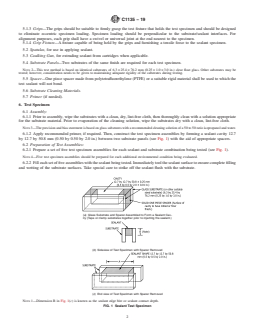
6.1.2 Apply recommended primer, if required. Then, construct the test specimen assemblies by forming a sealant cavity 12.7
by 12.7 by 50.8 mm (0.50 by 0.50 by 2.0 in.) between two substrate panels (see Fig. 1) with the aid of appropriate spacers.
6.2 Preparation of Test Assemblies:
6.2.1 Prepare a set of five test specimen assemblies for each sealant and substrate combination being tested (see Fig. 1).
NOTE 4—Five test specimen assemblies should be prepared for each additional environmental condition being evaluated.
6.2.2 Fill each set of five assemblies with the sealant being tested. Immediately tool the sealant surface to ensure complete filling
and wetting of the substrate surfaces. Take special care to strike off the sealant flush with the substrate.
(a) Glass Substrate and Spacer
...