

ASTM C972-24
(Test Method)Standard Test Method for Compression-Recovery of Tape Sealant
General Information
- Abstract
SIGNIFICANCE AND USE
4.1 Tape sealants are tacky, deformable solids used between two or more surfaces of similar or dissimilar materials in a variety of sealing applications. This procedure presents an indication of the compression recovery characteristics of preformed tapes.
SCOPE
1.1 This test method covers a laboratory procedure for determining compression-recovery characteristics of tape sealant.
1.2 The values stated in SI units are to be regarded as the standard. The values given in parentheses are for information only.
1.3 This standard does not purport to address all of the safety concerns, if any, associated with its use. It is the responsibility of the user of this standard to establish appropriate safety, health, and environmental practices and determine the applicability of regulatory limitations prior to use.
Note 1: There are no ISO standards similar or equivalent to this ASTM standard.
1.4 This international standard was developed in accordance with internationally recognized principles on standardization established in the Decision on Principles for the Development of International Standards, Guides and Recommendations issued by the World Trade Organization Technical Barriers to Trade (TBT) Committee.
- Status
- Published
- Publication Date
- 31-Dec-2023
- Technical Committee
- C24 - Building Seals and Sealants
- Drafting Committee
- C24.20 - General Test Methods


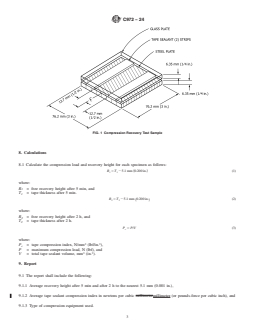

Overview
ASTM C972-24: Standard Test Method for Compression-Recovery of Tape Sealant is a widely recognized test method developed by ASTM International. This standard establishes a laboratory procedure for determining the compression-recovery characteristics of tape sealants. Tape sealants are tacky, deformable solids used for sealing between two or more surfaces made of similar or dissimilar materials. The standard provides a consistent approach to evaluate the ability of preformed tapes to recover after being compressed, which is crucial for assessing their long-term sealing performance in various applications.
Key Topics
- Compression-Recovery Characterization: The main focus is to measure how well a tape sealant recovers its shape after being compressed between surfaces, simulating real-world conditions.
- Test Apparatus and Specimen Preparation: Details on required equipment, including glass plates, steel panels, compression testing machines, and precise measuring tools, are provided to ensure repeatable results.
- Sample Conditioning: The standard outlines how to prepare and condition samples before testing, including removing the initial length of tape from a roll and establishing standard conditioning parameters.
- Measurement and Reporting: The test records recovery height at specified time intervals (5 minutes and 2 hours after compression removal) and calculates the compression index for quantitative assessment.
- Precision and Bias: ASTM C972-24 includes guidance on repeatability and reproducibility within and between laboratories for reliable quality control.
Applications
ASTM C972-24 is utilized across multiple industries that rely on the performance of sealing tapes in construction, manufacturing, and maintenance. Concrete benefits and practical applications include:
- Building Envelope Sealing: Used to ensure that tape sealants in windows, doors, roofing systems, and expansion joints will effectively recover from compression and provide lasting weather-tight seals.
- Automotive and Transportation: Relevant for verifying the quality of tape sealants in vehicle assembly, where vibration and thermal expansion demand compressible, resilient sealing products.
- Industrial Equipment: Applied during fabrication of HVAC systems, electronics enclosures, and process machinery to confirm that tape sealants maintain their sealing properties after repeated compression cycles.
- Quality Assurance: Manufacturers and quality control laboratories use this test method to compare tape sealant products during product development and batch release, ensuring performance consistency.
By comprehensively addressing the compression and recovery of tape sealants, this ASTM standard helps prevent seal failures, leaks, and associated maintenance costs.
Related Standards
- ASTM C717 - Terminology of Building Seals and Sealants: Provides definitions for terms used in ASTM C972-24 and other sealant standards.
- No Equivalent ISO Standards: As noted in ASTM C972-24, there are currently no ISO test methods directly equivalent to this standard.
- Additional related ASTM standards may include those focused on chemical resistance, adhesion, and durability of sealants, supporting well-rounded quality evaluation in building and industrial environments.
Key Terms: tape sealant, compression-recovery, laboratory test method, ASTM C972-24, sealing applications, building seals, construction standards.
This standard supports global best practices for specifying, testing, and validating tape sealant products. It ensures project teams and manufacturers achieve reliable, repeatable results relevant to real-world sealing challenges.
Relations
- Effective Date
- 01-Jan-2024
- Effective Date
- 01-Jan-2024
- Effective Date
- 01-Jan-2024
- Referred By
ASTM C1281-16(2023) - Standard Specification for Preformed Tape Sealants for Glazing Applications - Effective Date
- 01-Jan-2024
Get Certified
Connect with accredited certification bodies for this standard

DIBt (Deutsches Institut für Bautechnik)
German Institute for Building Technology.
DIN CERTCO
DIN Group product certification.

Aboma Certification B.V.
Specialized in construction, metal, and transport sectors.
Sponsored listings
Frequently Asked Questions
ASTM C972-24 is a standard published by ASTM International. Its full title is "Standard Test Method for Compression-Recovery of Tape Sealant". This standard covers: SIGNIFICANCE AND USE 4.1 Tape sealants are tacky, deformable solids used between two or more surfaces of similar or dissimilar materials in a variety of sealing applications. This procedure presents an indication of the compression recovery characteristics of preformed tapes. SCOPE 1.1 This test method covers a laboratory procedure for determining compression-recovery characteristics of tape sealant. 1.2 The values stated in SI units are to be regarded as the standard. The values given in parentheses are for information only. 1.3 This standard does not purport to address all of the safety concerns, if any, associated with its use. It is the responsibility of the user of this standard to establish appropriate safety, health, and environmental practices and determine the applicability of regulatory limitations prior to use. Note 1: There are no ISO standards similar or equivalent to this ASTM standard. 1.4 This international standard was developed in accordance with internationally recognized principles on standardization established in the Decision on Principles for the Development of International Standards, Guides and Recommendations issued by the World Trade Organization Technical Barriers to Trade (TBT) Committee.
SIGNIFICANCE AND USE 4.1 Tape sealants are tacky, deformable solids used between two or more surfaces of similar or dissimilar materials in a variety of sealing applications. This procedure presents an indication of the compression recovery characteristics of preformed tapes. SCOPE 1.1 This test method covers a laboratory procedure for determining compression-recovery characteristics of tape sealant. 1.2 The values stated in SI units are to be regarded as the standard. The values given in parentheses are for information only. 1.3 This standard does not purport to address all of the safety concerns, if any, associated with its use. It is the responsibility of the user of this standard to establish appropriate safety, health, and environmental practices and determine the applicability of regulatory limitations prior to use. Note 1: There are no ISO standards similar or equivalent to this ASTM standard. 1.4 This international standard was developed in accordance with internationally recognized principles on standardization established in the Decision on Principles for the Development of International Standards, Guides and Recommendations issued by the World Trade Organization Technical Barriers to Trade (TBT) Committee.
ASTM C972-24 is classified under the following ICS (International Classification for Standards) categories: 91.100.50 - Binders. Sealing materials. The ICS classification helps identify the subject area and facilitates finding related standards.
ASTM C972-24 has the following relationships with other standards: It is inter standard links to ASTM C972-18, ASTM C990M-09(2019), ASTM C990-09(2019), ASTM C1281-16(2023). Understanding these relationships helps ensure you are using the most current and applicable version of the standard.
ASTM C972-24 is available in PDF format for immediate download after purchase. The document can be added to your cart and obtained through the secure checkout process. Digital delivery ensures instant access to the complete standard document.
Standards Content (Sample)
This international standard was developed in accordance with internationally recognized principles on standardization established in the Decision on Principles for the
Development of International Standards, Guides and Recommendations issued by the World Trade Organization Technical Barriers to Trade (TBT) Committee.
Designation: C972 − 24
Standard Test Method for
Compression-Recovery of Tape Sealant
This standard is issued under the fixed designation C972; the number immediately following the designation indicates the year of
original adoption or, in the case of revision, the year of last revision. A number in parentheses indicates the year of last reapproval. A
superscript epsilon (´) indicates an editorial change since the last revision or reapproval.
1. Scope variety of sealing applications. This procedure presents an
indication of the compression recovery characteristics of pre-
1.1 This test method covers a laboratory procedure for
formed tapes.
determining compression-recovery characteristics of tape seal-
ant.
5. Apparatus
1.2 The values stated in SI units are to be regarded as the
5.1 Glass Plates, two, each 6.35 mm by 76.2 mm by
standard. The values given in parentheses are for information
76.2 mm (0.25 in. by 3 in. by 3 in.).
only.
5.2 Steel Panels, two, cold-rolled, each 0.762 mm by
1.3 This standard does not purport to address all of the
76.2 mm by 76.2 mm (0.03 in. by 3 in. by 3 in.).
safety concerns, if any, associated with its use. It is the
responsibility of the user of this standard to establish appro- NOTE 2—Substitutes such as aluminum, acrylic, acrylonitrile-
butadiene-styrene (ABS), may be substituted for the plates (5.1) and
priate safety, health, and environmental practices and deter-
panels (5.2).
mine the applicability of regulatory limitations prior to use.
5.3 Compression Testing Machine, with a cross-head speed
NOTE 1—There are no ISO standards similar or equivalent to this
of 50 mm (2 in.)/min and capable of stopping at specified
ASTM standard.
settings.
1.4 This international standard was developed in accor-
NOTE 3—Load values may differ when determined on screw-type
dance with internationally recognized principles on standard-
versus spring-type test machines due to a drift past the desired stop in the
ization established in the Decision on Principles for the
spring-type machine. It may be necessary to use shims to obtain the
Development of International Standards, Guides and Recom-
desired stop.
mendations issued by the World Trade Organization Technical
5.4 Recorder, for recording compression loads in newtons
Barriers to Trade (TBT) Committee.
(or pounds-force).
2. Referenced Documents
5.5 Stop Watch, measuring in minutes and seconds.
2.1 ASTM Standards:
5.6 Gage or Rule, capable of measuring tape thickness to
C717 Terminology of Building Seals and Sealants
0.025 mm or 0.001 in.
3. Terminology 6. Test Specimen and Sample
3.1 Definitions—For definitions of terms used in this test 6.1 Conditioning:
method, refer to Terminology C717, standard conditions. 6.1.1 Condition the specimens for 24 h at standard condi-
tions.
4. Significance and Use
6.2 Samples to be tested shall be taken from a roll or tape
4.1 Tape sealants are tacky, deformable solids used between sealant after first removing and discarding approximately the
two or more surfaces of similar or dissimilar materials in a
first 0.6 m (2 ft) of the roll.
6.3 Tape sealant configuration should be approximately
9.53 mm by 9.53 mm by 76.2 mm (0.375 in. by 0.375 in. by
This test method is under the jurisdiction of ASTM Committee C24 on Building
3 in.). The sample should be re-extruded rather than plied to
Seals and Sealants and is the direct responsibility of Subcommittee C24.20 on
conform to the specified size if the sample does not approxi-
General Test Methods.
Current edition approved Jan. 1, 2024. Published January 2024. Originally mate these dimensions.
approved in 1982. Last previous edition approved in 2018 as C972 – 18. DOI:
6.4 Total tape volume (V) should be calculated (width by
10.1520/C0972-24.
For referenced ASTM standards, visit the ASTM website, www.astm.org, or length by thickness) for determination of tape sealant compres-
contact ASTM Customer Service at service@astm.org. For Annual Book of ASTM
sion index.
Standards volume information, refer to the standard’s Document Summary page on
the ASTM website. 6.5 Prepare two test specimens for each sample as follows:
Copyright © ASTM International, 100 Barr Harbor Drive, PO Box C700, West Conshohocken, PA 19428-2959. United States
...
This document is not an ASTM standard and is intended only to provide the user of an ASTM standard an indication of what changes have been made to the previous version. Because
it may not be technically possible to adequately depict all changes accurately, ASTM recommends that users consult prior editions as appropriate. In all cases only the current version
of the standard as published by ASTM is to be considered the official document.
Designation: C972 − 18 C972 − 24
Standard Test Method for
Compression-Recovery of Tape Sealant
This standard is issued under the fixed designation C972; the number immediately following the designation indicates the year of
original adoption or, in the case of revision, the year of last revision. A number in parentheses indicates the year of last reapproval. A
superscript epsilon (´) indicates an editorial change since the last revision or reapproval.
1. Scope
1.1 This test method describescovers a laboratory procedure for determining compression-recovery characteristics of tape sealant.
1.2 The values stated in SI units are to be regarded as the standard. The values given in parentheses are for information only.
1.3 This standard does not purport to address all of the safety concerns, if any, associated with its use. It is the responsibility
of the user of this standard to establish appropriate safety, health, and environmental practices and determine the applicability of
regulatory limitations prior to use.
NOTE 1—There are no ISO standards similar or equivalent to this ASTM standard.
1.4 This international standard was developed in accordance with internationally recognized principles on standardization
established in the Decision on Principles for the Development of International Standards, Guides and Recommendations issued
by the World Trade Organization Technical Barriers to Trade (TBT) Committee.
2. Referenced Documents
2.1 ASTM Standards:
C717 Terminology of Building Seals and Sealants
3. Terminology
3.1 Definitions—For definitions of terms used in this test method, refer to Terminology C717, standard conditions.
4. Significance and Use
4.1 Tape sealants are tacky, deformable solids used under compression between two or more surfaces of similar or dissimilar
materials in a variety of sealing applications. This procedure presents an indication of the compression recovery characteristics of
preformed tapes.
5. Apparatus
5.1 Glass Plates, two, each 6.35 by 76.2 by 76.2 mm (0.25 by 3 by 3 in.).6.35 mm by 76.2 mm by 76.2 mm (0.25 in. by 3 in. by
3 in.).
This test method is under the jurisdiction of ASTM Committee C24 on Building Seals and Sealants and is the direct responsibility of Subcommittee C24.20 on General
Test Methods.
Current edition approved June 1, 2018Jan. 1, 2024. Published July 2018January 2024. Originally approved in 1982. Last previous edition approved in 20112018 as
C972 – 00 (2011).C972 – 18. DOI: 10.1520/C0972-18.10.1520/C0972-24.
For referenced ASTM standards, visit the ASTM website, www.astm.org, or contact ASTM Customer Service at service@astm.org. For Annual Book of ASTM Standards
volume information, refer to the standard’s Document Summary page on the ASTM website.
Copyright © ASTM International, 100 Barr Harbor Drive, PO Box C700, West Conshohocken, PA 19428-2959. United States
C972 − 24
5.2 Steel Panels, two, cold-rolled, each 0.762 by 76.2 by 76.2 mm (0.03 by 3 by 3 in.).0.762 mm by 76.2 mm by 76.2 mm (0.03 in.
by 3 in. by 3 in.).
NOTE 2—Substitutes such as aluminum, acrylic, acrylonitrile-butadiene-styrene (ABS), may be substituted for the plates (5.1)(5.1) and panels (5.2).(5.2).
5.3 Compression Testing Machine, with a cross-head speed of 50 mm (2 in.)/min and capable of stopping at specified settings.
NOTE 3—Load values may differ when determined on screw-type versus spring-type test machines due to a drift past the desired stop in the spring-type
machine. It may be necessary to use shims to obtain the desired stop.
5.4 Recorder, for recording compression loads in newtons (or pounds-force).
5.5 Stop Watch, measuring in minutes and seconds.
5.6 Gage or Rule, capable of measuring tape thickness to 0.025 mm or 0.001 in.
6. Test Specimen and Sample
6.1 Conditioning:
6.1.1 Condition the specimens for 24 h at standard conditions.
6.1.2 Other conditioning parameters may be included as desired.
6.2 Samples to be tested shall be taken from a roll or tape sealant after first removing and discarding approximately the first 0.6
m (2 ft) of the roll.
6.3 Tape sealant configuration should be approximately 9.53 by 9.53 by 76.2 mm (0.375 by 0.375 by 3 in.). 9.53 mm by 9.53 mm
by 76.2 mm (0.375 in. by 0.375 in. by 3 in.). The sample should be re-extruded rather than plied to conform to the specified size
if the sample does not approximate these dimensions.
6.4 Total tape volume (V) should be calculate
...