

ASTM E2189-19
(Test Method)Standard Test Method for Testing Resistance to Fogging in Insulating Glass Units
General Information
- Abstract
SIGNIFICANCE AND USE
4.1 This test method is intended to provide a means for testing the resistance to fogging in insulating glass units.
4.2 This test method is also intended to provide a means for testing the resistance to fogging caused by the volatility of components within the unit, including the sealing system components and internal components.
SCOPE
1.1 This test method covers procedures for testing the resistance to fogging of pre-assembled permanently sealed insulating glass units or insulating glass units with capillary tubes intentionally left open or closed.
1.2 This test method is applicable only to insulating glass units that are constructed with glass or suspended film.
1.3 This test method is applicable to both double-glazed and triple-glazed insulating glass units; for triple-glazed insulating glass units where both of the outer lites are glass and the inner lite is either glass or a suspended film.
1.4 The unit construction used in this test method contains construction details that are essential components of the test. Different types of glass, different glass thicknesses, and different cavity sizes may affect the test results.
1.5 This test method is not applicable to insulating glass units containing a spandrel glass coating due to testing limitations.
1.6 The values stated in SI units are to be regarded as standard. The values given in parentheses after SI units are provided for information only and are not considered standard.
1.7 This standard does not purport to address all of the safety concerns, if any, associated with its use. It is the responsibility of the user of this standard to establish appropriate safety, health, and environmental practices and determine the applicability of regulatory limitations prior to use.
1.8 This international standard was developed in accordance with internationally recognized principles on standardization established in the Decision on Principles for the Development of International Standards, Guides and Recommendations issued by the World Trade Organization Technical Barriers to Trade (TBT) Committee.
- Status
- Published
- Publication Date
- 31-Mar-2019
- Technical Committee
- E06 - Performance of Buildings
- Drafting Committee
- E06.22 - Durability Performance of Building Constructions
Buy Documents
ASTM E2189-19 - Standard Test Method for Testing Resistance to Fogging in Insulating Glass Units
REDLINE ASTM E2189-19 - Standard Test Method for Testing Resistance to Fogging in Insulating Glass Units
Overview
ASTM E2189-19: Standard Test Method for Testing Resistance to Fogging in Insulating Glass Units is an important standard published by ASTM International. It establishes clear procedures for evaluating the resistance to fogging of insulating glass units (IGUs), which are widely used in construction for thermal and acoustic insulation. The test method addresses concerns about fogging caused by the volatility of components inside the IGU, such as sealing materials and decorative or functional internal components.
This standard applies specifically to pre-assembled, permanently sealed insulating glass units, whether they have capillary tubes intentionally left open or closed. It covers IGUs constructed from glass or suspended film, and applies to both double- and triple-glazed configurations, provided the units do not contain spandrel glass coatings. Proper adherence to this test method helps ensure long-term clarity and durability of IGUs in building applications.
Key Topics
- Test Applicability: Focuses on pre-assembled, permanently sealed IGUs constructed with glass or suspended film, including double- and triple-glazed units.
- Scope Limitations: Not suitable for IGUs with spandrel glass coatings or those constructed of materials other than glass or suspended film.
- Fogging Resistance: Measures the tendency of the glass unit to develop visible deposits (fog) due to volatile materials from internal and sealing components.
- Test Conditions: Specifies detailed procedures for exposure to elevated temperatures, ultraviolet light, and controlled cooling, simulating real-world conditions that could induce fogging.
- Reporting: Outlines requirements for recording essential information such as type of specimen, glass composition and thickness, coatings, cavity sizes, component descriptions, and test results.
Applications
The ASTM E2189-19 standard is highly relevant for:
- IGU Manufacturers: Ensures product quality by verifying resistance to fogging, which impacts both appearance and performance in final installations.
- Quality Assurance Programs: Provides a repeatable and standardized method for third-party or in-house quality control testing of insulating glass units.
- Building and Construction Sector: Helps architects, builders, and project specifiers select reliable IGUs that will maintain transparency and high performance over time.
- Product Development: Assists R&D teams in designing IGUs with improved durability, lower risk of internal condensation, and extended service life.
- Certification and Compliance: Supports manufacturing compliance with international building standards and helps meet contractual or regulatory requirements related to insulated glazing.
Related Standards
For a comprehensive approach to insulating glass unit performance and terminology, the following ASTM standards are closely related:
- ASTM E2188: Test Method for Insulating Glass Unit Performance
- ASTM E2190: Specification for Insulating Glass Unit Performance and Evaluation
- ASTM C162: Terminology of Glass and Glass Products
- ASTM C717: Terminology of Building Seals and Sealants
- ASTM E631: Terminology of Building Constructions
Practical Value
Implementing ASTM E2189-19 helps manufacturers, testers, and building professionals ensure IGUs remain clear and free of fogging throughout their lifecycle. This contributes to improved occupant comfort, energy efficiency, and aesthetic value in buildings. By using this test method, stakeholders can minimize risks associated with component volatility, guarantee product reliability, and align with global best practices in IGU assessment and quality control.
Keywords: ASTM E2189-19, insulating glass units, fogging resistance, IGU testing, building glass standards, double-glazed, triple-glazed, sealing systems, quality control, building construction standards.
Relations
- Replaces
ASTM E2189-10e1 - Standard Test Method for Testing Resistance to Fogging in Insulating Glass Units - Effective Date
- 01-Apr-2019
- Effective Date
- 01-Oct-2023
- Effective Date
- 01-Apr-2019
- Effective Date
- 01-Mar-2019
- Effective Date
- 01-Mar-2018
- Effective Date
- 01-Nov-2017
- Effective Date
- 01-Jan-2017
- Effective Date
- 15-Nov-2016
- Effective Date
- 01-Sep-2016
- Effective Date
- 01-Nov-2015
- Effective Date
- 01-Mar-2015
- Effective Date
- 01-Nov-2014
- Effective Date
- 01-May-2014
- Effective Date
- 01-Feb-2014
- Effective Date
- 01-Nov-2013
Buy Documents
ASTM E2189-19 - Standard Test Method for Testing Resistance to Fogging in Insulating Glass Units
REDLINE ASTM E2189-19 - Standard Test Method for Testing Resistance to Fogging in Insulating Glass Units
Frequently Asked Questions
ASTM E2189-19 is a standard published by ASTM International. Its full title is "Standard Test Method for Testing Resistance to Fogging in Insulating Glass Units". This standard covers: SIGNIFICANCE AND USE 4.1 This test method is intended to provide a means for testing the resistance to fogging in insulating glass units. 4.2 This test method is also intended to provide a means for testing the resistance to fogging caused by the volatility of components within the unit, including the sealing system components and internal components. SCOPE 1.1 This test method covers procedures for testing the resistance to fogging of pre-assembled permanently sealed insulating glass units or insulating glass units with capillary tubes intentionally left open or closed. 1.2 This test method is applicable only to insulating glass units that are constructed with glass or suspended film. 1.3 This test method is applicable to both double-glazed and triple-glazed insulating glass units; for triple-glazed insulating glass units where both of the outer lites are glass and the inner lite is either glass or a suspended film. 1.4 The unit construction used in this test method contains construction details that are essential components of the test. Different types of glass, different glass thicknesses, and different cavity sizes may affect the test results. 1.5 This test method is not applicable to insulating glass units containing a spandrel glass coating due to testing limitations. 1.6 The values stated in SI units are to be regarded as standard. The values given in parentheses after SI units are provided for information only and are not considered standard. 1.7 This standard does not purport to address all of the safety concerns, if any, associated with its use. It is the responsibility of the user of this standard to establish appropriate safety, health, and environmental practices and determine the applicability of regulatory limitations prior to use. 1.8 This international standard was developed in accordance with internationally recognized principles on standardization established in the Decision on Principles for the Development of International Standards, Guides and Recommendations issued by the World Trade Organization Technical Barriers to Trade (TBT) Committee.
SIGNIFICANCE AND USE 4.1 This test method is intended to provide a means for testing the resistance to fogging in insulating glass units. 4.2 This test method is also intended to provide a means for testing the resistance to fogging caused by the volatility of components within the unit, including the sealing system components and internal components. SCOPE 1.1 This test method covers procedures for testing the resistance to fogging of pre-assembled permanently sealed insulating glass units or insulating glass units with capillary tubes intentionally left open or closed. 1.2 This test method is applicable only to insulating glass units that are constructed with glass or suspended film. 1.3 This test method is applicable to both double-glazed and triple-glazed insulating glass units; for triple-glazed insulating glass units where both of the outer lites are glass and the inner lite is either glass or a suspended film. 1.4 The unit construction used in this test method contains construction details that are essential components of the test. Different types of glass, different glass thicknesses, and different cavity sizes may affect the test results. 1.5 This test method is not applicable to insulating glass units containing a spandrel glass coating due to testing limitations. 1.6 The values stated in SI units are to be regarded as standard. The values given in parentheses after SI units are provided for information only and are not considered standard. 1.7 This standard does not purport to address all of the safety concerns, if any, associated with its use. It is the responsibility of the user of this standard to establish appropriate safety, health, and environmental practices and determine the applicability of regulatory limitations prior to use. 1.8 This international standard was developed in accordance with internationally recognized principles on standardization established in the Decision on Principles for the Development of International Standards, Guides and Recommendations issued by the World Trade Organization Technical Barriers to Trade (TBT) Committee.
ASTM E2189-19 is classified under the following ICS (International Classification for Standards) categories: 81.040.20 - Glass in building. The ICS classification helps identify the subject area and facilitates finding related standards.
ASTM E2189-19 has the following relationships with other standards: It is inter standard links to ASTM E2189-10e1, ASTM C162-23, ASTM E2188-19, ASTM C717-19, ASTM C717-18, ASTM C717-17a, ASTM C717-17, ASTM C717-16a, ASTM C717-16, ASTM C162-05(2015), ASTM E631-15, ASTM E631-14, ASTM C717-14a, ASTM C717-14, ASTM C717-13. Understanding these relationships helps ensure you are using the most current and applicable version of the standard.
ASTM E2189-19 is available in PDF format for immediate download after purchase. The document can be added to your cart and obtained through the secure checkout process. Digital delivery ensures instant access to the complete standard document.
Standards Content (Sample)
This international standard was developed in accordance with internationally recognized principles on standardization established in the Decision on Principles for the
Development of International Standards, Guides and Recommendations issued by the World Trade Organization Technical Barriers to Trade (TBT) Committee.
Designation: E2189 − 19
Standard Test Method for
Testing Resistance to Fogging in Insulating Glass Units
This standard is issued under the fixed designation E2189; the number immediately following the designation indicates the year of
original adoption or, in the case of revision, the year of last revision. A number in parentheses indicates the year of last reapproval. A
superscript epsilon (´) indicates an editorial change since the last revision or reapproval.
1. Scope 2. Referenced Documents
1.1 This test method covers procedures for testing the 2.1 ASTM Standards:
resistance to fogging of pre-assembled permanently sealed C162 Terminology of Glass and Glass Products
insulating glass units or insulating glass units with capillary C717 Terminology of Building Seals and Sealants
tubes intentionally left open or closed. E631 Terminology of Building Constructions
E2188 Test Method for Insulating Glass Unit Performance
1.2 This test method is applicable only to insulating glass
E2190 Specification for Insulating Glass Unit Performance
units that are constructed with glass or suspended film.
and Evaluation
1.3 This test method is applicable to both double-glazed and
3. Terminology
triple-glazed insulating glass units; for triple-glazed insulating
glass units where both of the outer lites are glass and the inner
3.1 Definition of Terms:
lite is either glass or a suspended film.
3.1.1 For definitions of terms found in the standard, refer to
TerminologyC717,TerminologyC162andTerminologyE631.
1.4 The unit construction used in this test method contains
construction details that are essential components of the test.
3.2 Definitions of Terms Specific to This Standard:
Different types of glass, different glass thicknesses, and differ-
3.2.1 cavity, n—the space within an insulating glass unit
ent cavity sizes may affect the test results.
created by the sealing system where water vapor is controlled
to prevent the formation of condensation. Cavities may be
1.5 This test method is not applicable to insulating glass
air-filled or inert gas-filled.
units containing a spandrel glass coating due to testing limita-
tions. 3.2.2 fog, n—visible deposits present after testing in accor-
dance with Section 8 that were not present prior to testing. Fog
1.6 The values stated in SI units are to be regarded as
doesnotincludedefectsinaglasscoatingortheglasssubstrate
standard. The values given in parentheses after SI units are
when examined prior to testing.
provided for information only and are not considered standard.
3.2.3 internal components, n—the components of an insu-
1.7 This standard does not purport to address all of the
lating glass unit that typically do not contribute to water vapor
safety concerns, if any, associated with its use. It is the
control of the cavity. Internal components may be decorative,
responsibility of the user of this standard to establish appro-
such as false muntins, decorative glass, caming, and other
priate safety, health, and environmental practices and deter-
decorative materials. Internal components may also be
mine the applicability of regulatory limitations prior to use.
functional, such as blinds or shades.
1.8 This international standard was developed in accor-
3.2.4 sealing system, n—the components of an insulating
dance with internationally recognized principles on standard-
glass unit that together function to create the cavity and control
ization established in the Decision on Principles for the
cavity water vapor content. Sealing system components typi-
Development of International Standards, Guides and Recom-
cally include a spacer, a desiccant, and sealant(s).
mendations issued by the World Trade Organization Technical
Barriers to Trade (TBT) Committee.
4. Significance and Use
4.1 This test method is intended to provide a means for
testing the resistance to fogging in insulating glass units.
This test method is under the jurisdiction of ASTM Committee E06 on
Performance of Buildings and is the direct responsibility of Subcommittee E06.22
on Durability Performance of Building Constructions. For referenced ASTM standards, visit the ASTM website, www.astm.org, or
Current edition approved April 1, 2019. Published May 2019. Originally contact ASTM Customer Service at service@astm.org. For Annual Book of ASTM
e1
approved in 2002. Last previous edition approved in 2010 as E2189–10 . DOI: Standards volume information, refer to the standard’s Document Summary page on
10.1520/E2189–19. the ASTM website.
Copyright © ASTM International, 100 Barr Harbor Drive, PO Box C700, West Conshohocken, PA 19428-2959. United States
E2189 − 19
4.2 This test method is also intended to provide a means for 5.5 For double-glazed units, at least three specimens of
testing the resistance to fogging caused by the volatility of identical component materials and construction shall be sub-
components within the unit, including the sealing system mitted.
components and internal components.
5.6 For triple-glazed units, at least five specimens of iden-
tical component materials and construction shall be submitted.
5. Test Specimens
For these units, the manufacturer shall specify the exterior
5.1 Each test specimen shall be manufactured in accordance
surface.
with Test Method E2188, Section 5.
NOTE 1—Certain reflective coatings may interfere with the ability to
view fog.
5.2 For test specimens containing muntin bars, the speci-
5.7 During all stages of storage and handling, the units shall
mens shall be fabricated with one vertical and one horizontal
beheldinaverticalpositionwithequalsupporttoallpanesand
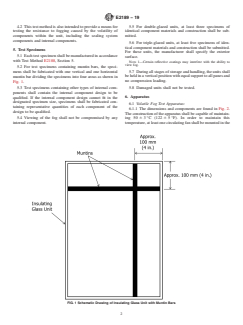
muntin bar dividing the specimens into four areas as shown in
no compression loading.
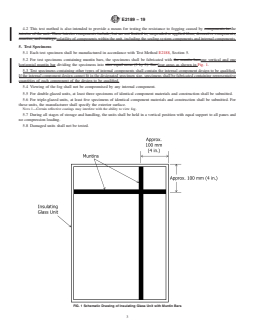
Fig. 1.
5.8 Damaged units shall not be tested.
5.3 Test specimens containing other types of internal com-
ponents shall contain the internal component design to be
6. Apparatus
qualified. If the internal component design cannot fit in the
designated specimen size, specimens shall be fabricated con-
6.1 Volatile Fog Test Apparatus:
taining representative quantities of each component of the
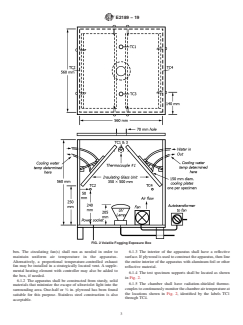
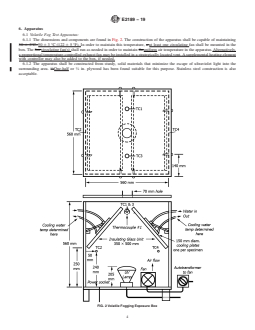
6.1.1 The dimensions and components are found in Fig. 2.
design to be qualified.
The construction of the apparatus shall be capable of maintain-
5.4 Viewing of the fog shall not be compromised by any ing 50 6 3 °C (122 6 5 °F). In order to maintain this
internal component. temperature,atleastonecirculatingfanshallbemountedinthe
FIG. 1 Schematic Drawing of Insulating Glass Unit with Muntin Bars
E2189 − 19
FIG. 2 Volatile Fogging Exposure Box
box. The circulating fan(s) shall run as needed in order to 6.1.3 The interior of the apparatus shall have a reflective
maintain uniform air temperature in the apparatus.
surface. If plywood is used to construct the apparatus, then line
Alternatively, a proportional temperature-controlled exhaust
the entire interior of the apparatus with aluminum foil or other
fan may be installed in a strategically located vent. A supple-
reflective material.
mental heating element with controller may also be added to
6.1.4 The test specimen supports shall be located as shown
the box, if needed.
in Fig. 2.
6.1.2 The apparatus shall be constructed from sturdy, solid
6.1.5 The chamber shall have radiation-shielded thermo-
materials that minimize the escape of ultraviolet light into the
couplestocontinuouslymonitorthechamberairtemperatureat
surrounding area. One-half or ⁄4 in. plywood has been found
the locations shown in Fig. 2, identified by the labels TC1
suitable for this purpose. Stainless steel construction is also
through TC4.
acceptable.
E2189 − 19
6.1.6 The cooling plates shall be constructed of a conduc- 8.2 Test Procedure:
tive material such as copper or brass. The cooling plates shall 8.2.1 Randomly select two double-glazed specimens or four
be 150 65mm(6 6 ⁄16 in.) diameter and shall be placed in triple-glazed specimens for testing.
complete, direct contact with the glass surface for the duration 8.2.2 Examine the surfaces of each test specimen prior to
of the test. Alternatively, a rectangular cooling plate shall be testing for flaws and deposits as indicated in 7.3. Record the
2 2
177 66cm (27.4 6 0.9 in. )inareawithanaspectratio(long position or location of any surface flaws that are seen. If any
side/short side) less than or equal to 1.4. deposits are seen, the specimen shall not be tested.
6.1.7 The cooling water temperature shall be determined as 8.2.3 Mount the two selected specimens within a volatile
the water immediately exits the apparatus from each cooling fog test apparatus similar to that shown in Fig. 2.Any internal
plate as shown in Fig. 2. The cooling water temperature at components shall not be located beneath, or in line with, the
...
This document is not an ASTM standard and is intended only to provide the user of an ASTM standard an indication of what changes have been made to the previous version. Because
it may not be technically possible to adequately depict all changes accurately, ASTM recommends that users consult prior editions as appropriate. In all cases only the current version
of the standard as published by ASTM is to be considered the official document.
´1
Designation: E2189 − 10 E2189 − 19
Standard Test Method for
Testing Resistance to Fogging in Insulating Glass Units
This standard is issued under the fixed designation E2189; the number immediately following the designation indicates the year of
original adoption or, in the case of revision, the year of last revision. A number in parentheses indicates the year of last reapproval. A
superscript epsilon (´) indicates an editorial change since the last revision or reapproval.
ε NOTE—6.1.6, 6.1.7, and 6.2.1 were corrected editorially in March 2012.
1. Scope
1.1 This test method covers procedures for testing the resistance to fogging of preassembledpre-assembled permanently sealed
insulating glass units or insulating glass units with capillary tubes intentionally left open.open or closed.
1.2 This test method is applicable only to sealed insulating glass units that are constructed with glass.glass or suspended film.
1.3 This test method is applicable to both double-glazed and triple-glazed insulating glass units; for triple-glazed insulating
glass units where both of the outer lites are glass and the inner lite is either glass or a suspended film.
1.4 The unit construction used in this test method contains construction details that are essential components of the test.
Different types of glass, different glass thicknesses, and different airspacecavity sizes may affect the test results.
1.5 This test method is not applicable to sealed insulating glass units containing a spandrel glass coating due to testing
limitations.
1.6 The values stated in SI units are to be regarded as standard. No other units of measurement are included in this The values
given in parentheses after SI units are provided for information only and are not considered standard.
1.7 This standard does not purport to address all of the safety concerns, if any, associated with its use. It is the responsibility
of the user of this standard to establish appropriate safety safety, health, and healthenvironmental practices and determine the
applicability of regulatory limitations prior to use.
1.8 This international standard was developed in accordance with internationally recognized principles on standardization
established in the Decision on Principles for the Development of International Standards, Guides and Recommendations issued
by the World Trade Organization Technical Barriers to Trade (TBT) Committee.
2. Referenced Documents
2.1 ASTM Standards:
C162 Terminology of Glass and Glass Products
C717 Terminology of Building Seals and Sealants
E631 Terminology of Building Constructions
E2188 Test Method for Insulating Glass Unit Performance
E2190 Specification for Insulating Glass Unit Performance and Evaluation
3. Terminology
3.1 Definition of Terms:
3.1.1 For definitions of terms found in the standard, refer to Terminology C717, Terminology C162 and Terminology E631.
3.2 Definitions of Terms Specific to This Standard:
3.2.1 cavity, n—the space within an insulating glass unit created by the sealing system where water vapor is controlled to prevent
the formation of condensation. Cavities may be air-filled or inert gas-filled.
This test method is under the jurisdiction of ASTM Committee E06 on Performance of Buildings and is the direct responsibility of Subcommittee E06.22 on Durability
Performance of Building Constructions.
Current edition approved Nov. 1, 2010April 1, 2019. Published November 2010May 2019. Originally approved in 2002. Last previous editionsedition approved in
e1
20022010 as E2189 – 02.E2189–10 . DOI: 10.1520/E2189-10E01.10.1520/E2189–19.
For referenced ASTM standards, visit the ASTM website, www.astm.org, or contact ASTM Customer Service at service@astm.org. For Annual Book of ASTM Standards
volume information, refer to the standard’sstandard’s Document Summary page on the ASTM website.
Copyright © ASTM International, 100 Barr Harbor Drive, PO Box C700, West Conshohocken, PA 19428-2959. United States
E2189 − 19
3.2.2 fog, n—visible deposits present after testing in accordance with Section 8 that were not present prior to testing. Fog does
not include defects in a glass coating or the glass substrate when examined prior to testing.
3.2.3 internal components, n—the components of an insulating glass unit that typically do not contribute to water vapor control
of the cavity. Internal components may be decorative, such as false muntins, decorative glass, caming, and other decorative
materials. Internal components may also be functional, such as blinds or shades.
3.2.4 sealing system, n—the components of an insulating glass unit that together function to create the cavity and control cavity
water vapor content. Sealing system components typically include a spacer, a desiccant, and sealant(s).
4. Significance and Use
4.1 This test method is intended to provide a means for testing the resistance to fogging in sealed insulating glass units.
E2189 − 19
4.2 This test method is also intended to provide a means for testing the resistance to fogging caused by components in the
interior of the unit. These interior components include, but are not limited to, suspended or applied films, decorative components,
muntins, and coatings.volatility of components within the unit, including the sealing system components and internal components.
5. Test Specimens
5.1 Each test specimen shall be manufactured in accordance with Test Method E2188, Section 5.
5.2 For test specimens containing muntin bars, the specimens shall be fabricated with the muntin barsone vertical and one
horizontal muntin bar dividing the specimens into nine equal areas (3 by 3). See four areas as shown in Fig. 1.
5.3 Test specimens containing other types of internal components shall contain the internal component design to be qualified.
If the internal component design cannot fit in the designated specimen size, specimens shall be fabricated containing representative
quantities of each component of the design to be qualified.
5.4 Viewing of the fog shall not be compromised by any internal component.
5.5 For double-glazed units, at least three specimens of identical component materials and construction shall be submitted.
5.6 For triple-glazed units, at least five specimens of identical component materials and construction shall be submitted. For
these units, the manufacturer shall specify the exterior surface.
NOTE 1—Certain reflective coatings may interfere with the ability to view fog.
5.7 During all stages of storage and handling, the units shall be held in a vertical position with equal support to all panes and
no compression loading.
5.8 Damaged units shall not be tested.
FIG. 1 Schematic Drawing of Insulating Glass Unit with Muntin Bars
E2189 − 19
6. Apparatus
6.1 Volatile Fog Test Apparatus:
6.1.1 The dimensions and components are found in Fig. 2. The construction of the apparatus shall be capable of maintaining
50 6 3°C. 50 6 3 °C (122 6 5 °F). In order to maintain this temperature, a at least one circulating fan shall be mounted in the
box. The fan circulating fan(s) shall run as needed in order to maintain theuniform air temperature in the apparatus. Alternatively,
a proportional temperature-controlled exhaust fan may be installed in a strategically located vent. A supplemental heating element
with controller may also be added to the box, if needed.
6.1.2 The apparatus shall be constructed from sturdy, solid materials that minimize the escape of ultraviolet light into the
1 3
surrounding area. ⁄2One-half or ⁄4 in. plywood has been found suitable for this purpose. Stainless steel construction is also
acceptable.
FIG. 2 Volatile Fogging Exposure Box
E2189 − 19
6.1.3 The interior of the apparatus shall have a reflective surface. If plywood is used to construct the apparatus, then line the
entire interior of the apparatus with aluminum foil or other reflective material.
6.1.4 The test specimen supports shall be located as shown in Fig. 2.
6.1.5 The chamber shall have radiation-shielded thermocouples to continuously monitor the chamber air temperature at the
locations shown in Fig. 2, identified by the labels TC1 through TC4.
6.1.6 The cooling plates shall be constructed of a conductive material such as copper or brass. The cooling plates shall be 150
6 5150 6 5 mm (6 6 ⁄16 mmin.) diameter and shall be placed directly in complete complete, direct contact with the glass surface
for the duration of the test. Alternatively, a rectangular cooling plate shall be
2 2
177 6 6 cm177 6 6 cm (27.4 6 0.9 in. ) in area with an aspect ratio (long side/short side) less than or equal to 1.4.
6.1.7 The cooling water temperature shall be determined as the water immediately exits the apparatus from each cooling plate
as shown in Fig. 2. The cooling water temperature at these locations shall be 21 6 2°C.21 6 2 °C (70 6 4 °F).
6.1.8 Alternatively, an electric chilling apparatus shallmay be used to controlkeep the cooling plate.plate at 21 6 2 °C
(70 6 4 °F).
6.2 Ultraviolet Light Source:
6.2.1 Warning—Ultraviolet light sources used in this test method are harmful to the human body, especially to the eyes.
Appropriate protective measures must be observed. The source shall consist of one 300 W ultraviolet lamp and shall be placed as
shown in Fig. 2. The output of the UV source shall be measured from a distance of 355 6 5 mm with a long-wave ultraviolet meter
and shall not be less than 400 μW/cm .
6.2.2 The light source shall consist of one 300 W ultraviolet lamp that shall be mounted to, and centered on, the floor of the
box such that the top of the lamp is 205 6 5 mm (8 6 ⁄16 in.) from the box floor. The voltage to the lamp shall be 230 6 10 VAC.
6.2.3 The output of the UV light source shall not be less than 400 μW/cm when measured with a UVA ultraviolet radiometer
at a distance of 355 6 5 mm (14 6 ⁄16 in.) normal to the top surfa
...