

ASTM C1265-22
(Test Method)Standard Test Method for Determining the Tensile Properties of an Insulating Glass Edge Seal for Structural Glazing Applications
General Information
- Abstract
SIGNIFICANCE AND USE
5.1 Frequently IG units are adhered with a structural sealant to a metal framing system. In such applications, only the inward lite of glass is usually adhered to the frame. As a result, a significant portion of any outward-acting or negative wind load must be carried in tension by the joint seal between the two lites of the IG unit. This test will not provide information on the integrity of the IG unit primary seal; however, it may provide data on load sharing between the primary IG vapor seal and the secondary structural sealant.
5.2 Although this test method prescribes one environmental condition, other environmental conditions and exposure cycles can be employed for specific project evaluation. Such deviations should be described when reporting the data.
SCOPE
1.1 This test method covers a laboratory procedure for quantitatively measuring the tensile strength, stiffness, and adhesion properties of insulating glass edge seals that are used in structural sealant glazing applications. Edge seals for these applications use a structural sealant to bond both glass lites and the edge spacer into a monolithic sealed insulating glass unit. In typical applications, the structural sealant acts to hold the outside lite in place under wind and gravity load and to maintain the edge spacer in its proper position. Hereafter, the term “insulating glass” will be abbreviated as “IG.”
1.2 The characterization of the IG secondary sealant properties, as defined by this test method, are strongly dependent on glass and edge spacer cleaning procedures, IG spacer profile, location of spacer, and primary IG sealant application. Users of this test method must recognize that the IG edge seal assembly influences the secondary sealant properties.
1.3 The values determined by this test method will be characteristic of the particular edge seal assembly that is tested.
Note 1: Presently, only elastomeric, chemically curing silicone sealants specifically formulated for use as the secondary seal of IG units are recognized as having the necessary durability for use in structural sealant glazing applications.
1.4 The values stated in SI units are to be regarded as standard. The values given in parentheses after SI units are provided for information only and are not considered standard.
1.5 This standard does not purport to address all of the safety concerns, if any, associated with its use. It is the responsibility of the user of this standard to establish appropriate safety, health, and environmental practices and determine the applicability of regulatory limitations prior to use.
1.6 This international standard was developed in accordance with internationally recognized principles on standardization established in the Decision on Principles for the Development of International Standards, Guides and Recommendations issued by the World Trade Organization Technical Barriers to Trade (TBT) Committee.
- Status
- Published
- Publication Date
- 31-May-2022
- Technical Committee
- C24 - Building Seals and Sealants
- Drafting Committee
- C24.30 - Adhesion
Buy Documents
ASTM C1265-22 - Standard Test Method for Determining the Tensile Properties of an Insulating Glass Edge Seal for Structural Glazing Applications
REDLINE ASTM C1265-22 - Standard Test Method for Determining the Tensile Properties of an Insulating Glass Edge Seal for Structural Glazing Applications
Overview
ASTM C1265-22 is the Standard Test Method for Determining the Tensile Properties of an Insulating Glass Edge Seal for Structural Glazing Applications. This ASTM standard provides a laboratory test method that quantitatively measures the tensile strength, stiffness, and adhesion properties of edge seals in insulating glass (IG) units used in structural glazing. The method is critical for ensuring IG edge seals can withstand structural loads such as wind or gravity in glazed building systems.
The test focuses on secondary structural sealants, which are typically elastomeric, chemically curing silicone compounds known for durability in high-performance glazing applications. By simulating real-world conditions and environmental exposures, the results help inform the selection, specification, and quality control of IG units in architectural applications.
Key Topics
- Tensile Testing of IG Edge Seals: The method establishes a procedure to measure tensile properties (strength, stiffness, adhesion) that are essential for IG units in structural glazing.
- Edge Seal Assembly: The effectiveness of the edge seal depends heavily on cleaning procedures, IG spacer profile, location, and the application of the primary sealant.
- Load Sharing Data: Results provide information on how mechanical loads are shared between the primary IG vapor seal and the secondary structural sealant, an essential factor in design and risk assessment.
- Environmental Conditioning: While one standard environmental condition is prescribed, the method allows for different exposure cycles to match specific project needs.
- Failure Modes: The test details are recorded for both cohesive and adhesive failures, which are critical for understanding sealant performance under load.
- Accuracy and Reproducibility: Precision and bias data are established for both repeatability within a single lab and reproducibility between laboratories.
Applications
- Structural Glazing Design: This standard is widely used by architects, engineers, and manufacturers to evaluate IG edge seals intended for structural sealant glazing systems in building envelopes.
- Quality Control: Manufacturers can use the test to verify batch-to-batch consistency of IG units, confirm compatibility of spacers and sealants, and meet project specifications.
- Product Certification: Test data from ASTM C1265-22 is often required for product certification in compliance with industry and regulatory standards for safety and performance.
- Research and Development: The method supports the development of new sealant chemistries and designs by allowing quantitative comparison of tensile properties under standardized conditions.
- Forensic Analysis: In the investigation of facade or glazing failures, this method helps identify whether edge seal design or workmanship contributed to the issue.
Related Standards
- ASTM C717 - Terminology of Building Seals and Sealants: Provides definitions used in ASTM C1265-22.
- ASTM E2190 - Standard Specification for IG Units: Covers long-term durability requirements for insulating glass units.
- ASTM C920 - Standard Specification for Elastomeric Joint Sealants: Pertinent to structural silicone sealant materials.
- ASTM E1300 - Standard Practice for Determining Load Resistance of Glass in Buildings: Often referenced alongside C1265-22 for structural performance evaluation.
Adhering to ASTM C1265-22 ensures rigorous, reproducible evaluation of insulating glass edge seals for structural glazing, ultimately enhancing building safety, durability, and energy performance. This test method serves as a cornerstone in modern curtain wall and facade system design, supporting the delivery of resilient, long-lasting building envelopes.
Relations
- Effective Date
- 01-Mar-2019
- Effective Date
- 01-Mar-2018
- Effective Date
- 01-Nov-2017
- Effective Date
- 01-Jan-2017
- Effective Date
- 15-Nov-2016
- Effective Date
- 01-Sep-2016
- Effective Date
- 01-May-2014
- Effective Date
- 01-Feb-2014
- Effective Date
- 01-Nov-2013
- Effective Date
- 01-Dec-2012
- Effective Date
- 01-May-2012
- Effective Date
- 15-Jan-2012
- Effective Date
- 01-Mar-2011
- Effective Date
- 15-Jan-2011
- Effective Date
- 15-Jun-2010
Buy Documents
ASTM C1265-22 - Standard Test Method for Determining the Tensile Properties of an Insulating Glass Edge Seal for Structural Glazing Applications
REDLINE ASTM C1265-22 - Standard Test Method for Determining the Tensile Properties of an Insulating Glass Edge Seal for Structural Glazing Applications
Frequently Asked Questions
ASTM C1265-22 is a standard published by ASTM International. Its full title is "Standard Test Method for Determining the Tensile Properties of an Insulating Glass Edge Seal for Structural Glazing Applications". This standard covers: SIGNIFICANCE AND USE 5.1 Frequently IG units are adhered with a structural sealant to a metal framing system. In such applications, only the inward lite of glass is usually adhered to the frame. As a result, a significant portion of any outward-acting or negative wind load must be carried in tension by the joint seal between the two lites of the IG unit. This test will not provide information on the integrity of the IG unit primary seal; however, it may provide data on load sharing between the primary IG vapor seal and the secondary structural sealant. 5.2 Although this test method prescribes one environmental condition, other environmental conditions and exposure cycles can be employed for specific project evaluation. Such deviations should be described when reporting the data. SCOPE 1.1 This test method covers a laboratory procedure for quantitatively measuring the tensile strength, stiffness, and adhesion properties of insulating glass edge seals that are used in structural sealant glazing applications. Edge seals for these applications use a structural sealant to bond both glass lites and the edge spacer into a monolithic sealed insulating glass unit. In typical applications, the structural sealant acts to hold the outside lite in place under wind and gravity load and to maintain the edge spacer in its proper position. Hereafter, the term “insulating glass” will be abbreviated as “IG.” 1.2 The characterization of the IG secondary sealant properties, as defined by this test method, are strongly dependent on glass and edge spacer cleaning procedures, IG spacer profile, location of spacer, and primary IG sealant application. Users of this test method must recognize that the IG edge seal assembly influences the secondary sealant properties. 1.3 The values determined by this test method will be characteristic of the particular edge seal assembly that is tested. Note 1: Presently, only elastomeric, chemically curing silicone sealants specifically formulated for use as the secondary seal of IG units are recognized as having the necessary durability for use in structural sealant glazing applications. 1.4 The values stated in SI units are to be regarded as standard. The values given in parentheses after SI units are provided for information only and are not considered standard. 1.5 This standard does not purport to address all of the safety concerns, if any, associated with its use. It is the responsibility of the user of this standard to establish appropriate safety, health, and environmental practices and determine the applicability of regulatory limitations prior to use. 1.6 This international standard was developed in accordance with internationally recognized principles on standardization established in the Decision on Principles for the Development of International Standards, Guides and Recommendations issued by the World Trade Organization Technical Barriers to Trade (TBT) Committee.
SIGNIFICANCE AND USE 5.1 Frequently IG units are adhered with a structural sealant to a metal framing system. In such applications, only the inward lite of glass is usually adhered to the frame. As a result, a significant portion of any outward-acting or negative wind load must be carried in tension by the joint seal between the two lites of the IG unit. This test will not provide information on the integrity of the IG unit primary seal; however, it may provide data on load sharing between the primary IG vapor seal and the secondary structural sealant. 5.2 Although this test method prescribes one environmental condition, other environmental conditions and exposure cycles can be employed for specific project evaluation. Such deviations should be described when reporting the data. SCOPE 1.1 This test method covers a laboratory procedure for quantitatively measuring the tensile strength, stiffness, and adhesion properties of insulating glass edge seals that are used in structural sealant glazing applications. Edge seals for these applications use a structural sealant to bond both glass lites and the edge spacer into a monolithic sealed insulating glass unit. In typical applications, the structural sealant acts to hold the outside lite in place under wind and gravity load and to maintain the edge spacer in its proper position. Hereafter, the term “insulating glass” will be abbreviated as “IG.” 1.2 The characterization of the IG secondary sealant properties, as defined by this test method, are strongly dependent on glass and edge spacer cleaning procedures, IG spacer profile, location of spacer, and primary IG sealant application. Users of this test method must recognize that the IG edge seal assembly influences the secondary sealant properties. 1.3 The values determined by this test method will be characteristic of the particular edge seal assembly that is tested. Note 1: Presently, only elastomeric, chemically curing silicone sealants specifically formulated for use as the secondary seal of IG units are recognized as having the necessary durability for use in structural sealant glazing applications. 1.4 The values stated in SI units are to be regarded as standard. The values given in parentheses after SI units are provided for information only and are not considered standard. 1.5 This standard does not purport to address all of the safety concerns, if any, associated with its use. It is the responsibility of the user of this standard to establish appropriate safety, health, and environmental practices and determine the applicability of regulatory limitations prior to use. 1.6 This international standard was developed in accordance with internationally recognized principles on standardization established in the Decision on Principles for the Development of International Standards, Guides and Recommendations issued by the World Trade Organization Technical Barriers to Trade (TBT) Committee.
ASTM C1265-22 is classified under the following ICS (International Classification for Standards) categories: 81.040.20 - Glass in building. The ICS classification helps identify the subject area and facilitates finding related standards.
ASTM C1265-22 has the following relationships with other standards: It is inter standard links to ASTM C717-19, ASTM C717-18, ASTM C717-17a, ASTM C717-17, ASTM C717-16a, ASTM C717-16, ASTM C717-14a, ASTM C717-14, ASTM C717-13, ASTM C717-12b, ASTM C717-12a, ASTM C717-12, ASTM C717-11a, ASTM C717-11, ASTM C717-10. Understanding these relationships helps ensure you are using the most current and applicable version of the standard.
ASTM C1265-22 is available in PDF format for immediate download after purchase. The document can be added to your cart and obtained through the secure checkout process. Digital delivery ensures instant access to the complete standard document.
Standards Content (Sample)
This international standard was developed in accordance with internationally recognized principles on standardization established in the Decision on Principles for the
Development of International Standards, Guides and Recommendations issued by the World Trade Organization Technical Barriers to Trade (TBT) Committee.
Designation: C1265 − 22
Standard Test Method for
Determining the Tensile Properties of an Insulating Glass
Edge Seal for Structural Glazing Applications
This standard is issued under the fixed designation C1265; the number immediately following the designation indicates the year of
original adoption or, in the case of revision, the year of last revision. A number in parentheses indicates the year of last reapproval. A
superscript epsilon (´) indicates an editorial change since the last revision or reapproval.
1. Scope mendations issued by the World Trade Organization Technical
Barriers to Trade (TBT) Committee.
1.1 This test method covers a laboratory procedure for
quantitatively measuring the tensile strength, stiffness, and
2. Referenced Documents
adhesion properties of insulating glass edge seals that are used
2.1 ASTM Standards:
in structural sealant glazing applications. Edge seals for these
C717 Terminology of Building Seals and Sealants
applications use a structural sealant to bond both glass lites and
the edge spacer into a monolithic sealed insulating glass unit.
3. Terminology
In typical applications, the structural sealant acts to hold the
3.1 Definitions—Refer to Terminology C717 for definitions
outside lite in place under wind and gravity load and to
of the following terms used in this test method: adhesive
maintain the edge spacer in its proper position. Hereafter, the
failure, cohesive failure, elastomeric, glazing, lite, primer, seal,
term “insulating glass” will be abbreviated as “IG.”
sealant, silicone sealant, structural sealant, substrate, stan-
1.2 The characterization of the IG secondary sealant
dard conditions.
properties, as defined by this test method, are strongly depen-
dent on glass and edge spacer cleaning procedures, IG spacer
4. Summary of Test Method
profile, location of spacer, and primary IG sealant application.
4.1 Five specimens are fabricated to duplicate the edge seal
Users of this test method must recognize that the IG edge seal
design of an IG unit for structural glazing applications. After
assembly influences the secondary sealant properties.
the secondary structural sealant is cured the specimens are
1.3 The values determined by this test method will be
tested to failure in tension. Testing is conducted at 23 °C
characteristicoftheparticularedgesealassemblythatistested.
6 2 °C(74 °F 6 3.6 °F)atarateof5 mm 60.5 mm(0.2 in. 6
0.02 in.) per minute. Strength, load-displacement response,
NOTE 1—Presently, only elastomeric, chemically curing silicone seal-
ants specifically formulated for use as the secondary seal of IG units are
failure mode, and primary IG edge seal behavior are recorded.
recognized as having the necessary durability for use in structural sealant
glazing applications.
5. Significance and Use
1.4 The values stated in SI units are to be regarded as
5.1 Frequently IG units are adhered with a structural sealant
standard. The values given in parentheses after SI units are
to a metal framing system. In such applications, only the
provided for information only and are not considered standard.
inward lite of glass is usually adhered to the frame.As a result,
1.5 This standard does not purport to address all of the
a significant portion of any outward-acting or negative wind
safety concerns, if any, associated with its use. It is the
load must be carried in tension by the joint seal between the
responsibility of the user of this standard to establish appro-
two lites of the IG unit. This test will not provide information
priate safety, health, and environmental practices and deter-
on the integrity of the IG unit primary seal; however, it may
mine the applicability of regulatory limitations prior to use.
providedataonloadsharingbetweentheprimaryIGvaporseal
1.6 This international standard was developed in accor-
and the secondary structural sealant.
dance with internationally recognized principles on standard-
5.2 Although this test method prescribes one environmental
ization established in the Decision on Principles for the
condition, other environmental conditions and exposure cycles
Development of International Standards, Guides and Recom-
can be employed for specific project evaluation. Such devia-
tions should be described when reporting the data.
This test method is under the jurisdiction of ASTM Committee of C24 on
Building Seals and Sealants and is the direct responsibility of Subcommittee C24.30
on Adhesion. For referenced ASTM standards, visit the ASTM website, www.astm.org, or
CurrenteditionapprovedJune1,2022.PublishedJuly2022.Originallyapproved contact ASTM Customer Service at service@astm.org. For Annual Book of ASTM
in1994.Lastpreviouseditionapprovedin2017asC1265-17.DOI:10.1520/C1265- Standards volume information, refer to the standard’s Document Summary page on
22. the ASTM website.
Copyright © ASTM International, 100 Barr Harbor Drive, PO Box C700, West Conshohocken, PA 19428-2959. United States
C1265 − 22
6. Apparatus and Accessory Materials 6.3 Caulking Gun, for extruding sealant from cartridges
when applicable.
6.1 Tensile Testing Machine, capable of producing a tensile
load on the specimen at a rate of 5.0 mm 6 0.5 mm (0.20 in.
6.4 Glass Substrates, of the same type(s) as used in the joint
6 0.02 in.) per minute. The machine shall be capable of design being evaluated.
measuring the load to 64N(61 lb). See Fig. 1.
NOTE 2—This test method is based on glass substrates of 6.3 mm by
6.1.1 Fixed Member—A fixed or essentially stationary
25 mm by 76 mm (0.25 in. by 1.0 in. by 3.0 in.) in size. Other thicknesses
member carrying a grip.
may be tested; however, consideration should be given to preventing
6.1.2 Movable Member—A movable member carrying a breakage or excessive bending of the glass during testing.
NOTE 3—The sample tested should reflect the actual IG unit edge
second grip.
construction; that is, glass with sensitive coatings should be tested as they
6.1.3 Grips—The grips should be suitable to firmly grasp
are used. If a coating is edge-deleted in practice, it should be edge-deleted
the test fixture that holds the test specimen and should be
for the test.
designed to minimize eccentric specimen loading. Specimen
6.5 Edge Spacer—The spacer should be identical in
loading should be perpendicular to both glass substrates. A
material, cross section, and surface finish to the spacer to be
swivel or universal joint near one or both ends of the test
used in the IG edge seal design being evaluated.
specimen may be helpful for alignment purposes.
6.1.4 Grip Fixture—A fixture capable of being held by the
6.6 Primary Sealant—This sealant or sealant tape, that is
grips and furnishing a tensile force to the joint specimen.
non-structural, provides a vapor seal for the IG unit. Its
presence and configuration affects the geometry and behavior
6.2 Spatulas, for use in applying sealant.
of many structural IG edge seal designs; therefore, it should be
included as part of the specimen.
6.7 Assembly Spacer(s)—Spacer(s) or end blocks, or both,
made from TFE-fluorocarbon or other suitable non-bonding
material are used to maintain the proper specimen dimensions
duringspecimenassembly.Becausedetailsofspecimenstested
bythistestmethodwillvary,itisnotpossibletodefineasingle
spacer or end block shape.
6.8 Glass Substrate Cleaning Materials:
6.8.1 Primary—Materials common to industry practice for
the IG unit being evaluated.
6.8.2 Alternate—Clean, dry, lint-free cloths. A solution ap-
propriate for the substrate such as isopropyl alcohol.
6.9 Edge Spacer Cleaning Materials:
6.9.1 Primary—Materials common to industry practice of
the IG unit being evaluated.
6.9.2 Alternate—Clean, dry, lint-free cloths. Isopropyl alco-
hol (99 %).
7. Test Specimen Assembly
7.1 Assembly:
7.1.1 Glass Cleaning Procedure:
7.1.1.1 Prior to assembly, clean the glass using the methods
recommended by the manufacturer of the IG unit being
evaluated.
7.1.1.2 When no manufacturer’s cleaning guidelines are
available, wipe substrates with a clean, dry, lint-free cloth, then
thoroughly clean with a second clean, lint-free cloth and a
solution appropriate for the substrate such as isopropyl alcohol
and allow to air dry.
7.1.2 Edge Spacer Cleaning Procedure:
7.1.2.1 Prior to assembly, clean the edge spacer using the
methods used by the manufacturer of the IG unit being
evaluated.
7.1.2.2 When no manufacturer’s cleaning guidelines are
available, wipe substrates with a clean, dry, lint-free cloth, then
thoroughly clean with a second clean, lint-free cloth and
FIG. 1 Suggested Assembly Method diisopropyl alcohol (99 %) and allow to air dry.
C1265 − 22
7.1.3 Construct the test specimen assemblies by forming a 7.3.2 Remove all assembly spacer sections, but not the IG
sealant cavity 50 mm (2.0 in.) long, with a cavity width and edge spacer. If assembly spacers are removed prior to the cure
depth as dictated by the joint design being evaluated. (See Fig. time given in 7.3.1, note this in the report.
2). Care should be taken to ensure that assembly of the
8. Procedure
substrate panels, IG joint spacer, and primary IG joint seal are
8.1 Testing
representative of the actual joint design.
8.1.1 Measure and record to the nearest 0.5 mm (0.02 in.)
7.2 Sample Preparation:
the actual minimum length (dimension L), minimum bond
7.2.1 Prepareaminimumoffivespecimensforeachsealant,
width (dimension W) and minimum IG spacer setback (dimen-
substrate, and geometry combination being tested, as shown in
sion S), as shown in Fig. 2.
Fig. 2.
8.1.2 All specimens are pulled on the tensile test machine at
NOTE 4—Five test specimen assemblies should be prepared for each
23 °C 6 2 °C (73 °F 6 4 °F). Test speed shall be 5 mm 6
additional environmental condition being evaluated.
0.5 mm (0.2 in. 6 0.02 in.) per minute. The orientation of the
7.2.2 Each specimen in each set should be individually
specimen in the test grips is shown in Fig. 3.
identified.
8.1.3 Record tensile load, in Newtons (lb) versus elongation
7.2.3 Fig. 1 shows a suggested approach to assembly of the
percent by a continuous plot or at 0.5 mm (0.02 in.) intervals
twopiecesofglass,theIGedgespacer,andthetwoprimaryIG
toanelongationof10 %.Alsorecordtheloadatelongationsof
edge seals prior to application of the secondary structural
25, 50, and 100 %. Record the initial load peak at failure of the
sealant. Special care must be given to accurate placement of all
primary IG seal (see Fig. 3). Record the elongation when
assembly components. Also, it is important that the final
maximum load is first reached and the highest value of
configuration(thickness,width,andposition)oftheprimaryIG
elongation achieved at maximum load, if some yielding of the
edge seal match that seen in the actual joint design being
maximum load is evident.
evaluated. See Appendix X1 for a discussion of assembly
8.1.4 Record the nature of the failure, whether cohesive or
procedures that have been found suitable.
adhesive, or what percentage is cohesive.
7.2.4 Fill each assembly with the secondary structural
8.2 Observations:
sealant that is to be tested. Immediately tool the sealant surface
8.2.1 If possible, observe and record the elongation causing
to ensure complete filling of the cavity and wetting of the
failure of the IG primary seal. This may be taken as the
substrate surfaces. Take special care to strike off the sealant
elongation corresponding to the initial load peak due to the
flush with the glass
...
This document is not an ASTM standard and is intended only to provide the user of an ASTM standard an indication of what changes have been made to the previous version. Because
it may not be technically possible to adequately depict all changes accurately, ASTM recommends that users consult prior editions as appropriate. In all cases only the current version
of the standard as published by ASTM is to be considered the official document.
Designation: C1265 − 17 C1265 − 22
Standard Test Method for
Determining the Tensile Properties of an Insulating Glass
Edge Seal for Structural Glazing Applications
This standard is issued under the fixed designation C1265; the number immediately following the designation indicates the year of
original adoption or, in the case of revision, the year of last revision. A number in parentheses indicates the year of last reapproval. A
superscript epsilon (´) indicates an editorial change since the last revision or reapproval.
1. Scope
1.1 This test method covers a laboratory procedure for quantitatively measuring the tensile strength, stiffness, and adhesion
properties of insulating glass edge seals that are used in structural sealant glazing applications. Edge seals for these applications
use a structural sealant to bond both glass lites and the edge spacer into a monolithic sealed insulating glass unit. In typical
applications, the structural sealant acts to hold the outside lite in place under wind and gravity load and to maintain the edge spacer
in its proper position. Hereafter, the term “insulating glass” will be abbreviated as “IG.”
1.2 The characterization of the IG secondary sealant properties, as defined by this test method, are strongly dependent on glass
and edge spacer cleaning procedures, IG spacer profile, location of spacer, and primary IG sealant application. Users of this test
method must recognize that the IG edge seal assembly influences the secondary sealant properties.
1.3 The values determined by this test method will be characteristic of the particular edge seal assembly that is tested.
NOTE 1—Presently, only elastomeric, chemically curing silicone sealants specifically formulated for use as the secondary seal of IG units are recognized
as having the necessary durability for use in structural sealant glazing applications.
1.4 The values stated in SI (metric) units are to be regarded as the standard. The inch-pound values given in parentheses are
approximate equivalents, after SI units are provided for information purposes. only and are not considered standard.
1.5 This standard does not purport to address all of the safety concerns, if any, associated with its use. It is the responsibility
of the user of this standard to establish appropriate safety, health, and environmental practices and determine the applicability of
regulatory limitations prior to use.
1.6 This international standard was developed in accordance with internationally recognized principles on standardization
established in the Decision on Principles for the Development of International Standards, Guides and Recommendations issued
by the World Trade Organization Technical Barriers to Trade (TBT) Committee.
2. Referenced Documents
2.1 ASTM Standards:
C717 Terminology of Building Seals and Sealants
This test method is under the jurisdiction of ASTM Committee of C24 on Building Seals and Sealants and is the direct responsibility of Subcommittee C24.30 on
Adhesion.
Current edition approved Sept. 15, 2017June 1, 2022. Published October 2011July 2022. Originally approved in 1994. Last previous edition approved in 20112017 as
C1265-94(2011).C1265-17. DOI: 10.1520/C1265-17.10.1520/C1265-22.
For referenced ASTM standards, visit the ASTM website, www.astm.org, or contact ASTM Customer Service at service@astm.org. For Annual Book of ASTM Standards
volume information, refer to the standard’s Document Summary page on the ASTM website.
Copyright © ASTM International, 100 Barr Harbor Drive, PO Box C700, West Conshohocken, PA 19428-2959. United States
C1265 − 22
3. Terminology
3.1 Definitions—Refer to Terminology C717 for definitions of the following terms used in this test method: adhesive failure,
cohesive failure, elastomeric, glazing, lite, primer, seal, sealant, silicone sealant, structural sealant, substrate, standard conditions.
4. Summary of Test Method
4.1 Five specimens are fabricated to duplicate the edge seal design of an IG unit for structural glazing applications. After the
secondary structural sealant is cured the specimens are tested to failure in tension. Testing is conducted at 23 6 2°C (74
6 3.6°F)23 °C 6 2 °C (74 °F 6 3.6 °F) at a rate of 5 6 0.5 mm (0.2 6 0.02 in.) 5 mm 6 0.5 mm (0.2 in. 6 0.02 in.) per minute.
Strength, load-displacement response, failure mode, and primary IG edge seal behavior are recorded.
5. Significance and Use
5.1 Frequently IG units are adhered with a structural sealant to a metal framing system. In such applications, only the inward lite
of glass is usually adhered to the frame. As a result, a significant portion of any outward-acting or negative wind load must be
carried in tension by the joint seal between the two lites of the IG unit. This test will not provide information on the integrity of
the IG unit primary seal; however, it may provide data on load sharing between the primary IG vapor seal and the secondary
structural sealant.
5.2 Although this test method prescribes one environmental condition, other environmental conditions and exposure cycles can
be employed for specific project evaluation. Such deviations should be described when reporting the data.
6. Apparatus and Accessory Materials
6.1 Tensile Testing Machine, capable of producing a tensile load on the specimen at a rate of 5.06 5.0 mm 6 0.5 mm (0.20 in.
6 0.02 in.) per minute. The machine shall be capable of measuring the load to 64 N (61 lb). See Fig. 1.
6.1.1 Fixed Member—A fixed or essentially stationary member carrying a grip.
6.1.2 Movable Member—A movable member carrying a second grip.
6.1.3 Grips—The grips should be suitable to firmly grasp the test fixture that holds the test specimen and should be designed to
minimize eccentric specimen loading. Specimen loading should be perpendicular to both glass substrates. A swivel or universal
joint near one or both ends of the test specimen may be helpful for alignment purposes.
6.1.4 Grip Fixture—A fixture capable of being held by the grips and furnishing a tensile force to the joint specimen.
6.2 Spatulas, for use in applying sealant.
6.3 Caulking Gun, for extruding sealant from cartridges when applicable.
6.4 Glass Substrates, of the same type(s) as used in the joint design being evaluated.
NOTE 2—This test method is based on glass substrates of 6.36.3 mm by 25 by 76 mm (0.25 by 1.0 by 3.0 in.) 25 mm by 76 mm (0.25 in. by 1.0 in. by
3.0 in.) in size. Other thicknesses may be tested; however, consideration should be given to preventing breakage or excessive bending of the glass during
testing.
NOTE 3—The sample tested should reflect the actual IG unit edge construction; that is, glass with sensitive coatings should be tested as they are used.
If a coating is edge-deleted in practice, it should be edge-deleted for the test.
6.5 Edge Spacer—The spacer should be identical in material, cross section, and surface finish to the spacer to be used in the IG
edge seal design being evaluated.
6.6 Primary Sealant—This sealant or sealant tape, that is non-structural, provides a vapor seal for the IG unit. Its presence and
configuration affects the geometry and behavior of many structural IG edge seal designs; therefore, it should be included as part
of the specimen.
C1265 − 22
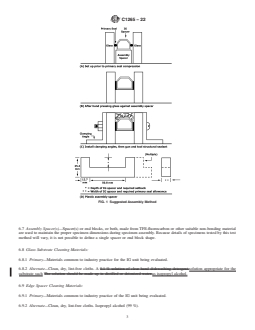
FIG. 1 Suggested Assembly Method
6.7 Assembly Spacer(s)—Spacer(s) or end blocks, or both, made from TFE-fluorocarbon or other suitable non-bonding material
are used to maintain the proper specimen dimensions during specimen assembly. Because details of specimens tested by this test
method will vary, it is not possible to define a single spacer or end block shape.
6.8 Glass Substrate Cleaning Materials:
6.8.1 Primary—Materials common to industry practice for the IG unit being evaluated.
6.8.2 Alternate—Clean, dry, lint-free cloths. A 0.1 % solution of clear hand dishwashing detergent.solution appropriate for the
substrate such The solution should be made up in distilled or deionized water.as isopropyl alcohol.
6.9 Edge Spacer Cleaning Materials:
6.9.1 Primary—Materials common to industry practice of the IG unit being evaluated.
6.9.2 Alternate—Clean, dry, lint-free cloths. Isopropyl alcohol (99 %).
C1265 − 22
7. Test Specimen Assembly
7.1 Assembly:
7.1.1 Glass Cleaning Procedure:
7.1.1.1 Prior to assembly, clean the glass using the methods recommended by the manufacturer of the IG unit being evaluated.
7.1.1.2 When no manufacturer’s cleaning guidelines are available, wipe substrates with a clean, dry, lint-free cloth, then
thoroughly clean with a second clean, lint-free cloth and 0.1 % solution of a clear hand dishwashing detergent,a solution
appropriate for as described in 6.8. Rinse the surfaces (without touching them) in distilled or deionized water the substrate such
as isopropyl alcohol and allow to air dry.
7.1.2 Edge Spacer Cleaning Procedure:
7.1.2.1 Prior to assembly, clean the edge spacer using the methods used by the manufacturer of the IG unit being evaluated.
7.1.2.2 When no manufacturer’s cleaning guidelines are available, wipe substrates with a clean, dry, lint-free cloth, then
thoroughly clean with a second clean, lint-free cloth and diisopropyl alcohol (99 %) and allow to air dry.
7.1.3 Construct the test specimen assemblies by forming a sealant cavity 50 mm (2.0 in.) 50 mm (2.0 in.) long, with a cavity width
and depth as dictated by the joint design being evaluated. (See Fig. 2). Care should be taken to ensure that assembly of the substrate
panels, IG joint spacer, and primary IG joint seal are representative of the actual joint design.
7.2 Sample Preparation:
7.2.1 Prepare a minimum of five specimens for each sealant, substrate, and geometry combination being tested, as shown in Fig.
2.
NOTE 4—Five test specimen assemblies should be prepared for each additional environmental condition being evaluated.
7.2.2 Each specimen in each set should be individually identified.
7.2.3 Fig. 1 shows a suggested approach to assembly of the two pieces of glass, the IG edge spacer, and the two primary IG edge
seals prior to application of the secondary structural sealant. Special care must be given to accurate placement of all assembly
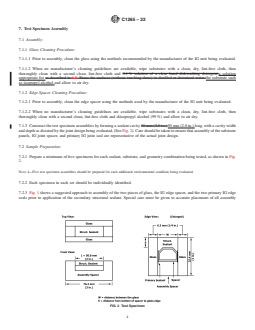
FIG. 2 Test Specimen
C1265 − 22
components. Also, it is important that the final configuration (thickness, width, and position) of the primary IG edge seal match
that seen in the actual joint design being evaluated. See Appendix X1 for a discussion of assembly procedures that have been found
suitable.
7.2.4 Fill each assembly with the secondary structural sealant that is to be tested. Immediately tool the sealant surface to ensure
complete filling of the cavity and wetting of the substrate surfaces. Take special care to strike off the sealant flush with the glass
edges.
7.3 Conditioning:
7.3.1 The structural sealant manufacturer’s recommended curing conditions and time should be followed. In the absence of
specific manufacturer’s recommendations, cure the specimens for 21 days (one part sealants) or seven days (two part sealants) at
standard conditions. List any deviations in curing conditions in the report.
7.3.2 Remove all assembly spacer sections, but not the IG edge spacer. If assembly spacers are removed prior to the cure time
given in 7.3.1, note this in the report.
8. Procedure
8.1 Testing
8.1.1 Measure and record to the nearest 0.5 mm (0.02 in.) the actual minimum length (dimension L), minimum bond width
(dimension W) and minimum IG spacer setback (dimension S), as shown in Fig. 2.
8.1.2 All specimens are pulled on the tensile test machine at 2323 °C 6 2°C (732 °C (73 °F 6 4°F).4 °F). Test speed shall be
5 6 0.5 mm (0.2 6 0.02 in.) 5 mm 6 0.5 mm (0.2 in. 6 0.02 in.) per minute. The orientation of the specimen in the test grips
is shown in Fig. 3.
8.1.3 Record tensile load, in Newtons (lbs)(lb) versus elongation percent by a continuous plot or at 0.5 mm (
...