

ASTM F1993-24
(Classification)Standard Classification System of Human Land Search and Rescue Resources
General Information
- Abstract
SIGNIFICANCE AND USE
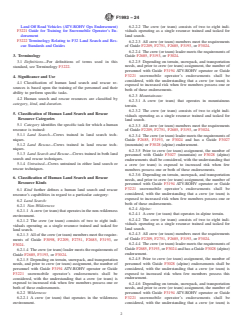
4.1 Classification of human land search and rescue resources is based upon the training of the personnel and their ability to perform specific tasks.
4.2 Human search and rescue resources are classified by category, kind, and duration.
SCOPE
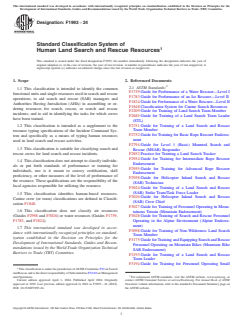
1.1 This classification is intended to identify the common functional units and single resources used in search and rescue operations; to aid search and rescue (SAR) managers and Authorities Having Jurisdiction (AHJs) in assembling or ordering resources for search, rescue, or search and rescue incidents; and to aid in identifying the tasks for which crews have been trained.
1.2 This classification is intended as a supplement to the resource typing specifications of the Incident Command System and specifically as a means of typing human resources used in land search and rescue activities.
1.3 This classification is suitable for classifying search and rescue crews for land search and rescue incidents.
1.4 This classification does not attempt to classify individuals or put forth standards of performance or training for individuals, nor is it meant to convey certification, skill proficiency, or other measures of the level of performance of the resource. These qualifications are the responsibility of the local agencies responsible for utilizing the resource.
1.5 This classification identifies human-based resources. Canine crew (or team) classifications are defined in Classification F1848.
1.6 This classification does not classify air resources (Guides F2958 and F3026) or water resources (Guides F1739, F1783, and F1824).
1.7 This international standard was developed in accordance with internationally recognized principles on standardization established in the Decision on Principles for the Development of International Standards, Guides and Recommendations issued by the World Trade Organization Technical Barriers to Trade (TBT) Committee.
- Status
- Published
- Publication Date
- 31-Mar-2024
- Technical Committee
- F32 - Search and Rescue
- Drafting Committee
- F32.02 - Management and Operations
Overview
ASTM F1993-24: Standard Classification System of Human Land Search and Rescue Resources is an international standard developed by ASTM. This document provides a comprehensive classification system for human land search and rescue (SAR) resources. The classification aids SAR managers and Authorities Having Jurisdiction (AHJs) in the effective assembly and deployment of trained human resources during search, rescue, or combined search and rescue incidents. By promoting a systematic approach, the standard ensures appropriate resource selection based on personnel training, capabilities, and operational duration.
Key Topics
- Human Resource Typing: Human land search and rescue resources are classified by category, kind, and duration, considering the specific capabilities and training of teams rather than individuals.
- Categories and Kinds: Categories identify the nature of tasks (such as land search, land rescue, or combined operations), while kinds further distinguish operational environments and specialized roles (e.g., non-wilderness, wilderness, mountainous, alpine, mounted, mountain bike, ATV-ROHV, tracking, and technical rope rescue).
- Endorsements and Training: Classification requires alignment with various ASTM standards and guides that specify training for team members and leaders. Endorsements for specialized operations (e.g., alpine, mountain, ATV-ROHV, snowmobile) are key for deployment decisions.
- Duration: The standard recognizes three deployment durations-12 hours, 24 hours, and 72 hours-to match teams to incident needs based on their ability to operate without additional logistical support.
- Scope and Exclusions: The standard focuses on human-based resources for land environments, excluding canine, air, and water resources, which are addressed in related ASTM standards.
Applications
The ASTM F1993-24 classification system is practical for a wide range of organizations involved in search and rescue operations, including emergency management agencies, fire departments, SAR teams, law enforcement, and military units. Typical applications include:
- Resource Planning and Ordering: Enables incident command staff to identify, request, and deploy suitable SAR crews for specific terrain and operational requirements.
- Training Compliance: Helps ensure teams meet established training and endorsement requirements for various land-based SAR roles.
- Operational Readiness Assessment: Assists agencies in evaluating and inventorying their available SAR resources for incident response.
- Incident Command System Integration: Serves as a supplement to the resource typing specifications within the Incident Command System (ICS), supporting standardized communication and resource management during multi-agency operations.
- Risk Management: Guides pre-deployment evaluation of crews based on terrain, environmental hazards, and the number of personnel with appropriate endorsements, supporting safer operations in challenging environments.
Related Standards
ASTM F1993-24 is designed for integration and cross-referencing with other ASTM SAR standards and relevant guidelines, fostering an interoperable approach to rescue operations. Key related documents include:
- ASTM F1848: Classification System for Canine Search Resources
- ASTM F2209, F2751, F2685, F3193, F3024: Guides for training land search and rescue team members and leaders
- ASTM F2794, F2852, F3175, F3194, F3221: Guides for specialized SAR resources (mounted, tracking, mountain bike, ATV-ROHV, snowmobile endorsements)
- ASTM F1739, F1783, F1824: Guides for water and ice rescuer performance
- ASTM F2954, F2955, F2752: Guides for rope rescuer endorsements (basic, intermediate, advanced)
- ASTM F3027, F3028: Guides for mountain and alpine environment SAR operations
- ASTM F3026, F2958: Guides for helicopter and air SAR resources
By aligning with ASTM F1993-24, organizations gain a reliable, internationally recognized framework for classifying and deploying human land search and rescue resources, supporting greater effectiveness and safety in SAR operations.
Keywords: human resource typing, incident command system, search and rescue classification, land SAR teams, ASTM SAR standards, operational readiness, resource management.
Relations
- Replaces
ASTM F1993-16(2022) - Standard Classification System of Human Land Search and Rescue Resources - Effective Date
- 01-Apr-2024
- Effective Date
- 01-Jul-2022
- Effective Date
- 01-Nov-2018
- Effective Date
- 01-Apr-2018
- Effective Date
- 01-Apr-2024
- Effective Date
- 01-Apr-2024
- Effective Date
- 01-Apr-2024
- Effective Date
- 01-Apr-2024
- Effective Date
- 01-Apr-2024
- Effective Date
- 01-Apr-2024
- Effective Date
- 01-Apr-2024
- Effective Date
- 01-Apr-2024
- Effective Date
- 01-Apr-2024
- Effective Date
- 01-Apr-2024
- Effective Date
- 01-Apr-2024
Get Certified
Connect with accredited certification bodies for this standard

CIS Institut d.o.o.
Personal Protective Equipment (PPE) certification body. Notified Body NB-2890 for EU Regulation 2016/425 PPE.

Kiwa BDA Testing
Building and construction product certification.
Kmetijski inštitut Slovenije
Agricultural Institute of Slovenia. Soil testing, plant health, agricultural product analysis.
Sponsored listings
Frequently Asked Questions
ASTM F1993-24 is a standard published by ASTM International. Its full title is "Standard Classification System of Human Land Search and Rescue Resources". This standard covers: SIGNIFICANCE AND USE 4.1 Classification of human land search and rescue resources is based upon the training of the personnel and their ability to perform specific tasks. 4.2 Human search and rescue resources are classified by category, kind, and duration. SCOPE 1.1 This classification is intended to identify the common functional units and single resources used in search and rescue operations; to aid search and rescue (SAR) managers and Authorities Having Jurisdiction (AHJs) in assembling or ordering resources for search, rescue, or search and rescue incidents; and to aid in identifying the tasks for which crews have been trained. 1.2 This classification is intended as a supplement to the resource typing specifications of the Incident Command System and specifically as a means of typing human resources used in land search and rescue activities. 1.3 This classification is suitable for classifying search and rescue crews for land search and rescue incidents. 1.4 This classification does not attempt to classify individuals or put forth standards of performance or training for individuals, nor is it meant to convey certification, skill proficiency, or other measures of the level of performance of the resource. These qualifications are the responsibility of the local agencies responsible for utilizing the resource. 1.5 This classification identifies human-based resources. Canine crew (or team) classifications are defined in Classification F1848. 1.6 This classification does not classify air resources (Guides F2958 and F3026) or water resources (Guides F1739, F1783, and F1824). 1.7 This international standard was developed in accordance with internationally recognized principles on standardization established in the Decision on Principles for the Development of International Standards, Guides and Recommendations issued by the World Trade Organization Technical Barriers to Trade (TBT) Committee.
SIGNIFICANCE AND USE 4.1 Classification of human land search and rescue resources is based upon the training of the personnel and their ability to perform specific tasks. 4.2 Human search and rescue resources are classified by category, kind, and duration. SCOPE 1.1 This classification is intended to identify the common functional units and single resources used in search and rescue operations; to aid search and rescue (SAR) managers and Authorities Having Jurisdiction (AHJs) in assembling or ordering resources for search, rescue, or search and rescue incidents; and to aid in identifying the tasks for which crews have been trained. 1.2 This classification is intended as a supplement to the resource typing specifications of the Incident Command System and specifically as a means of typing human resources used in land search and rescue activities. 1.3 This classification is suitable for classifying search and rescue crews for land search and rescue incidents. 1.4 This classification does not attempt to classify individuals or put forth standards of performance or training for individuals, nor is it meant to convey certification, skill proficiency, or other measures of the level of performance of the resource. These qualifications are the responsibility of the local agencies responsible for utilizing the resource. 1.5 This classification identifies human-based resources. Canine crew (or team) classifications are defined in Classification F1848. 1.6 This classification does not classify air resources (Guides F2958 and F3026) or water resources (Guides F1739, F1783, and F1824). 1.7 This international standard was developed in accordance with internationally recognized principles on standardization established in the Decision on Principles for the Development of International Standards, Guides and Recommendations issued by the World Trade Organization Technical Barriers to Trade (TBT) Committee.
ASTM F1993-24 is classified under the following ICS (International Classification for Standards) categories: 13.200 - Accident and disaster control. The ICS classification helps identify the subject area and facilitates finding related standards.
ASTM F1993-24 has the following relationships with other standards: It is inter standard links to ASTM F1993-16(2022), ASTM F3024-13(2022), ASTM F3027-18, ASTM F3028-18, ASTM F2752-19, ASTM F1422-08(2020), ASTM F3315-18, ASTM F3098-16, ASTM F2209-20, ASTM F2685-14(2022), ASTM F3070-14(2022), ASTM F2852-19, ASTM F2954-19, ASTM F3024-24, ASTM F2751-16. Understanding these relationships helps ensure you are using the most current and applicable version of the standard.
ASTM F1993-24 is available in PDF format for immediate download after purchase. The document can be added to your cart and obtained through the secure checkout process. Digital delivery ensures instant access to the complete standard document.
Standards Content (Sample)
This international standard was developed in accordance with internationally recognized principles on standardization established in the Decision on Principles for the
Development of International Standards, Guides and Recommendations issued by the World Trade Organization Technical Barriers to Trade (TBT) Committee.
Designation: F1993 − 24
Standard Classification System of
Human Land Search and Rescue Resources
This standard is issued under the fixed designation F1993; the number immediately following the designation indicates the year of
original adoption or, in the case of revision, the year of last revision. A number in parentheses indicates the year of last reapproval. A
superscript epsilon (´) indicates an editorial change since the last revision or reapproval.
1. Scope 2. Referenced Documents
2.1 ASTM Standards:
1.1 This classification is intended to identify the common
F1739 Guide for Performance of a Water Rescuer—Level I
functional units and single resources used in search and rescue
F1783 Guide for Performance of an Ice Rescuer—Level II
operations; to aid search and rescue (SAR) managers and
F1824 Guide for Performance of a Water Rescuer—Level II
Authorities Having Jurisdiction (AHJs) in assembling or or-
F1848 Classification System for Canine Search Resources
dering resources for search, rescue, or search and rescue
F2209 Guide for Training of Land Search Team Member
incidents; and to aid in identifying the tasks for which crews
F2685 Guide for Training of a Land Search Team Leader
have been trained.
(STL)
F2751 Guide for Training of a Land Search and Rescue
1.2 This classification is intended as a supplement to the
Team Member
resource typing specifications of the Incident Command Sys-
F2752 Guide for Training for Basic Rope Rescuer Endorse-
tem and specifically as a means of typing human resources
ment
used in land search and rescue activities.
F2794 Guide for Level 1 (Basic) Mounted Search and
1.3 This classification is suitable for classifying search and
Rescue (MSAR) Responder
rescue crews for land search and rescue incidents.
F2852 Practice for Training a Land Search Tracker
F2954 Guide for Training for Intermediate Rope Rescuer
1.4 This classification does not attempt to classify individu-
Endorsement
als or put forth standards of performance or training for
F2955 Guide for Training for Advanced Rope Rescuer
individuals, nor is it meant to convey certification, skill
Endorsement
proficiency, or other measures of the level of performance of
F2958 Guide for Helicopter Inland Search and Rescue
the resource. These qualifications are the responsibility of the
(SAR) Technician
local agencies responsible for utilizing the resource.
F3024 Guide for Training of a Land Search and Rescue
(SAR) Strike Team/Task Force Leader
1.5 This classification identifies human-based resources.
F3026 Guide for Helicopter Inland Search and Rescue
Canine crew (or team) classifications are defined in Classifi-
(SAR) Crew Chief
cation F1848.
F3027 Guide for Training of Personnel Operating in Moun-
1.6 This classification does not classify air resources
tainous Terrain (Mountain Endorsement)
(Guides F2958 and F3026) or water resources (Guides F1739, F3028 Guide for Training of Search and Rescue Personnel
F1783, and F1824). Operating in the Alpine Environment (Alpine Endorse-
ment)
1.7 This international standard was developed in accor-
F3098 Guide for Training of Non-Wilderness Land Search
dance with internationally recognized principles on standard-
Team Member
ization established in the Decision on Principles for the
F3175 Guide for Training and Equipping Search and Rescue
Development of International Standards, Guides and Recom-
Personnel Operating on Mountain Bikes (Mountain Bike
mendations issued by the World Trade Organization Technical
SAR Endorsement)
Barriers to Trade (TBT) Committee.
F3193 Guide for Training of a Land Search and Rescue
Team Leader
F3194 Guide for Training for Personnel Operating Small
This classification is under the jurisdiction of ASTM Committee F32 on Search
and Rescue and is the direct responsibility of Subcommittee F32.02 on Management
and Operations. For referenced ASTM standards, visit the ASTM website, www.astm.org, or
Current edition approved April 1, 2024. Published April 2024. Originally contact ASTM Customer Service at service@astm.org. For Annual Book of ASTM
approved in 1999. Last previous edition approved in 2022 as F1993 – 16 (2022). Standards volume information, refer to the standard’s Document Summary page on
DOI: 10.1520/F1993-24. the ASTM website.
Copyright © ASTM International, 100 Barr Harbor Drive, PO Box C700, West Conshohocken, PA 19428-2959. United States
F1993 − 24
Land Off Road Vehicles (ATV-ROHV Ops Endorsement) 6.2.2.2 The crew (or team) consists of two to eight indi-
F3221 Guide for Training for Snowmobile Operator’s En- viduals operating as a single resource trained and tasked for
dorsement land search.
F3222 Terminology Relating to F32 Land Search and Res-
6.2.2.3 All crew (or team) members meet the requirements
cue Standards and Guides
of Guide F2209, F2751, F2685, F3193, or F3024.
6.2.2.4 The crew (or team) leader meets the requirements of
3. Terminology
Guide F2685, F3193, or F3024.
6.2.2.5 Depending on terrain, snowpack, and transportation
3.1 Definitions—For definitions of terms used in this
needs, and prior to crew (or team) assignment, the number of
standard, see Terminology F3222.
personnel with Guide F3194 ATV-ROHV operator or Guide
F3221 snowmobile operator’s endorsements shall be
4. Significance and Use
considered, with the understanding that a crew (or team) is
4.1 Classification of human land search and rescue re-
exposed to increased risk when few members possess one or
sources is based upon the training of the personnel and their
both of these endorsements.
ability to perform specific tasks.
6.2.3 Mountainous:
4.2 Human search and rescue resources are classified by
6.2.3.1 A crew (or team) that operates in mountainous
category, kind, and duration.
terrain.
6.2.3.2 The crew (or team) consists of two to eight indi-
5. Classification of Human Land Search and Rescue
viduals operating as a single resource trained and tasked for
Resource Categories
land search.
5.1 Category identifies the specific task for which a human
6.2.3.3 All crew (or team) members meet the requirements
resource is trained:
of Guide F2209, F2751, F2685, F3193, or F3024.
5.1.1 Land Search—Crews trained in land search tech-
6.2.3.4 The crew (or team) leader meets the requirements of
niques.
Guide F2685, F3193, or F3024 and has a Guide F3027
5.1.2 Land Rescue—Crews trained in land rescue tech-
(mountain) or F3028 (alpine) endorsement.
niques.
6.2.3.5 Prior to crew (or team) assignment, the number of
5.1.3 Land Search and Rescue—Crews trained in both land
personnel with Guide F3027 (mountain) or F3028 (alpine)
search and rescue techniques.
endorsements shall be considered, with the understanding that
5.1.4 Untrained—Crews untrained in either land search or
a crew (or team) is exposed to increased risk when few
rescue techniques.
members possess one or both of these endorsements.
6.2.3.6 Depending on terrain, snowpack, and transportation
6. Classification of Human Land Search and Rescue
needs, and prior to crew (or team) assignment, the number of
Resource Kinds
personnel with Guide F3194 ATV-ROHV operator or Guide
F3221 snowmobile operator’s endorsements shall be
6.1 Kind further defines a human land search and rescue
considered, with the understanding that a crew (or team) is
resource’s capabilities in regard to a particular category:
exposed to increased risk when few members possess one or
6.2 Land Search:
both of these endorsements.
6.2.1 Non-Wilderness:
6.2.4 Alpine:
6.2.1.1 A crew (or team) that operates in the non-wilderness
6.2.4.1 A crew (or team) that operates in alpine terrain.
environment.
6.2.4.2 The crew (or team) consists of two to eight indi-
6.2.1.2 The crew (or team) consists of two to eight indi-
viduals operating as a single resource trained and tasked for
viduals operating as a single resource trained and tasked for
land search.
land search.
6.2.4.3 All crew (or team) members meet the requirements
6.2.1.3 All of the crew (or team) members meet the require-
of Guide F2209, F2751, F2685, F3193, or F3024.
ments of Guide F3098, F2209, F2751, F2685, F3193, or
6.2.4.4 The crew (or team) leader meets the requirements of
F3024.
Guide F2685, F3193, or F3024 and has a Guide F3028 (alpine)
6.2.1.4 The crew (or team) leader meets the requirements of
endorsement.
Guide F2685, F3193, or F3024.
6.2.4.5 Prior to crew (or team) assignment, the number of
6.2.1.5 Depending on terrain, snowpack, and transportation
needs, and prior to crew (or team) assignment, the number of personnel with Guide F3028 (alpine) endorsements shall be
considered, with the understanding that a crew (or team) is
personnel with Guide F3194 ATV-ROHV operator or Guide
F3221 snowmobile operator’s endorsements shall be exposed to increased risk when few members possess this
endorsement.
considered, with the understanding that a crew (or team) is
exposed to increased risk when few members possess one or
6.2.4.6 Depending on terrain, snowpack, and transportation
both of these endorsements.
needs, and prior to crew (or team) assignment, the number of
6.2.2 Wilderness: personnel with Guide F3194 ATV-ROHV operator or Guide
6.2.2.1 A crew (or team) that operates in the wilderness F3221 snowmobile operator’s endorsements shall be
environment. considered, with the understanding that a crew (or team) is
F1993 − 24
exposed to increased risk when few members possess one or 6.2.8.4 Prior to crew (or team) assignment in mountainous
both of these endorsements. terrain or the alpine environment, the number of personnel with
Guide F3027 (mountain) or F3028 (alpine) endorsements shall
6.2.5 Tracking:
be considered, with the understanding that a crew (or team) is
6.2.5.1 A crew (or team) consists of one to three individuals
exposed to increased risk when few members possess one or
operating as a single resource trained and tasked in tracking.
both of these endorsements.
6.2.5.2 All personnel actively tracking on the team meet the
requirements of Practice F2852.
6.3 Land Rescue and Land Search and Rescue:
6.2.5.3 The crew (or team) leader meets the requirements of
6.3.1 Wilderness and Non-Wilderness:
Guide F2685, F3193, or F3024.
6.3.1.1 A crew (or team) that operates in the wilderness
6.2.5.4 Prior to crew (or team) assignment in mountainous
environment.
terrain or the alpine environment, the number of personnel with
6.3.1.2 The crew (or team) operates in non-technical terrain.
Guide F3027 (mountain) or F3028 (alpine) endorsements shall
6.3.1.3 The crew (or team) consists of two to eight indi-
be considered, with the understanding that a crew (or team) is
viduals operating as a single resource trained and tasked for
exposed to increased risk when few members possess one or
land rescue or land search and rescue.
both of these endorsements.
6.3.1.4 All crew (or team) members meet the requirements
6.2.5.5 Depending
...
This document is not an ASTM standard and is intended only to provide the user of an ASTM standard an indication of what changes have been made to the previous version. Because
it may not be technically possible to adequately depict all changes accurately, ASTM recommends that users consult prior editions as appropriate. In all cases only the current version
of the standard as published by ASTM is to be considered the official document.
Designation: F1993 − 16 (Reapproved 2022) F1993 − 24
Standard Classification System of
Human Land Search and Rescue Resources
This standard is issued under the fixed designation F1993; the number immediately following the designation indicates the year of
original adoption or, in the case of revision, the year of last revision. A number in parentheses indicates the year of last reapproval. A
superscript epsilon (´) indicates an editorial change since the last revision or reapproval.
1. Scope
1.1 This classification is intended to identify the common functional units and single resources used in search and rescue
operations; to aid search and rescue (SAR) managers and Authorities Having Jurisdiction (AHJs) in assembling or ordering
resources for search, rescue, or search and rescue incidents; and to aid in identifying the tasks for which crews have been trained.
1.2 This classification is intended as a supplement to the resource typing specifications of the Incident Command System and
specifically as a means of typing human resources used in land search and rescue activities.
1.3 This classification is suitable for classifying search and rescue crews for land search and rescue incidents.
1.4 This classification does not attempt to classify individuals or put forth standards of performance or training for individuals,
nor is it meant to convey certification, skill proficiency, or other measures of the level of performance of the resource. These
qualifications are the responsibility of the local agencies responsible for utilizing the resource.
1.5 This classification identifies human-based resources. Canine crew (or team) classifications are defined in Classification F1848.
1.6 This classification does not classify air resources (Guides F2958 and F3026) or water resources (Guides F1739, F1783, and
F1824).
1.7 This international standard was developed in accordance with internationally recognized principles on standardization
established in the Decision on Principles for the Development of International Standards, Guides and Recommendations issued
by the World Trade Organization Technical Barriers to Trade (TBT) Committee.
2. Referenced Documents
2.1 ASTM Standards:
F1633 Guide for Techniques in Land Search (Withdrawn 2017)
F1739 Guide for Performance of a Water Rescuer—Level I
F1783 Guide for Performance of an Ice Rescuer—Level II
F1824 Guide for Performance of a Water Rescuer—Level II
F1848 Classification System for Canine Search Resources
F2209 Guide for Training of Land Search Team Member
F2685 Guide for Training of a Land Search Team Leader (STL)
This classification is under the jurisdiction of ASTM Committee F32 on Search and Rescue and is the direct responsibility of Subcommittee F32.02 on Management and
Operations.
Current edition approved Nov. 1, 2022April 1, 2024. Published November 2022April 2024. Originally approved in 1999. Last previous edition approved in 20162022 as
F1993 – 16.F1993 – 16 (2022). DOI: 10.1520/F1993-16R22.10.1520/F1993-24.
For referenced ASTM standards, visit the ASTM website, www.astm.org, or contact ASTM Customer Service at service@astm.org. For Annual Book of ASTM Standards
volume information, refer to the standard’s Document Summary page on the ASTM website.
Copyright © ASTM International, 100 Barr Harbor Drive, PO Box C700, West Conshohocken, PA 19428-2959. United States
F1993 − 24
F2751 Guide for Training of a Land Search and Rescue Team Member
F2752 Guide for Training for Basic Rope Rescuer Endorsement
F2794 Guide for Level 1 (Basic) Mounted Search and Rescue (MSAR) Responder
F2852 Practice for Training a Land Search Tracker
F2954 Guide for Training for Intermediate Rope Rescuer Endorsement
F2955 Guide for Training for Advanced Rope Rescuer Endorsement
F2958 Guide for Helicopter Inland Search and Rescue (SAR) Technician
F3024 Guide for Training of a Land Search and Rescue (SAR) Strike Team/Task Force Leader
F3026 Guide for Helicopter Inland Search and Rescue (SAR) Crew Chief
F3027 Guide for Training of Personnel Operating in Mountainous Terrain (Mountain Endorsement)
F3028 Guide for Training of Search and Rescue Personnel Operating in the Alpine Environment (Alpine Endorsement)
F3098 Guide for Training of Non-Wilderness Land Search Team Member
F3175 Guide for Training and Equipping Search and Rescue Personnel Operating on Mountain Bikes (Mountain Bike SAR
Endorsement)
F3193 Guide for Training of a Land Search and Rescue Team Leader
F3194 Guide for Training for Personnel Operating Small Land Off Road Vehicles (ATV-ROHV Ops Endorsement)
F3221 Guide for Training for Snowmobile Operator’s Endorsement
F3222 Terminology Relating to F32 Land Search and Rescue Standards and Guides
2.2 ANSI Standard:
ANSI/SVIA 1-2010 Four Wheel All-Terrain Vehicles—Equipment, Configuration, and Performance Requirements
3. Terminology
3.1 Definitions:
3.1.1 ATV-ROHV, n—a motorized off-highway vehicle designed to travel on four low-pressure tires, having a seat designed to be
straddled by the operator, and handlebars for steering control. ATVs are subdivided into two types as designated by the
manufacturer. ANSI/SVIA 1-2010
3.1 Definitions—For definitions of terms used in this standard, see Terminology F3222.
4. Significance and Use
4.1 Classification of human land search and rescue resources is based upon the training of the personnel and their ability to
perform specific tasks.
4.2 Human search and rescue resources are classified by category,kind, and duration.
5. Classification of Human Land Search and Rescue Resource Categories
5.1 Category identifies the specific task for which a human resource is trained:
5.1.1 Land Search—Crews trained in land search techniques.
5.1.2 Land Rescue—Crews trained in land rescue techniques.
5.1.3 Land Search and Rescue—Crews trained in both land search and rescue techniques.
5.1.4 Untrained—Crews untrained in either land search or rescue techniques.
6. Classification of Human Land Search and Rescue Resource Kinds
6.1 Kind further defines a human land search and rescue resource’s capabilities in regard to a particular category:
6.2 Land Search:
6.2.1 Non-Wilderness:
F1993 − 24
6.2.1.1 A crew (or team) that operates in the non-wilderness environment.
6.2.1.2 The crew (or team) consists of two to eight individuals operating as a single resource trained and tasked for land search.
6.2.1.3 All of the crew (or team) members meet the requirements of Guide F3098, F2209, F2751, F2685, F3193, or F3024.
6.2.1.4 The crew (or team) leader meets the requirements of Guide F2685, F3193, or F3024.
6.2.1.5 Depending on terrain, snowpack, and transportation needs, and prior to crew (or team) assignment, the number of
personnel with Guide F3194 ATV-ROHV operator or Guide F3221 snowmobile operator’s endorsements shall be considered, with
the understanding that a crew (or team) is exposed to increased risk when few members possess one or both of these endorsements.
6.2.2 Wilderness:
6.2.2.1 A crew (or team) that operates in the wilderness environment.
6.2.2.2 The crew (or team) consists of two to eight individuals operating as a single resource trained and tasked for land search.
6.2.2.3 All crew (or team) members meet the requirements of Guide F2209, F2751, F2685, F3193, or F3024.
6.2.2.4 The crew (or team) leader meets the requirements of Guide F2685, F3193, or F3024.
6.2.2.5 Depending on terrain, snowpack, and transportation needs, and prior to crew (or team) assignment, the number of
personnel with Guide F3194 ATV-ROHV operator or Guide F3221 snowmobile operator’s endorsements shall be considered, with
the understanding that a crew (or team) is exposed to increased risk when few members possess one or both of these endorsements.
6.2.3 Mountainous:
6.2.3.1 A crew (or team) that operates in mountainous terrain.
6.2.3.2 The crew (or team) consists of two to eight individuals operating as a single resource trained and tasked for land search.
6.2.3.3 All crew (or team) members meet the requirements of Guide F2209, F2751, F2685, F3193, or F3024.
6.2.3.4 The crew (or team) leader meets the requirements of Guide F2685, F3193, or F3024 and has a Guide F3024F3027
(mountain) or F3028 (alpine) endorsement.
6.2.3.5 Prior to crew (or team) assignment, the number of personnel with Guide F3024F3027 (mountain) or F3028 (alpine)
endorsements shall be considered, with the understanding that a crew (or team) is exposed to increased risk when few members
possess one or both of these endorsements.
6.2.3.6 Depending on terrain, snowpack, and transportation needs, and prior to crew (or team) assignment, the number of
personnel with Guide F3194 ATV-ROHV operator or Guide F3221 snowmobile operator’s endorsements shall be considered, with
the understanding that a crew (or team) is exposed to increased risk when few members possess one or both of these endorsements.
6.2.4 Alpine:
6.2.4.1 A crew (or team) that operates in alpine terrain.
6.2.4.2 The crew (or team) consists of two to eight individuals operating as a single resource trained and tasked for land search.
6.2.4.3 All crew (or team) members meet the requirements of Guide F2209, F2751, F2685, F3193, or F3024.
6.2.4.4 The crew (or team) leader meets the requirements of Guide F2685, F3193, or F3024 and has a Guide F3028 (alpine)
endorsement.
F1993 − 24
6.2.4.5 Prior to crew (or team) assignment, the number of personnel with Guide F3028 (alpine) endorsements shall be considered,
with the understanding that a crew (or team) is exposed to increased risk when few members possess this endorsement.
6.2.4.6 Depending on terrain, snowpack, and transportation needs, and prior to crew (or team) assignment, the number of
personnel with Guide F3194 ATV-ROHV operator or Guide F3221 snowmobile operator’s endorsements shall be considered, with
the understanding that a crew (or team) is exposed to increased risk when few members possess one or both of these endorsements.
6.2.5 Tracking:
6.2.5.1 A crew (or team) consists of one to three individuals operating as a single resource trained and tasked in tracking.
6.2.5.2 All personnel actively tracking on the team meet the requirements of Practice F2852.
6.2.5.3 The crew (or team) leader meets the requirements of Guide F2685, F3193, or F3024.
6.2.5.4 Prior to crew (or team) assignment in mountainous terrain or the alpine environment, the number of personnel with Guide
F3024F3027 (mountain) or F3028 (alpine) endorsements shall be considered, with the understanding that a crew (or team) is
exposed to increased risk when few members possess one or both of these endorsements.
6.2.5.5 Depending on terrain, snowpack, and transportation needs, and prior to crew (or team) assignment, the number of
personnel with Guide F3194 ATV-ROHV operator or Guide F3221 snowmobile operator’s endorsements shall be considered, with
the understanding that a crew (or team) is exposed to increased risk when few members possess one or both of these endorsements.
6.2.6 Mounted:
6.2.6.1 A crew (or team) that consists of one to three individuals operating as a single resource deployed on horseback.
6.2.6.2 All personnel assigned to a mounted crew (or team) meet the requ
...